Wednesday, December 21, 2011

Community college enrollment boom over
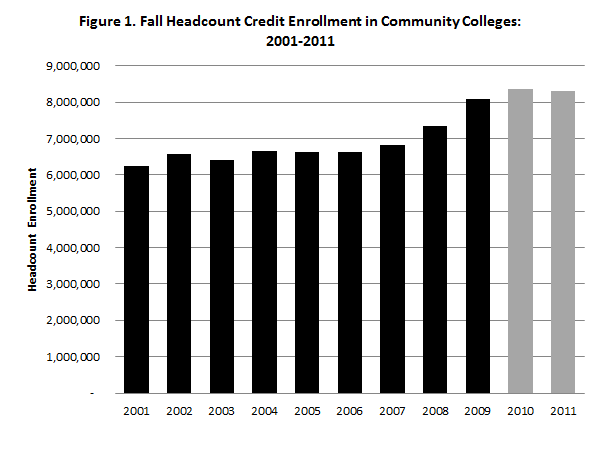
The enrollment boom at community colleges may be over, according to a new analysis that found a nationwide decline of almost 1 percent since the fall of 2010. But two-year colleges remain crowded, as enrollment remains up by about 22 percent since 2007.
“It’s not that enrollment is down. It has essentially stopped growing,” said Kent Phillippe, a senior research associate for the American Association of Community Colleges. The association prepared the analysis jointly with the National Student Clearinghouse, drawing data from at least 700 public, two-year institutions. So while the figures are not a comprehensive look at the sector, they do provide a reliable snapshot.
Phillippe, a co-author of the report, said community college enrollments have “stabilized at a high number.”….
Samantha Brown shoots Anthony Bourdain with "Paula"
 |
| Deceptively perky |
Despite my vegetarianism, I am a fan, I guess, both of Brown’s perkiness (which, I'm sure, disguises complexity and darkness) and Bourdain’s edginess (which, I'm convinced, disguises simplicity and a love of Cher), and so, well, I love it:
Tuesday, December 20, 2011
Drinking study funded at OCC
Orange Coast College gets $220,000 grant for alcohol project (OC Reg)
 Orange Coast College received a $220,000 grant from the Orange Count Health Care Agency to fund a campus-wide study of student drinking habits.
The study also aims to reduce underage and high-risk drinking among the student population, with an emphasis on DUI enforcement.
Similar studies have been conducted at four-year universities, but not much is known about the drinking habits of community college students, said Sylvia Worden, associate dean of student health services, in a statement.
"No one really knows about alcohol use in community college. We expect to find out a lot," she said. "Our students don't live in dorms and don't participate in the Greek system. It's very different."
. . .
The OCC community has experienced two DUI-related tragedies in as many years, prompting campus leaders to address the issues of underage and high-risk drinking, according to the college's grant proposal.
. . .
The program will target new or inexperienced drinkers, who are most likely to respond to interventions, according to the grant proposal. The college will also identify sources of alcohol for new and inexperienced drinkers, as well as where they drink and driving distances, and enact a high-visibility DUI enforcement project….

The study also aims to reduce underage and high-risk drinking among the student population, with an emphasis on DUI enforcement.
Similar studies have been conducted at four-year universities, but not much is known about the drinking habits of community college students, said Sylvia Worden, associate dean of student health services, in a statement.
"No one really knows about alcohol use in community college. We expect to find out a lot," she said. "Our students don't live in dorms and don't participate in the Greek system. It's very different."
. . .
 |
| You know what they say about OCC |
. . .
The program will target new or inexperienced drinkers, who are most likely to respond to interventions, according to the grant proposal. The college will also identify sources of alcohol for new and inexperienced drinkers, as well as where they drink and driving distances, and enact a high-visibility DUI enforcement project….
Emerging strategy: "success courses"
“Success courses” could help community college students reach academic goals (EdSource)
 An emerging strategy to promote community college success is to have students enroll in “student success courses” that focus on study and career skills and help guide them through their community college experience.
Encouraging more students to take these courses, as part of a range of “student support services,” is a principal recommendation of the California Community College’s Student Success Task Force.
. . .
The Task Force, whose recommendations will be considered by the California Community College’s Board of Governors next month, pointed out that students’ “college knowledge,” or awareness and understanding of “college culture” and support services, can help them navigate the complexities of life on campus and access services such as tutoring labs and financial aid that may be critical to their success.
The report said the student success courses the Task Force had in mind would most likely be provided in a noncredit format in order to avoid issues related to cost or financial aid. But it left it up in the air as to whether they should be required for students who demonstrate they need help after taking an assessment test to measure their skill levels.
If required, it is not clear how the community colleges would pay the costs of adding multiple new course sections to serve larger numbers of students. Some community college leaders also worry that making a student success course a requirement could have the unintended impact of erecting yet another obstacle that students have to traverse in order to reach their educational goals.
. . .
[Nadine Rosenthal, the director of City College’s Learning Assistance Center] opposed making it a required course for students who are shown to be lagging on a placement test. She said it would be “logistically challenging” as well as extremely costly to offer as many as 100 course sections without a major increase in staffing — an unlikely prospect during this period of extreme cuts to the community colleges’ budget.
. . .
The push to expand student success courses, said Bob Gabriner, a task force member and director of the Education Leadership Program at San Francisco State, is in part a response to the difficulties in providing students with regular access to college counselors, whose ranks have been drastically diminished as a result of budget cuts, even as enrollments have increased.
“As you cut back on counseling resources and student services resources, you have to figure out how to deliver those services and that information in a more efficient way,” Gabriner said. Providing information during a 16-week semester course may be more effective than a one-time session with a counselor, he said, because instructors can reach far more students and can respond to students’ needs as they arise.
. . .
The most compelling research showing the impact of comes from Florida, where students have taken “student life skills” classes. A 2006 study found that students who completed those classes were more more likely to earn a community college credential, transfer to the state university system, or still be enrolled in college after five years….
Encouraging more students to take these courses, as part of a range of “student support services,” is a principal recommendation of the California Community College’s Student Success Task Force.
. . .
The Task Force, whose recommendations will be considered by the California Community College’s Board of Governors next month, pointed out that students’ “college knowledge,” or awareness and understanding of “college culture” and support services, can help them navigate the complexities of life on campus and access services such as tutoring labs and financial aid that may be critical to their success.
The report said the student success courses the Task Force had in mind would most likely be provided in a noncredit format in order to avoid issues related to cost or financial aid. But it left it up in the air as to whether they should be required for students who demonstrate they need help after taking an assessment test to measure their skill levels.
If required, it is not clear how the community colleges would pay the costs of adding multiple new course sections to serve larger numbers of students. Some community college leaders also worry that making a student success course a requirement could have the unintended impact of erecting yet another obstacle that students have to traverse in order to reach their educational goals.
. . .
[Nadine Rosenthal, the director of City College’s Learning Assistance Center] opposed making it a required course for students who are shown to be lagging on a placement test. She said it would be “logistically challenging” as well as extremely costly to offer as many as 100 course sections without a major increase in staffing — an unlikely prospect during this period of extreme cuts to the community colleges’ budget.
. . .
The push to expand student success courses, said Bob Gabriner, a task force member and director of the Education Leadership Program at San Francisco State, is in part a response to the difficulties in providing students with regular access to college counselors, whose ranks have been drastically diminished as a result of budget cuts, even as enrollments have increased.
“As you cut back on counseling resources and student services resources, you have to figure out how to deliver those services and that information in a more efficient way,” Gabriner said. Providing information during a 16-week semester course may be more effective than a one-time session with a counselor, he said, because instructors can reach far more students and can respond to students’ needs as they arise.
. . .
The most compelling research showing the impact of comes from Florida, where students have taken “student life skills” classes. A 2006 study found that students who completed those classes were more more likely to earn a community college credential, transfer to the state university system, or still be enrolled in college after five years….
Monday, December 19, 2011
SOCCCD: a raise for administrators and classified managers?

Yeah, that’s so helpful.
It’s about salaries. Raises.
The agenda page explains that a company was hired to assess, um, salaries, I guess, of SOCCCD managers and administrators.
It goes on to say: “it was determined that a new integrated salary schedule is appropriate….” Upshot (I think): raises are appropriate.
There’s a recommendation: “that the BoT approve the SOCCCD District Administrator Manager Salary Schedule as shown in Exhibit A.” I'm assuming that Exhibit A represents systematic raises, which, I believe, have long been delayed.
Here’s Exhibit A:

I described the testy board discussion of this item in my meeting coverage two weeks ago. It seemed to me that Poertner and Co. really wanted the trustees to just approve the item, which seemed to have been long in the making, but the trustees resisted, perhaps owing to their usual cluelessness (or maybe owing to a knowledgeable assessment—that's at least possible, if improbable).
The item was not approved (it only got three votes: Padberg, Milchiker, Prendergast), but will, I believe, return in January in some form.
(I added this post in response to a reader's impassioned comment about this item today.)
Disliking atheists
 |
| Atheism and agnosticism around the world (Wikipedia) |
I was heartened to learn recently that atheists are no longer the most reviled group in the United States: according to the political scientists Robert Putnam and David Campbell, we’ve been overtaken by the Tea Party. … I was wondering anew: why do so many people dislike atheists?....Those who wonder what it is that philosophers talk about in the classroom might read Antony’s piece from yesterday’s New York Times. In her essay, she explains that, contrary to (apparent) popular opinion, it is a serious mistake to suppose that being moral depends on God. Yes, being moral is consistent with the existence of God and a belief in God, but any view that insists that morality rests on God’s will is compelled to embrace doctrines that are, well, utterly unacceptable.*
To see what I mean, read Antony’s clearly-written piece.
As Antony points out, that point has been understood at least since the time of Plato, who made it more than two thousand years ago in his dialogue Euthyphro. It is an important point. And it is not difficult to grasp (I routinely explain it in my Philosophy 2 courses). It is a routine part of the college curriculum.
Nevertheless, unsurprisingly (I’m afraid), most people don’t understand it. And that’s a problem. It means that many anxious theists are inclined to fight a confused and unnecessary battle, for they fight atheism, imagining it to be an enemy that it is not. Oddly enough, a far more real enemy to a coherent and decent religiousness isn’t atheism but the kind of unreflective theism that seems now so common—the kind that relies on slogans and Straw Men.
I mention this because I want people to understand that philosophy is important and valuable. It is important like many other things are important—like enjoying poetry or understanding history or appreciating the complexity of language are important.
And it is in higher education that one learns these things. No, one does not learn them on the Oprah Winfrey Show or the Today Show. They aren’t embedded in the breezy verbiage of Better Homes and Gardens or Reader’s Digest.
We keep our best thinking in colleges. It’s true.
And, today, higher education has a very uncertain future. It is transforming. And it is losing what has always been best about it.
*I have written about this matter previously: Why morals cannot be rooted in religion.
Subscribe to:
Posts (Atom)
Roy's obituary in LA Times and Register: "we were lucky to have you while we did"
This ran in the Sunday December 24, 2023 edition of the Los Angeles Times and the Orange County Register : July 14, 1955 - November 20, 2...

-
 Professor Olga Perez Stable Cox OCC Trumpsters/GOP A professor called Trump’s election an ‘act of terrorism.’ Then she became the vict...
 -
 Recently, I spoke with a veteran who’s been part of the vet community here at IVC for some time. He too has complained about Mr. Ma...
 -
 I don’t know how anyone could learn about the way our colleges are funded and how their budget decisions are made without thinking...