Showing posts with label Superfund. Show all posts

Saturday, August 4, 2007

The SOCCCD and EPA’s “List 11”

TODAY, while researching our benighted district, I stumbled across something odd. I came upon a website provided by The Center for Public Integrity, a respected watch dog organization with which I am familiar. (See Charles Lewis.)

It turns out that the website is part of the CPI’s March 2007 two-part report on the sorry state of the Superfund program (Wasting Away: Superfund’s Toxic Legacy). That report is mighty grim.

Here’s what the website claims to provide:
As a public service, the Center for Public Integrity created a search of the Environmental Protection Agency’s database that connects companies, organizations and government agencies to Superfund sites. The results below come from the database, also known as list 11, which tracks the EPA’s interactions with these “potentially responsible parties.”
For those who need reminding about the notion of a “Superfund” site, the CPI explains:
A Superfund site is a toxic waste site that falls under the Environmental Protection Agency’s Superfund program. After public awareness grew about heavily polluted areas like Love Canal, Congress passed the … Superfund law… in 1980. Under the law, companies and other parties found responsible for polluting sites are required to clean up the area or pay the costs for cleanup to the EPA.
But what is a “potentially responsible party”? According to the CPI,
A “potentially responsible party” or PRP, is a company, organization or individual that the EPA determines possibly played a role in the contamination of a Superfund site. … The EPA keeps a database of all PRPs called List 11….
List 11 is very long. I searched for “South Orange County Community College District” on CPI’s version of List 11 and, sure enough, our district appears on it, alongside “Casmalia Resources,” a Superfund site in Santa Barbara County.

According to an EPA website regarding Casmalia,
The Casmalia Resources Superfund Site is a 252-acre inactive commercial hazardous waste treatment, storage, and disposal facility located … 10 miles southwest of the City of Santa Maria, 1.2 miles from north of the Town of Casmalia, and four miles from the Pacific Ocean.

Between 1973 and 1989, the site accepted approximately 5.6 billion pounds of waste at its 92 waste management facilities which included landfills, ponds, shallow wells, disposal trenches, and treatment units. More than 10,000 companies and government entities sent waste to Casmalia during this period.

…[T]he site’s owners and operators (Casmalia Resources, Hunter Resources, and Kenneth H. Hunter, Jr.) accepted ... industrial and commercial waste material, which included sludges, pesticides, solvents, acids, metals, caustics, cyanide, and nonliquid polychlorinated biphenyls (PCBs).

Facing multiple regulatory enforcement actions, the site’s owners and operators stopped taking shipments of waste material in 1989. In 1991, the owners and operators abandoned efforts to properly close and clean up the site. At that time, conditions at the site presented imminent and substantial endangerment to human health and the environment.

From 1992 to 1996, EPA used Superfund authorities to take emergency actions to stabilize the site. These actions included installing and operating systems for collecting, treating, and disposing of contaminated subsurface liquids, controlling the flow of storm water, and stabilizing the landfills.
(See EPA.)
In its discussion of the Casmalia Superfund site, the EPA, too, refers to “potentially responsible parties” (PRPs). It then explains that
One of EPA’s major responsibilities is to create an equitable process to ensure that each of these parties [i.e., customers whose waste went to the site] pays its share of total site costs—both for the expenses that EPA has incurred already, and for future improvements and maintenance at the site. The current estimate of these expenses is $271.9 million….

EPA will finance site work through settlements with the entities that sent waste to be disposed of at Casmalia, as well as with the site’s owners and operators….
The EPA then goes on to describe a series of settlements with PRPs, one in 1996, another in 2000, and yet another in 2003. The favorability of terms of settlement appear to decline with the passage of time.

“EPA,” the site goes on to say, “will continue to offer ‘cash-out’ settlements to former Casmalia customers.”

It appears that this information was written in 2004. What has occurred since 2004 is not explained.

If CPI’s version of List 11 is accurate (a safe bet), SOCCCD is, according to the EPA, a potentially responsible party. But I have no idea if the current list includes the many parties (e.g., “de minimis” parties, i.e., parties with minimal responsibility) that have already settled.

Thus, for all that I know, SOCCCD has already settled (in which case, of course, there would be a public record of that).

Further, it is possible that the SOCCCD has successfully contested its status, assigned by the EPA, as a “PRP.” It would appear, however, that any customer whose waste went to Casmalia is ipso facto a PRP.

Can anybody shed light on any of this? —CW

P.S.:

Just now, I looked up "SOCCCD" and “Casmalia” with the Yahoo search engine, and, essentially, I got three items, only one of which was relevant.

It was Dissent!

In an article published in 1998 entitled Williams to Lang: “Stop living in an ivory castle!”, I described the September 14, 1998, meeting of the SOCCCD Board of Trustees. At one point, I reported that
After a break, we heard about a lawsuit against the district filed by Casmalia Resources Site. Evidently, the firm took our hazardous waste and buried it at its site. Then the EPA showed up and told Casmalia that they’ll have to spend a million bucks cleaning up. Naturally, Casmalia is now trying to get the money from its clients, including us. Frogue said something, but it was stupefying, and so I have no clear memory of it.
A million bucks? Try $270 million!

So did we pay our share or what?

Saturday, January 14, 2006

The "toxic plume"


"The long-term effects of trichloroethylene [TCE, a solvent] on human beings is unknown. In animal studies, chronic trichloroethylene exposure has produced liver cancer in mice, but not in rats. Studies on its effects on reproduction in animals have been similarly inconsistent, and so no conclusive statements about its ability to cause birth defects in humans can be made."
--Wikipedia on "TCE"


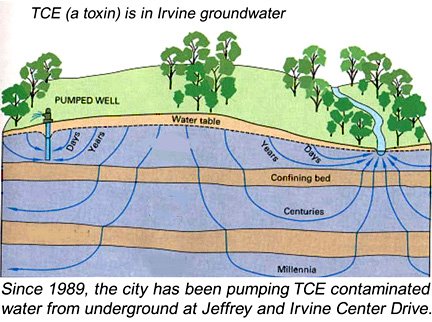
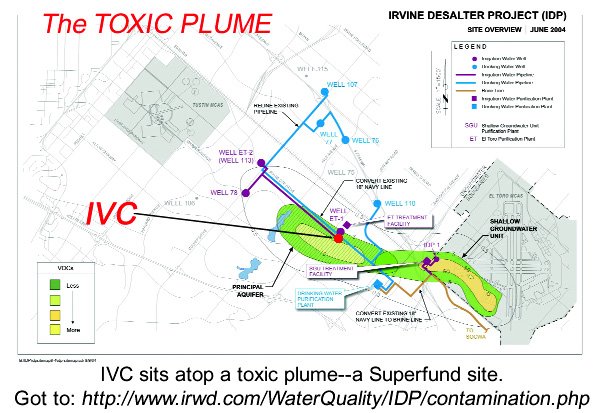
or some reason, we never seem to hear much about the toxic plume beneath us here in Irvine, caused by 40 years of solvent dumping at the former El Toro Marine Base.

When I say "we," I mean denizens of Irvine Valley College in particular. (See plume map below.)

If you visit the Irvine Ranch Water District (IRWD) website (IRWD contamination history), you'll find this helpful "History of El Toro Contamination":

* 1985: [TCE] Contamination discovered
* 1989: Installed Well ET-1 [across the street from IVC] to slow plume movement. However, one well is not enough to remove the plume completely
* 1990: Dept. of Navy accepted its responsibility and Superfund site created
* 1994-2001: Negotiations with the Navy and the Dept. of Justice
* 2001: Settlement agreement reached: Navy agreed to pay for removal of the volatile organic compound contamination
* In October 2003, proposed project modifications were made, including changing well locations, and adding a shallow groundwater unit (SGU) volatile organic treatment facility near the former MCAS El Toro
* In February 2004, well site acquisition in Woodbridge was unsuccessful
* IRWD reached agreement with The Irvine Company (TIC) to take over existing TIC agricultural wells and pipelines, some of which can be incorporated into the Irvine Desalter Project. Therefore, construction costs were lowered, resulting in a more cost effective project


ecently, the IRWD has attempted to build a much-needed second toxic cleanup pump, but that got NIMBYd into oblivion. For the story, go to "Woodbidge nix sends well back to drawing board"

Some excerpts from that Irvine World News article:

The Irvine Ranch Water District is back to re-evaluating options in the project to clean up the plume of toxins in the groundwater under Irvine.

The Woodbridge Village Association board voted Feb. 4 to not allow the water district to drill a cleanup well near the community's North Lake Lagoon and to work with IRWD to find another solution in dealing with the "toxic plume."

The board had initially agreed to allow the water district to use the Woodbridge Lake well to pump trichloroethylene (TCE)-contaminated water from the plume in groundwater that extends from the old El Toro air base. The well would have been part of the larger project, dubbed the Irvine Desalter Project, which would clean up toxins from the air base that seeped into the groundwater over a period of about 40 years. One such cleanup well has been in operation at Irvine Center Drive and Jeffrey Road since 1989, but the water district says that one well is not enough.

Other wells will pump uncontaminated water upstream from the plume to help slow the progress of the plume's expansion and slow movement toward areas in the underground water that provide drinking water.

The plume also is headed toward areas in the aquifer that might be used in the future to supply Irvine with drinking water. And, the contaminated part of the water basin is a potential source of drinking water for the future.

...Some residents questioned why the project was named "Irvine Desalter Project," when it's a toxic plume clean-up.

...Without the cleanup well, the lake will continue to be filled with water pumped from the toxic plume by an existing well owned by the Woodbridge Village Association, as it has been since the lake was created. About two years ago, the association stopped using the well water to fill the swimming lagoon beside the lake, which is now filled with drinking-quality water. No TCE has been detected in the lake, according to association official Bob Figeira, though it has been detected in the existing well.

...At [a] meeting, environmental medicine specialist Mary McDaniel said that measures would be taken to ensure the safety for the community during the drilling of the proposed toxic plume well.

She said a study indicated that the project did not present a health risk during the drilling of the well or during the clean-up operation, which is estimated to last about 40 years....
(Feb. 12, 2004)


P.S.:

I ran across an interview of Ray Watson, former President of the Irvine Company (Watson). He designed the Woodbridge Village Association, which opened in 1976. In the interview (evidently in 2001), he explains why North Lake is warmer than South Lake:

The main idea was to have a recreational community connected by paths. We also came up with the idea of lakes. I don’t know if you ever heard the story, but the water that goes into the North Lake Lagoon is warmer than the water that goes into the South Lake Lagoon. This happened by accident in the sense that when we were drilling for water for the North Lake, we hit a natural hot water spring.

Yeah, but that's not all they hit.


Note: NIMBY = "not in my back yard"
It would seem that opposition to the El Toro Airport was largely fueled by NIMBYism, although other motives existed.
Trustee Fuentes was among the leaders of the opposition movement. Oddly, given their differing politics, so was Irvine's Larry Agran.

Roy's obituary in LA Times and Register: "we were lucky to have you while we did"

  This ran in the Sunday December 24, 2023 edition of the Los Angeles Times and the Orange County Register : July 14, 1955 - November 20, 2...