Showing posts with label plagiarism. Show all posts

Thursday, July 21, 2016

"The same sequence of thoughts and ideas"


     Turnitin, the company known for its plagiarism detection software, this week took a look at Melania Trump's much-debated convention speech at the Republican National Convention, finding examples of language "that an educator would flag as … examples of plagiarism." After her speech Monday evening, Trump was accused of stealing passages from Michelle Obama's speech during the 2008 Democratic National Convention. Trump's speech contained both examples of "cloning" (copying passages word for word) and "find-and-replace" plagiarism (copying a passage but changing a few key words), Turnitin found.
     "No matter what the intent, copying another’s work is plagiarism, but educators do consider intent when weighing how to handle instances of plagiarism in student papers," the company wrote. "More than just the copying of words, a comparison of [the] speeches follows the same sequence of thoughts and ideas. To an educator, this belies intent."

Irvine Lake c. 1940s
I-5 at Avery Parkway, March 3, 1965
A day at the beach; OC; 1940s

Wednesday, May 30, 2012

Plagiarism is a form of theft, Glenn (but all is well, really)

Chris Mars: "Community Pillars"
     Here’s a story we’ve held back for a week and a half, not wishing to spoil students’ big day:

     You’ll recall that we’ve offered some, um, perspective on IVC President Glenn Roquemore’s curious approach to choosing commencement speakers. (See Too political and That’s some leadership!)
     This year, as usual, the Commencement Speaker Committee, comprising wide representation, selected three speaker candidates from a master list that they had assembled. They sent those names forward to the President for consideration.
     But, for whatever reason, Roquemore didn’t secure any of those three. Without conferring with the committee, he went back to the Committee’s master list and chose Mr. Keith Rhodes, CEO of Big Brothers Big Sisters of Orange County—a “safe” choice, I guess, among the embracers of the GOP world view (according to which, essentially, all is well and patriotism—combined with cheerful "getalongitude"—are the chief moral virtues).
     Well, whatever. Process Schmocess, I guess.
     Rhodes was entertaining, if manifestly unoriginal. (I barely listened to him, occupied as I was by my photographic efforts. I do remember his bit about marrying somebody smarter.) But, immediately after the ceremony, I started hearing from faculty who found Mr. Rhodes’ address—oh, kinda familiar.
     Since that day, several faculty have sent us a link to a recent article in which NPR lists advice from the book The 10 Things You Won't Hear At Commencement by Charles Wheelan.
     Gosh, that advice does seem awfully familiar.
     Oh my.
     Draw your own conclusions.

• D.A. won't charge accused coaches (OC Reg)
Saddleback College in Mission Viejo, meanwhile, disciplined one athletic department employee in the Lapes Athletic matter, while Irvine Unified completed an investigation but determined no wrongdoing on the part of its employees….
• Attorneys General Urge Congress to Close Military 'Loophole' at For-Profit Colleges (Chronicle of Higher Education)
Attorneys general for 21 states have called on Congress to close an "apparent loophole" that they say encourages for-profit colleges to use "high-pressure recruiting tactics" on military veterans….

Sunday, November 20, 2011

Derek Reeve qua Saddleback College instructor

     Earlier today, a DtB reader suggested that I consider Saddleback College Poli Sci instructor Derek Reeve’s conduct—namely, his plagiarism—in relation to the Saddleback College Student Handbook.
     OK. The relevant section of the college student handbook states that
Students may be disciplined for one or more of the following causes related to college activity or attendance: [A through R. Item P is] …Academic dishonesty....
     This is followed by points a, b, and c, which explain "academic dishonesty." Point b defines the form of academic dishonesty known as “plagiarism”:


     Obviously, based on the evidence—including admissions by Reeve—that has appeared in the press in recent months, Reeve plagiarized: on a community newsletter/blog, he engaged in political discourse or argument, repeatedly wielding ideas (or formulations of ideas) not his own but as though they were his own.
     But Reeve is not a student at Saddleback College and the Student Handbook is a handbook for Saddleback studentsOf course, I do not deny that the Handbook's code for students implies a standard regarding honesty that applies to others beyond students, including instructors. Perhaps this is what the reader had in mind. But, as we'll see, we need not rely on "implied" standards to see the problem with Reeve's conduct.
     Further, even if Reeve were a Saddleback College student, his plagiarism would not have been a disciplinable offense, since the Handbook's code refers only to student behavior "related to college activity or attendance." The college is unwilling to enforce its honesty code upon students in their lives beyond the college. This raises an interesting question: is there a reason that a college would be so willing in the case of other persons—e.g., professors?
     Reeve is, of course, a student at Claremont Graduate School, or so says his Saddleback profile. Previously (see On Derek Reeve's failure to be honest, Sept. 27), I unearthed the honesty code for CGS, and I suggested that he violated the spirit, if not the letter, of that standard.

* * *
     There is a code explicitly relevant to Reeve’s conduct re honesty/dishonesty insofar as he is a Saddleback College instructor; it is the college's Faculty Code of Ethics and Professionalism. In the aforementioned post, I wrote the following:

     ...As it turns out, a dozen years ago, Saddleback College faculty adopted a “Faculty Code of Ethics and Professional Standards.” It quotes a familiar American Association of University Professors statement:

"Professors, guided by a deep conviction of the worth and dignity of the advancement of knowledge, recognize the special responsibilities placed upon them. Their primary responsibility to their subject is to seek and to state the truth as they see it. To this end professors devote their energies to developing and improving their scholarly competence. They accept the obligation to exercise critical self-discipline and judgment in using, extending, and transmitting knowledge. They practice intellectual honesty…." (AAUP Statement, 1990) [My emphasis.]

The Saddleback “code” goes on to require that

Faculty exhibit intellectual honesty and integrity in all scholarly endeavors.

     …Qua scholar and qua college faculty, Reeve is expected to be honest, and, obviously, one aspect of honesty is not passing off other’s writings and ideas as one’s own—even in less-than-scholarly settings. Jenna Chandler’s recent piece in the SJC Patch makes very clear that Mr. Reeve does exactly that—he passed off others’ ideas and writings as his own—and he has done so repeatedly. [End of quotation.]

     Observe that the prohibition against plagiarism, understood as a professional standard, does not restrict its scope to what one writes or says at one's college or even in academic settings. College professors are supposed to approach authorship honestly period, for they are to seek "the truth," employing competent methods. One who offers others' ideas as his own, even on a blog, is no seeker of truth. He is an enemy of that fine endeavor. 
     Further, academia is all about communities—such as communities of experts/scholars. The effort of some community of experts/scholars (re subject X) to arrive at understanding (re X) and to effectively communicate that understanding to the public is damaged when one of its members engages in discourse about X dishonestly, even in somewhat non-academic settings. That Mr. Reeve publicly argued his political theses fraudulentlyi.e., with plagiarized elementsundermined the larger enterprise of the community of political scientists and of scholars. Thus, a college, among other entities, has a good reason to concern itself with the honesty/dishonesty of its "experts," even when the dishonesty occurs outside the strict bounds of the Academy. 
     Especially given Reeve's unambiguous denial that he plagiarizeddespite his plainly having done soI concluded (in Sept.) that he "cannot be trusted to argue honestly; he certainly cannot be trusted to instill academic honesty in his students."
     In any case, it seems clear that Reeve violated the above codeSaddleback College's faculty code of professional ethics.

* * *
     So what is the college doing about that? What is the Academic Senate doing?
     Nothing, it appears.
     Sometimes, one's doing nothing amounts to one's plainly doing something—such as exhibiting one's actual values, despite official verbiage implying very different values.
     Again, SC's inaction contrasts with the action of Concordia U to (evidently) fire Reeve based on his failures of honesty. (See More clarity on Reeve and Concordia.)

Tuesday, October 11, 2011

Plagiarism is just all right with Saddleback? (We illustrate some of Reeve's handiwork.)

Apparently, Saddleback is OK
with Reeve's plagiarism
     The OC Reg catches up with the Reeve story: Councilman with dog Muhammad out as Concordia instructor.
     Nothing new here, except:
Reeve also is a part-time instructor at Saddleback College in Mission Viejo. A representative there said Monday that Reeve is still employed at Saddleback.
     Meanwhile, again, Reeve says he can’t comment about his Concordia departure:
     Reeve said he is unable to discuss whether his departure had anything to do with his recent controversies.
     "Unfortunately, at this time I am not at liberty to comment," he said. "Hopefully that will change in the coming weeks."
Illustrating some of Mr. Reeve's curious handiwork:


I wanted to see for myself what all the fuss is about. I went to one of Reeve's July 2011 postings on the SJC Patch (at left above) and then I Googled some of "his" verbiage there. Right away, I got hits, including the NRA's "Institute for Legislative Action" website. Chunks of Reeve's "writing" (at left) are the same, word for word, as chunks of the "right-to-carry" verbiage on the NRA website (at right). The latter is dated April, 2010.
Click on graphic to enlarge it.
     A week ago, Reeve explained that he “carelessly submitted previously published material.”
     —That doesn't quite capture it, does it? Here, he evidently cut apart and then reassembled others' writings, submitting the product under his own name. The SJC Patch, of course, has presented other examples.


    See also:

 Derek Reeve, SJC Councilman, Loses Teaching Gig as Newspaper and Website Scrum Over Plagiarism (Matt Coker; Navel Gazing)
• O.C. councilman who named his dog Muhammad loses teaching job (LA Times)
• Jesus is just alright (Doobies)

Monday, October 10, 2011

More sophistry from Derek Reeve

     Today, the Capistrano Insider’s Jonathan Volzke (SJC Councilman Reeve's Response to Plagiarism Allegations....) explains that CI received a “column” by SJC City Councilman and Saddleback College adjunct Derek Reeve. Reeve asked CI to publish it, which they did. (See.)
     The column includes yet another defense against the charge that Reeve repeatedly plagiarized others' writings:
...On balance, I may be partly responsible—along with most of the human race that uses the Internet. In the atmosphere of today’s massive electronic echo chamber, in which we are assaulted with dozens of concepts and ideas each minute, I doubt if any of us have had a totally original idea in the past 50 years. Certainly that is the way it is in the legal profession in which I work. Yes, in formal documentation, one is more precise in adding footnotes to identify the origin of our ideas, which makes it extremely complicated when wading through such writing. However, in normal everyday communication, not to mention blogging, it is impossible for us to precisely identify each antecedent and besides, the atmosphere is much more relaxed and informal (or so I thought). [My emphasis.]
     Just to be clear: based on information presented by the SJC Patch (see), Reeve repeatedly submitted the works of other writers, under his own name, modifying wording slightly. These instances are classic plagiarism. (For a concrete instance, see this.)
     Reeve's guff about "precisely" identifying antecedents is a red herring (or utter nonsense). One is not obliged to identify the "precise" antecedents of one's ideas, whatever that is supposed to mean. One is, however, obliged to identify the sources of writings by others that one quotes or repeats. Reeve repeatedly failed to do so, posing as the actual author. That's dishonest.
     Obviously, that he presented others’ writings as his own on a blog—as opposed to, say, a journal or newspaper—is immaterial to whether he was plagiarizing. That he presented others’ writing as his own means that he was plagiarizing, and plagiarism is a serious sin, especially among writers, journalists, and academics.
     One would naturally suppose that it is a serious sin among Christians, too, but Reeve evidently feels otherwise. He's a special kind of Christian, I guess.
     Oddly, Reeve told the Capistrano Insider that he can’t now comment on whether his employment at Concordia U of Irvine has come to an end. But he implied that he will comment on that matter in future.
     We look forward to it.

Thursday, September 29, 2011

"I'm frustrated we're talking about dogs...."

Famous talking dog
     Jonathan Volzke of the Capistrano Dispatch joins the San Juan Capistrano Patch in reporting that SJC Councilman Derek Reeve has pulled his controversial anti-illegal immigration proposal. (See Anti-Illegal Immigration Policy Proposal in Capistrano Pulled after Plagiarism Allegations.)
     Volzke seems to view Reeve’s action as a consequence of recent plagiarism allegations made against him by the SJC Patch. A kind of strategic retreat, under a rock, I guess.
     Based on Jenna Chandler and the Patch’s reporting, it seems very clear that Reeve, a lawyer, a realtor, and a Saddleback College Poli Sci instructor, has blatantly plagiarized the works of various authors in recent months—on the Patch.
     Not sure if anyone’s checked any other publications yet.
     Mayor Sam Allevato said that Reeve’s plagiarism issue is distracting:
“I feel further discussion by the City Council (of the plagiarism allegations) is unwarranted as it does nothing to further the interests of the residents of San Juan Capistrano and is yet another distraction from the important work of this Council,” Allevato said. “Ultimately, Mr. Reeve will have to answer to the public and his employers regarding his actions.”
     —Gosh, I think Allevato is alluding to Concordia U and Saddleback College, where Reeve teaches. No?
     Another City Councilman, John Taylor, evidently worries that Reeve could mess up SJC's rosy rep:
“Members of an elected body are supposed to be leaders—plagiarism is against the law,” Taylor said in a written statement “This lack of character and leadership is a hindrance in his ability to govern the affairs of our City.”
"Distracted"
     I don't know about plagiarism being against the law; it does invite civil lawsuits. Surely it's unethical, scandalous.
     Another council member, Laura Freese, evidently a fan of absurd remarks, said: “I’m frustrated we’re talking about dogs, the right to gather and now plagiarism” (CD).
     I’ll bet. This fracas sure reminds me of the old Frogue/Board Majority days, when SOCCCD officials spent most of their time 'splainin' the board’s absurd actions and policies, many of which were clear instances of “red meat tossage” to the Board Four’s benighted right-wing constituency—you know, the people who, fifteen years later, sip tea and support Reeve.
     A former Councilman is urging others to take a good look at Reeve. Maybe he thinks there’s more to find under the rocks of SJC. Do you suppose?
     Meanwhile, Reeve ain’t talkin’. He won’t respond to his old buds at the SJC Patch, who want to know about this unseemly pattern of plagiarism that he saddled ‘em with. I bet they’re pissed. Are they gonna delete all that stuff?
     I wonder if Saddleback College’s Academic Senate is dusting off its "code of ethics"? I mean, what’s the point of having a code if you don’t do something when one of your own members violates it bigtime?
     For all I know, they're on the case right now. I can just imagine the discussion:
     "Well, he's obviously taken other writers' words and ideas and claimed them as his own! The rascal!"
     "Wait. The stuff on the Patch is written, right? Maybe his dog Muhammad peed on his submissions, messing 'em up?"
     "Never mind pee. Our code is about being honest with academic stuff. When he writes for the Patch blog, that's not academic stuff; it's political stuff."
     "Wait! Doesn't he teach politics here at the college? I'm so confused!"
     "Let me get this straight. If he goes on TV and announces that he wrote Huckleberry Finn, that's OK, cuz it's only TV?"
     "He'd better not say it on Saddleback TV. Nancy Padberg watches that shit, and I bet she hates Mark Twain. Have you ever read Letters from the Earth?"
     "Yeah. Gosh."
     I happen to know that they really do talk that way down at Saddleback. They're seriously serious down there, man.

Tuesday, September 27, 2011

On Derek Reeve's failure to be honest

     As you know, controversial San Juan Capistrano City Councilman Derek Reeve is on the faculty of Saddleback College and he is enrolled at Claremont Graduate University, where he is seeking a doctorate.
     Recently, we learned that he's a plagiarist, one who offers others' words and ideas as though they are his own.
     According to his faculty profile at the Saddleback College website, Reeve expects to finish his doctorate in 2013:
CLAREMONT GRADUATE UNIVERSITY [CGU] – Doctorate of Philosophy, 2013 Major: Political Science;  Double Academic Emphasis: International Relations and American Politics;  Sub-emphasis: International Terrorism; U.S. Constitutional Law and Interpretation
     I checked, and, unsurprisingly, CGU has a policy on Academic Honesty, one that mentions plagiarism. According to the policy,
The ideal of academic honesty is crucial to the integrity of a college or university; conversely, academic dishonesty undermines the very basis upon which institutions of higher education are organized and function. All students at Claremont Graduate University are expected to meet the highest standards of honesty in the performance of their academic work….
. . .
The Standards of Academic Honesty proscribe (but are not limited to) the giving or receiving of unauthorized help in examinations or other assignments, plagiarism and other unacknowledged or undocumented use of source material, and forgery. [My emphases.*]
     Such standards are utterly familiar to any academic. CGU’s conception of “academic honesty” is typical. So is its rejection of plagiarism.
     CGU’s policy on Academic Integrity explains “plagiarism” as follows:
     Plagiarism is a serious academic offense, which will lead to disciplinary procedures when detected. ... Faculty members are required to report all cases of apparent plagiarism to the office of the Vice President of Academic Affairs. Most plagiarism occurs unintentionally, due to ignorance of academic expectations on citing sources. However, ignorance is no defense in cases of plagiarism….
. . .
     Plagiarism is a serious violation of academic ethical standards….
. . .
     The range of definitions [of plagiarism] is illustrated by the following examples:
• "Plagiarism...means trying to pass off someone else's work as your own."
• "Plagiarism … means using another person's language or ideas without acknowledgement."
• "Plagiarism is defined as the attempt to fob off another's thought or language as one's own..."
• "Fundamentally, plagiarism is the offering of the words or ideas of another person as one's own.. . .
The key to avoiding plagiarism is documentation. When you take words, ideas or facts, which are not common knowledge from someone else, cite your source…. [My emphasis.]
     I doubt that one could find an institution of higher education in this country that did not have policies regarding academic honesty that are essentially similar to CGU’s. That is, throughout academia, students and professors are expected to be “academically honest,” and the most familiar element of any account of academic honesty is its rejection of plagiarism—i.e., its rejection of the passing off of others’ ideas and writing as one’s own.
     Naturally, CGU’s primary concern is with Reeve’s conduct as a student and as a scholar. One might suppose, therefore, that his conduct outside that realm—e.g., as a contributor to political blogs or newsletters—is of no relevance to them or to academia. That supposition is dubious, I think.
     Let’s return to Saddleback College, where Reeve has worked for six or seven years as an Associate Faculty. As it turns out, a dozen years ago, Saddleback College faculty adopted a “Faculty Code of Ethics and Professional Standards.” It quotes a familiar American Association of University Professors statement:
"Professors, guided by a deep conviction of the worth and dignity of the advancement of knowledge, recognize the special responsibilities placed upon them. Their primary responsibility to their subject is to seek and to state the truth as they see it. To this end professors devote their energies to developing and improving their scholarly competence. They accept the obligation to exercise critical self-discipline and judgment in using, extending, and transmitting knowledge. They practice intellectual honesty…." (AAUP Statement, 1990) [My emphasis.]
The Saddleback “code” goes on to require that
Faculty exhibit intellectual honesty and integrity in all scholarly endeavors.
     The point I'm making is simple. Qua scholar and qua college faculty, Reeve is expected to be honest, and, obviously, one aspect of honesty is not passing off other’s writings and ideas as one’s own—even in less-than-scholarly settings. Jenna Chandler’s recent piece in the SJC Patch makes very clear that Mr. Reeve does exactly that—he passed off others’ ideas and writings as his own—and he has done so repeatedly. He cannot be trusted to argue honestly; he certainly cannot be trusted to instill academic honesty in his students.
     Who knows. Perhaps this will make him more attractive to his hooting Neanderthalic supporters—a loutish crew known for anti-intellectualism and a suspicion of science. But to academics, Reeve is a scholar and teacher who has failed to internalize or accept what is utterly central to academic life: honesty.**

*Tea Partiers, the word "emphases" is the plural form of the word "emphasis."
**Mr. Reeve is turning out to be quite the lout, what with his willingness to engage in juvenile taunts of Muslims and repeated intellectual theft. Why am I not surprised that he is also pious?

• Matt Coker has noticed the Reeve saga, including this latest chapter.
• The OC Reg's Frank Mickadeit updates: Did city councilman plagiarize?
…"Did City Councilman Plagiarize?" editor Jenna Chandler asked in the headline over her story. The weight of the evidence she presents combined with Reeve's lack of a credible response makes it difficult to reach any other conclusion….

Monday, September 26, 2011

Derek Reeve, plagiarist? (He's toast)

     —Two recent developments re Derek Reeve, the Saddleback College adjunct and SJC City Councilman who mirthfully informed the people of SJC that he had named one of his dogs "Muhammad."
     You'll recall that that action yielded the fellow much attention plus the designation "pinhead" from Bill O'Reilly.
     Now, the two developments:

1. Poll: No apology needed for Muhammad dog comment (OC Reg)
77% of 481 respondents to a Register online poll don’t think San Juan Capistrano Councilman Derek Reeve should apologize for his public remarks about naming his dog after the Muslim prophet. 
     Yeah, whatever. Reg readers are living up to their reputation.

2Jenna Chandler of the San Juan Capistrano Patch weighs in with this: Did City Councilman Plagiarize?
     San Juan Capistrano Councilman Derek Reeve has published essays that are virtually identical to the words of other writers.
     He helps run the city, lectures at local colleges and practices law, but for the past few months, San Juan Capistrano City Councilman Derek Reeve has also blogged on Patch, opining on local issues and promoting some of his government proposals.
     He stopped blogging earlier this month after Patch questioned him about dozens of passages that appear to be lifted from other publications, word for word and without attribution.
     In one case, an entire post submitted by Reeve matched content from other publications. In others, as much as two-thirds of Reeve's essays were a patchwork of paragraphs identical to material written by newspaper columnists and reporters for such publications as The Oregonian and The Hill.... (continued)
     Oh my.
     Chandler has details in her article. They're devastating. Check 'em out.
     Tea Partiers, in academia, plagiarism is a VERY SERIOUS SIN. I know you won't be able to understand that. Nevertheless, it's true.
     Reeve might have a future as a Tea Partier, since tea people have no standards and seem attracted to jerks and morons. But, unless Chandler is making all of this stuff up, as an academic, Reeve is now toast.

Monday, August 11, 2008

Semester at sea

CRITICISM = HARASSMENT?
In this morning’s Inside Higher Ed (Presidential ‘Pabulum’ and a Professor’s Punishment), there’s yet another disconcerting story about a university's flouting of academic freedom.

It concerns a professor’s less-than-worshipful response to his college’s president’s email.

Rensselaer Polytechnic Institute’s President, Shirley Jackson, had sent an email out to everyone, whereupon professor Donald Steiner—evidently, a respected member of the university community—responded (to “all”), writing “Sadly, I found more of the same subterfuge and insulting pabulum.”

Steiner also highlighted Jackson’s other alleged failings, including a failure to advocate for faculty, follow the faculty handbook procedures, etc.

In response, Steiner was cut out of RPI's email system. On what grounds? Steiner, said RPI, had violated two rules: one about everybody’s right not to be “harassed by others,” another about the responsibility to respect the rights (including privacy rights) of others.

Wow. I guy criticizes the President and he gets pulled from the email system 'cause he's a harasser! Sounds familiar.

Some RPI faculty contacted Inside Higher Ed, saying that Steiner is dissenting, not harassing:

They note that in an era when some faculty critics attack presidents in anonymous blogs full of four-letter words, Steiner offered his critiques without hiding and without getting vile. Further, they note that in the context of intense debate over governance at RPI, kicking a critic off the RPI e-mail system reinforced the view that the administration won’t tolerate dissent.

A veritable shit-storm has been blowing over RPI in the last year:

RPI’s administration has replaced the Faculty Senate when its members voted to give voting rights to those off the tenure track, and kicked off campus a controversial video art exhibit that upset College Republicans. And those decisions followed a debate over President Jackson that resulted in her narrowly avoiding a vote of no confidence.

I’m reminded of my own adventures ten years ago here at the South Orange County Community College District. When I distributed a newsletter (Dissent) that (fairly, albeit humorously) criticized the college president and the board of trustees, a letter was placed in my file (a precursor to termination) according to which I had violated the district’s policies. 

I took ‘em to court. There, the district argued that I was the district bully who had single-handedly intimidated the community into silence and had even caused the colleges’ accreditation difficulties! (In the course of its action against me, the district had violated several "handbook" rules, which it seemed to gladly acknowledge.)

Luckily for me, throughout the court process, the judges opined that the district’s claims about me were absurd and the district’s methods were Orwellian:

…[T]his is a case where [the concept of workplace violence], is being stretched for the purpose of taking a vigorous critic of the administration and the board of trustees and trying to keep them quiet. (See Bauer’s court victory.)

I think I’ll drop Steiner and crew a line. Do check out the comments at the end of the IHR article: Presidential ‘Pabulum’ and a Professor’s Punishment.

YOU'LL HAVE TO DO SOMETHING.
Inside Higher Ed also reports the arrest of a U of Iowa political science professor regarding a series of alleged incidents. In one alleged incident, a student went to see the professor about what she could do about her poor grades. He told her she’d have to “do something.” He then “grabbed and sucked on her breast”:

The student said that the professor sent her an e-mail congratulating her on earning an A+ and offered to meet to help her get into law school.

OK, OFF THE FREAKIN' BOAT!
Finally, IHE reports on the U of Virginia’s tough anti-plagiarism policy, which was recently enforced on two students who were enjoying the university’s Semester at Sea program off the coast of Greece. The university explained that “students who are forced to leave the ship are never disembarked in unsafe locations….”

Oh good.

PARTé.
Last night, a former student (he’s now a full-time professor in the CSU system) and his fiancé dropped by—and that turned into a party. I’ve posted some pictures. Pictured are: Mortimer, a fine young man who is uncommonly quiet and alert—he was the life of the party. Also: Jason and Robyn, the bloggers behind the fine 13 Stoploss (do check it out). Also: Melissa making a point with my 44 Magnum. (It’s my late brother’s beyond-repair gun that, long ago, blew up in my hand down at the range. My first and last experience with such a thing.) Also: Shelly & Robyn. And Ken & Mortimer.

Santa Barbara City College President Andreea Serban recently spotted in her new Cadillac.

See also "Tell me more, Herr Bauer"

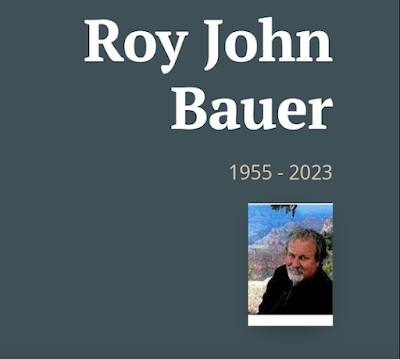
Roy's obituary in LA Times and Register: "we were lucky to have you while we did"

  This ran in the Sunday December 24, 2023 edition of the Los Angeles Times and the Orange County Register : July 14, 1955 - November 20, 2...