Showing posts with label Lee Walker. Show all posts

Tuesday, July 7, 2020

Johnny Rebs' Burns Down

Photos from Orange City FD's Facebook page

FOR YEARS, on Sundays, after church, the local Sons of Confederate Veterans met at Johnny Rebs' Southern Roadhouse on Chapman in Orange. Rebel Girl knows this because Steven Frogue, retired Foothill High School history teacher and SOCCCD trustee and Holocaust denier is a member and occasional officer of the chapter and on occasion she researches him to see what he is up to. Frogue is pretty unforgettable. After all, he once brought her a bouquet of roses from his garden and his son Jim was Trump's senior health advisor in the 2016 campaign. You really can't make this stuff up even if you tried. Why would you? High school history teacher + Holocaust denier + college board trustee + Sons of Confederate Veterans = ????

Frogue's chapter is named after James I. Waddell, captain of the Shenandoah, who kept fighting the Civil War until November 1865 when word finally reached him that the war ended in April. During that time Waddell attacked a U.S. whaling fleet in the Arctic. Waddell surrendered in Liverpool and thus presided over the last official lowering of the Confederate flag. 

In 2015, five years ago, when Johnny Rebs' finally took down their Confederate flag and replaced it with the American flag, Frogue and the local chapter of the Sons of Confederate Veterans stopped meeting there in protest. They began to meet at a steak house in Laguna Hills which doesn't fly any flag at all and they seem to now meet at members' homes. The minutes (posted online) notes that one recent meeting closed this way: "We sang Happy Birthday to General Lee and General Jackson. We sang Dixie while standing shoulder to shoulder facing the Confederate Battleflag." 

The Johnny Rebs' outpost in Orange closed last year, after 19 years in business, and since then the fenced off property had been slowly covered over with, as the kids might say, random graffiti. Yesterday, on July 6, Johnny Rebs' burnt down.

"Welcome to the south"
"Welcome to the South."


* * *
[RB's intrusion:] 20 years ago:

            …Right about then, the audience thrilled as one of the videocamera operators initiated an impressive TV studio-style countdown, culminating in the point of a finger at Dorothy Fortunewho then spoke to all the lovely voters out there in the dark. She explained that a group known as the “Sons of the [American] Revolution" would help us to celebrate the 200th anniversary of George “Worshington’s” death. That was Lee [Walker]'s group.
            The lights dimmed; then four of the Sons, including two musketeers, marched the colors up the left aisle. Meanwhile, Lee, along with a bugler and a fifist, tooted stoically up the right aisle. When they reached the back of the room, Lee played his drum. Then a woman warbled the national anthem. Trustee Padberg said something about “honoring our war dead”; this was followed by a moment of silence….
[Note: "Dot" Fortune was one of two women on the original SOCCCD "conservative" "Board Majority" (1996-1998) [the other was Teddi Lorch, who resigned, with her sights on the district's head HR job, which, after a bit of litigation, she secured!]. That group's emergence was engineered by our then-corrupt Faculty unionAmong that corrupt union's regulars (and beneficiaries) was Lee Walker, an illiterate English instructor who occasionally dressed up in Revolutionary War garb and/or dropped his pants/shorts.]

More about the SOCCCD faculty union’s bad old days: 

*

Monday, February 14, 2000

THE INFAMOUS DROPPED DRAWERS by Red Emma


From February 14, 2000 (Dissent 44)
Originally entitled:

GOODBYE, BLUE MOONDAY!

--The Feb. 7 union meeting


By Red Emma
“Merely corroborative detail, intended to give artistic verisimilitude to an otherwise bald and unconvincing narrative.”
—W.S. Gilbert

It’s hard to know where to begin reporting on Faculty Association meetings such as the one that occurred at IVC last Monday afternoon. Often, the elaborate digressions necessary to explain the bewildering context surrounding actions by the unhappy Old Guard dysfunctional family overwhelm this reporter’s ability to arrange his narrative into elements familiar to most readers: recognizable chronology, clear dialogue, description and convincing characterization of otherwise unconvincing characters.

How, for example, to fully explain dysfunctional paterfamilias “El Rey” Chandos’ time-wasting, obstructionist strategy of asking pointedly pointless questions, followed by his just plain getting up and leaving the meeting in order to destroy a quorum, but not before consulting his prepared Rep Council PAC vote spreadsheet? How to portray convincingly the transparent duplicity and obfuscation of Old Mother Sharon’s meeting facilitation? How to account for Sharon’s interminable non sequiturs about what she “was asked” by invisible others to do at Rep Council meetings (take a voice roll call, object to proposals, confuse Roberts Rules of Order with a Monty Python Sketch) toward promoting the views of those purposely not attending said meeting? Her leaving early for the past four meetings in a row to “pick up my little girl”? And how to avoid painting a pathetic picture of a weeping waif standing lost at a lonely Mission Viejo street corner, waiting for her mother?

“Where is your mommy, little girl?”

“She’s at a meeting overseeing the destruction of democratic unionism by right-wing born again Republican fundamentalists.”

“Oh, I’m sorry. My own dear mother was only an axe murderer.”


How to relate naughty Little Brother Lee Walker’s act of physically escorting his clueless Big Sister Deluda out of the meeting so as to—you guessed it!—avoid that quorum required even to hold this meeting, crucial to taking the PAC away from the cruel brood? And how to illustrate the outrage visible on the face of the usually unflappable Margaret Hoyos (CTA regional rep, God bless her) as she watched El Rey stand up and, just moments before the vote, leave? And, speaking of Brother Lee’s fully revealed white rear end, how, finally, to get through this confusing and possibly illegal obstruction of the democratic process by what’s left of the Old Guard Cosa Nostra without mentioning, dear readers, that, in a fit to please the bigger kids, Lee Walker, leaping up to harass Margaret, actually lost his pants, exposing his sagging bottom to a half-dozen remarkably sober, patient, and committed quorumistas, who never, not even after nearly three years of this coordinated acting out, imagined that they’d be exposed to that particular deportment? And how, finally, to avoid consolidating into this report every possible double entendre (and I do mean double), cheeky remark, flabby pun (i.e., “the naked truth,” “no ifs, ands, or butts,” “crack reporter,” “harass”—well, you see my problem)?

You know, people think Dissent reporters make this stuff up, like the part in the newly proposed board “speech and advocacy” policy where they give Raghu a yardstick and he gets to go out and measure the rainfall on the lawn to see if it’s okay for Deb and Wendy and Scott to plant signs in it. Yeah, that part. Raghu Mathur, Doctor of Horticultural Sciences. Raghu Mathur, Meteorologist. And, now for the weather report with Raghu “Fritz” Mathur: “Well, folks, we’ve got 74 per cent chance of no confidence today with possibility of ACLU.”

But I digress.

Regarding the meeting: first, there were the forty minutes where we all waited around for Margaret, who was later followed out of the meeting after opining that Red Emma’s vote did in fact count on the Rep Council. (Oh, yeah, did I mention? In an elegant concurrence of administrative mismanagement and easy political retaliation, Red’s own writing class was canceled in week 2 with 18 enrolled students—this as El Rey teaches Engineering courses with 6 students.) The question: should Red Emma, now paying his own monthly dues, be allowed, like Sharon, to remain on the Rep Council while on an extended (if involuntary) “leave”? Little Lee huffed and soughed, Sharon and El Rey passed wise looks (think Moe and Curly), Lee Haggerty was absent.

Then, in no particular order that I am capable of reconstructing, Margaret arrived, we “officially” started the meeting, Lee Haggerty arrived, Sharon left, Margaret left, Lee dropped his drawers, El Rey left, and we voted. And, with a quorum (with or without Red’s vote), this local finally changed the standing rules of the PAC at about 4:20 on a Monday afternoon! This without any of the Family Values Family even present.

A highlight:

Sharon
Sharon: I received lots of calls about this.

Red Emma: Excuse me, Sharon. You received a lot of calls about my not teaching? How many? Who called?

Sharon: Yes, I received some calls.

Red Emma: More than one? About little ole me, a part-time faculty? From whom?

Sharon: Yes. Um. Buh. Duh.


It doesn’t take much of a sleuth to identify the attempt by the old folks to rig the meeting, including somebody from administration contacting Sharon to catch her up on Red Emma’s cancelled course. Did I mention El Rey’s spreadsheet? Folks, you gotta admire that level of organization! I wish we were that together, except for the illegal and lying and conspiring part.

Butt (sorry) let’s return to that metaphorical moment when Lee actually lost his pants, hung so precariously from just below his gut. Yes, comrades, there it was, offered to the world, the proud derriere of a great great great-grandson of George Washington, that famous slaveholder and lousy general. Oh glorious, Oh vivid flab. Seeing it, exposed in the doorway of A403, made me want to chop down a cherry tree or throw Curt across the Potomac (except he wasn’t at the meeting) or just stand up and salute what makes America great: too much fried food.

Instead, I pointed. I really did. “Look,” I exclaimed. “His butt!” A couple of other attendees will vouch for the patriotic display, but the curious thing is that, when I mentioned the incident to a couple of SOCCCD veteran teachers, one said, calmly enough, “I’ve been looking at Lee’s ass for twenty years.”

To review: Lee again exposed himself, purposely or not. They all did. We won the historic PAC vote, returning our local to its constituents, as the last of the Old Guard assholes, fully revealed, left the room. —RE

The Saddleback College Lariat, March 30, 2000

Lee Walker at the SAR

Andrew Tonkovich

Tuesday, January 4, 2000

SOMETHING WICKED THIS WAY COMES: THE DECEMBER 13 BOARD MEETING by Chunk Wheeler


[From Dissent 40, 1/4/00] 
  “I never go to church; kneeling bags my nylons.” From [Billy Wilder’s] Ace in the Hole, 1951 
  F Troop 
 DECEMBER 13: I arrived at Library 105 just after 6:00 p.m. and, for once, I found that the room was packed. Why? Lee Walker, dressed as an American Revolutionary, was busy organizing something. But what? All the seats had been taken, and so I leaned against the right-hand wall near the main door. After several minutes, I looked to my left: Lee, now strapped to a drum, had settled in the doorway. I regarded him. He regarded me. I said, “Nice drum, Lee.” Right about then, the audience thrilled as one of the videocamera operators initiated an impressive TV studio-style countdown, culminating in the point of a finger at Dorothy Fortune, who then spoke to all the lovely voters out there in the dark. She explained that a group known as the “Sons of the Revolution” would help us to celebrate the 200th anniversary of George “Worshington’s” death. That was Lee’s group.
   The lights dimmed; then four of the Sons, including two musketeers, marched the colors up the left aisle. Meanwhile, Lee, along with a bugler and a fifist, tooted stoically up the right aisle. When they reached the back of the room, Lee played his drum. Then a woman warbled the national anthem. Trustee Padberg said something about “honoring our war dead”; this was followed by a moment of silence. 
    Boy, it was one damn thing after another. Next, John Williams led us in the Pledge of Allegiance. Naturally, this was followed by a brief address from the “great great grandson of Francis Scott Key.” The fellow spoke warmly of the Father of Our Country, highlighting his military victories. He neglected to mention our national Dad’s vast slave holdings or his questionable abilities as a military commander. 
   In general, the evening’s anniversary “activities” presupposed a Disneyesque take on American history--a Goofy history. 
    Suddenly, a Gold Star mother stood behind the podium to read a “poem.” It said that it is the soldier, not the “campus organizer” or the “reporter,” who ensures our liberties. Thanks to brave American fighting men, it continued, those darned campus protestors are free to “burn the flag.” One suspects that, if it were up to this Gold Star mom, flag burners would be skinned alive. 
   Trustees nodded and smiled approvingly. 
   Next, a student, doing an impression of Henry Gibson, got up and said, simply, “George Washington,” whereupon he recited five or so bowdlerized factoids about “the Father of Our Country.” Williams and Frogue took notes. 
    President Fortune attempted to say something: “Now we will have”--SQUONK! Apparently, the bugler, having studied Dot for several minutes, decided it was time for “Taps.” He spewed the tune all over the back of Marcia Milchiker’s head; the latter, plus its owner, fled to the wings. When the horn emitted a breathtakingly sour note, everyone thought: “F Troop!” 
    After Taps, one of the Sons took command. “Skirt the obstacle! March!”, he barked, and the color guard tramped back down the left aisle. Meanwhile, the Lee Walker Trio tramped down the right aisle. No one was surprised when the strap of Lee’s drum caught one of the legs of a video camera, briefly offering the hope of a dramatic and expensive faux pas. Alas, Lee managed to extricate himself and soon caught up with his pals, who, in typical American Revolutionary fashion, had deserted, leaving Lee to fight the camera leg alone. 
    Pam Zanelli, her brain a needle in her haystack head, preserved the moment on film. I think Lee looked up and said “cheese.” Then, as Lee marched under my nose, I briefly met the glances of the two senate presidents, who, judging by their wild eyes, were either very ill or much amused. 
    When it was clear that the Sons of the Revolution had finished their performance, the audience simply got up and left, taking no notice whatsoever of the board meeting that struggled to continue in the background. After all, they had come for flag-waving and protester-bashing, and that was now over. Why stay for the actual meeting? Why would anyone do that? 

A year of Miss Fortune 
    The board clerk, Mr. Wagner, read out the board’s closed session actions: Glenn Roquemore, an IVC geology instructor and Mathurian crony who, despite an almost total lack of administrative experience (he had been a school chair for two months), was appointed Acting VP of Instruction two years ago, was now appointed as permanent dean of Advanced Technology, a role, naturally, for which he is not even remotely qualified. (Also, a man named Deshazer, I think, was appointed the assistant director of something.) 
    Next, in another exercise in bowdlerization, Dot listed the board’s alleged achievements under her presidency. The first of these was the televising of board meetings, an act which, she said, “expresses” the board’s “openness.” (I wondered what its “persistent and defiant” violations of open meeting laws expresses?) Meetings, she said, have been productive. Plus board members are now dedicated to “civility and respect,” and they’ve “stayed on point.” Trustees, she added, asked for reports—for instance, they requested an accounting of faculty “release time,” which led to a cap on release time expenditures that, she insisted, saved the district big money. Dot failed to mention the $127,000 the district spent on its own attorneys unsuccessfully defending El Ced when he violated the Constitutional rights of a certain philosophy instructor. (Eventually, the district will have to pay his attorney, too, though they seem to imagine otherwise.) 
   And what about the huge legal costs incurred in Brown Act II, which the district lost? And the legal expenses incurred defending the district’s unconstitutional speech and advocacy policy? The board, she said, has tried to improve its relationship with the faculty, even scheduling a “prayer breakfast.” Dot forgot to mention that only one instructor showed for the prayer breakfast, and the board’s relationship with that guy was already pretty good. 
    Evidently striving for maximum irony, she added that the board has worked to increase “accountability.” Hiring processes for administrative positions, she noted, have yielded the “best candidates” rather than the “in house” crowd. That remark was mighty strange in view of Glenn Roquemore’s appointment a few seconds earlier. And what about Armando Ruiz’s appointment? Wasn’t he “in house”? And how does all this “best candidate” guff square with the fact that almost no one is applying for SOCCCD administrative openings? And why did Patricia Spencer, IVC VP of I, flee to Fullerton College after only one semester? 
    At the end of her account of board achievements, Dot expressed relief that she could now remove the “cross” of the board presidency from her shoulders. Yeah. Everyone else was pretty goddam relieved, too.

Lee Walker at the Sons of the American Revolution confab
An uncivil action 
    Next came the organizational meeting, the chief task of which was the appointment of officers for the coming year. Trustee Frogue explained that he had witnessed Nancy Padberg’s performance as vice president over the past year and was therefore pleased as punch to be able to nominate her for the presidency. She was the only nominee. 
    Evidently relying on intuition, Dot dispensed with a formal vote and declared that Padberg was elected “by acclamation.” She then handed the gavel to Padberg, saying, “It’s in your hands.” That was Padberg’s cue: she walked over to a bag behind the table and pulled out an ugly brown plaque to which a wooden gavel was afixed. She handed the thing to Dot, who yanked the gavel from its mounting and said, “This is very handy.” 
    Next, Don Wagner was elected vice president—again, “by acclamation.” That left only the office of the clerk. Marcia, who has held every board office, nominated Dave Lang, who, despite his three years on the board (two more than Padberg or Wagner), has held no board office. No doubt she refrained from nominating Dave for the higher offices because they are powerful, and the Board Majority will not share power. 
   Marcia noted some of Dave’s virtues. Then she expressed her quite reasonable belief in the rotation of offices among trustees. It was high time, she said, for Lang to “become an officer,” even if that office was only clerk. Surely she was right. 
    Fortune, Williams, Padberg, Wagner, and Frogue were unmoved by Marcia’s plea. Indeed, they simply ignored it. Amazingly, without discussion, they made Mr. Frogue, who has already held various offices, the new clerk on a 5-2 vote. It was a clean sweep for the Board Majority. It was also a nadir of board “civility and respect.” When, a few days later, the board meeting was broadcast, TV audiences saw none of this. In the broadcast, after Wagner’s election “by acclamation,” the screen fades to black, and the following message is displayed: “Due to a loss of video during the taping of this meeting, the election of Steven J. Frogue as Clerk of the Board was not recorded. He was elected in a 6-1 [sic] vote.” How’s that for “openness”? 
    The snubbing incident seemed to anger Marcia. She spent the rest of the evening voting against Board Majority initiatives and sniping at Miss Fortune. 
    During the break, I asked the student trustee why she had failed to vote for Lang for clerk. She said, “Well, I talked to Dave. He didn’t seem interested.” “Yeah,” I said, “but Frogue’s a Nazi.” That, of course, was only a joke, a poor one. Still, Frogue never repudiated the support he received from hard-core neo-Nazis and racists (such as Joe Fields and George Kadar) in the days following his Michael Collins Piper “seminar” fiasco. Frogue’s friend Piper, of course, works for Willis Carto, who, in a sworn deposition in 1979, acknowledged that he embraces the tenets of Francis Parker Yockey’s “Proclamation of London,” a document which advocated the expulsion of Jews from Europe. Carto, publisher of the anti-semitic The Spotlight (one of Frogue’s favorite publications) and founder of the Holocaust-denying Institute for Historical Review (one of Frogue’s favorite organizations), has reprinted Yockey’s infamous book, Imperium—The Philosophy of History and Politics, which is dedicated to—you guessed it!—Adolf Hitler. 
   But I digress. 


Lip buttoning & gratuitous prize-giving 
    When the meeting reconvened, the trustees tackled more “organizational” issues. Wagner urged the board to hold more meetings at IVC, but Dot demurred, saying that Wagner’s proposal—to hold every third meeting at IVC—was “a little excessive.” She asserted that Irvine meetings burden the staff. Marcia responded by saying, “I appreciate that Dorothy Fortune thinks she knows everything,” but on what basis was she making these assertions? In the end, Wagner prevailed—mostly, I think, because IVC’s Raghu P. Mathur, who never misses an opportunity to enhance his importance, enthusiastically supported the initiative. 
    Somehow, Study Abroad came up. Dot, who has consistently expressed contempt for such programs (she once referred to the Costa Rica program as a “surf party”), had authored an amendment, just then provided, which, in Marcia’s mind, expressed Dot’s unreasoned animus. It would be a “courtesy,” said Marcia, taking a swipe at Dot, to be provided such documents in a more timely fashion. “I think that the intent of this is to inhibit the Study Abroad Program,” she added. 
   Frick and Frack immediately came to Dot’s defense. Soon, there was a discussion about the length of time permitted for trustee reports. About four years ago, in an attempt to rein in Mr. Frogue (who then devoted much board time to rants against the Anti-Defamation League, the boogeyman of choice among American anti-Semites), trustee reports were limited to 5 minutes. A year ago, they were limited further, to three minutes, an action the Froguester, who loves nothing more than to hear himself speak, opposed. 
   This night, Dot, who was ready for her closeup, sought to limit reports to one minute. We need to “button our lip a bit,” said Dot. Well, she needs to, anyway. No one supported her. 
   In the end, a more moderate “two minute” proposal passed. 
   The organizational stuff seemed to go on forever. When it finished, we returned to the regular meeting, and president Padberg asked whether there were any requests for public comments. There were none. 
   Later, there were no reports from the Academic senates, or the student government officers, or the unions. Yeah. What would be the point—what with all the civility and openness goin' on? 
   Next, a resolution praising Mr. Armando R. Ruiz for his “outstanding leadership since 1989” was read aloud. I have found no one who has worked with Ruiz who has much good to say about him. On the other hand, he’s willing to play ball with Mathur and his BM patrons. Hence, the prize. 
   They’re grooming him for something. 
   Raghu P. Mathur offered a few feeble words of praise for Armando: “reliable,” “trustworthy,” "hirsute." (Well, maybe not that last one.) Armando smiled so hard, it looked like his face might split. He spent about a half hour shaking every hand in the room. 


A very special Christmas party 
   Eventually, the trustees gave their reports. Padberg said she attended a “Graucho Banquet,” I think. Must be where everybody dresses up as a Marx Brother. She wished everyone a happy holiday. 
   The student trustee had no report. “Finals,” she said. 
   Williams, looking staunch while humming a Disney tune, reported that he went to the “Feast of Lights” concert and raised money for football by playing golf. He said something about getting a “hole in his head,” I think. 
   Good honesty. But why does he persist in dying his hair a nasty shade of “Hitler” brown? 
   In her report, Dot referred to a Christmas party, which occurred on the previous Friday at Don Wagner’s place. I later learned that the faculty’s representatives—the academic senate presidents—were not invited. The party, said Dot, was an attempt to bring together board members and district administrators. Faculty didn’t figure in. 
   But, in fact, some faculty were invited—people like Sharon MacMillan and Lee Walker. Those two, or course, are members of the union’s Old Guard—the faculty group that, despite howls of protest from the rank and file, used tens of thousands of union dollars to help get Fortune, Williams, Frogue, Padberg, and Wagner elected. 
   Wagner, looking sheepish, had nothing much to report. Frogue thanked Dot for a “fine and productive year.” He reported that he had attended an IVC ASG meeting plus a Christian Club Bible Study meeting, the “highlight of my week.” He also attended the Global Humanitarian Club’s showing of a “heart-rending film” on child soldiers. He explained that an application to join the “Sons of the Revolution” has been sitting on his desk for 28 years, and, soon, dagnabbit, he will submit it. 
   Frogue will fit right in. Maybe his pal Piper can come along and play a Hessian. 
   Marcia reported attending a performance of the IVC Wind Ensemble. Perhaps for Frogue’s benefit, she mentioned the ADL “man of the year,” who, because his children attend Saddleback College, called her and expressed concerns about our colleges’ accrediting status. Just as her two minutes ran out, Marcia, amid efforts by Padberg to shut her up, closed by saying: “I’m appalled and astounded and furious at the letter that was sent out to the U.S. Department of Education—that I never got.” 
   Dave Lang, alluding to the party, thanked the Wagners for their hospitality and wished everyone a happy holiday. As usual, Sampson, Bullock, and Mathur had nothing to say. Mathur, who, for once, refrained from referring to his “goose pimples,” yammered about a $20K challenge grant to help open a multicultural center for which matching funds have been found. 
   “Multiculturalism” at IVC: that’s when you arrange screenings of “The King and I.” Really. 


Cedric’s Big Adventure 
   Eventually, we got to the Chancellor’s items on the agenda. Item 26 concerned a proposal, by the Chancellor, to revise board policy 2100.1—“delegation of authority to the academic senate.” 
   On Nov. 27, a Times article reported the following: 
  The faculty senates at Irvine Valley and Saddleback colleges vow to fight—in court, if necessary—a suggested policy change aimed at reducing their power and giving the Board of Trustees more say over academic matters... Sampson’s recommendation would change the senates’ role from “authority over” academic and professional matters to “responsibility for advising the board” on those matters...“The board felt it delegated too much authority to the faculties and it needs to clarify and correct some of the policies,” Sampson said... According to Sampson, the wording change would bring the board policy more in line with state regulations... Peter Morrison, senate president at Irvine Valley, disputes Sampson’s reasoning: “The board policy is exactly in compliance with [state] regulations.” 
   (The article cites the “soccer” issue at Saddleback as an example of the board’s failure to accept senate recommendations. I’m told that one dean took the faculty’s side in this particular dispute [Robinson]. Guess what? A few weeks ago, his administrative contract was not renewed.) 
    If you’ve been reading your Dissent, you know that Peter is right. Dissent 38 reprinted the language of board policy 2100.1 and Title V, section 53203. These documents make clear that Sampson’s (reported) assertion—that 2100.1 is in some sense out of compliance with Title V—is erroneous. Title V states that “the governing board” may elect “to rely primarily upon the advice and judgment of the academic senate.” Our board policy says that the “governing board...will rely primarily upon the advice and judgment of the academic senates.” 
   As usual, Sampson doesn’t know what he’s talking about. 
   Incidentally, the board has engaged in persistent and defiant violations of Title V, section 53203. The latter says that, when the board elects to rely primarily on the senate, “the recommendations of the senate will normally be accepted... If a recommendation is not accepted, the governing board or its designee, upon request of the academic senate, shall promptly communicate its reasons in writing to the academic senate.” Accordingly, our board policy states, “If a recommendation of the senate is not accepted, the governing board or its designee will promptly communicate its reasons in writing.” But, as I understand it, on several occasions, the board has failed to accept the senate’s recommendations (on matters over which it is given authority by BP2100.1). Then the board has failed to provide the required reasons in writing.
   On the 13th, Sampson announced that he will soon recommend this change to lessen the Senates’ authority. He also said that he will seek the consent or agreement of the faculty senates. If, however, the senates don’t agree to the change, said Sampson, the board can make the change unilaterally. 
   In fact, however, the board has no such authority. This is made clear by the existing board policy, which states: “This policy is a mutual agreement between the governing board and the academic senates and may be modified upon mutual consent of the parties.” It mentions no exception to this requirement.
   During the meeting, Sampson ignored our own board policy and drew the board’s attention instead to an “exception clause” in Title V, which gives to the board the right, under special circumstances, to make a unilateral decision. According to Title V, the board can indeed make a unilateral decision—when the status quo “exposes the district to legal liability or causes substantial fiscal hardship”—but only after it has made a “good faith” effort to “reach agreement” with the senate. 
   Sampson, winking and purring through his nose, argued that it is the board’s prerogative to judge whether these exigent conditions obtain; thus, if it so judges, it can make a change unilaterally. 
   There are three flaws in this reasoning. First, no such exigent conditions obtain. Second, the Title V exception clause refers, not to board/senate disagreement over the policy itself, but disagreement over “policies and procedures on academic and professional matters”—such as whether to have a soccer program. Third, and most importantly, Sampson is ignoring our existing board policy, which expressly prohibits a unilateral change of 21001.1 by the board, and which, as a definition of senate rights agreed to by the board itself, is not voided by the language in Title V, with which it is not in conflict.


  TRANSCRIPT: Here’s what was actually said during the discussion of item 26: SAMPSON: 
This item is before you today simply for notice that I will be making future recommendations in regard to this board policy. What occurred is that I brought this up for discussion in the chancellor’s cabinet, and it became something of notice to the press, and there were several articles about it in the press, and I had not brought it to the board for your attention until it was my plan to have had it discussed in the cabinet. However, because it is an item of public notice now, I’d like you to take this under advisement...[He discusses the content of the packet he has given to trustees.] In dealing with the Accreditation process and the many comments about shared governance in our district—that it is not understood and there is confusion about faculty roles—I’ve identified this policy as the center of the problem and something that the board needs to devote some time and attention to possible modification. My expectation [is] that I will bring this back to you for action in January. However, that action will be simply to request that I take this to the Academic Senates to ask them to change what is a mutual agreement and to solicit their response to that proposal....
LANG: My first question is that—assuming that this does go back to the Academic Senate, and they do not agree, mutually consent, to change the existing policy, then what would you be recommending to our board? SAMPSON: Well, I think we’ll go with an effort to solicit their support of a change. However, if they do not wish to change it, there are provisions in the code for a district to act—(LANG interjects: “unilaterally?”)—after a certain process is followed. And we will fully comply with the law. FROGUE: ...I would like to report—I won’t do it now—but just to report on certain problems that have existed in the past with the Academic Senates regarding to [inaudible] delegate to them the right to operate under the constitution. This is before—Dr. Sampson—before you came here. I think it is important that this be part of the record in understanding why there might be a lack of confidence—uh—I never meant this to be, you know, sniping—but I could never get answers to certain questions about certain operations, certain reports that were being made, replete with false information that was being passed off as fact—one or two board members trying to pass it off as fact also, and that leads to disinformation, confusion, and I think it leads to a lack of trust, an erosion of trust, over the years. I think that that brings us pretty much to the point we are at now. And I think the process resulting—we need to review the history of it and I would be happy to do that. [Frogue looks hopefully at Padberg, who says nothing.] [The Academic Senate presidents—Peter Morrison of IVC and Anne Cox of Saddleback College—are asked to comment on item 26:] MORRISON: [He distributes a packet to help trustees prepare for the January meeting.] ...I’d like to read into the record a letter on behalf of the senate this evening. It reads as follows: “Because we’ve found neither the current format nor the conduct of board meetings conducive to dialogue or fruitful exchange of views between the Academic Senates and the governing board, the officers of the IVC Academic Senate request a meeting with the officers of the board to discuss the roles and responsibilities of the senate as understood by the trustees and by us. Events of the past year have persuaded us that we indeed have a fundamental difference of opinion on this matter. If this is indeed the case, we believe the specific forms and content of that difference must be defined before the parties can agree how best to resolve it. If not, then we need to understand how best to avoid [inaudible] conflicts or potential conflicts between us. Our previous efforts to identify and work [out?] these differences have unfortunately not proved effective. And we hope that direct, frank, and informal meetings between the senate and elected board officers might reverse the situation.” [End of letter.] You have a copy of that letter as part of your packet...I have included a correspondence between our senate and the chancellor on this matter over the last year...Let me restate that, should you take action, [inaudible] proposal here, we will of course agendize that and give it all due consideration. Thanks. COX: Thank you. Of course, as Chancellor Sampson has said, he put this on the chancellor’s cabinet agenda—I believe it was November 9 and again December
 
2. He asked the presidents of the Academic Senates to go back to their respective constituencies...[Cox goes on to explain that “the discussion that ensued” among the Saddleback senators “was overwhelmingly opposed to these changes.” She then reads a unanimous senate resolution which rejects Sampson’s proposal in no uncertain terms. Finally, she reports two unanimous petitions from two divisions that also oppose the proposed changes.] SAMPSON: [Smiling unctuously:] Well, I would just like to respond that, happily, the board and the board item before you complies fully with the request here from the Academic Senate in that no change will be made—uh—the board has not yet had an opportunity to study or discuss this. The board has not yet given any direction, and I have not yet requested a change from the Academic Senates. However, when I do, then we will be in consultation on this item. We are recognizing this as a mutual agreement. We’ll deal with it as such. [Naturally, at this point, some trustees are confused. “We,” says Sampson, are recognizing this as a “mutual agreement”; and yet “we” can--and apparently should--unilaterally change the policy?] WAGNER: ...In the event one or both Academic Senates absolutely refuse to change the existing mutual agreement, is there a process by which this board can then implement changes in the policy or not? SAMPSON: Yes, there is. FORTUNE: [She asks for the specific language in the “state law” that would permit the board to change the policy unilaterally. Sampson spends a few seconds looking for it. Then he reads:] SAMPSON: “in instances were the governing board elects to provide for mutual agreement with the academic senate, and agreement has not been reached, existing policy shall remain in effect unless continuing with such policy exposes the district to legal liability or causes substantial fiscal hardship. In cases where there is no existing policy, or in cases where the exposure to legal liability or substantial fiscal hardship requires existing policy to be changed, the governing board may act, after a good faith effort to reach agreement, only for compelling legal, fiscal, or organizational reasons.” [Sampson fails to read the crucial section of Board Policy 2100.1 that expressly forbids a unilateral change of 2100.1 by the board.] What this says to me is that, if the district has compelling legal, fiscal, or organizational reasons, it may change this policy—and of course in the conversation and the discussion of this, the board would be the group who would determine whether you had those compelling reasons. PADBERG: O.K. [End of transcript.]
“They made us do it”
 
   Item 32 concerned the Saddleback soccer program. President Bullock expressed her support for soccer. Uncle Steve explained that he was once a soccer coach. John, looking especially staunch, pressed the chancellor for resolution of the “soccer” issue. Sampson agreed that resolution is necessary, but offered none. Bullock, despite her support of soccer, expressed the faculty worry that, by pursuing soccer, other sports, which are often underfunded, will be hurt. John blathered about the “huge demand” for soccer among women. Dot silently tore away at some jerky treats, occasionally spitting a fragment into the camera. 
   Items 33 and 34 concerned faculty stipends. Trustee Fortune seemed to suggest that faculty are getting paid for work they are not doing. 
   Item 35 was “reports” from constituency groups. There were none. 
   After the meeting, out in the parking lot, Trustee Frogue approached me, saying, “When are we gonna get together at my place?”—or something to that effect. It wasn’t the first time. 
   I shook his hand, but I affected reserve. I said: “I was surprised by your vote to appeal the judge’s ruling in my First Amendment suit. I thought you believed in the First Amendment. You always say you do.”
   Frogue seemed flustered. I said something like, “I’m not violent or threatening [as the district, seeking to silence me, absurdly asserted], and you know it.” 
   He said, “Of course not! But these lawyers. They made us do it. We could get sued if we don’t pursue this.” 
   Williams walked up. “Good evening, Roy,” he said. I said “good evening,” and walked away, into the night and into a new goddam millennium. —CW [Roy B.]

Monday, November 23, 1998

Frogue on a nut roll; Lorch's "straight productivity model"; Raghu's finger

[Dissent 12, 11/23/98]

[Originally entitled:]

THE NOVEMBER 16 BOARD MEETING:

Bullock and Sampson show gumption! Frogue calls for list of “class sizes” per district instructor! Lorch urges use of “straight productivity model” for faculty hires; a new era of super-duper micromanagement!


by Chunk Wheeler [Roy Bauer]

Were a stranger to drop on a sudden into this world, I would show him, as a specimen of its ills, a hospital full of diseases, a prison crowded with malefactors and debtors, a field of battle strewed with carcasses, a fleet foundering in the ocean, a nation languishing under tyranny, famine, or pestilence. To turn the gay side of life to him and give him a notion of its pleasures—whither should I conduct him? To a ball, to an opera, to court? He might justly think that I was only showing him a diversity of distress and sorrow.

—DAVID HUME

I arrived at IVC’s Student Services Center at about 7:30. I thought I had arrived early, for this board has consistently started late—sometimes very late—for many months. On the other hand, evidently, I hadn’t missed much, except for Marcia Milchiker’s “Invocation,” which, by her own account, was rambling and “philosophical,” and the pulling of item #24: “Irvine Valley College: Costa Rica Study Abroad Program.”

What’s that about? Board observers will recall that, on Dot Fortune’s first night as trustee two years ago, she expressed the groundless suspicion that the Costa Rica program was, in reality, a mere “surf party.” Perhaps that incompetent notion has struck her again.

I arrived in time for item #7: “SOCCCD ADMINISTRATIVE REORGANIZATION.” According to the agenda, “The district, Irvine Valley College, and Saddleback College have reviewed the current administrative structure as directed by the Board of Trustees, and are submitting for review and study their recommendations for realignment of units to best serve the administrative needs of the district and colleges.”

Now, I don’t recall our college having participated in this effort. Evidently, the document, which is a draft, recommends, among other things, nine deans each for Saddleback and IVC. Wow. Later, during his report, Peter Morrison, president of the IVC Academic Senate, stated that “we [the IVC Academic Senate] are not a party to the recommendations discussed tonight.”

Fortune complained about the document’s charts. Evidently, she’s not a chart person; she’s a list person. She complained about the quality of the information being submitted, and, naturally, Mr. Frogue, who suspected intrigues, concurred.
Ms. Lorch indicated that we’re “behind” on the Tustin base project, and so she favored moving ahead with the Tustin “Provost” position. (Some have speculated that the board is contemplating moving the Gooster out to Tustin. Someone asked me, “Do you suppose Lorch’s support for the Tustin position has anything to do with that?”)

Fortune expressed her dissatisfaction with the number of deans “cropping up” in this recommendation. For reasons unknown, soon thereafter, we broke for 20 minutes.

After the break, we moved on to item #8: FACULTY HIRING. The board was being asked to accept “for review and study” the 1999-2000 “Position Request Lists” from the two colleges. As you know, these lists reflect much discussion, compromise, Sturm und Drang. Naturally, the Board Four, showing their usual low regard of every other group in the district, approached the lists with suspicion and disdain.

Ms. Milchiker noted that the district should hire the “best and the brightest,” which has been a district desideratum, she said, from its beginning. Mr. Lang asked how many positions we can expect to fill. Answer: maybe 5 for IVC; maybe 7 for Saddleback. Saddleback must fill many vacancies created by retirements, said president Bullock. Chancellor Sampson urged the board to approve the lists.

At about this time, Mr. Frogue launched into his familiar rant about “wait lists.” “Wait lists, wait lists, wait lists,” he seemed to say. He noted that no business instructors appeared on the lists. He asked if students had had input.

Chancellor Sampson was quick to respond. He assured the board that enrollments and student demand were certainly taken into account in creating the lists. He asked the two Senate presidents to comment. Saddleback’s Maureen Smith explained that a mathematical formula concerning demand, etc., was used early in the process.

Then, Mr. Frogue, surprising no one, demanded “raw meat.” (Or was it “raw data”?) He seemed to suggest that the hiring lists reflected not true need, but a “slant.” As I recall, at some point, Ms. Fortune, too, implied that these hiring lists reflect the desires of those who exert the most influence on the process.

Did they offer any evidence for these suspicions? They did not.

Mr. Frogue was very concerned that five PE hires were on the lists (or Saddleback’s list). John “PE Boy” Williams began to hiss. Smith indicated that, among other things, the list reflected retiree replacements, and that accounted for some apparent oddities.

“I’ve heard,” said Mr. Frogue, that there are PE courses “with 2, 3, 5 students.” (The hissing grew louder.) We should stress class size, he said. He brought up wait lists again.

Thus began the career of the Board Majority’s idée fixe of the evening: WAIT LISTS = HIRING PRIORITIES. The notion metastasized; despite everyone’s efforts, it spread outward and left no survivors.

Eventually, Ms. Hill, the student trustee, weighed in. “I’ve waited sometimes three semesters to get a cornerstone class” in computers, she said.

Ms. Lorch stated that we need to use more of a “productivity model.” (Later, this became a “straight productivity model.”) As things stand, we follow a “program based” model, and, for that reason, we are losing revenue. She said that she did not see “productivity” reflected in the hiring lists. There are long wait lists, she said, for human development classes, and yet no human development instructor is being hired! Thus students will go elsewhere, and we’ll all go to hell in a handbasket.

Mr. Frogue commented that, from the beginning of his long teaching career, he has always been bothered by this talk of a “formula” used to hire new instructors. We need to consider students as more than just a factor in a formula, he said, idiotically. He added that the trustees need to understand the formula that’s being used, for “things have become unglued.”

Chancellor Sampson looked desperate. He noted, lamely, that the trustees’ comments were “appropriate,” that productivity is indeed important. He confessed that he was remiss in not including in his report the elements used—including productivity—in arriving at the lists. He explained that each college had a different way of doing the formulas, but their intent was to respond to productivity concerns. “I think it’s here,” he said. “I just haven’t got it out.”

Ms. Fortune claimed to be quoting former fiscal VC Newmeyer when she proclaimed that if something could not be explained in a paragraph, then something’s wrong. Evidently, she judged that the process by which the hiring lists were determined remained unclear. Showing momentary intelligence, she noted that the issue of class demand does not necessarily imply a need for full-time hires, since part-timers can be used to staff added classes. (I believe that Lorch and Frogue responded to this by forming puddles of drool.) She even commented on the lack of rooms for additional classes. (More drool.)

Mr. Williams then awoke from his dogmatic slumber. He indicated that what he wanted to say had already been said by others. He added, however, that the presence of so many PE instructors on the list reflected the large number of retirees in PE. This was not the only time this night that Mr. Williams and Mr. Frogue seemed to disagree.

It was President Bullock, I believe, who noted that, if we don’t replace the retirees, we will thereby do away with some programs. Earlier, someone had noted the presence of a Fashion instructor on the list and was doubtful; in fact, said Bullock, the Fashion instructor is our last, so if we don’t replace him/her, that’s it for Fashion.

Raghu “the Beav” Mathur asked IVC Academic Senate president Morrison to explain IVC’s list. Peter stated in no uncertain terms that IVC’s list is based on productivity. One element among the considerations was the need to reach the 55% standard. (I believe this refers to the following situation: when the ratio of full-timers to part-timers is below a specific number, the state fines us for being out of compliance.) Peter added that, in arriving at the list, it was left to areas (e.g., Humanities and Languages) to make specific decisions (e.g., Philosophy vs. History). These decisions were examined by the Senate, and if they made sense, we went forward with them.

Saddleback’s Maureen Smith explained that Saddleback is a “comprehensive college.” In fact, Fashion is a vital program. Further, by failing to replace the retiring Fashion instructor, we would end that program, and, she said, you don’t discontinue programs without going through a process.

Lorch

Ms. Lorch insisted, against all evidence, that she understood the special case of retiring instructors. She now seemed to say that IVC evidently uses a productivity model but, it seems, Saddleback does not. “I am correct, then,” she announced peevishly. Sure enough, somebody isn’t using a “straight productivity model.”

Bullock pointedly reiterated that Saddleback is a “comprehensive college,” and that, therefore, we simply cannot follow a straight productivity model.

Lorch snippily declared that, in pursuing this comprehensive college business, we are doomed to bankruptcy! She fell back into her chair as if to express disgust.

Ms. Miller-White, whose love of fashion is manifest, stated that she had problems with a straight productivity model.

Thereupon Mr. Frogue went into “nut” mode. “Who,” he asked, “has control of the hiring process?” He implied that we don’t always hire the “best and the brightest” because there are people who control the hiring process, and these nasty characters—Communists? Zionists?—make sure that their people get hired.

Frogue was on a nut roll. He launched into his favorite topic: the fate of information as it travels in bureaucracies. He spoke once again of the “universe of information” and “thrice selected samples.” (Mr. Frogue never says anything he hasn’t already said in exactly the same way many times before.) The last time he spoke of these things, he accused administrators of deleting and manufacturing information as it traveled to the board. This time, he seemed to say that the board couldn’t trust the process whereby the hiring lists were assembled. Once again, he demanded raw meat.

“Wait lists, wait lists, wait lists!” he said. And then, a new thought: “I’d like to see a list of class sizes for every teacher in the district!” (You can bet that Mr. Chandos and his friends will soon put a stop to that. I do believe that Mr. C has recently crossed into “negative students” territory.)

The Chancellor gently expressed skepticism of the value of the “class sizes per instructor” list. Perhaps class size lists per area or discipline, he offered. And he was doubtful about this “PE classes with two students” business. Somewhat pointedly, he asked: “What was your expectation [in receiving these lists]?” Did Mr. Frogue expect only Math positions and the like to be on the list?

“Yes,” said Frogue, inspiring laughter. “I need this data to do my job,” he added.

Lorch had evidently used her brief time away from the mike to create a demeanor of utter stupidity and condescension. She now lectured: “We are in a new era.” There is an “industrial revolution in education.” We need to compete with other schools, and that requires being productive. Concerning productivity and its role in the hiring process, she was hearing one thing from IVC, another thing from Saddleback, she said. She just wanted to know whether the colleges were using a “straight productivity model.” “I don’t need more data,” she concluded, once again sinking into her chair with an air of peevitude.

Someone near me muttered that, after 5 1/2 years, Lorch had learned absolutely nothing. Another person just shook his head, saying, “She’s an idiot.”

Not to be outdone, Dot Fortune suggested that what might be happening in these hiring processes is that “the biggest chum” is being hired. Of course, as we all know, there is truth in this. There is truth exactly insofar as we focus upon the subset of hiring processes that involve some of the Board Majority’s supporters among the faculty. Indeed, among that unsavory crowd, the practice of seeking to hire someone you sleep with is not unknown. But never mind.

* * * * *
During public remarks, Jack Drummond, the Frogue-friendly Lariat reporter, spoke on behalf of the similarly deserving Mr. Walker, advisor to the paper. It is not true, said Drummond, that Mr. Walker threw furniture across the room. Blah blah blah, he said.

At that point, the board had heard testimony (a month or two ago) from about a dozen former and current editors of the Lariat, all of whom judged Walker to be doing a strikingly lousy job. Now, upon having heard this solitary dissenting voice, Mr. Frogue proclaimed, “This is what I suspected all along!”

I wanted to burst into peals of laughter. I did, inside. My eyeballs spun.


Mr. Frogue explained that he has known Walker for many years, and he’s a great guy. He said that he wanted to “draw a parallel here.” We see people bent on destroying the reputations of their leaders, using the newspapers to spread lies, and all for selfish ends. Frogue confessed that he never understood that behavior. It is “gang” behavior, said Frogue, and he has always fought against that.

Eventually, Lee Walker spoke “from his heart,” he said. The charges against him are all untrue, he insisted. He said that he would be happy to compare his credentials as a journalist with those of any instructor in the community college system—indeed, in the state university system. After all, he has even taught in the Sudan.

At one point, Walker expressed disappointment that administrators hadn’t come to his defense. “I would think some administrators would stand up to defend me!” he said. For three semesters, said the Walk Man, he has been “brutalized.” Speaking to the board, he said: “I expect you to support me.”

(This is not the first time that Mr. Walker has demanded support in this fashion. He was the Lariat’s advisor many years ago, but when he returned from his epoch-shattering trip to the Sudan, the job had been given to someone else. He thus threatened to resign, but the board pleaded with him to stay.)

Ms. Fortune opined that the attacks against Mr. Walker were “unconscionable.” She noted that none of these students had ever bothered to pursue a written grievance.

Mr. Frogue provided an analysis of the situation. People feel that they own the “vehicle,” the “animal,” he said. Their emotional commitment is so great that they think they own the place.

Somehow, that point inspired Mr. Frogue to denounce the professional reporters (from the LA Times and the OC Register) who had criticized those hapless student reporters who spoke on his behalf during a notorious press conference. It was that old gang behavior again, said Frogue.

“People should be stood up for,” offered the Froguester. “I’ve known Lee for two decades.” He’s a “fine man, a fine teacher.” I detected laughter coming from somewhere in the building.

Frogue concluded by saying that the attacks on Walker were, “un-American” and “disgusting.”

* * * * *
This brought us to the Board members’ reports. Marcia wished Lorch and Hueter well in their “future endeavors.” She also explained that the Irvine Spectrum area will become the “new Silicone Valley.”

Mr. Lang expressed special thanks to Joan Hueter. He congratulated Nancy Padberg and Don Wagner on their recent election victories and expressed hope that they would, as promised, be independent. He also expressed hope that the board would heed the advice of the Accrediting Teams by accepting its policy-making role and ceasing to micromanage.

Mr. Frogue thanked Ms. Lorch profusely, saying that she was “head and shoulders above others” with respect to her knowledge. (No, she’s an idiot.)

He added that, though they often disagreed, he always respected Ms. Hueter. Something tells me the feeling isn’t mutual.

Frogue asked for “extended time” to make his remarks, which were, despite his efforts, bitter and bilious. He has been the subject of two recalls, he said. He feels bad more for the people who pursued them than for himself. They started to believe their own lies, said the Froguester, believing his own lie. He condemned those who play on the fear and ignorance of others. These remarks seemed to be directed to, among others, certain “members of the board.”

He listed some of the officials and institutions that joined the recall effort. But the “people,” he said, rejected the recall “wholesale.” (Well, no.) I may be mistaken, but I believe that he said that those who signed the recall petitions were “stupid.”

At one point, Mr. Frogue displayed cartoons that people had sent him. He seemed especially fond of a cartoon that depicted reporters all drinking from the same toilet bowl. “I beat ‘em with one hand tied behind my back,” said Frogue.

Nevertheless, he added, it is “a time for healing.” He urged the Chancellor to put together a “reconciliation committee.” We should watch to see who refuses to back off from the hostilities—and then we can place blame where it belongs, said the Froguester. Yeah, that’ll promote healing all right.

Ms. Hill said that she learned “how to ask questions” from Ms. Lorch.

Inexplicably, Mr. Frogue interrupted Hill’s report to present John Williams with what appeared to be a broom wrapped in newsprint (issues of the Irvine World News). “I’m supposed to tell you it’s a two-seater,” said Frogue. Williams looked as though he had just been handed a sack of excrement. Everyone else just looked puzzled.

Ms. Lorch, apparently running for office, offered an odd report that referred occasionally to an essay by a part-timer. Lorch seemed to be saying that part-timers are exploited. What had she done about that situation in the last 5 1/2 years?

Nothing.

She closed by urging others to pursue community service. For the community’s sake, I would like to urge her to please stop pursuing community service.

Ms. Fortune blathered about her being unclear whether the reorganization saved money. We never have been able to get a definitive answer from the “fiscal authorities,” she said.

She took a swipe at the Academic Senates, saying that she wanted minutes of their meetings. She said something about wait lists.

Evidently, Dot has just heard about this hot new thing called “distance learning.” Could we have a forum on distance learning? she asked.

Mr. “Goo” Mathur’s report was emotional. He explained that things have been tough for him in the last 16 months, but his “faith” has sustained him. At the end of his remarks, he stated, as is his custom, that when one points one’s finger at others, three fingers point right back.

After the reports, item #38 came up for discussion: CLASSIFIED EMPLOYMENT AND STATUS CHANGES. Teddi Lorch seemed to object to the recommendation. After a fairly unpleasant exchange between Bullock and Lorch, the latter stated that “either I was lied to or I don’t get full information. I’m not real happy.”

Chancellor Sampson took Bullock’s side. He seemed to suggest that Lorch’s questions were of such a nature that they should have been asked much earlier in the process. He advised her—and the board—not to pursue issues at this level of detail, at least at this late stage. I seem to recall that Sampson urged the board to focus on issues of policy.

Near the end of the meeting, the issue of “Review of Academic Administrative Evaluation” came up. Peter Morrison pointed out that, according to the Ed code, faculty are to have a role in the evaluation of administrators.

Ms. Fortune simply rejected his point. --BB

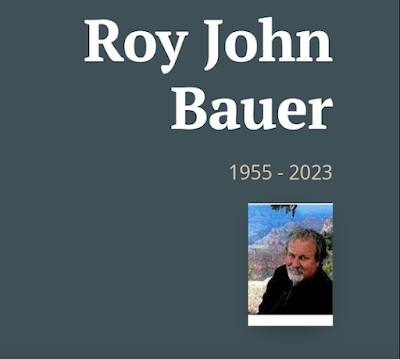
Roy's obituary in LA Times and Register: "we were lucky to have you while we did"

  This ran in the Sunday December 24, 2023 edition of the Los Angeles Times and the Orange County Register : July 14, 1955 - November 20, 2...