Showing posts with label Lyle Overby. Show all posts

Monday, December 31, 2012

No-bidsville: same old same old

Tom Fuentes with boss, Ron Caspers, c. 1973
     Just read Frank Mickadeit’s column in the Reg. He reports that the public relations firm Forde & Mollrich will be losing their lucrative contract with the Great Park:
     Over the weekend, Councilman Jeff Lalloway gave me a copy of the memo he will send to the [Irvine] city manager this morning calling to immediately terminate the contract that guarantees F&M at least $600,000 a year and allows it to make up to $900,000.
     Lalloway's memo will place the termination vote on the Jan. 8 City Council agenda. Lalloway also will be asking his fellow council members to terminate a $201,000-a-year contract with Great Park lobbyist Townsend Public Affairs.
     This, of course, was the inevitable result of the election outcome in November, when Larry Agran lost to Steven Choi for Mayor and also lost his “majority” on the Irvine City Council. It was a stunning defeat.
     F&M enjoyed a no-bid contract, and that’s what irked Mickadeit:
     I've railed about this contract for years. It's not the product I groused about – everything I saw looked very professional. Rather it was that nobody else ever got a chance to bid on it. My files show that I was questioning F&M's contract back in 2005 when it was a mere $564,000. At the peak of the absurdity, the contract was up to $1.5 million a year.
     You’ll recall that the “Forde” of F&M is the dirty trickster and Super Crony so intimately involved in the rise of Ron Caspers to political office (Board of Supervisors) in 1970. A young Tom Fuentes ran Caspers’ ugly campaign and soon became Caspers’ chief assistant at the county and even an employee at his S&L. In 1974, Caspers perished in a mysterious boating accident off the coast of Baja. Fuentes was slated for Caspers’ replacement until a residency requirement nixed the deal.
     Fuentes was supposed to be on that ill-fated boat trip but ultimately declined the invitation, though he did provide a cooler full of goodies for his boss.
     Another person invited to join the trip was another Supervisor's aide, Lyle Overby, who jumped ship after its first leg (at Cabo).
     He must feel like a lucky guy.
     Overby, too, has flourished. He’s a top lobbyist.

     Three days ago, the Reg’s Watchdog reported that
     Two political action committees with links to CR&R Waste and Recycling Services have spent thousands to re-elect public officials who supported lucrative contracts with the company, public records show.
     …[They] spent more than $33,000 to support—and on one occasion oppose—candidates running for the Costa Mesa Sanitary District and city council seats in Rancho Santa Margarita and Tustin.
     Most of the money went to support incumbent candidates who voted on CR&R contracts during their most recent terms in office, according to public records. The candidates voted to maintain or extend the trash hauler’s contracts without opening the process to bidding [my emphasis]. These two contracts have so-called evergreen clauses that automatically renew for terms of five or six years, without additional votes or competitive bids.
. . .
     “It’s not illegal, but in my mind it just shows the influence of campaign money on the governmental process,” said Bob Stern, president of the Center for Governmental Studies.

     Who do you suppose CR&R’s lobbyist is?
     Lyle Overby, a registered lobbyist for CR&R who had links to both PACs, also said campaign contributions were unlikely to influence public officials’ votes.
     “These tiny amounts of dollars don’t buy anybody,” Overby said.
     But there’s more:
     Along with his work as a lobbyist for clients including CR&R, Overby served for more than a decade as treasurer for the Committee for Improved Public Policy, a PAC funded in part by contributions from CR&R.
     The trash company contributed $25,000 to the Committee for Improved Public Policy between April 1 and June 30, campaign finance records show. Overby gave the committee $8,000 in independent contributions.
. . .
     The committee also contributed $7,500 to another PAC, Concerned Californians for Effective Government, campaign finance forms showed. Overby gave Concerned Californians for Effective Government $5,000 in June.
     Contributions from Overby and the Committee for Improved Public Policy accounted for more than half of the$17,946 Concerned Californians for Effective Government brought in between Jan. 1 and Oct. 20, records showed.
     Et cetera. Ad nauseum.

SEE ALSO
Fuentes, Michelena & Overby: plump mosquitoes from the same swamp
The corruption files: early seventies (Fuentes, Michelena, et al.)
Tommy Tales: lobbying plus piety. Genius!

Sunday, December 2, 2012

Murder à la Robin Hood

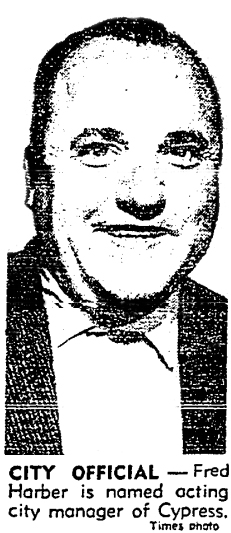
From the "Trustee Tom Fuentes files" [Fuentes got his start working for corrupt OC supervisor Caspers; Caspers' chief crony was the corrupt Fred Harber; Hoffman was a common thread]:

Update: Wyoming community college killing

     Police released more details Saturday of a grisly murder-suicide at a Wyoming community college, saying a man shot his father in the head with a bow and arrow in front of a computer-science class not long after fatally stabbing his father’s live-in girlfriend at their home a couple miles away. … Computer-science instructor James Krumm, 56, may have saved some of his students’ lives Friday by giving them time to flee while trying to fend off his son. (12/3 update)

* * *

     FAMOUS OC MURDER MYSTERY. This odd episode reminds me of one of Orange County’s greatest murder mysteries, a case that we’ve discussed previously. Here are the facts:
     Tom Fuentes’ political career started when he served, first, as OC Supervisor Ron Casper’s campaign manager (c. 1969-70), then as his executive assistant (1971-4). Casper’s chief political advisor those days was Fred Harbor, owner of the Shooting Star, the yacht that mysteriously disappeared off the coast of Baja in 1974, along with Caspers, Harber, and eight other men. (My earlier examination into the careers of Harber and Caspers has convinced me that these two were quite dirty. If so, it is difficult to avoid the conclusion that Fuentes was in the thick of these dark doings. See Shooting Star.)
     At the time, Harbor’s trusted secretary was one Arlene Hoffman, who, twenty years later, became a secretary for OC Supervisor Jim Silva:
Arlene Hoffman
     Late in 1994, not long after her husband's death, at the recommendation of Lyle Overby [who, incidentally, disembarked the Shooting Star after the first leg of its doomed voyage], she was employed by newly-elected OC Supervisor Jim Silva, a Republican. When, one day late in December, she didn’t show up for work, Silva had the police go to her Laguna Niguel home. They found her dead body near the entry. She had been killed with an arrow, possibly from a cross-bow, the night before. The arrow was not found on the scene. Nothing was.
     Evidently, nothing had been taken from her home; it had not been ransacked. Her dog was still with her when the police arrived.
     The murderer has never been identified.
OC Register
May 10, 2006
Police, fire, courts LAGUNA NIGUEL
     Orange County sheriff's investigators continue to ask for the public's help in finding the person who killed Arlene Hoffman nearly eight years ago [sic?—eleven and a half years ago].
     Hoffman, 57, was found dead in her Laguna Niguel home Dec. 30, 1994. She may have been killed with an arrow or a similar instrument.
     Anyone with information about the case is asked to call (714) 647-7055.
May 9, 1976 - LA Times - Case against Cella

Thursday, July 19, 2012

Writing OC history: the Bold and the Ruthless

     IT'S BECOMING CLEAR—to me, a slow learner, I guess—that, at least in our benighted county, the phenomenon, in politics, of brazenly deceptive but highly effective “smear” campaign tactics—including last minute (i.e., impossible to counter) attack mailers—was seized upon and perfected by the one-time consulting firm of Butcher-Forde—and by Butcher and Forde considered independently, both before and after that firm. That is, insofar as one dons one’s historian’s cap and approaches the last half-century of OC political campaigning, asking: How did we get here?—well, that answer, more or less, is these guys, William Butcher (now William Lord-Butcher) and Arnold Forde.
     A crucial aspect of Butcher-Forde’s “success,” it seems, was an early embrace of computer technologies—technologies that are not in themselves dubious, but, in the hands of Butcher-Forde, powerfully magnified their clients’ efforts to gain control of government and to shape it for the sake of their dubious and anti-democratic ends.
     But this kind of campaigning, to be effective in transforming the landscape, takes sustained money. Starting around 1970, developers provided that key ingredient. The combo of big developer money and no-holds-barred campaigning was the new animal that metamorphosed Orange County into the hyper-developed and politically nasty place that it is.
     And again, donning one’s historian’s cap in hopes of identifying a meaningful narrative, with beginning, middle, and end—it appears that one will not go too far wrong in starting with the 1969-1970 campaign of Ron Caspers to challenge and replace 5th District Supervisor and Republican Alton Allen. At least as far as the Republican establishment was concerned, Caspers seemed to come from out of nowhere. But he had money. More specifically, he had “Dick and Doc” money. And he had the talents (the ruthless and clever methods) of Arnold Forde (and later Butcher-Forde) plus the uncommon energy and ambition of young Tom Fuentes. Most importantly—and here, I believe, Fred Harber is the crucial figure—Caspers had a vision of how county government should operate. That vision was actualized after his 1970 election, when “Caspers made the contacts and set the ground rules for developer participation in the grand scheme of patronage carried to an exponential degree” (Tom Rogers).
     I’m sure there are many people who understand what I do not: the complex or convoluted sense in which this scheme or these schemes were masterminded. Richard O’Neill (the “Dick” of “Dick and Doc”) was a rich landowner interested in development; but he was also a Democrat who sought to further the success of his party and its philosophies. I have trouble seeing him as intent on establishing a “grand scheme of patronage” unless it was, in his mind, ultimately in the service of Democratic ends. [A friend who has long worked for Democratic candidates seems to disagree; he insists that O'Neill was not at all idealogical; he was simply pro-development.]
     His partner, Louis Cella, was a Republican, but, like Caspers, Cella didn’t seem particularly interested in furthering any particular political philosophy. He was a kind of grifter who got in over his head. Many, of course, have wondered if there were people behind Cella and all that money he controlled. The mob? Who knows.
     What was Fred Harber’s role in all of this? There’s plenty of evidence that he was the brains behind two or three or more supervisors, pulling the strings. He was brilliant, we’re told—certainly Cella thought so—but it seems clear that, like Cella, he was also dirty. I’ve traced Harber’s history back into the late fifties, and, though he seemed always to have an interest in Democratic politics, he was pretty consistently near or in settings of graft and corruption. He’s the one person in this saga who seemed to view himself as some sort of “mastermind,” and he evidently welcomed being seen as such. (See Puppets and Puppeteers.)

     Lobbyists, we know, have a bad reputation; it is such that they would seem to fit right into this world of schemes and quid pro quo deals. Whatever the fate of the grand schemes mentioned above, it seems clear that several persons involved in the early days of our saga—Fuentes, Lyle Overby, Frank Michelena, et al.—went on to engage in lobbying most foul.
     I started my inquiries into this saga because I was intrigued by Tom Fuentes, a trustee in our district. He was a ruthless man who once wielded great power in our county as chairman of the OC GOP. Tom was a guy who always seemed to keep his eye on the larger chess game of local politics and who thus endlessly involved himself in machinations and schemes relative to the remnants of a spoils system he long ago constructed. In my opinion, starting with his chairmanship of the OC GOP in the mid-80s, Tom maintained the grand scheme of patronage initiated by his mentor in the early 1970s. But he did so on behalf of the Republican Party, and especially its right wing. (See What is a Repuglican?)
     But, like O’Neill (at least, as I understand him), Tom was also, in some sense, a true believer in his particular political philosophy. That’s a big part of what made him fascinating. For much of his history, especially his early history, seemed to stand in stark contrast with that philosophy. He was a profoundly contradictory figure.
     Tom noisily stood for principles such as, “Thou shalt not speak ill of other Republicans.” Accordingly, he stood by Republican incumbents. But his start in politics was his substantial part in an effort to defeat an incumbent Republican, Alton Allen—a Republican that Caspers and company spoke seriously “ill of.”
     Fuentes could not abide rogue Republicans: consider his treatment of Republicans who sought to challenge incumbent Republican office holders (see Guiding with an iron hand). But the whole Caspers emergence of 1969-1970 was a rogue project, relative to the party. It utterly bewildered and confounded the Republican establishment of that time.
     Fuentes was known for his intolerance of Democrats—even of “moderate” Republicans, whom he dismissed as “RINOs” or worse. But, between 1970 and 1974, he was a key player in Team Caspers, which included card-carrying Democrats (e.g., Fred Harber) and was linked to efforts to promote and elect Democratic office holders (such as Ralph Clark and Robert Battin).

* * *
     I recently came across some old news articles that help fill out our story.

Wenke
     1. PLEASURES OF THE HARBER. In “Wenke Says He May Sue Over Letter” (LA Times, June 22, 1972), Republican supervisorial candidate William Wenke expressed his intention to sue Robert Battin’s campaign manager of the 1972 primary campaign. Battin’s manager was Fred Harber.
     That’s because Wenke had been “the target of a last-minute primary campaign letter linking him to school busing in Santa Ana….” Wenke, said the Times, “was accused of helping to get pro-busing candidates elected to the Santa Ana school board.”
     According to the Times, “The letter was linked to … Harber, campaign manager for Supervisor Battin, by two former aides to Battin….” (See Puppets and Puppeteers.)
     Wenke had decided that a lawsuit was his only recourse. But he didn’t want money:
“…I make this proposal,” he added. “If you (Harber) will corroborate the statements … that you, in fact, were behind the school busing smear letter, you may consider this a release from any action against you.”
     Harber responded with utter confidence and defiance: “If he wants to file a lawsuit, let him go ahead.” He added:
Quite frankly, I don’t see where school busing is an issue in this campaign since the board of Supervisors doesn’t have anything to do with that….”
     Well, yeah. That's what makes this smear particularly foul!

Segerstrom
     2. THE BOLD & THE RUTHLESS. In “Redistricting Eliminates 4 Potential Battin Foes” (Oct. 29, 1971), the Times reports “redistricting” actions that turn out to be highly convenient for a certain supervisor:
     All of next year’s known potential election opponents of Board of Supervisors Chairman Robert Battin were eliminated by this week’s supervisorial redistricting, detailed maps of the new boundaries showed Thursday.
     The maps … showed that three rumored candidates … were wiped out by shifts of territory from Battin’s 1st District to Supervisor Ralph Clark’s 4th District.
     The residence of a fourth possible opponent … was transferred from the 1st District to Supervisor Ronald Caspers’ 5th District.
     …[That fourth opponent’s] transfer was made public Wednesday when [he] appeared before the board to plead for revision to restore all of his city … to the 1st District.
     That effort failed when Battin, Caspers and Supervisor William Phillips approved the redistricting map as submitted.
. . .
     But it was not until detailed maps of the changes became available that it was known that the population shifts also had eliminated both attorney William Wenke and rancher Henry Segerstrom, both of whom live in the north Santa Ana area.
     Their census tract … was shifted to the 4th District as a finger jutting into the 1st District.
     The change appeared to be politically fortunate for the board’s chairman, but Battin’s executive aide said no thought was given to the residences of potential candidates when the revised district lines were drawn.
. . .
     The change also affected the district residence of two other influential persons connected with county government. Both Dr. Louis Cella Jr. and Fred Harber, close associates of Battin since his election in 1968, live in the area and are now within Clark’s district.
Butcher/Forde, c. 1982

Tuesday, July 10, 2012

Louis Cella's trial: Harber, Overby, Hoffman and unanswered questions


     This morning, I read a May 9, 1976 LA Times article, a substantial piece of reporting about the trial of the infamous Dr. Louis Cella, who, along with OC land baron Richard O'Neill, ran a campaign financing scheme in the 1970s—benefitting mostly Democratic candidates but also Republicans such as Ron Caspers—known as the "Dick and Doc Show" ("The Case Against Dr. Cella: Bits and Pieces of Paper").
     It was reported by Richard O'Reilly and Tracy Wood. These days, Wood is Senior Writer for The Voice of OC. Don't know about O'Reilly.
     Cella's business interests involved two hospitals, which devoted substantial square footage to non-medical workers and such non-medical activities as printing. Here, hospital funds would be directed to various persons and vendors. Ultimately, Cella was found guilty of a host of illegal activities, including fraud against the state and feds.
     According to the article, one of the ways in which money was dispersed—often to persons having no clear relationship to the hospital(s)—was through postage refunds issued as treasury checks or postal money orders. Presumably, this helped obscure the money trail from Cella to payees:
     The Grand Jury devoted a full day to testimony by Postal Inspector Peter Hickok about how the hospitals spent at least $145,000 on postage for political campaign mailings.
     He said the hospital checks would set up bulk mailing accounts or buy credit on postage meters. But not all of the postage would be used and refunds would be issued in the form of treasury checks or postal money orders.
     The practice involved about a dozen post offices, but at the time Hickok testified, he said, his investigation was incomplete. He said records showed that refunds totaling more than $92,000 were obtained from two post offices alone—Santa Ana and Cypress. Of that, $55,000 went to Butcher, he said.
     Butcher, who has repeatedly refused to be interviewed by Times reporters, was not called as a witness by the Orange County Grand Jury. He was called before the federal grand jury, however, where he reportedly refused to testify.
The O'Neill family (c. 1950)
     "Butcher" was William Butcher of the campaign consulting firm "Butcher-Forde," which became notorious for bringing computer-assisted mailings and new levels of demagoguery and dirty tricks to OC politics. According to Tom Rogers, B-F were also important in the rise of the influence of developers in OC. 
     Fred Harber, Dick and Doc's chief political advisor, was very close to Butcher-Forde. He was also close to Cella, O'Neill, and Caspers.
     You'll recall that lobbyist Lyle Overby has come up again and again in our saga of curious, Fuentes-related political activity forty years ago and thereafter. He, too, received these curious postal refunds:
     Another person who is recorded as having received postage refunds is Lyle Overby, now an aide to Supervisor Ralph Diedrich. In 1974, Overby received $4,600 in 16 money orders acting as an agent for [codefendant Theodore] Schiffman, Hickok testified.
     Overby, who was then working for the late Fred Harber, has refused to respond to a Times query as to what he did with the money.
     Hickok told the jury it is highly unusual for refunds that large to be made in money orders, which are limited to a maximum of $300 each. (Money orders are issued with the payee’s name blank so that the person obtaining the money order can make it payable to anyone he wishes without anyone else knowing.)
     Why did Overby receive payment in so odd and inconvenient a fashion? And just what was he being paid for? Brain surgery?
     You'll recall that Harber's secretary was a woman named Arlene Hoffman, who was ultimately murdered in her Laguna Niguel home (with a cross bow!) twenty years later. That crime was never solved. (See Who killed Arlene Hoffman? ) (Incidentally, Overby had recommended Hoffman to Supervisor Silva, for whom Hoffman was working when she was killed.)
     She was a witness at Cella's trial, but she was decidedly uncooperative:
Tracy Wood (these days)
     Another mystery man in the transcripts is Fred Harber, a political strategist who was closely teamed with Cory, Cella and O’Neill until he was lost at sea with nine others in June, 1974, when his boat sank off Baja California.
     The Grand Jury called Harber’s executive secretary, Mrs. Arlene Hoffman, to testify, but she repeatedly claimed not to know many details of his work.
     Mrs. Hoffman was paid by the hospitals from 1972 until last fall, but told the jury she didn’t do much work at either hospital until after Harber’s death.
     Before that she worked with Harber in Jesse Unruh’s 1973 mayoral campaign in Los Angeles, Democratic Party fund raising, and in the 1974 primary campaigns of Cory, Assemblyman Richard Robinson (D-Santa Ana) and Rep. Jerry Patterson (D-Calif.)
     Mrs. Hoffman testified that Harber was a consultant to the hospitals and said she considered the work she did on politics as public relations for the hospitals.
     (However, Patterson told the Times he was not aware she was being paid by the hospitals during the time Harber was working on his congressional campaign.
     (“If there was public relations for the hospitals, they were doing it very subltey,” [sic] Patterson said. “I didn’t know there was a connection with the hospital.”)
     Dep. Dist. Atty. Brice repeatedly tried to get details of Harber’s activities from Mrs. Hoffman, usually without success.
     “Can you tell us anything that he did for Mission Hospital?” Brice asked. “If he was a landscaper there, you could tell us he planted 15 trees regardless of the day or when it occurred, or if he was a nurse, you could say he changed bed pans or something. Do you know something that Fred Harber did related to the activities of Mission Hospital?”
     “No. I can’t answer that question for you; I can only speak in generalities,” Mrs. Hoffman testified.
     One of the “generalities” was that shortly before his death Harber was working on contracts to help large construction firms win approval for their projects from city and county governments.
     What was Hoffman's motive in revealing so little about her and Harber's activities? By the time of the trial, Harber had been dead for nearly two years. Was she motivated by loyalty? By self-interest? (Note: Pam Zanelli, later a SOCCCD PIO, was among those working in the "political" wing of the hospital at the time.)
     You'll recall that, according to developer Richard Jordan, Harber and Caspers were shaking him down for "help" in overcoming county non-approvals that his construction project had encountered. This was at the time of the Shooting Star sinking in June of 1974.


     Caspers, Harber, and eight other men perished in that disaster. Their bodies were never found despite a massive search. (Cella desperately searched for his man Harber long after the "official" searches were abandoned.)
     Like Tom Fuentes, Lyle Overby was supposed to be on that fateful boat trip. But he bailed after its first leg (to Cabo San Lucas). Richard Jordan was also invited but declined (for he wanted the DA to record conversations, which would have been impossible in Mexico).
     It's all very odd.

May 9, 1976 - LA Times - Case against Cella

Saturday, June 30, 2012

Fuentes, Michelena & Overby: plump mosquitoes from the same swamp


     “Frank G. Michelena is the guy you go to see when you want something from Orange County government.”
LA Times, 1990

     "I challenge Mr. Bein and his lobbyist Tom Fuentes to give even one legitimate reason why their firm gives gifts to individuals who have decision-making power over contracts…. ...Now we all know what it takes to be a successful engineering firm in Orange County."
Shirley Grindle, 1993
     In my last post, I laid out former SOCCCD PR gal Pam Zanelli's fortuitous appearances, like magical momentary moths, in the tangled fabric of Orange County politics and corruption. As you know, our own Tom Fuentes, late SOCCCD trustee, was all over that fabric; and, in particular, he had connections to a notorious (c. 1970s) campaign finance entity—the duo "Dick and Doc"or at least to that entity's delighted and deficient beneficiaries. Now, as it happens, it's a seriously small world, 'cause Pam Zanelli was an employee of the notorious Dr. Louis Cella, the "Doc" half of "Dick and Doc." What a coincidence!
     Anyway, our gal Pam worked for Dr. Cella at exactly the time when his curious operation (hospital, political giving, printing, Medicare and Medi-Cal fraud, etc.) was in full operation.
     She assures us, of course, that she had no idea what her boss was really doing, insofar as any of it was something he shouldn't o' been doing. Natch.

From the Times' "Lobbyists: dealers in trust and compromise," 2/20/72, where Michelena is
identified as one of six "top" professional lobbyists in OC. At the time, the Rancho Mission
Viejo was owned by the O'Neill family (headed by Richard O'Neill of "Dick & Doc").
     Among Zanelli's other moth-like flittings in OC's lurid fabric was a cheese-and-wine party she helped organize for Governor Jerry "Moonbeam" Brown (1981). Just who would be invited to that bash was a critical and delicate matter, it seems, 'cause it was OC where there are no Moonbeams. Now, some of the fat cats in attendance were invited by notorious lobbyist Frank Michelena. Michelena, as it turns out, worked with Tom Fuentes on the seriously hinky Team Caspers, back in 1970 and thereafter.
     (Frank Michelena was an aide to OC Supe Bill Phillips [1957-1973] and later to Supe Ralph Clark, a D&D beneficiary who ultimately resigned under a cloud [prostitutes for favors?!] and became a lobbyist.)

From "The case against Dr. Cella," May 9, 1976 (Times)
     Another coincidence! It's, like, everybody's connected to everybody.
     Now when people talk about famous (or infamous) OC lobbyists, Michelena isn't the only name to pop up. Another one, a big one, is Lyle Overby, a fella who's made lots of money helping entities (including himself) secure lucrative government contracts. He's a go-between guy, a kind of pricey lubricant in a world of big wallets straining against nasty moral and legal friction to be emptied or filled like they wanna be. Pfffffwoooooo!
     (In the early 70s, Overby was an executive aide to Supervisor Ralph Diedrich, a fellow who was later indicted [1977] on 16 felony and misdemeanor violations concerning campaign finance. Soon after, the county grand jury charged him with two counts of bribery and one count on conspiracy. In the 80s, he served 20 months in Chino.)
     Overby, you'll recall, shares with Tom Fuentes membership in a very special group: guys who were invited on that fateful 1974 trip on the doomed yacht "Shooting Star" but who bailed, thereby saving their goddam lives. Ten men died on that trip, including Supervisor Caspers and Dick and Doc's political guru, Fred Harber. That spelled disaster for the "Dick and Doc show," 'cause Harber was like the Spiderman of creepy OC politics/business/whatever webulosity, and none of the other bugs had web-shooters.
     In Fuentes' case, though he made sure to stow a special cooler of goodies for his boss (Caspers) on the boat, at the last minute, he refused to board 'cause it wasn't safe. (Selfish bastard. What about his pals?) Overby actually traveled on the first leg of the trip—but bailed before the ship headed north, to its appointment with danged destiny.
     Lucky guys. Or something.
     One more thing before I go on: Tom Fuentes was also a lobbyist, you know. Near as I can tell, he made his living getting firms he worked for in contact with government officials who were in the position of granting big contracts. (He also invested in properties and such, just like his pal Fred H.)
     He had to be mighty careful, as you can imagine. He slipped up sometimes. You can't let the strings show.
     Now, as it happens, you can find points in time and space when all of these dudes spectacularly and accidentally come together to become one slime-event in the universe or something. One good example is June, 1985, in Santa Ana, CA:

$1-Million Contract for Vote-Count Unit Awarded, LA Times, June 26, 1985
     Ignoring staff recommendations, the Orange County Board of Supervisors voted unanimously Tuesday to award a $1-million contract to a San Francisco firm for a new ballot-counting system.
     After months of intense lobbying by the major manufacturers, Sequoia Pacific Systems of San Francisco was chosen to supply the county with new machinery in time for November's community college, school and special-service district elections.
     Sequoia's price for the new system, which uses computer cards with candidates' names printed on them and a hole-punching machine to mark ballots, is about $500,000 more than the pen-marking system recommended by a board-appointed advisory committee.
. . .
     The decision is controversial because the new system will replace existing vote-tally equipment installed five years ago, also over the strong objections of county staff....
. . .
     As late as Monday afternoon, Sequoia Pacific's lobbyist, Frank Michelena, was visiting board members in their offices. Moreover, county Republican Party Chairman Tom Fuentes wrote letters to supervisors and called Board Chairman Thomas F. Riley to urge selection of Sequoia Pacific. [Gosh, I wonder why the reporter neglected to mention that Frank and Tom were pals from way back?]
. . .
     "We don't feel the county did the right thing," said DFM President Tom Diebolt after Tuesday's decision.
     However, Diebolt said he did not think any improprieties had occurred during the bidding process.
. . .
     Diebolt said he did not employ the services of a lobbyist because "Our firm has never had to deal directly with county board members before . . . In every county where our services have been selected, we dealt only with county staff, who made the selection and then followed up with recommendations to the board. Often, we were simply an item on a consent (no discussion) calendar (agenda)."
     Fuentes said he recommended Sequoia Pacific to Riley and other board members after he met with Michelena and a Sequoia official to discuss the importance of audit trails in close recounts, such as occurred in last year's 256-vote victory by Assemblyman Richard Robinson (D-Garden Grove) over Republican challenger Richard Longshore. The term "audit trails" refers to the process of being able to trace and analyze the ballots cast so that none are lost or misplaced. Fuentes said he received no compensation for recommending Sequoia.
. . .
     The existing system was sold to the county by Valtec Co. of Tulsa, Okla.
     There was intense lobbying—including controversial campaign contributions from vendors to county supervisors—during the selection process last time. In the end, the board ignored the recommendations of its own staff and picked a system that had never been tried.
     Valtec hired Lyle Overby, an aide to former supervisor Ralph Diedrich, during the last bidding war. Overby was not involved in the current competition, county officials said….
     In May, the Times had reported:
     The existing system was purchased—over the objections of a county advisory group—from the Valtec Co. of Tulsa, Okla., after an intensive lobbying campaign in which Valtec hired lobbyist Lyle Overby, who earlier had served on the staffs of former Supervisors Ralph Diedrich and Robert Battin.
     Battin and Diedrich, of course, were beneficiaries of Dick and Doc's largesse.

* * *
     “When we wrote TIN CUP (the county law limiting campaign donations), one of the main reasons was to stop what [Frank Michelena] was doing,'' said campaign watchdog Shirley Grindle, who agreed he was one of the most influential people in the county in the 1970s. “Once there was TIN CUP, he played by the rules. In fact, we became friends. He had a very generous heart. He was basically a kind person."
Shirley Grindle, OC Reg, 8/2/2005
     One lobbyist, Frank Michelena, has established himself as the Santa
Claus of county consultants. He has given more than $ 7,800 in
sporting-event tickets, meals and other gifts to supervisors and their
aides in the past five years, according to gift reports filed by the
officials.
     In second place is lobbyist Lyle Overby, who has given $ 2,834 in gifts
to supervisors and aides during the same period, the reports show.

OC Register, 11/20/88 

BATTIN: the "COALITION" HARBER'S "BRAINCHILD

OC Reg Feb 18 1976


Friday, June 8, 2012

Norton Simon in Orange County—Tom Rogers' terrific "chopper" yarn—and Arlene Hoffman


Jennifer Jones
     He was a rich industrialist (Hunt-Wesson, Avis) and art collector who ran for Republican candidate for the Senate (in 1970), married actress Jennifer Jones (1973), and is most remembered today for his impressive art museum.
     I'm talking about Norton Simon, Republican.
     He was born in 1907, in Oregon. He died in 1993.
     Susan Stamberg of NPR did a great little piece about Simon and his museum a year or so ago: The Best Museum You Haven't Visited.
     The piece was occasioned by the publication of a book by Sara Campbell, the museum’s senior curator, who has some interesting stories and comments about Simon:
     The successful industrialist approached his art museum with a businesslike efficiency. When he came to visit, he would inspect his collection, but never linger, Campbell recalls: "He would make a circuit of every single work of art and walk as fast as he could."
     Simon hired Campbell 41 years ago [1970] as a typist. She remembers him as a wonderful boss who solicited opinions about art from everyone.
Norton Simon
     "He asked everybody what they thought about the collection," Campbell says. "He would ask me, he would ask the most prestigious museum director, and he would ask his cook."
     But after gathering the information so democratically, Simon would do whatever he wanted, Campbell says.
     SIMON COMES TO OC. Simon quit college (UCB) in 1925 to start a sheet-metal business. In 1927 he paid $7000 for an orange juice bottling plant in Fullerton, named Val Vita Food Products Co. The company soon expanded into vegetable juices and then canning. By 1943, Simon was in charge of Hunt Foods after its merger with Val Vita.
     Evidently, Simon was a pioneer of aggressive marketing, placing ketchup ads in upscale magazines. By 1945, Hunt Foods was a household name and the company slogan, “Hunt for the best,” was familiar to everyone. I recall the slogan from my youth.
     So Simon was an Orange County guy, in some sense.
     I found this picture of workers at Val Vita in Fullerton (see at right)—probably in the 30s. Very cool. (I briefly worked at the Hunt-Wesson factory during one summer, circa 1974. As I recall, the whole placeeven the interiorseemed covered in oil.)

At Val Vita, Fullerton
     TOM ROGERS' YARN. Do you recall Tom Rogers? I’ve written about him recently—in connection with Tom Fuentes and his mentor, the decidedly hinky Mr. Ronald Caspers, the OC Supe who died in 1974.
     Rogers, who died about six years ago, was an OC landowner and rancher who became involved in OC Republican politics starting in the early 60s. He served as OC GOP chair starting about 1968just before things went all to hell. By the 80s, he became alienated from the GOP establishment and was a leader in OC’s “slow growth” movement, which, sadly, failed miserably in staunching the tide of ruinous development, which continues.
     Despite his having supported right-winger John Schmitz, all things considered, Rogers seems to have been an admirable guy. (See Straight-shooting conservative Tom Rogers on Caspers, Harber, and what they portended.)
     Well, I’ve been rereading Rogers' important book (Agents’ Orange—I seem to have the only copy that's left) and I came across the following terrific story about the Norton Simon campaign of 1970:
Actor George Murphy
     In 1970, [conservative Senator George] Murphy was up for reelection, and a surprise opponent appeared, vowing to contest the Republican Primary [—namely, industrialist Norton Simon of Fullerton]….
     It was clear to most observers that Simon was in the race as a stalking horse [i.e., not a serious candidate] to discredit Murphy. He had scads of money, and would be formidable in weakening Murphy in the primary campaign.
     Given the scenario, I [as OC GOP chair] was at the Registrar of Voters office in Santa Ana on the last day for filing papers, a practice that I had followed for several years. My purpose was to scout the opposition, and to dissuade any “ringer” from jumping in on the GOP side of the ticket. To solve any problem which might arise, I had three of my most trusted interns assist me at the Registrar that particular day.
     At about 3:30 P.M. a stranger came in looking somewhat harried. It was obvious that he did not know the procedures, so I approached him and asked if he needed help. Grateful, he told me he was from the Norton Simon campaign, and when they tried to file their papers with the LA Registrar, they were told that because Simon had listed an OC address as his place of residence (Hunt Foods in Fullerton), the papers would have to be filed in OC. They were also told that the papers would require the signatures of 30 local residents.
     I took the man in the gray suit over to the counter, and helped him obtain the forms. When I asked him how he was going to get signatures at such a late hour, he told me that they had a roomful of local Republican employees ready to sign, and he was on his way to gather the signatures and would return to Santa Ana before 5:00 P.M.
     It was after 4:00 by the time he had everything, and when he left the building I called one of the interns over, filled him in on the situation and directed him to follow the man’s car to the Grand Avenue on-ramp, and to rear-end him on the ramp. My orders were to insist that the Highway Patrol be called, and this [delay] would effectively end Simon’s bid since any delay would cause the papers to be filed too late. It would have been close even without the fender bender.
     The young staffer, always loyal and unquestioning, jumped into his wreck of a car, and took off in hot pursuit.
     I could not believe my great good fortune. I had pulled off the coup of the decade, and even called Murphy headquarters to let them in on how brilliant I actually was. In what seemed a rather short time, the intern came back, out of breath and red in the face. I was concerned that he had gone too far and had actually caused a real wreck.
     “What happened?” I asked.
     “I jumped into my car, and the man got into his, but he drove across the street to the orange grove. He got out and ran, and I followed him on foot.” His story stopped while he caught his breath.
     “Then what?”
     He responded, “The man ran to a clearing past the grove, and jumped into a helicopter which was waiting for him—he jumped in and they took off and I tried, but I couldn’t stop the chopper.”
     Simon’s man got back in time with the papers, and the business tycoon spent millions in a campaign, which did nothing except discredit George Murphy.
     Murphy lost to John Tunney….
(pp. B-18-B-20)
     Now that’s a great yarn. I believe every word of it.
     (You’ll recall that the Robert Redford movie, The Candidate (1972), was loosely based on the Tunney campaign.)

Val Vita Foods, Fullerton
P.S.: Arlene Hoffman—& Simon—& Harber—& Cella
     At the time of the "chopper" incident, Simon's secretary was one Arlene Hoffman.
     Remember her? From 1972 until 1974, she was the office manager or secretary for Fred Harber and Associates. Harber was the “genius” political consultant who, starting in the late 60s or early 70s, assisted the infamous Dr. Louis Cella (partner of Richard O'Neill), who essentially controlled Orange County politics (or at least the Board of Supervisors) during the mid to late 70s. 
     It was the worst scandal in OC's history.
     Among the OC Supervisors Cella owned was Ron Caspers, for whom Tom Fuentes was chief assistant (Fuentes had also been made a "consultant" to Caspers S&L).
     Both Caspers and Harber mysteriously disappeared off the coast of Baja California in June of 1974—in the famous “Shooting Star” incident.
     After that tragedy, Ms. Hoffman worked at Cella's hospital and was eventually (1976) compelled to testify before a grand jury about Cella's political and business activities. 
     Some (in the DA's office) believe that she lied on the stand to protect him.
     Then, from 1978 through 1991, she ran her husband’s office (he was a probate referee).
     Late in 1994, not long after her husband's death, at the recommendation of Lyle Overby [who, incidentally, disembarked the Shooting Star just before it left for its doomed voyage], she was employed by newly-elected OC Supervisor Jim Silva, a Republican. When, one day late in December, she didn’t show up for work, Silva had the police go to her Laguna Niguel home. They found her dead body near the entry. She had been killed with an arrow, possibly from a cross-bow, the night before. The arrow was not found on the scene. Nothing was.
     Evidently, nothing had been taken from her home; it had not been ransacked. Her dog was still with her when the police arrived.
     The murderer has never been identified.
Unsolved 1994 murder in Laguna Niguel
OC Register
May 10, 2006
Police, fire, courts LAGUNA NIGUEL

     Orange County sheriff's investigators continue to ask for the public's help in finding the person who killed Arlene Hoffman nearly eight years ago [sic?—eleven and a half years ago].
     Hoffman, 57, was found dead in her Laguna Niguel home Dec. 30, 1994. She may have been killed with an arrow or a similar instrument.
     Anyone with information about the case is asked to call (714) 647-7055.

Sunday, April 1, 2012

Orange County incomporuption: toward a "big picture"

A young Tom Fuentes and his hero, Richard Nixon, San Clemente
     A couple of days ago, somebody over at the Orange Juice Blog beefed about corruption and incompetence in OC government. (See Orange County Government Melting Down, by OBNO.)
     That’s like Arizonans complaining about the heat.
     But in Orange County, incompetence/corruption ("incomporuption") varies from bad to extreme from era to era. We’re in the midst of a so-so era, incomporuption-wise. We've seen worse.
     Carps OBNO, “it looks like no one on the Board of Supervisors is interested in or capable of doing the things it takes to effectively run a large organization. Things like team building, leadership, ethical behavior and vision come to mind as essential characteristics that seem to be lacking. It also looks like the job of attracting and retaining top talent to run the various county programs is not a priority for the Supervisors either.”
     OBNO notes the obvious recent examples, including “the multi-year saga of disarray in the office of the County Public Guardian/Public Administrator position resulting from a Board-driven appointment of [long-time SOCCCD trustee] John Williams to the Public Guardian position against the advice of key county staff….”
     Here on DtB, we’ve pursued various stories increasingly in relation to the larger fabric of corruption and cronyism that is OC politics. The truth is, you can’t make sense of guys like John Williams, Tom Fuentes, Don Wagner, or Dave Lang unless you understand county politics, the OC GOP Central Committee, and trends and factoids of the last, ten or twenty years.
     Besides, anyone who’s been reading DtB for a while knows that we have an interest in the past, and especially OC’s past—e.g., the appearance of the KKK in the 20s, the doings of ranchers and farmers and businessmen in the 19th Century, the adventures of Madame Helena Modjeska in Anaheim and in the Santa Anas, etc.

     TOM FUENTES. One figure who has been present for a huge chunk of OC political history—from the late sixties to the present, more than 40 years—is our own trustee Tom Fuentes, who, as near as I can tell, is in the last stages of terminal cancer but who nevertheless has maintained oars in the political waters throughout his remarkably long good-bye. (I recently noticed that he is listed as the campaign co-chair for OC Board of Education trustee Ken Williams’ June reelection bid!)
     So here’s some OC incomporuption history—from the perspective of someone attempting to understand the highly odd Mr. Tom Fuentes.

* * * * *
Ron Caspers (1931-1974)
     RON CASPERS & THE BOARD OF SUPES. It turns out that, at least according to some of my sources, the Orange County Board of Supes were neither important players nor even particularly noticed until the late sixties, when people with big money started buying supervisorial candidates. That started, it seems, with Ron Caspers’ ruthless campaign for Alton Allen’s board seat in 1969 (he won it in 1970). According to former OC GOP Central Committee Chair Tom Rogers (see), “it was after his election that Caspers made the contacts and set the ground rules for developer participation in the grand scheme of patronage carried to an exponential degree.” Elsewhere, Rogers notes that many Orange Countians “blame [Caspers] for the descent of Orange County into the world of political intrigue, campaign finance abuses and influence peddling.”
     And, right at the start, Fuentes was there.
     Caspers was a Republican but the rest of corrupt 70s kingpin Louis Cella’s stable of Supes were Democrats, and so the patronage wasn’t really about politics; mostly, it was about money—i.e., how to get lots of it.
     Tom Fuentes would have been twenty years old at the time of this patronage genesis or pre-genesis. From what I’ve read, Fuentes was up to his eyeballs in that nasty campaign of 1969-1970, and, upon its success, he was showered with Caspersian goodies: he received retroactive support for his education; he became Caspers’ executive aide; and he even got a job with Caspers’ S&L in Anaheim.
     It seems clear that Caspers was not merely ruthless; he was dirty. It is likely that he was spared from lasting ignominy by his own death, via the peculiar “Shooting Star” disaster in 1974. The criminal prosecutions that brought down the Cella-O’Neill political machine of which Caspers was a part started a year or two later. The county settled a lawsuit that charged Caspers and (“Shooting Star” owner and Cella’s chief strategist) Fred Harber with a shakedown—quietly, in the late 70s.


     FRANK MICHELENA. But let’s go back to those early years, starting in 1969. According to Tom Rogers, “As Casper’s assistant, Tom Fuentes … worked diligently to convince Republicans that Caspers was not what many party regulars feared, an unscrupulous opportunist who had no permanent loyalty to any political party. Fuentes was aided in his duties by the ubiquitous Frank Michelena. Michelena, a lobbyist with a checkered career, was notorious in the field of political influence.”
I couldn't find a pic of
Frank M. This'll have to do
     I haven’t been able to find out much about Michelena, Fuentes’ coworker on Team Caspers. I know this: he was born in 1930 and lived in Costa Mesa (it appears that he died in 2005). He seems to have started his political career in his thirties, as an assistant to OC Supervisor Bill Phillips (1957-1973). Later, he was a campaign advisor to the Cella-sponsored OC Supervisor, Ralph Clark, and has been associated with campaigns that, early on, used outrageous tabloid-style hit pieces against opponents.
     By the 80s, he was known in Orange County as a high-powered lobbyist. According to a 1990 Times article, “Frank G. Michelena is the guy you go to see when you want something from Orange County government.”
     Writes Rogers (in 2000), “Frank Michelena’s activities have been so pervasive over the years that no brief history [of OC] could possibly list their scope and impact on Orange County and the establishment political structure.”
     Elsewhere, Rogers adds: “After striking out on his own [in the 70s] [Michelena] seemed always in the shadows of county political controversies….”

Lyle Overby
     LYLE OVERBY. Another name that pops up in the Cella saga is that of OC lobbyist Lyle Overby, with whom I briefly corresponded. (He wrote to tell me that he was on the “Shooting Star” during its fateful trip, but he disembarked at Cabo before the more hazardous portion of the trip; see this and this.). By the early 70s, Overby was an aide to Supervisor Ralph Diedrich, a fellow who was later indicted (1977) on 16 felony and misdemeanor violations concerning campaign finance. (Soon after, the county grand jury charged him with two counts of bribery and one count on conspiracy. In the 80s, he served 20 months in Chino.)
     Back to Overby: during the era of the “Dick and Doc Show”—i.e., the shadow government organized by Dr. Louis Cella and land baron Dick O’Neill—the two actually gave over a million dollars to various political candidates in one year, 1974. Dr. Cella was diverting money from medical companies to candidates. Beyond that, Cella provided candidates with printing, postage, and other services.
     Cella’s Mission Hospital hired workers whose work was entirely political. (Arlene Hoffman, who was mysteriously murdered—with a crossbow!—in the 90s, was among these workers.) The place had a printing press that churned out campaign literature and mailers. Some curious persons received refunds from the hospital for postal costs, including Bill Butcher of the consulting firm Butcher-Forde. (Forde had been closely associated with Caspers and his campaigns.) Another was—you guessed it!—Lyle Overby, who received $4,600 in postage funds from the hospital. (Source: Rogers.)
Bill Butcher, c. 1982
     One older reporter I spoke with advised me not to trust Overby. Back in ’74, he said, Overby was an aide, like Fuentes, and seemed to be perfect for the “bagman” role. (You'll recall that Nathan Rosenberg once referred to Fuentes as "Caspers' bagman.") After the “Shooting Star” disaster in 1974, Overby was hired by O’Neill’s company and, still later, he became a major “lobbyist” in Orange County.
     Back in 2000, the OC Weekly declared Overby to be one of OC’s top 31 “Scariest” people:
#16. [Lyle Overby is] Orange County's überlobbyist and the former aide to two county supervisors—both later convicted of corruption. He's close to former county Supervisor Don Roth—also convicted—and close to onetime county Treasurer Bob Citron—jailed after the 1994 bankruptcy. His name appears repeatedly in just about every county supervisor's campaign-finance statement. He lobbied for Newport Beach City Council (until recently), the Irvine Co. and Lockheed Martin. He's now the boss of American Taxi, for whom he delivered in March an exclusive contract for taxi service at John Wayne Airport—despite the fact that (a) his company was barely six months old and the contract required at least five years' experience; and (b) his company was bleeding money through every fiscal orifice, clocking an operating loss of more than $130,000 when airport officials gave him the contract. [Note: as I understand it, Louis Cella also assisted Bob Citron in his bid for OC Treasurer.]
     In the early 90s, Supervisor Don Roth was investigated by the DA for various abuses, including the receiving of gifts. Among the people who gave Roth questionable gifts were Lyle Overby and Frank Michelena. (Source: Rogers.)
     Overby and Michelena were involved in setting up an expensive fundraiser for their pal Roth when he resigned and entered a guilty plea to seven charges in 1993. (Rogers.)

* * * * *
Tom Fuentes, c. 1973
     Big Picture-wise, here’s what’s becoming clearer to me.
  • CASPERS AND THE PATRONAGE SYSTEM. Things changed in Orange County politics/governance, starting with the arrival on the scene of banker and businessman Ron Caspers in 1969-1970. Caspers, who was supported by the ambitious team of Louis Cella, Richard O’Neill, and Fred Harber (aka the “Coalition”), established a patronage system, focusing on developers. This scheme survived Caspers and Harber’s death and ultimately led to a disastrous and ongoing over-development of Orange County, especially in the south. The manner and degree to which OC politicians are routinely "influenced" is not yet widely appreciated by the public. 
  • CASHING IN. Many of the figures, some minor, of the early days of this saga (Fuentes, Michelena, Overby, et al.) have become rich and powerful in subsequent decades.
  • CASPERS & MODERN CAMPAIGNS. Caspers set a new standard by employing, not merely stunningly unscrupulous campaign tactics (some of these, of course, were already familiar), but also advanced, computerized, data-driven campaign approaches associated with the consulting firm Butcher-Forde. These approaches have come to be considered essential.
  • THEY MUST HAVE KNOWN. Caspers and his pals were dirty, and, as reporters have suggested to me, though some people present for the hinky financial and political dealings of Caspers-Harber (et al.) may not have actually directly participated in criminal schemes and activities, they were certainly at least aware of them. This group would include such minor players as, say, supervisorial aides of the principles.
* * * * *
Some further thoughts:

  • I find it odd that Tom Fuentes, a man known for his intolerance of Republicans who are not sufficiently “conservative” (RINOs, they're called), and who has long been a noisy champion of party discipline and unity ("thou shalt not speak ill of another Republican"), got his start, and learned his chops, from a man like Ron Caspers, a “Rockefeller Republican” (as one reporter I spoke with labeled him) who seemed to care much more about making money than about pursuing an ideological agenda or remaining true to his party (or to its incumbents).
  • A find it less odd that Mr. Fuentes, with all his airs and gestures of piety and rectitude, got his start with a politician who is memorable (at least to me) for being unscrupulous, unprincipled, and just plain dirty.
  • As near as I can tell, a year or so after the “Shooting Star” disaster (and after an aborted training for the priesthood), Fuentes commenced his career as a “consultant”—a job that seemed to involve, among other things, his “influencing” government officials on behalf of private firms. How curious that he pursued such work in an era known for the rise of patronage and influence peddling most foul—an era initiated by his first boss and the man he reportedly credits for his political rearing.
     It's a curious world, is it not?

Roy's obituary in LA Times and Register: "we were lucky to have you while we did"

  This ran in the Sunday December 24, 2023 edition of the Los Angeles Times and the Orange County Register : July 14, 1955 - November 20, 2...