Showing posts with label Wayne Clark. Show all posts

Friday, March 23, 2012

Shooting Star, part 11: mob connections, an unexplained murder

The entire “Fuentes/Shooting Star” saga can be found here.

      For those of you with the patience, I have more background on the “Shooting Star” story. You’ll recall that the yacht, Shooting Star, disappeared off the coast of Baja California in June of 1974, taking ten men with her, including Orange County Supervisor (5th District) Ron Caspers and political consultant Fred Harber. Harber was a key strategist for Dr. Louis Cella and his “shadow government” (to use OC DA Cecil Hicks’ phrase), which included in its stable four Supes, including Caspers. Caspers’ “executive aide” at the time of the Shooting Star incident was Tom Fuentes, who, it is often reported, decided to pass on the trip at the last minute, but not before he packed an extra ice chest for his boss filled with hors d’oeuvres and drinks.
      In my last post, we learned (based on the account of one-time OC GOP chair Tom Rogers) that Caspers, a Republican banker, engaged in foul deceptions to tarnish the reputation of 5th District Supervisor Alton Allen, whose office he evidently coveted.
      Below are excerpts from two articles from the January, 1976, edition of The California Journal. The first, by Dan Walters and his partner, describes Dr. Cella’s relationship to former Buena Park Mayor Fred Harber. Here, Harber emerges as a more interesting, and perhaps important, figure (at the time of the Shooting Star disappearance, he was 55 to Caspers’ 43 years of age).
      We also learn that Cella, (OC land baron) Richard O’Neill, and Harber partnered with a man tied to the mob.
      The next article, written by Nancy Boyarsky, briefly discusses Dr. Cella’s background. These details are pretty interesting.
      The last pair of articles, from the LA Times, have no very clear relationship to the Shooting Star/Cella saga. They concern the mysterious 1994 murder of a much-beloved woman who had worked as an assistant to many of the characters who have cropped up on these pages. Arlene Hoffman was slain, evidently, with an arrow from a cross-bow, in her Laguna Niguel home. The murderer took the arrow with him.
      Her murder has never been solved.
      She was once Fred Harber’s secretary at one of Louis Cella's hospitals. She had also worked for "Big Daddy" Jess Unruh and Norton Simon. At the time of her death in 1995, she had just been hired by new OC Supervisor Jim Silva.


The Tangled Web: Two
By Al Downer and Dan Walters
. . .
Mysterious figure [Dr. Louis Cella]

      Cella, whose business interests range from ranching to real estate but are concentrated in the medical field, is the mystery man of Orange County politics. Rumors about him and his political and business deals abound, but most of them evaporate under scrutiny.
      Cella operated behind-the-scenes until 1974, when he lost his front man, Fred Harber, who had been Cella’s chief political aide and sometimes business associate until his disappearance in June 1974. He and nine other persons, including Orange County Supervisor Ronald Caspers, vanished when Harber’s boat apparently sank off the coast of Baja California. Caspers was a member of the Cella-ONeill stable and his family savings-and-loan company had provided at least some of the financing for Cella’s chain of hospitals. “Harber was smooth, and as long as he was around things operated quietly with no fuss and muss,” says a knowledgeable Orange County observer. Harber operated out of one wing of the Cella clinic across the street from the county courthouse and once was on the payroll as an assistant to Supervisor Robert Battin, another organization politician who is now under indictment for using his staff in a political campaign.
      [State Controller Ken] Cory has described Harber as “a very good friend of mine, perhaps the best friend I have had.” And with good reason. Harber not only was the tactician for Cory’s early political successes, but he loaned Cory’s small insurance agency, Cornet Insurance Counselors, $95,250 in 1967 when the agency appeared to be having difficulty making payments on a note.
      Harber and Carl D’Agostino, now Cory’s deputy controller, were the co-founders of Demographic Communications Consultants, a campaign-management firm that has handled many campaigns for the Cella-ONeill organization. With Harber’s passing, Cella was forced to move into the open, and investigators began taking an interest in his complex of business affairs. Orange County District Attorney Cecil Hicks, perhaps the only major Orange County official openly hostile to Cella and O’Neill, has called Cella the man behind “a shadow government”. Cella hired a private investigator, through one of the hospitals, to investigate arch-enemy Hicks.
. . .
More ties 

      The influence of Cella and O’Neill in county government is apparent in many ways. A prime example is the El Toro case.
      El Toro Land Company was formed as a partnership in 1970 to develop a 39-acre parcel along the San Diego Freeway in Orange County. One of the original partners, with a $25,000 investment, was Albert Parvin, one-time Las Vegas casino-owner and head of the Parvin-Dohrmann Company and the Parvin Foundation. Meyer Lansky, reputed Mafia financial brain, was one of Parvin’s partners in the Flamingo Hotel and the Parvin Foundation had former Supreme Court Justice William O. Douglas on its payroll for $12,000 per year – a revelation that sparked an impeachment effort against Douglas several years ago.
      Cella, O’Neill and Harber bought into El Toro Land in 1971 and remain as major partners, along with Parvin, according to corporate records. Shortly after they bought in, the Orange County Board of Supervisors took emergency action to establish a freeway interchange adjacent to that property and the land increased in value by 600 percent, county records show.
      As Cella and O’Neill were expanding their business and political empires, Cory was experiencing a growth of personal wealth and political influence. Cory, who attended four colleges and graduated from none, became involved in politics while still a teen-ager. He went to Sacramento in the early1960s as an aide to then-Assemblyman Richard Hanna, the first Democrat to achieve major office in Orange County in recent years, and Cory served on the staff of the Assembly Education Committee, which was chaired by Hanna.
. . .

The Tangled Web: Three
Richard O’Neill—last of the big spenders?
By Nancy Boyarsky
. . .
An enigma 

      The 51-year-old physician [Lou Cella] is something of an enigma. Two popular exercises in Orange County political circles are estimating the size of his wealth and speculating on its source. The estimates on size range from $50 million to $500 million, although he generally is regarded as being less wealthy than O’Neill. Even his closest business associates, including O’Neill, don’t know the extent of Cella’s business interests. And Cella’s own explanations elude verification. It is known that he came to Orange County about 20 years ago from Providence, Rhode Island, where his father was also a physician and political figure. But the elder Cella left an estate of less than a quarter-million dollars. Cella came to Orange County after losing a position as senior resident surgeon at Rhode Island Hospital. The hospital’s staff had given him a vote of “no confidence”. Cella had been expelled from one medical school for cheating and eventually graduated from another. Although he has maintained a small private practice in Santa Ana, Cella’s chief occupation in California has been that of businessman and political operative. He is involved in at least seven Orange County hospitals and has wide real-estate and other investments. The Internal Revenue Service says, however, that Cella hasn’t filed an income tax return for the past three years.

January 27, 1995 - NANCY WRIDE
. . .
      …From 1972 to 1974, she worked as a secretary for a political consulting firm called Fred Harber and Associates.
. . .
      "She spent everything they had trying to prolong his life," said Lyle Overby [you'll recall that he was on the Shooting Star but disembarked at Cabo], a political consultant and friend of 20 years whose admiration for Arlene Hoffman led him to recommend her to Silva….


NANCY WRIDE - TIMES STAFF WRITER

LAGUNA NIGUEL — Portions of drywall were hacked away from her condo in a futile hunt for clues. Detectives asked childhood friends and family to undergo fingerprinting and lie detector tests to narrow the field of suspects. Her son even offered a $25,000 reward from his inheritance for details leading to the conviction of the killer.
      But, one year later, the mystery remains unsolved as to who fired a hunting-type arrow through the chest of Arlene Hoffman, leaving her to bleed to death on the marble floor of her Laguna Niguel foyer.
      Hoffman, 57, widowed nine months earlier, was long active in the backfield of Southern California political campaigns. Shortly before she was found slain Dec. 30, 1994, she had been hired as personal secretary to Jim Silva, newly elected to the Orange County Board of Supervisors.
. . .
      Simply put, there was little if any physical evidence at the scene to trace back to Hoffman's killer—no shell casings or fingerprints, no permits or licensing required to buy or use an arrow, no weapon left behind….
*
      In her lifetime, Hoffman moved in some high-profile circles. In the 1970s, she was connected to some of the major stories and players of the day.
      She worked for the late millionaire industrialist and world-class art collector Norton Simon, up to and including his failed campaign for U.S. Senate in 1970. She was involved in other political campaigns, including former Assembly Speaker Jesse M. Unruh's unsuccessful 1973 bid to become mayor of Los Angeles. She was secretary to Fred Harber, a political consultant who vanished at sea off the coast of Baja California in June 1974.
      In 1976, she was called to testify as a witness before the Orange County Grand Jury investigating political corruption.
      Hoffman told the grand jury she was an employee of the hospital run by Dr. Louis Cella, a political kingmaker and largest campaign contributor in California at the time. Now dead [sic], Cella was accused of billing Medi-Cal for nonexistent patients, then funneling the money into the campaigns of numerous candidates who went on to hold major office. He ultimately was convicted of income-tax evasion, Medicare and Medi-Cal fraud, embezzlement and conspiracy. He spent 31 months in federal prison.
      Investigators believed Hoffman was on the payroll of a state-funded hospital but was actually working on political projects at Cella's behest—such as mimeographing campaign hit mailers out of the hospital's print shop. District attorney investigators say now that they believe she lied to protect her employers. Cella ran the first campaign of former Orange County Treasurer-Tax Collector Robert L. Citron, who has pleaded guilty for his role in the county's bankruptcy.
      Because Hoffman's slaying occurred in the high-anxiety days after the nation's largest municipal bankruptcy, the case has seemed ripe for speculation about a political connection. But beyond smoky rumor, investigators say, no such link between Hoffman's death and the bankruptcy has crystallized.
*
      By nightfall on Dec. 30, 1994, there was no call from Hoffman's cellular phone, no sign of her Mercedes-Benz in the county government parking lot. Supervisor Silva, whose entire family had become quite fond of Hoffman, grew worried and personally called Sheriff Brad Gates to have deputies check his secretary's condo. They found her dead in her hallway, the victim of an arrow possibly fired from a crossbow. An autopsy placed her death sometime during a 12-hour period between 7:30 p.m. Dec. 29 and 7:30 the following morning.
      Detectives have not recovered the arrow—which might have passed through her body or been removed from it by the killer. Her dog was skittering around the entryway, its bark surgically squelched by a previous owner. The front door was unlocked and there was no sign of a break-in.
      Inside her garage was her Mercedes and her cellular phone. Nothing of any value appeared missing from the house. Partial fingerprints taken from a stairway from which investigators suspect the killer fired the arrow down on Hoffman didn't lead to an arrest.
      Archery shops and sporting good stores in the region were questioned for leads.
      "They've interviewed everyone who ever had contact with her or might have had contact with her," Wilkerson said, "and any place she might have frequented, employees."
      Her relatives declined to discuss the case, requesting privacy in their grief. Her son, Charles Anthony Hoffman, 26, who was talkative July 12, 1994, when he announced the reward for information leading to the conviction of his mother's killer, did not return phone calls….
      No creditors emerged, court records show. There were not even any claims stemming from the personal bankruptcy she and her late husband, Joel, filed and had resolved two weeks before his death in March 1994 after battling cancer.
      Hoffman leased her condo from her sister and brother-in-law, Joanne and John Dougherty, who friends say wanted her close to them in Dana Point.
      The condo was sealed off for several months during evidence gathering. Then came cleanup and repairs totaling $12,000 from damage caused by the slaying and police investigation.
      Wilkerson said Hoffman's son eventually made the condo his home—at least for several months after that.
      At the time he offered the $25,000 reward, Charles Hoffman said he hoped it would lead to an arrest and some "closure" for his family, which had suffered two deaths within a year.
      In the year since her death, though, there has been no closure.
      The Sheriff's Department has not received any calls responding to the reward, Wilkerson said, and they have no fresh clues.
      The family still grieves.
      And everyone still wonders why someone would kill Arlene Hoffman.


Thursday, March 22, 2012

Shooting Star, part 10: the "grand scheme of patronage"

The entire “Fuentes/Shooting Star” saga can be found here.

El Toro Road, 1970
Ronald Caspers
            This series of posts has focused on the 1974 disappearance of the Shooting Star and the political corruption and misdeeds that served as that tragedy's backdrop. Recently, I acquired a copy of Agents’ Orange, a history of recent Orange County politics by former OC GOP chair Tom Rogers, who, starting in the 80s, emerged as a leader in the fight against developers and the Supervisors they “owned.”
            Here’s Rogers' discussion of Ronald Caspers, who perished in the 1974 disaster and who, it seems, was a pretty nasty piece of work:

            [TAKING OUT ALTON ALLEN.] The incumbent in the 5th district was [Republican] Alton Allen [born: 1897], a retired banker, who lived in the charming village of Laguna Beach….
            Allen was widely respected for his representation of the 5th District, which included the beach communities of Newport, Balboa, Laguna, and San Clemente, plus the vast inland areas held by the Irvine Ranch and the Rancho Mission Viejo, with thousands of acres devoted to agricultural production.
Alton Allen
            It came as a rude shock when, in 1969, a tabloid-type mailer was received by residents of the 5th District alleging wrongdoing on the part of Allen and his staff. Allen’s reputation for honesty and integrity had been undoubted, never a whisper against his character had ever been heard. Campaign finance reporting requirements were almost nonexistent in those days, so it was impossible to determine who was behind this puzzling attack, which was to develop into a recall movement. Anthony Tarantino, one of the nominal sponsors of the mailer, … was a man of modest means and it was obvious that there was someone else, unidentified, who was engaged in the expensive campaign to destroy Alton Allen’s character.
            Allen contacted Republican leadership for help against this scurrilous attack. At a meeting at the Balboa Bay Club, GOP leaders met with Allen and those in attendance were at a loss for any explanation of the anti-Allen campaign. The retired banker was obviously distraught at having unfounded insinuations directed at himself and his staff. There was some speculation tentatively expressed. Organized crime? Democrats taking over a neglected facet of Orange County politics? ….
            [NEXT: RECALL.] The mysterious anti-Allen forces opened a headquarters in Laguna Hills from which to launch a formal recall campaign. The mailers kept arriving with insinuations of Allen’s “wrongdoing.” Staff at the recall headquarters refused any information to the press that had become interested in the plot. The Alton Allen recall petition failed to obtain sufficient signatures and it is doubtful that the exercise was anything other than to prepare the way for the upcoming supervisorial election in the 5th District. Alton Allen’s campaign for reelection was close at hand.
Paul Carpenter
            [CELLA AND HARBER.] It would be revealed later that Tarantino had ties to [corruption kingpin] Lou Cella, [Shooting Star owner] Fred Harber, and others identified by [corrupt Supervisor] Robert Battin as “the Coalition.” Battin, in an attempt to depict his own conviction as discriminatory, revealed the existence of the group, which also included [OC land baron] R.J. O’Neill.
            Tarantino’s connection was that as a cabinet-maker he had worked for Cella and become friends with both him and Fred Harber. It was at their request that he agreed to lend his name to the Allen recall. Tarantino was also on the payroll of the Mission Viejo Hospital at $800 per month, until the law caught up with Cella.
            The original plan to recall Allen was scrubbed when it was decided that if Allen were recalled, Governor Reagan would probably appoint his assistant John Killifer, who was in no way connected to the scheme….
            [THE "SHADOW GOVERNMENT"* VS. ALLEN.] Robert Battin was to use his position on the Board of Supervisors to make Allen look inept in dealing with certain issues. [Local politician and (ultimately) convicted felon] Paul Carpenter also admitted to being part of the recall effort much later, but denied knowledge of the other Coalition members being involved. Carpenter claimed that the clandestine effort was confined to himself and a Republican who aspired to be a supervisor.
            [RON CASPERS EMERGES.] Emerging out of the shadows was Ron Caspers, a Republican who was the owner of Keystone Savings and Loan in Westminster. In the beginning there were suspicions expressed that he was the moving force behind Allen’s recall, a charge he denied but which was later confirmed in the course of several unrelated criminal prosecutions.
Robert Battin
            [AN EARLIER BOATING DISASTER.] Caspers had made headlines prior to the Allen affair. He and his wife Beatrice had been cruising in coastal waters south of Port Hueneme in the ketch Aloha on the night of October 1, 1954. With Caspers at the helm, the Aloha veered in front of an oncoming Coast Guard cutter. The Aloha sank and the remains of Beatrice Caspers were never found, despite an intensive search by Coast Guard vessels and aircraft. An investigation by the U.S. Coast Guard of this tragedy at sea never resulted in any criminal proceedings.
            Allen’s reelection campaign received no help from the GOP, and his campaign staff were amateurs, at best. Alton never recovered from the personal attacks and he went down to defeat.
            Casper had made his conservative Republican credentials a key part of the contest, although investigation turned up the fact that he had been a sponsor of and signatory to a “Republican for Alan Cranston” newspaper political advertisement. [Cranston’s political career was later destroyed by his involvement in the Keating Five scandal.]
. . .
            [CASPERS, THE COALITION, AND “SHAKEDOWN” RUMORS.] With Caspers’ election, Orange County politics were turned upside down. It was the dawning of a new era, and whether Caspers was a Republican or a Democrat, the special interests flocked to his office confident that they had a supervisor with whom they could do “business.”
            The fact he claimed to be a Republican had little to do with the support he received from the Coalition. That group supported other Republicans including Larry Schmit for supervisor.
            Caspers is rumored to have indicated that important county appointments, such as the Planning Commission, would cost an applicant $15,000.
            [ENTER YOUNG TOM FUENTES.] Caspers hired a young graduate of Chapman College who had helped in his campaign to serve on this staff. As Casper’s assistant, Tom Fuentes [born: 1949] (who would become prominent in Republican circles later on) worked diligently to convince Republicans that Caspers was not what many party regulars feared, an unscrupulous opportunist who had no permanent loyalty to any political party. Fuentes was aided in his duties by the ubiquitous Frank Michelena. Michelena, a lobbyist with a checkered career, was notorious in the field of political influence. [“Checkered” is an understatement.]
            If there were ever any doubts regarding Casper’s ties to the Democratic Party, they were soon dispelled. It was discovered later that Caspers had a business arrangement with [Democrat] Ken Cory through a company called Anaheim Insurance Agency. It was out of the office of this company that Democrats operated their registration efforts in Orange County. Assemblyman Cory was to be the subject of a criminal investigation concerning the no bid purchase of insurance by the City of Carson in Los Angles County. Although several Carson City Councilmen were involved, Cory was never indicted.
Ken Cory
            In this election, it appears that the candidate preceded the special interests, and it was after his election that Caspers made the contacts and set the ground rules for developer participation in the grand scheme of patronage carried to an exponential degree.
            [ORGANIZED CRIME?] In a later criminal case, a paid informant with reputed ties to organized crime would allege that Caspers had received a $600,000 loan from two banks, Coast and U.S. National. The informant, Gene Conrad, had been working with the district attorney’s office in an attempt to connect the Board of Supervisors to the syndicate. Conrad’s testimony did not bear out the suspicion of the D.A. that supervisors had been provided with interest-free loans from gambling interests. Conrad stated that his research had determined that the loan in question did carry interest. Whether it was ever paid back remains a mystery.
. . .
Leisure World, 1974
            Casper’s career was cut short on June 14, 1974, when he disappeared at sea aboard the Shooting Star owned by Fred Harber. Caspers and his two sons were returning from a trip to Cabo San Lucas in Baja California when Harber’s converted … rescue craft was overtaken by a violent storm. After sending out a mayday signal on January 13, the vessel was never heard from again, and all of the occupants were presumed dead, lost at sea.            
            [FUENTES AND OVERBY DODGE A BULLET.] Tom Fuentes, who was scheduled to go on the trip, backed out at the last minute, and was saved from a similar fate. Another county luminary who backed out of the ill-fated trip at the last minute was Lyle Overby.
            Despite a full-scale search operation directed by Fuentes that included the use of commercial swordfishing “spotter planes,” no trace of the craft of its passengers was ever found.


*OC DA Cecil Hicks' phrase (referring to Louis Cella, et al.)

Tuesday, March 20, 2012

Shooting Star, part 9: straight-shooting conservative Tom Rogers on Caspers, Harber, and what they portended

The entire “Fuentes/Shooting Star” saga can be found here.

Tom Rogers (1924-2006), OC GOP chair, 1969-1972
             (For parts 1-8, go here.)
             TALK TO TOM ROGERS. The other night, I spoke with an old acquaintance who’s been active in mostly Democratic politics in Orange County going back at least thirty years. I mentioned to him that I was researching the sinking of the “Shooting Star.” He immediately knew what I was referring to.
            “You need to talk to Tom Rogers,” he said. “He’s the guy who knows.”
            “Yeah? Is he still alive?” I asked.
            “Don’t know.”
            When I got home, I did a little research. Tom Rogers was an interesting guy. He grew up in LA County, served with distinction during WW II, went to college on the GI Bill, got married, and, by the early 60s, owned a ranch in south Orange County.
Tom Riley, developers' friend
            That’s when he got into politics. Rogers was decidedly right-wing—he was an early supporter of the notorious John Schmitz. But he was also the kind of now-rare conservative who was into “conserving” things, especially the rural life of OC that still existed in the 60s and that now exists only in the canyons of the Santa Ana Mountains (where the Reb and I live). 
            He was a leader: he served as the Chair of the local GOP from 1969 to1972 and then served as a state GOP big shot during Reagan’s gubernatorial years (see).
            But things changed. Especially after Ron Caspers was replaced with Reagan appointee Thomas Riley—that fellow was the answer to developers’ dreams—Rogers settled into a slow-growth philosophy that directly opposed the “rapid development” direction of the Board of Supervisors and their Big Money patrons. Hell, in his efforts to oppose the developers and their Supervisors, he even embraced bipartisanship.
            The story is told in a 1996 article by Nathan Callahan: Tobacco Road: Tom Rogers & the Philip Morris Tollway.
            I’ve gotta say: Tom Rogers may have been a conservative Republican, but he was a cool guy. Read the article and see why. It comes as no surprise that the left-wing Callahan declared Rogers to be “my favorite Orange County Republican.”
            According to my friend (who is a close associate of Callahan's), Rogers always thought that the sinking of the Shooting Star was seriously hinky. The whole business soured him on the OC GOP. Or so the friend said.

* * *
Ron Caspers
            CALLING MRS. ROGERS. I looked Rogers up. I managed to find a phone number, called it. His wife, who seems to have a European accent, answered the phone.
            I said: “Hello, is Mr. Tom Rogers there?”
            “My husband died six years ago. In fact the date of his death is a month away: April 16. Why are you calling?”
            “I’m writing an article about the sinking of the Shooting Star in 1974.”
            “Oh, Ron Caspers?”
            She told me that she wasn’t the one to talk to about that, that her husband had written about Caspers and the Shooting Star in his book.
            “Agents’ Orange?” I asked. That was the only book that Rogers seems to have written. It was published in 2000.
            She then recited the whole title: “Agents’ Orange: the unabridged political history of Orange County 1960-2000.”
            “We stopped printing it,” she said. “But we made the book available to local libraries.”
            I told her that I had already located a copy at the Santa Ana Public Library and that I would probably be reading it tomorrow.
            “Sorry to bother you,” I said.
            “It’s no bother. I’m glad that people are still interested in those things.”
            I’m not entirely sure what she meant by “those things,” but I'll take whatever encouragement I can get.

Irvine Heritage Library: "lost"
            LIBRARY SNIPE HUNT. Yesterday, I finished my last class and got back to my office. I Googled “Agents’ Orange.” I found that the book was supposed to be available just down the street, at the Irvine Heritage Park Library. So I zipped over there, found the book’s call numbers, and headed for the stacks.
            Couldn’t find it.
            I asked a librarian for help, and that sent her into a fury of searching and conferring and whatnot. After about twenty minutes, she acknowledged that the book was “lost.” That’s an official category, evidently. 
            While at the Irvine Heritage, I found that the book was supposed to be available also at the San Juan Capistrano Library, and so I headed down the 5. Fifteen minutes later, I entered the smallish building, just behind the Mission, and headed for the reference section. 
            Couldn’t find the book.
San Juan Capistrano Library: "lost"
            Talked to a librarian. She informed me that the book was in the “California Collection,” which, as it happened, was immediately behind me. Aha! She walked over and looked for it. 
            Couldn't find the book. 
            That sent her into search and confer mode, and, at the end of that process she declared that the book was “lost.”
            Gosh, what are the chances?
            I headed home and called the Santa Ana Public Library, which was also supposed to have a copy, but their copy was in the “Local History” room, which is only open from Tuesdays through Thursdays. (It was Monday.) Dang! So I planned to go there the next day.
            Feeling lucky, I did a quick search at Irvine Valley College Library, and, guess what? They supposedly had a copy, too, and it was “available”! Skeptical, I called up the IVC Library and spoke with some guy who went in search of the book. After about fifteen minutes, he declared, “Got it!”

IVC Library: "Got it!"
            TOM ROGERS' EXCELLENT ADVENTURE. So, today, I picked up the book. Just now, I got a chance to give it a quick once over. It appears to be excellent. It is a marvelous book that seems to have been almost entirely ignored for the last dozen years. Near as I could tell, it had never been checked out at any of those libraries.
            I’ll have more soon, but, for now, I'll start off with some quotations that provide a sense of Rogers' theses.
            This is from Rogers’ “Introduction.” According to Rogers’ "unabridged" OC History, starting in the 1970s,
the driving forces behind those who would gain political control of Orange County were motivated by the pursuit of corporate profits, and party affiliation was simply a matter of convenience rather than conviction.
. . .
        The most devastating result of dollar politics was that Republicans and Democrats abandoned their core party principles. The temptation was just too strong to win elections with the unlimited funds available to those who passed the litmus test. The special interests were soon able to control the county and some cities when computer technology replaced motivated volunteers as a decisive force in winning elections.
El Toro Road (in Caspers' district), 1970
             THE "CAVE MEN." Eventually, according to Rogers,
a relatively small group of Republican incumbents began to exert influence at the state level, by pre selecting candidates for State Assembly and Senate. The criteria for their selection process was a willingness … to accept and embrace the incumbents’ view of what constitutes a “proper” conservative. Once they passed this Biblical/Philosophical vetting, those Republicans who made the cut would have the assurance of sizeable donations plus professional management of their campaigns. This all-knowing, all-powerful group became known as “The Cave Men” [elsewhere, Rogers notes that the term is non-pejorative], who by virtue of being incumbents had the capability of extracting money from lobbyists in Sacramento, a literal bonanza for all ambitious politicians…. Whether it was the financial support of the special interests or of the GOP incumbents, the net result was that in many cases individuals were elected to an office for which they were totally unqualified.
Tom and wife at Supervisor Riley's annual BBQ, c. mid-80s
             THE COALITION. In one section of his book, Rogers provides a chronological sketch of the events covered in his book. Things don’t really start popping until 1970:
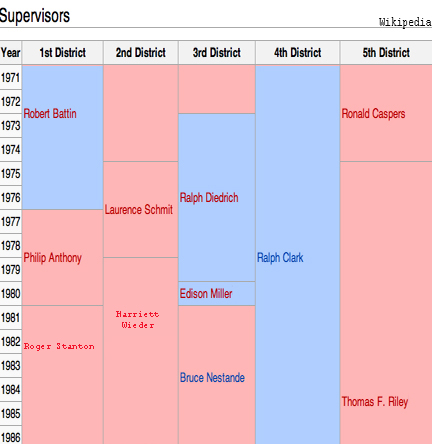
1970   Mysterious newcomer runs a behind-the-scenes campaign to gain election to the Board of Supervisors. Ron Caspers is elected in the 5th District, changing the direction of politics in Orange County. Ralph Clark is also elected to the board making a third vote for the emerging special interests. This new group of wealthy individuals is called The Coalition, and they begin to exert power in Orange County. [Rogers later states that the “Coalition” comes to an end in 1978 with the indictment of Louis Cella, Richard O'Neill's partner in achieving political influence.]
Dr. Louis Cella
            Despite their brief tenure, Caspers and Co. loom large in Rogers’ remarkable account of OC political corruption: “…[M]any blame [Caspers] for the descent of Orange County into the world of political intrigue, campaign finance abuses, and influence peddling” (p. 154).

            CASPERS AND HARBER: SHAKEDOWN. Elsewhere, Rogers discusses “Shooting Star” owner, Fred Harber (you’ll recall that Harber was among the ten victims of the Shooting Star disaster that also took Caspers' life), who, according to Rogers, engaged in an activity “now called lobbying”:
     Harber had been considered a prime mover in county politics….   Prior to his disappearance, he was alleged to have been involved in a shakedown of a developer in behalf of Supervisor Caspers. The builder Richard V. Jordan, in a sworn statement, declared that Harber had contacted him after his project in Casper’s 5th District had been turned down, and had told him what it would take to solve the problem. “$10,000 and $2,000 per month” Harber is alleged to have demanded form Jordan…. 
     Jordan asserted in his deposition that the meeting with Harber was prior to meeting with Caspers in a rubber raft off Cabo San Lucas. Jordan was represented by attorney R.S. “Sam” Barnes and his client contacted District Attorney [and Cella foe] Cecil Hicks and arranged for a payoff with marked bills. [A sting!] Before the plan was put into motion, Caspers won reelection and, with Harber, boarded the Shooting Star and headed once again for the Cape…. [From there, the ship headed north and disappeared.]   In the end the county paid off $700,000 to Jordan’s company…, as a result of losses caused by the extortion scheme.
            In his 1984 article ("The Sinking of a Political Machine"), journalist Larry Peterson wondered if Harber and Caspers attempted this "shakedown" with others—others who, unlike Jordan, were disposed to respond with violence rather than litigation.
            Rogers’ account of the dirty tricks campaign waged in 1969 against Republican Supervisor Alton Allen is fascinating. As it turns out, Ron Caspers was behind that campaign. Caspers won the Supervisorial seat away from Allen in 1970, with Tom Fuentes’ help.
            One more thing: in his book's first reference to the "Shooting Star" disaster, Rogers writes: "Fred Harber's controversial career was cut short by what appeared to be a maritime accident" (151).
            "Appeared to be"?
—More to come—
SEE Part 10
OC Supervisor Alton Allen, 1969.
Essentially taken out by dirty trickster Ron Caspers.
Tom Fuentes was Caspers' right hand man

Tuesday, March 13, 2012

Shooting Star, Part 8: La Paz-to-Cabo details


The entire “Fuentes/Shooting Star” saga can be found here.

At the tip of Baja: Cabo San Lucas
     (For parts 1-7 of the series, see here.)

     I have heard back from Mr. Lyle Overby (LO), who generously provides the following answers to my questions:
Tom Klein
   DtB: “All that we have learned thus far is that at least one of [brothers John and Tim Klein] was acting as a “caretaker” of the boat, and that he had been serving in that capacity probably since April.”

   LO: Tom Klein [Executive Aide to OC Supervisor Ralph B. Clark] knew the boat owner, [political strategist] Fred Harber, personally and well, and very much wanted to be around him, so that when he was offered the chance for a free trip to Mexico, he quickly agreed and encouraged his brothers to go along. It may be that Tom had one of the brothers working on the boat as a revenue source. The boat wasn't big enough to have a captain and crew, but there is always something to be done on a boat once you have an engine, electronics, heads, electrical and gas systems on board.

   DtB: “I’ve also learned that the Shooting Star was taken out for a four-day fishing trip in early May. Were you on that trip?”

   LO: The boat was taken out almost every weekend. It would be like the boat owner [Harber] to conduct a shakedown voyage before leaving for Mexico.

Ronald Caspers
   DtB: “Reportedly, the June trip was planned at that time [in May]. Did you know the three Klein brothers, including Tommy? Anything you might tell us about them would be greatly appreciated.”

   LO: Of the three Klein brothers on the trip, I only knew Tom Klein – personally and well. It seemed to me that the other brothers looked up to and followed Tom. Tom had a dynamic and confident personality. [Tom was eldest of the three.]

   DtB: “We were under the impression that the ‘crew’ of the SS flew from LAX to La Paz and then took a chartered plane to Cabo. Had you been with the Kleins in La Paz prior to the arrival of the others?”
Did the entire crew take the Shooting Star from La Paz to Cabo, contrary to earlier reports?
   LO: The group flew from LAX to LaPaz to board the boat and went to Cabo and then on to Guerreo Nigro [sic] and then [they were] lost at sea. I was on the LaPaz to Cabo leg of the boat trip. Mr. Caspers and his group flew to Cabo and I left from Cabo to come home – just dumb luck for me. Tragically, I tried to get others to go home with me so I wouldn't appear a lone ingrate, but everyone wanted to stay on not knowing how long it would take to motor back to So Cal – what I understand to be against the currents and rough waters.

Young Tom Fuentes
   DtB: “I’ve read that Ron Caspers’ executive aide, Tom Fuentes, was supposed to join the others for the trip (from Cabo), but did not ultimately do so. Is that correct? Was he among those who flew down? Why did he not join the others as first planned?”

   LO: Mr. Fuentes did not accept the invite to go to Mexico. He is/was not a boat type guy*, nor a guy that would want to be with twelve other guys in tight quarters. If he went on a boat, it would have to be a first class yacht. The shooting Star was a working class boat that could be used to go fishing off the back.
   Generally, the boat owner [Fred Harber] was a cautious seaman and would have retraced his route down to Mexico [months earlier?] which would have been to hug the coastline. Caspers was an expert yachtsman. It is speculated that as the trip dragged on, many of the guys were restless. In response to the restlessness, Caspers may have convinced them to take a shorter route home by going out to Cedros Island and then straight into Dana Point. When they did that, they were caught in a storm and lost. No bodies were ever found, but parts of the boat were – including the Boston Whaler dingy that could have been used for a life raft. However, it is pitch dark in the night and in heavy seas and probably never got launched from its perch which required a winch to launch.
   As I mentioned, many speculate about wide [wild?] tales of murder and sabotage, but it was just a case of a small, ill equipped boat in heavy seas in the dark of night. [END]
Tim Klein on the Shooting Star in La Paz
     I’m still a bit unclear about one thing. Who exactly was on the Shooting Star for the La Paz-to-Cabo “leg” of the trip? Generally, it sounds as though LO is saying that “everyone” was on the boat, starting in La Paz. But then LO says that “Mr. Caspers and his group flew to Cabo.” (Earlier reports stated that the group took a chartered flight from La Paz to Cabo.) I find this a bit confusing. Are others confused by this?
     LO seems to be saying that, in Cabo, the rest of the group simply didn’t realize how rough the trip "motoring" north (on the SS) would be, and so they did not join him in bailing on the trip. LO seems to be suggesting that, after the first leg, he had had enough, and so he bailed. In doing so, he felt like an “ingrate.”
     LO seems to say that Fuentes never made it to Mexico at all: “Mr. Fuentes did not accept the invite to go to Mexico.” His further remarks about Fuentes are amusing.
     Finally, LO says that Mr. Fuentes is not the sort to want to be "with twelve other guys in tight quarters." I only count 11 other guys. Ten were lost, and then there's LO, who bailed at Cabo. Who’s number 12?
     I’ve emailed LO for clarification.
     I think that LO makes a good case for the difficulty of launching the Boston Whaler during the dark of night in rough seas. I was unaware of the difficulty with the winch. But why didn’t the crew don their life vests? As I understand it, the vests were found among the floating debris, unused, some torn.


*Fuentes is known for his love of the Balboa Bay Club, but, while there, he seems only to embark cigar smokings and Scotch sippings, not yachts.

Tom Fuentes, 1976

Shooting Star, part 7: my correspondence with passenger Lyle Overby


The entire “Fuentes/Shooting Star” saga can be found here.

For the rest of the series, see Shooting Star

March 12:
Mr. Overby:

I'm a local blogger with an interest in Orange County history. I've been working on a story about the sinking of the "Shooting Star" in 1974--the yacht that disappeared along with Ronald Caspers and nine others. 
This morning, I spoke with Wayne Clark, who once wrote two fine articles about the disaster (for Orange County Illustrated, late in 1974), and he said that he recalled that someone on the trip got off the boat--perhaps during the refueling stop at Tortoise Bay--before it sank. At first he couldn't recall the person's name. Just now he emailed that he remembered that it was you. 
Is that correct? Were you among the crew of the Shooting Star from June 9 until, I suppose, June 13, 1974? 
Thanks for any light you can cast on this sad episode.

     Roy Bauer,  949 xxx xxxx
March 13:
Roy, 
Click on graphic to enlarge
First of all, I have to ask who are you besides a blogger? These folks that lost their lives were not strangers to me and I don't want to be part of further desecrating theirnames for curiosity. What is your interest in this old story? 
I was on the Shooting Star, but I got off the ship at Cabo San Lucas and did not make the troubled trip from Cabo to Guerrero Negro - the last time the the Shooting Star was seen. There are a whole lot of old news stories that chronicle the tale quite well, including probably the best two of all "The Last Voyage of the Shooting Star - Part 1 and 2" by the very Wayne Clark that referred you to me. 
The boat was not sabotaged as many conspiracy types speculate. It was a pleasure boat taken out into heavy weather without the proper high seas survival equipment needed to make the journey in a cabin cruiser (Shooting Star was 65 feet in length).
There isn't that much more to add. 
     LYLE OVERBY
March 13:
Mr. Overby: 
I am a professor of philosophy at Irvine Valley College, and I have been blogging (Dissent the Blog) since 2005.      
Though our blog focuses on items of interest to the college community, it also occasionally delves into Orange County history in general--e.g.,       
A century-old "History of Orange County": towns called Celery and Delhi and a women's club aiming for "sober, Christian citizenship"  (Feb. 16)
Recently, I blogged about the sinking of the “Shooting Star” and was contacted by the daughters of one of the victims of the sinking (John Klein), who encouraged any efforts on my part to learn more about the disaster.    
For instance, we would love to learn more about what the Klein brothers (John and Tim) were doing in La Paz. All that we have learned thus far is that at least one of them was acting as a “caretaker” of the boat, and that he had been serving in that capacity probably since April. I’ve also learned that the Shooting Star was taken out for a four-day fishing trip in early May. Were you on that trip? Reportedly, the June trip was planned at that time.    
Did you know the three Klein brothers, including Tommy?      
Anything you might tell us about them would be greatly appreciated.      
We were under the impression that the “crew” of the SS flew from LAX to La Paz and then took a chartered plane to Cabo. Had you been with the Kleins in La Paz prior to the arrival of the others?       
I’ve read that Ron Caspers’ executive aide, Tom Fuentes, was supposed to join the others for the trip (from Cabo), but did not ultimately do so. Is that correct? Was he among those who flew down? Why did he not join the others as first planned?      
Any information you might provide would be greatly appreciated. 
--Roy
SEE Part 8

Note: Mr. Overby, like Tom Fuentes, Tommy Klein, and Wayne Clark, served as an executive aide to a member of the Orange County Board of Supervisors in the 1970s. Note: the upshot of the above: there was no "11th passenger."

Monday, March 12, 2012

The sinking of the Shooting Star, part 6: an 11th passenger?


The entire “Fuentes/Shooting Star” saga can be found here.

Ronald Caspers, 1973
[See UPDATE below] [See also Part 7, where it is revealed that the mystery passenger likely sailed from La Paz (with the Klein brothers) to Cabo, where he disembarked. Hence, there is no "11th passenger."]
     Recently, I’ve posted a series of articles about the odd 1974 disappearance of the yacht “Shooting Star” off the coast of Baja California. Ten people disappeared with that boat, including OC Supervisor Ronald Caspers and political consultant Fred Harber. (Our own Tom Fuentes was Caspers' "executive aide" at the time.)
     Harber and Caspers were linked to the Orange County "shadow government”—DA Cecil Hicks’ term—allegedly masterminded by Dr. Louis Cella, who, not long after this episode, was tried and then sent to prison for corruption concerning campaign contributions to officials across the state. Cella's partner in the giving of huge chunks of money to key state politicians (including Jerry Brown) was South Orange County land baron Richard O’Neill, who died in 2009; Cella died in 2011.
John Klein
     In most of these posts, I have relied on two long-unavailable articles that appeared in the November and December, 1974, editions of the defunct Orange County Illustrated (many editions of that magazine were recently acquired by the OC archives). I was sent copies of the articles by the daughter of one of the victims of the tragedy (John Klein).
     The articles really are well-written, but they do raise questions.
     I decided to contact their author, Wayne Clark, who, at age 84, is still a busy man. He is Associate Executive Director of the Urban Water Institute in Irvine. (I do believe he holds other offices as well.)
Tony Moiso of Rancho 
Mission Viejo
     Clark is an interesting guy. After participating in the military occupation of Japan after WWII, he went to college and then studied the law. He seems to have spent many years as a journalist, working for the LA Times, among other organizations. From about 1963 to 1973, he was UCI’s Public Information Officer. After that, he worked as a “deputy” for one of the supes on the OC Board of Supervisors (I recently speculated that he had held that position at about the time that the “Shooting Star” episode occurred). He then started a successful PR firm and then, starting in the early 90s, he held various positions on local water boards. The politics of water seems to have kept Mr. Clark occupied in the last twenty.
     As we'll see, Clark was in fact the aide to someone (according to one reporter) very much caught up in infamous OC 70s corruption free-for-all. More on that in a moment.
     I left an email with him last night, asking about the old OC Illustrated articles. This morning, he got back to me by phone. Here are my notes (not verbatim unless quotation marks are used) of our twenty-five or so minute conversation:

Conversation with Wayne Clark, March 12, 2012
Wayne Clark
     Clark: “I’m 84, and my memory’s not always so good.”
     I told him I was impressed with his career and accomplishments. Then I zeroed in on his work in the seventies with a member of the OC Board of Supervisors. He said: I started to work as deputy to Supervisor [Laurence] Schmit – probably, the “worst Supervisor of all time.” (Laughs, not unpleasantly.)
     I asked: You were a deputy? Is that the same as an executive aide? Yes. [In ’74, Tom Fuentes was the executive aide of Ronald Caspers. A victim of the SS disaster, Tommy Klein, was the executive aide to Supervisor Ralph Clark.]
     I asked: Did you work for Schmit at the time of the Shooting Star incident in 1974?
     No, a bit later, about 1976, after I worked for Orange County Illustrated. I left them before they went out of business. [Schmit appears to have served as a Supe from 1975 through 1978, one term.]
     The people who hired me [for the exec. aide job] told me that my job was to “keep him out of jail,” which I did, more or less (laughs).
     I [Roy] asked what sort of questionable or illegal activity we were talking about, but Clark was either unwilling to tell me or he didn’t remember.
     We talked about the ill-fated trip of the Shooting Star. I asked whether he knew who flew down to La Paz for the trip. Was anyone along who didn’t get on board the boat? Is it true that Tom Fuentes was supposed to join the group but backed out at the last minute? Clark couldn’t remember such details.
     But then he said something remarkable:
     Clark: One passenger got off the boat. . . –wasn’t that in the article?—can’t remember his name. [I said that that certainly was not in the article. Note: as far as I know, there has never been any mention of an 11th passenger who got off the boat in any news stories or official reports. See Part 5 of this series: Coast Guard report, etc.]
     I mentioned that the SS stopped at Turtle Bay to refuel. Did the passenger got off there? Clark didn't seem to know or to remember.
     Clark: He [that passenger] is still around. He works as a consultant. Works for O’Neill down in South County [Rancho Mission Viejo]. Worked for Tony Moiso [President and Chief Executive Officer of Rancho Mission Viejo, which is associated with the O’Neill family. Moiso and O’Neill have run RMV since the 60s]. Clark just couldn't remember the guy's name.
Phil Anthony
     I asked about the article that appeared in Orange Coast Magazine in 1984—the one that focused on the political aftermath of the SS disappearance and that mentioned an ex-Chicago cop’s investigation and his view that the Shooting Star was destroyed by a bomb. (You don’t find body parts if they’re blown to bits; they then become fish food.)
     Clark: No, I didn’t know about the ex-cop and his theory. (Evidently, Clark didn’t follow the case.)
     I mentioned Dr. Louis Cella, the remarkable political donor and political machine kingpin. Clark had interviewed him, he said. He was doctor, said Clark. Clark remembered that Cella had gone down to Mexico to try to find Caspers and the others.
     Clark: The rumor was that he was in the mafia, but I don’t think so. [No longer referring to the Shooting Star:] He had a plane and he’d go off once a week, pretty mysterious—maybe on a Thursday—but, as it turns out, he didn’t go where he said he was going. Clark seemed to suggest that there was some funny business there. No doubt some of the mystery was uncovered during the criminal investigation of Cella and others, though, as I recall, journalists who reported the story have opined that they never got answers to where all the money was coming from.
     Clark: I remember interviewing him. It was odd. There was all this printing equipment (I think at the hospital). It was “strange.” (Clark seemed to use the word “strange” for Cella himself, not just for the presence of the equipment.) You might want to talk to Phil Anthony, who was a Supervisor and who’s on the OC Water District board these days. At the time, I seem to recall he resigned to avoid indictment.
      Clark: You should talk to Tom Fuentes. He’d know all about this.
 
     I explained that Fuentes is now dying of cancer. I said I knew him and that I wasn’t going to contact him.
     Clark laughed that I knew his background so well. How do you know all this about me? I read his bio, I said. Yes, I was UCI PIO for about ten years, said Clark. Worked for the LA Times at the OC office before that. 
[UPDATE: Just heard back from Mr. Clark:
Roy - L... O... [email address given] is the person I remember as having got off the boat in Central Baja before it being lost at sea. I believe he is still engaged as a consultant to the Ranch. - Wayne 
He gave me the guy's full name, but I want to contact him and discuss his own recollections before I say more. --I've contacted Mr. LO. It'll be interesting to see what he says, if he responds.]
Laurence Schmit, giving a speech
     —Well, that’s about it. Clark is an old fellow and seems nice enough. I didn’t want to bother him further. He said he might be able to remember the name of the “passenger” who got off the Shooting Star. “If you remember the name,” I said, “you can call or email me. I’d very much appreciate that."

* * *
     I did a little digging after the phone call, and now I’ve got new questions. Evidently, Supervisor Schmit, the guy Clark worked for for several years, was very much a full member of the OC “shadow government,” as DA Hicks used to describe it. (See Peterson's article below.) He took office in 1975. After his 1978 reelection defeat, he moved to Northern California.
     Phil Anthony started out on the Westminster City Council, became mayor, and then served as a Supervisor from 1976 to 1981. He’s served on various boards since then. (See.)
     You can read about Moiso here and here. He’s still very much a player also (he’s only 72).
     I’ll close with this excerpt from the 1984 Orange Coast Magazine article: The Sinking of a Political Machine by Larry Peterson:
Larry Peterson (1984)
     …The voyage was supposed to be a celebration of Caspers’ re-election only a few days before. The victory was engineered by [“Shooting Star” owner Fred] Harber, who had close links to Dr. Louis Cella and other political figures who later were to be indicted on charges ranging from fraud and embezzlement to campaign-finance cover-up and bribery.
     At the time, Cella headed the closest thing Orange County has ever had to a political machine. [Please note: Fuentes’ turn as county GOP chair started in 1984 and lasted about twenty years. He also is often described as having constructed and maintained a “machine.”] In the mid-seventies, Cella and south Orange County land baron Richard O’Neill teamed up to donate hundreds of thousands of dollars to dozens of candidates.
     District Attorney Cecil Hicks, close to the country’s Republican establishment, fought a running battle with Cella. Hicks once publicly accused the doctor of heading a “shadow government” that controlled the county Board of Supervisors. Cella responded by accusing Hicks of alcoholism. In any case, a majority voting bloc [including Caspers], usually consisting of recipients of Cella’s political largesse, repeatedly helped stymie Hicks’ attempts to investigate Cella and his allies.
     Within four years after the sinking of the Shooting Star, most members of the shadow government had been driven into political exile. Some, indeed, were behind bars, and others were fighting rear-guard legal battles that would end in their incarceration.
     Cella was convicted in 1978 of using a hospital he owned to defraud the federal government of hundreds of thousands in Medi-Cal funds, much of it used to underwrite his campaign contributions. After serving time in federal prison, he moved to Coachella. County Supervisor Robert Battin, for whom Harber had been an aide, was convicted in 1976 and briefly jailed for illegally using county funds to help his unsuccessful 1974 bid for the Democratic nomination of lieutenant governor. He now practices law in Santa Ana. Supervisor Laurence Schmit, a Cella ally and a major beneficiary of his political influence was defeated in his 1978 re-election bid. He moved to Northern California. Supervisor Ralph Diedrich, who tried to reassemble the shattered machine, was convicted in 1979 on bribery charges. Recently released from prison, he, too, has left the county. [Land baron Richard] O’Neill—never accused of wrongdoing—eventually became chairman of the state Democratic party. But that was only after years of virtual political hibernation during which he lived down the onus of his alliance with Cella.
Moiso and Governor Brown in January
     Cella, interviewed last year in Coachella, where he practices medicine at a farm workers’ clinic, said the sinking of the Shooting Star marked the “death knell” for his role as a power broker.
     The loss of Harber, he said, deprived him of his political allies of a “political genius,” who, had he steered the boat safely home, could have helped pilot the shadow government through troubled political waters.
     And, in Caspers, Cella added, the group lost a reliable ally who could have helped push through a Cella-backed move to investigate the district attorney’s office and blunt any possible probe of the Cella-O’Neill combine.
     “If Caspers had lived, we would have had the votes to stop Hicks,” said Cella. “He was a very strong vote against Cecil and he disliked Cecil even more than Fred did.”
     Battin agrees with Cella’s assessment, calling the loss of Harber and Caspers “the beginning of the end.” [END] 
      So, if Peterson has his facts right, our guy Wayne Clark was the executive aide to someone very much tied to Cella’s “machine.” And his job was to keep him out of jail? Well, he seems to have accomplished that.
     And the mystery passenger? He went to work for Tony Moiso and Rancho Mission Viejo—the company of Richard O'Neill, Cella's partner? [L.O.?]
      It’s all very odd.

* * *
ANOTHER EXCERPT FROM  The Sinking of a Political Machine
by Larry Peterson:

[WAS IT MURDER?]

     ...Neither bodies nor pieces of the wooden hull of the ship were ever found....
     The Coast Guard investigation failed to determine why the life jackets apparently were not used or why radio reports before the sinking indicated different positions.
     Also still a mystery is why no one, according to the official report, apparently was able to transfer from the Shooting Star to the lifeboat. 
Robert Battin
    Another discrepancy that remains unexplained is that a mayday message picked up by a research vessel in the area said there were nine persons aboard.
     And still subject to guesswork—and not addressed by the report—is why, according to witnesses, the party on board suddenly forsook plans for two days of leisurely marlin fishing and headed—apparently in a hurry—for San Diego.
     The Coast Guard said it found no evidence of fire or explosion aboard the lifeboat. But at least one person believes there was an explosion aboard the Shooting Star and that it was set off deliberately.
     Private detective Neal Graney, who conducted his own unofficial probe, went so far as to publish a 200-page fictional account—Mayday! Mayday! Morningstar—a thinly disguised rendition of his speculations about what happened. The names, of course, have been changed. Currently, he is trying to market a screenplay based on the same theme. “I know I don’t have a smoking gun,” says the former Chicago policeman. “But, in my gut, I’m sure it was murder.”
     Though long on conjecture and short on proof, he also theorized that one of the men aboard knew the yacht was about to blow up and left in the lifeboat before the explosion. That, he argues, explains the mayday report of nine aboard and the great distance between the discovery place of the lifeboat not only from the sinking site but also from the other debris.
     And the bodies? “There are many reasons,” explains one of Graney’s fictional characters. “When bodies go down to the bottom of the sea, they usually float to the top within two or three days. That is, unless they are in small pieces. Then they are fish bait.” As for the condition of the life preservers, some of them damaged but none demonstrably bloodied, Graney attributes that to the impact of metal or wood fragments from the explosion.
     There is some support, however slender, for Graney’s belief that someone got off the boat alive. One former west Orange County elected official told me he thinks he saw a member of the ill-fated party about three years ago in Hawaii.

Richard O'Neill and family, 1950
     At the time, the former official says he was on the beach near the Pacific Beach Hotel in Waikiki, and the supposedly deceased man crossed the street nearby.
     “It looked so much like him that I just yelled his name without thinking that he was supposed to be dead,” said the vacationer, who was well-acquainted with the Shooting Star passenger he thinks he saw. “He took off and disappeared into the crowd….I’m sure that, when I yelled out, he would have recognized me….It seemed deliberate.”
     Scenarios just as bizarre as Graney’s based more on conjecture than provable fact, have been widely circulated and are passed on by Cella, Battin and others to anyone who asks.
     Details vary, but the essentials are this: Somebody hired either organized crime-related figures or a right-wing paramilitary group to blow the Shooting Star out of the water.
     Implausible as that may seem, there is some evidence that the boat would not normally have sunk, even with the pounding it took from heavy seas. Louis Fallows, co-owner of the Wilmington-based firm that was one of the government’s contractors for the type of naval rescue boat that was rebuilt to create the Shooting Star, is graphically emphatic on that question. She said the boats were built with air-tight compartments that would have buoyed themselves so much that it wouldn’t have sunk completely even if there were a big hole in the hull. “The only thing that would have sunk it would have been if it were blown apart,” she said, without being prompted by being told of theories about an explosion.
     Why anyone would want to deep-six the Shooting Star, especially in the manner Graney suggests, is unclear.
     But evidence that Harber and Caspers were up to potentially dangerous mischief at the time surfaced four years later. In 1978, developer Richard V. Jordan alleged in a suit against the county that the two were trying to shake him down for a $10,000 payoff plus $2000 a month for approval of a project he wanted to build near El Toro, in Caspers’ supervisorial district.
     The county settled out of court on Jordan’s claim that the county illegally revoked his building permit, paying him $700,000. The matter was investigated by the district attorney’s office to determine whether persons still alive might be criminally liable, but that probe ended inconclusively.
     As it turns out, preliminary discussion concerning the alleged deal took place in Mexican waters aboard the Shooting Star, Jordan said in papers filed with his lawsuit.
     Before the arrangement could be consummated, however, Caspers, Harber and the others departed on the fateful trip. Ironically, Jordan said, he was invited along, but declined because he didn’t think the Shooting Star was seaworthy. But the Coast Guard cited reports that deficiencies on the boat had been corrected prior to the trip.
     Jordan, the record shows, knew how to seek and obtain remedies for his grievance in a court of law. But one is tempted to ask: Were Harber and/or Caspers using the same routine on anyone else, perhaps someone prone to resort to different—and more violent—remedies?
     That might be a point of departure for any resumed investigation of the disaster. For years, however, there has been no evidence of any official interest in the matter—with one exception. In the past year or so, the FBI, questioning a politically connected Orange County person on a different matter, slipped in some questions about the Shooting Star. That doesn’t amount to a new probe, of course. But ten years later, even a residue of official curiosity at any level is intriguing.
     Still, until the questions left hanging by the official report are answered, who is to say that Graney’s explicit but seemingly farfetched version is wrong? Those questions, of course, may never be answered. And the tale of the last voyage of the Shooting Star may make as good a whodunit ten years from now as it does today.

SEE Part 7

Roy's obituary in LA Times and Register: "we were lucky to have you while we did"

  This ran in the Sunday December 24, 2023 edition of the Los Angeles Times and the Orange County Register : July 14, 1955 - November 20, 2...