Wednesday, August 12, 2009

The Worrisome Specter of a Million Yahoo March


1. Focusing on the paranormal

In yesterday’s Guardian, a psychologist, Professor Chris French, explains his peculiar psychological specialty that focuses on the “paranormal” and the extraordinary (Spoon-bending for beginners: Teaching anomalistic psychology to teenagers).

French is in the field of anomalistic psychology (AP), which can be defined as "the study of extraordinary phenomena…, including … those which are often labelled ‘paranormal’.”

AP is not to be confused with the more familiar field of parapsychology (PS), which, in practice, tends to assume the validity of paranormal ideas and seeks evidence to support them. AP, in contrast, “is directed towards understanding bizarre experiences that many people have without assuming a priori that there is anything paranormal involved.”

That is, AP is cautious. And it's skeptical.

Skepticism—an unwillingness to adopt an idea until sufficient evidence is identified, i.e., until, among other things, sources of doubt are overcome—is, and has been, essential to the success of the sciences. In the face of a possibility (hypothesis), the skeptic always looks for possible sources of doubt. Non-skeptics, in the meantime, ignore the sources of doubt, heading straight to belief.

It’s a lot easier.

You'd think that, by now, we would have largely overcome such abject yahooery.

A scientific- (i.e., skeptical-) minded person would never adopt the belief, say, that James Van Praagh actually communicates with the dead--when it remains possible that something else—something more mundane—could be going on that fully explains his performances. Those who have actually studied Van Praagh’s routine observe the expected: that he throws out lots of ideas and then pounces upon those few that seem to cause a reaction in grieving but hopeful audience members.

To the unwary, this can seem astounding.

It isn’t.


I love talking about the paranormal and the weird in the classroom. As a logic/critical thinking/philosophy instructor, I also urge my students to be skeptical in the face of extraordinary claims.

Sounds negative, but it isn't. I explain that skepticism isn’t like atheism: the denial of something’s existence. Obviously, it is not like theism either. It is more like agnosticism, which is neither belief nor disbelief. Essentially, agnosticism—or skepticism—is the position one is compelled to take when the evidence is inconclusive. In that situation, both (confident) belief and (confident) disbelief are unreasonable, illogical, a mistake.

So far, I’m a skeptic about Bigfoot (shouldn't it be "Bigfoots"?). Certainly, there is no strong evidence (yet) that Bigfoot exists. But I would be unjustified in confidently declaring the non-existence of B. (Declaring his likely non-existence is another matter; I’m happy to do that.)

Like me, French believes in teaching students about alleged paranormal phenomena:
[Beginning]... next month, potentially thousands of teenagers at schools and colleges throughout the UK will start lessons that deal with telepathy, psychokinesis, psychic healing, near-death experiences and talking to the dead. … From September, anomalistic psychology will be offered as an option … for A-level students from … the largest of the three English exam boards….

Why focus on the paranormal and daffy?

Well, French, like me, thinks that a scientific and skeptical approach to the paranormal is a great way to teach critical thinking. (People, including me, are genuinely interested in the paranormal. And young people are naturally attracted to the rejection of “establishment” thinking--and in their benighted world, believing in the paranormal is normal.)

Beyond that, belief in the paranormal is widespread and, says French, it is “deep-seated.” Maybe so. It isn’t something we can ignore.


2. Worrying about Stupid People

People sure do believe in some goofy notions, ridiculous though those notions may be.

Something like that is happening in politics too.

I don’t know if you’ve noticed, but, these days, we seem to witness the growing political power of the Stupid People contingent (aka the “Republican base,” more or less). You know who I’m talking about: the birthers, deathers, and fans of Sean Hannity. --People who think that gays recruit at college campuses and that college professors like me get up in the morning intent on teaching “socialism” and godlessness.

I’m a little surprised. Don’t these people watch TV? Don’t they read the paper? Do they live on an island? How could they possibly be that clueless?

But wait! Maybe the Stupid People aren’t as numerous as they seem. It’s hard to say. The “mass media” are not some first-rate organization, you know.

Imagine a graduate from the “Columbia School of Broadcasting” (Is it fictional?), a used car salesman, and a fresh graduate of Clown College independently setting out to cover the news in your town. Your knowledge of what goes on there pretty much depends on what these three publish and make available in leaflets that are strewn about.

That’s pretty much our situation, informationwise. So it's easy for myths and exaggerations to get promulgated. Maybe the noisy “town hall” agitators represent nothing more than a few stray dopes and some seriously wily and wicked lobbyists!

My guess, though, is that the Stupid People are numerous, albeit a distinct minority. But minorities with a sneaky (can the stupid be sneaky? 'Fraid so.) strategy can grow and can gradually control groups. If the Stupid People play their cards right, they can manipulate the Republican Party’s Presidential candidate nominating process.

If that happens, we must prepare for things to get weirder. And dicier.

And extraordinary!

Picture the year 2010. GOP (or independent) Candidate Sarah Palin is preaching to the choir: “President Obama believes in a one-world government, you betcha. He’s pretty much into racism and genocide against the elderly, too. --An' innocent babies! (Loud boos.) He’s working with doctors and dentists and scientologists right this very minute to poison our children with mind-altering homosexuality drugs and vaccines.” (Outrage!)

Then comes the clincher: “I may be just a gun owner and mom, but I think that’s just un-American.”

The crowd explodes. Wild applause. Then: grunting, hooting. Waves.

Moaning.

I can just see one of the Stupid People reading this post. Later, she’ll tell her friends, “Yeah, that liberal professor says he believes in Animalistic Psychology and he wants to teach agnosticism and homosexuality to our kids. I think he’s into Dutch painters too, 'cause he threw in something about one of 'em, so he’s some egghead type. You know whad-I-mean.

(Staunchly, curtly, and with a knowing look, the friend responds:) “YES I DO.”

Now, how does this “birther” stuff work in the mind of a Stupid Person? Here are some possibilities:
1. It could be true. Sometimes things like this ARE true. So it’s true.
2. The information I saw on that one website is just incredible. How can you not believe? You can’t argue with fax, and they got ‘em!
3. My minister says I gotta believe this, and he’s never led me astray—remember about that awful Reverend Wright? So I gotta go with it. You gotta trust somebody, put your faith in somethin’. Otherwise, you’re a godless communist like Obama.
4. Well, my Congressman seems to believe in this stuff, so that’s good enough for me, ‘cause he’s important, educated. Plus he’s a church-goin’ man. So there you go.

People can be pretty clueless and illogical. Some of 'em are beyond the pale. At a certain point, you know, there’s no use arguing with Stupid People. They can be too far gone to be reasoned with, like grizzly bears and boulders. All you can do is stand aside, avoid their spittle and fury.

What if these Stupid People get even more organized and confident and bold? Imagine millions of ‘em standing together and demonizing the President, condemning and glossolalianatin’ about our nation’s godless embrace of homosexuality and socialism.

What then?

I have no idea.

Tuesday, August 11, 2009

Better pay attention: textbooks

Big changes are afoot in many spheres and especially in education.

How students acquire and use texts is a good example. Clearly, we’re taking a techno turn. We’re gettin’ all digital. And it’s happening pretty quickly. Better pay attention!

In this morning’s Inside Higher Ed (Textbook Bonanza), Doug Lederman reports that

…Monday saw a flurry of news about the campus bookstore and textbook markets, which, like many industries related to information and publishing, are being buffeted by technological and other trends. … [T]he array of news … does suggest a lot of intensity and interest surrounding the transformation of the college textbook market.

The highest-profile transaction by far on Monday was Barnes & Noble's agreement to buy Barnes & Noble College Booksellers for a total of $596 million….

[T]he combination of the two companies … would have significant benefits for college bookstores and their student and faculty customers, [Barnes and Noble's chief financial officer Joe] Lombardi said. Foremost among those is the 750,000-title electronic bookstore that Barnes & Noble's publicly traded self has developed, to which customers of the college store arm would have full access once the companies are merged.

The digital textbook space is where Academos operates; it creates and manages online bookstores and market places for colleges under their own names. And on Monday, the company announced that it had taken in $2.5 million in additional funding from Kohlberg Ventures, a California venture capital firm.

“The online bookstore landscape is rapidly changing as schools and students increasingly rely on technology to meet their needs,” Jim Kohlberg, managing director of the venture firm, said in a news release about the investment. “Academic institutions across the nation, as well as their students, need low cost and easy-to-use options to streamline the purchase of textbooks. Akademos brings an innovative and timely service to a growing market – one that addresses a very real need for virtually every college, university and student body.”

The third and last of Monday's news developments also comes in the digital textbook arena – but from the free, rather than for-profit, perspective. The Community College Collaborative for Open Educational Resources said the William and Flora Hewlett Foundation had given it $1.5 million in new funds to expand its work, which focuses on increasing the number of free, online textbooks and training community college instructors on how best to use such books. Its main resource, the Community College Open Textbook Project, has dozens of college members and seeks to significantly expand the number of freely available digital textbooks it makes available.

"This grant comes at an opportune time,'' said Mike Brandy, chancellor of the Foothill-De Anza Community College District, which leads the online collaborative. "It coincides with the growing interest in open educational resources, such as President Obama's proposal to invest $500 million over the next decade in developing free high school and college courses. Open textbooks are moving into the mainstream as financially distressed states such as California look to free digital textbooks to reduce the cost of public education.''

THE RETURN OF REBEL GIRL:

Rebel Girl has returned from the Sierra Nevada, where she (and Louis B. Jones) run the fiction portion of the summer writers’ workshops of the famous Squaw Valley Community of Writers.

People write about the Squaw Valley group all the time, but, recently, they got a write up in, of all places, Business Week magazine:

Management as a Liberal Art:
At the Squaw Valley Community of Writers, there's a call to get business professors to integrate this Peter Drucker idea into their classes

By Rick Wartzman

Here’s an excerpt:
…The problem is that the broad world of ideas has become largely separated from the world of business.

"What [management guru Peter] Drucker wanted was for knowledge to "no longer be ornamental—to be consumed to refine oneself or to impress others," says Joseph Maciariello, the academic director at the Drucker Institute, which I run. Rather, knowledge is to be brought down to the grimy earth, where we all work, and integrated so that work can be made more productive and more humane."

Maciariello is spearheading an effort to bring the concept of "management as a liberal art" into the nation's colleges and universities. The goal is to have business professors integrate the humanities more fully into their classes, while liberal arts majors contemplate "not just applied reasoning and ethics but virtuous living," as Maciariello puts it, rooted in real results. Ultimately, the intention is for these ideals to transcend the academy and reach the realm of practice.

In the meantime, the creative souls at Squaw Valley have, unbeknownst to them, underscored a few things that all managers would profit from thinking about. For starters, there's the Community of Writers itself. Founded 40 years ago by novelists Blair Fuller and Oakley Hall, the organization is thriving, thanks in large measure to a strong sense of self. "Community" is not just a throwaway word in the name here, but the very essence of the place. The authors on staff, many of them highly acclaimed, are unfailingly unpretentious and nurturing of the young writers they teach.

What has also been made clear at Squaw Valley this week is that work of value never comes easy. "I do not believe in genius," Dorothy Allison, the bestselling author of Bastard Out of Carolina and Cavedweller, declared the other night. With that, she implored everyone trying to get his or her first book published to keep honing the manuscript—through 19 drafts, need be—until it's just right.

Managers could benefit from the same basic advice. "Brilliant men," Drucker noted, "are often strikingly ineffectual; they fail to realize that the brilliant insight is not by itself achievement. They never have learned that insights become effectiveness only through hard systematic work."

Finally, and most importantly, there are the books. As I've sat and listened to Allison, Dagoberto Gilb, Lynn Freed, and others read from their latest narratives, I've been reminded how much literature can shed light on a subject that lies at the very heart of management: the human condition. "I am rereading each summer—and have for many years—the main novelists," Drucker wrote to a friend in 1997. Among them, he said, were Austen, Thackeray, Trollope, and George Eliot. "I never read management books," Drucker added. "All they do is corrupt the style."

Monday, August 10, 2009

The boy who cried "wolf!"—and then got et

Aint no big deal

OC Weekly’s Gustavo Arellano reports that money is so tight at Cal State Fullerton that libraries there can’t even afford to purchase professors' newly published books.

Um, that’s no big friggin’ deal, if you ask me. Let's move on, please.

“Like the academically dubious University of Phoenix”

Meanwhile, over at the University of California, fiscal Sturm und Drang continue to wrack that system.

On Friday, the Reg’s Gary Robbins reported that a “small group of UC Irvine professors has proposed raising the state income tax as one way of way of shielding the University of California from the impact of the $813 million the system has been told to cut to help the state balance its budget.”

Like the way Robbins zeroes in on the tax idea? It was just one of several, Gare. Way to throw raw meat at the Real Neanderthals of Orange County.

The four Humanities professors opine that UCI’s chancellor and other officials are being dishonest with the public about the crisis. Drake is assuring everyone that the good ship UCI can weather this storm by swabbing the deck and closing the portholes. In truth, say the Professors, he's planning to save the vessel by sawing a series of neat little hole in its hull.

Here’s how the four humanists describe Drake and co.’s de facto vision of the U of Cal of the future:
Imagine overcrowded classrooms and reduced expectations for students, and the substitution of computers for teachers, and you’re in the ballpark. What looms is the transformation of a world-class university into either a factory for BA students or an online correspondence school like the academically dubious University of Phoenix.

I just love that last part.

So they’re asking Drake to step up to the plate and show some real leadership:

“UC Irvine Chancellor Drake and the Commission could take the lead in forging the public consensus necessary to halt the erosion of … state support of public education. They could propose and support legislators endorsing viable alternatives, which range from levies on the state’s petroleum production and closing corporate tax loopholes to, yes, raising state income taxes, which are among the lowest in the country. What role would be more natural than this for them?”

The Four note that this situation applies just as much to the Cal States and the community colleges.

Dang!

The boy who cried "Wolf!" an' villagers blew 'im off and then he got et (an old folk tale)

When huge budget cuts come down the pike, everybody goes into “We be essential!” mode. At such times, cynicism comes easy.

Reminds me of this couple I once knew in grad school. When one of ‘em got sick, he or she would be a total whimpering, mewling lout. I’d make fun of ‘em. "Listen, save this stuff for when you're dyin', OK?"

One time, they got sick at the same time. It was a perfect storm of miserable, desperate whimpitude:

“[Cough, choke.] Help me!!”

“What?! [Sniff, whimper.] Shuddup, shuddup, shuddup! [Yelp.] Help me!

It’s easy to snicker. But, you know, when you hear lots of cries and whimpers and bleats over time, it’s likely that someone, sometime really does have something serious to yammer about.

You know that it’s at least possible. You’d be an asshole to deny it. C'mon!

Years from now, we’ll realize that, among the noisy chorus of “wolf!” cries, there were a few boys who cried wolf because there was a friggin' wolf.

"Yeah, sure," we said.

Then they got gobbled up.

They're not around anymore.

Bummer.

Sunday, August 9, 2009

Don Wagner enters the Assembly race

Gosh, I leave for a coupla days, and then shite happens!

A blogger friend tells me that Don Wagner has issued an announcement. It appeared on Friday on the local Red County blog:

Donald Wagner Enters AD 70th Assembly Race

[Allan Bartlett of RC identifies the following as a “press release from Don Wagner:]
Irvine Attorney and Community College District President Enters Race

IRVINE- Attorney and Community College District President Donald Wagner has kicked off his campaign to replace termed out Assemblyman Chuck Devore to represent the 70th Assembly District.

Wagner's strong conservative message of change away from the current fiscal recklessness in Sacramento, and his long history of effective government leadership, has already earned the Wagner campaign a number of endorsements from conservative education leaders, the Family Action Pac, and Republican voters and community activists throughout Orange County.

"I believe that the State Assembly is simply not doing the job we are paying it to do," said Wagner. "By raising taxes and allowing spending to get out of control, the State Assembly is not putting the needs and concerns of the citizens of California first."

Wagner has hired Duane Dichiara and Jason Roe of Revolvis Consulting. Long time conservative activist John Fugatt is already aboard the Wagner campaign as its treasurer. Grassroots volunteers and fundraisers are also in place as the campaign kicks into high gear. Wagner will later this month report more cash on hand for this race than his primary opponent, Tustin Councilman Jerry Amante, who has been running for more than eight months yet reported less than $12,000 cash on hand at the close of the last reporting period.

Wagner and his wife Megan have three children, and have been residents of Irvine since 1991. He is a graduate of UCLA and the University of California, Hastings College of Law. Wagner has been elected to three consecutive terms on the Board of Trustees of the South Orange County Community College District since 1998, and currently serves as the Board's President. Wagner also founded the Orange County chapter of the Federalist Society, a nationwide organization of lawyers, law professors, and judges.

Interesting factoids:

Don has run for Assembly (the 70th) before, though with little success. He's just too peevish a being. See 2004 campaign website. "Corporal punishment in the lower grades work [sic]," opines the Donster. (See Q and A.)

According to Politics, Revolvis Consulting, which launched only two months ago, “will specialize in general consulting and direct mail with an emphasis on targeting Latino voters, a fast-growing demographic and one essential to future Republican success.”

John Fugatt is (or was) the Executive Director of “Christian Coalition of California,” which is, of course, affiliated with the notorious Pat Robertson-founded “Christian Coalition.”

Nice tats

I'M ABOUT to leave my beauteous suite here at the San Luis Obispo Days Inn (on Monterey). Been here for the wedding of an old pal—who happens to have been among my very first students at Irvine Valley College back during the Reagan Administration! (Fall 1986)

Lovely wedding. Lovely bride. Nice tats. Took pics, but don't have the technology to show them here.

SLO is one of the great Cal towns. I'd love to stay and explore, but...

Gotta go. Stay cool!

The band: the excellent Tres Gatos

P.S.:

I was mystified by 100 Miles' comment, and then I got to thinking: Hmmm, Could it be that the word "tats" refers to something other than tattoos?

The Urban Dictionary gives two meanings: first, "tats" refers to tattoos. Second, "tats" is a synonym for, um, well, tits. (I did not know that.)

Actually, what I said works both ways, but I meant only the first. (Pace, M!)

Thursday, August 6, 2009

Born late, '78

Been archiving old photos again. Today: pics from 1978.

This one's nice, eh? (Click on it.)
Nowadays, this area is part of the city of Rancho Santa Margarita. Back in the 70s, as I recall, it was a vast, empty plain: Plano Trabuco.

This is the magnificent Ildy Pie. Very sweet and very smart. A great watchdog. Amazing athlete.

Visiting with my sister somewhere on the coast north of San Francisco.

Attila the Pup, atop Santiago Peak (Saddleback Mt.).
Attila seemed to enjoy the magnificent view.

Things occasionally got a little "physical" when my brother Ray came around. Attila would always break up these fights.
What a sweet guy!
He was my best pal.

Graduation day (UCI), with my best friend Greg.

Wednesday, August 5, 2009

Unscientific America — today

The topic for the last part of Patt Morrison’s radio show (KPCC, 89.3) today (2:30 p.m.) is Scientific Illiteracy:

Unscientific America
Despite the fact that the United States leads the world in scientific breakthroughs most American citizens can not name a living scientific role model. Why has our nation fallen so behind in science and does it really matter? According to Chris Mooney it does. Patt sits down with the co-author of “Unscientific America: How Scientific Illiteracy Threatens Our Future.”

Guest: Chris Mooney, co-author of “Unscientific America: How Scientific Illiteracy Threatens Our Future.”

Listen to the program (any time) here.

Mooney lectures. Listen at least to the first few minutes.

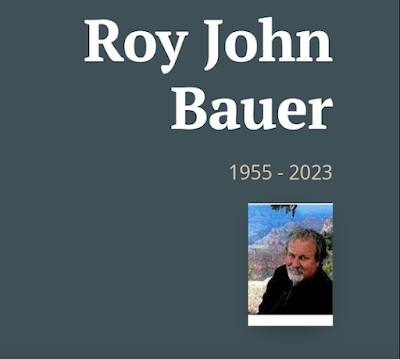
Roy's obituary in LA Times and Register: "we were lucky to have you while we did"

  This ran in the Sunday December 24, 2023 edition of the Los Angeles Times and the Orange County Register : July 14, 1955 - November 20, 2...