Tuesday, August 3, 2010

An undercover investigation of for-profit colleges' recruiting tactics

• Congress's 'Secret Shopper' (Inside Higher Ed)
     A government report detailing the findings of an undercover investigation of for-profit colleges’ recruiting tactics reveals admissions and financial aid officers engaged in unethical and sometimes illegal practices, all in the interest of persuading students to enroll and obtain federal financial aid.
     The report, along with an accompanying video of undercover footage, is the culmination of a three-month effort by the Government Accountability Office, Congress’s investigative wing, to determine whether and to what degree for-profit colleges are engaging in “fraudulent, deceptive or otherwise questionable marketing practices.” A copy of the report is available here.
     Both the report and the video will be released Wednesday morning at the Senate Health, Education, Labor and Pensions Committee’s second oversight hearing on the for-profit sector, where Gregory D. Kutz, GAO’s managing director of forensic audits and special investigations, is set to testify.
. . .
     Undercover investigators posing as students found that employees at all 15 for-profit colleges visited for the investigations made “deceptive or otherwise questionable statements” to students about accreditation, graduation rates, employment outcomes, program costs or financial aid.
     At four institutions visited, admissions or financial aid officials encouraged students to submit fraudulent financial information in order to qualify for federal aid, the GAO says in its report.
. . .
     …Some institutions were chosen because the Education Department reports that they receive at least 89 percent of their revenues from the Title IV federal student aid programs, while others were chosen based on their location in a state that was among the top 10 recipients of Title IV money.
     Because the investigators visited an admittedly specific group of institutions that were already raising red flags for the Title IV program, advocates for for-profit colleges will almost certainly challenge the report’s findings (as they have done in response to many newspaper reports and other investigations), arguing that the GAO cherry-picked institutions where data from the U.S. Department of Education already hinted at potential improprieties, and that the institutions cited represent “bad actors,” not the sector’s norm.
     The investigators also submitted contact information for four prospective students with fictitious identities to “lead generation” websites that supply colleges with names of interested students, and encountered aggressive behavior, they said. Some students began receiving marketing calls from colleges within five minutes of submitting the information and, over the course of a month, one received more than 180 calls. Some came as late as 11 p.m.
. . .
     More damning than aggressive calls are instances in which college employees encouraged prospective students to commit fraud, or conveyed incomplete or false information about the institution’s costs and student outcomes.
     The GAO sent two prospective students using fictitious identities to each of the 15 colleges it investigated -- one with income and assets low enough to qualify for a Pell Grant and the other with $250,000 in savings and annual income too high to qualify for any aid other than unsubsidized loans.
     At four privately-owned colleges, the agency said, undercover students encountered admissions or financial aid officers who encouraged them to submit false financial information to improve their chances of eligibility for federal financial aid.
. . .
     At all four institutions where college employees encouraged applicants to commit fraud, the applicants reported having just received an inheritance of $250,000 – enough to pay full tuition without any grants or loans – and yet were, in all four instances, encouraged to take out loans and offered assistance in altering their financial information to become eligible for federal grants and subsidized loans. But, the report said, “[I]t was unclear what incentive these colleges had to encourage our undercover applicants to fraudulently fill out financial aid forms given the applicants’ ability to pay for college.”
     Not all colleges encouraged prospective students to commit fraud, but all were found to have made “deceptive or otherwise questionable statements” during the recruitment process, the GAO report said.
. . .
     At all but two of the colleges visited, college employees offered deceptive or questionable information about graduation rates, exaggerated likely earnings, or guaranteed applicants jobs after graduation….
     At six colleges in four states, according to the GAO, admissions representatives told undercover applicants that they could not speak with financial aid officers or find out what aid they qualified for until they completed the college’s enrollment forms and paid a small application fee.
     Two colleges told undercover students they could earn rewards like a gift card or an MP3 player by recruiting other students – a practice that could run afoul of a federal statute on “incentive compensation,” depending on the monetary value of those items….
• See also Undercover Investigation Finds Widespread Deception in Marketing by For-Profit Colleges (Chronicle of Higher Education)

• California Dreamer (Inside Higher Ed)
     Much of the news surrounding the University of California system has involved whether the network of universities will be able to survive its current budgetary crisis without shrinking in size or quality. In that context, it is no surprise that Christopher Edley Jr.’s plan to use online education to expand the university’s footprint “from Kentucky to Kuala Lumpur” has turned some heads – and churned some stomachs.
     Edley, dean of the law school at the University of California at Berkeley, has been using his position as co-chair of the education and curriculum working group for the UC Commission on the Future to advocate for an ambitious expansion of the system’s online arm that could eventually include fully-online bachelor's degree programs designed to rake in hundreds of millions of dollars.
     California is not the only state eyeing online education as a way to increase access and cut costs. But while many states are looking to use the popular medium to reach adult learners or save money at non-elite institutions, the University of California is a top-shelf research university that boasts one of the country's most competitive undergraduate programs. If the system does end up offering an online bachelor's degree, it would be a big step for online education.
. . .
     Members of a union representing graduate student-instructors at UC, finding Edley’s plan for “squadrons” of teaching assistants serving on “the frontline of online contact” more than a little dystopic, showed up to a regents’ meeting in May wearing patches that read “Dean Edley = Class(room) Enemy.” Edley’s goals for online education at UC were primarily profit-driven, they argued in a statement, and would “undoubtedly end in the complete implosion of public higher education in the embattled state of California.” Some professors and media outlets have expressed similar concerns.
. . .
     But some UC professors, like the graduate students' union, remain skeptical. The Berkeley Faculty Association — a group of about 300 professors — put out a report in May that did not condemn the pilot but voiced concerns about where Edley wants it to lead.
     The association was particularly unnerved by the idea of graduate student-instructors being the “frontline of contact” with online students, as Edley put it. For some, that sort of talk evokes a model many for-profit institutions have used to keep payroll expenses low and administrative control high: have full-time faculty put together the syllabus, then hire less-expensive adjuncts to deliver it. Faculty resistance to this sort of University of Phoenix-inspired arrangement was a major factor in last year’s implosion of the University of Illinois Global Campus, a similarly ambitious online effort….
     Wendy Brown, a political science professor at Berkeley who co-authored the Faculty Association report, told Inside Higher Ed that she has no qualms with a pilot going forward. What she worries about is the way Edley has been framing it as a first step toward something larger and perhaps more controversial. Inferring from Edley's idea of graduate student-instructors forming the "frontlines of contact" with online students, Brown says she worries the law dean's proposed cyber-campus would contribute to the displacement of full-time faculty members with adjuncts — a perennial concern among traditional faculty everywhere, given the decline of tenure and the popularity of the Phoenix model. “This is absolutely part of a larger set of proposals referred to by the Commission on the Future that describe the necessity of shrinking the letter-rank faculty and increasing part-time faculty,” says Brown….

Mom in Germany: c. 1940-1950

Mom, walking with friends, c. 1949 (that's her on the right)
Mom left Germany for Canada, alone, in 1951, at age 17.
(Click on photos to enlarge them)

Yes, people really do sunbathe on the beach in Germany.
Mom c. 1950
UPDATE: she tells me that she often took her vacations at a coastal resort town north of Hamburg, on the Baltic Sea (Timmendorfer Strand). She usually went with some girlfriends, and sometimes with some old boy friends (i.e., town friends who happened to be boys and who regarded her virtually as a sister). It was all very innocent, she insists. They slept in tents at the beach. They had virtually no money. Mom seemed to know how to have fun.

Visiting the grave of her stepfather, c. 1941

I don't know what this is about. I'll ask!
UPDATE: mom tells me that, starting at age 14, she started training to become a kind of county clerk--a bureaucratic government worker. Her four classmates were all boys. Needless to say, she was popular with them and with the teacher. She was only three weeks away from completing her training when she set out for Canada in 1951. "The boys were all good at math," she says, "but not me. But they were always very willing to help me with that."

Monday, August 2, 2010

The era of über-cluelessness: most voters have no clue how clueless they are

     In my view, the moral of the “Bell” scandal isn’t that greedy and unscrupulous creeps have bilked the taxpayer; the more important lesson here is that most citizens wrongly imagine that, if evil or corruption or mismanagement is afoot in government, the “system” will detect it and take steps to deal with it. And so people are stunned by this crazy Bell fubar.
     They shouldn’t be. Our system is now such that shit happens in their city, county, state and federal government all of the time about which they haven’t a solitary clue. It's still pretty easy to get clued in. But people don't make the effort. They don't think they need to. They even think they are knowledgeable.
     They're deeply, f*cking clueless. They're über-clueless!
     The prevailing cluelessness of voters—admittedly, also encouraged by the decline of local newsreporting—is well illustrated by the SOCCCD. Our seven elected trustees oversee the expenditure of hundreds of millions of taxpayer dollars. Do people understand this? Do they know who these trustees are and how they conduct themselves? Clearly not. Over and over again, trustee incumbents are reelected, even when they act badly and irresponsibly. Several of them have done so. For years.
     The SOCCCD comprises three campuses: Saddleback College, Irvine Valley College, and ATEP (the Advanced Technical and Education Park), in Tustin. Very big things have been promised at ATEP for many years—it’s the SOCCCD’s endlessly promised but albatrossian “Great Park”—and, despite the expenditure of many millions of dollars, all we have there so far is a dinky cluster of tin buildings, a few bewildered administrators, and a few hundred students.
     The board has been divided about ATEP, but its champions have generally prevailed, in part because of the ardent advocacy of former Chancellor Raghu Mathur, who saw the facility as his Mt. Rushmore. It seems to me that it was not unreasonable for trustees, all those many years ago, to pursue the property, which was part of the old Tustin Marine Corps Air Station, and to try to do something special with it. But, in part owing to some bad luck, things haven’t worked out.
     For several years now, it has seemed to many observers that we’re throwing good money after bad. In the meantime, money gets tighter and tighter, and important college services have been cut back or worse.
     Do citizens have any idea about this? Don’t think so.


* * *
     As it happens, one of our trustees, John Williams, is also the county’s Public Guardian/Public Administrator, a job that he has royally screwed up, or so said two Grand Jury reports and lots of unhappy people who work or have worked with the fellow.
     Williams eventually faced a kind of “day of reckoning” before the OC Board of Supervisors, but at least four of the five Supes are politically affiliated with Williams. Three of them decided essentially to leave Williams and his combined offices alone, despite the top-heavy management, the irregularities and unprofessionalism, the growing costs. It was outrageous and inexplicable (well, no, it was way explicable, I’m afraid).
     Does the community understand any of this? Clearly not. In the recent election, despite those “scathing” Grand Jury reports, Williams was reelected.
* * *
     Two important issues have come up in county politics very recently: redistricting and campaign finance restrictions. Things could have gone very badly, but that hasn’t happened yet. Do you think your neighbors know about this?
     Journalists do report these things. We’ve still got some excellent news media in this county. For instance, the Voice of OC seems so far to be doing a good job reporting on important local issues in politics. I've been a big fan from the start.
     Check out editor-in-chief Norberto Santana’s recent appearance on the Real Orange (KOCE). Again, important decisions are being made—or, more recently, have failed to be made—in county government. Santana lays it out.
     And don’t forget to read The Voice of OC online!

Clueless feds, clueless youth—clueless freakin' everybody

Puppies do not plagiarize; nor do they offer poor theistic arguments

FBI Admits It Tracked Howard Zinn (Inside Higher Ed)
     The Federal Bureau of Investigation on Friday admitted that it tracked Howard Zinn, the noted historian and political activist who died in January, from 1949 to 1974, and the bureau released 423 pages of records from the monitoring of Zinn. Salon noted that this monitoring took place "despite having apparently no evidence that he ever committed a crime." And TPM noted that the records indicate that a senior official at Boston University, where Zinn taught, tried to have him fired in 1970. (If you are wondering if that official might have been John Silber, the long-time BU president with whom Zinn had many disagreements, it wasn't, as Silber hadn't been hired at the time.)
Plagiarism Lines Blur for Students in Digital Age (Trip Gabriel, New York Times)
     At Rhode Island College, a freshman copied and pasted from a Web site’s frequently asked questions page about homelessness — and did not think he needed to credit a source in his assignment because the page did not include author information.
     At DePaul University, the tip-off to one student’s copying was the purple shade of several paragraphs he had lifted from the Web; when confronted by a writing tutor his professor had sent him to, he was not defensive — he just wanted to know how to change purple text to black.
     And at the University of Maryland, a student reprimanded for copying from Wikipedia in a paper on the Great Depression said he thought its entries — unsigned and collectively written — did not need to be credited since they counted, essentially, as common knowledge.
. . .
     [T]hese cases — typical ones, according to writing tutors and officials responsible for discipline at the three schools who described the plagiarism — suggest that many students simply do not grasp that using words they did not write is a serious misdeed.
. . .
     “Now we have a whole generation of students who’ve grown up with information that just seems to be hanging out there in cyberspace and doesn’t seem to have an author,” said Teresa Fishman, director of the Center for Academic Integrity at Clemson University. “It’s possible to believe this information is just out there for anyone to take.”
. . .
     …[Th]e number who believed that copying from the Web constitutes “serious cheating” is declining — to 29 percent on average in recent surveys from 34 percent earlier in the decade.
. . .
     A University of Notre Dame anthropologist, Susan D. Blum, disturbed by the high rates of reported plagiarism, set out to understand how students view authorship and the written word, or “texts” in Ms. Blum’s academic language.
     She conducted her ethnographic research among 234 Notre Dame undergraduates.
     “Today’s students stand at the crossroads of a new way of conceiving texts and the people who create them and who quote them,” she wrote last year in the book “My Word!: Plagiarism and College Culture,” published by Cornell University Press.
     Ms. Blum argued that student writing exhibits some of the same qualities of pastiche that drive other creative endeavors today — TV shows that constantly reference other shows or rap music that samples from earlier songs.
     In an interview, she said the idea of an author whose singular effort creates an original work is rooted in Enlightenment ideas of the individual. It is buttressed by the Western concept of intellectual property rights as secured by copyright law. But both traditions are being challenged.
     “Our notion of authorship and originality was born, it flourished, and it may be waning,” Ms. Blum said.
. . .
     At the University of California, Davis, of the 196 plagiarism cases referred to the disciplinary office last year, a majority did not involve students ignorant of the need to credit the writing of others.
     Many times, said Donald J. Dudley, who oversees the discipline office on the campus of 32,000, it was students who intentionally copied — knowing it was wrong — who were “unwilling to engage the writing process.”….
Philosophy and Faith (Gary Gutting, New York Times)
     …The standard view is that philosophers’ disagreements over arguments about God make their views irrelevant to the faith of ordinary believers and non-believers. The claim seems obvious: if we professionals can’t agree among ourselves, what can we have to offer to non-professionals? An appeal to experts requires consensus among those experts, which philosophers don’t have.
     This line of thought ignores the fact that when philosophers’ disagree it is only about specific aspects of the most subtle and sophisticated versions of arguments for and against God’s existence…. There is no disagreement among philosophers about the more popular arguments to which theists and atheists typically appeal: as formulated, they do not prove (that is, logically derive from uncontroversial premises) what they claim to prove. They are clearly inadequate in the judgment of qualified professionals. Further, there are no more sophisticated formulations that theists or atheists can accept — the way we do scientific claims — on the authority of expert consensus.
     In these popular debates about God’s existence, the winners are neither theists nor atheists, but agnostics — the neglected step-children of religious controversy, who rightly point out that neither side in the debate has made its case. This is the position supported by the consensus of expert philosophical opinion.
     This conclusion should particularly discomfit popular proponents of atheism, such as Richard Dawkins, whose position is entirely based on demonstrably faulty arguments. Believers, of course, can fall back on the logically less rigorous support that they characterize as faith. But then they need to reflect on just what sort of support faith can give to religious belief. How are my students’ warm feelings of certainty as they hug one another at Sunday Mass in their dorm really any different from the trust they might experience while under the spell of a really plausible salesperson?
     What sort of religious experience could support the claim that Jesus Christ was God incarnate and not just a great moral teacher?. . .
     But how can religious experience sustain faith in a specific salvation narrative, particularly given the stark differences among the accounts of the great religious traditions? What sort of religious experience could support the claim that Jesus Christ was God incarnate and not just a great moral teacher? Or that the Bible rather than the Koran is the revelation of God’s own words? Believers may have strong feelings of certainty, but each religion rejects the certainty of all the others, which leaves us asking why they privilege their own faith….

Sunday, August 1, 2010

From the archives

Mammoth Mountain
(Click on photos to enlarge them)


Sunny Girl and her two kittens (Kathie took this one)


North of Morro Rock


Bishop sunset


Felix, cat ("Fat Thing")


Santiago Oaks Park


My good pal Buster, cat


The magnificent Ildy Pie


Sunny Girl again

The elderly, wonderful Ildy

Friday, July 30, 2010

Special SOCCCD board meeting on Wednesday

     I just noticed that there is an announcement of a Special Board Meeting posted on the district website.
     The meeting concerns the districts's Advanced Technology and Education Park (ATEP) in Tustin.
     Below are the "notice" and the first of agenda item:


(Click on the graphics to make them larger.)

Oddly, the last and crucial line of the "background" is an incomplete sentence: "As construction activities come closer it is believed that seeking professional real estate brokerage services with firms with established national higher education experience and contracts...." 


     Presumably, the author meant to say that securing the services of such a company might lead to success after all of these years of failure. Something like that. (It will certainly lead to considerable expense.)
     All is made clear, I suppose, in the remainder of the agenda, including the Chancellor's recommendation: to approve an agreement with CB Richard Ellis, Inc., which claims to be the world leader in its kind of real estate business.
     CBRE has a satellite office in tony Newport Beach that is managed by Mark Prottas.
     I did a quick search, and the guy doesn't appear to be the Grand Wizard of the KKK or anything. I couldn't even link 'im to the Republicans!

“Ask God what your grade is”

LA college district tries to use UC Hastings ruling in its free-speech case (California Watchdog)

     When the U.S. Supreme Court endorsed a UC Hastings College of the Law decision to bar a Christian student group from receiving university funds last month, some free-speech advocates winced, saying the court's opinion would be used by colleges and universities to squelch offensive or unpopular speech.
     It looks like they might be right.
     The Los Angeles Community College District is trying to use the Hastings ruling to bolster its defense in a speech code case, in which a college professor mocked a student who was speaking about his Christian faith in class.
     The Los Angeles case began in fall 2008 when Los Angeles City College student Jonathan Lopez gave an impassioned talk about his Christian beliefs during a Speech 101 class. He spoke about his opposition to gay marriage in the wake of the passage of the controversial Proposition 8, which banned gay marriage in the state.
     According to the complaint, professor John Matteson interrupted Lopez, called him a "fascist bastard" and refused to let him finish his speech. Matteson left an evaluation form on Lopez's backpack that said "Ask God what your grade is."
     Lopez sued, seeking financial damages and a ban on enforcing the sexual harassment code, which prohibited "hostile" and "offensive" remarks in and out of the classroom.
     In a motion to dismiss, college district officials said they did not approve of Matteson's behavior and had put him through a disciplinary process. But Lopez's suit, they said, was a publicity stunt. The Speech 101 class was not a public forum and First Amendment rights could be limited in that setting, they argued.
     In July 2009, U.S. District Judge George H. King granted a preliminary injunction barring the enforcement of the harassment code at the district, the Los Angeles Times reported. The college district appealed....

College in Mississippi Withdraws Penalties Against Student Who Swore (Chronicle of Higher Education)

     A community college in Mississippi has dropped penalties against a student for using a profanity after learning he had received a poor grade on a tardy assignment. The student, Isaac Rosenbloom, said in an interview that Hinds Community College sent a letter on Tuesday stating that he would "not suffer any future consequences" related to the March 29 incident.
     Mr. Rosenbloom and a few other students had remained after a speech class one day to discuss their grades with the instructor, Barbara Pyle. Upon seeing that he had received a score of 74 on the late assignment, Mr. Rosenbloom testified in a recorded disciplinary hearing that he turned to a classmate and said, "This grade is going to [expletive] up my entire GPA." He said the instructor had told him his language was unacceptable and ordered him to detention.
     Hinds does not have detention, but it does punish students who use profanity through a system of fines and demerits, an arrangement that the Foundation for Individual Rights in Education, a free-speech advocacy group known as FIRE, contends is unconstitutional.
     Hinds found Mr. Rosenbloom guilty of "flagrant disrespect" and issued 12 demerits against him. The college also blocked him from finishing the course and placed a record of the incident in his student file, an action that FIRE says caused Mr. Rosenbloom to lose his student aid.
     Mr. Rosenbloom, who works as an emergency medical technician and is pursuing paramedic training at Hinds, appealed the decision twice and lost both times. His lawyers, Robert B. McDuff and Sibyl C. Byrd, persuaded Hinds to reverse its decision, according to a statement by FIRE….

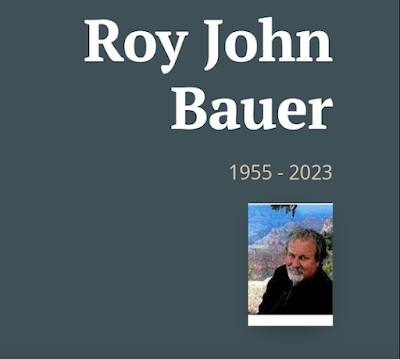
Roy's obituary in LA Times and Register: "we were lucky to have you while we did"

  This ran in the Sunday December 24, 2023 edition of the Los Angeles Times and the Orange County Register : July 14, 1955 - November 20, 2...