Sunday, January 9, 2011

Update on the tutoring "protocol"

     1/09/11 — I spoke this afternoon with someone knowledgeable about the Learning Center and the new “protocol” according to which instructors who leave the box (that appears at the bottom of their rosters) checked thereby “refer” all of their students to tutoring.
     It is, I think, natural for faculty to suppose that the new “protocol” entails some process whereby each of one’s students is sent to the Learning Center to meet with a tutor. Evidently, that is not what is involved here. As the practice was explained to me this afternoon, the new protocol simply brings it about that  students who seek tutoring will not have to go to the trouble of acquiring their instructor’s signature; nor will the instructor be inconvenienced; for the signature/referral has already been supplied (if, that is, the instructor has left that box checked).
     Evidently, no “boondoggle” is involved in the increase in “referrals” (likely brought about by the “protocol"). That is because the Learning Center has a budget and it must stay within that budget when, for instance, it pays tutors. There is no opportunity for bringing in further monies by maximizing referrals to tutoring. At some point, the Learning Center provides an accounting of the number of tutoring hours that it has provided throughout the year (again, within the budget); and that amount is eventually reimbursed by the state (this is the apportionment). Again, there is no opportunity to spend money beyond what is budgeted each year.
     I have also been told that it is an error to suppose that the tutors of the Learning Center attempt to do what instructors do. In fact, they have been trained to provide assistance that emphasizes the nature and importance of study skills, preparing for classes, and the like. What they do is very unlike what instructors do and does not presuppose the sort of specific and deep understandings of an expert in some field.
     Further, it is in fact quite easy for a student to gain a referral for tutoring. Again, the point of the protocol was merely to eliminate the phenomenon of students hunting down and pestering their instructors for referrals.
     Briefly, I should add that this protocol developed over the last year at Saddleback College—not at IVC—and it arose as an opportunity for Irvine Valley College only three or so days ago. That is, IVC was simply brought into a scheme that had been the product of a lengthy process at its sister college. Perhaps that could have been handled better.
     It does appear to me that their have been some “failures to communicate” here that could have been avoided. But it does also now seem to me that there is no great problem afoot.
     No doubt, more clarity will be brought to this situation in the coming days. We should all probably relax. One possible benefit of this little brouhaha is that we are all reminded that there is indeed a Learning Center and that it does provide tutoring and that the tutors have been trained to emphasize study skills and the like.
     To learn more about the IVC Learning Center and what it offers, please go here. See also here for SC's Learning Assistance Program.

GP's pup

Saturday, January 8, 2011

Referring students, sight unseen, to tutoring? Huh?

     [See Update above.]
     1/08/11 — Yesterday, Rebel Girl called me to relate a story she had heard about a recent School meeting. According to the story, at the meeting, faculty were informed (by the head of our Learning Center) that, upon downloading our rosters (for our classes, which begin on Monday), we (faculty) will somehow automatically refer our students to tutoring. We can “opt out” by undoing the check in a box.
     Something like that.
     I didn’t know what to make of the story. Sounded mighty strange.
     Subsequently, all faculty (at IVC) received an email from the district’s TechMaster, Jim Gaston, which referred to precisely this new peculiarity of our rosters. “As a part of Title 5 requirements,” he wrote,
an instructor-generated electronic tutor referral protocol is being added to MySite faculty rosters for the Spring 2011 Semester. At the bottom of the roster download page in MySite you’ll see the following text:

In support of student success, I refer all students listed on this roster to tutoring assistance in the Learning Center, if available. Please contact the Coordinator of the Learning Center to discuss specific learning needs for your students.

There is a checkbox labeled “Learning Center Approved” and it is checked by default. The first time you download your roster each semester your approval for your students to access the services of the Learning Center will be recorded which will greatly streamline student access to these services. If for some reason, you do not want your students to use the Learning Center, simply uncheck the box before you click on the “Retrieve” button. The checkbox will only be available the first time you download your roster each semester.
     I’ve got to say: this seems mighty hinky to me. The default, it seems, is an instructor’s referring “all students” (in his class/section) to tutoring. An instructor has to go out of his or her way not to do these blanket referrals.
     But doesn’t this new "protocol" presuppose that all students of an instructor who leaves the box checked require tutoring? How on Earth can an instructor make that determination before he has met with his students (i.e., when he downloads his roster, something he does before the first day of class)?
     Like I said. Hinky.
* * * * *

     I told Rebel Girl that I’d look up the actual language in Title 5.
     I went to the State Chancellor’s website (which is part of the system of California government websites). That led me to:

Title 5 Guidelines Related to Curriculum and Instruction

     And that led me to

California Community Colleges Supplemental Learning Assistance and Tutoring Regulations and Guidelines

     Bingo.
     I skimmed the document (a pdf) to a section about “Apportionment for Tutoring” ("apportionment" refers to the distribution of monies—typically, by the state—to individual college districts). There, one learns that “Apportionment may be claimed for individual student tutoring only if all the following conditions are met…" (page 9).
     The conditions are pretty much what you’d expect. The tutoring must occur at or through a designated learning center; the learning center must be properly supervised; the tutors must receive training; etc.
     Unsurprisingly, among the conditions is (e):
Students enroll in the Supervised Tutoring course … after referral by a counselor or an instructor on the basis of an identified learning need.
     Elsewhere in the document, we are told:
A counselor or an instructor, on the basis of an identified learning need, must refer all students seeking tutoring. Students cannot refer themselves for tutoring….” (p. 10)
     OK, so the point is that, to do this tutoring thing right, all students who are tutored (through this state-supported system) must be enrolled on the basis of a referral.
     The referral must be by a “counselor or an instructor.”
     The latter must be referring the student to tutoring because of “an identified learning need.”
     Got it.
     Is this what Gaston is referring to when he refers to Title 5? Guess so.
     Gaston (well, since he’s the tech guy, no doubt he’s going by what he’s been told by, say, a VPI or some other academic administrator/authority) seems to be saying that, if the college is to provide maximal tutoring in a manner that squares with Title 5, we’d better find a way to have students pretty much automatically referred to tutoring by instructors.
     Is that Gaston's message to faculty? Are we missing something here?
     Please tell us if we’re wrong about this.
     Presumably, Title 5 includes condition (e) (at least in part) because the state does not wish to support boondoggles. No, the state is happy to support tutoring if it exists to deal with a “learning need” that has been identified in an actual student by an actual instructor. But it has no intention of supporting a tutoring free-for-all.
     Am I right? Is that what e is about?
     If so, it’s hard to avoid the conclusion that something hinky is afoot here. "Greatly streamlined" access? Well, that's one way to put it. I will resist the urge to offer a more telling phrase.
     This new “protocol” whereby students are referred by instructors to tutoring before the instructors have met with the students surely violates the spirit of this law (—if, that is, I understand the law correctly).
     Well, in any case, I personally would take a dim view of an instructor who would “refer” all of his students to tutoring before he has actually encountered them and has considered their ability/work. Do bear in mind that, as one might expect, a significant proportion of our students do not require tutoring.
     ALSO: shouldn’t this “protocol” have been approved by faculty? I mean, it creates a situation in which, obviously, inattentive faculty (um, there are lots of those) will be doing lots of referring without knowing it. Why would we go along with something like that? And I don't recall this coming up at a Senate meeting. (OK, I do forget things sometimes.)
     Let us know what you think. If we've made a factual mistake, we'll be happy to correct it, as always.

Tea and bullets


"Arizona has become a Mecca for prejudice and bigotry."
—Pima County Sheriff Clarence Dupnik
(at a press conference today)

"Don’t Retreat; Instead – RELOAD!"
—Sarah Palin

"We’re paying particular attention to those House members who voted in favor of Obamacare and represent districts that Senator John McCain and I carried during the 2008 election... [W]e’re going to hold them accountable for this disastrous Obamacare vote. They are: Ann Kirkpatrick (AZ-1), Harry E. Mitchell (AZ-5), Gabrielle Giffords (AZ-8)...."
—Sarah Palin

Friday, January 7, 2011

Creepological postings (in the past year)

     What with Tom Fuentes being named Dissent the Blog's “SOCCCD creep of the decade,” I thought it might be nice to gather together some of the factoids that explain his creepimorphic infamy.
     Below are posts concerning trustee Fuentes that appeared on DtB in the last year or so. They paint quite a picture. Of a Creep. (I might add earlier posts.)
     (Rebel Girl, it seems, is annoyed that Fuentes got the nod before our little poll (at right) was quite finished. I think she was figurin’ on Dave Lang as our SuperCreep. But C’mon! The people have spoken! Mostly.)

Tom Fuentes at age 34: "consultant"
Tom Fuentes: professional schmoozer, circumventer of open processes, and THUG
Was Tom Fuentes a shill for LFC re the Coast Rabbit Island sale?
Tom Fuentes: ubiquitous paid consultant
Fuentes, Williams, & LFC: new documents
Tom Fuentes and LFC/Lange
LFC, Fuentes, and Williams: oh my!
New charges filed against one of Tom Fuentes’ former advisees
The long and lurid FUENTESization of the SOCCCD
Tom discusses tomorrow's commencement
Low in the Fuentesphere (where it's always low)
History question: who argued that college Poli Sci professors should teach the Board’s political views? Guess!
Old boys, young boys in the OC GOP
A new board majority? Fuentes gets hopping mad


Tom's "poll guards." Remember?
OK, this isn't about Tom, but I just like it so much that I'm gonna show it again.

The Fair Political Practices Commission and Tom Fuentes

     Months ago, DtB noted the curious fact that Trustee Tom Fuentes did not list LFC (Lang Financial Corporation) on his economic disclosure forms. In fact, Fuentes has flatly stated that he has no financial interest in LFC. DtB, however, found seemingly clear indications that, at least until a few years ago, Fuentes was a Senior Vice President with the firm.
     Today, the OC Reg reports that, according to Fair Political Practices Commission officials, Fuentes seems to be violating the law:

Should public official have disclosed business relationship?

     Should a public official disclose his status as an officer of a company that does business with public agencies, even if he doesn’t get paid?
     The Fair Political Practices Commission says yes.
     Tom Fuentes, former chairman of the Orange County Republican Party, long-time trustee of a community college and senior vice president of a Newport Beach auction house called LFC, says no.
     Fuentes maintained an office at LFC for about three years beginning around 2004, he says. As recently as this week, he was still sending out emails on an LFC account.
     But as our colleagues over at Voice of OC have reported, Fuentes never mentioned LFC on any of the economic disclosure forms he was required to file from 2004 to 2010 as a trustee of the South Coast County Community College District.
     That’s a potential violation of state law, punishable by a fine of up to $5,000 for each violation, the FPPC says.
     Fuentes’ relationship with the auction house and with Public Administrator/Public Guardian John S. Williams, who uses LFC for land sales, has drawn the interest of county officials.
     Williams’ office was criticized in two Orange County grand jury reports in 2009, and has come under renewed fire since August. That’s when former state Assemblyman and county supervisor Todd Spitzer was fired from his post at the Orange County District Attorney’s office after he started asking questions about a conservatorship being handled by Williams.
     Fuentes and Williams served together on the community college district together for years until Williams resigned last month.
     Williams also gave a testimonial for LFC on the company’s website, praising LFC’s Internet-based auction program and highlighting its work to help Orange County out of its bankruptcy in 1990s.
     County officials worry that this is all too cozy; the supervisors have ordered a review into the Public Administrator/Public Guardian’s Office along with its dealings with LFC.
     In an email obtained by The Watchdog through the California Public Records Act, Fuentes explained to Williams his relationship with LFC. Williams had asked him to write the explanation, Fuentes told The Watchdog.
     Fuentes acknowledged in the Sept. 28 email he had maintained the office space and had access to a company email account. But Fuentes maintained “I have no financial interest in LFC, nor do I receive any compensation from LFC.”
     Fuentes reiterated that claim in an interview with The Watchdog.
     “I’ve never been on their payroll,” Fuentes told us. “I have no fiduciary interest in LFC.”
     As for his Statements of Economic Interest, no disclosure was made of his relationship with LFC because no money was changing hands, he said. And the title of senior vice president was merely a courtesy title given by the owners of LFC, who are lifelong friends.
     The California Political Reform Act says that public officials who hold a title with a for-profit company are required to disclose the relationship on their Form 700 Statement of Economic Interest.
     Section 18703.1 of the Regulations of the Fair Political Practices Commission states that “a public official has an economic interest in a business entity if … The public official is a director, officer, partner, trustee, employee, or holds any position of management in the business entity.” A pamphlet published by the state explaining how to fill out an economic disclosure form states that officials are required to “(d)isclose the job title or business position, if any, that you held with the business entity, even if you did not receive income during the reporting period.”
     In other words, if you have a title with a company you have, by definition, a business interest in that company and are required to disclose it, said Roman Porter, executive director of the California Fair Political Practices Commission, the state’s political watchdog.
     Porter said disclosing such relationships are important, even if no money changes hands, because it “makes the official and the public aware of any potential conflicts of interest.”
     Porter, speaking generally about the law, said failing to disclose a business interest carries the same penalty as any violation of the Political Reform Act: a fine of up to $5,000. He noted, however, that determining whether a violation occurred requires some investigation. Sometimes the specifics of a case may mean there was no violation.
     The law firm hired by the county to investigate Williams and his agency is expected to make a report of its findings to the county CEO in mid-January.
     It is unclear how much of that report will be made public.

Rebel Girl's Poetry Corner: "remembering mine"


In this morning's New York Times, Michiko Kakutani weighs in on the recent, uh, revision of Huck Finn which replaces the term "nigger" with the word "slave":

excerpt:
Haven’t we learned by now that removing books from the curriculum just deprives children of exposure to classic works of literature? Worse, it relieves teachers of the fundamental responsibility of putting such books in context — of helping students understand that “Huckleberry Finn” actually stands as a powerful indictment of slavery (with Nigger Jim its most noble character), of using its contested language as an opportunity to explore the painful complexities of race relations in this country. To censor or redact books on school reading lists is a form of denial: shutting the door on harsh historical realities — whitewashing them or pretending they do not exist.

Mr. Gribben’s effort to update “Huckleberry Finn” (published in an edition with “The Adventures of Tom Sawyer” by NewSouth Books), like Mr. Foley’s assertion that it’s an old book and “we’re ready for new,” ratifies the narcissistic contemporary belief that art should be inoffensive and accessible; that books, plays and poetry from other times and places should somehow be made to conform to today’s democratic ideals. It’s like the politically correct efforts in the ’80s to exile great authors like Conrad and Melville from the canon because their work does not feature enough women or projects colonialist attitudes.

Authors’ original texts should be sacrosanct intellectual property, whether a book is a classic or not. Tampering with a writer’s words underscores both editors’ extraordinary hubris and a cavalier attitude embraced by more and more people in this day of mash-ups, sampling and digital books — the attitude that all texts are fungible, that readers are entitled to alter as they please, that the very idea of authorship is old-fashioned.
Rebel Girl considered this in the context of yesterday's reading of the Constitution by members of the House of Representatives.

The version offered up was the amended version, not the full original text with its three-fifths clause, which deemed "slaves" as less than full-people for population counting purposes as well as other references.

This desire to shut the door to the past reminded her of a poem by the late poet Lucille Clifton:

why some people be mad at me sometimes
they ask me to remember

but they want me to remember

their memories

and I keep on remembering
mine

To read the rest of Kakutani's essay, click here.

(above: Thomas Hart Benton, A Social History of the State of Missouri: Huckleberry Finn (detail of north wall), 1936, Missouri Department of Natural Resources, Missouri State Museum.)

*

Thursday, January 6, 2011

Tom Fuentes: DtB's SOCCCD "CREEP OF THE DECADE"

Tom thinks he's Tom America. But he's really Freddie Beelzebub
Tom is well-known for building and maintaining his machine, though he was eventually compelled to hand over his wrench
A more pious man you'll never meet
Tom really likes to hang with the boys, especially at the BBC
Tom in his element: doin' somethin' mean to somebody
Here's Tom fully engaged in his pre-prayer warmup, which is quite involved. I don't think Nancy thinks much of it or him.
Part of our popular "King Kong" series
Occasionally, we illustrate Tom's wild years
No doubt Tom fantasizes about a return to his lapsed simian glory

I friend sent this video. Pretty good, I guess.

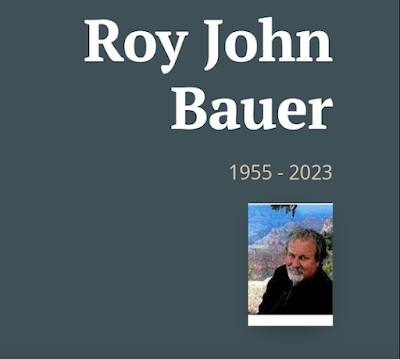
Roy's obituary in LA Times and Register: "we were lucky to have you while we did"

  This ran in the Sunday December 24, 2023 edition of the Los Angeles Times and the Orange County Register : July 14, 1955 - November 20, 2...