Thursday, November 25, 2010

Never listen to those fools at the CCLC


     Our district—the SOCCCD—pays the “Community College League of California” (CCLC) $36,000 a year in membership dues. Evidently, all 72 of the state’s CC districts pay their share and are members.
     I’m not sure how the board feels about the CCLC. Once in a while, some trustees grumble about some of the district’s memberships, but I’m not sure if they’ve carped about CCLC in particular. In any case, some board members have connections with the CCLC, and some have even been CCLC officers (including John Williams, I think; no doubt he got a trip to Orlando out of it).
     I recently visited CCLC’s website and came across some interesting info. For instance, the organization offers advice about trusteeship (here), including “What Being a Trustee is Not.” Ready?
     You have no personal authority as an individual trustee. ... Individual trustees do not direct college staff or programs.
     Being a trustee is not a paying job, although state law permits a stipend for board service. Trustees rarely have offices; staff support is for the board as a whole. Being a trustee is a public service—a gift of individual talent, experience, knowledge, energy and time....
     Trustees should not use the board to focus on single interests [e.g., the Bible-totin’ Booboisie] or the needs of employee groups [goddam unions]. While those interests are important, trustees are there to represent the common public good. The board is not a platform for individual campaigns for future public office….
     Something tells me that Don and Tom (and John and Quisling Boy) don’t agree with CCLC about trustee NOTitude. —Or they agree, but they've opted for being wicked is all.
     Imagine Don Wagner’s “Complete Idiot’s Guide to Community College Trusteeship.” His “5 crucial tips” might be:
  1. Yell down opponents and recalcitrants, even Marcia, until they shut the f*ck up.
  2. If yelling doesn’t work, glare at ‘em as if you’re contemplating violence.
  3. Never apologize, but pledge to the flag and pray often and noisily.
  4. Don’t hire that bastard Raghu P. Mathur.
  5. Don’t listen to those fools at the CCLC.
     CCLC "TALKING POINTS": Boy, those CCLC people sure are opinionated! Check out their responses to “Common Criticisms” (I’ve excerpted from lengthier responses). To me, these responses sound like political "talking points":

Too many trustees turn the office into a full-time job, becoming inappropriately immersed in the internal operations of the college.

Horror story
“Of the 435 elected trustees serving on the boards of the state’s 71 community colleges districts, there are trustees who take the job so seriously and who are so committed to helping their districts that they sometimes do become involved in activities better left to college administrators. But this number is very small and certainly does represent a significant statewide problem. It gets a great deal attention, however, because anecdotes—or ‘horror stories’—about a handful of trustees get spread statewide and are repeated often.”

Too many candidates supported by special interests such as employee unions are elected to boards of trustees, thus giving these groups far too much influence on the boards and creating roadblocks for innovation and change.

“It is true that district boards have been criticized for being under the influence of employee unions. It is also true, however, that boards have been criticized for being unresponsive to employee unions.”

Look for the union label
It is not appropriate to have a K-12 governance model imposed on a collegiate institution.

“There is an unspoken assumption in this particular criticism that any connection to K-12 education is demeaning to a higher education system. In fact, California’s 90-year system of community college governance, with its emphasis on the leadership of locally-elected boards, has been replicated throughout the nation.”

Local boards are responsible for the rapid turnover of community college [CEOs], which has led to a breakdown in leadership and effective management.

“In any organization there will arise, from time to time, conflict over goals, processes or priorities that result in disagreement and difficult relationships between individuals…. ¶ Some boards and CEOs do have a difficult time working together. Some CEOs have poor communication or leadership skills [yeah, or they’re just rat bastards]. Some boards lack good judgment when selecting a new CEO or when working with the CEO.”

Orlando Boy
The notion of community service has been lost. Trustees are provided generous financial compensation as well as health and life insurance benefits.

“Very few trustees are wealthy. To some degree, receiving compensation allows trustees to spend the time necessary to undertake their significant responsibilities. The compensation received equals very low wages when divided by the hundreds and hundreds of hours required to do the job.”

Elections of community college trustees are a sham. Only a small percentage of voters actually cast ballots for trustees. They do not truly represent the people.

“Board members … do everything in their power to encourage voters to participate in the democratic process. In some district elections, tens of thousands of voters, even hundreds of thousands of voters, turnout for the community college board election. In some, very few people turn out. Low voter turnout is a much broader societal issue. ¶ But whether a lot or a few, the successful candidate received, in the end, the endorsement of local voters—something an appointed board can never claim.”

Community colleges operate under an incompatible finance and governance structure. The state pays a majority of the bills and locally-elected boards make a majority of the decisions.

“In many of our own personal lives, someone else decides our income level but we make the decisions about how to spend that income. Sound decision-making does not require those who control the revenue level to be the same as those who decide the expenditure levels. In truth, proponents of this argument are advocates of the political Golden Rule: ‘He who has the gold, rules.’ That does not equate with sound education judgments.”

Deregulation is good, evidently.
A rigid, state-determined finance system is imposed on campuses that are locally governed and administered, causing conflict and preventing cooperation and coordination.

“In other sectors of our society and economy, deregulation has fueled creativity and innovation [and massive taxpayer bailouts]. In the community colleges, however, decisions that should be left to locally-elected board members and educators are often pre-empted by State law and regulation.”

The community colleges’ historical vestiges with California’s public elementary and secondary schools continue to be evident in several ways and contribute to the perception that it is not an equal partner in California higher education.

“As the [1960] Master Plan made clear, the three systems of higher education are intended to accomplish complementary but unique missions. The mission of the community colleges is not to be a world-renown research university…. The community college mission is, however, of equal value to the residents of this state and, according to public opinion polls, more highly regarded than either UC or CSU.”

If community colleges were governed by centralized boards like the University of California and the California State University, they would be much more prestigious institutions.

“‘Prestige’ is an issue that rests squarely in the mind of the beholder. Universities as diverse as Harvard and Cal State, Hayward are often considered by academicians more ‘prestigious’ than community colleges because of their student body, the degrees held by faculty, the degrees awarded by the institution, their research mission and the visibility of successful faculty and alumni.”

Organizing community college districts under a state board would allow districts to cut back on administration and put more money and resources into the classroom.

“There is no evidence that implementing a single state board governance structure would reduce administrative costs.”

P.S.: CCLC has a handful of corporate partners, including the big law firm of SOCCCD attorney Warren Kinsler: Atkinson, Andelson, Loya, Ruud & Romo. The notorious Capo Unified School District also retains this firm. Another corporate partner: Keenan & Associates--also retained by the SOCCCD.

Higher education as a deeply uncivic project

 
"I think it would be a good idea."
     —Mahatma Gandhi, when asked what he thought of Western civilization

     A friend sent this article (see below) my way.
     I’m no Marxist. I am less impressed by Freire and Giroux’s radical theorizing than my friend.
     On the other hand, I recognize that huge changes are afoot, and, in the absence of leadership, education in this country is becoming far more hollow than it has already been. I am amazed by the trends and the forces at work—and, as usual, by the general stupor of Americans and their educators.
     Good grief.
     I do wish radicals would abandon their religion and then learn to speak more plainly.* Still…
Lessons to Be Learned From Paulo Freire as Education Is Being Taken Over by the Mega Rich (Truthout)

Henry A. Giroux

     At a time when memory is being erased and the political relevance of education is dismissed in the language of measurement and quantification, it is all the more important to remember the legacy and work of Paulo Freire. Freire is one of the most important educators of the 20th century and is considered one of the most important theorists of "critical pedagogy" – the educational movement guided by both passion and principle to help students develop a consciousness of freedom, recognize authoritarian tendencies, empower the imagination, connect knowledge and truth to power and learn to read both the word and the world as part of a broader struggle for agency, justice and democracy. His groundbreaking book, "Pedagogy of the Oppressed," has sold more than a million copies and is deservedly being commemorated this year – the 40th anniversary of its appearance in English translation – after having exerted its influence over generations of teachers and intellectuals in the Americas and abroad.
     Since the 1980s, there have been too few intellectuals on the North American educational scene who have matched Freire's theoretical rigor, civic courage and sense of moral responsibility. And his example is more important now than ever before: with institutions of public and higher education increasingly under siege by a host of neoliberal and conservative forces, it is imperative for educators to acknowledge Freire's understanding of the empowering and democratic potential of education. Critical pedagogy currently offers the very best, perhaps the only, chance for young people to develop and assert a sense of their rights and responsibilities to participate in governing, and not simply being governed by prevailing ideological and material forces.
     When we survey the current state of education in the United States, we see that most universities are now dominated by instrumentalist and conservative ideologies, hooked on methods, slavishly wedded to accountability measures and run by administrators who often lack a broader vision of education as a force for strengthening civic imagination and expanding democratic public life. One consequence is that a concern with excellence has been removed from matters of equity, while higher education – once conceptualized as a fundamental public good – has been reduced to a private good, now available almost exclusively to those with the financial means. Universities are increasingly defined through the corporate demand to provide the skills, knowledge and credentials in building a workforce that will enable the United States to compete against blockbuster growth in China and other southeast Asian markets, while maintaining its role as the major global economic and military power. There is little interest in understanding the pedagogical foundation of higher education as a deeply civic and political project that provides the conditions for individual autonomy and takes liberation and the practice of freedom as a collective goal.
     Public education fares even worse. Dominated by pedagogies that are utterly instrumental, geared toward memorization, conformity and high-stakes test taking, public schools have become intellectual dead zones and punishment centers as far removed from teaching civic values and expanding the imaginations of students as one can imagine….
*And, no, I don’t mean more simply.

Wednesday, November 24, 2010

Golden Oldie: an aerial tour of the SOCCCD


Music:
   "Dawn is a Feeling," Moody Blues (1967)
   "Chances Are," Bob Marley (1968)
Created on Google Earth by R. Bauer

Justice DeLayed

     Driving home from the college, I tuned into NPR and was informed that Tom DeLay has at long last been convicted of money laundering, etc. I am very pleased.
     Naturally, OC Weekly's Matt Coker is pleased too, and he takes the opportunity to explain that Orange County’s own Dana Rohrabacher has been a big defender of the “Hammer.” Indeed, Rohrabacher was the recipient of some of DeLay’s creepy Jack Abramoff-derived dough:

Remember Dana Rohrabacher's Vehement Defense of His Pal (and Felon) Tom DeLay?

     OC Republicans, man. What’s the deal with those people?


• Steve Cooley concedes race for attorney general to Kamala Harris (LA Times)
• DeLay convicted of money-laundering charges in campaign finance scheme (Washington Post)
• Ward Churchill Loses in Colorado Appeals Court (Chronicle of Higher Education)

No confidence

Vote of No Confidence at Northeastern Illinois (Inside Higher Ed)
     The Faculty Senate at Northeastern Illinois University voted no confidence Tuesday in Sharon Hahs, president of the university, and Lawrence Frank, provost and vice president for academic affairs. The Faculty Senate cited a series of instances involving budget and curricular matters in which it says the views of faculty members were either ignored or not sought….

Report Faults For-Profit Colleges as Providers of 'Subprime Opportunity' (Chronicle of Higher Education)
     Students who enroll in for-profit colleges take on high levels of debt in pursuit of credentials that have little chance of leading to high-paying careers, and those who enroll in four-year-degree programs graduate at lower rates than students at nonprofit colleges, according to a new report from the Education Trust, a Washington-based policy group.
     The authors of the report, "Subprime Opportunity: The Unfulfilled Promise of For-Profit Colleges and Universities," analyzed information from a number of federal studies about student-loan debt, and default rates, as well as data the Education Trust collected about graduation rates. They concluded that, while proprietary institutions are providing higher-education access to underserved students that other colleges are not, they are "paving a path into the subbasement of the American economy" for many of the students they enroll.
. . .
     Mr. Cruz and his co-authors, Mamie Lynch and Jennifer Engle, say the sector needs more government oversight. The title of their report deliberately alludes to the 2008 subprime mortgage crisis, which they say was a failure of government to correctly regulate a quickly growing sector of the economy that, while expanding "opportunity" to an underserved group, ended up taking advantage of those same people and leaving many of them worse off. The authors see the same thing happening with for-profit education.
     The report finds that, on average, only 22 percent of students who enroll in four-year-degree programs at for-profit colleges graduate within six years, compared with 55 percent and 65 percent at public and private nonprofit colleges, respectively….

REMEMBERING 2003: No, IVC instructors may not discuss the war. Not while Glenn Roquemore is President

Tuesday, November 23, 2010

The latest on the curiously complicated Public Administrator "review"

Investigator to probe public administrator agency (OC Reg)
     After a couple of misfires, Orange County supervisors finally chose an investigator Tuesday to look into accusations that Public Administrator/Public Guardian John S. Williams is unnecessarily taking over estates to pad his own budget.
     On a 3-2 vote, supervisors agreed to pay $40,000 to the Los Angeles law firm of Colantuono & Levin to investigate how Williams liquidates large estates. Supervisors John Moorlach and Shawn Nelson dissented, saying they were fine with another lawyer that had been hired then dumped....
     The job was initially given to attorney Tim Kay last October, but the contract was yanked from the Board of Supervisors’ agenda without explanation and the lawyer was told his services were no longer needed. Officials talked of keeping the investigation in-house at the executive level....
  . . .
     Two grand jury reports lambasted the Public Administrator/Public Guardian’s office in 2009. More criticism fell on the obscure office in August when District Attorney Tony Rackauckas fired then-heir apparent Assistant District Attorney Todd Spitzer for a dustup with one of William’s employees. ¶ Rackauckas said Spitzer overstepped by ardently questioning the office over a conservatorship. That conservatorship involves a 92-year-old woman at the center of a PA/PG elder abuse investigation. The woman’s daughter accused Williams of taking over estates or conservatorships to make money for his office.
     Williams ... blames all the allegations on disgruntled employees and political enemies.

President Roquemore's Cake

Cake, oh cake
That pie—a big mistake
Cake, oh cake
Shall I, shall I bake?

Yes, I (BvT) DID make the above "movie." And no, I did not make the one below, though I certainly remember Sheriff John's program. The guy always struck me as being kind. That's what stood out about him for me. I recall my mother and I being impressed with this man, Sheriff John, who somehow managed to sing those songs in exactly the same way every single day. "Momma, how does Sheriff John do that?", I asked. "Vell," she said, "I tink I just don't know!"

Other DtB xtranormal "movies": HERE

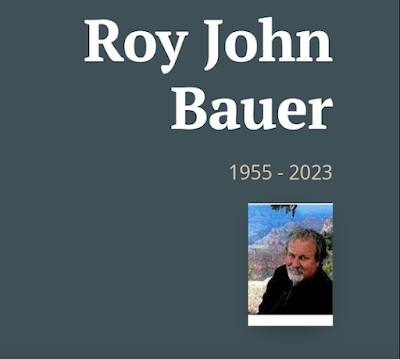
Roy's obituary in LA Times and Register: "we were lucky to have you while we did"

  This ran in the Sunday December 24, 2023 edition of the Los Angeles Times and the Orange County Register : July 14, 1955 - November 20, 2...