The SOUTH ORANGE COUNTY COMMUNITY COLLEGE DISTRICT —
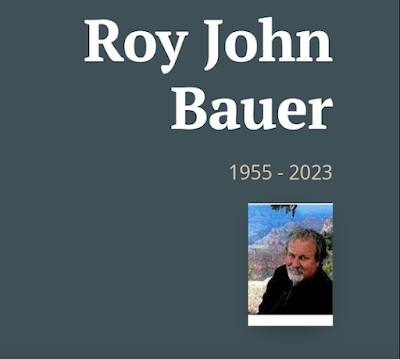
"[The] blog he developed was something that made the district better." - Tim Jemal, SOCCCD BoT President, 7/24/23
Since Oakley Hall passed away, I’ve consoled myself by reaching again for his books. Hall published more than 20 novels in a half-century writing life, most set in the West. Hall co-founded UC Irvine’s master’s-of-fine-arts fiction program (I was his student) and the Community of Writers at Squaw Valley (where I work). Warlock revisits the shootout at the O.K. Corral—but much more. A 1958 Pulitzer Prize finalist, Warlock famously inspired Thomas Pynchon. Fans of Cormac McCarthy and HBO’s Deadwood should see where it all began.
I fell hard for Alfredo Vea’s Gods Go Begging 10 years ago; today, it resonates Iraq-wise. Meet Jesse Pasodoble, a Vietnam vet criminal-defense attorney in 1990s San Francisco. He discovers yesterday’s war being fought today while solving a double murder. Vea, himself a combat vet and attorney, both fulfills and transcends multiple genres—war novel, Chicano novel, mystery—laced with magic realism, sharp humor and, somehow, hope. I taught it in my Chicano lit class and will add it to composition classes next fall.
Robert Hass’ Time and Materials: Poems 1997-2005. I bought a dozen last year as gifts for friends. And that was before Hass won both the National Book Award and Pulitzer Prize. What I like best about this poet is all here: sense of place, humanity and history—so often starting in California, in the High Sierra, then traveling to landscapes past and present, near and far.
Inlandia: A Literary Journey Through California’s Inland Empire, an anthology edited by Gayle Wattawa, features writers who also appear with me in Latinos in Lotusland (Kathleen Alcala, Michael Jaime-Becerra and Alex Espinoza) but ranges widely in its thoughtful reach, with the usual suspects (Mary Austin, Raymond Chandler, Joan Didion, M.F.K. Fisher, Carey McWilliams, John Steinbeck), some surprises (hmmm . . . Joan Baez? Norman Mailer? Calvin Trillin?) and real finds such as Katherine Saubel’s translation of the Cahuilla Indian creation story, which opens this must-have collection.
In Jim Krusoe’s latest novel, Girl Factory, the innocent and almost archetypally misguided Jonathan works at Mr. Twisty’s, a yogurt shop in the mall. He confronts the responsibilities of liberation upon discovering in the basement five naked ladies kept in suspended animation in, yes, acidophilus. In Esquire recently, Krusoe suggests this novel explores the desire to bring dead people back to life. I’m ready. Like Hall, Krusoe is a former teacher of mine, and he’s a crafter of instructively wise, funny, elegant prose. I look forward to this long-awaited novel of quotidian allegory.
THE AMERICAN LIBRARY ASSOCIATION (aka "liberal busybodies") OFFERS BOOK RECOMMENDATIONS:
.....Interviews with 80 female faculty members at a research university — the largest qualitative study of its kind — have found that many women in careers are deeply frustrated by a system that they believe undervalues their work and denies them opportunities for a balanced life. While the study found some overt discrimination in the form of harassment or explicitly sexist remarks, many of the concerns involved more subtle “deeply entrenched inequities.” .....While the study was conducted, with support from the National Science Foundation, at the University of California at Irvine, the report’s authors and most of those who were interviewed for the research state that they don’t believe the problems discussed are unique to Irvine.… … .....The article, “Gender Equity in Academia: Bad News From the Trenches, and Some Possible Solutions,” appears in the new issue of Perspectives on Politics (abstract available here)…. .....…Here are some of the highlights: Unintended bias and outdated attitudes: Many of the women in the study described a steady stream of comments, some of them ostensibly offering support, that suggested that the older men who made them didn’t really understand how to interact with women in a professional manner. These men generally had no clue that their attitudes were either patronizing, sexist or both, the report says. One woman is quoted as describing a job interview in a top department in which an African American scholar took her aside and said, “This is a great place for people like you and me, if you know what I mean, honey.” …. Devaluing positions once women hold them: At Irvine, as at most research universities, the last decade has seen a significant change in the number of women serving as committee chairs, department chairs, deans and administrators in a variety of capacities. And the women interviewed for the study praised this development, crediting women in various senior positions for being mentors or going to bat for their younger counterparts. But the women — across disciplines — described a pattern in which once a woman was named to a more senior position, others treated it as more service-oriented and less substantive….
Service and gender: Those interviewed reported some protection for junior faculty women, but said that among the senior faculty ranks, women were picked disproportionately for service assignments, especially those that are time-consuming. Then those same women are criticized for not doing more research, and the theoretical credit awarded service is never to be found.
Family vs. career: As in similar reports, women reported intense pressure — well beyond that faced by their male colleagues — with regard to having children, raising them, and also caring for aging parents. Many women reported strong reluctance to take advantage of policy options that might be helpful, fearful of how they would appear to male colleagues, and women reported regret and some dismay over choices they made to avoid confronting colleagues with their needs for more flexibility…. … .....Asked for a reaction to the study, Irvine released a statement criticizing it. “Professor Monroe’s article draws attention to the persistence and toll of sex discrimination on women faculty. Unfortunately, the article cannot to be said to offer original insight into the promise and challenge of gender equity in higher education. The formulation of the problem overlooks research in a host of related issues, such as gender schemas, work-life balance, and leadership development among others,” the statement said….
.....Despite warnings in many recent reports that the United States is losing its edge in science and technology, the lead remains significant and U.S. investments in science remain high, according to a new report from the Rand Corporation. The study said that the United States should not be complacent, and that some other countries are stepping up, but that the idea of a significant decline having taken place is unfounded.
.....Saddleback College has been oddly quiet re its accreditation problem (its report to the Accreds is due in October). I'm told that their Accreditation task force, which includes trustee Dave Lang, doesn't even have faculty representation. Good grief. .....Meanwhile, IVC has approached its parallel accreditation challenge with great seriousness and industry. Its focus group, which includes a cooperative Don Wagner (President of the Board), meets every two weeks or so. It has wide representation (faculty participate in a manner that honors the existing "work to contract"). The group even gave a fine and well-attended presentation of its work at an all-college meeting at the end of April. .....It appears that the ACCJC has brought it about that someone will visit our colleges/district to scope things out. Mathur is insisting on calling this person a "consultant," but that's just obfuscation. The visitor is liable to finally arrive (the original guy was delayed by an emergency) some time this summer, which is unfortunate, since, during summer, the colleges are ghost towns.
.....Re our looming and inevitable violation of the 50% Law: we've heard almost nothing about it for some time. I'm told that a delegation went up to the state to plead for leniency and whatnot, but that profited them nothing.
.....Late in the Spring, the Faculty Association, unhappy with the district's failure to bargain the contract in good faith, called for a "work to contract," which ended up affecting the massive (and absurd) effort to hire 35 to 40 new full-time faculty (a ploy to bring instructional costs up to the 50% mark). But, owing to the usual union SNAFU, the WTC affected IVC much more than Saddleback and thus caused tensions among faculty. We seem to be getting past that now though. (Essentially, owing to fortuities and adjustments, the hires turned out OK, even at IVC.) .....No contract yet. There is no way, of course, to approve a contract during summer anyway, owing to the usual faculty diaspora. Our 50% situation clearly calls for serious salary increases (our salaries do not compare well with those of faculty at contiguous districts), but this board just will not go there. .....Contempt for faculty is the norm as far as the policies of this board are concerned.
.....There's been quite an administrative exodus of late, adding no doubt to "administrative instability"—one of the Accreds' worries. VC Andreea Serban bolted for the President job back in Santa Barbara (she'd only been on the job for two years). ATEP Provost Bob Kopecky was essentially canned—no doubt made a scapegoat by the wily Mathur. (Bob will return as faculty in the Fall.) VC Bob King left for greener pastures. Several IVC deans left in the course of the Fall and Spring (Feldhus, Cooper, Corum, et al.). .....Essentially, IVC is experiencing deanlessness. It's like an experiment or something. .....No doubt I've left somebody out. Whatever.
.....Board President Don Wagner really stepped in it at the recent Saddleback College "scholarship" event, where, in the minds of many observers (including some doners), he "politicized" the occasion by lecturing in defense of prayer. Evidently, he had just received a missive from a "church/state separation" organization suggesting that prayer at college/district events is inappropriate, and so he felt the need to rebut. .....Don seems to lack self-control. .....Someone posted Don's scholarship remarks on YouTube, and then the shit hit the fan. At the May board meeting, Nancy Padberg opined that Don should apologize; she challenged him to make up the loss in moola after the exodus of doners. (Don't know how many, if any, doners are actually bolting.) Lots of community members came to carp at 'im. He responded with defiance. Wrong move, Don. .....Don doesn't apologize. He doesn't recognize his mistakes. Still, I like 'im. He's like a smart but recalcitrant little bro. Let's call 'im "Donny."
.....Trustee Tom Fuentes, who has liver cancer, received a liver transplant—which surprised everyone, since he was quite obviously a poor candidate (owing to his age, diabetes, etc.). People have muttered their suspicions in the hallway, but that's all. But I don't buy it. My theory: the Lord intervened on Tom's behalf, owing to the fellow's manifest goodness.
.....The Faculty Association (union) is gearing up for the November election, at which time they hope to unseat Lang and Fuentes (Bill Jay is a friend, and John Williams has supported faculty with regard to the contract). Late in Spring, the FA held a lunch at the Spectrum at which time its candidates spoke and spoke well.
.....Amazingly, the board continues to support Mathur, despite the ample reasons to can him. Mathur, of course, committed the massive "50%" blunder and is heavily implicated in our accreditation woes (which are grave). It is by no means obvious that both colleges will have their accreditation renewed in early 2009. If you suppose otherwise, you're just not paying attention.
.....Leaving aside IVC's Wendy Gabriella and her crew, faculty leadership seems to be disintegrating—no big deal: faculty effectiveness historically waxes and wanes. It seems that, at Saddleback College, faculty have collapsed into consternation and despair. Am I wrong?
.....On the up side: the weather's been nice, and some of us our flourishing. I sense no despair at IVC—shared governance-wise, we're doing fine—though it may exist in buckets at the administrative level. I wouldn't know.
.....Dissent the Blog is flourishing and growing in stature. Trivia, I know, but true nonetheless.
BILL O'REILLY CONTINUES TO O'REILLYize the airwaves:
.....Saddleback College President Richard D. McCullough, Ph.D., is retiring June 30 following a 45-year career in academia. Thirty-eight of those years were spent at Saddleback College in several capacities – during his tenure, McCullough was a professor of biological sciences, a department chair, a dean, and a vice-president – all before becoming president in 2004. McCullough will resume teaching biology and physiology in 2009 after enjoying a year off. .....McCullough's contributions to Saddleback College are many. He led a team to build a solar observatory on the roof of the college's Math, Science, and Engineering Division building. The college's electron microscopy laboratory was designed by McCullough and was used as a model for similar programs at other colleges. He was the first chair of the college's honors program, and he served two terms as president of the Academic Senate. The college's Associated Student Government twice named McCullough the Administrator of the Year, the only time a president at Saddleback College earned this distinction. .....As president, McCullough oversaw the major remodel of the Business and General Studies Building, causing the temporary move of thousands of students to the newly-built Village. Additionally, McCullough spearheaded the idea and construction of the Saddleback College Veterans Memorial to honor service men and women who have served the United States in times of war. .....Throughout his years at Saddleback College, McCullough worked with thousands of colleagues and students who admired his knowledge and valued his friendship. Dr. James Wright, dean of the Division of Math, Science, and Engineering, said, "Dr. Rich McCullough has been an amazing instructor in the biological sciences, a valued colleague, a wonderful boss and trusted friend. No one cares more or has done more to make Saddleback the quality college it is than he has."….
.....Just a week after the city of Fountain Valley nixed a proposal to display the national motto in Council Chambers, the local school board will discuss whether to display "In God We Trust" in its meeting room. .....The Fountain Valley School District trustees will discuss Thursday whether to put a resolution on a future agenda to display the national motto in the boardroom. .....The resolution proposed by Ocean View School District Trustee John Briscoe states that the words "In God We Trust" be placed behind the dais in letters 6 inches or taller. .....The motto will "have people think about our country and our governance," Briscoe said. It "belongs up there. It reminds them the basis of governance is our creator." … .....Briscoe said that he wants to eventually bring the resolution to the elected leaders of the Huntington Beach City School District, Huntington Beach Union High School District and the Coast Community College District. … .....The motto "should be on all places of governance," Briscoe said….
.....Two much-discussed trends in academe — the adoption of corporate values and the decline in the percentage of faculty jobs that are on the tenure track — are closely linked and require joint examination. That is the thesis of a new book, The Last Professors: The Corporate University and the Fate of the Humanities, just published by Fordham University Press. Frank Donoghue, the author, is associate professor of English at Ohio State University. Donoghue recently responded to e-mail questions about the themes of his book. … Q: What are the main reasons for the erosion of the tenure-track career?
A: I believe that tenure and the kind of career it makes possible are disappearing largely for financial reasons. Opponents of tenure are less likely to make political arguments against it — except in very inflammatory cases like Ward Churchill’s — but instead are now inclined to argue that professors’ labor costs too much. The casualization of labor is the global norm, practiced by employers everywhere. Academia is one of the last workplaces to come almost completely under this management philosophy, where payment by the job replaces the traditional salary, benefits and, in the case of professors, job security. Medicine and the law are currently engaged in less acute versions of this transition from one management system to another. Among the professions, only the clergy and the officer ranks of the military seem to be immune to the erosion of tenure or its equivalent.
Q: Many advocates for adjuncts say that tenure-track (and especially tenured) professors did nothing or far too little as academe was restructured. Is this true? Why do you think this happened?
A: Certainly most tenure-track professors were oblivious as the teaching workforce was restructured, and very few predicted how dire a problem it would become. Had we identified the casualization of the teaching workforce as a problem when it began to take hold in the 1980s, we might have been able to correct it. Paul Lauter referred to the misuse of adjuncts as a “scandal” in 1991 in Canons and Contexts, and he may have been the first to use language that strong. That we could have done much about it over the past twenty years presupposes that professors set hiring policies. At most institutions, professors have a lot of input in the hiring of other professors, but not in the hiring of adjuncts, either the people themselves or the terms of their contracts. Decisions about adjunct labor have, by and large, never been made by faculty, but have instead been part of larger administrative policies.
Q: How have humanities professors fared, compared to those in other fields?
A: The liberal arts, and the humanities in particular, suffer the most because they lack any connection to sources of funding outside the university. Humanists typically don’t do consulting work, they don’t compete for large corporate or government grants, they don’t have the option of working in the private sector (and thus insisting that universities pay a competitive wage). These factors conspire to put humanists in a bad bargaining position: We depend entirely on our home institutions not only to pay us a fair salary but to determine both the kinds of work and the amount of work we have to do (publishing, teaching, service, outreach) in order to earn that salary. … Q: What are key steps that could be taken to restore the tenure-track professoriate?
A: The tenure-track professoriate will never be restored. Two factors seal its fate. First, the hiring of adjuncts continues to outpace the hiring of tenure-track professors by a rate of three to one. It’s silly to think we can reverse the trend toward casualization when, despite a great deal of attention and effort, we can’t even slow it down. Second, the demographics of American higher education don’t help us either. For 40 years, students have been moving away from the humanities toward vocationalism. This trend has been accompanied by an equally pronounced shift in enrollments from four-year schools (with English and History majors) to community colleges, where the humanities have never had a strong presence. Tenure-track professors don’t have a place in this new higher education universe. Much as it pains me to say it, I never considered putting a question mark at the end of my title, The Last Professors.
.....It was an odd day. I went to school with Rebel Girl to take care of some bullshit. The weather was fantastic. I took the Reb to this fish taco place that she likes. .....School was a ghost town, mostly. After taking care of business, we "toured" the place, looking for something to write about. Took two or three pics, nothing special. Talked to some friends. "Thanks," said someone. Don't know what for. .....Driving home with the Reb, I looked at the trees and the hills. I was struck, as I often am, by the weirdness, the utter strangeness, of the existence of anything at all. ....."Existence sure is strange," I said. ....."It's all we've got," said the Reb. .....Sometimes I don't know if I'm happy or sad. I saw the sparkle of the leaves on the trees. I marveled at the great golden hills. .....OK. Happy, then.
.....Friday was the last day of classes at the University of California at San Diego, where students faced a weekend of studying before finals began on Monday. If any of them ventured to a nearby La Jolla shopping center, they might have encountered representatives from a new Web site there to make their pitch: Give us a test — any old test — and we’ll give you a $5 Starbucks coffee card. .....If that sounds like a surprisingly blunt quid pro quo, it’s consistent with the purpose of the site, called PostYourTest.com, which encourages students to upload tests and exams from their courses — anonymously, if they want — for others to find and download. The concept has already aroused suspicion and concern among some faculty members at UCSD, where many of the posted tests originated, and seems to run afoul of both traditionally accepted norms of academic integrity and, potentially, copyright law. .....The PostYourTest event on Friday, at which students could electronically scan old tests for a coffee card on the spot, is part of a campaign to raise awareness and collect materials for the site. Its creator, Demir Oral, is from San Diego and is initially focusing his efforts there. Among the 500 or so exams currently available (by Oral’s reckoning), those not from UCSD are mainly from other institutions in the area, such as Palomar Community College. .....“I’m sure I will get a lot of questions about the morality of PostYourTest.com,” Oral writes on the site. “I want people to understand that this website is not a tool for cheating, and I do not advocate cheating in any way. However I know that in this time anonymity is appreciated, and I am always thinking a step ahead, so to create and download tests you do not have to have a user account.”….
.....The Spellings Commission lives, in a way: The U.S. Education Department is planning a summit in Chicago on July 17-18 to which it has invited many members of the secretary of education’s panel on higher education and other college leaders. Details about the meeting are few at this time. Some people familiar with early planning for the meeting have described it as an effort to assess how the panel’s recommendations have been implemented so far, but others who have spoken to department officials said they have been contemplating one last bold effort to prod change in higher education.
 In today’s OC Weekly:
In Jim Krusoe’s latest novel, Girl Factory, the innocent and almost archetypally misguided Jonathan works at Mr. Twisty’s, a yogurt shop in the mall. He confronts the responsibilities of liberation upon discovering in the basement five naked ladies kept in suspended animation in, yes, acidophilus. In Esquire recently, Krusoe suggests this novel explores the desire to bring dead people back to life. I’m ready. Like Hall, Krusoe is a former teacher of mine, and he’s a crafter of instructively wise, funny, elegant prose. I look forward to this long-awaited novel of quotidian allegory.