Tuesday, November 13, 2007

Tonight's board meeting: the 50% law is "bad"

It seemed to be a bad night for Chancellor Raghu P. Mathur. He didn't seem to get what he wanted. Not about Reassigned Time, not about the 50% Law. Essentially, he just looked like an asshole.

The discussion about our struggles with the 50% Law was interesting. There was an effort to sell the idea that it is a new-fangled and "bad" law, and, gosh, how were we supposed to know about so goofy a requirement?


In truth, the 50% Law is more than 40 years old. That Mathur and Co. were caught by surprise by it suggests gross incompetence. No, it is not true that a third (or, as Mathur put it, a "turd") of community colleges have run into difficulty with this law. Compton College and Beaver Fang College (I think that was the name) had a problem with it. And us.

And, no, we won't be able to solve the problem by reducing Reassigned Time.


Remarkably, some trustees seemed to understand the situation perfectly. Fuentes, Wagner, and Williams, however, seemed to come from somewhere out in left field. Evidently, they intend to launch a state-wide effort to rid the state's community colleges of this "bad" law!

No, I'm not kidding.

More tomorrow.


P.S.:

Trustee Fuentes’ (and Chancellor Mathur’s) remarks about the nature and origins of the 50% Law are curious. Mathur referred to unions. Fuentes referred to "special interests."

I have endeavored to look into the legislative intent of that law, which seems to trace back to 1961.

• My inquiries are preliminary, but I did find this “legal opinion” issued by Ralph Black in 2000, the General Council of the State Chancellor, regarding the definition of “Salaries of Classroom Instructors” contained in Education Code Section 84362, the ‘Fifty Percent’ Law”:
…There is also ample evidence that the Legislature enacted Section 17503 (the predecessor to Section 84362) in 1961 with the intention of reducing class size by having instructors time being devoted to instructional activities. [The law was then applied to K-12 "teachers."] The report, “An Analysis of School District Expenditures for Certificated Personnel Salaries” by the Senate Fact Finding Committee on Governmental Administration (which gave rise to the introduction of Assembly Bill 1789 which amended former Section 17503) explained that, “The proposed revision of Section 17503 is designed specifically to encourage the reduction of class size. The alarming trend toward larger class size in California must be reversed if we expect our children to be able to compete with equal advantage with children from other states and nations. …” As a result, while the Legislature in enacting Section 17503 did not mandate the amount going to teacher salaries, it is abundantly clear that they sought to compel districts to spend more on teacher salaries precisely because they believed there was a direct relationship between money spent to pay teachers and class size….”
• And this is CA senate testimony from three years ago:
Education Code Section 84362 requires that community college districts expend during each fiscal year fifty percent of the district’s current expense of education for the payment of salaries of classroom instruction. … This provision of the Education Code was adopted in 1959 at a time when community colleges were part of the K-12 system. The law was originally adopted to address K-12 class size issues as well as to limit the number of guidance counselors. (Arnold Bray, ACCCA)
• Check out this CCLC "background paper" from 2000 (a pdf file).

Meeting of the SOCCCD board of trustees: tonight

MEANWHILE...

Another one of Trustee Tom Fuentes’ pals is—what else?—dogged by evidence of corruption: Chriss Street traveled well on bankrupt trust: Before he became OC treasurer, Chriss Street billed, and in some cases, double-billed a bankrupt trust for tens of thousands in expenses and travel:
Chriss Street double-billed a bankrupt trust for thousands of dollars in expenses, including a $3,584 laptop computer and $1,200 in office supplies, according to newly released court records….
In yesterday’s OC Reg: Minuteman, activists to debate on campus:
Students and professors at California State University, Long Beach will protest Jim Gilchrist's views on immigration.

Monday, November 12, 2007

Yikes! Ash + wind = pseudo-smoke

THIS MORNING, from my place in Lambrose Canyon (in Live Oak Canyon), I noticed lots of ash on my car. Uh-oh!

I looked toward nearby Hamilton Trail—one of the areas hit by the great Santiago fire—and I saw something that looked like smoke.

But wait. Is there anything over there left to burn? Not much. (Check out my pictures from yesterday: Visiting Hamilton Trail.)


It soon became clear to me (I think) that I was looking, not at smoke, but at the result of winds picking up ash. That's all.

I hope.

MEANWHILE, the Santiago fire is "contained but not controlled," which means, I think, that there's no fuel around the remaining fire, but that not all flames are out. (The Orange County Fire Authority issued its last update three days ago, when it announced that the Santiago fire was fully "contained." OCFA did not mention that the fire was not yet "controlled." See OCFA. Near as I can tell, that announcement is the OCFA's "final" announcement.)


(All pictures taken this morning, about 11:00 a.m.)

UPDATE:


Since my post (above), the OC Reg reported as follows: Santiago fire smolders in forest: No flames, but hot spots remain, officials say:
Four days after the Santiago fire was contained by firefighters the blaze continues to smolder in an area away from homes and residents.

Dark clouds today looked as if smoke were visible in the direction of the 28,400-acre blaze, but officials said it was the result of increasing winds that picked up ash and dust particles left behind by the fire.

The remaining fire continues to be confined to a steep 300-acre area inside the Cleveland National Forest which currently is monitored by about 150 firefighters from the U.S. Forest Service, said Frank Romero, of the U.S. Fire Services' fire prevention patrol.

Two fire engines remain on the scene to monitor remnants of the fire, and a helicopter is on standby to keep the fire in check, Romero said.

Firefighters set blazes in a 300-acre area close to the eastern containment lines as the Santiago fire was losing strength but before full containment was reached. The area was burned in a controlled setting in order to keep the fire from regaining strength by the thick vegetation.

Today, that area continues to slowly burn.

Fire officials continue to monitor the area and allow the fire to burn itself out, Romero said. The steep area prevents crews from climbing deep inside because they could be surrounded if the flames are fed by thick brush and wind. The steep terrain would prevent a speedy retreat, officials said.

Because of increasing winds, firefighters have been monitoring the area during the day and night in case the fire picks up.

Officials also are using heat sensors to spot burning areas. Hand crews follow up by going through and looking for hot spots, some of which are hidden underground in the roots of vegetation, Romero said.

Engaging and retaining community college students

From this morning’s Inside Higher Ed: Rules of (Community College) Engagement:
It’s no great secret that community college students spend much of their time away from campus. As this year’s report on an annual survey of the academic experiences of students at two-year institutions puts it: “Most students simply are not on campus enough for engagement to occur spontaneously. They rarely bump into instructors on campus and have serendipitous informal conversations.”

Thus, the report argues, community college faculty need to take advantage of their limited classroom time, and administrators need to think about ways to create opportunities for students — and particularly part-timers — to engage with instructors and their peers while on campus.

The Community College Survey of Student Engagement, released Monday, reached that conclusion after tracking data compiled over the past five years (700,000 students, 548 institutions) on how students spend their time and interact with people at their institutions.

In addition to the wide-angle view, the survey provides its usual look at a three-year cohort — those who responded from 2005 to 2007, a group that includes more than 310,000 students from 525 institutions.

The students responded to survey questions in the spring after having several months’ worth of experiences from which to draw. Those who are included in the report are the “survivors,” as the report says. But, as CCSSE notes, many more students don’t stay past the first semester — and researchers want to know what factors into a student’s level of engagement and satisfaction at the start of college.

That’s why, in the “special focus” survey section, questions this year asked students to think back to their first four weeks of college. (Questions asked to beginning students this fall about their first month will be released as part of a separate report in the spring.) The results from this year’s focus section show that:

• Fewer than half of students met with an adviser to discuss academic plans in the first four weeks.
• Slightly more than half completed an assessment test for course placement.
• Thirty-two percent didn’t attend an orientation program, and only one in three who did said they were “very satisfied” with the experience.

Kay McClenney, director of the survey, said that some of the engagement results are alarming, given that the first few weeks of college are essential in capturing students’ attention…. (My emphases.)

Sunday, November 11, 2007

Visiting north of Hamilton Trail

WADDA dreary day.

Jan emailed. He wrote me that Mojo, son of Sunny Bear, had died "in his sleep," last night.

Mojo was an excellent young man, and I will miss him. He was about 16 years old.

EVEN THOUGH there was little sun, I decided it was a good time to visit Hamilton Trail, which is very near Lambrose Canyon, where I live.

I walked up Live Oak. Then I hopped the fence up at the crest of Harris Grade.

It looked very bad. It looked worse as I got further in. Well, there's no use talking about it. Here are some pictures.

I'm gonna miss that Mojo. He was a knucklehead, but he didn't have a mean bone in his body. He sure was a sweet guy.

Sunny says "hey."

(See Hangin' with Mojo, Democrat & Sunny and Mojo.)


THE SANTIAGO FIRE: According to InciWeb, that a fire is “contained” means that a “fuel break around the fire has been completed.” “Control” refers to the “complete extinguishment of a fire, including spot fires.”

At present, the Santiago fire is contained, but not controlled. 30 mph winds are expected in Santiago Canyon tomorrow morning.

A suggestion

Saturday, November 10, 2007

Tom Fuentes’ man: fat fiscal FUBAR

"Last Tuesday I read in the LA Times…that the CEO of Morgan Stanley had been asked to resign. As I read that, I was struck by the irony that, in the private sector, when a corporation is experiencing difficulties, the CEO is asked to resign. Apparently, in the public sector, when the corporation is experiencing difficulty, the CEOs are awarded a new contract and a raise….”

—An IVC instructor, urging trustees not to grant Chancellor Raghu Mathur a new contract & raise (during the 6/21/05 meeting of the SOCCCD Board of Trustees). Hours later, Mathur was granted a very generous new contract.


ITEM 6.3 of the South Orange County Community College District’s Board of Trustees agenda [pdf file] for the Nov. 13 meeting is: Compliance with the 50% Law.

As you know, the SOCCCD is in the midst of a huge fiscal FUBAR, owing to mismanagement by the district. The 50% Law requires that at least 50% of expenditures (by California school districts, including community colleges) be devoted to "instruction," but, over the last five or so years, the district's instructional expenses have dipped increasingly toward the 50% line and, for 2007-08, those expenses will descend to 46%, according to district projections. (See graphic below.)

It is not clear what this violation will mean for the district and its two colleges (and one park), since, evidently, it is unprecedented for a "basic aid" district (i.e., a district that relies on local property taxes, not state money) to be out of compliance with this law.

MASSIVE HIRING OF FACULTY. In response to this crisis—which, somehow, was recognized only recently—the district is moving toward a huge push for new faculty hires—perhaps 30 at Saddleback College and 15 at Irvine Valley College. Naturally, the hire of full-time faculty is an important and time-consuming process—something that should be done carefully and deliberately, not hurriedly—and thus considerable resistance is growing among faculty to this massive hiring initiative.

The Chancellor of the SOCCCD, Raghu P. Mathur, is widely seen as the conservative “board majority’s” hatchet man, one who is willing to do the board’s bidding, even when the bidding involves highly unusual and unpopular (and even illegal) measures.

A few years ago, Mathur received a 94% faculty vote of “no confidence.” It had no evident impact on the Board Majority’s support for Mathur.

Indeed, at the urging of Trustee Tom Fuentes—former head of the Orange County Republican Party—Mathur has been showered with rewards. At present, he receives a salary of about $300,000—an amount that is, at best, unusual for the Chancellor of a district comprising only two campuses. (Naturally, this kind of expenditure only worsens the 50% issue.)

Tuesday night’s discussion is liable to be interesting. Just how "fiscally conservative" are these board members? Do they really believe in accountability? Will they fail to state clearly what the data shouts: that their man Mathur has screwed up?

And not just a little!

[Luddites: don't forget to click on the blue words. But skip "agenda."]

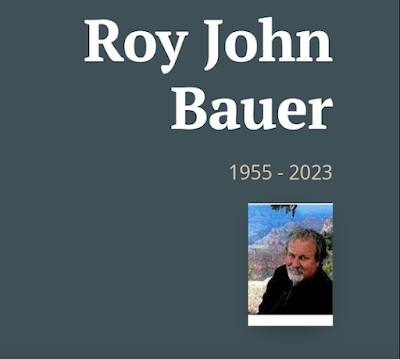
Roy's obituary in LA Times and Register: "we were lucky to have you while we did"

  This ran in the Sunday December 24, 2023 edition of the Los Angeles Times and the Orange County Register : July 14, 1955 - November 20, 2...