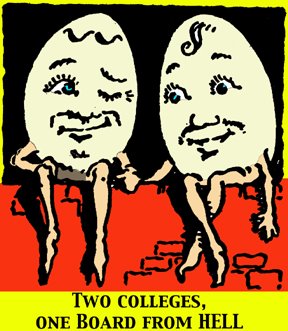
Friday, August 11, 2006

Perceiving chaos


I gave my summer school final exam yesterday. Afterward, some of us wandered outside and found that the weather was wonderful. Campus was quiet. We smiled at the sky.

I soon ran into a colleague who, despite the pleasant summery atmosphere, carried the heavy burden of perceiving chaos.

It wasn’t the weather that he saw as chaotic. It was governance and, in particular, administration.

He (and later, others) related several rumors, including stories of conflict--or unhappiness, anyway--among top administrators. Plus important work of one kind or another just wasn’t getting done, in part owing to emergencies.

We were about to start up the school year, said one colleague, and the college is, right now, a “nuthouse.”


There was some buzzage, too, about the agenda for Monday’s board meeting. Once again, I was told, Chancellor Raghu Mathur is being evaluated by the trustees (in closed session). Nothing new there. But the agenda also indicated that someone might be disciplined or dismissed.

Who’s that? Nobody knew. Couldn't be Mathur. They just love that guy.

I went to take my own gander at the agenda, which was posted inside A100. Item 16 is the recommended approval of travel expenses for a trustee (or trustees?). The second item listed was the October ACCT Community College Leadership Congress. The “estimated cost” per person: $3,000.

Guess where? Yep, ORLANDO, FLORIDA.

Looks like John will be sunning his ass again in the Sunshine State. In the past, Trustee Padberg has noted that ACCT (or was it another organization?) offers west coast conferences, but John doesn’t seem so interested in those. (See Closing in on junket abuse?.)

Looks like the board will be discussing the review process for board policies and administrative regulations . Some of the BPs and ARs are important. Expect things to get interesting on Monday night.

On Monday, the board will be presented drafts of the Accreditation “progress reports” for Saddleback and Irvine Valley Colleges. (—For “review and study,” not approval. Not yet.) These are each college's effort to respond to the Accred's recommendations (i.e., their criticisms). Have you seen these drafts?

SADDLEBACK COLLEGE:

In its action re Saddleback College, the Accrediting people recommended that the board of trustees cease its micromanagement. The progress report (draft) that will be revealed on Monday night notes progress but is not entirely positive about the board’s efforts to address that recommendation:

Despite the positive progress, some problematic issues remain. One such issue is the district’s imposition of its own planning process on the college….

Another problematic and embarrassing issue is the board’s rejection of college-determined institutional memberships…

This, of course, is a reference to the board’s action of pulling the American Library Association from the district’s list of memberships. You know: the ALA are a bunch of “liberal busybodies.” They want kids to view porn, etc. (See Wagner takes on the ALA.)

The draft discusses continued conflict regarding the ban on (or continued district parsimony regarding) reassigned time for senate leadership.


IRVINE VALLEY COLLEGE:

IVC’s report, too, presents positives and negatives. With regard to the Accred’s recommendation that the board cease micromanagement, the draft presents a series of facts (especially direct quotations of trustees and the chancellor, etc., from televised board meetings) that paint a vivid picture of board/chancellor unhappiness with the recommendation itself. (See Faculty "macromanagement"?.)

Re the Accred's "micromanagement" complaint, one board member seems to say, "FU."

I'm paraphrasing.

The Accreds recommended a rethinking and defining of “leadership roles and scopes of authority of...constituent groups….” Once again, the draft offers a series of relevant facts, including the content of a set of “New Rules of Business” offered by the Chancellor. The draft helpfully quotes all of the Chancellor’s rules, including:

• We need to change the way we think and approach issues.
• We need to focus on working together rather than power control and territory.
• We need to act smart and keep it simple.
• We need to be nice to all people.

[All grammatical, syntactical, and logical errors appear in the original.]

Relevant trustee suggestions, which were offered during public meetings, are also reported in the draft, including:

• Have a rumor hotline.
• Be positive and don’t just criticize.
• Invite board members to where you are working.
• Be guided by love.
this is an audio post - click to play

The draft goes on to report that:

A common theme among the faculty and the classified constituent groups was a strong desire for the chancellor and the board to respect and comply with the statutory and regulatory roles and authority granted to each employee unit. All constituent groups expressed a desire to have their rights respected without involving the legal system, the state chancellor’s office, and/or the grievance process or other external agencies.

The last part is a reference to the faculty’s successful lawsuit re the district's illegally imposed hiring policy--and the ongoing appeal to the State Chancellor’s Office re the district’s unilateral development of planning processes (development which, by law, the faculty are to be allowed to participate in). (See The board is determined to violate Title 5.)

The Accrediting agency’s executive director, Barbara Beno, is quoted as saying (in April):

The college [sic] and the district are making impressive progress in resolving the issues of governance and climate that have proved troublesome in the past…I encourage you all to keep up the good work….”

The Accreds recommended that the college address the climate of “hostility” and “despair." Again, the draft emphasizes facts, such as the occurrence of relevant remarks during board meetings.

Here’s an example of such a remark by the Chancellor:

MATHUR: The past negative press coverage [re the district] has come primarily from some faculty leaders who’d rather blame the chancellor or blame the board of trustees in an effort to seek power and control of the district…[W]here is the sense of fair play and balance? When do faculty and staff come to the podium to thank and appreciate the many good deeds of this board? (March 27 board meeting) (See Listen to Mathur blame our problems on faculty leadership.)

(I invite you to Google press coverage of the district [and colleges] in recent years. As you’ll see, there’s been some very negative and very public press. All of it concerns actions of the board, such as its curious cancellation of the Spanish study abroad program. See Trustee Fuentes' Spanish adventure.)

The former president of the faculty union is also quoted:

Your unfortunate comments at the board meeting tonight have undone a tremendous amount of real progress toward a new and positive working relationship between the faculty…and the administration…It’s sad…to find the chancellor perpetuating, in the midst of a report on the efforts to end hostility and despair, the very hostility he’s supposed to be working to end. It must be said: at no time now or in the past have faculty members sought to “take over” the colleges or the district. Faculty members have rightfully demanded to be included, as required by code and statute…[A]ssigning blame, especially from a televised public pulpit, benefits no one….


CODA:

After perusing the board agenda, I ran into another colleague, who explained that the trustees continue to be angered at Chancellor Mathur. As you know, Raghu recently pissed off the board by recommending that he receive a substantial raise—at a time when positions in his office were being eliminated to cut costs.

Evidently, the board is now angry anew--this time because it has finally figured out that Mathur has been listing goals that he has achieved that, in truth, have already been achieved or have been achieved by others. (See I will prepare for meetings "in advance".)

The story could be true. After all, months ago, addressing the board, faculty made public remarks concerning the very curious nature of trustee “goals.” “These have already been accomplished!” we said. “The colleges are already doing this!”

Why won’t these people listen?

Education: the good news and the bad news

1. College newspapers to be protected!

Looks like the law in this state might soon protect college newspapers. In this morning’s LA Times (Bill Would Protect College Newspapers), we learn:
Without debate, the state Senate on Thursday sent Gov. Arnold Schwarzenegger a bill that would make California the first state to prohibit college and university administrators from censoring student newspapers.

Sen. Debra Bowen (D-Marina del Rey) said the bill would give college journalists the same free-press rights as high school reporters and their professional colleagues. Schwarzenegger has not taken a position on the measure, a spokeswoman said.

The bill came in response to a ruling last year by the U.S. 7th District Court of Appeals in Chicago. The court said administrators at Midwestern universities could review student articles before publication if their student-run newspapers were published under the auspices of the college.

The California Newspaper Publishers Assn. and free-speech advocates said college administrators might try to apply the ruling to campuses in other states. Bowen referred specifically to a memo from Christine Helwick, general counsel for the California State University system, suggesting that campus presidents may "have more latitude than previously believed to censor the content of subsidized student newspapers."

In 1992, California adopted a law protecting high school students from censorship, except for material that is obscene, libelous or slanderous.

Anyone who's followed the sorry college newspaper saga of Saddleback College and Irvine Valley College knows that this new law could come in pretty handy!

IVC once had a student newspaper. It was called the Voice, and, in its early days, it did some good work. For instance it broke the story concerning Trustee Steve Frogue's alleged Holocaust denial. (See Is Trustee Frogue a Holocaust denier?.)

I recall that, when now-Chancellor Mathur became President of IVC, he eventually took control of the Voice and used it as a house organ for the college. Faculty were appalled.

Back in about 1997, when the advisor for the Saddleback Lariat, a part-timer, allowed students to write stories critical of the board, her dean was ordered to relieve her of her duties. Here's how Peggy Goetz reported the situation at the time:

Saddleback College cans newspaper adviser [LARIAT? 6/5/97]
Student paper has been critical of district board


Kathleen Dorantes received word May 20, without warning that she would no longer be the adviser to the Saddleback Valley College newspaper, The Lariat.

She was told the decision came from the office of the college president, Ned Doffoney, and Doffoney had given no reason, Dorantes said last week from her home in Riverside.

Some sources at the Mission Viejo college , governed by the same board as Irvine Valley College, say the move was politically motivated. The student paper has been critical of the majority of the college district's board of trustees since the election in the fall.

The faculty member appointed to take Dorantes' place as adviser, Lee Walker, is an outspoken supporter of the board majority.

Dorantes was adviser of the paper for two years on a part-time contract with the district. According to other employees as well as students who worked on the paper, Dorantes was respected by the students and worked well with them.

"Kathy has done a good job. Advising a student publication is a difficult educational task," said Mike Reed who leads the journalism program at the college.

During one of the years she was the adviser, 1996, the paper won one of the top awards in the state for community college newspapers, the General Excellence Award from the California Journalism Association of Community Colleges.

Dorantes said she was told by humanities dean Daniel Rivas that Doffoney had said she should apply to teach English classes at the college and that it was the college paper advisory position that would no longer be open to her.

Doffoney said in a telephone interview that the decision had been a "contractual" one. He said that any full-time faculty member can bump any part-time faculty member at any time. Doffoney said that Walker had approached him and indicated that he wanted to advise the newspaper.

Walker could not be reached for comment.

Journalism program head Reed said that he had been asked recently to take over the paper as well.

Doffoney said in the telephone interview that Reed could have had the position if he wanted it.

When asked about reasons for the change or reasons that the college president, rather than an immediate supervisor, would make a decision about a faculty teaching assignment, Doffoney said, "I think this conversation has gone about as far as it can," and indicated he did not want to comment further.

I recall Ned telling me--and telling numerous others--that the board had ordered him to fire Dorantes. He was plenty pissed, boy.

2. Are college students learning enough?

This morning’s San Diego Union-Tribune reports on a federal commission’s new report on higher education (U.S. panel endorses standards for colleges):
A federal commission approved a final report yesterday that urges a broad shake-up of U.S. higher education, calling for public universities to measure student learning with standardized tests, for federal monitoring of colleges' quality, and for sweeping changes to the financial aid system.

The panel also called on policy-makers and higher education leaders to find new ways of controlling costs, saying that college tuition should grow no faster than median family income, although it opposed price controls….

Eighteen of the commission's 19 members voted to sign the report, which assails rising tuition costs and points to signs of complacency on some campuses.
…..
Secretary of Education Margaret Spellings established the panel a year ago, drawing members from various sectors of higher education – community colleges, for-profit trade schools, liberal arts colleges and large research universities, public and private – as well as from the ranks of executives at IBM, Boeing, Microsoft and other companies….

Spellings urged the commission to examine access, affordability and accountability in higher education, to determine whether colleges and universities were turning out students qualified to compete in the global economy.

The answer in too many cases, the panel said in its report, is no.

“Too many Americans just aren't getting the education that they need,” the report said. “There are disturbing signs that many students who do earn degrees have not actually mastered the reading, writing and thinking skills we expect of college graduates.”….

Tuesday, August 8, 2006

Not just healthy, but yummy too!—SOCCCD’s magazine for women

If you go to the South Orange County Community College District website, you’ll find a Newsroom, where you’ll encounter the usual press releases, newsletters, and so on.

But you’ll also find links to recent issues of Today’s Woman in South Orange County (TW).

What on earth is that?

I clicked on the link for the July/August issue, and that opened a pdf file, comprising the cover of the latest TW plus it’s cover story—“Discover Your Potential.”

The website leaves the impression (mostly by omission) that the district produces TW. Don’t think so. So, after my class today, I grabbed a copy of the magazine, which I’ve often seen in the IVC Admin. Bldg.

I perused it. On page 6, we learn that TW is published by “Liberty Publications West” of Rancho Santa Margarita, not the district. On the other hand, TW is clearly designed to "sell" becoming a student at one of our colleges. The district is forking over money for this thing.

The cover story about “potential” concerns women and how, for many of them, “life”—family, career—gets “in the way,” and so they miss out on going to college. Eventually, the kids grow up or the career goes sour. What then? –Well, of course: these women can start over by taking some classes at Saddleback College or Irvine Valley College!

The article is unobjectionable, I suppose, aside from its implicit suggestion that the difference between South County men and South County women is that the latter don’t go to college. Surely the set of those South Countians for whom “life gets in the way” includes members of both sexes!

I perused my hard copy of TW to get a sense of the whole magazine. Just what kind of rag is our district promoting?

I know. You don’t care. But I care. I want district publications (including publications commissioned or used by the district) to be, well, at least collegiate. And intelligent.

TW is neither collegiate nor intelligent. In part, TW (or at least this particular issue) is a New Age sandwich—a decent cover story squeezed between two slices of ultra-flaky Wonder Bread. In part, it’s just a magazine for silly women.

For instance, its “business” section offers an article in which we learn of the power of “affirmations.” Among the more powerful affirmations, we’re told, are:

I AM CONFIDENT
I AM POWERFUL
I AM SUCCESSFUL
I AM RELAXED.

According to TW, “you can say affirmations any number of times during the day and the more you do so, the better.”

Imagine running into such a woman.

There’s a “personal enrichment” section, which describes the glories of aromatherapy. Aromatherapy, of course, is a pseudoscientific alternative medicine, like urine therapy. (Aromatherapy.) Nevertheless, the article chirps that “Thousands of people around the world have discovered the powerful benefits of Aromatherapy. And you can do it too.” Evidence and the like don’t come up much in TW.

Some of TW’s articles aren’t so much New Agey as silly. A women named “Tanya” informs South County women that “Summertime is ‘me time.’” One article sings the praises of “vitamin smoothies.” They’re “not just healthy, but yummy too!”

In the “travel” section, the ladies of South County are encouraged to opt for a “destination wedding,” i.e., a wedding in some “fabulous vacation area.” What about the prohibitive cost to guests? No problem: “particularly fabulous vacation areas are just too tempting to resist—even if they are expensive.”

Something tells me that those pneumatic “real housewives” of Coto de Caza would just love this magazine.

In the “furry friends” section of the magazine (no, I’m not making this up), we’re told how to housebreak a puppy. We are offered such pointers as that “puppies need food and water” and “if you decide to train your puppy to go in the house, you will need to find a specific place where they can go.”

I did not know that.


In the “dining & entertainment” section, there’s an article about chocolate. “Science,” it says, teaches us that chocolate has “some health benefits.” Inexplicably, pets come up again: “If a pet becomes ill after eating chocolate, take it to the vet immediately.”

In the “beauty & fashion” section, we’re treated to a dissertation on your “new best friend,” namely, “self-tanning.” Here, we’re advised to “experiment with a portion of your body that no one will see.”

I’ve got to admit, that’s pretty sensible. First tan your ass, then go for the face.

There’s advice on how to shop for a diamond, most notably, “prepare[] to spend some money.” Indeed.

Naturally, no South County women’s magazine would be complete without an article on the treatment of wrinkles. No doubt, wrinkles are a woman’s “worst enemy.”

According to TW’s Dr. Le, “a combination of Botox, fillers, and laser resurfacing can give amazing results.”

Surely that line is some sort of joke?

So, anyway, that’s the district’s women’s magazine. It’s stupid.

I do like the pictures though. Just wanted to end on a positive note.

Monday, August 7, 2006

Do our colleges teach "applied kinesiology," the pseudoscience?

At the Saddleback College website, under “news,” we find this bulletin:

The Division of Physical Education and Athletics is now listed uinder Kinesiology in the fall class schedule beginning on page 59

Well, that sounds pretty good. “Kinesiology” is a respectable field doing respectable work. So, what’s wrong with filing your PE/Athletics courses under “kinesiology”?

Nothing, maybe. On the other hand, maybe it’s confusing, and maybe it inadvertently associates Saddleback College with quackery. Let me explain.

The Merriam-Webster dictionary defines “kinesiology” as

the study of the principles of mechanics and anatomy in relation to human movement

So far, so good.

But now Google the word “kinesiology.” Here’s what you get.

1. The Kinesiology Network (KN)

Here, we’re told that the KN concerns something called “applied Kinesiology”:

What’s applied kinesiology (AK)? The website explains:

The "Applied Kinesiology, AK" was founded in 1964 by the American chiropractor George Goodheart and are now used by chiropractors, osteopaths, medical doctors, dentists and others with a license to diagnose. Dr. George Goodheart found that evaluation of normal and abnormal body function could be accomplished by using muscle tests. Since the original discovery, the principle has broadened to include evaluation of the nervous, vascular, and lymphatic systems, nutrition, acupuncture, and cerebrospinal fluid function.

So AK is some sort of diagnostic tool related to chiropractic. Hmmm.

2. International College of Applied Kinesiology

Again, an effort is made to describe AK:

Treatments may involve specific joint manipulation or mobilization, various myofascial therapies, cranial techniques, meridian and acupuncture skills, clinical nutrition, dietary management, counselling skills, evaluating environmental irritants and various reflex procedures.

Here, we learn that AK is some sort of therapy.

3. The University of Michigan Division of Kinesiology

I did a search at this site for “applied kinesiology.” There, I am referred to an article that happens to be about ADHD, which explains:

Some treatments that the National Institute of Mental Health and the American Academy of Pediatrics warns have not been proven to work in scientific studies are…Chiropractic adjustment, bone realignment, applied kinesiology and realigning bones in the skull. [My emphasis]

So what gives? Is kinesiology some sort of alternative medicine?

I consulted the Skeptic’s Dictionary (Applied Kinesiology), which explains:

Applied kinesiology (AK) is an alternative therapy created by George Goodheart, D.C. According to the International College of Applied Kinesiology, the therapy "is based on chiropractic principles and requires manual manipulation of the spine, extremities and cranial bones as the structural basis of its procedures."

However, Goodheart and his followers unite chiropractic with traditional Chinese medicine (among other things); not only do they accept the notion of chi and the meridians of acupuncture, they posit a universal intelligence of a spiritual nature running through the nervous system. They believe that muscles reflect the flow of chi and that by measuring muscle resistance one can determine the health of bodily organs and nutritional deficiencies.

These are empirical claims and have been tested and shown to be false (Hyman 1999; Kenny et al. 1988). Other claims made by practitioners are supported mainly by anecdotes supplied by advocates

…Applied kinesiology should not be confused with kinesiology proper, which is the scientific study of the principles of mechanics and anatomy in relation to human movement. However, many practitioners of applied kinesiology refer to their quackery as kinesiology and themselves as kinesiologists.

Wikipedia says this about “kinesiology”:

Kinesiology is the scientific study of human movement. It should not be confused with the pseudoscience applied kinesiology (AK). While an understanding of kinesiology is fundamental for the analysis and treatment of problems in the musculoskeletal system, it is not—unlike "applied kinesiology" (AK)—a method for the treatment or diagnosis of illness…The study of kinesiology is often part of the curriculum for some of the areas in which kinesiological information is used (akin to a medical study – see sports medicine).

There are some professional physical therapists who are fully credentialed in some jurisdictions as "Registered Kinesiologists." In this case, the word "kinesiology" is being used as a synonym for "physical therapy."

The terms we choose to use can cause problems, obviously. Stephen Barrett of “Quackwatch” (Applied Kinesiology) warns us that

Applied kinesiology should be distinguished from kinesiology (biomechanics), which is the scientific study of movement. Unfortunately, some professionals and educators refer to science-based kinesiology as "applied kinesiology," which increases the risk that people searching for information will confuse the two.

OK, but applied kinesiologists often call themselves “kinesiologists.”

Wow, what a mess.

It seems clear that, to much of the public, scientific kinesiology and pseudoscientific “applied” kinesiology are not clearly distinguished. Even science-based kinesiologists tend to confuse matters with their manner of speaking.

I did a search under “applied kinesiology” at the IVC website and found that that college actually offers courses called “applied kinesiology.” D'oh!

Surely there is an alternative term (than "kinesiology" or "applied kinesiology") that Saddleback and Irvine Valley faculty can use in referring to their courses, which, as far as I know, are rooted in scientific, not pseudoscientific, “kinesiology.”

What do you think?

Friday, August 4, 2006

So-called "conservative" SOCCCD trustees

1. Greed is Good, just not tonight

You'll recall that Chancellor Raghu Mathur got spanked at the last board meeting for recommending that he receive a hefty raise, some of it retroactive. So annoyed was the board by this self-serving "recommendation" that it quietly deleted the item from the agenda.

Raghu responded by stewing and putrefying. It was ghastly.

Insiders now tell me that, what made matters worse, as it turns out, was Raghu's timing. Faculty senate leadership chose last meeting to make a strong and public (i.e., televised) plea for increased reassigned time for the senates. Evidently, compared to officers in other districts, our academic senate leaders are poorly supported in their endeavors, a situation made worse by increased inclusion of the senates in district governance in recent years (some of it compelled by legal decisions going against the district).

More importantly, as everyone knows who hangs with senate presidents, those people spend 40+ hours a week doing senate business, but they're paid for a mere fraction of that time. They work like dogs, and they've gotta teach their load and run their private lives to boot.

Well, just in case somebody didn't know--for instance, those Seizure World geezers who watch the BOT on Friday cable mighta been outa the loop--the two senate presidents spelled it out in gruesome detail, using charts and stuff.

Uh-oh. "Thank God we didn't throw more money at Raghu!" thought some trustees, I guess. "It woulda looked bad, real bad!"

I've got a question for you guys. How come you don't believe in PAYING PEOPLE (or, anyway, people who happen to be faculty senate officers) FOR THEIR WORK? You don't mind paying a worthless sycophantic load like Mathur a quarter million dollars. But faculty senate officers? Well, let's just scr** those guys!

You call yourselves "conservatives." Do conservatives favor making people work too much--so much that it cuts way into their family lives--and without compensation? --Um, nope.

I DON'T GET IT.

(I've been told that reassigned time HAS now been increased for the senates, but not by much. Not by nearly enough. How are these people supposed to have family lives?)

2. Old news, but still:

I ran across an old Community College Week article that many of us missed. It reports the Academic Senates' big win over the district--in the Court of Appeals--concerning the district's illegal unilateral imposition of a faculty hiring policy: Academic Senates Get Big Win in California Appeals Court.

An excerpt:

[T]he Court of Appeal...[noted] that the legislature gave specific responsibilities to academic senates. For example, the legislature directed that hiring criteria, policies and procedures for new faculty members “shall be developed and agreed upon jointly” by the trustees and academic senate.

“The faculty has an inherent professional responsibility in the development and implementation of policies and procedures governing the hiring process,” Justice Eileen Moore wrote for the court.

The court rejected the district’s assertion that allowing the senates a “veto” would enable them to frustrate and obstruct the process of revising hiring policies, and it found no evidence that the two senates were acting maliciously or intended to obstruct the process.

Chancellor Mathur is quoted as saying, "...we are keeping our options open in terms of appeals.”

That went nowhere, of course. The district lost the case simpliciter and finito.

I've been told by informed attorneys that our victory will have (perhaps already has had) significant ramifications throughout the system. It's a huge step toward finally satisfying the intent of the late 80s AB1725 legislation.

So I've got another question for you trustees. How come you don't care about OBEYING THE LAW? Tell me that! And I'm not even counting your earlier incarnation's "persistent and defiant" violation of the Brown Act!

What kinda conservative thinks he gets to cheat and and spin and wriggle his way out of obeying THE GODDAM LAW?

I DON'T GET IT.

Wednesday, August 2, 2006

The return of a nice bedtime story

The New York Times reports this morning that the see-saw battle between anti-science and pro-science forces on the Kansas State Board of Education has again tilted toward science. (Evolution Opponents Lose Kansas Board Majority.) Ralph Blumenthal reports:
Kansas voters on Tuesday handed power back to moderates on the State Board of Education, setting the stage for a return of science teaching that broadly accepts the theory of evolution, according to preliminary election results.

With just 6 districts of 1,990 yet to report as of 8 a.m. Central time today, two conservatives — including incumbent Connie Morris, a former west Kansas teacher and author who had described evolution as “a nice bedtime story” — appear to have been defeated decisively by two moderates in the Republican primary elections. One moderate incumbent, Janet Waugh from the Kansas City area, held on to her seat in the Democratic primary… If her fellow moderates prevailed, Ms. Waugh said last week, “we need to revisit the minutes and every decision that was 6-4, re-vote.”
…..
The results seem likely to give the moderates a 6-4 edge on the 10-member board when it takes over in January…Both moderate Republican winners face Democratic opponents in November, but the Democrats are moderates as well, favoring a return to the traditional science standards that prevailed before a conservative majority elected in 2004 passed new rules for teaching science. Those rules, enacted last November, called for classroom critiques of Darwin’s theory….The changes in the science standards, favored by advocates of intelligent design who believe life is too complex to be have been created by natural events, put Kansas at the vanguard of efforts by religious advocates critical explanations of the origin of life that do not include a creator …The curriculum changes, coming after years of see-sawing power struggles between moderates and conservatives, drew widespread ridicule and, critics complained, threatened Kansas’s high standing in national education circles….

What, you may ask, has any of this to do with the South Orange County Community College District?

Well, dear reader, at least one, and perhaps some, trustees on the SOCCCD board seem to be sitting out there on the benighted anti-science end of the see-saw.

The clearest case, perhaps, is Mr. Tom Fuentes, who has numerous ties to radical anti-science Christian leaders, a group that includes his pal Howard Ahmanson, the chief funder of the anti-evolution movement (see Discovery Institute). (See archives.)

Well, Fuentes has a finger in lots of wacky Neanderthal pies. Here's one of my favorites: the fellow is a director of Eagle Publishing, which publishes "Regnery" books.

If one goes to the Regnery website (Regnery Publishing), one will find the publisher's catalog. (Catalog.) As we explained ten months ago, anti-evolution books can be found listed there, including:

Icons of Evolution: Science or Myth?, … "Jonathan Wells has news for you. Everything you were taught about evolution is wrong. Icons of Evolution will light the fires of controversy and provide a brutally honest report of who what we've truly discovered about evolution in recent years"

As we noted back in November, other books in Regnery's catalog are also kinda special. Here are some typical Regnery titles:

God, Guns & Rock and Roll, … "Rock and Roll legend, Ted Nugent, contends that a lot of what is wrong with this country could be remedied by a simple, but controversial concept, gun ownership….

The Millennium Bug: How to Survive the Coming Chaos, Michael S. Hyatt…“Hyatt explains the depth or the millennium crisis in layman’s terms, and discusses how the upcoming situation will affect all of us—and what you can do to protect yourself”

Inventing the AIDS Virus, Peter Duesberg, 1996, “Peter Duesberg, M.D., an eminent scientist anda pioneer in the discovery of retroviruses (such as HIV), challenges the widely accepted belief that HIV is the cause of AIDS”

The Bible Is History, Ian Wilson, … "Ian Wilson looks at the latest findings of eminent Biblical archeologists and scholars in order to provide physical and scientific evidence of some of the greatest stories in the Bible"

The Myth of Heterosexual Aids, Michael Fumento, ... “Fumento exposes one of the disease’s most damaging rumors: that AIDS is no longer anchored to the high risk groups of homosexual men and intravenous drug abusers but is spreading from heterosexual to heterosexual through intercourse at epidemic speeds”

The Politically Incorrect Guide to Science, Tom Bethell, 2005,... "Part of the runaway bestselling series, this guide takes on the controversies of science, spanning evolution, cloning, AIDS, abortion, stem cell research, global warming, and more." [Bethell attempts to disprove global warming, evolution, etc.]

--Pretty scientific, eh?

Tuesday, August 1, 2006

Brown Act kickoff at Capo

In the latest chapter in the ongoing Capistrano Unified School District story, a citizen has, according to one paper, “sued” the district over its alleged Brown Act violations.

As a former petitioner in two Brown Act lawsuits, I have some familiarity with these cases. Normally, one who detects a Brown Act violation begins by, not suing, but rather issuing a “demand of cure and correct.” Accordingly, the CUSD board would be asked to fix its error by holding open sessions, redoing what it did (and should not have done) in closed session. If they fail to do that, or if they fail to do it adequately, a lawsuit comes next.

Evidently, Martin Wisckol of the Register has made the same point, but he now assures us that the petitioner in this case (represented by attorney Jim Lacy) has indeed filed a lawsuit. (See Total Buzz: lawsuit against CUSD.)

According to this morning’s LA Times (Capistrano Unified is Sued for Alleged Violation of Open-Meetings Law):

An outspoken retired teacher sued the Capistrano Unified School District on Monday, accusing its trustees and superintendent of conspiring to curtail his ability to speak at public school board meetings.

Ron Lackey… attends every board meeting and regularly speaks on agenda items related to district spending.

In the suit, filed in Orange County Superior Court in Santa Ana, Lackey alleges that the district violated the state's open-meetings law by discussing inappropriate matters — including how to silence him — during a closed-session meeting. He is seeking a declaration that the trustees violated the Brown Act, wants an order requiring the board to videotape future closed meetings, and wants to be reimbursed for his attorney's fees.
…..
The state's Brown Act allows elected officials to meet in closed-session in strictly limited circumstances, such as employee evaluations and labor negotiations.

A July 30, 2005, meeting was held to discuss Fleming's performance evaluation. But a document summarizing the meeting lists topics such as the school-year calendar, parental fundraising and advertising on school buses.

The first item on the minutes, labeled "School Board Meeting Conduct Protocol," notes "In general board members want to start to limit Ron Lackey and the amount of items he can address. Suggest that the board go back to only allowing members of the public to address two items as stated in board policy."

Fleming said the items listed were potential topics of his plan for the upcoming school year, and as such are allowed to be discussed in closed session because they could form the basis for his next evaluation.

Trustee Duane E. Stiff said he had never witnessed any Brown Act violations. "I have no idea what [Lackey] is talking about," Stiff said….

• Stiff’s “no idea” guff is pretty darned familiar. We got similar guff from John Williams and his pals during our successful Brown Act lawsuits against the SOCCCD back in 1997-98. When we asked them to "cure and correct," they totally blew us off.
• I do believe that our own (SOCCCD) board of trustees was the first to be required by a court to “tape” its closed sessions, owing to trustees’ “persistent and defiant” misconduct, as the judge put it. The taping order was a result of the second of our Brown Act lawsuits. (Those cases concerned, among other things, the appointment of Raghu Mathur as interim, then permanent, Irvine Valley College President.)
• Guess what? Our board (which, by then, included attorney Don "sue us!" Wagner) defied the order! Our side chose not to pursue the matter.
• Evidently, the CUSD’s attorney is none other than Dave Larsen. He was the high-priced lawyer (of the firm Rutan and Tucker) who defended the SOCCCD during my successful 1st Amendment lawsuit against Chancellor Sampson. (Sampson and the district had illegally sought to silence a "vigorous critic,” namely, Dissent’s Chunk Wheeler.)

Roy's obituary in LA Times and Register: "we were lucky to have you while we did"

  This ran in the Sunday December 24, 2023 edition of the Los Angeles Times and the Orange County Register : July 14, 1955 - November 20, 2...