Showing posts sorted by relevance for query Shooting Star. Sort by date Show all posts

Monday, January 28, 2019

The Sinking of the Shooting Star: the amazing FBI files, PART 2

 
Tom Fuentes: the 70s?
     SEE Part 1 from exactly one year ago:

(DtB, January 25, 2018)


     BELOW are the latest FBI files that have been secured by the Klein family, et al., in their efforts to learn what the FBI found (and were pursuing) in the years after the shocking 1974 Shooting Star tragedy.

Shooting Star
     Tom Fuentes was Supervisor Casper's chief assistant at the time; at the last minute, Fuentes opted not to join the group on the yacht. He did, however, leave a cooler full of goodies for his boss.
     You'll recall that the late SOCCCD Trustee (and local GOP kingpin) joined a seminary not long after the event. But it didn't take: he was back at his no-holds-barred style of politics after only a year.

     Here's the latest document. Some elements here are pretty jaw-dropping. (Note my commentary in red.) But it's hard to say how seriously to take some of this testimony. Who are these people? Why did the FBI close the case?
     Those who wish to learn more about the Fuentes/Shooting Star saga should go here and here.


So, who is being interviewed here?
And what's this about "two unknown hookers"?
The interviewee evidently believed that the "unknown" "13th passenger" was involved in the plot to sink the Shooting Star.
The OC District Attorney investigation mentioned above might be the investigation sparked by a citizen, Richard Jordan, who sought to develop property in OC but who was advised to talk with Caspers and his crew (including Fuentes). According to that citizen, who eventually contacted the DA, Caspers and his associate, Fred Harber (who owned the Shooting Star), demanded monthly payment in order to do business in OC. Just as Jordan was working out his cooperation with the DA's office (to nail Harber, Caspers, et al.), the yacht disappeared, with Caspers and Harber (among others) on board.

Just who is the Marine referred to here? See Part 1. The Gambler.

Who's a "flake"? Doesn't sound like Casper or Harber.

NOW who is being interviewed?
A "missile" used to sink the Shooting Star?
Cassette tape? WHICH cassette tape?
Bombs taken from the El Toro base just prior to the tragedy? Good grief.

An interviewee is claiming that the El Toro "bombs" were stored on the Shooting Star and caused its sinking. Sheesh!


     I should mention that pages 8 and 9 above were part of the jumbled set of documents that we received and discussed a year ago. It is now clear that those pages belonged here, with this document, not the earlier document.
     What a mess!
     Further: many pages of this report were entirely redacted.
     (If you wish to learn the basics of the mysterious "Shooting Star" saga, go here.)
     Here are the earlier pages (from a year ago) with slightly different, less intrusive, redactions:


Friday, February 24, 2012

The mysterious sinking of the "Shooting Star." Part 1


The entire “Fuentes/Shooting Star” saga can be found here.

A typical AVR conversion
Ron Caspers
     Occasionally, DtB readers ask me about that curious moment in Trustee Tom Fuentes’ career when he passed on a fishing trip down up the Baja coast with his boss, OC Supervisor Ron Caspers, a few days after Caspers’ reelection in 1974. The ship—the "Shooting Star"—mysteriously disappeared, with all hands lost.
* * *
     In 1974, the ambitious 25-year-old Fuentes was Caspers’ “executive assistant.” A 1985 article about Fuentes, on the eve of his twenty-year tenure as OCGOP chair (Changing of the Guard for Orange County GOP), explains Fuentes' relationship to Caspers:
     Fuentes credits former Supervisor Ronald Caspers for much of his political rearing. He worked as an aide to Caspers for four years in the 1970s. Caspers' boat was lost at sea with 10 aboard—including Caspers—in 1974. (Fuentes would have been aboard the Shooting Star himself on the voyage to celebrate Caspers' reelection to a second term but decided against going at the last moment.) None of the 10 aboard was found.
     Fuentes had hoped that he would be appointed to replace Caspers. When he discovered that there was a one-year residency requirement that he did not meet, he decided to carry out an earlier plan to enter a seminary and study for the priesthood.
Tom Fuentes, c. 1974
     A year or so after this article (1986), Fuentes had by then established his bullying and autocratic reputation. During a political debate, faced with the Fuentean dictate that his time to run for a local office had not yet arrived, a well-known and respected local Republican (Nathan Rosenberg) angrily referred to Fuentes as Caspers' one-time "bag man."
     It will come as no surprise to long-time OC observers that Caspers, Fuentes' boss, was associated with a powerful group whose corruption eventually made headlines (see below).
* * *
     The 1974 sinking of the "Shooting Star" has never been satisfactorily explained.
     Recently, a close relative of one of the victims of that disaster contacted me in an effort to gather information—she says the family has always been dissatisfied with how little information they got from authorities or from the press—and this renewed my own interest in the event.
     The disaster started on June 13, 1974:

The Star-News, June 15, 1974
Ex-Pasadenan, Sons on Sinking Craft


     A sea search for a pleasure boat containing 10 persons … intensified late Friday with the Mexican Navy and Air Force vessels joining the U.S. Coast Guard in the effort.
     On board the 59-foot “Shooting Star” are Supervisor Ron Caspers, 43 … and his two sons, Kirk, 20, and Rick, 18.
     The drama began late Thursday night [June 13] when the converted Navy vessel was reported sinking by its owner-skipper Fred Harber, an Orange County political manager. In a “May Day” call, Harber radioed that the “Shooting Star” was taking in water off the Baja California coast.
     As the rescue units converged in the search area, about 275 miles south of San Diego in an area dotted by the San Benito Isles and Island De Cedros [see map], authorities said an advancing hurricane was rapidly approaching the operation area.
     Friends and former associates who knew Caspers as a banker here during the fifties recalled ominously Friday how the supervisor’s first wife, Barbara, was killed in an accident at sea on Oct. 2, 1954.
. . .
     Another person, advertising executive Harold Kelly, also was killed in that accident but Caspers and two other friends survived.
. . .
     Also aboard the boat are Thomas Klein, 26, an aide to Orange County Supervisor Chairman Ralph Clark; two of Klein’s brothers, identified as John and Tim Klein; Leonard Basher, an Anaheim contractor; Basher’s son-in-law, Richard Tully, 21, and Basher’s nephew, Robert Basher, also of Anaheim.
     As the search continued, authorities reported that the approaching Hurricane Connie was causing rough seas and limiting visibility to 500 feet. Most of the vessels steaming toward the area were said to have arrived in the rescue area late Friday night or early today. In two calls prior to the distress signal, however, Harber reported that the $65,000 vessel is well-stocked with rations, life jackets and a small lifeboat with outboard motor.
     The 10-member party was on a fishing trip from Cabo San Lucas, at the tip of the Baja peninsula, to Newport Beach when the problems arose.


     Ultimately, all ten passengers were lost. Despite some big unanswered questions, the incident faded into oblivion. Slowly, politically aware locals began to view the matter as curious, mysterious, odd. It became mythic.


     Nine years later:
     Here’s a portion of an article about Orange County “mysteries” that appeared in Orange Coast Magazine in October of 1983 (“Some OC Tales Could Add Another Chapter To Ripley’s—Believe It Or Not”; by Cathy Eilts):

     ...The third major mystery occurred June 13, 1974, when the 59-foot yacht, the Shooting Star, carrying Orange County Supervisor Ron Caspers, the former Buena Park Mayor and Cypress City Manager Fred Harber, and eight others disappeared near San Benitos Islands off Baja California. The group was on a return voyage from Cabo San Lucas celebrating Casper’s reelection as 5th District Supervisor.
     According to an article which appeared in the Register of October 2, 1974, a search for the vessel began after an engineer aboard a private research ship on the night of June 13 picked up the following distress signal: “Mayday. This is the Shooting Star with nine persons aboard… We are sinking about 50 miles from Turtle Bay.”
     The Coast Guard searched for the Shooting Star from June 14 to June 20, covering 40,000 square miles. Six to ten private planes also searched the area….
     In June, debris was found from the yacht including the top of the cabin, some furniture, and a sailboat which had capsized. In July, a foreign freighter recovered the yacht’s lifeboat 350 miles from the first sighting of debris. None of the bodies or the yacht’s hull were found.
     Three years later, according to another Register article, new questions surfaced regarding the incident. A sea captain who often traveled from Orange County to Cabo San Lucas may have been the last American, other than the Shooting Star travelers, to talk to Harber. According to the seaman, Harber had said the group planned to make a leisurely voyage and do some marlin fishing. However, in order to travel to the spot near Turtle Bay where the distress call was picked up, the yacht would have had to travel 69 hours straight and often in stormy seas. Why did Harber, who was considered an expert seaman, try the fast-paced and dangerous voyage contrary to former plans?


     This next article, which appeared, again in OC Magazine, exactly ten years after the incident, continues the “mystery” theme and reports some remarkable speculation and political intrigue.
     Some began to ask, "Was it murder?"

The Sinking of a Political Machine
by Larry Peterson

Dr. Louis Cella


     …Among the ten men lost and presumed dead on the ill-fated fishing trip were County Supervisor Ron Caspers and political strategist Fred Harber.
     Following its investigation of the disappearance of the converted naval rescue craft just before midnight on June 13, 1974, the U.S. Coast Guard concluded that there was no evidence of foul play.
     But, other than to suggest that bad weather may have been a factor, the probe failed to determine why the 63-foot vessel, owned by Harber, disappeared with barely a trace in rough, shark-infested waters. What is not subject to question is that Orange County’s politics never have been the same since that tragic night.
     The voyage was supposed to be a celebration of Caspers’ re-election only a few days before. The victory was engineered by Harber, who had close links to Dr. Louis Cella and other political figures who later were to be indicted on charges ranging from fraud and embezzlement to campaign-finance cover-up and bribery.

     At the time, Cella headed the closest thing Orange County has ever had to a political machine. [Please note: Fuentes’ turn as county GOP chair started in 1984 and lasted about twenty years.] In the mid-seventies, Cella and south Orange County land baron Richard O’Neill teamed up to donate hundreds of thousands of dollars to dozens of candidates.
     District Attorney Cecil Hicks, close to the country’s Republican establishment, fought a running battle with Cella. Hicks once publicly accused the doctor of heading a “shadow government” that controlled the county Board of Supervisors. Cella responded by accusing Hicks of alcoholism. In any case, a majority voting bloc, usually consisting of recipients of Cella’s political largesse, repeatedly helped stymie Hicks’ attempts to investigate Cella and his allies.
     Within four years after the sinking of the Shooting Star, most members of the shadow government had been driven into political exile. Some, indeed, were behind bars, and others were fighting rear-guard legal battles that would end in their incarceration.

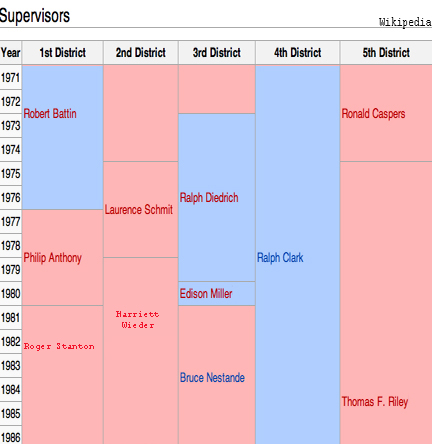
     Cella was convicted in 1978 of using a hospital he owned to defraud the federal government of hundreds of thousands in Medi-Cal funds, much of it used to underwrite his campaign contributions. After serving time in federal prison, he moved to Coachella. County Supervisor Robert Battin, for whom Harber had been an aide, was convicted in 1976 and briefly jailed for illegally using county funds to help his unsuccessful 1974 bid for the Democratic nomination of lieutenant governor. He now practices law in Santa Ana. Supervisor Laurence Schmit, a Cella ally and a major beneficiary of his political influence was defeated in his 1978 re-election bid. He moved to Northern California Supervisor Ralph Diedrich, who tried to reassemble the shattered machine, was convicted in 1979 on bribery charges. Recently released from prison, he, too, has left the county. O’Neill—never accused of wrongdoing—eventually became chairman of the state Democratic party. But that was only after years of virtual political hibernation during which he lived down the onus of his alliance with Cella.
Ralph Diedrich
     Cella, interviewed last year in Coachella, where he practices medicine at a farm workers’ clinic, said the sinking of the Shooting Star marked the “death knell” for his role as a power broker.
     The loss of Harber, he said, deprived him of his political allies of a “political genius,” who, had he steered the boat safely home, could have helped pilot the shadow government through troubled political waters.
     And, in Caspers, Cella added, the group lost a reliable ally who could have helped push through a Cella-backed move to investigate the district attorney’s office and blunt any possible probe of the Cella-O’Neill combine.
     “If Caspers had lived, we would have had the votes to stop Hicks,” said Cella. “He was a very strong vote against Cecil and he disliked Cecil even more than Fred did.”
     Battin agrees with Cella’s assessment, calling the loss of Harber and Caspers “the beginning of the end.”

     But even if the demise of the Cella-O’Neill machine is attributable to that of the Shooting Star, the events that sealed the boat’s fate remain a mystery.
     Neither bodies nor pieces of the wooden hull of the ship were ever found. Recovered 350 miles away from what was believed to be the site of the boat’s sinking was its thirteen-foot lifeboat. More than 300 miles from the presumed resting place of the Shooting Star, but a like distance from the lifeboat, debris from the yacht was found: a thirteen-foot sailboat, two large pieces of cabin top, two life jackets, some furniture and a few smaller items.
     The Coast Guard investigation failed to determine why the life jackets apparently were not used or why radio reports before the sinking indicated different positions.
     Also still a mystery is why no one, according to the official report, apparently was able to transfer from the Shooting Star to the lifeboat.
 
Robert Battin
    Another discrepancy that remains unexplained is that a mayday message picked up by a research vessel in the area said there were nine persons aboard.
     And still subject to guesswork—and not addressed by the report—is why, according to witnesses, the party on board suddenly forsook plans for two days of leisurely marlin fishing and headed—apparently in a hurry—for San Diego.
     The Coast Guard said it found no evidence of fire or explosion aboard the lifeboat. But at least one person believes there was an explosion aboard the Shooting Star and that it was set off deliberately.
     Private detective Neal Graney, who conducted his own unofficial probe, went so far as to publish a 200-page fictional account—Mayday! Mayday! Morningstar—a thinly disguised rendition of his speculations about what happened. The names, of course, have been changed. Currently, he is trying to market a screenplay based on the same theme. “I know I don’t have a smoking gun,” says the former Chicago policeman. “But, in my gut, I’m sure it was murder.”
     Though long on conjecture and short on proof, he also theorized that one of the men aboard knew the yacht was about to blow up and left in the lifeboat before the explosion. That, he argues, explains the mayday report of nine aboard and the great distance between the discovery place of the lifeboat not only from the sinking site but also from the other debris.
     And the bodies? “There are many reasons,” explains one of Graney’s fictional characters. “When bodies go down to the bottom of the sea, they usually float to the top within two or three days. That is, unless they are in small pieces. Then they are fish bait.” As for the condition of the life preservers, some of them damaged but none demonstrably bloodied, Graney attributes that to the impact of metal or wood fragments from the explosion.
     There is some support, however slender, for Graney’s belief that someone got off the boat alive. One former west Orange County elected official told me he thinks he saw a member of the ill-fated party about three years ago in Hawaii.


Richard O'Neill and family, 1950
     At the time, the former official says he was on the beach near the Pacific Beach Hotel in Waikiki, and the supposedly deceased man crossed the street nearby.
     “It looked so much like him that I just yelled his name without thinking that he was supposed to be dead,” said the vacationer, who was well-acquainted with the Shooting Star passenger he thinks he saw. “He took off and disappeared into the crowd….I’m sure that, when I yelled out, he would have recognized me….It seemed deliberate.”
     Scenarios just as bizarre as Graney’s based more on conjecture than provable fact, have been widely circulated and are passed on by Cella, Battin and others to anyone who asks.
     Details vary, but the essentials are this: Somebody hired either organized crime-related figures or a right-wing paramilitary group to blow the Shooting Star out of the water.
     Implausible as that may seem, there is some evidence that the boat would not normally have sunk, even with the pounding it took from heavy seas. Louis Fallows, co-owner of the Wilmington-based firm that was one of the government’s contractors for the type of naval rescue boat that was rebuilt to create the Shooting Star, is graphically emphatic on that question. She said the boats were built with air-tight compartments that would have buoyed themselves so much that it wouldn’t have sunk completely even if there were a big hole in the hull. “The only thing that would have sunk it would have been if it were blown apart,” she said, without being prompted by being told of theories about an explosion.
     Why anyone would want to deep-six the Shooting Star, especially in the manner Graney suggests, is unclear.


From the 6/24/74 Star-News
     But evidence that Harber and Caspers were up to potentially dangerous mischief at the time surfaced four years later. In 1978, developer Richard V. Jordan alleged in a suit against the county that the two were trying to shake him down for a $10,000 payoff plus $2000 a month for approval of a project he wanted to build near El Toro, in Caspers’ supervisorial district.
     The county settled out of court on Jordan’s claim that the county illegally revoked his building permit, paying him $700,000. The matter was investigated by the district attorney’s office to determine whether persons still alive might be criminally liable, but that probe ended inconclusively.
     As it turns out, preliminary discussion concerning the alleged deal took place in Mexican waters aboard the Shooting Star, Jordan said in papers filed with his lawsuit.
     Before the arrangement could be consummated, however, Caspers, Harber and the others departed on the fateful trip. Ironically, Jordan said, he was invited along, but declined because he didn’t think the Shooting Star was seaworthy. But the Coast Guard cited reports that deficiencies on the boat had been corrected prior to the trip.
     Jordan, the record shows, knew how to seek and obtain remedies for his grievance in a court of law. But one is tempted to ask: Were Harber and/or Caspers using the same routine on anyone else, perhaps someone prone to resort to different—and more violent—remedies?
     That might be a point of departure for any resumed investigation of the disaster. For years, however, there has been no evidence of any official interest in the matter—with one exception. In the past year or so, the FBI, questioning a politically connected Orange County person on a different matter, slipped in some questions about the Shooting Star. That doesn’t amount to a new probe, of course. But ten years later, even a residue of official curiosity at any level is intriguing.

     Still, until the questions left hanging by the official report are answered, who is to say that Graney’s explicit but seemingly farfetched version is wrong? Those questions, of course, may never be answered. And the tale of the last voyage of the Shooting Star may make as good a whodunit ten years from now as it does today.

SEE Part 2

The "Shooting Star" was a converted WWII-era AVR
Background on Fuentes:

• Dear Mr. Fuentes (Nathan Calahan, April 28, 1999)
• GOP's Fuentes Favored to Win 7th Term Chairing O.C. Party (LA Times, January 19, 1997)
• Interview With Tom Fuentes, Part 1 (Red County, September 15, 2008)
• Interview With Tom Fuentes, Part 2 (Red County, September 16, 2008)
• Trouble in the Big Tent (Jean Hastings Ardell, Orange Coast Magazine, March 1996)
• Guiding With an Iron Hand (LA Times, July 11, 1996)

Saturday, March 10, 2012

The sinking of the Shooting Star, part 5: psychics & shadow governors & seriously special executive aides

Just what happened on the night of June 13, 1974?

The entire “Fuentes/Shooting Star” saga can be found here.

     THE SECOND VOLUNTEER SEARCH. By Tuesday, the 18th of June, 1974, the disappearance of the Shooting Star and her crew of ten, including OC Supervisor Ron Caspers, was a big news story, and, though it had been nearly five days since the SS’s MAYDAY (late Thursday night), there was considerable interest among the public in launching another civilian search, even as it was clear that chances of finding any survivors were almost nil. A large prayer meeting occurred in the Supervisors’ meeting room. Meanwhile, plans were made.
Ron Caspers
     Even more aircraft were involved in this second effort, including planes to ferry personnel to and from Guerrero Negro. Early Wednesday, at OC Airport, there was a briefing, and then the squadron headed south, commencing a search of Vizcaino Bay (the waters between the Baja coast and Cedros Island) by noon. This time, there was considerably more ground support as well, including a tanker with 4000 gallons of aviation fuel and a radio network, linked to the Supervisor’s office and command post back in Santa Ana (Orange County). There was even a massive effort to photograph and search the Baja beaches, using planes and four-wheel-drive vehicles.

Way out west: Guadalupe Island
     GOOD LORD, PSYCHICS! Plus: psychics got involved:
On Wednesday, a well-known psychic was flown to the search area, meeting with the volunteers at the El Presidente [hotel in Guerrero Negro] that evening to give his impressions of the voyagers washed up on a rocky island and huddled in caves. He was flown next morning to scan islands where he felt survivors might be found. One of the photo planes was dispatched to Guadalupi Island, 200 miles to the west, to photograph its shores after another seer had a vision of the men clinging to rocks there. (From "The Last Voyage of the Shooting Star, part 2," by Wayne Clark; Orange County Illustrated, Dec., 1974)
     Gosh, I wonder if they tossed chunks of cash into the ocean, too? That would have been more useful.
Guadalupe Island: psychic misdirection
     THE COAST GUARD (TRIES TO) PULL THE PLUG. On Wednesday night, the Coast Guard, a more objective player, decided to give up the search, but the usual suspects got to California Senators Tunney and Cranston, who pressured Coast Guard bigwigs in Washington, and so the Venturous and search planes, already heading home, turned back to the search area. On Thursday, they resumed a search “southeast along the drift line from the debris area, offshore from Turtle Bay.” Meanwhile, the civilians scanned 75 miles to the south in a strip of ocean from the coast to 50 miles out.
     Nothing was found.
     Thursday evening, a week after the sinking, the Coast Guard finally headed home, but the volunteers back in Guerrero Negro planned for yet another day of searching, this time further south another 100 miles.

Tom Fuentes, 1973
     YOUNG TOM FUENTES PULLS THE OTHER PLUG. On Friday morning, however, just as the squadron was ready to set off, they got a call from the Santa Ana command post, which
insisted they abandon the plan and return home. Caspers’ executive aide, Tom Fuentes, reasoned the risk of one of the volunteer planes going down at sea was too great, now that the Coast Guard had withdrawn. The chance that any of the Shooting Star party still survived was also very slim. Reluctantly, the volunteer squadron returned home. (LVSS)
     I find this odd. —Not the decision, but who seemed to make it. Fuentes could not have been senior among the crew back in Santa Ana, which seemed to count some fairly powerful county figures among its members. He was a mere Supervisor’s aid and at most 25 years old. He had no military or rescue experience.
     Why was this green kid making decisions for the search effort? Why would he be even advising the éminences grises huddled in that office in Santa Ana?
     I’ve got other questions.
Tommy Klein, Supervisor
Clark's "executive aide"
     Keep in mind that the writer of the account I am here relying on—Wayne Clark—had been or was at the time a Supervisor’s deputy, whatever that is. I’m not entirely sure about the chronology, but Clark seemed to have ended his PIO job at UCI in about 1973 or 1974, and the next job listed in his bio is the “Supervisor’s deputy” gig (I haven’t determined which Supervisor). If Clark had that job at the time of the SS disaster, it seems likely that he was friendly, or at least acquainted, with some of the principals of this story. Consider the Shooting Star crew: Caspers, of course, was a Supervisor, and Fred Harber, the yacht’s owner, was the mastermind of several recent election victories (including Caspers, I believe). Tommy Klein, like Fuentes, was a Supervisor’s (viz., Ralph Clark’s) “executive aid.” (You'd think the five executive aids--and deputies?--would be chummy, but who knows.)
     Was Clark acquainted with some of the victims of the Shooting Star disaster? And was he close to Fuentes or to others directly involved in commanding or executing the search efforts?
     And, again, why does Fuentes have so prominent a role?
     Possibly, Fuentes was close to Caspers’ family and to Caspers’ wife. I came across an article about the SS disaster (dated 6/24/74) that reports:
   Fuentes said he and Caspers’ wife, Ann, had asked Caspers not to make the trip. “Premonition is perhaps too strong a word to use here,” Fuentes said, “but Ann and I had a bad feeling about the whole thing. Neither of us liked the boat.”
     I dunno. Maybe Fuentes was close to the family and that gave him special authority with regard to whether the search effort should continue.
     No doubt there are perfectly good answers to my questions. I wonder if Clark is still around? I might give ‘im a call.

* * *
Cella's search heads south
     POLITICAL BOSS CELLA, HOWEVER, WON'T GIVE UP. So, on the 21st, based evidently on Fuentes’ concerns for the safety of searchers, the large volunteer search effort was called off.
     But Dr. Louis Cella, a close associate of Caspers and Harber (and the boss of OC’s then political machine—aka the OC “shadow government”), pushed on with great determination. He hired four airborn spotters for the tuna industry to scan the area south of Cedros Island all the way to Magdalena Bay, 300 miles away. They found nothing.
     Cella also hired (through a Mexican go-between) perhaps as many as 200 villagers to search the beaches. That effort was continuing as Clark was writing his articles (in late 1974).
     As I indicated earlier, the SS’s Boston Whaler was eventually found on July 4 by a Swedish freighter, 60 miles south southwest of Magdalena Bay. (That’s 350 miles south of where the other debris was found.) The whaler was “awash” with its outboard motor “attached.” There “were no signs of fire or explosion,” writes Clark. The Coast Guard examiner was convinced that none of the crew had been aboard.
     According to some calculations, the Coast Guard searchers likely passed over the whaler several times without spotting it.

* * *
     Clark ends his story with the conclusion of two court hearings:
Ronald Caspers, Fred Harber, Caspers’ two sons, Erik and Kirk, Leonard Bashor, his nephew, Robert Bashor, and son-in-law, Richard Tully, Thomas Klein and his two brothers, Timothy and John, died at sea June 14, 1974, in the vicinity of the San Benito Islands, off the coast of Baja California. (LVSS)
John Klein and his daughters (not long before the Shooting Star disaster)
* * *
     THE COAST GUARD REPORT. I’ve looked over the Coast Guard report of the Shooting Star case. Below are some elements of that report that strike me as interesting.

* There’s a cover letter, dated 8/2/74, from J. M. Bowen, Commander, U.S. Coast Guard, Chief, Search and Rescue Branch TO an attorney in Ogden Utah (the Klein brothers were from that area). The letter explains the Coast Guard effort. It ends with this: “The names of the reported ten persons on board, including John and Tim Klein, were provided to the Coast Guard by Mr. Tom Fuentes, of Supervisor Ronald Casper’s [sic] Office.” It then provides Fuentes’ phone number.

* According to the Coast Guard report, the Shooting Star was constructed in 1947; it had a 340 hp diesel engine; it was 63 feet long and it had a wooden hull.

* The CG estimates that, at the time of the MAYDAY, the SS was “approximately fifty miles northwest of San Benito Island….”

* There’s a “record of missing.” Ronald Caspers is listed as living on Lido Isle, Newport Beach.

* All three Klein brothers are listed as living in Roy, Utah.

* “Weather on 13 June … in the area of San Benito Island … was overcast, visibility unknown; wind was fifteen to twenty-five knots, gusting to forty knots; seas and swells were running from the northwest at ten to fifteen feet….”

Roy, Utah, is in the Ogden area
* “The vessel Scandia, while anchored in the Gulf of Baja, Mexico, was attempting to contact KMI Oversees Radio when the distress call from the Shooting Star came over the air. The Scandia copied the message as “Mayday/Mayday, this is the Shooting Star, fifty miles south of Turtle Bay, sinking, nine people on board.” The Scandia then contacted KMI Radio and informed them that they had also heard the distress call. KMI acknowledged at that time but also stated that the position that the Scandia had copied was not the one that KMI had heard. KMI stated that the radio station had copied fifty miles out but could not hear anything else for the position. The Scandia stated that they heard fifty miles south of Turtle Bay.”

* “The two life jackets that were recovered from the debris were in a torn and semi-mutilated condition. The life jacket that was in the worst condition [difficult to read] was delivered to the Long Beach [illegible] criminology laboratory for testing of traces of blood or of any other substance. All tests and reports were negative. The life jacket check [ties?] were [tied?] at the time of recovery. One life jacket tie was tied in a bow and the other tie was tied in a knot. The lower straps on the jacket were clasped closed, although the straps were ripped, torn and/or severed. The body of the jackets were ripped and torn in several places with one [illegible] chest pad missing entirely from one of the life jackets. It is not known in what manner the life jackets were [stowed?] prior to the casualty. It is known that some of the life jackets were new and were stowed while still in the original plastic bags prior to the vessel’s departure from the United States.”

Tim Klein on the Shooting Star, La Paz, Baja California Sur, Mexico
* “The thirteen-foot Sea Witch (i.e., the Boston Whaler) that was recovered by the ... Nihon [i.e., the Swedish ship] was examined by the U.S. Air Force Investigators … This investigation revealed the following:
When the small boat was located, it was awash with [seas?] boarding the small craft over the stern. … The outboard motor, a 30-horsepower Evinrude, was still attached to the vessel but the controls, including the fuel lines, were all torn loose and adrift in the bottom of the vessel. There were no portable fuel tanks in the boat. … The Master of the Nihon stated that when the boat was recovered there were no signs of fire or explosion. … The investigator from the Canal Zone stated that it was his opinion that the craft did not contain any survivors prior to the time it was picked up by the Nihon. … Upon inspection of the debris when returned to the Coast Guard Base, Terminal Island, California, it was noted that the cradle which housed the small boats was undamaged. The crome padeyes that a nylon grip[e?] attached to were undamaged. There was no evidence of forcible separation of the small boats from the Shooting Star.” 
. . .
Shooting Star crewmen John and Tim Klein: proud Marines

* “The last insurance survey [after the near casualty in 1971] was conducted on the vessel Shooting Star on 17 March 1972…. Applicable sections pertaining to the condition of the hull of the vessel are quoted from the report:
     “Inspecting the vessel externally found topsides to be in fair condition… at this time we do not deem rework necessary.”
     “Inspecting the vessel internally in all accessible areas found structural members to be in fair condition with no apparent fractures noted….
     “…The vessel Shooting Star was hauled from the water at Windward Yacht and Repair, Inc., in Marina del Rey on 21 Sept. 1972 and … repair was accomplished…. Mr. G[illegible] stated that the vessel, to the best of his knowledge, was in good shape.”

CONCLUSIONS

     The Shooting Star sank … at about fifty miles northwest of San Benito Island…. This location was determined as the most probable position for the sinking by U.S. Coast Guard Rescue Coordination Center, Long Beach, CA.
     The exact cause of the sinking of the Shooting Star is unknown, although heavy weather may have been a contributing factor.
     The differences in the location as passed to KMI Overseas Radio and as overheard by the vessel Scandia cannot be positively resolved but it is felt that because of atmospheric conditions the words “south” and “but” were confused by either one of the involved parties. It cannot be determined which word is correct.

From the Coast Guard report
. . .
     It cannot be determined if the life jackets were or were not used by the persons on board the Shooting Star.
     It cannot be determined whether or not any persons were, at any time, in the thirteen-foot Sea Witch, nor can it be determined that the small craft was or was not forcibly removed from the Shooting Star.
     The cause of the damage to the life jackets and the small boat cannot be determined.
     The incident that occurred at Dana Point in July, 1971, did not contribute to this casualty.
     The work that was accomplished on the vessel after the survey … corrected all the deficiencies that were listed in the survey report….
     The deficiencies as listed in the survey of July, 1973, most probably were not contributory to this casualty.
     There is no evidence of foul play…. [For a brief discussion of Neal Graney's "murder" theory, see Part 1 of this series.]

RECOMMENDATIONS:

     It is recommended that no further action be taken and this case be closed with the submission of this report.

     L.P. Minott, Jr.


The Coast Guard's Venturous

Tuesday, March 13, 2012

Shooting Star, part 7: my correspondence with passenger Lyle Overby


The entire “Fuentes/Shooting Star” saga can be found here.

For the rest of the series, see Shooting Star

March 12:
Mr. Overby:

I'm a local blogger with an interest in Orange County history. I've been working on a story about the sinking of the "Shooting Star" in 1974--the yacht that disappeared along with Ronald Caspers and nine others. 
This morning, I spoke with Wayne Clark, who once wrote two fine articles about the disaster (for Orange County Illustrated, late in 1974), and he said that he recalled that someone on the trip got off the boat--perhaps during the refueling stop at Tortoise Bay--before it sank. At first he couldn't recall the person's name. Just now he emailed that he remembered that it was you. 
Is that correct? Were you among the crew of the Shooting Star from June 9 until, I suppose, June 13, 1974? 
Thanks for any light you can cast on this sad episode.

     Roy Bauer,  949 xxx xxxx
March 13:
Roy, 
Click on graphic to enlarge
First of all, I have to ask who are you besides a blogger? These folks that lost their lives were not strangers to me and I don't want to be part of further desecrating theirnames for curiosity. What is your interest in this old story? 
I was on the Shooting Star, but I got off the ship at Cabo San Lucas and did not make the troubled trip from Cabo to Guerrero Negro - the last time the the Shooting Star was seen. There are a whole lot of old news stories that chronicle the tale quite well, including probably the best two of all "The Last Voyage of the Shooting Star - Part 1 and 2" by the very Wayne Clark that referred you to me. 
The boat was not sabotaged as many conspiracy types speculate. It was a pleasure boat taken out into heavy weather without the proper high seas survival equipment needed to make the journey in a cabin cruiser (Shooting Star was 65 feet in length).
There isn't that much more to add. 
     LYLE OVERBY
March 13:
Mr. Overby: 
I am a professor of philosophy at Irvine Valley College, and I have been blogging (Dissent the Blog) since 2005.      
Though our blog focuses on items of interest to the college community, it also occasionally delves into Orange County history in general--e.g.,       
A century-old "History of Orange County": towns called Celery and Delhi and a women's club aiming for "sober, Christian citizenship"  (Feb. 16)
Recently, I blogged about the sinking of the “Shooting Star” and was contacted by the daughters of one of the victims of the sinking (John Klein), who encouraged any efforts on my part to learn more about the disaster.    
For instance, we would love to learn more about what the Klein brothers (John and Tim) were doing in La Paz. All that we have learned thus far is that at least one of them was acting as a “caretaker” of the boat, and that he had been serving in that capacity probably since April. I’ve also learned that the Shooting Star was taken out for a four-day fishing trip in early May. Were you on that trip? Reportedly, the June trip was planned at that time.    
Did you know the three Klein brothers, including Tommy?      
Anything you might tell us about them would be greatly appreciated.      
We were under the impression that the “crew” of the SS flew from LAX to La Paz and then took a chartered plane to Cabo. Had you been with the Kleins in La Paz prior to the arrival of the others?       
I’ve read that Ron Caspers’ executive aide, Tom Fuentes, was supposed to join the others for the trip (from Cabo), but did not ultimately do so. Is that correct? Was he among those who flew down? Why did he not join the others as first planned?      
Any information you might provide would be greatly appreciated. 
--Roy
SEE Part 8

Note: Mr. Overby, like Tom Fuentes, Tommy Klein, and Wayne Clark, served as an executive aide to a member of the Orange County Board of Supervisors in the 1970s. Note: the upshot of the above: there was no "11th passenger."

Monday, March 12, 2012

The sinking of the Shooting Star, part 6: an 11th passenger?


The entire “Fuentes/Shooting Star” saga can be found here.

Ronald Caspers, 1973
[See UPDATE below] [See also Part 7, where it is revealed that the mystery passenger likely sailed from La Paz (with the Klein brothers) to Cabo, where he disembarked. Hence, there is no "11th passenger."]
     Recently, I’ve posted a series of articles about the odd 1974 disappearance of the yacht “Shooting Star” off the coast of Baja California. Ten people disappeared with that boat, including OC Supervisor Ronald Caspers and political consultant Fred Harber. (Our own Tom Fuentes was Caspers' "executive aide" at the time.)
     Harber and Caspers were linked to the Orange County "shadow government”—DA Cecil Hicks’ term—allegedly masterminded by Dr. Louis Cella, who, not long after this episode, was tried and then sent to prison for corruption concerning campaign contributions to officials across the state. Cella's partner in the giving of huge chunks of money to key state politicians (including Jerry Brown) was South Orange County land baron Richard O’Neill, who died in 2009; Cella died in 2011.
John Klein
     In most of these posts, I have relied on two long-unavailable articles that appeared in the November and December, 1974, editions of the defunct Orange County Illustrated (many editions of that magazine were recently acquired by the OC archives). I was sent copies of the articles by the daughter of one of the victims of the tragedy (John Klein).
     The articles really are well-written, but they do raise questions.
     I decided to contact their author, Wayne Clark, who, at age 84, is still a busy man. He is Associate Executive Director of the Urban Water Institute in Irvine. (I do believe he holds other offices as well.)
Tony Moiso of Rancho 
Mission Viejo
     Clark is an interesting guy. After participating in the military occupation of Japan after WWII, he went to college and then studied the law. He seems to have spent many years as a journalist, working for the LA Times, among other organizations. From about 1963 to 1973, he was UCI’s Public Information Officer. After that, he worked as a “deputy” for one of the supes on the OC Board of Supervisors (I recently speculated that he had held that position at about the time that the “Shooting Star” episode occurred). He then started a successful PR firm and then, starting in the early 90s, he held various positions on local water boards. The politics of water seems to have kept Mr. Clark occupied in the last twenty.
     As we'll see, Clark was in fact the aide to someone (according to one reporter) very much caught up in infamous OC 70s corruption free-for-all. More on that in a moment.
     I left an email with him last night, asking about the old OC Illustrated articles. This morning, he got back to me by phone. Here are my notes (not verbatim unless quotation marks are used) of our twenty-five or so minute conversation:

Conversation with Wayne Clark, March 12, 2012
Wayne Clark
     Clark: “I’m 84, and my memory’s not always so good.”
     I told him I was impressed with his career and accomplishments. Then I zeroed in on his work in the seventies with a member of the OC Board of Supervisors. He said: I started to work as deputy to Supervisor [Laurence] Schmit – probably, the “worst Supervisor of all time.” (Laughs, not unpleasantly.)
     I asked: You were a deputy? Is that the same as an executive aide? Yes. [In ’74, Tom Fuentes was the executive aide of Ronald Caspers. A victim of the SS disaster, Tommy Klein, was the executive aide to Supervisor Ralph Clark.]
     I asked: Did you work for Schmit at the time of the Shooting Star incident in 1974?
     No, a bit later, about 1976, after I worked for Orange County Illustrated. I left them before they went out of business. [Schmit appears to have served as a Supe from 1975 through 1978, one term.]
     The people who hired me [for the exec. aide job] told me that my job was to “keep him out of jail,” which I did, more or less (laughs).
     I [Roy] asked what sort of questionable or illegal activity we were talking about, but Clark was either unwilling to tell me or he didn’t remember.
     We talked about the ill-fated trip of the Shooting Star. I asked whether he knew who flew down to La Paz for the trip. Was anyone along who didn’t get on board the boat? Is it true that Tom Fuentes was supposed to join the group but backed out at the last minute? Clark couldn’t remember such details.
     But then he said something remarkable:
     Clark: One passenger got off the boat. . . –wasn’t that in the article?—can’t remember his name. [I said that that certainly was not in the article. Note: as far as I know, there has never been any mention of an 11th passenger who got off the boat in any news stories or official reports. See Part 5 of this series: Coast Guard report, etc.]
     I mentioned that the SS stopped at Turtle Bay to refuel. Did the passenger got off there? Clark didn't seem to know or to remember.
     Clark: He [that passenger] is still around. He works as a consultant. Works for O’Neill down in South County [Rancho Mission Viejo]. Worked for Tony Moiso [President and Chief Executive Officer of Rancho Mission Viejo, which is associated with the O’Neill family. Moiso and O’Neill have run RMV since the 60s]. Clark just couldn't remember the guy's name.
Phil Anthony
     I asked about the article that appeared in Orange Coast Magazine in 1984—the one that focused on the political aftermath of the SS disappearance and that mentioned an ex-Chicago cop’s investigation and his view that the Shooting Star was destroyed by a bomb. (You don’t find body parts if they’re blown to bits; they then become fish food.)
     Clark: No, I didn’t know about the ex-cop and his theory. (Evidently, Clark didn’t follow the case.)
     I mentioned Dr. Louis Cella, the remarkable political donor and political machine kingpin. Clark had interviewed him, he said. He was doctor, said Clark. Clark remembered that Cella had gone down to Mexico to try to find Caspers and the others.
     Clark: The rumor was that he was in the mafia, but I don’t think so. [No longer referring to the Shooting Star:] He had a plane and he’d go off once a week, pretty mysterious—maybe on a Thursday—but, as it turns out, he didn’t go where he said he was going. Clark seemed to suggest that there was some funny business there. No doubt some of the mystery was uncovered during the criminal investigation of Cella and others, though, as I recall, journalists who reported the story have opined that they never got answers to where all the money was coming from.
     Clark: I remember interviewing him. It was odd. There was all this printing equipment (I think at the hospital). It was “strange.” (Clark seemed to use the word “strange” for Cella himself, not just for the presence of the equipment.) You might want to talk to Phil Anthony, who was a Supervisor and who’s on the OC Water District board these days. At the time, I seem to recall he resigned to avoid indictment.
      Clark: You should talk to Tom Fuentes. He’d know all about this.
 
     I explained that Fuentes is now dying of cancer. I said I knew him and that I wasn’t going to contact him.
     Clark laughed that I knew his background so well. How do you know all this about me? I read his bio, I said. Yes, I was UCI PIO for about ten years, said Clark. Worked for the LA Times at the OC office before that. 
[UPDATE: Just heard back from Mr. Clark:
Roy - L... O... [email address given] is the person I remember as having got off the boat in Central Baja before it being lost at sea. I believe he is still engaged as a consultant to the Ranch. - Wayne 
He gave me the guy's full name, but I want to contact him and discuss his own recollections before I say more. --I've contacted Mr. LO. It'll be interesting to see what he says, if he responds.]
Laurence Schmit, giving a speech
     —Well, that’s about it. Clark is an old fellow and seems nice enough. I didn’t want to bother him further. He said he might be able to remember the name of the “passenger” who got off the Shooting Star. “If you remember the name,” I said, “you can call or email me. I’d very much appreciate that."

* * *
     I did a little digging after the phone call, and now I’ve got new questions. Evidently, Supervisor Schmit, the guy Clark worked for for several years, was very much a full member of the OC “shadow government,” as DA Hicks used to describe it. (See Peterson's article below.) He took office in 1975. After his 1978 reelection defeat, he moved to Northern California.
     Phil Anthony started out on the Westminster City Council, became mayor, and then served as a Supervisor from 1976 to 1981. He’s served on various boards since then. (See.)
     You can read about Moiso here and here. He’s still very much a player also (he’s only 72).
     I’ll close with this excerpt from the 1984 Orange Coast Magazine article: The Sinking of a Political Machine by Larry Peterson:
Larry Peterson (1984)
     …The voyage was supposed to be a celebration of Caspers’ re-election only a few days before. The victory was engineered by [“Shooting Star” owner Fred] Harber, who had close links to Dr. Louis Cella and other political figures who later were to be indicted on charges ranging from fraud and embezzlement to campaign-finance cover-up and bribery.
     At the time, Cella headed the closest thing Orange County has ever had to a political machine. [Please note: Fuentes’ turn as county GOP chair started in 1984 and lasted about twenty years. He also is often described as having constructed and maintained a “machine.”] In the mid-seventies, Cella and south Orange County land baron Richard O’Neill teamed up to donate hundreds of thousands of dollars to dozens of candidates.
     District Attorney Cecil Hicks, close to the country’s Republican establishment, fought a running battle with Cella. Hicks once publicly accused the doctor of heading a “shadow government” that controlled the county Board of Supervisors. Cella responded by accusing Hicks of alcoholism. In any case, a majority voting bloc [including Caspers], usually consisting of recipients of Cella’s political largesse, repeatedly helped stymie Hicks’ attempts to investigate Cella and his allies.
     Within four years after the sinking of the Shooting Star, most members of the shadow government had been driven into political exile. Some, indeed, were behind bars, and others were fighting rear-guard legal battles that would end in their incarceration.
     Cella was convicted in 1978 of using a hospital he owned to defraud the federal government of hundreds of thousands in Medi-Cal funds, much of it used to underwrite his campaign contributions. After serving time in federal prison, he moved to Coachella. County Supervisor Robert Battin, for whom Harber had been an aide, was convicted in 1976 and briefly jailed for illegally using county funds to help his unsuccessful 1974 bid for the Democratic nomination of lieutenant governor. He now practices law in Santa Ana. Supervisor Laurence Schmit, a Cella ally and a major beneficiary of his political influence was defeated in his 1978 re-election bid. He moved to Northern California. Supervisor Ralph Diedrich, who tried to reassemble the shattered machine, was convicted in 1979 on bribery charges. Recently released from prison, he, too, has left the county. [Land baron Richard] O’Neill—never accused of wrongdoing—eventually became chairman of the state Democratic party. But that was only after years of virtual political hibernation during which he lived down the onus of his alliance with Cella.
Moiso and Governor Brown in January
     Cella, interviewed last year in Coachella, where he practices medicine at a farm workers’ clinic, said the sinking of the Shooting Star marked the “death knell” for his role as a power broker.
     The loss of Harber, he said, deprived him of his political allies of a “political genius,” who, had he steered the boat safely home, could have helped pilot the shadow government through troubled political waters.
     And, in Caspers, Cella added, the group lost a reliable ally who could have helped push through a Cella-backed move to investigate the district attorney’s office and blunt any possible probe of the Cella-O’Neill combine.
     “If Caspers had lived, we would have had the votes to stop Hicks,” said Cella. “He was a very strong vote against Cecil and he disliked Cecil even more than Fred did.”
     Battin agrees with Cella’s assessment, calling the loss of Harber and Caspers “the beginning of the end.” [END] 
      So, if Peterson has his facts right, our guy Wayne Clark was the executive aide to someone very much tied to Cella’s “machine.” And his job was to keep him out of jail? Well, he seems to have accomplished that.
     And the mystery passenger? He went to work for Tony Moiso and Rancho Mission Viejo—the company of Richard O'Neill, Cella's partner? [L.O.?]
      It’s all very odd.

* * *
ANOTHER EXCERPT FROM  The Sinking of a Political Machine
by Larry Peterson:

[WAS IT MURDER?]

     ...Neither bodies nor pieces of the wooden hull of the ship were ever found....
     The Coast Guard investigation failed to determine why the life jackets apparently were not used or why radio reports before the sinking indicated different positions.
     Also still a mystery is why no one, according to the official report, apparently was able to transfer from the Shooting Star to the lifeboat. 
Robert Battin
    Another discrepancy that remains unexplained is that a mayday message picked up by a research vessel in the area said there were nine persons aboard.
     And still subject to guesswork—and not addressed by the report—is why, according to witnesses, the party on board suddenly forsook plans for two days of leisurely marlin fishing and headed—apparently in a hurry—for San Diego.
     The Coast Guard said it found no evidence of fire or explosion aboard the lifeboat. But at least one person believes there was an explosion aboard the Shooting Star and that it was set off deliberately.
     Private detective Neal Graney, who conducted his own unofficial probe, went so far as to publish a 200-page fictional account—Mayday! Mayday! Morningstar—a thinly disguised rendition of his speculations about what happened. The names, of course, have been changed. Currently, he is trying to market a screenplay based on the same theme. “I know I don’t have a smoking gun,” says the former Chicago policeman. “But, in my gut, I’m sure it was murder.”
     Though long on conjecture and short on proof, he also theorized that one of the men aboard knew the yacht was about to blow up and left in the lifeboat before the explosion. That, he argues, explains the mayday report of nine aboard and the great distance between the discovery place of the lifeboat not only from the sinking site but also from the other debris.
     And the bodies? “There are many reasons,” explains one of Graney’s fictional characters. “When bodies go down to the bottom of the sea, they usually float to the top within two or three days. That is, unless they are in small pieces. Then they are fish bait.” As for the condition of the life preservers, some of them damaged but none demonstrably bloodied, Graney attributes that to the impact of metal or wood fragments from the explosion.
     There is some support, however slender, for Graney’s belief that someone got off the boat alive. One former west Orange County elected official told me he thinks he saw a member of the ill-fated party about three years ago in Hawaii.

Richard O'Neill and family, 1950
     At the time, the former official says he was on the beach near the Pacific Beach Hotel in Waikiki, and the supposedly deceased man crossed the street nearby.
     “It looked so much like him that I just yelled his name without thinking that he was supposed to be dead,” said the vacationer, who was well-acquainted with the Shooting Star passenger he thinks he saw. “He took off and disappeared into the crowd….I’m sure that, when I yelled out, he would have recognized me….It seemed deliberate.”
     Scenarios just as bizarre as Graney’s based more on conjecture than provable fact, have been widely circulated and are passed on by Cella, Battin and others to anyone who asks.
     Details vary, but the essentials are this: Somebody hired either organized crime-related figures or a right-wing paramilitary group to blow the Shooting Star out of the water.
     Implausible as that may seem, there is some evidence that the boat would not normally have sunk, even with the pounding it took from heavy seas. Louis Fallows, co-owner of the Wilmington-based firm that was one of the government’s contractors for the type of naval rescue boat that was rebuilt to create the Shooting Star, is graphically emphatic on that question. She said the boats were built with air-tight compartments that would have buoyed themselves so much that it wouldn’t have sunk completely even if there were a big hole in the hull. “The only thing that would have sunk it would have been if it were blown apart,” she said, without being prompted by being told of theories about an explosion.
     Why anyone would want to deep-six the Shooting Star, especially in the manner Graney suggests, is unclear.
     But evidence that Harber and Caspers were up to potentially dangerous mischief at the time surfaced four years later. In 1978, developer Richard V. Jordan alleged in a suit against the county that the two were trying to shake him down for a $10,000 payoff plus $2000 a month for approval of a project he wanted to build near El Toro, in Caspers’ supervisorial district.
     The county settled out of court on Jordan’s claim that the county illegally revoked his building permit, paying him $700,000. The matter was investigated by the district attorney’s office to determine whether persons still alive might be criminally liable, but that probe ended inconclusively.
     As it turns out, preliminary discussion concerning the alleged deal took place in Mexican waters aboard the Shooting Star, Jordan said in papers filed with his lawsuit.
     Before the arrangement could be consummated, however, Caspers, Harber and the others departed on the fateful trip. Ironically, Jordan said, he was invited along, but declined because he didn’t think the Shooting Star was seaworthy. But the Coast Guard cited reports that deficiencies on the boat had been corrected prior to the trip.
     Jordan, the record shows, knew how to seek and obtain remedies for his grievance in a court of law. But one is tempted to ask: Were Harber and/or Caspers using the same routine on anyone else, perhaps someone prone to resort to different—and more violent—remedies?
     That might be a point of departure for any resumed investigation of the disaster. For years, however, there has been no evidence of any official interest in the matter—with one exception. In the past year or so, the FBI, questioning a politically connected Orange County person on a different matter, slipped in some questions about the Shooting Star. That doesn’t amount to a new probe, of course. But ten years later, even a residue of official curiosity at any level is intriguing.
     Still, until the questions left hanging by the official report are answered, who is to say that Graney’s explicit but seemingly farfetched version is wrong? Those questions, of course, may never be answered. And the tale of the last voyage of the Shooting Star may make as good a whodunit ten years from now as it does today.

SEE Part 7

Roy's obituary in LA Times and Register: "we were lucky to have you while we did"

  This ran in the Sunday December 24, 2023 edition of the Los Angeles Times and the Orange County Register : July 14, 1955 - November 20, 2...