Friday, April 30, 2021

Thursday, April 29, 2021
Is our own Don Wagner "the second dumbest Don in the Republican Party"?
Jimmy Kimmel calls OC supervisor (and former SOCCCD trustee) Don Wagner the "second dumbest Don in the Republican Party." The OC angle starts at the 4:45 mark.
The roasting seems only right since after months of ginning up skepticism about the virus and vaccine, Wagner now has to deal with what he created: mobs of conspiracy-minded constituents at the Board of Supes meeting, some wearing, get this, homemade Stars of David because the vaccination campaign is so much like the Holocaust.
Friday, April 23, 2021
UC, CSU to mandate vaccines for students, staff and faculty

from the Department of It's About Time:
California’s massive UC and Cal State systems plan to require COVID-19 vaccinations this fall
The University of California and California State University announced Thursday that they will require COVID-19 vaccinations for all students, faculty and staff on campus properties this fall once the Food and Drug Administration gives formal approval to the vaccines and supplies are sufficiently available. The directive is the largest of its kind in U.S. higher education, affecting more than 1 million members of the two public university systems...The California Community Colleges, which serve 2.1 million students, said Thursday that they would leave vaccination policy decisions to the system’s 73 local districts.
Time to reach out to the board!
Saturday, April 17, 2021
Monday, April 5, 2021
Why isn’t a “psychic phenomenon” simply a mental phenomenon?
Houdini perhaps benefited from interest in Spiritualism;

but he became its chief debunker by the time that he died.
woo-woo:
noununconventional beliefs regarded as having little or no scientific basis, especially those relating to spirituality, mysticism, or alternative medicine….Adjectiverelating to or holding unconventional beliefs regarded as having little or no scientific basis, especially those relating to spirituality, mysticism, or alternative medicine…. (New Oxford American Dictionary)
It is still possible—just barely—to use the adjective “psychic” to mean “of the psyche,” i.e., “of the mind.” But that meaning has long been squeezed into obscurity by the “having to do with woo-woo” meaning.
My issue: what’s with use of the term “psychic” to refer to alleged woo-woo phenomena? Why isn’t a psychic phenomenon simply a mental phenomenon?
* * *
With regard to the concept of the “psychic,” the Oxford English Dictionary (OED) demands attention to two adjectives: “psychical” and “psychic.” The less-familiar “psychical” is the earlier word, having been used as early as 1642 (to refer to the spiritual). The noun or adjective “psychic” didn’t appear until two hundred years later.
But let’s start with the root: the noun, “psyche.”
The noun “psyche”:
The Ancient Greek word “psyche” originally referred to breath or life, but it is usually translated as soul or mind or spirit. According to the OED, the “name was extended by Plato and other philosophers to the anima mundi…, conceived as animating the general system of the universe, as the soul animates the individual organism.”
The earliest English use of the noun “psyche” recognized by the OED occurs in 1647:
The animating principle of the universe; = anima mundi n. Obsolete.
That meaning didn't last long.
The OED also cites a longer-lasting use of the noun meaning mind/soul/spirit, dating from the same time (1648):
The mind, soul, or spirit, as distinguished from the body.
That, I think, is what most of us would expect to be the case. In the English language (one might suppose), “psyche” has tended to refer to the “mind or soul or spirit,” which is what the Ancient Greeks meant. By the 19th Century, a more scientific sense of psyche—referring to the mind, not to spirit or soul—emerged.
All true.
The adjective “psychic/psychical”:
The OED dates the first use of the adjective “psychical,” meaning “of or relating to the spirit, spiritual,” to 1642. That meaning, it says, is “now rare.” It largely gave way to the concerning-the-mind/soul meaning, though it was still possible to use the term “psychic” for the “spirit” meaning in the mid-19th Century.
I should mention that the OED’s examples of the “spirit” meaning of “psychical” often seem to refer ambiguously to the spiritual or mental. (See for yourself.)
The OED lists an odd early 18th Century, theological (“now chiefly historical”) meaning of “psychical”: “Of or relating to the animal or natural life of man, esp. the natural or animal soul, as opposed to the spiritual.” Here, it seems, the psychical is the mental that is not the spiritual—e.g. (I suppose), our desire (a mental phenomenon) for sex or food in contrast with, say, our love or respect for God (also a mental phenomenon, but one presumably not rooted in our bodily nature).
This would seem to be a very specialized meaning, very like Kant's notion of the self as possessing natural "inclinations," apart from the faculty of reason.
* * *
The concept arrives:
By 1836, it was possible to use the adjective “psychical” to mean psychic in the contemporary woo-woo sense. But then, by 1871, the term “psychic” replaced “psychical” to refer to all things woo-woo:
Psychical: (3) Of, relating to, or designating faculties or phenomena, such as telepathy and clairvoyance, that are apparently inexplicable by natural laws and are attributed by some to spiritual or supernatural agency; involving paranormal phenomena of the mind, parapsychological. [1836 - ]PSYCHIC, adj.3.a. = PSYCHICAL adj. 3. [1871 - ]
So the concept of woo-woo related stuff—our contemporary sense of “psychic”—traces back to about the 1830s. The use of the term "psychic" to refer to that stuff begins in the 1870s or so.
Meanwhile, as one might expect given the origins of “psyche” and the rapid emergence of the science of psychology (in the 19th Century), the term “psychic” was also used to refer to “the mental” (“Of, relating to, or generated by the human mind or psyche”) starting around 1845:
Interestingly, the noun “psychic,” referring to a practitioner or "manifester" of woo-woo, dates back to 1860:PSYCHIC adj. 1.1. Of, relating to, or generated by the human mind or psyche; psychological; mental. Also, of an illness or condition: psychogenic (now rare)….1845 Dublin Univ. Mag. Jan. 496/1 The nightmare..may indeed be a mere phantasm or psychic image.1873 W. WAGNER tr. W. S. Teuffel Hist. Rom. Lit. I. 422 In its refined descriptions of psychic events the poem recalls Virgil's manner.1883 Brit. Q. Rev. July 14 The varied stimuli, psychic and physical.1896 Alienist & Neurologist 17 520 Hysteria, is a constitutional psycho-neuropathy with morbid impulsions, caprices, delusions, hallucinations, and illusions, psychic and sensory. ¶1902 J. BUCHAN Watcher by Threshold II. 131 Among women his psychic balance was so oddly upset that he grew nervous and returned unhappy.1910 Jrnl. Abnormal Psychol. 5 68 I have successfully treated by Freud's psychoanalytic method cases of homosexuality, psychic impotence..and many other so-called perversions.1925 J. LAIRD Our Minds & their Bodies ii. 32 ‘Psychic’ tumours or false pregnancies have deceived skilled observers.1968 New Scientist 2 May 226/1 The so-called ‘psychic poisons’, capable of inducing temporary or even permanent insanity.1974 M. MENDELSON Psychoanalytic Concepts of Depression (ed. 2) vii. 254 Unlike the energy of science..psychic energy is directional.2004 D. BIRKSTED-BREEN et al. In Pursuit of Psychic Change vi. 106 His psychic life was dominated by this phantasy which was suffused with such hatred toward his sibling..that it had led to an unconscious belief that he had actually murdered him.
PSYCHIC. n.
B. n.
1.a. A person who is regarded as particularly susceptible to supernatural or paranormal influence; a medium; a clairvoyant.
1860 W. D. HOWELLS Let. 14 Nov. in Sel. Lett. (1979) I. 64 We talked chiefly about psychics... I am going largely into skepticism at present.
OK, so here are the facts, I believe:
• In English, the noun “psyche” has long referred to the mind or soul, though esoteric theological meanings have come and gone.• The adjective “psychical” (17 Century) is older than the term “psychic,” which only emerged in the 19th Century.• The contemporary concept of “the psychic” (i.e., and adjective referring to woo-woo matters) emerged in the early 19th Century, though the term then used was “psychical,” not “psychic.” The term (adjective) “psychic” replaced “psychical” by the 1870s or perhaps a bit earlier (1860s?).• Given the emergence of the scientific experimental study called “psychology” (often viewed as formally commencing with Wundt in 1879), one naturally supposes that a noun, “psyche,” referring, not to the soul or spirit, but simply to the mind, has existed from at least that time. According to the OED, the term, with that constrained meaning, has existed since the mid-19th Century, as has the corresponding adjective "psychic."

This leaves me with a bit of a mystery. Given the history of psyche-related English terms, the emergence, in the 19th Century, of a noun referring to the mind and an adjective referring to the mental makes perfect sense.
But why would the study or appreciation of alleged woo-woo phenomena come to be called “psychic”? And why has that use of "psychic" almost entirely eclipsed the sensible of-the-mental use?
Two obvious points, I suppose:
1. The Ancient Greek term “psyche” referred to the mind or soul or spirit. The soul or spirit are, of course, supernatural entities.
2. The 19th Century saw (in Britain and the US) the rapid rise of a powerful movement called “Spiritualism,” which concerned alleged supernatural communications between people and their dead relatives (i.e., spirits).
It is possible that a keen interest in the “spirit world,” especially among the British and American upper classes, in the mid- and late-19th Century yielded a kind of competition for use of the term “psychic” between the (often powerful and connected and endlessly watched) woo-woo crowd and the scientific/academic world that gave rise to the field of psychology.
In case you are unfamiliar with the Spiritualist movement, here’s the Encyclopedia Britannica’s account:
Spiritualism, in religion, [is] a movement based on the belief that departed souls can interact with the living. Spiritualists sought to make contact with the dead, usually through the assistance of a medium, a person believed to have the ability to contact spirits directly....Modern spiritualism traces its beginnings to a series of apparently supernatural events at a farmhouse in Hydesville, N.Y., in 1848. The owner and his family, as well as the previous occupants of the house, had been disturbed by unexplained raps at night. After a severe disturbance, the owner’s youngest daughter, Kate Fox, was said to have successfully challenged the supposed spirit to repeat in raps the number of times she flipped her fingers. Once communication had apparently been established, a code was agreed upon by which the raps given could answer questions, and the spirit was said to have identified himself as a man who had been murdered in the house.The practice of having sittings for communication with spirits spread rapidly from that time, and in the 1860s it was particularly popular in England and France. Kate Fox (afterward Mrs. Fox-Jencken) and one of her sisters, Maggie Fox, devoted much of their later lives to acting as mediums in the United States and England. Many other mediums gave similar sittings, and the attempt to communicate with spirits by table turning (in which participants place their hands on a table and wait for it to vibrate or rotate) became a popular pastime in Victorian drawing rooms….…Spiritualism also inspired the rise of the discipline of psychic research to examine the claims made by mediums and their supporters. A variety of techniques were developed to study not only basic psychic experiences (telepathy, clairvoyance, and precognition) but the more complex phenomenon of spirit contact. By the end of the 19th century, significant efforts were being made to verify the phenomena of mediumship, especially the occasional materialization of spirit entities. ... Among the most prominent supporters of spiritualist claims was the chemist Sir William Crookes (1832–1919), a president of the Royal Society ..., who investigated and pronounced genuine the materialization phenomena produced by medium Florence Cook.Those who placed their hopes in physical phenomena, however, were destined for disappointment. One by one, the mediums were discovered to be engaged in fraud, sometimes employing the techniques of stage magicians in their attempts to convince people of their clairvoyant powers…. Spiritualism fared better in Britain, especially in the 1950s after the repeal of the witchcraft laws, which had been used against mediums quite apart from any charges of fakery....
* * *
 |
| The Fox sisters' home |
Today, "psychic research" has a bad name among scientists and academics—for good reason. But, during the era of Spiritualism (1840s-1920s), it was taken seriously by much of the population, especially members of the upper classes. I suppose we shouldn't be surprised that, when the woo-woo crowd blundered their way towards appropriation of the term "psychic," they might well succeed in "owning" the term, despite the remarkable successes of the scientifically minded in elevating psychology (the study of the psyche, i.e., the mind) to a science.


Wednesday, March 31, 2021
Monstrous to my ears

I love thinking about words as having surprising and curious histories as they snake through time. I cringe at the popular notion that a word’s meaning—that is, its “real” or “true” meaning—is its original meaning, a static thing. To mix metaphors: the original meaning of a word is just one of the ingredients in the stew that is that word—or perhaps it is the starting point of a complex transformative journey.
It is not the essence. It is not the core.
The word may even have left its one-time core far behind, a betrayal of its original self.
* * *
Speaking of metaphors: one kind of change to which a word can be susceptible is our understanding of a word’s metaphorical quality.
It can lose that.
Take the word “based.” I like that word. There is the noun, “base,” which refers (often) to “the bottom of something considered as its support : FOUNDATION” (Merriam-Webster).
Then there is the verb “base,” as in “have as the foundation for (something)” or “to find a foundation … for : to find a base … for —usually used with on or upon.”
And so there is a base: something upon which some other thing rests or is supported. And then there is that which is “based” on (or upon) it.
Sensible. Logical.

But illogic has long been afoot.
In my long career as a teacher—i.e., an evaluator of young people’s verbal efforts—I’ve noticed a definite change in how they think about the verb “base.” Because I think of something being based on something else in relation to the metaphor of a base and that for which it is a support, I have always spoken in this way:
• Led Zepplin’s “Stairway to Heaven” is based on Spirit’s “Taurus.”
• The 1960 TV series “The Fugitive” was loosely based on Victor Hugo’s Les Miserables.
• Based on your accent, I gather that you’re from crazy town.
How else am I to make my meaning known?
Here’s how the youth of today speak: :
• Led Zepplin’s “Stairway to Heaven” is based off of Spirit’s “Taurus.”
• The 1960 TV series “The Fugitive” was loosely based off of Victor Hugo’s Les Miserables.
• Based off of your accent, I gather that you’re from crazy town.
The horror:
I was horrified when, maybe thirty or so years ago, I first began to encounter in student writing the construction “based off.”
Based off?! A base is something that supports something on top of it. Hence, one must speak of X being BASED ON Y. Talk of X being BASED OFF of Y is nonsense! It’s confused!
I crossed “based off” out whenever I found it. “That’s not English,” I’d say or write.
But I kept encountering that construction. It started as a trickle but became a flood.
A few years ago, I spoke with some of my younger colleagues at the college. Yep, they, too, said “based off.” When I suggested that “based off” makes no sense, they just stared at me, uncomprehending.
(This reminds me of the time that I asked a fresh new colleague who her favorite musical artist was. “Justin Timberlake,” she said. I was nonplussed.)
Since then, I’ve paid attention—on TV and elsewhere—and, sure enough, the new standard—at least in my part of the world (Southern California)—is BASED OFF, not that musty old metaphor-minded BASED ON.
I discussed all this with an old colleague and friend. I asked her if she is still horrified upon encountering “based off” in her students’ speech and writing.
She is.
Nay, she is incensed. She is, she says, infuriated by it.
But it seems clear that our efforts to draw a line in the sand about “base” are hopeless. Somehow, “base” has been torn from its once familiar moorings (or base). The torch has been passed—and transformed—and “base” is no longer the glowing metaphor it once was.
It’s just a word.
Without pictures. [END]
—No, wait. I want to end by citing two entries from the New Oxford American Dictionary: "nonplussed" and "public school":
Nonplussed:
1 … PERPLEXED
USAGE In standard use, nonplussed means ‘surprised and confused’: the hostility of the new neighbor's refusal left Mrs. Walker nonplussed. In North American English, a new use has developed in recent years, meaning ‘unperturbed’—more or less the opposite of its traditional meaning: hoping to disguise his confusion, he tried to appear nonplussed. This new use probably arose on the assumption that non- was the normal negative prefix and must therefore have a negative meaning. It is not considered part of standard English.
Public school:
1 (chiefly in North America) a school supported by public funds.
2 (in the UK) a private for-fee secondary school. [I.e., the opposite meaning]
* * *
Coming soon: On the adjective “psychic”
Subscribe to:
Posts (Atom)
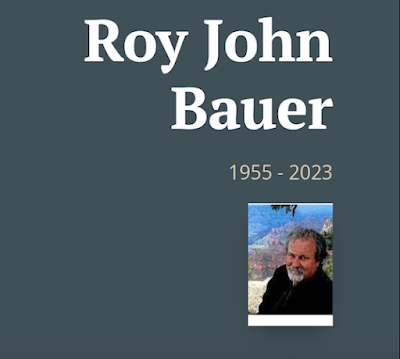
Roy's obituary in LA Times and Register: "we were lucky to have you while we did"
This ran in the Sunday December 24, 2023 edition of the Los Angeles Times and the Orange County Register : July 14, 1955 - November 20, 2...
-
 Professor Olga Perez Stable Cox OCC Trumpsters/GOP A professor called Trump’s election an ‘act of terrorism.’ Then she became the vict...
-
 Recently, I spoke with a veteran who’s been part of the vet community here at IVC for some time. He too has complained about Mr. Ma...
-
 I don’t know how anyone could learn about the way our colleges are funded and how their budget decisions are made without thinking...