The SOUTH ORANGE COUNTY COMMUNITY COLLEGE DISTRICT —
"[The] blog he developed was something that made the district better." - Tim Jemal, SOCCCD BoT President, 7/24/23
...In fact, there is a conspicuous absence of any collective mourning at all. The reason is as simple as it is terrible: We share no understanding of these staggering losses as ours, as belonging to all Americans, as national.... (continued)
"Coupla more, I guess"
"The powers of the president will not be questioned."
THIS WEEK, I have given the students of my "Ethics" (Philosophy 2) classes questions/prompts of the kind that will appear on the final exam, to be given in a week. I have invited them to write answers and to email them to me for me to review. I've been doing that all week. I'm doing it today. (Topics: Utilitarianism, Kantianism, Ethical Relativism, the Milgram Experiment, etc.)
Also, at 4:00 today, as per usual, I'll post my notes that provide "elements" of a good answer to the question of the day.
As it happens, today's question/prompt asked students to explain the Milgram Experiment (1961-3) and its validity & relevance. (I'm assuming that you are familiar with it. It tested whether ordinary Americans were willing to obey clearly harmful/wrongful orders from authoritative figures. Answer: yes. For a review of the basics of the experiment, go here.) I've already written my "elements of a good answer" post to appear at 4:00. I thought some of you might be interested in the issues that arise there.
I wrote, in part:
"The authority is total"
...Obviously, if valid, the [Milgram] experiment has important implications for many events ... in the world of liberal democracies such as the U.S.A. (where people are "free" and have a right to protest, a freedom to dissent).
For instance, without the support of Republican and Democratic leadership and most ordinary Americans, the War in Iraq would never have launched in 2003. That war, which (unsurprisingly) killed many hundreds of thousands of innocent civilians, was sold to the American people based on very dubious grounds—that the Iraqis were responsible for 9-11 [plainly false], that the Iraqis were actively developing WMDs [poorly supported; ultimately determined to be false] that have turned out to be lies and distortions and exaggerations. But most Americans readily went along with that dubious project—and put dissenters under great pressure to go along. (For a good local example: see this (Links to an external site.).)
Consider, too, the My Lai Massacre, in which dozens of ordinary soldiers followed the plainly wrongful orders of officers—such as Lt. Calley—to machine-gun innocent civilians, including children. It is plain that such events occur often in war and that the American military is by no means an exception.... [All of this was discussed in lecture.]
There have long been objections to Milgram’s experimental methods and protocols. For instance, his subjects were all men. Do his findings, then, apply to women as well? Further, virtually all versions of the Milgram experiment have been done in industrialized societies, not rural societies. Do Milgram's findings apply to the citizens of rural or tribal societies? [I go on to describe the largely positive history of replication of Milgram's results, even recently.]
. . .
"Who's gonna take responsibility...?" —I'm responsible. Continue.
Obviously, such moral failings as the Iraq war (ordinary—and non-ordinary—people “going along” with dubiously-justified or immoral projects) occur all the time, and all around us.
Right now, in relation to the Covid-19 pandemic, despite a mountain of evidence and expert testimony indicating that, for the sake of the public's health, people need to maintain “social distancing” and, if possible, stay at home, there is a movement to resist such advice (including an oddly ambivalent or inconsistent President). To the extent that those people succeed, they are causing unnecessary future deaths, since they are allowing the Covid-19 pandemic to spread instead of helping to halt or thwart its spread.
Years from now, people will ask: how can it be that so many individuals participated in this reckless and irresponsible movement and behavior? (Those who refuse to stay at home; those who refuse to wear masks; those who press for early “reopening” of the economy, despite clear indications that [such action] will make the contagion worse, et al.)
Many who are part of this movement now will then say: it wasn’t my fault; I was just doing what the President and others urged us to do!
But it's clearly wrong. Its plainly reckless. Now.
“Hey, don’t look at me. Look at the president (and various others).”
Nope. You are responsible for what you do. Others can’t take responsibility for what you do, unless these others coerce you; but you aren’t being coerced. [If you are part of this movement,] you're focusing on plainly dubious reporting, accepting plainly dubious information (about conspiracies, secret agendas, etc.). —Like members of a "flat earth" society.
[What do you think? Too much advocacy? Not enough? I reject the false equivalency of supposing that there is "another side" to the "issue" (of whether the pandemic is a fraud, whether it is being exploited to control American citizens, — or the milder "Democrats resist opening things up because blah blah blah," etc.)—just as I reject the notion that there is "another side" to the "issue" of whether Earth is round or whether the Holocaust occurred. —I am, after all, a "critical thinking" instructor.]
As Daniel Farzannekou prepared to take an online exam late last month in his naval science elective at the University of California, Los Angeles, the software directed him to pick up his laptop and scan his room, his desk, his ID and his face.
. . .
“Please note that this exam is NOT open note or book,” wrote the adjunct professor, Lt. Alexander Dellva, “and I am therefore relying on your integrity to take this exam using only the knowledge in your brain.” Continued
“Mourning in America” is the Lincoln Project’s second coronavirus-related attack ad to take inspiration from ads made famous by Reagan’s 1984 campaign. In March, as it became clear that Trump had downplayed the pandemic and wasted valuable time by failing to prepare for the crisis, the group released “Virus in the World,” which echoed Reagan’s “bear in the woods” ad—a Cold War-era attack on critics of Reagan’s hardline stance against the Soviet Union.
The late-night diatribe on Tuesday all but confirms that the group is hitting a nerve with Trump, particularly as reelection polls increasingly show him at risk of losing to Joe Biden in November....
Saddleback staff and faculty get a letter which includes a vision of the future...
May 1, 2020 | Saddleback College
Happy May, everyone!
There has been a loud drumbeat in the air this week for returning to normal. The economy is in tatters. 30 million people are newly unemployed. Many of us are feeling housebound. We’re sick of the new normal. We crave the old normal.
Some of our students are frustrated and struggling with online learning. They want to come back to our campus. Many of our faculty are frustrated and are still working like crazy to adapt to online teaching. They, too, want to come back to real classrooms. I hear it.
Our college’s Emergency Operations Policy Team has been discussing how to create a pathway back to normal (or our improved normal!). But bear in mind that we have no decision-making authority until criteria have been fulfilled for the lifting of restrictions at the State, County and District levels. Among the criteria still to be fulfilled:
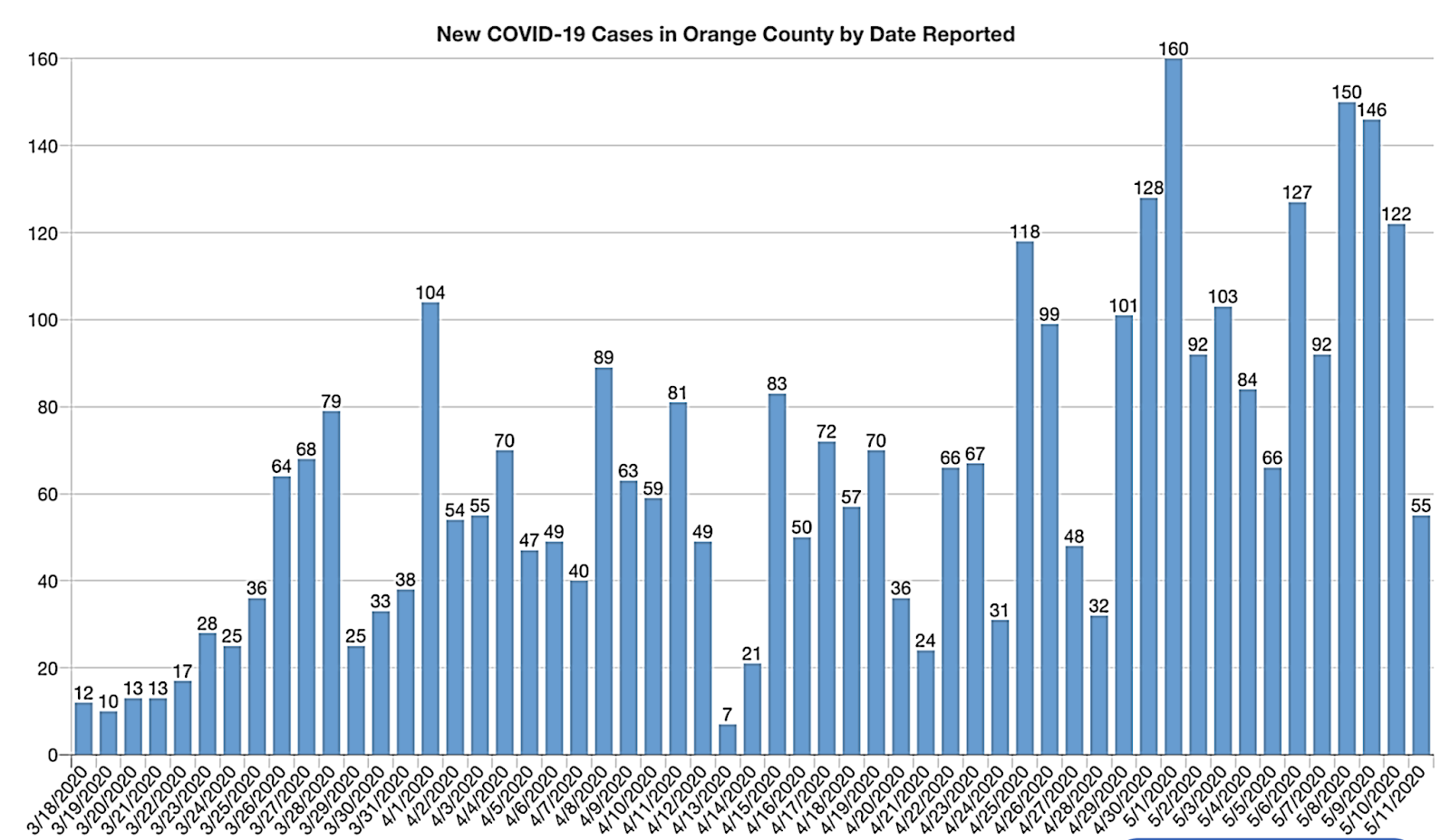
(1) Increased testing so that public health officials can identify the patients that need to be traced, tracked, treated and isolated. Right now, we’re confirming only a fraction of all cases; so we don’t know where the dangers lurk around us, making social contact without distancing very risky. 60,000 Americans have died of Covid-19 and a million have tested positive. That would suggest a death rate of 6%, which we know is not true. If the death rate is really between 1 and 2%, this means that the number of cases should be closer to 3-6 million. (Most think the real number is bigger than that.) We cannot bring back thousands of students to campus if most people with Covid-19 still aren’t even tested.
(2) Reduce the transmission of disease to the point where the people infected, on average, infect less than one person each, such that the “curve” descends steadily and to the point where we have enough public health officials to trace, track and isolate all who become ill. Despite the drumbeat for getting people back to work, we have barely started to descend the curve at this point, and the rate of descent is much slower than our climb up to this plateau. (Flattening the curve lessens the severity of the peak but actually extends the time it takes to descend to levels that can be “contained” rather than “mitigated.”) If mitigation measures are lifted before the incidence of disease is low enough to contain, we will see another surge, potentially worse than the first.
This week, Governor Newsom drew the very rough outline of a 4-stage pathway back to normal for Californians. In the second stage, which he said was close at hand, he indicated that more offices might open and consideration could be given to opening schools, perhaps in July. But there’s a whole lot still missing from this broad outline, and some may be interpreting his statements, shall we say, a bit optimistically. More specifically, Governor Newsom said that those additional offices which might open are those in which “telecommuting isn’t possible.” And his “schools” reference was not likely intended for higher ed, but rather for lower and middle grades in K-12, where distance learning isn’t working well and isn’t practical for the long haul.
If and when the Governor does lift restrictions on colleges, and assuming the State and District follow suit, we will make decisions about Saddleback’s phased return to normal based on “internal” goals/criteria, set out by the policy team and intended to be utilized in our Covid-19 response planning:
(1) Preventing Covid-19 transmission on our campus, and, more broadly, protecting the physical safety and well-being of our students and employees (read: social distancing);
(2) Maintaining psychological well-being and wellness of our students and employees (not creating high risk environments that generate anxiety);
(3) Learning continuity (with integrity) for all students (so that learning outcomes can be achieved, including those that require hands-on activity for which virtual experiences cannot be substituted);
(4) Student achievement and completion (because we don’t want our response to this crisis to reverse the progress we’re making in helping more students reach their goals);
(5) Equitable access and achievement for all students (because we don’t stop looking at our work through an equity lens just because we’re in crisis mode).
Accordingly, with the assumption that State, County and District restrictions on our ability to return to campus are lifted in the next few months as we reach containable levels of disease and are testing sufficient numbers in the population, we view fall semester as the earliest time at which we might bring back students--but in numbers that will permit social distancing.
Our students and some of you will ask: If and when authorities lift restrictions on campus, why wouldn’t we bring back all who want to resume on-ground learning? (Perhaps some schools will do so or at least publish fall schedules that suggest that they intend to do so.) To answer this question, I ask you to think about (and start to picture) how we will facilitate social distancing when we bring students back to campus.
Right now you’re visualizing a classroom with the desks set farther apart than normal. That’s the visual that most people conjure.
But now think about how you’re going to get these students in and out of this classroom through a common door. How will you get them through the halls, in and out of bathrooms, and through doors to the building?
Think about how your local grocery store has set up waiting areas and one-way aisles and limits traffic in the store. Picture all that red adhesive tape. And that’s to bring 20 people into a Trader Joe’s! Now do it with--let’s start small--just a couple hundred students (say a half dozen classes) in one building. That’s a lot of red adhesive tape and staff needed to direct traffic.
Now imagine 20,000 students back on our campus. Or half that. Or a quarter. Picture the walkways, the quad, the halls and offices in the SSC, gatherings of students in halls, waiting for classes to start while another group tries to leave. We’re still social distancing in your vision, right?
We will not be bringing 20,000 students back to our campus this fall. Nor 10,000. Nor 5,000. Because we cannot do so without compromising safety and running the risk of creating a nidus of infection in our community. Because we cannot do so without creating anxiety in all who have direct contact with our students, faculty in particular. Because we cannot achieve learning continuity or ensure student achievement and equity if we force fearful students to miss class to avoid a health risk to themselves, or to those with whom they live or care for.
What we will try is to bring back students for applied learning that needs to happen on campus because of certification requirements or because special equipment is required or because fulfillment of learning outcomes cannot otherwise be achieved virtually.
We will also try to create options for students and faculty who would want to come back if conditions improved faster than we expect. We hope to build some of our online classes with schedules for synchronous learning sessions, so that if students enrolled in these classes receive word that they are moving to on-ground from online, they would already have a class schedule that would not conflict with other classes on their schedule.
Conversely, we will all be ready to clear students back out and step back, once again, if conditions in our community worsen or if we have an outbreak on our campus. All of our on-campus hands-on learning experiences are being planned and scheduled in such a way that would allow us to start them late or end them early if conditions worsened. And it is easier to move 1-2000 or so students back online, once again, than it is to move 20,000, as you recall.
I have spoken of this broad vision for fall semester before, and I will speak of it again. And each time I do, I know that there will be some who will hear it and question whether we are being too cautious in not planning to bring more students back in fall; and I know that there will be some who will question whether we should have any students back if we were able to get through this semester without doing so.
I will remind the latter group that we cannot achieve all student learning outcomes in all courses or obtain certifications through virtual environments. I will remind the former group that we will do our part, in service of our community, to rebuild our local economy and retrain workers for re-employment; but we will not sacrifice the health and safety of our students or our employees to re-open sooner or at a faster pace. We can be a strong nidus for economic growth in our community only if we do not let ourselves become a nidus of infection.
We are Saddleback. We are an aggregate of beautiful faces, brilliant minds and giant hearts filled with love for learning and students. We collaborate. We think critically. We use data and science in our decision-making. We will return to normal the right way, along the right timeline, for all the right reasons. We got this.