Saturday, April 18, 2015

DISSENT! Contra anti-intellectualism

Kool-aid drinkers are often unaware of their complete and utter
pitcheresque Kool-aiditude. They become nasty enforcers of the sugary way.
Information?
     Sometimes, a student will ask me, “What’s the information we’ll have to know for the exam?”
     I really hate that word, “information.” It’s a small word for small things.
     The word has its place, I suppose. Perhaps you need a phone number. You call "information." Yeah.
     What students learn in a college classroom is not information. To have some notion of the fate of, say, teleology in Western history is anything but “info”! Neither is a grasp of the relevance of Locke’s liberal political ideas to, say, contemporary American politics. Information is small and ridiculous, but these things are rich and sprawling, like sagas and symphonies.
     But there are those who would reduce education to information bits and bytes.
     Philistines!

The inevitable forces of anti-intellectualism
Phyllis Schlafly
     The enemies of reason have a way of destroying the good slowly—incrementally and by degrees. Thus it is with education in America. It is endlessly under assault by the forces of anti-intellectualism: all those under-educated educationists, with their useless Ed.D. degrees, who have no conception of logic or evidence; and the business crowd with their notions of widgets and customers; —and the political crowd, especially on the right, who, unlike the others, actually wear their contempt for knowledge and learning on their sleeves.*
     I was trained as a philosopher, and, in any case, I tend to distrust how things strike us at the moment, for we tend to be blind to big and "obvious" problems. It’s amazing how we do that, over and over. Though few seem willing to say it aloud, it is big and obvious that the kind of lousy thinking that has long characterized K-12 reform has invaded higher education. For California's community college instructors, the chief episode of insurgency took the form of new accreditation standards, adopted in 2002, that assume that all educational goals (including what students learn in a particular course) can be captured in “measurable student learning outcomes” (SLOs).
     They can’t.
     At any rate, when the “outcomes” approach (to reviewing and improving education) was adopted by the ACCJC, the new standards were imposed sans evidential backing for the superiority of that approach. The State Academic Senate requested that such evidence be provided. The ACCJC provided nothing, since there was nothing to provide.
     And so, naturally, the “reform” went forward anyway. We’ve been banging our heads against walls and creating dubious “SLOs” ever since. It’s been, and it continues to be, a colossal waste of time and money. Imagine what we could be doing instead?
     I’m sick of it.

One more time
     I’ve been told that, by now, the appropriate studies have been conducted: meta-analytical investigations of comparisons between the “outcomes” approaches and more traditional approaches. And, unsurprisingly, the news is bad for the Kool-aid saturated “outcomes” crowd (not that they'll notice or care). So, once again, a shiny new idea has fogged our minds and busied the world and produced a spirit-sucking fiasco. And, hey, the fiasco continues!
     Here we stand: the strong case against the “outcomes” approach is even better today than in 2002, when the ACCJC rammed “outcomes” down everybody’s throats, amid howls of protest and demands for justification, ignored.
The ACCJC's Babs Beno
     Recently, I instigated and then helped write** a proposed resolution about all this, presented at the recent State Senate Plenary in San Francisco. Essentially, it demanded that the ACCJC provide evidence that its “outcomes” approach is superior to alternatives. Again, the State Senate had essentially done that back in 2002, in a series of resolutions.
     Despite early indications of support for the resolution, it was eventually voted down.
     I’m told that the resolution’s defeat may reflect, not rejection of the basic idea, but of details it contained, including its account of the state of the evidence re the efficacy of the “outcomes” approach. And so IVC’s Academic Senate is proceeding to compose a revised resolution.
     I’m glad. But even if we manage to get the new resolution adopted at the State Senate, it is unlikely that the move will do better this time than it did a dozen years ago. (Who knows.)
     But we’ve got to do something. Maybe we can generate interest in setting things aright.

Better to go along with OBE folly?
     Or no? At such times, there are those who will argue that dissent is pointless, that it is better simply to make the best of a bad situation. Despite the utter wrongheadedness and inefficiency of busying ourselves with the composition of endless silly SLOs, we need to find a way to make the goshdarn effort useful somehow.
     That’s not for me. I can’t help but think about the big picture. I don’t want to look back at this time, twenty years from now, and know that, when the enemies of reason showed up, we laid down our arms, saluted Babs Beno, and joined the march to mediocrity and ruin.

*At first, far right critics of education embraced Outcomes Based Education—probably because they liked the idea of demanding "outcomes." But then they got the notion that it was a cover for all sorts of dastardly worldly and New Age instruction. So they became its enemy.

**Well, I hastily wrote something, which was quickly and faithfully adapted by Senate officers to the resolution format. I take responsibility for any deficits of the resulting verbiage.

Widget production efficiency experts

Interesting articles about the ACCJC’s President, Babs Beno:

• ACCJC prez admits City College got unfair treatment (48 Hills, OCTOBER 28, 2014)

• The elusive Barbara Beno: The story of the person who is behind the move to shut down City College (48 Hills, DECEMBER 18, 2014)
Why We Let Prison Rape Go On (New York Times, opinion pages)
By CHANDRA BOZELKOAPRIL 17, 2015
     IT’S been called “America’s most ‘open’ secret”: According to the Bureau of Justice Statistics, around 80,000 women and men a year are sexually abused in American correctional facilities. That number is almost certainly subject to underreporting, through shame or a victim’s fear of retaliation. Overall, only 35 percent of rapes and sexual assaults were reported to the police in 2010, and the rate of reporting in prisons is undoubtedly lower still.
     To tackle the problem, Congress passed the Prison Rape Elimination Act, signed into law by President George W. Bush in 2003. The way to eliminate sexual assault, lawmakers determined, was to make Department of Justice funding for correctional facilities conditional on states’ adoption of zero-tolerance policies toward sexual abuse of inmates.
. . .
     But only two states — New Hampshire and New Jersey — have fully complied with the act. Forty-seven states and territories have promised that they will do so. Using Justice Department data, the American Civil Liberties Union estimated that from 2003 to 2012, when the law’s standards were finalized, nearly two million inmates were sexually assaulted.
     Six Republican governors have neglected or refused to comply, complaining of cost and other factors....
. . .
     According to Allen Beck, senior statistical adviser at the Bureau of Justice Statistics, “institutional culture and facility leadership may be key factors in determining the level of victimization.” Rape persists, in other words, because it’s the cultural wallpaper of American correctional facilities. We preserve the abuse because we’re down with perps getting punished in the worst ways….

Friday, April 17, 2015

From IVC to Ivy League


Good news this morning from the Department of Memorable Students:

Some will remember Sara Ivette Merced. She graduated with distinction from IVC a couple years ago. She transferred (with a full scholarship) to USC to pursue her bachelor's in Psychology with a minor in forensics and criminality.  She graduates this Spring.

Sara was one of our older students, a single mother who returned to school in her early 40s after raising her two children. She was a distinctive presence in Rebel Girl's Writing 1 class for many reasons. Sara's strong sense of social justice was rooted in her pride as a Puerto Rican-American. Her deep joy in scholarship and her intellectual curiosity were inspiring in the classroom and on the page. 

This morning Sara accepted an offer from Columbia (with a most generous scholarship) to study in a Master's program in clinical psychology with a specialty in psychopathology. Her career goal is to work at-risk urban youth.

Columbia! Scholarship! A master's degree!

Footnote: Sara's two daughters, Lauren Winder and Elise Merced, attended IVC as well. Lauren came to IVC before Sara and transferred to and graduated from Berkeley. She now works as an editor.

*

Here's a link to Rebel Girl's write up of Sara's daughter Lauren, during the days of Occupy at Berkeley:
Occupy Cal: a former IVC Student Reports from Sproul

*

Wednesday, April 15, 2015

25% of college adjunct faculty get government assistance (Marketwatch)
By SILVIA ASCARELLI

     A quarter of the growing number of part-timers who are teaching college students need some government help to get by, according to a study from the University of California Berkeley Center for Labor Research and Education.
. . .
     “It’s shocking, but it’s the reality,” said Carol Zabin, research director at the Center for Labor Research and Education. “Universities are depending much more on part-time and adjunct faculty.”….


Monday, April 13, 2015

IVC Foundation event

     So far, by all accounts, the word is that the IVC Foundation event on Saturday was a big success. Several who attended told me that it was the best such event they had been to in years.
     More later. Rebel Girl attended, and she'll have a fuller report.


Sunday, April 12, 2015

Systematic rational failures and SLOs, part III: why don’t we do something?

     Outcomes assessment is an odd business. It is not to the credit of higher education that we have tolerated this external assault on our work. Its origins are suspect, its justifications abjure the science we would ordinarily require, it demands enormous efforts for very little payoff, it renounces wisdom, it requires yielding to misunderstandings, and it displaces and distracts us from more urgent tasks, like the teaching and learning it would allegedly help.
—John W. Powell
     The core alleged insight of the “outcomes” philosophy goes like this. Traditionally, our schools and their functioning have been viewed in relation to “inputs”: money, equipment, training, increased instruction hours, and so on. We invest all of these things in our educational system, and then we expect it to produce educated students.
     That’s all wrong, say the proponents of “outcomes.” We need to focus instead on the desired output—for instance, the kinds of skills and knowledge we want our kids to have at the end of their schooling—and then work backwards from there. It’s just logical! How do we get from where we are, point A, to where we want to end up, point B? That’s the $64,000 question. So our emphasis should be first on “outcomes,” which should be measurable, and second on how to achieve them.
     (For a sympathetic overview of the "outcomes" philosophy, see here. For a very different overview that emphasizes the politics, see here.)

     WAIT A MINUTE. Observe, however, that it is not obvious that this approach is workable. (In fact, states and nations who have embraced OBE have tended to find it unworkable and have tended to abandoned it.) Can one step back from, say, my “Introduction to Philosophy” course and capture “that which I intend to teach my students” in a set of sentences of the form, “upon taking this course, a student will be able to...”? Among thoughtful and intelligent people, the notion will arise that this task will be difficult. Perhaps impossible.
     When I step back from my Intro course and ask about the intended “takeaways” for students, I gravitate toward such things as:
• Rational confidence: I want students to begin to reject widely-held skepticism about the possibility of profitably thinking about and discussing/debating difficult (philosophical and other) issues. They need to begin to see that some ideas are more defensible than others and that a community of good thinkers can make progress reasoning about and discussing issues (rejection of the notion that any idea is as good as another). 
• Epistemological moderation: I want students to begin to settle into a middle area between skepticism (the notion that there is no point in thinking/arguing for the sake of maximally justifiable positions, for none exist) and dogmatism (the notion that the truth is had and that, therefore, it should not be questioned or challenged). 
• The particularity of our conceptions/forms of life: that our conceptions and traditions are properly understood in relation to history and that there exist and have existed a multiplicity of intellectual/moral traditions in the world of which ours is one example (please note that this is not necessarily an expression of “relativism”*). 
• Etc.
     When I consider these and other intended “takeaways” for my students, I am doubtful of the prospect of successfully reducing or capturing them in a set of “measurable learning outcomes” that can be listed on the syllabus. Happily, I am inclined to think that students’ exposure to my course and various other courses, assuming some effort at balance, will tend to produce the above “outcomes,” among others, unmeasurable (through, at any rate, SLOs) though they might be.

     HOW TO IMPOVERISH TEACHING/LEARNING. It is true, of course, that, to some extent, takeaways from my Intro course are amenable to the “measurable outcomes” approach. But why would anyone assume that that subset represents what is most important in the course? Mightn’t one worry that that subset represents what is least important and that a focus on securing that subset would dumb down the course or rid it of intellectual depth or gravity?
     And further: why should it be assumed that the ability to reduce the “takeaways” of a course (or a course of study, including a degree) to a set of discrete and “measurable” learning outcomes is necessary? That this reduction (or essence-capture) is available would, I suppose, be desirable. But that such a thing is desirable does not in any way imply that it is available or necessary.
     It is no secret that we—our society, the Academy, et al.—have long debated the question, “What is a college education for?”. But does anyone suppose that the unavailability of some received view, some firmly held consensus, means that our college students generally fail to be educated? (Well, obviously, in fact, some of them do fail. But many do not.)

* * *
     FACTOIDS. Let’s be sensible. Toward that end, here are some factoids to consider:

     1. Near as I can tell, there is no scientific evidence (i.e., studies that do the appropriate comparisons between systems that embrace OBE and systems that do not) supporting the efficacy or unique efficacy of OBE. (Please see John W. Powell’s Outcomes Assessment: Conceptual and Other Problems.) To be sure, proponents of OBE are able to produce enormous piles of studies and the like in "support" of OBE. But these tend to consist of, not evidence that OBE (compared to anything else) works, but that someone somewhere has in fact implemented OBE. Such muddled thinking should not be surprising among "experts" who have never heard of the need for replicating study results.

     2. Given the recent emergence of such tests as the PISA, we are living in an era of improved data concerning the efficacy of education approaches. It is more possible than ever to compare nations with regard to the success of their educational efforts. Guess what? The most successful countries do not embrace OBE. They embrace more traditional approaches.

     3. It is no secret that our nation’s efforts at reform (in the nation’s system of elementary/secondary education) have been dismal. In fact, it has been characterized by (1) a gravitation to meretricious shiny objects (better equipment, smaller class size, educationist trends [whole language, self-esteem]) and (2) being repeatedly hijacked or undermined by political movements and interest groups. Despite spending enormous sums of money, our efforts have plainly failed. (And, no, the data do not suggest that poverty or diversity are insurmountable problems in establishing an effective school system. See what countries like Poland and Singapore have achieved, despite poverty or diversity.)

     4. Thanks to muddled national and state politics, accreditors have been pressured to adopt OBE, that once shiny object, even at the level of higher education. As a result, the accrediting agencies, including our own ACCJC, have indeed adopted OBE, and, consequently, colleges and universities across California continually dedicate vast monies and energies to writing SLOs (for programs, courses, etc.). In general, the “SLO” mandate is poorly received, especially by faculty. Consequently, institutions confront a choice between two options: (1) trying to make a bad system work, to the extent that that is possible (and it is typically judged to be not very possible), or (2) bad faith implementation—i.e., simply giving our benighted accreditors what they want and then, to the extent possible, ignoring SLOs. In fact, the most common response to the SLOs mandate is a mix of (1) and (2). (Some will dispute this. Some believe that the Earth is flat.) If so, our system is wasting vast amounts of energy and money on an approach that is very substantially inferior to previous approaches. Nice going, America.

     This is a fiasco, a disaster. Under the circumstances, it is very odd indeed that there isn’t more push-back.

* * *
     THE STATE SENATE. Community college “Academic Senates” represent faculty with regard to academic matters and are key players in so-called “shared governance” or “collegial consultation.” The Academic Senates of California’s community colleges long ago (1970) organized into the Academic Senate for California Community Colleges (ASCCC), commonly referred to as the “State Senate.”
     As you know (see recent post), thirteen years ago, the State Senate tried to push back against the accreditors (ACCJC), challenging them to justify abandonment of old standards and embrace of the new "measurable outcomes" standards. It was a rare moment of good sense and spunk.
     That got them nowhere.
     The State Senate had its big Spring meeting last week, from Thursday until Saturday.
     Saturday was reserved for “resolutions.” One of the resolutions that (as I understand it) was voted upon yesterday was #2.04 S15: “Justification of SLO Use.” Here it is:


Whereas, In the last 15 years, new attempts to track the success of school systems around the world (e.g., Program International Student Assessment) have achieved impressive bodies of data useful in measuring the effectiveness of education approaches; 
Whereas, These data indicate that the more successful countries do not embrace the notion of “measurable student learning outcomes” that are central to the Accrediting Commission for Community and Junior Colleges’ (ACCJC) existing standards for evaluating and reviewing institutions and the philosophy that emphasizes that tool; and 
Whereas, It continues to be the case that research fails clearly to establish that continuous monitoring of course-level student learning outcomes (SLOs) results in measurable improvements in student success at a given institution but does engender frustration that continues to characterize community colleges’ attempts to implement the SLO approach; 
Resolved, That the Academic Senate for California Community Colleges request no later than July 1, 2015 that ACCJC justify its continued implementation of SLOs and explain why it does not opt for approaches more consistent with the approaches of successful countries in educating their students.
     I don’t yet know the outcome of the vote. I'll get back atcha when I do.

P.S.: yesterday (4/13) I contacted someone who attended the Plenary and asked her what happened to our/my resolution. She wrote back, explaining that
     I’m still trying to figure it out (in terms of bigger picture): In Area D it was accepted, someone from another Area “improved” it by adding a due date; Area D left it on the consent calendar. People from Area D & other regions came up to me in the hall to praise it.
     And then, somehow, it failed at the vote. I didn’t understand the opposition. The arguments against it seemed to be small detail stuff....
     Pretty disappointing.

*That there are multiple "traditions" does not in itself imply that they are necessarily equal or incommensurable. Such notions, of course, are matters of controversy.

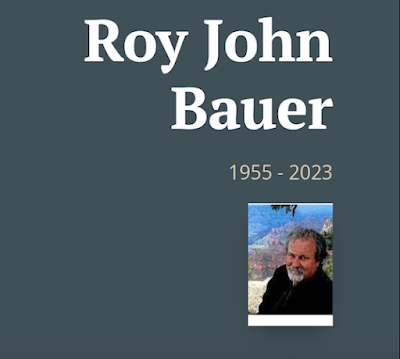
Roy's obituary in LA Times and Register: "we were lucky to have you while we did"

  This ran in the Sunday December 24, 2023 edition of the Los Angeles Times and the Orange County Register : July 14, 1955 - November 20, 2...