Well, yes. It's summer. Things change. I've been busy with other projects. One of them is my usual summer "family archive" project. These days, I've been writing up some Bauer family stories. You can find them here:
.
Well, here's one of 'em. I think you'll find it interesting. Or not. It concerns my mother's side of the family and World War II. ("Edith" refers to my mother, otherwise known as "Sierra.") —BvT
 |
| Sierra (Edith) and friend, c. 1950 |
You’ll recall that Edith (Bauer) was
raised by her Aunt,
Martha Hänfler (né Schultz) and Martha’s husband Otto. Edith regarded the two as her parents and referred to them as “mother” and “father.”
Otto died (of TB) in 1941, when Edith was about eight. And so, starting in ’41, Edith lived only with Martha, although Martha maintained close ties to her family—and people seemed to come and go, living for a time in their house or some portion of it.
AN AMOROUS FRENCHMAN:
Hänfler, who himself seemed to be pretty well-off, had a wealthy brother in Berlin (actually, in the adjoining town of Falkonsee). (Incidentally, the brother was sweet on Martha, but to no avail.) In 1943, brother Hänfler’s 19-or-so-year-old daughter, Edith, became pregnant by a handsome French POW named Pierre Henyon(?) [Frederic François Hennion]. (The name is pronounced HenYOn, rhyming with “alone.”)
Pierre Frederic's family was wealthy, and they had pull with the Red Cross. The Red Cross arranged for Frederic to receive special privileges as a POW, and so he was “free” to go to work—at the garden of Herr Hänfler’s estate—during the day. Ordinarily, he would report to a POW facility at night. (These prisons were typically placed in city centers to discourage aircraft bombing there.)
Edith (i.e., our Edith, Edith Bauer) recalls that Frederic was handsome, dark-haired, and of medium build. He spoke little German. Evidently, he was very much in love with Edith Hänfler. (One wonders how much French Edith spoke! My guess: little.)
Naturally, it wouldn’t do for a woman to become pregnant by a French POW—were that circumstance to come to the attention of authorities, said POW would be executed. And so for that reason (among the usual ones), young Edith Hänfler left town before she started to show. She was sent to live way to the east—with Martha and Edith in sleepy Bärwalde, Pommern.
Our Edith—I’ll call her “Sierra” to avoid confusion—remembers Edith Hänfler. She was one of twins. These twins were very attractive and seemed always to travel and do everything together. (Well, not every thing.)
 |
| "SuperNazis" above, Hogan's Heroes below |
AN EPISODE OF “HOGAN’S HEROES”
When the time came, young Edith went to the nearby town of Neustettin, which had a hospital. Meanwhile, Frederic was a POW in Berlin, but he was determined to be with his love. When Edith gave birth to the child—she insisted that she didn’t know who the father was—Frederic declared that he would steal himself to Neustettin by train.
Naturally, this was a lunatic notion, but Frederic would not be dissuaded, and so brother Hänfler (reluctantly, I hope) helped Frederic with operation Loony Lover: smuggling this non-German-speaking Frenchman from Berlin all the way to Bärwalde and back without alerting the authorities. Edith remembers that a great effort was made to dress Frederic properly for the trip. The plan involved his saying nothing, dressing well, and hiding in the train’s restroom. It was all very French.
(Update: just spoke with mom [Sierra]. She explains that Hänfler did help Frederic to Bärwalde, but the Bärwalde crew—Martha, et al.—were taken completely by surprise when they arrived. I can just see Martha muttering, "Mein Gott!" [if, that is, she's anything like Sierra] It was at that point that the gang worked out the plan to smuggle Frederic into the hospital, several miles down the road. Sierra, who was eleven at the time, remembers helping to dress him up. I asked her, "Who will play Colonel Hogan when they do the miniseries?" She laughed. But she still insists that this yarn is all true.)
The plan worked. They got Frederic into Martha and Edith’s Bärwalde home. The home was large, and its top floor had by then been commandeered by high-ranking Nazi officials (Sierra always refers to them as “those SuperNazis”). Those people tolerated no funny business. Edith tells of how she and her mother would listen to illegal non-German radio broadcasts at night, but they had to be careful that the “SuperNazis” couldn’t hear them.
So the story—Edith eyewitnessed much of it—is that Frederic was smuggled into their downstairs apartment, and then, later, he was smuggled to Neustettin Hospital to visit with Edith, who had just given birth days earlier. (In those days, new mothers would spend about two weeks in the hospital, recovering.) All of this occurred over a few days, perhaps a weekend. Eventually, Frederic was smuggled back to Berlin and back to his POW facilities. None of this skullduggery was ever detected. Whew.
This yarn is pretty hard to swallow, but Sierra swears that all of it is true. And she’s no liar.
 |
| Martha and Else, c. 1912 |
THE TRAGICALLY MATERNAL ELSE ZEMKE:
 |
| The last of Peter |
The baby was named Peter. Naturally, young Edith could not keep Peter—she needed to return to Falkonsee as if nothing was up—and so it was decided that Tante Else (one of the younger Schultz sisters) would take him.
Else had no children but was crazy about them. She might have been just crazy. She had a reputation in town for taking in children from women who could not keep them, but, typically, these schemes would come to grief, for Else would grow very attached to these kids and, inevitably, the authorities would take them away from her.
Else, who lived in Bärwalde, was married to one
Georg Zemke (no relation to
Gerhard Zemke). The Zemke family had money, and so Georg had money. He was well liked, but he was also a known gambler and alcoholic—not a good candidate for parenthood.
When Hermann Schultz (Sierra’s father) died in 1939, someone had to take Ilse, Sierra’s sister (who would have been about nine years old). And so Else and Georg took her. (That's right; Else took Ilse.)
A few years earlier, Else had inherited the family homestead (near the Jewish temple), and that is where Else and Georg made their home. But Georg managed to gamble and drink it all away. They were forced to move to a cheap apartment in town.
So, on the 28th of February, 1944, Peter was born and was handed over to Else, who was thrilled. The arrangement was decidedly unofficial, off the books.
* * *
The great German flight to the west—in response to the dreaded Soviet invasion—occurred exactly one year later. Martha, Edith, Else (Georg had died), and little Peter managed to escape by train, ending up in the Munster area south of Hamburg.
Meanwhile, Frederic somehow ended up back in France. He and his family made great efforts to locate Edith and Peter, and, pretty soon, Edith and Frederic were reunited, in France, where they married. They wanted to retrieve their son, Peter, who, of course, was being raised by Else.
The post-war chaos was such that it took years for Red Cross (and other?) officials to locate Else and Peter. At some point—perhaps in ’47 or ’48 [49?], Else received a letter from the Red Cross that alerted her to the efforts of Peter’s parents to have Peter returned to them. Evidently, it was very clear that, legally, Else could not prevent this from occurring.
Oddly, Else never shared these warnings with anyone. As far as anyone knew, Peter was Else’s child, and that was that. Else commenced secretly worrying and fretting about the impending arrival of officials to take her “son” away. Her health suffered. Sometimes, family members would have to take in young Peter, who had become beloved by all. Sierra was particularly fond of him. He was very much a member of the family.
But, in truth, a time bomb was ticking and it was bound to explode in the middle of their lives.
 |
| Operation Loony Lover: smuggling a French POW from Berlin to Bärwalde and back |
ELSE’S SUICIDE:
Finally, in about 1949 1950, the arrival of Red Cross officials became imminent—though, still, Else kept the fact a secret. Else’s distress increased. She fell apart. She would declare to friends and relatives that “tonight” she would die. She would even tell people what they were going to inherit from her. (She told Sierra that she wanted her to have her wonderful sewing machine.)
Naturally, everyone was concerned.
But then she would not die. Then, suddenly, it became clear that Else was suicidal. Over a period of days, she attempted suicide, unsuccessfully.
It was during these tense “suicidal” days that Sierra, riding her bike to work one morning, stopped by Else’s place to check in on her. (Peter was in the care of others.) Sierra, who would have been sixteen or seventeen, called out to Else, but there was no answer. Sierra used her key to open the door. Everything was still; the place was immaculate, as always. There was a bedroom to the left. The door was closed. She entered it. Else was hanging, motionless, from the curtain rod, her face draped.
It was obvious what had happened.
Sierra was horrified. She does not recall what she did then. After a time, she realized that she had to get help, but there was no phone. Sierra managed to ride her bike to the office, which was perhaps a quarter mile away. From there, she called her boyfriend, a cop. He said he would get right over there (evidently, all relevant personnel were elsewhere than Bärwalde). Sierra then returned to Else’s. She stayed downstairs, in the basement. Finally, after a half hour or so, her cop boyfriend arrived, but he “brought everyone”: the usual officials and workers for such circumstances. It was overwhelming.
Until just a few days earlier, no one had thought of Else as someone who might commit suicide. But she had kept the fact of Peter’s imminent departure from everyone. Even during the few days after Else’s death, no one understood what had motivated Else’s action.
But, soon, Red Cross (and other) officials made clear that they were about to take Peter to France. At about that time, the family had found Else’s letters and read them, which revealed what she had feared and what had caused her suicide.
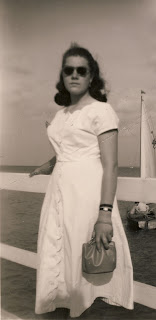 |
| Sierra (Edith), c. 1950 |
BUREAUCRATIC VIOLENCE:
What happened next is odd. Or perhaps not. Even when officials arrived to take Peter—he was taken from Edith and Martha’s household—it was months before Peter was actually taken to France. By then, Peter was about six years old and he was a big part of the lives of Edith, Martha, and others. But he was taken away, and he was moved from orphanage to orphanage while bureaucratic red tape (or something else?) held up his relocation to France (Paris, I believe).
The family was horrified. For a while, Sierra would travel great distances on weekends to spend time with little Peter. Tante Martha was incensed. Given the slowness of the process in which Peter was relocated to France, it seemed to her that those who wanted Peter didn’t seem to want him very badly. She wrote to Peter’s mother, revealing the toll that this action was taking on the family. It even seemed to lead to Else’s suicide, wrote Martha.
Peter eventually arrived in France. After that, the family no longer traveled to visit with him. (One can easily imagine the reasons.) He was simply gone. Forever.
Sierra wrote to him, and he wrote back. But, only a year after Else’s suicide, Sierra emigrated, starting a new life and a family, far far away. Still, she wrote to Peter, and Peter would write to her.
THE NOT-SO-SWEET PETER:
One might suppose that Frederic, the Frenchman, having been raised in a rich family accustomed to privilege, was spoiled. Certainly, the crazy "train to Bärwalde" caper casts an unfavorable light on the fellow. It seemed to Sierra that, at the hands of his parents, Peter, too, had become spoiled. His letters continued to demand of Sierra that she rescue him. He would ask for other things. Even money.
After a while, the Pen Pal Peter didn’t seem like such a nice kid anymore.
* * *
One day in 1956 (perhaps a year or two later), Ilse, Sierra's sister, heard the door knock. When she opened it, she was amazed to find Peter standing before her! He seemed to think that Ilse must take him in. And she did.
Peter remained for a long time. Eventually, Ilse asked, “Isn’t it time for you to go to your home in France?” Peter was old enough to travel the trains by himself (trains and train stations were safe then), but he certainly was not old enough to leave home permanently.
By then, Ilse was married to Franz, who clearly thought that enough was enough—Peter needed to return to France. Ilse and Franz paid for his ticket back home, and off he went.
It isn’t clear what Peter’s parents thought of all this.
Subsequently, Peter would occasionally show up on Ilse’s doorstep again, and he’d stay too long again. Invariably, he would spend all of his money—playing around—and use that as an excuse not to buy a ticket home. Ilse is not the sort to put up with such behavior. When he would show up, she would demand from him enough money to pay for his return home.
Meanwhile, Peter continued to correspond with Sierra, asking for rescue, for money, etc.
Eventually, Peter married. His wife was a success in the fashion industry, and she made good money. He sent pictures of his two (?) beautiful girls. Later, Sierra would discover that the girls had attended a Catholic school in Orange County (probably Tustin's Saint Jeanne de Lestonnac School)! She had had no idea!
Peter would occasionally show up on Ilse’s doorstep—with his entire family. Ilse would “go nuts,” says Sierra.
By then, the Sierra-Peter correspondence had come to an end. All information about Peter came indirectly through Ilse (who, these days, is no longer able to communicate). It seems to Sierra that Peter eventually divorced his wife and returned to bachelor life.
And he continued to show up occasionally on Ilse’s doorstep.
* * *
The last “Peter” story related to Sierra by Ilse comes from the late 90s—a few years before Ray’s death, says Sierra (Ray died in August of 2001). Peter suddenly phoned Ilse, declaring, “I’m back in Germany. Germany is my home. I’m a German, not a Frenchman.”
That was remarkable enough. But then he asked her, “Can I stay with you?”
Ilse being Ilse, said “no.” She had moved, and so Peter did not have Ilse’s new address.
And she did not volunteer it.
< end >
 UPDATE:
Yesterday (6/21/12), I was contacted by one of Peter's granddaughters in France. She identifies herself as Edith Hennion, and she was born, oddly enough, on Peter's birthday—February 28—in 1966, which would make her Ron's age (46).
She has already sent me several photos, including the one at left of Peter's wife, Edith Martha Hänfler, who, she tells me, died on october 2, 1960, at age 42. She also sent a roughly written "family tree," which indicates that Peter's father was Frederic Francois Hennion, who was born on October 20 26, 1915. He died around 1971 from cancer; he is buried in Noyon cemetery. He married Edith Martha Hänfler on the 1st of June, 1945, in Charlottenburg (Berlin). Peter's name is given as Peter Frederic Remo Hänfler.
For some reason, Peter's wife's name is not indicated. But in a subsequent correspondence, Edith states that her mother's name is Josiane.
Peter Hänfler did not become a Hennion until 1959, when his father at last recognized him as a son.
Edith indicates that her father, Peter, died ten years ago at age 58. That was news to us.
Edith also sent three old photos: one of a man by the beach, another (perhaps at the same beach) of two young children, and one of the two young children, slightly older, with a dog. She writes that she does not know who these people are.
I've already emailed her, informing her that the man is my father, Gunther Bauer, and that the two kids are Annie and me. The dog, of course, is Prince. These photos were taken in 1960 and about 1961 (in Santa Monica and Orange).
Ma (our Edith) is very excited about this turn of events. She is surprised that Peter and his family had the photos of our family, since, as she understood it, her sister Ilse was unwilling to part with any family photos and give them to Peter. (They were in contact, though they have apparently not been in contact in recent years.) Maybe that wasn't true.
More to come.
P.S.: Edith sends an email today (6/23/12) in which she writes: "I remembered he [Peter] received from California a photo of your family in front of a house, it was probably [sent] in the eighties. This photograph diseappeared as well as the one of a beautiful young (15-16 years) black-haired woman at the very beginning of our family photo album, a beautiful face with a white net gloved hand. Maybe you can recognized your mother ? This photo was with him when he came to France."
I'll have to ask Edith about those photos.
Later!