Monday, January 4, 2010

This crazy web of homophobic wackitude

Our district has a couple of threads hangin' on that web, which is pretty tangled.

Today, a friend alerted me to an article in the New York Times about those crazy homophobic Ugandans: Americans’ Role Seen in Uganda Anti-Gay Push.

The upshot: Ugandan politicians pursued their notorious "execute homosexuals" bill almost immediately upon attending a conference featuring three dubious American homosexuality “experts”:
Last March, three American evangelical Christians, whose teachings about “curing” homosexuals have been widely discredited in the United States, arrived here in Uganda’s capital to give a series of talks.

For three days, according to participants and audio recordings, thousands of Ugandans, including police officers, teachers and national politicians, listened raptly to the Americans, who were presented as experts on homosexuality. The visitors discussed how to make gay people straight, how gay men often sodomized teenage boys and how “the gay movement is an evil institution” whose goal is “to defeat the marriage-based society and replace it with a culture of sexual promiscuity.”

Now the three Americans are finding themselves on the defensive, saying they had no intention of helping stoke the kind of anger that could lead to what came next: a bill to impose a death sentence for homosexual behavior.
One of these American anti-gays was Scott Lively. According to the Times, Lively (and the other two) have sought to distance themselves from the draconian legislation, but
the Ugandan organizers of the conference admit helping draft the bill, and Mr. Lively has acknowledged meeting with Ugandan lawmakers to discuss it. He even wrote on his blog in March that someone had likened their campaign to “a nuclear bomb against the gay agenda in Uganda.” Later, when confronted with criticism, Mr. Lively said he was very disappointed that the legislation was so harsh.
Disappointed? Yeah, I'm positively miffed.

But wait a minute. Haven't we heard about this Scott Lively fella before?

Yes we have. Back in November (That Raghu Sure can Pick ‘em, 11/20/09), I noted that the lawyer SOCCCD Chancellor Raghu Mathur hired to defend the district against the "prayer" lawsuit, David Llewellyn, is up to his eyeballs in this kind of crap about curing those evil-doing gays. For instance, he founded the Western Center for Law and Religious Freedom [WCLRF], a public interest law firm that seems to focus on the "homosexual" problem—you know, how gays seek to "recruit" innocent Christian children and all.

Back in November, I noted a connection between WCLRF and notorious homophobe—and friend of SOCCCD trustee Tom Fuentes—Howard Ahmanson, Jr.  According to Wikipedia, Howard Ahmanson gave more than $60,000 to WCLRF.
 
Ahmanson was very close to R.J. Rushdoony, the "Christian Reconstructionist." (You might wanna look that up.) That influence was evident when Ahmanson told the OC Register (in 1984) that "My goal is the total integration of biblical law into our lives." Reportedly, Howie has backed off of that position a bit in recent years. It didn't play well for some reason.

Rushdoony, of course, thought that homosexuals should be executed. But Howie's not that wacky. According to Wikipedia,
[Ahmanson] is reported to have "never supported his mentor's calls for the death penalty for homosexuals"; rather, as the Orange County Register reported in 2004, "he stops just short of condemning the idea", saying that he "no longer consider[s] [it] essential" to stone people who are deemed to have committed certain immoral acts. Ahmanson also told the Register, "It would still be a little hard to say that if one stumbled on a country that was doing that, that it is inherently immoral, to stone people for these things. But I don't think it's at all a necessity."
Yeah, killing gays isn't necessary. So, like, Howard's become a liberal or something.

Of course, Ahmanson has been a player in the huge rift over homosexuality in the Episcopal Church. Naturally, Ahmanson has been on the side that has strong connections to those crazed Ugandans (see Arellano's correspondence with A).

But let's get back to Mr. Lively.

Evidently, the "Western Center"—founded by SOCCCD's Llewellyn—is now known as the Pro-Family Law Center of Abiding Truth Ministries. I Googled that and got the website for the Pro-Family Resource Center of Abiding Truth Ministries, which presents writings by Scott Lively, the “President of Abiding Truth Ministries and lead attorney for ATM's Pro-Family Law Center.” (That was Llewellyn's old job, I believe.)

The Pro-Family Law Center (see) seems obsessed with the EVIL that is homosexuality. PFLC sells such books as:
The Pink Swastika (by Scott Lively and Kevin Abrams)
The Pink Swastika is a thoroughly researched, eminently readable, demolition of the "gay" myth, symbolized by the pink triangle, that the Nazis were anti-homosexual.
Right, those Nazis always get such a bad rap. Bill Berkowitz (in Buzzflash) called this book, by Lively, a “Holocaust revisionist anti-gay book.” (According to Berkowitz, Scott Lively declared “war against the Southern Poverty Law Center for refusing to remove his Abiding Truth Ministries (http://www.abidingtruth.com) from its list of hate groups.”)

Clearly, this Scott Lively fella is seriously bad news. Of course, it's possible that, under Llewellyn's leadership, the organization was less daffy.

Yeah.

As I reported in November, there can be no doubt regarding Mr. Llewellyn's feelings about homosexuality. I came upon a reference to a video, entitled "The Gay Agenda," which is narrated (in part) by Llewellyn. Here's the video blurb:
…[It] is an authoritative and comprehensive explanation of the homosexual movement, and homosexual activity. The narrators on the tape are David Llewellyn, President, Western Center for Law and Religious Freedom; Stanley Monteith, M.D., author of "AIDS, The Unnecessary Epidemic;" Joseph Nicolosi, Ph.D., a well known specialist in homosexuality, and author of "Reparative Therapy of Male Homosexuality," and many other publications; John Smid, an ex-homosexual, and Director of Love in Action, an organization which helps homosexuals who want to change to a decent way of life; and John Paulk, an ex-homosexual, and Administrator of Love in Action. Dr. Montieth gave the statistical references on homosexual acts….
These people are total nutjobs. Llewellyn is a nutjob. Lively is a nutjob.

As you know, recently, even Saddleback Church's stellar Rick Warren has been tarnished by this whole Uganda thing. According to the New York Times:
Uganda has ... become a magnet for American evangelical groups. Some of the best known Christian personalities have recently passed through here, often bringing with them anti-homosexuality messages, including the Rev. Rick Warren, who visited in 2008 and has compared homosexuality to pedophilia. (Mr. Warren recently condemned the anti-homosexuality bill, seeking to correct what he called “lies and errors and false reports” that he played a role in it.)
Did you know that, recently, the Ahmansons gave Warren a huge chunk of change? Yeah. They had a ceremony and a blow-out and a speaker series at that ridiculous star-spangled mega-church; the Ahmansons got a prize.

Lines drawn in the sand, invisible


"As you know, the Premier loves surprises."
Two weeks ago, adjunct Babson College rhetoric and history instructor Kara Miller wrote a piece for the Boston Globe (My lazy American students) that suggested that American students are, well, lazy. That’s caused a stir, at least in Boston. Inside Higher Ed caught wind of it and wrote about it, and we reprinted some of that.

Today, Inside Higher Ed (Are American Students Lazy?) updates us on the controversy:
…[Kara Miller’s] comparison of American students (who continually disappoint) and foreign students (who don't) has set off quite a discussion in Boston….

"My 'C,' 'D,' and 'F' students this semester are almost exclusively American, while my students from India, China, and Latin America have – despite language barriers – generally written solid papers, excelled on exams, and become valuable class participants," Miller wrote. She noted that many of her foreign students have difficulty with English, but make up for that with hard work. Her American students, meanwhile, appear challenged by work.

"Too many 18-year-old Americans, meanwhile, text one another under their desks (certain they are sly enough to go unnoticed), check e-mail, decline to take notes, and appear tired and disengaged," she wrote. Given that many American students arrive at college without basic skills, she wrote, "we've got a knowledge gap, spurred by a work-ethic gap."

The response was immediate and intense. Hundreds of people posted comments.

Many ... professors appear to think Miller has a point. "I know this author will be criticized for this article, but based on my decades of college teaching experience she is exactly right," wrote one. "What she leaves out is that we are dealing with a generation of students that have been left behind by No Child Left Behind, supervised by 'Helicopter Parents.' Students now feel entitled to high grades despite little work and want their hands held on every assignment, while they are unable to think for themselves."

Another professor wrote in: "I used to be a university faculty with a joint appointment in engineering and management schools – the biggest difference I noticed with domestic and international students was the ability to handle criticism. Domestic students tended to be very defensive when pointing out what can be improved."

That professor wasn't alone in finding Miller to be correct outside of her fields. Another comment said: "I've been an adjunct teaching engineering for 10 years, and I see the same trends. Even in engineering classes, many of the U.S. students expect to be given A's for inhaling and exhaling, and look at you like you have four heads if you suggest that perhaps coming to class, doing homework, and studying might improve their grade."

Some who had experience teaching international students noted that students who cross oceans to study in the United States are highly motivated, and so are not necessarily a fair comparison for the average American.

Several comments suggested that while Miller was correct in noticing differences between American and non-American students, she might not be giving enough credit to the creativity of Americans. A graduate student at the Massachusetts Institute of Technology wrote that when he teaches undergrad sections, he's also annoyed by the texting.

But following rules rigidly has a down side, the comment said: "My lab has a large number of foreign postdocs, who've been brought up in an environment where they've learned to be obedient and diligent. They end up lacking in leadership and creativity, and this shows up in their ability to be effective scientists. The American/Western postdocs tend to be more independent and creative in their approaches to problems, something that I attribute to the American emphasis on creativity rather than knowledge. Maybe we need a mix of cultures to truly produce the most effective students."

Plenty of less than thoughtful comments mocked either Miller's students or Miller, suggesting she must not be a good teacher. And others defended the right of American students to act as they wish. "Sounds like a typical egghead liberal professor who think there's a correlation between the classroom and the real world," wrote one. "Sorry, teach, but our American kids know that college is for boozing, drugs and hooking up. They'll start working hard when it matters – the day they get their first job."….
Many of my students seem unable to accept course rules that, in some cases, cause them to receive failing grades. I tell them at the start (and I remind them continually): to pass this course, you must receive a minimal score (it’s an abysmally low standard) on weekly writing assignments.

I explain that this requirement is a regrettable but necessary mechanism to encourage students to keep up with the course. I lay my cards out on the table for all to see: "Don't wanna do this, but here's why I do it."

“And I hope you can understand that I cannot lay down these rules and then not enforce them.” I explain. I discuss deterrence theory, show a clip of Dr. Strangelove. (See above.) All is made clear.

They smile and accept this. I remain wary. Toward the end of the semester, I notice that many students are in danger of failing the requirement. I remind them again. (Evidently, you cannot remind them enough times.) I send emails. Some respond to this. They scramble to do better. Often, they do.

But many do not. They get Fs. Then they email me: “How can this be?” I explain (yet again). They respond: “What can I do?” I suggest that, well, they can learn from their mistake. They write back: “No, you need to tell me what I can do to get a good grade!”

Eventually, I have to say, “Your have earned an F. That’s the situation. It isn’t changing. Grow up.”

I’ve always had to deal with this crap. All instructors do. But, over time, the problem has increased. When I teach, I'm always thinking about it. ("What more can I do to make students do what they need to be doing?", "If I say more, will I be hectoring them?")

Frankly, I’ve got a similar problem with my niece and nephew (ages 7 and 5), which they seem to share with their entire generation and several gens before them. They’re great kids, but dealing with their misbehavior can be frustrating. I say "no," but its force is strangely ephemeral. I keep wanting to say, “Has no one taught these kids the meaning of ‘No’?”

I draw clear lines in the sand. These kids don't see them, or they see them as something other than lines--that is, as barriers, limits, demarcations of zones they must not enter. Halt. Stop. No.

It is as though they have never encountered anything like it before: a "no" that involves actual No-ness.

How can that be?

Comments:

Anonymous‬ said...
yes, American students ARE lazy and demand special treatment.

 Then they grow up and become lazy American administrative types who don't want to follow the rules and demand special treatment.
11:48 AM, January 04, 2010

‪Anonymous‬ said...
What clip from DR. Strangelove do you show?

 My students routinely ignore the rules posted in the syllabus and reinforced in class (come to class! unplug yourself! do your work! be on time!) – then they wonder why they fail. 

I don't wonder at all.

 Right now I have a handful who have written to inform me that they won't be attending the first week of class because they are still on vacation. "I hope I don't miss anything." "Please send me all asssignments, syllabus and notes." "Please don't drop me."

These requests are for classes that are full with waiting lists.
11:53 AM

‪B. von Traven said...
I have posted the relevant section of "Dr. Strangelove," a film that seems greater to me with each decade that passes. If you're impatient, you might jump ahead to about 2 minutes into this particular clip, when [the Ruskie, and then] Dr. S begin to explain the theory of deterrence–and of deterrence via a "doomsday machine" in particular. This is the sort of thing that philosophers love to discuss: that the best outcome (for all concerned, from a "moral" point of view) might be attainable only by setting a trigger that only an insane and immoral person could pull–hence the need for the machine. (See Gregory Kavka's work on this paradoxes of deterrence.) The "joke" here, of course, is that the entire mechanism is undone by the desire to offer the Premier a "birthday surprise."
12:23 PM

Anonymous‬ said...
Many of my students, often on the first day of class, express the hope that I can make an "exception" for them. 

Their work schedules have changed and they can't stay until the class is over but must leave 30 minutes early each day. 

Their team has scheduled practices so that they miss every other class session during a two month period — will that be a problem? 

They can't buy the textbooks until next month, can they borrow mine? 

Can they print out their work on my office computer? Better yet, can they just send me their work so I can print it out and bring it to class with me? 

Their family has scheduled a week-long vacation in Hawaii in April, so....They always go to Hawaii.

 They are really terrible in the particular subject I teach and they hope that I understand that they need to pass the class in order to get into the university next semster.
12:34 PM

Sunday, January 3, 2010

Chancellor's opening session: expect announcements and boosterism

SOUNDS LIKE MATHUR BLATHER. My back is out but I still hope to make it to the Chancellor’s Opening Session on Wednesday. Gosh, anything could happen!

The special speaker for Wednesday morning’s event is Chris Harrington, a VP at Toshiba America Information Systems. According to the inservice schedule BLURB, he plans to talk about the importance of innovation and education “in creation of intangible wealth through governance, accountability and corporate social responsibility as we prepare the workforce of tomorrow.”

OK, that gets an F. Harrington must've taken one of Mathur's rhetoric courses at Argosy Clown College.

MR. GOP. I Googled Mr. Harrington’s name and I immediately came upon something called “Fundrace 2008” at the Huffington Post. I gather that “Fundrace” monitored campaign contributions during that election.

Mr. Harrington is down as having donated $33,500 to the Republican National Committee. Gosh. I think that means he’s a Republican. Like Mathur. (And Fuentes. And Wagner. And Williams. And Lang. And Padberg. And Milchiker. And Jay.)

Mathur and Harrington are pals because they each chair a committee (among eleven committees) of the Orange County Business Council (OCBC), which is a kind of county "Chamber of Commerce." Harrington chairs the “Workforce Development Committee” and Mathur chairs the “Community College Working Group.” So they probably also sit on the “chairs committee” together.

But what (you ask) is the OCBC? Well, it’s
the leading voice of business on important issues locally, regionally and nationally. The organization works to enhance Orange County’s economic development and prosperity to preserve a high quality of life.
… The Orange County Business Council serves pro-business interests so that the region's vibrant economy will continue to expand, bringing the benefits of prosperity to every corner of the county.
Naturally, they’ve got a “mission statement,” according to which the OCBC “represents and promotes the business community….”

That sounds mighty Republican.

MOVERS & SHAKERS. I scanned the website and found the usual suspects: the Irvine Company, Safeway/Vons, Disneyland Resort, the OC Realtors Association, and the big law firms such as Rutan and Tucker (the district used them in my First Amendment lawsuit; boy were they steamed when they lost) and Manatt Phelps and Phillips.

Manatt Phelps and Phillips—you remember them. They hired up-and-coming Republican star Jeffrey Nielsen, mentee of such bulwarks of GOP rectitude as Tom Fuentes and Michael Schroeder—and current head of the OC GOP, Scott Baugh, who got ‘im that job!

Jeff’s a pedophile. Just got out of prison.

He’s really into the Lord. Like his mentor Tom.

Which reminds me: will there be a prayer Wednesday morning?

Why don’t you show up and find out!

Weird Uncle Steve, living in obscurity


I’m glad that Steve Frogue has kept a low profile since he resigned from the SOCCCD board nine years ago. I always saw his rise and fall as an instance of the Peter Principle. His guff was OK for as long as he was talking to his pals down at the lodge. But he was definitely not ready for the Spotlight—er, the spotlight.

I just Googled his name and it popped up in a church newsletter, where we are told of his “micro-grooming” of Lake Forest—i.e., his routine of picking up trash (see). Evidently, when the city refused to take responsibility for some of it, he bagged the trash and threw it into City Hall. Something like that.

But he didn’t blame it on the ADL or the Academic Senate; and he didn’t hold a press conference or a pancake prayer breakfast.

He popped up this morning in a little OC Register story about an IVC Emeritus creative writing course in Lake Forest (Writers: Living life all over again).

There’s a photo. Yep, that's our Steve. But he’s not quoted.

Good for you, Steve.

Saturday, January 2, 2010

"Bottom up" cuts at Southwestern College: a tale w/ accordion


A week ago, our friends at Southwestern College posted a brief video that describes their ongoing troubles with a dictatorial Superintendent and a clueless board. (See Trouble at Southwestern College.)

Union Prez Phil Lopez (aka 100 Miles Down the Road) describes the proposed college budget cuts that led to student protests; and he describes the Keystone episode and subsequent bizarre administrative action that got the college into the funny papers not long ago.

It's nicely done.

Plus there's accordion music. Funny.

Friday, January 1, 2010

A weird windowless library, alleged marauding flag-swiping Hippies, the protean name, and other district mysteries—Solved!


I think you'll like these historical factoids:

1. The "Sea Mountain Valley Community College District"?

Our district was founded on Valentine's Day, February 14, 1967. At the time, the notion of a multi-college district wasn’t on anybody’s mind, I suppose. Everybody was focused on building “the college.”

"Puttin' a college here, even a shitty one, would raise property values!"

"Yeah, that's good, as long as it doesn't cost us anything."

The original five-person board comprised Alyn M. Brannon and Hans W. Vogel of Tustin; Louis J. Zitnick of Laguna Beach; Patrick J. Backus of Dana Point; and Michael T. Collins of Laguna Niguel. Vogel remained on the board until about 1975 and often served as its president (SOCCCD website).

I get the sense that Vogel was a dominant figure in these early years. (Anybody know?) Evidently, it was through his connections that Governor Ronald Reagan (now: "Saint" Ronald) showed up for the Saddleback College dedication (at a site near what came to be Mission Hospital).

During planning, “the district was referred to as the South Coast Junior College District” (see district website), but at a March 1967 meeting, “the board named the new district Saddleback Junior College District.”

In 1970, it was renamed again, this time the “Saddleback Community College District.”

Then came the infamous “board majority” of 1996, a crew that was as hubristic as it was benighted. Naturally, they decided to change the name again. In February of 1997, they asked the public for help. Trustee John Williams favored the name “South Orange County Community College District,” but
Other names being considered [were] South Valley Community College District, South Coast Community College District, Sea Mountain Valley Community College District and Old Groves Community College District. (LA Times)
Sea Mountain Valley? Old Groves?


2. We don't need no stinkin' “Gauchos”

It appears that the original board was responsible for Saddleback College’s unfortunate mascot, the “Gaucho.” (What do South American cowboys have to do with the OC?)

According to the district website, “Saddleback College was officially named by action of the board on February 26, 1968. In June of that year, the board approved the Gaucho as mascot and school colors as cardinal and gold.”

But since (according to the website) the first students didn’t arrive until September, it follows (more or less) that students didn’t choose the “Gaucho.”

I bet it was these trustees.


3. Dress Codes, war protesters, phantom Hippies

We have among us an old-timer who can remember the early days of the district. John Williams. In a 2008 Lariat article (Through the decades), we learn that
Williams moved to Mission Viejo in 1969 when his brother David, a receiver for the St. Louis Cardinals, purchased a home and needed a caretaker while he was on the road. He registered for classes at Saddleback, competing in both football and track. … "During the construction of the lower campus, we watched as the portable buildings were brought in on trailers. In the fall of 1969, the sidewalks had not been poured and when it would rain, they would lay down planks to walk on."
Williams implies that he went to college to avoid the draft: "If you didn't go to college, you could get drafted," he is quoted is saying.

According to the article, there was some “political activism” in the early years, plus some classic OC fatheaded patriotism:
"Every day at 8 a.m. the campus had their flag salute," Williams said. "The national anthem played and students had to stop what they were doing."

Williams said the student government tried to organize a war protest, and didn't want the track team to get on the team bus. Another time, a rumor was flying around that some "hippies" were going to come to Saddleback to steal the American flag, so some of the football players stood around and guarded it. The "hippies" never showed.
Williams also noted the college dress code:
"There was a strict dress code in those days, almost as if it were a parochial school," said … Williams…. "It covered everything from how to dress to the length of your hair."

4. A mighty fortress is our Library

I happened upon, of all things, a cool Saddleback College in-service pamphlet (Fall, 2008) that is punctuated with interesting factoids and images from the college circa 1968—no doubt as part of the college’s 40th Anniversary celebration.

On pages 20 and 21, the editor writes:
Several years ago a reporter from The Lariat called. He wanted to know the “real story” of the windows in the library. Or actually, the absence of windows in the library. After all, the building sat on a hill and had an unobstructed 270 degree panoramic view which was hardly observable from inside. I told the reporter that I would try to find information. I did, but he never called back. I saved the information anyway, and now do present it here for your consideration.
The “information” turns out to be a newspaper article about the Utt library published in 1970. The article describes a meeting between the board and the library architects. The architects (and the college president) wanted windows. The board? Not so much.
Library Windows Asked. Saddleback Tells Architects to Review Exterior.

By George Leidal, Daily Pilot, December 15, 1970

Situated in the rolling hills of the Mission Viejo campus with potential for a 270-degree view, the Saddleback College library will be windowless. Trustees Monday night instructed the architects, Ramber and Lowery, of Santa Ana, to revise the exterior plans removing the second and third floor windows. [There are no first floor windows, aside from the entrance doors.]

The library, the first permanent structure planned for the Mission Viejo campus, is estimated at $3.7 million and is expected to go to bid next March.

President Fred H. Bremer, said, “From an aesthetic viewpoint I feel a certain amount of windows are desirable, even in a library. Otherwise the building would have a prison like appearance.”

Board President Hans W. Vogel of Santa Ana argued against windows in the library on two grounds, maintenance and insurance costs for possible breakage.

“A library is a learning center with a function to perform,” Vogel said, “and that function is best performed if there are no distractions. A student should be able to escape completely from reality. A fortress without windows is the ideal environment for library study since when you go to the library you are trying to reach the depths of your own mind.”

Vogel further argued that savings of maintenance and insurance that might be projected for a windowless library could be applied in fitting the building with more equipment.

Robert Lowery of the architectural firm noted trustees had already approved the interior floor plans for the library, which will initially house classrooms that later will be converted to library space. Noting the aesthetic value of windows “because human beings like to know what’s going on outside even if they only see a patch of sky or clouds,” Lowery suggested library stacks would not require use of outside walls. The plan submitted to trustees included slanted high windows on the second and third floors.

Alyn M. Brannon, trustee from Santa Ana, concurred with the breakage argument against the windows and added, “I’m opposed to high windows, they are hardly ever washed, anyway.”

The slant of the windows, Lowery said, was to discourage breakage by rock throwing.”

Brannon countered, that with the slant “they’ll just collect more dirt.”

Responding to a question by John B. Lund, Laguna Beach trustee, Lowery noted there would be little difference in construction cost of the library with or without windows. Vogel said it was not the construction cost that concerned him, but said “from a security standpoint I would question high windows and would favor solid walls.” [What happened to “maintenance and insurance costs”?]

Security precautions called for by trustees at an earlier meeting, Lowery said, had already been included in the library plan. [Gosh, had something happened in the meantime?]

“We cut out the second floor outdoor reading balconies,” he said, in order to eliminate the chance students will throw books down from them to other students as you suggested.”

The present plan requires students to check out books before going outside to outdoor, second level terraces, Lowery said.

Features of the plan acceptable to trustees were the beige, sandblasted concrete exterior that requires no painting.

“I should note that I have no recommendation about what you could do [if] a student decided to spray paint an inscription on the surface,” Lowery said. “But there will be considerable maintenance savings if it is never painted.”

Vogel said he hoped that such defacing tactics would not occur.

Lower portions of the façade will be done in adobe brick and an imitation quarry tile made of concrete will surface patios.

Vogel noted that he had used new libraries at Cal State Fullerton, UC Irvine and UCLA and found all were built without windows. “These aren’t old libraries.”


The in-service pamphlet editor reminds us that
a scant 10 months prior to this article, the local branch building of the Bank of America in the community of Isla Vista, Santa Barbara County, was burned to the ground by students on February 25, 1970.
Yeah, that was a big deal at the time. Everybody was talking about it. (Reagan called the protesters "cowardly little bums" and sent in 400 National Guardsmen.)

The editor notes that the title—Library Windows Asked—“doesn’t really make sense.” The article seems more about eliminating windows than asking for them:
It makes one wonder if someone got the title wrong. Should it have read: "Library Windows Axed"?....
Hans Vogel is still alive, living in Tustin—he’s 87 years old. He and his family came to America from Germany in the late 20s. During the war, he evidently distinguished himself, serving as an interrogator of prisoners of war (i.e., Germans) under General Patton.

He describes himself (he has two blogs) a Lieutenant Colonel, Retired.

After the war, he got his degree at USC and became a volleyball coach with that institution. The guy seems to be all about volleyball and war memories.

Thursday, December 31, 2009

1982: The district hires Larry Stevens and learns to regret it


More SOCCCD history.

This story centers on Larry P. Stevens, that other awful Chancellor, and his stormy three-year tenure. The faculty's struggle to send Stevens packing reached its conclusion six months before I was hired at IVC, and so I came to this saga with no understanding but with a vague sense that Chancellor troubles are nothing new to the district.

What follows is based entirely on abstracts of old LA Times articles. (That’s right; I’m too cheap to pay for the articles themselves. There's like twenty of 'em.) Hence, the following account is full of gaps, some minor, some major. I'm hoping that some of them can be filled by readers. The most notable gap? Just what did Chancellor Stevens say at that assembly in November of 1982 that got people so riled?

Please note: the dates in parentheses are dates of source Times articles (i.e., abstracts).

Late 1982

Larry Stevens was hired as Chancellor of the Saddleback Community College District (SCCD) in September of 1982.

Stevens had been “president of Tacoma Community College in Washington before coming to Saddleback. In the late 1970s and early '80s, he was the target of faculty criticism—and a vote of no confidence—at that college” (2/19/85).

One report indicated that the “friction” between Stevens and SCCCD faculty “first surfaced in November, 1982…, when he addressed a faculty assembly…” (2/19/85).

(Gosh. Just what did he say?)

Evidently, Stevens “probed” issues in ways that were objectionable to some. E.g., he sought “more expansion land for fast-growing Saddleback College” (7/16/85).

1983

By 1983, the faculty union, led by Sharon MacMillan, charged that Stevens “’hired cronies,’ wasted money on administrative frills and was dictatorial” (11/4/85).

To complicate matters, starting in July of 1983, faculty were working without a contract (2/19/85).

During this period, the board of trustees comprised Eugene McKnight, William Watts, Robert Price, and Robert Moore. (Don’t know who the other three were.)

Stevens weighed in on the big "fees" debate, 5-24-84, Tustin News
1984

At the March 1984 board meeting, faculty of the district “called for the board of trustees to fire Chancellor Larry P. Stevens.” In a press conference held just before the meeting, faculty union president MacMillan reported that Stevens had suffered an overwhelming vote of no confidence (90%) (3/27/84).

The board refused to comply with faculty wishes. In response, faculty eventually “sought to recall three trustees who consistently supported [Stevens]” (11/4/85). Watts, Price, and Moore were targeted.

The recall effort was announced in early May of 1984 (5/4/84).

Soon thereafter, Stevens “rebuked” the union for pursuing a recall of board members (5/8/84).

In October, “Four Saddleback Community College District Trustees not named as recall targets …  condemned the recall threat and supported their three targeted colleagues” (10/28/84).

Union leaders denied that difficult contract negotiations were the reason for the recalls. The recalls concerned Stevens, not salaries (11/3/84).

"An accreditation team described the overloads as 'very heavy' and
recommended the practice 'should be examined to determine if
there is an adverse effect on the quality of education.'" (Tustin News, 5-17-84)
5-24-84, Tustin News
1985

The faculty contract was settled in February of ’85.

“Despite the overwhelming approval of the [contract] agreement, [Robert Kopfstein] said the union will continue to seek the recall of three college district trustees” (2/26/85).

“Effort to Recall Trustees Fails for Lack of Signatures” (5/30/85).

(On July 1, 1985, Saddleback College “North Campus” became the autonomous “Irvine Valley College,” Saddleback's sister college.)

“South County Veteran Saddleback Trustee to Step Down” (7/16/85).

Trustee McKnight was not running for reelection, and so the faculty union sought to fill his seat (in the Nov. ‘85 special election) with someone more to their liking (11/1/85).

“Mike Eggers, an aide to Rep. Ron Packard (R-Carlsbad), [was] among four candidates for [Eugene McKnight]'s seat. Eggers … clashed with the teachers' union and accused it of being behind a mailer … that accused him of unethical behavior and links to an alleged ‘racketeer.’ Eggers said the accusations were ‘lies’” (11/4/85).

In the end, though the 1985 recall effort failed (too few signatures), the union’s goals for the November ('85) election were successful. Watts and Price were gone. (Moore was not up for reelection.) McKnight was replaced with a union-friendly trustee (who?).  Both Iris Swanson and Marcia Milchiker became trustees in this election. (Swanson died in 1993 and was replaced by Teddi Lorch.)

At that point, the union had the votes it needed to get Stevens fired.

The salary debate, 5-17-84, Tustin News


1986

Stevens announced his resignation in January of 1986.

At the time, Bill Watts, opined: “I think [the faculty’s] biggest complaint is that Larry Stevens expected them to work five days a week"(1/8/86). McKnight spoke of a “communication problem” between Stevens and faculty.

“Faculty in the Coast Community College District [sic], after failing at a recall, succeeded in electing three union-endorsed trustees, who became the new board majority. The incumbent chancellor, whom the union opposed, resigned a week after those elections” (1/8/86).

The terms of Stevens’ resignation were that “neither the trustees nor Stevens would issue any ‘negative comments’ about each other” (1/8/86).

Upon Stevens’ exit, executive Vice Chancellor (of Educational Services and Student Development) David Habura served as acting chancellor (2/26/86).

Eventually, Richard Sneed succeeded Stevens as Chancellor.

* * * *

In 1986, Stevens became “Assistant Professor of Administration, Rehabilitation and Postsecondary Education” at San Diego State U. He retired in 1991. He came out of retirement to set up Cascadia Community College. He then worked in accreditation until 2001. He is again retired.

Comments:

Bob Cosgrove said...


When Stevens was interviewed he indicated that he taught communication courses but no one followed up on that until I requested a copy of his dissertation. In the blurb that we all write about ourselves, he indicated that he taught in (I believe) an elementary school. He was not quite as forthright as he claimed. The FA [faculty union] made copies of the self assessment page from his dissertation. There was a brief period of embarrassment for him and some BOT members. The dissertation was not well written and typical of bad education degrees of that time.

7:45 PM, January 01, 2010

P.S.: found this:

Saddleback College Faculty's Actions, LA Times, Apr 29, 1984

     Recently, I have been drastically disturbed by the lack of professionalism and, more important, the lack of objectivity demonstrated by some of my fellow faculty members at Saddleback College. Some have rushed to judgment without having researched the facts related to administrative leadership by Chancellor Larry Stevens.
     An essential ingredient of any teaching learning process is objectivity. I would have to assign an F grade to the recent conduct of some of the Saddleback College faculty for their lack of objectivity in asking the board of trustees to discharge its recently selected chancellor.
     Stevens’ actions since assuming the role of chancellor have been evaluated and praised by many objective groups, including the Western Assn. of Schools and Colleges [the accreditor].
     In its evaluation, that body made a number of recommendations. Dr. Stevens embarked on programs to make those improvements.
     One program Dr. Stevens improved was that of affirmative action. Historically, Saddleback College has been criticized and sued for discrimination in its hiring policies. Recently, the board, with the leadership of Dr. Stevens, strengthened its affirmative action program and policies. As a result Saddleback College has welcomed to its administration three very capable females: Dr. Maria Sheehan, a Hispanic, who was elevated to vice chancellor; Constance Carroll, a black, who was recently installed as president of South Campus, and Marley Bergerud, who heads the South Campus Business Science Division.
     For these and other improvements, the students and taxpayers of this district owe Dr. Larry Stevens a debt of gratitude and support. I call upon my fellow faculty members to accept a position of reconciliation so that together we can work to offer quality education to people of all ages.

JACK BYERLY

Lake Forest

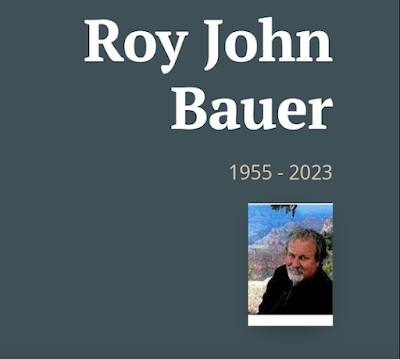
Roy's obituary in LA Times and Register: "we were lucky to have you while we did"

  This ran in the Sunday December 24, 2023 edition of the Los Angeles Times and the Orange County Register : July 14, 1955 - November 20, 2...