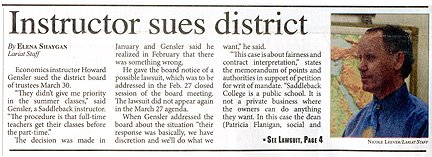
IVC is suddenly abuzz with the latest chapter in the Howard Gensler saga, which was revealed on the front page of yesterday's
Lariat.
According to the Lariat, Howard Gensler, a Saddleback College economics instructor, is suing the district. Why? Because "[the dean and the chair] didn't give me priority in the summer classes...The procedure is that full-time teachers get their classes before the part-time."
According to Howard's petition (says the Lariat), his dean and his chair "simply do not like the petitioner (Gensler) and have ignored the rules to harass and to injure him."
They don't like him?
I'm shocked! Shocked!
He's being harassed?
We'll see.
Whatever the merits of this "harassment" charge—sounds implausible—it strikes some at IVC as ironic. Or maybe poetic.
That's because Dean Gensler—a Raghu Mathur hire and "golden boy" who retreated into the classroom several years ago after the infamous "Howard Hilton" fiasco (see below)—was the source of much faculty consternation during his administrative tenure.
In particular, some faculty—especially those known to be critical of then-President Mathur—objected to what Howard did to their teaching schedules.
That word "harassment" came up then, too.
For instance, at one point, Dean Gensler announced that he forbade instructors' teaching "back-to-back classes." That is, faculty in his Schools were told that they were not permitted to teach, say, an 8:00 a.m. class followed immediately by a 9:30 a.m. class. Or a 9:30 class followed by an 11:00 class.
Huh?
When individual faculty met with Howard to explain the special burdens this rule created—burdens felt by no other faculty in the district—he readily waived the rule for some but not for others.
Interestingly, in the case of one especially well-known Mathur critic, no exception could be made.
It wasn't only dissenting full-timers who suddenly found themselves up sh*t creek owing to Gensler's curious edicts and peculiar norms. When an adjunct writing instructor wrote a short piece for the OC Weekly that spoofed Mathur (
Here), soon thereafter, he was given no teaching assignments.
When asked for the reason, Gensler cited the instuctor's
inappropriate attire. I think the problem was his sandals. Or maybe his beard.
Another part-timer—a senior and highly-regarded philosophy instructor—objected to the arbitrary manner with which the writing instructor was treated. Guess what happened to him? Yup.
Even buildings were not safe from Howard's whimsical standards and odd innovations. Those who are familiar with IVC will remember when building A300 was an ordinary classroom building, a decent place in which to teach. Like most of the buildings at IVC, it had an internal hallway which led to its seven or so classrooms.
But for some reason, Howard decided that the building should be radically reconfigured. According to his unique vision, the hallway would be closed off and used as an oddly-shaped space (for the theater people, I believe), and the other classrooms would now be entered from outside doors, which, with much violence, were now smashed into existence.
You should take a look at A300 now. It is ugly and ridiculous. And appalling. Plus denizens of its classrooms must endure random theater warblings.
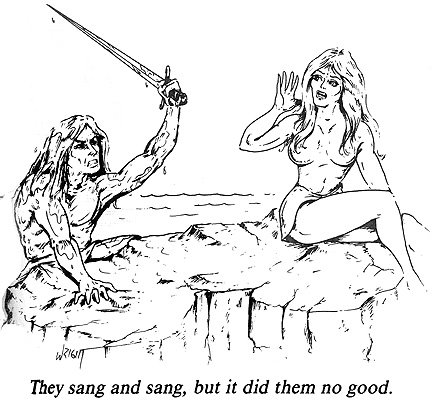
Recently, Dissent the Blog referred to one of Howard's "publications," an unfortunately revealing book called "The Avenger of Blood." To get a sense of this book's caliber and nature, consider one of its illustrations:

Impressive, ain't it?
For those who seek to learn more about the Howard Saga, they might start by reading the following article from a September 2001 issue of Dissent:

From Dissent 65, September 30, 2001
Raghu Mathur has a remarkable record as an employer and promoter of very special administrators. Rodney Poindexter is a real standout in this regard (see ARCHIVES: “Mathur vs. Women”, 9/05).
Another is Howard Gensler, who was appointed interim or temporary dean some years ago, but Raghu liked him, so he was eventually named permanent dean (of PE/Fine Arts/Humanities!). But, not long after some negative press concerning a project of his and Raghu's that is commonly referred to as the "Howard Hilton," the fellow left that position in a cloud of dense smoke and quizzical expressions.
Ultimately, Howard popped up again as a full-time Econ instructor at Saddleback College, sans the usual search and hire process. He is now fully tenured.
The following piece from a September 2001 Dissent tells some of the Gensler story at IVC. Please note that, at one point, Rod Poindexter was chosen by ASIVC as "administrator of the year." (The ASIVC president at the time was a noted Mathurian.)
We figured we would complete the picture by offering Howard the same title.]
DISSENT’S “ADMINISTRATOR OF THE YEAR,” HOWARD GENSLER
Howard Gensler, Dissent’s “Administrator of the Year,” first entered our lives in 1989, when he was hired as an adjunct. Now, he’s a Dean at IVC, and he’s made quite a splash!
Dean Gensler’s background is fascinating. In the late 70s, he received five Bachelor’s degrees, and soon thereafter, at UCB, he received a law degree. By 1983, he was teaching tax and law at Northrop University, where he assisted Dean Carl Sederholm.
In 1984, he succeeded Sederholm, becoming Dean of Northrop’s School of Law (see Times, 1/26/85). As such, Howard was the Chief Academic Officer of the Graduate Tax Program.
As if that weren’t enough, he then published an epic poem, The Avenger of Blood. [Note: you’ve really got to get a copy of this book. It is quite special.]
Northrop University:
Northrop U sure is an interesting place. Founded in 1942 by the well-known aeronautics firm as a school for airplane mechanics, Northrop later expanded into “computer science, business and law studies” (L.A. Times). In August of 1979, it became the site of the Institute for Historical Review’s first international Holocaust “revisionist” conference.
In 1986, Northrop began a master’s program in international business and taxation.
Alas, the program ran into difficulty. According to the Times (9/12/89),
Northrop University…should lose its accreditation because of ethical violations in recruiting foreign students, awarding credits and bookkeeping practices involving millions of dollars, the agency that monitors California colleges announced Monday…The rare action by the Western Assn. of Schools and Colleges stems from complaints about Northrop’s master’s of science program in international business and taxation, which enrolls many students from Asia. But the problems have “substantially affected the infrastructure of the university in nearly every aspect,” according to a WASC official…The agency recently voted to strip the school of its accreditation beginning in November…According to [the WASC official], Northrop operated part of the master’s in international business program in Taiwan without WASC approval. An investigation also showed “substantial irregularities” in how the school admitted foreign students, processed immigration documents, graded student performances and awarded credits, he said…[He] also said millions of dollars in tuition are unaccounted for or improperly accounted for. “We are entirely unsure of the magnitude,” he said…
Soon, Northrop’s long time president, B.J. Shell, unexpectedly retired; he was replaced by John Beljan, who was “given authority to take any measures necessary to guide the institution out of its financial troubles” (Times).
Northrop appealed WASC’s adverse Accreditation decision; still, the school has dwindled, and it is now the tiny Northrop Rice Aviation Institute of Technology.
Howard’s “extraordinarily unusual” legal victory:
Howard left Northrop U in 1987, whereupon he worked for the IRS, but only briefly. In 1988, Howard ran for a seat on the Costa Mesa City Council, though he was later forced to withdraw from the race, owing, evidently, to his failure to register to vote (see OC Register, 10/6/88).
Starting in 1988, Howard practiced law. In 1990, he represented a UCI math professor who accused the university of “punishing him for failing to publish enough scholarly articles” (see OC Register, 4/20/90). Not long after, he represented another UCI math instructor, Paul McGill, who sued because he had been denied tenure. Eventually, McGill prevailed. According to the Times (7/23/93), a judge “ordered UC Irvine to rehire” McGill. Said Howard, “This is an extraordinarily unusual and unique situation…The university is given remarkable latitude in terms of giving tenure; it’s a really hard area to win.”
Howard’s Cato years:
Howard, always the busy bee, received his doctorate in Economics in 1993. Then, according to the Laser Beam, during the mid-90s, Howard “taught for three years at the Hong Kong University of Science and Technology,” where he was a lecturer in Accounting.
During this period, Howard published at least 2 articles for the Cato Institute, a conservative/libertarian think tank that opposes government regulation and welfare. In one article entitled “The Effect of Race and Sex on Welfare Benefits” (Vol. 15 No. 2-3), Howard argued:
At the national level…disparities exist in the allocation of welfare. Black single female-headed households received $756 more welfare per year than similarly situated non-black families…At the state level for single female-headed households, 15 states gave blacks an average of $1,569 more welfare per year…The analysis…indicates that fundamental problems of equity in either access or assessment persist in the income maintenance system….
Gee willikers! In another Cato article, entitled “The Effect of Welfare on High School Graduation” (Vol. 16, no. 2), Howard offered a fascinating study of welfare mothers:
The hypothesis that higher welfare levels adversely impact high school graduation rates is confirmed with a high degree of statistical precision…Increases in the welfare system do not promote accumulation of human capital…[T]he basic negative relationship between welfare and education must be understood before effective public policies concerning welfare, education, and poverty can be formulated.
Meanwhile, Howard found time to edit a book entitled The American Welfare System, which remains in print.
Another deanship for Howard:
In 1999, Howard became the interim dean of Humanities and Languages, replacing Richard Prystowsky, who had resigned after brief service. (Prystowsky had succeeded Dan Rivas, who also resigned after brief service. [As I recall, Dan resigned in part because then-President Mathur was instructing him to include negative remarks in the evaluations of those faculty who had been critical of him and the board—remarks that Dan regarded as unwarranted and unjustified.]
In 2000, owing to President Mathur’s staunch support, Howard was appointed permanent Dean of Humanities and Library Services (and, later, of Fine Arts). The details of the appointment evidently raised concerns about “process”:
Three administrative appointments were approved in closed session on Monday…Howard Gensler was appointed dean of humanities and library services at Irvine Valley…[The other appointees] were appointed with unanimous votes, but Gensler was appointed on a split vote of 4-3, with trustees Lang, Marcia Milchiker and Don Wagner dissenting…“I personally haven’t heard anything negative about the guy himself, but there were questions raised about process that I didn’t get fully answered,” said Wagner. (Irvine World News, 6/22/00)
Process problems notwithstanding, then-president Mathur exclaimed that Howard was his “first choice.”
Howard and Raghu’s “top secret plan”:
About a year ago, faculty began hearing about a massive project that would provide facilities for Fine Arts (and fish). The word was that Howard was developing the project with the blessing and encouragement of his mentor, president (now chancellor) Mathur.
Howard eventually provided Chancellor Mathur with a “report” concerning the project on May 23, 2002. According to my sources, then, in early June, Howard and Raghu met with three Board Majoritarians, including Wagner, to discuss the project. (Ask Dot.)
That’s about when the L.A. Times caught wind of it [gosh, I wonder how they found out?]. On June 15, the Times reported
Irvine Valley College officials are quietly trying to find investors for a private hotel, entertainment and office complex on campus that could cost as much as $800 million, officials confirmed this week…As described in recent meetings among campus officials, the project would include a hotel, a multistory parking structure, two 2,000-seat theaters, office buildings, a sound stage and a lake, replacing orange groves and an athletic field at the southern end of campus…The scope of the privately funded, for-profit project—whose cost estimates nearly double Staples Center in downtown Los Angeles—is believed to be unprecedented, not only for a community college, but for any public university in the state…The cost would be enough to build two community colleges, said Kirsten McIntyre, spokeswoman for the California Community Colleges Chancellor’s Office, which was unaware of the proposal…The project is a long way from reality and would have to be approved by trustees for the South Orange County Community College District, which includes Irvine Valley and Saddleback colleges.
According to the Times, some college employees had doubts about the project: “they don’t understand how the two-year college benefits from such a deal. ‘It would be a commercial enterprise that would not be a benefit to our students,’ said Jan Wyma, Irvine Valley’s choral director.”
The Times reported that Dean Gensler was the man behind the plan and that Mathur was aware of it. Glenn Roquemore, president of IVC, however, said that he hadn’t yet received a proposal.
The scope of the Gensler/Mathur venture was truly stunning:
The proposal has changed over the months, but the basic plan calls for construction on 25 to 35 acres…Several sources said Gensler was pitching the deal to investors as a 99-year lease, and that it would include a Hilton or Hyatt hotel with conference center facilities, restaurants, a four- or five-story parking structure, an office building of several stories, the theaters, an art museum, an observatory and a building with sound stages for TV and film…Also contemplated are a movie complex and soccer stadium.
Massive unbeknownstitude:
City officials were miffed about all of this secret planning. The Times quoted an Irvine official who said: “Any construction not associated with the college’s educational mission must be approved by Irvine.” Nevertheless, “she had not heard of the proposal.”
Three days later, the Register weighed in with a story that presented Howard’s project—now described as involving a paltry $463 million—in a less sympathetic light:
Board members interviewed said they were surprised at the planning that has gone into Gensler’s vision and that they should have been informed about it earlier…“Apparently this was really being pursued by just a few people unbeknownst to other members of the board,” said trustee Dave Lang…One instructor described the project as “absurd” in that it “flies in the face of the college’s long-term planning.”
During the Board Meeting of June 24th, trustees decided to pull the plug on the whole business:
Irvine Valley College trustees got their first official look Monday night at a controversial proposal to develop a $463 million entertainment complex on campus–and decided they wanted no part of it… “The feeling was that the proposal that came to us did not sufficiently meet the needs of the college and the students,” said board president Don Wagner, who said trustees first learned of the project in the press…“It came to us as a take-it-or-leave-it proposal, and we are going to leave it.”…. (OC Register, June 25, 2002; my emphasis)
On the 25th, the Times quoted Dorothy “Dot” Fortune, who carped that the Gensler/Mathur project would give “away half the land at IVC.”
Howard, however, defended his project; it would, he said, make IVC “one of the most important cultural centers in Southern California.”
Nonagenarian takes plan elsewhere:
The Times eventually reported the proposed project’s builder:
The complex was to be built by the Newport Financial Group of Newport Beach. One company figure is Charles Ross, 91, of Laguna Woods, who proposed a similar project at UC Riverside, without success, Fortune said…Ross said Monday he would not discuss the plan, but that if the district turned it down, he would take it elsewhere.
In an article for the Irvine World News on the 27th, Wagner is again reported as saying that “trustees first learned of the project after the top secret plan was leaked to the press.” Well, no, according to my sources, he and two other Board Majoritarians heard about the “top secret plan” two weeks before the Times report.
C’mon Don!
Some newspaper articles claimed that, on campus, the project was called “the Howard Hilton.” In truth, it had been dubbed “Howie World” by the Chevy Chase fans who have always dominated IVC.
“One has to wonder…”
On the 30th, Times editorial writers offered a harshly critical perspective on “the Howard Hilton”:
Irvine Valley College’s mission statement…[says that the] college exists to provide quality education for students…The document doesn’t say anything about leasing a huge chunk of the campus to a private developer for a $500 million entertainment and office complex…That’s why people were caught off-guard earlier this month when word surfaced that an IVC dean had been meeting with a developer who wanted to build a massive, for-profit venture. The trustees of the SOCCCD are to be commended for putting the educational purpose of the district first by rejecting the plan last week before it could gather more momentum…The proposal was out of sync with the city of Irvine’s general plan and existing zoning. The city envisioned the orange groves…as one day hosting recreational facilities and college-related construction—not hotels, parking garages and a Hollywood production lot. City officials hadn’t had a chance to review the proposal, and from what it suggested, many of the plan’s elements also clashed with zoning in the area…The proposal also was at odds with IVC’s own planning process. Community colleges are required to create a master plan that describe how they intend to grow. There’s nothing in IVC’s long-range planning that was even remotely close to the proposal that was submitted to the board by Howard Gensler…College deans have a lot of clout, but one has to wonder how this kind of major campus land-use negotiation got to the stage it did. It probably should have been handled in the first place at a higher level of administration….
Hey, yeah! Then, on July 9, IVC issued an odd little press release. It announced plans to construct a modest “Performing Arts Building”:
Irvine Valley College submitted plans to the state…for the construction of a 400-seat Performing Arts Building… The…Building has been long in development as part of Irvine Valley’s Educational and Facilities Master Plan to unify campus services and to meet a growing demand by students and the community. The Educational and Facilities Master Plan and, in particular, the Performing Arts Building, is wholly separate from a recent $450 million proposal made by Irvine Valley Humanities Dean, Howard Gensler, who worked with a private investor to develop a possible alternative campus building project…
We at Dissent feel just awful about the unceremonious kiboshery of the “Howard Hilton.” I, for one, was really lookin’ forward to floatin’ around on that lake.
Well, at least we can name Howard our “Administrator of the Year”!
Congratulations Howard!