Tuesday, May 31, 2005

District regs

Naturally, it was a success. A good time was had by all. Sonny and Cher (i.e., Phil & Karima) have a nice place.

When me 'n' "mom & dad" (i.e., Julie and Keith) walked up to the house, Phil popped out and scared the bejesus out of Julie.

The thing at the top of the stairs. Very creepy.


Sonny and Cher. I told Karima that she ought to show up at school looking like that.

Phil was dressed up as "Death." He had a sickle and everything. He didn't poke anybody, though.

Pauline was there, still carpin' about how I got her fired.

Mary & Steve.

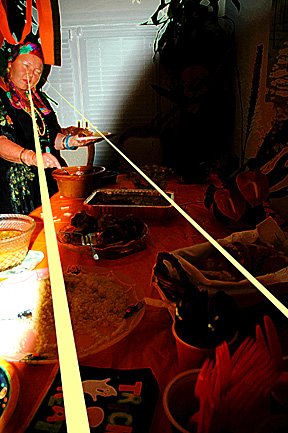
At one point, I felt pressure on the back of my head. I turned around. It was Susan, giving me the laser stink eye from across the room.

Some of the chicas calientes wore cool jewelry.

Shel is still wearin' shark hats and such. They're his signature.

I spotted some ectoplasm in the mirror. Took a snap. Here's what I got. You tell ME what it means! I dunno, but you can bet it isn't good.


Cher and Athena, on the "Chesterfield."

For obvious reasons, I feel that the booze deserves its own photo.

I don't know this lady, but she has a great smile.

I never got a chance to speak with this theatrical fellow.

Here's Athena again.

Julie grabbed my camera and declared that she would take a snap of me for once. After three tries, she got it.

WELL, THERE YOU ARE. A GOOD 'N' CREEPY HALLOWEEN PARTY...--I MEAN PARTAY.

Monday, May 30, 2005

A map of Romania

The green section is known as Transylvania.

The blue section is known as Wallachia, the area ruled by Vlad the Impaler--Dracula, sort of.

See Romania (Wikipedia)

The location of Romania's capital, Bucharest:

Naturally, Bucharest is the home of the University of Bucharest

Factoid: evidently, Vice Chancellor Andreea Serban held a position at the U of B.

Saturday, April 30, 2005

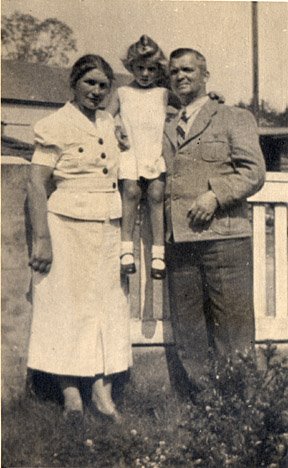
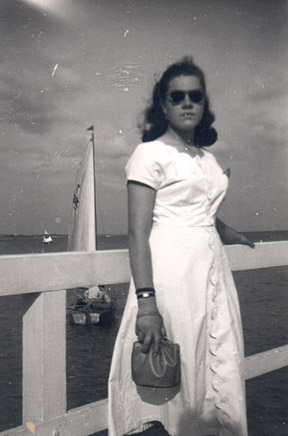
Chunk's mom


THIS, OF COURSE, is a map of modern Poland. The borders of Poland throughout history--well, that's a seriously messy and violent subject. I won't go into it.

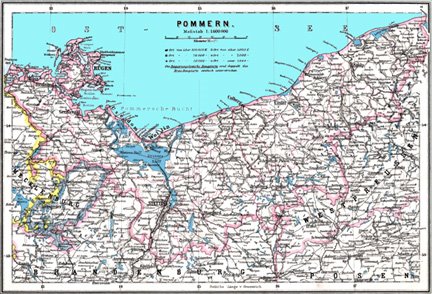
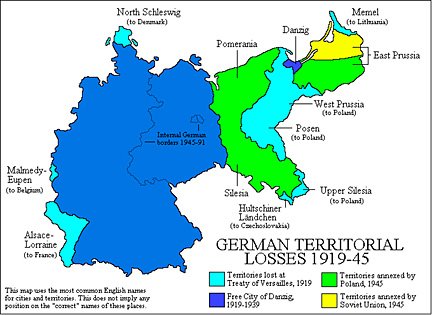
For a long time, regions of what we now know as northwestern Poland were German. Pommern (Pomerania) was among these regions. (See map.)

As Nazi Germany collapsed at the end of World War II, the Soviet forces invaded from the east, raping and pillaging. (See Red Army atrocities.) Civilians were ordered to flee to the west, and few remained. Many men--usually elderly--who remained, including one of my relatives, were killed. Almost all women were raped. See Every German female raped.

After the war, Pommern, renamed, was a part of Poland.

Until the "Russian" invasion of 1945, my mother lived in the town of Bärwalde ("bear forest"), Pommern. There were two towns in Pommern by that name at the time, and I do believe that my mother's town--her stepfather was its mayor until his death in 1939[?]--is now named Barwice.


In 1945, mom, then 11 years old, and her mother (actually, her aunt) fled west by rail, ending up in Hamburg, which was ultimately occupied by British forces. At one point as they planned their escape, the pair were faced with the choice of rail or ship (further north), including the 550-foot von Steuben. They chose rail. Their train was among the few that survived strafing by Russian aircraft. They were extremely lucky.

The Steuben was filled beyond capacity with 5000 people, including over 1000 refugees, almost all women and children. It was sunk by a Russian sub on Feb. 10. There were 659 survivors. (See National Geographic: Ghost Ship Found.)


Germans (correctly, near as I can tell) viewed the British and American invaders as much more humane than their Russian counterparts. Mom was very happy to settle in what became the British sector of post-war Germany.

She watched lots of American movies. She got the notion that she must go to America and become an American. Simultaneously, my father, in southern Germany, hatched similar dreams.

She eventually became an American citizen (during the mid-60s). Nobody's more American than my mom.

She voted for Bush, but we don't talk about that.

THE MORE DETAILED VERSION OF MOM'S STORY:

What follows is an account of the war and post-war experiences of Manny and Edith Bauer, based on taped anecdotes recorded in the summer of 2004. Manny and Edith were children at the time of the war’s end (his birthdate is 1932; hers is a year later), and they left Germany for Canada only a half-dozen years later, when Manny was 19 and Edith was 18 (she turned 18 on the boat). The two married not long after. Eventually, Manny and Edith moved their little family (including a girl and boy) to the U.S.A (in 1960).

I have generally resisted the temptation to editorialize about, or to correct, my parents' (usually my dad's) perceptions and historical assertions. I am telling the story essentially from their point of view. (--RJB aka CW.)


The Russians were coming:

By early 1945, the collapse of Germany had begun, and, in the eastern part of the country, the Russians advanced. Manny [my dad] states that the “Mongolians” were by then the vanguard Russian troops. “The Soviet Union had run out of white Russians,” he says. “So the Russians brought in the Mongolians.” These troops, he says, were even more brutal than the Russians.

Edith, who was 11 or 12 years old, lived with her mother in Pommern, in the eastern part of Germany. The woman Edith calls her mother was in reality her aunt, who, along with her husband, took Edith in when her real mother died in the late [?] 30s. [Her death is somewhat mysterious.] In 1939 or perhaps later, her uncle died as well. Edith was very close to him.

In those days, in Germany, no child was legally permitted to be without two parents, and so, when Edith’s uncle died, the town’s chief of police—a family friend—was assigned the role of father-guardian.

At the time of her real mother’s death, Edith’s sister, Ilsa, was sent to live with other relatives nearby.

Edith recalls that Ilsa was somewhat “gung ho,” a patriot. So was Edith, in a way, she now says, for she was an avid athlete, an ardent competitor, and, as we know, the Nazis promoted athletics. Edith remembers attending the 1936 Olympics in Berlin. She loved that sort of thing.

Ilsa’s “gung ho” tendencies got her into trouble with her family at least once. Polish prisoners were supposed to stand aside on sidewalks in deference to Germans. One time, evidently, a Polish prisoner did not stand aside quickly or far enough to satisfy young Ilsa, and so she angrily pushed the guy onto the ground. Someone saw this and reported it to Oma [Grandmother] Losa. There was hell to pay that night.

The family was very clear that they were not the sort to mistreat the Polish prisoners.


In the days before the Russian invasion, Ilsa moved in with Edith and her mother. They lived in a beautiful home on a hilltop—the last house on the eastern side of town, and thus the dwelling that would first encounter the advancing Russians. Already, local soldiers occupied it: ammunition and weaponry was stored in the garden, and men were billeted inside. Now, as the Russians drew close, the local soldiers selected this particular home for their defensive stand.

“It would be like a fort,” says Edith.

Edith’s mother stubbornly refused to abandon her home, protesting, repeatedly, that she had worked too long and hard on it simply to abandon it. The soldiers tried to tell her what the Russian troops would do to women, even to little girls, but she wouldn’t listen. Finally, the soldiers commanded: “Take the two girls and leave here, now!” And so, on the 28th of February 1945—Edith recites the date without hesitation—Edith, her “mother,” and her sister, along with several relatives, abandoned their fine home.

Most of Edith’s relatives lived on farms and thus owned wagons, but Edith and her mother lived in town, and they lacked transportation. The soldiers told them to go the railroad station to await the westbound military trains, so Mom and the girls and a few other relatives packed their most cherished belongings in suitcases and put them on a little wagon—Edith remembers that it was like the little red wagons kids have here in the U.S.—and rolled their stuff to the station.

They waited there for days, enduring strafing and bombing. Edith remembers the siren’s howl and the noise of bombs and guns. At one point, the station [?] suffered an attack that killed fifteen hundred people, including most of their neighbors and relatives, who were also waiting for the trains. (Apparently, German papers ardently covered such events.)

Finally, the trains arrived, and so the refugees hurriedly secured possessions, and themselves, to the open flatcars. Then, at the end, there came another attack. Some people hid by the flatcars, while others dove under nearby wagons. Edith ran clear of the trains and into a hole somewhere. All of a sudden, a portion of one train blew up, killing everyone aboard it.

Edith remembers that, about then, the engineer of her train yelled, “the Russians are closing in on all sides; everybody get on the train; we’re leaving now!”

The engineer was a Pole. Polish prisoners had worked and lived in the town since the invasion of Poland years earlier. People from conquered territories manned much German industry during the war, and, evidently, they did other work as well. Edith recalls that Polish women and girls worked as domestics in her town.

Edith’s mother ran the family lumberyard across the street from their home, and that business relied on thirty or so Polish workers who slept on bunk beds in a barn-like structure. Edith says that her mother prided herself in treating her prisoners with kindness, and, in general, prisoners were not mistreated in the town, though she recalls exceptions.

Manny explains that, on the eastern front, many “German” soldiers were in fact Poles, Ukrainians, and Finns who had decided to join the Wehrmacht [army]. They wore the regular German army uniform, but with a thin armband indicating their non-German nation of origin. (Manny lived in southern Germany.)

Evidently, during the Russian advance into collapsing Germany, some Poles stayed, hoping to be embraced by their new masters; others feared the Russians no less than did the natives and, alongside Germans like Edith and her little group, they fled to the west. Many Poles thus eventually ended up in barracks-like housing—at first, along with German refugees—in what became West Germany, and lived in those conditions well into the 50s.

Edith says that the non-German refugees were often mistreated, though she adds that the German refugees, too, were not treated well, since, wherever they showed up, they represented an added burden on already burdened locals.

Some of Edith’s relatives, including Oma Losa, didn’t make it out of Pommern. Later, Edith learned that the younger girls who remained behind—not Oma Losa, who was older, but virtually all of the younger women, including toddlers—were raped. That was the fate of Edith’s sister-in-law, Frida. Years later, says Edith, Frida refused to acknowledge the event, though what had happened to her was no secret at the time. There was no doubt that it had occurred and that it was traumatic.

The invading soldiers had diseases, and so, says Edith, it was necessary for rape victims to do all sorts of awful things to themselves. Terrible bubbling liquids were used, she says.

Frida was raped, but her husband was killed. He had worked for the diplomatic service, and, when the Russians entered and ransacked his and Frida’s home, they found pictures of him in uniform with his ribbons and medals. They assumed that he was a dignitary, an official. He had built a hiding place behind a false wall, and he and Frida were there when the Russians entered the house; but these Russians were no fools: they tapped on the walls and found the two. They dragged Frida’s husband to the front of the house and hanged him there.

Edith’s little group of refugees learned these terrible facts only later; they learned about the rapes and killings and about the burning of all the homes of the neighborhood; they learned, too, that all the younger people were forced by the Russians into work camps.

For some reason, says Edith, after about two years, the Russians allowed Germans to leave, and so they did, traveling west. That was before the Wall had been erected to prevent emigration.

During that exodus and before, people were scattered throughout the country and had no way to find each other. Agencies such as the Red Cross organized efforts to reunite family and friends. Thus, they would announce that former citizens of town X were to meet in town Y at a certain date. People arrived there, carrying signs with their names on them. This went on for years.

Edith remembers one day—this was years later, when she lived near Hamburg—coming home from work and noticing the smells of cooking wafting from her family’s small apartment. She was alarmed, for she knew that, at that moment, her mother and sister were elsewhere. When she entered, she was astonished to find that the mystery cook was none other than her Oma Losa!

Manny hastens to add that, before Edith and her group left Pommern by rail, they had the option of travelling north, instead, to a Baltic harbor, where a ship awaited refugees. But travel by ship would mean abandoning various larger things that they hoped to take with them. Edith’s mother therefore insisted that they take the train.

That was fortunate: later, they learned that the Russians sank that ship, killing most on board. [After this taping session, my father read an issue of National Geographic that described the sinking of the Steuben. I have done further research, and it appears that three refugee ships (part of a massive evacuation project) were sunk by a Russian sub at about that time, killing perhaps 20,000 people. It is possible that the ship that my mother almost boarded was one of the other two. See also Sinking of the Wilhelm Gustloff. See also Tragedy at Sea.]


Life as refugees:

So Edith’s little group, unlike so many others, did manage to escape to the west, to the area near the western port city of Hamburg. As Edith recalls, the area was at first controlled by the Americans, and then the British.

The Allied soldiers weren’t nearly as cruel as the Russians, but they were no angels. Rape was fairly common—it tended to happen to incautious “bad girls,” says Edith—and theft and ransacking were routine. Soldiers would regularly rifle through refugees’ suitcases and simply take what they wanted. Anyone who owned something of value—say, a radio—removed essential parts so that it didn’t work, hoping that that would deter theft, though Allied soldiers often simply smashed “broken” things.

Americans also tended to destroy anything that sported the Swastika, even though much that had no special connection with Nazism adorned with that symbol.

One had to be careful around Allied soldiers, to not be caught alone and in a quiet place with them. British soldiers seemed to be relatively decent and reliable compared to the Americans.

Edith remembers that many of the American soldiers who drove the trucks were black. She had never seen a black person before that.

Edith and Manny express disapproval at the misconduct of invading or occupying soldiers. German troops, says Manny, faced severe penalties for abusing civilians in occupied territories. Rape was especially forbidden in occupied territories, Edith explains, owing to the importance the Nazis placed on German racial purity. (One hopes that that was not the sole reason for the prohibition!)

Manny remembers that an older German friend named Karl—Manny met him years later, in Canada—was for a time thwarted in his efforts to emigrate, owing to a problem with his German military record. As a Wehrmacht soldier in Italy, some of Karl’s colleagues had taken firewood from a peasant, and the episode was duly noted as a black mark in Karl’s German military record!

Unfortunately for Karl, says Manny, the German army took a dim view of such misconduct relative to civilian populations.

Manny and Edith evidently detect no irony in the fact that, as they say, Germany applied high standards of conduct to its soldiers relative to the treatment of people. [To this day, my parents seem to view the Nazi atrocities that were revealed after the war as utterly strange, as though they were not a part of the Germany in which they lived.]

* * * * *


Edith’s arrival in Hamburg was no picnic. She and her small group were taken straight from the train to a large gymnasium—a kind of regional sports center, with wooden flooring. They were kept in that place with nothing to do for maybe two months.

Edith remembers how local families were forced to share their houses and apartments with the refugees, and this, along with other sacrifices in that time of scarcity and poverty, inspired strong anti-refugee feelings.

“They hated us,” she says, referring to the locals. She recalls when, during any icy February, soldiers came and ordered everyone in a neighborhood outside. Housing was then reassigned and people would be forcibly relocated and separated from their friends. Such events especially caused bitterness toward refugees.

Edith recalls curfews and the importance of carrying one’s papers on one’s person at all times....


☀☀☀☀
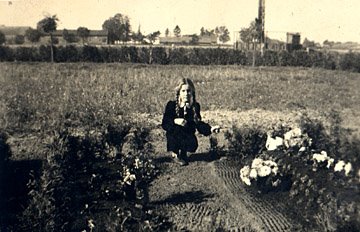
First in a series of accounts by Chunk of his family's history. This is Chunk with his nephew Adam, age 2.

Tustin Legacy Master Plan

Click on the map. I dare you!

The ATEP part of Legacy is 68 acres over on the left. (The whole shebang, Legacywise, is about 1600 acres.)

Note the "community park" (green) that runs from bottom left up to the right. That should be cool.

I'm thinking of proposing a miniature golf course. I've even got some name ideas. How about

"Goo's Chili Dip Acres." Or

"The Chancellor's Shitty Links."

OK, I'll keep workin' on it.

Tuesday, March 22, 2005

Trustee Fuentes’ Spanish Adventure —or “No one would do that!”


“Spain has abandoned our fighting men and women, withdrawing their support. I see no reason to send the students of our colleges to Spain at this moment in history.”

—Tom "Big-Foot" Fuentes
February 28, 2005:

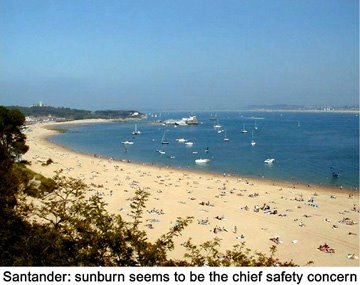
Board Meeting: on this night, the Board is asked to approve a summer “study abroad” program in Santander, Spain. Trustee Fuentes suggests that he will vote against the item in part because Spain has “abandoned our fighting men and women” by pulling out of Iraq.

Four other trustees follow Fuentes’ lead with regard to the item, though they cite a concern for students’ safety, not Spain's politics.

Student Trustee Poulton expresses concern about a “political precedent”—that is, rejecting a program owing to the politics of the host country.

Program approval is denied on a 2-5 vote. (Milchiker and Lang cast affirmative votes, joining student trustee Poulton, whose vote is advisory.)

Fuentes’ remarks are videotaped. By the next morning, transcripts of the remarks are produced. Within a day or two, the transcripts and a DVD containing the video are provided to the Orange County Register’s Marla Jo Fisher.

A columnist for the OC Weekly also receives the transcripts.

Soon, Fuentes will find himself at the center of an embarrassing media firestorm.

March 4:

In the online edition of OC Weekly, Gustavo Arellano reminds readers of Fuentes’ controversial history as head of the local GOP. He reports that the “vindictive” Mr. Fuentes has now launched a “campaign against Spain.” According to Arellano:

Fuentes unveiled his new crusade at the Feb. 28 SOCCCD Board of Trustees meeting, when he requested a discussion on Item 10…The item would have allowed Saddleback College students to study abroad in Santander, Spain, during the summer. It wasn’t expected to generate much controversy; the SOCCCD board has allowed Saddleback students to learn Spanish in the Iberian country for the past 15 years.

But Fuentes shocked everyone in the audience when he began to assail his ancestral home. "One hundred ninety-five years ago, in 1810, my family arrived on this continent from Spain, so I have an affection for that land," Fuentes said. But he quickly dropped the amicable pretense, simultaneously attacking Saddleback College’s study abroad program as catering to "an elite" and as a death wish given the March 11, 2004, Madrid train bombings that left 193 dead.

Terror wasn’t what disturbed Fuentes the most, though. "Now: something more," he intoned sternly. "Many of our students in this college, and of its sister college Saddleback and Irvine, past and future today, fight on the battlefield of Iraq under the flag that is behind us. Spain has abandoned our fighting men and women, withdrawing their support. I see no reason to send the students of our colleges to Spain at this moment in history."


Arellano notes the strangeness of Fuentes’ reasoning:

For the 2004-2005 academic year, SOCCCD trustees have approved study abroad to Cambodia, China, New Zealand and Vietnam, all countries with administrations that oppose the U.S. Invasion of Iraq. And Fuentes & Co. also permitted district-funded student trips to Boston, New York City and Washington, D.C.; last year, each of these cities passed resolutions condemning the Iraq war (and on Sept. 11, 2001, each was as dangerous as Madrid was on March 11, 2004).

Indeed, notes Arellano, two months after the Madrid bombing, a group of Saddleback students visited Spain, and not one solitary squawk of concern was voiced by the Board, including Trustee Fuentes.

March 5:

On Saturday, an article concerning the “study abroad” decision appears in the OC Register:

"Spain has abandoned our fighting men and women, withdrawing their support," said trustee Tom Fuentes, who spearheaded the vote to end the 15-year-old program. "I see no reason to send the students of our colleges to Spain at this moment in history."

…UC Irvine professor Jacobo Sefami, who runs the University of California's program there, said Spain is still a U.S. ally.

"I strongly disagree with the use of politics as a motivating factor to disallow an academic program," he said in an e-mail from his Madrid office. Right now, 18 Saddleback College students are in Salamanca, Spain, on a spring semester abroad, Saddleback professor Carmenmara Hernandez-Bravo said. There are no plans to tell them to return. About 30 students had been planning to take the 37-day summer session to Santander in northern Spain to study Spanish civilization and language, Hernandez-Bravo said. The college is planning trips this year to Cambodia and Vietnam.

… Marcia Milchiker, a trustee who took the summer program to Spain last year, retorted that two students were pistol-whipped outside the University of Southern California recently and that terrorists destroyed the World Trade Center in New York.

"Why are you letting them dictate what we do?" Milchiker said. "Are you going to stay in your house in a bomb shelter all the time?"


In its online edition, the Register provides the video [provided by Dissent] of Fuentes sternly explaining his vote against the program.

The Register article broaches the question of Fuentes’ possible hidden motives:

Several faculty members alleged in interviews afterward that the vote was intended to punish Hernandez-Bravo, the trip's organizer, for past criticism of the board, particularly Fuentes….

Fuentes said it was "absurd" to suggest he was trying to punish her.

Hernandez-Bravo said she didn't think the board's refusal to approve the annual trip was directed at her.

"No one would do that, disappoint the students, just to get back at one person," Hernandez-Bravo said.


In an article that appears in “Inside Higher Ed,” more light is shed on Fuentes' possible “punishment” motive:

[Some of Hernandez-Bravo’s colleagues believe] that Fuentes was punishing her for suggesting in a television interview last year that she would have flunked him for comments he made complaining about faculty members' light workload, "because before you speak in my class, you have to do your research."

No doubt, Hernandez-Bravo's "flunk" comment was a response to Fuentes’ remarks in a TV interview in 2004 in which he asserted, falsely, that SOCCCD faculty have a "36-hour work week" and that their average pay is $100,000 per year. (See Dissent ARCHIVES, October 28, 2005.)

The charming Ms. Hernandez-Bravo's criticism, made at a Board meeting in Fuentes' presence, was both strong and rhetorically winning. (She is a former diplomat.)

INSERT [8-23-23]: Why would those Register Republicans seize an opportunity to make Fuentes, the King of OC Republicans, look bad? To get to the gist of the matter, let's turn to an article in the OC Weekly, written by Gustavo Arellano, that appeared a year after Fuentes stepped down from OC GOP Chair. He attempts to explain the problem with Fuentes. He writes:

It's been a bit more than a year since you stepped down as chairman of Orange County's Republican Party, a position you held for 20 years. Now you sit in the Siberia of politics known as the South Orange County Community College District (SOCCCD) Board of Trustees. What happened? 

I'm reminded of the story of Pyrrhus. He was a Greek general who fought the Romans in the Battle of Asculum in 279 B.C. Upon defeating the Roman hordes despite his forces suffering huge casualties, the good king is said to have proclaimed, “One more such victory, and I am lost.” His insight spawned the term “Pyrrhic victory,” which the literati use to describe such ruinous triumphs. 

That's been your political career, Tom. As you led the Orange County Republican Party to dominate a region in a way unseen in local government since the days of Tammany Hall, you also ensured your political doom. Petty fights, bizarre grudges, besmirchments: if you had avoided all of that, you'd still be the pontificus maximus of the county GOP. Instead you'll spend the rest of your political days doodling on agendas through another stultifying SOCCCD board meeting and dreaming of the Balboa Bay Club. 

Tom Fuentes, this is your Pyrrhic life: 

•1988: You approved the use of poll guards to stand outside polling places in Latino neighborhoods when they cast ballots for the 72nd Assembly District race. The Republican Party candidate, Curt Pringle, won the election. But the subsequent furor led to your resignation as communications director for the Catholic Diocese of Orange, an exodus of Latino voters from the GOP (the first of many, it would turn out) and various settlements of lawsuits regarding the matter totaling more than $480,000. 

•1994: You led the local GOP in successfully pushing for the homegrown Proposition 187, the most vicious legislative attack on immigrants since the Chinese Exclusion Act of 1924. The measure passed overwhelmingly throughout the state—in Orange County, nearly 70 percent of voters approved it. Political scientists now consider such full-hearted support a colossal blunder, setting back GOP efforts to woo the Latino electorate by at least a decade. 

•1996: After Loretta Sanchez beat Bob Dornan in the 46th Congressional District, you joined Dornan's paranoid, ill-begotten campaign the following year, alleging Latino ballot-rigging. “Every day, more and more evidence of massive voter fraud by the Democrats and the Sanchez supporters comes to light,” you told a LosAngelesTimesreporter at the time. With your blessing, the House of Representatives launched an investigation but didn't find the light. Again, more Latinos shunned the Republican Party. 

•1998: On the eve of another battle between Sanchez and Dornan, you urged your old boss, Orange Bishop Norman McFarland, to admonish Sanchez's Catholic faith due to her pro-abortion beliefs, hoping the public scold would attract Latino Catholic votes. Sanchez slayed Dornan again; the Republican Party alienated Latinos again. 

•2000: A group of moderate Republicans calling themselves the New Majority unsuccessfully attempted a putsch against you. Instead of trying to mend bridges, you boasted to OrangeCountyRegistereditorial writer Steven Greenhut after the spring primaries, “We just cleaned their clock.” 

•2002: While the Bush administration backed Richard Riordan's campaign for the Republican nomination in California's governor race, you and other conservatives successfully got the nomination for Bill Simon. You told conservative columnist Bob Novak that Republicans who support moderates are “whores.” The move infuriates the Bushies: from that point on, any Orange County campaigning and fund-raising happen without you. 

•2003: While the rest of the state GOP rallied around replacing Governor Gray Davis with Arnold Schwarzenegger, you ordered local GOP staffers to remove 5,000 “Join Arnold” signs from county party headquarters. A week before the recall election, Schwarzenegger held a thousands-strong rally at the Orange County Fairgrounds. He did not invite you onstage. 

•Feb. 28, 2005: You persuaded four colleagues on the Board of Trustees to cancel Saddleback College's summer study-abroad program to Spain because the country had pulled its troops from Iraq. The decision drew national ridicule and outraged the locals; under heavy pressure, the SOCCCD board rescinded your decision on March 22 by a 5-2 vote. And, again, Latinos laughed at the GOP. [END of INSERT]


March 6:

On Sunday, the LA Times weighs in:

"Spain has abandoned our fighting men and women, withdrawing their support," said trustee Tom Fuentes…Fuentes, former head of the Republican Party in Orange County, said he also had concerns about student safety…When asked why students were allowed to go to Spain just three months after the Madrid bombings, Fuentes replied, "I think the terrorist situation is all the more prevalent and obvious today."

Professor Carmenmara Hernandez-Bravo, who runs the study-abroad program, said she was stunned by the board's decision. "I'm still in shock," she said. "I cannot believe a community college can put this much politics into academics."

…In deciding against sending students to Spain, board members also cited high program costs and potential liability to the school district.

"I think it's an affront to the working-student community who often utilizes the junior college system to propose a program of five weeks of study that is nearly $5,000," Fuentes said in a telephone interview Saturday.

The cost of the 37-day trip to Santander, Spain, is about $4,400 including meals, housing, transportation, books and airfare, Hernandez-Bravo said. But while rejecting the $119-per-day Spain trip, she said, the board approved a 14-day trip to Florence, Italy, costing $204 per day without airfare and some meals.


March 7:

On Monday, the Chronicle of Higher Education reports on the “Study abroad” matter:

[Hernandez-Bravo] said the students were safer in Spain than in parts of Los Angeles. "I feel a little more concerned," she said, "when I take my students to South Central LA when I take them to the Museum of Tolerance."…

And she said that the board had approved other trips at the same meeting that were more expensive and that included countries that have not sent troops to Iraq. "I'm confused," said Ms. Hernandez-Bravo. "I don't know the real reason" for the decision.

Mr. Fuentes could not be reached for comment on Sunday.

Ms. Hernandez-Bravo has sent an e-mail message to the college district's chancellor, Raghu P. Mathur, protesting the decision. She said she also plans to forward the message to Spanish and U.S. officials.

"Whatever Trustee Fuentes believes about Spain and its role as our ally, his personal political beliefs should have no part in determining the fate of a long-standing, successful, academic program," she wrote in the message. "It is irresponsible for a public official to make such remarks at a board meeting, because by doing so he is politicizing the educational process."


March 11:

On March 10, a columnist for USC’s “Daily Trojan” opines that Fuentes’ action and his reasoning are “inappropriately political.” (Dozens of articles and commentaries regarding the "study abroad" decision appear both in print and on TV; I am here providing a mere sample. As far as I know, no one defends Fuentes' reasoning.)

On the 11th, LA Times columnist Dana Parsons weighs in, emphasizing Fuentes’ controversial record as chair of the local Republican Party:

Leave it to Tom Fuentes to big-foot a situation. That was his calling card during the 20 years he ran the Orange County Republican Party, crushing enemies real and imagined.

If you want a handle on how Fuentes saw his job, picture Orange County as a house and Democrats as termites. Even peskier than Democrats, though, were Republicans who dared to challenge the party orthodoxy.

Fuentes' 20-year reign ended last year, and you'd think he might then have dropped from sight. Unfortunately, he's got the itch again, back as the apparent point man behind a decision to cancel a program that sends students to study in Spain.

…To state the obvious: Safety is an issue for the students and their parents to weigh. Fuentes' lament about the cost would make sense only if the district paid the bill. As for terrorists, the Basque separatists have been fighting the government for years and Islamic terrorists have shown they can strike any country in the world.

No, the only new factor is Spain's decision to pull its troops from Iraq and the year-old Socialist government's opposition to U.S. policy.


Parsons notes Fuentes’ effort to distance himself from his stated political motive:

I don't buy it for a minute.

This is Fuentes playing politics again with the same high-handedness he always has, couched in the same high-mindedness he developed into an art form. It was a tiresome act that eventually led many of the county's rank-and-file Republican leaders to want new party leadership.

Now he's taken his act to college.

Same old Tom Fuentes. Looking for enemies and finding them.


March 13:

The Register reports that Hernandez-Bravo has become something of a folk hero:

These days Carmenmara Hernandez-Bravo can't go anywhere on the Mission Viejo campus of Saddleback College without being stopped and cheered on.

"Are you going to Spain?" a dean asks.

"Of course I'm going to Spain," Hernandez-Bravo responds with a hint of humor and defiance in her voice.

Students, professors, support staff—everyone has an opinion.

"That's all we can do, be there for each other," a professor tells Hernandez-Bravo after a warm embrace. Another colleague blanketed her office walls with bright yellow fliers reading "bravíssima," a play on her last name and her courage. Students have inundated her with e-mails, and everyone from ABC to NPR is requesting interviews.


In the article, Fuentes stands by his decision while distancing himself from his political motives:

"I reserve the right, as I'm sure any citizen does, to comment," he says. "The decision to cancel the program was on the basis of cost, safety and liability risk. My concern for fighting men and women in the uniform of our land was not the reason the board voted 5 to 2."

So why bring it up? That's Hernandez-Bravo's question.


Fuentes joins other board members in emphasizing the “safety” issue, but the Register reporter is skeptical:

Hmmm. If safety comes first, why didn't Fuentes speak up last year when the summer study-abroad students arrived in Santander, Spain, just four months after the terrorist train bombings in Madrid?

Hernandez-Bravo says that trip went without incident, and she describes Santander as one of the safest cities in Europe.

Former Saddleback College student Brian E. Siedlecki said it best in his letter to Chancellor Mathur: "Having spent time in Santander, I can assure you it is as likely to be victimized by a terrorist attack as Modesto, California."

And what about Saddleback's study-abroad students who are in Salamanca, Spain, this semester, as in, right now. Isn't Fuentes concerned for their safety?

Fellow trustee Marcia Milchiker was quick to point out the holes in Fuentes' safety arguments, mainly that the U.S. is just as likely to be attacked, i.e. Sept. 11.

But Fuentes brushed off her concerns and told me: "I don't think that such comparisons without full information is worthy intellectually."


March 18:

In his “Diary of a Mad County” column in the OC Weekly, Steve Lowery connects the “study abroad” controversy to Orange County’s struggles to overcome its right-wing “wacko” image:

[On March 10,] Spaniards observe[d] a moment of silence for the 191 people who died in a terrorist train bombing last year. One of those not observing silence or even on the premises is frequent OC house guest and prime minister at the time of the attacks, Jose Maria Aznar, who was in Mexico at the time, perhaps looking for his soul. Spain eventually pulled its troops out of Iraq, which eventually led the South Orange County Community College District, under the equally soulless thumb of former local Republican jefe Tom Fuentes, to cancel its study abroad program in Spain. While this will have little to no effect on Spain, it is yet another humiliation for Orange County, which seemed to be emerging from the hick/wacko shadow of the likes of Bob Dornan, Bill Dannemeyer, John Schmitz, John Birch and Wally George. In fact, Orange County’s reputation has taken such a hit that the likes of Mississippi is looking down on us. Missif*ckingssippi! Prior to this, the only place Mississippi has been able to look down on is pre-wheel Mesopotamia….


March 22:

At its March meeting, many people, including at least one soldier, address the board, passionately urging trustees to reverse the February decision. Virtually no one speaks in defense of the action.

The board votes to rescind its decision of February and to approve the Santander trip--by a 5-2 vote with Fuentes and Wagner again casting negative votes. (Padberg, Williams, and Jay change their votes to approval, joining Lang and Milchiker.)

March 25:

The Chronicle of Higher Education reports that

A community college in California that canceled a study-abroad program to Spain this month for political and safety reasons has reversed its decision.

Trustees of the South Orange County Community College District initially voted three weeks ago to close the program...One board member...said it would be unpatriotic to send students to Spain after that country's decision to withdraw its troops from Iraq (The Chronicle, March 7).

But on Tuesday the trustees changed their minds. Worries about cost and liability were sorted out, according to the district's chancellor, Raghu P. Mathur. And the trustee who brought up Spain's position in Iraq subsequently dropped that issue, Mr. Mathur said, though news reports indicated that the trustee still voted against the program….


April 1:

OC Weekly’s Gustavo Arellano writes a mock letter to Fuentes:

It’s been a bit more than a year since you stepped down as chairman of Orange County’s Republican Party, a position you held for 20 years. Now you sit in the Siberia of politics known as the South Orange County Community College District (SOCCCD) Board of Trustees. What happened?

I’m reminded of the story of Pyrrhus…That’s been your political career, Tom. As you led the Orange County Republican Party to dominate a region in a way unseen in local government since the days of Tammany Hall, you also ensured your political doom. Petty fights, bizarre grudges, besmirchments: if you had avoided all of that, you’d still be the pontificus maximus of the county GOP. Instead you’ll spend the rest of your political days doodling on agendas through another stultifying SOCCCD board meeting and dreaming of the Balboa Bay Club.


Arellano then provides a bulleted summary of Fuentes’ remarkable political career, which ends with this item:

Feb. 28, 2005: You persuaded four colleagues on the Board of Trustees to cancel Saddleback College’s summer study-abroad program to Spain because the country had pulled its troops from Iraq. The decision drew national ridicule and outraged the locals; under heavy pressure, the SOCCCD board rescinded your decision on March 22 by a 5-2 vote. And, again, Latinos laughed at the GOP.

UPDATE:

October 24, 2005:

At it's October 2005 meeting, the Board votes to approve Saddleback College's study abroad program to Salamanca, Spain for Spring 2006. There was no discussion.

Fuentes and Wagner, offering no explanation, voted against the item. (See ARCHIVES, Oct. 25, 2005.)

Wednesday, July 7, 2004

Orange County, the right-wing cradle

From the Palm Beach Post-Times, Sunday, July 7, 1974

Orange County, the right-wing cradle
A Fertile Land of Firsts, It’s Patriotic Above All

By Kay Bartlett

ORANGE COUNTY, Calif (AP) – Just About anything will grow here. Most things will flourish.

Societies to fight income tax, counter committee to battle the “Communist infiltrated” PTA, even something called SHRIK (the Society to Harass the Reds and Intimidate the Kikes).

Miles and miles of freeway, acres of shopping centers, enough fast-food emporiums to feed a small nation.

People who stand in lines to buy a lot and a house in an instant village that was farmland a few months back, with the certain knowledge the value of their property will skyrocket in a year or two.

If that bores you, there’s a 75-year-old goldfish that does card tricks at Japanese Deer Park, one of the score of amusement palaces which thrive here.

Just south of Los Angeles and just north of San Diego, Orange County is a never-never land of affluence, sunshine and its own particular brand of patriotism.

It’s citizenry tend to add fuel to the image. Four-star Gen. Curtis LeMay, four-star patriot John Wayne, Sen. Barry Goldwater, an Arizonian who keeps an apartment at Newport Beach overlooking a bay.

Bordered by mountains on the east and the Pacific Ocean on the west, Orange County has been, among other things, a stronghold of the John Birch Society, a former stomping ground of the Ku Klux Klan, the fastest growing county in the United States (U.S. Census Bureau figures), and the home of the first drive-in church.

Richard Nixon was born in the northern city of Yorba Linda and periodically presides from the southern city of San Clemente. Between lies Disneyland, the institution that is Knott’s Berry Farm, an aerospace and electronics industry, one giant company that owns 20 per cent of the county’s land and a populace that believes there’s something slightly odd about anyone who would choose to live elsewhere.

Currently popular bumper stickers include “CommUNism,” “Hanoi is Fonda Jane,” “Kissinger My Ass,” “Would You Want Your Daughter to Date a Kennedy,” and “Nixon is a Liberal.” The “X” in Nixon is a swastika.

Politically, Orange County has long had a reputation for its ultra conservatism, a reputation that has been the subject of national magazine articles and popular jokes. It once prompted John Schmitz, a former congressman and 1972 presidential candidate of the American Independent party, to remark that he joined the John Birch Society to get into the mainstream of Orange County politics.

Many of my neighbors were Birch members,” says Mrs. Judy Rosener, who teaches a course in Orange County politics at the University of California at Irvine (UCI). “They were almost evangelistic about it. The thing that was disturbing to me was that they were well-educated, very bright and they took this thing very seriously.”

That was several years ago, Mrs. Rosener said. Since then Birch Society membership appears to have dropped off, or perhaps there’s less discussion about belonging. The society itself doesn’t give out membership figures.

Many residents claim the image attached to their county never was justified. And then you meet a resident like Anthony Hilder, a self-proclaimed “new rightist” and author of a book – “The War Lords of Washington” – which argues that international bankers conspired to involve American in World War II.

“I’m slightly to the right of Genghis Khan and far, far right of the Birch Society,” Hilder says. “If I was in charge, I’d bomb London, New York and Washington. That’s the seat of the international banking cartel that wishes to dominate the world.”

Roy Holm, mayor of Laguna Beach, one of the county’s 26 cities says, “I think Orange County has been portrayed much too simplistically. I don’t think Orange County was ever as conservative as it was portrayed east of the Colorado River.”

Most will agree that the county – 782 square miles and 1.6 million people – has more of a political mix now than it did 5 or 10 years ago. Still, it retains a uniqueness.

“Politically speaking, I guess you could say there are only two counties left in the United States – Orange County and Cook County (Chicago),” says George Delahanty, chairman of the county’s GOP Central Committee.

And Goldwater remarked that in his disastrous 1964 election bid against Lyndon Johnson he carried five states and Orange County.

Why did conservatism hang on when, between 1950 and 1965, the county was growing sometimes as much as 6,000 people per day? Some ascribe it to the agricultural economy that dominated for many years, and the traditional conservatism of farmers. Undoubtedly an influence, but one that does not explain why the conservatism lingered when the county’s population tripled and the immigrants weren’t farmers.

Engineers, technicians, scientists and skilled workers arrived. School teachers came as the schools increased, postal clerks, grocery store clerks – everyone necessary for an area whose needs suddenly triple.

In addition, thousands live here in retirement. El Toro Marine Corps Base has a population of 10,000. But the public information officer says 70,000 people have PX privileges. There are civilian retirement complexes. The largest, Leisure World in Rossmore, has 17,000 elderly.

“Orange County’s the kind of place that is very kind to people who want to do nothing but goof off,” says Gen. LeMay, among the retired. “In fact, that’s why I’m here.”

Many see in the Register, a Santa Ana newspaper with a circulation of 172,000, a major reason for the county’s conservative bent. Since 1905, the Register has editorialized unwaveringly against income tax, public schools and government in general. It refuses, for instance, to endorse political candidates because, as Jim Dean, the executive editor, puts it, “Government is the problem.”

Its late publisher, Raymond Cyrus Hoiles, would offer $100 to anyone who would debate him. His position was that government should not collect taxes for any reason. If you want a sidewalk in front of your house, build it yourself. Freeways should grow from private enterprise, Hoiles maintained.

The bearded executive editor, in stressing that schools would be better run by free enterprise, uses this analogy: “If the government ran the grocery stores, a loaf of bread would cost a dollar and it wouldn’t taste good.”

A major Orange County personality is Walter Knott, a rock-ribbed conservative, an Okie who migrated here in the 30’s and made millions with Knott’s Berry Farm. He’s a man who peddles politics as well as jam and jelly.

Then there was the late Jimmy Utt, a dapper man who sat in the U.S. House of Representatives from the 83rd Congress until his death in 1970. Known as “Mr. Conservative,” Utt usually was cheered back to Congress with 70 per cent of the vote.

When Utt died, he was replaced by Schmitz, who continued the ultra-conservative voting pattern.

Schmitz was defeated in the 1972 Republican primary, a development some view as a move away from conservatism. Others say it was an upshot of Schmitz’s attacks on Mr. Nixon at the height of the President’s national popularity.

“Schmitz was saying the emperor wore no clothes before anyone else noticed,” said a newspaperman.

“The people wanted to spank me but not defeat me,” says Schmitz.

Andrew Hinshaw, who replaced Schmitz, campaigned as “A real Republican.” He’s frequently described as a conservative. There are six men in the House representing Orange County and surrounding areas. Five are Republicans and one is a Democrat.

Dr. Richard Baisden, dean of the Extension Center at UCI, believes the county never was as conservative as its leaders.

“A lot of right-wing people controlled some key positions for years and years,” says Dr. Baisden.

And then a young career girl, a pretty youngster who worked as a guide at Disney’s Magic Kingdom, relates: “I told my mother I was moving to Santa Monica. She was shocked. She said, ‘But they are so liberal up there.’”

Dixon Gayer, a former newspaper columnist and now a professor of journalism, disputes the new view that the people are less conservative.

“They are more conservative here than ever before. It’s just that the organizations are weaker. It’s more underground now,” says Gayer.

Or, as John Zemanek, head of the very right-wing American Volunteer Group, put it: “We’re practicing obscurity.” He claims the AVG, also tagged the American Volunteer Guerrillas and the Alternate Volunteer Government, is still active, although membership is down.

At one point, AVG had a few thousand members, Zemanek said, but membership has dropped to 300 or 400 today.

James Townsend, publisher of a newspaper called the National Educator and a man sometimes called the hub of the right wing in Orange County, assessed the reduced membership this way:

“There were a bunch of retired colonels and other military people in the group. But they got scared of those guys running around all the time with guns sticking out of their pockets.”

Not so, counters Zemanek, a burly longshoreman and an expert marksman once ranked sixth in the state.

“We kicked a number of people out. Some of them were Reds. And we stopped making membership drives,” he said.

Zamanek disputes the charge that the AVG is, or ever was, a paramilitary outfit. “We’re basically an intelligence organization. Ninety per cent of guerrilla warfare is intelligence work.”

He cites as an example a scheduled hippie march on Disneyland several years ago. An AVG infiltrator in the hippie group, Zemanek said, suggested that the marchers pass out handbills showing Pluto, Goofy and Minnie indulging in obscenities.

The hippies did it.

“That, of course, turned the people against them. And they (the hippies) paid for the cost of the handbills and as far as they knew, it was their idea. That’s guerrilla warfare at its finest,” Zemanek said.

Gayer, who once lost a job as a columnist because he spoofed Orange County’s Birch Society, now publishes a small newspaper, “The Dixon Line,” which he describes as liberal. He has this theory why the county clings to conservatism.

People come here without any roots and without anything to believe in. Because they are seeking to be friendly, they come to believe what their neighbors believe. It doesn’t take very many people to influence a community.”

A more widespread theory is that people came to Orange County to find both the ocean and the mountains within their purview. They bought beautiful homes in a beautiful climate. Their children grew tall, nourished by sunshine and exceptionally good produce, and suddenly, life was never better, never brighter.

“These people want to conserve the middle-class values. These are the values upon which Western civilization is built,” says Schmitz. “But Orange County is just like anywhere else, only more so.

“In this age of welfarism, some people think it’s kooky to want to do it yourself. And that’s where Orange County gets its image. It’s not the kind of place where you come to get on welfare. But if you’ve got the get up and go, Orange County is the place for you.”

But Orange County is where sex education was pioneered, then banned in some districts; the county where a theater manager in the 60s banned a film festival because Charlie Chaplin was featured, the county in which one school system rejected Jonathan Livingston Seagull as high school reading because it dealt with reincarnation and Hindu philosophy.

With a few exceptions – secluded Laguna Beach, plus Newport Beach and San Clemente – the cities here blend into one another. Fullerton becomes Anaheim at no discernible point, Anaheim creeps into Garden Grove, Garden Grove into Santa Ana, Santa Ana into Orange.

“These little communities used to have identities and separate personalities,” says [Jim] Sleeper. “Now they’re all like sandwiches that have been kept in the refrigerator for three or four days. No matter what they ate made of they all taste alike.”

Whether Communism is to be feared remains a hot issue in Orange County. Zemanek, of course, says yes and allows as how his group watches a man down in Laguna Beach. Gayer says the only Communist he ever met in Orange County was a 70-year-old gardener. And Townsend believes communism is just a pawn of the real force: The secret societies of the international banking cartel, the Zionist movement and the internationalists.

“The Zionists are a powerful force, money-wise,” says Townsend. “It’s a very wealthy, very well-organized, very fanatical force. Anyone who doesn’t recognize the power of the force is naïve. It is alien and very dangerous to the people of the United States. Their goal is world control. They can buy a candidate for any office. They exert a tremendous influence on who wins the presidency of the United States.”

Townsend’s newspaper, The National Educator, is mailed across the country, but he won’t reveal circulation figures. It regularly attacks the school system, the National Education Association, abortion, the United Nations, sex education, both the Republican and Democratic parties, Darwinian theories of evolution and income tax. It named Mr. Nixon the “tax rebellion leader of 1973” and noted “Award presentation will follow recipient’s expected availability in 1976 or sooner.”

Townsend, a middle-aged six-footer, describes Mr. Nixon as a “wild-eyed liberal who did more to promote the concept of one world in his first five years in office than all the Democratic presidents put together. Well, maybe, except for FDR. Nixon takes the concept further than McGovern’s wildest dream. McGovern would never have gotten away with what Nixon has.”

Townsend heads the National Justice Foundation, a nationwide organization first formed in Orange County as the right wing’s answer to the American Civil Liberties Union. Other right-wing groups headquartered here include the Citizen’s Committee for California, which launched the draft-Goldwater movement in 1964, and a half-dozen anti-income tax associations.

“It’s become somewhat of a badge of courage to get arrested for failing to pay taxes,” says Gayer.

Orange County is deeply involved in conflicts between homeowners and environmentalists. It might have more homeowner associations and planning commissions per square foot than any other U.S. county.

For example, Larry Smith of Newport Beach is in court because the architecture committee of the Canyon Hills Homeowners Association says the basketball hoop he put up on his garage must come down.

Smith says he painted the backboard the color of his house. Even so, the association says the hoop must be in the backyard and not in the garage.

“You need to get an environmental impact study around here before you put up a fence nowadays,” says Register editor Dean.

Besides the private groups and organizations, much of the environment hoopla results from Proposition 20, a statewide requirement that studies must be made before any development can be done within one thousand feet of the shore.

One thing Orange County has not been accused of being is a center of culture.

“As I’m fond of remarking,” historian Sleeper says, “the last cultural innovation that came to Orange County was indoor plumbing.”

Or, as the man on the bus was explaining to a newcomer: “It’s a never-never land. We never have problems here. It never rains here, the riots and the unemployment are never here.”

It was raining as he spoke, and when he had finished his chamber-of-commercing, he allowed as how Orange County, dependent on freeways, certainly would need a special dispensation if the energy crisis brought gasoline rationing.

And so it goes, in the county that seems to be built on contradictions.

“Orange County was floating on federal aerospace money while people were running around objecting to federal grants,” said Hank Panian, a history professor at Orange Coast College.

“Orange County is on a continental water shelf and gets its water from a river in the desert.”

There was a famous aviator who filed an historic flight plan to go to California and would end up in Ireland.

And guess what? Wrong-way Corrigan lives here, too.

Tuesday, May 25, 2004

Cosgrove/Senate letter re cost of ATEP 5/12/10

You might have to click on the letter below to see all of it.
A LARGER rendition of the letter follows the one below.
This was to be a part of the discussion at the May 2010 board meeting--discussion item re ATEP. Trustees acted to table the item (re ATEP) until July. This posting occurred May 25, 2010

LARGER (IN PARTS A AND B):


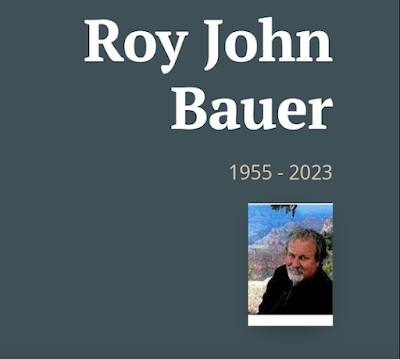
Roy's obituary in LA Times and Register: "we were lucky to have you while we did"

  This ran in the Sunday December 24, 2023 edition of the Los Angeles Times and the Orange County Register : July 14, 1955 - November 20, 2...