Thursday, March 6, 2014

The "College of the Future" (formerly "ATEP")


     This just in. We have it on good authority that district decision-makers have decided to rename ATEP (i.e., the Advanced Technology and Education Park) the “College of the Future,” and that they are close to settling the question of which of SOCCCD’s remaining campuses shall have its name changed to the “College of the Past.” (Surely that will be Saddleback.) The remaining college, of course, will be given the moniker the “College of the Present”—or just “The College.”

     I'm not making this up. (Not all of it, anyway.) [UPDATE: See College of the Future - Planning Assumptions - a district slide presentation dated July 2013]

There's a great big beautiful tomorrow,
Shining at the end of every day.
There's a great big beautiful tomorrow,
And tomorrow is just a dream away.
Man has a dream and that's the start.
He follows his dream in mind and heart
And when it becomes a reality,
It's a dream come true for you and me.
So there's a great big beautiful tomorrow,
Shining at the end of every day.
There's a great big beautiful tomorrow,
Just a dream away. 
                  —Carousel of Progress

Disneyland's Monsanto "home of the future"

The business model

Chomsky: How America's Great University System Is Getting Destroyed (AlterNet)
     …So when Alan Greenspan was testifying before Congress in 1997 on the marvels of the economy he was running, he said straight out that one of the bases for its economic success was imposing what he called “greater worker insecurity.” If workers are more insecure, that’s very “healthy” for the society, because if workers are insecure they won’t ask for wages, they won’t go on strike, they won’t call for benefits; they’ll serve the masters gladly and passively. And that’s optimal for corporations’ economic health. At the time, everyone regarded Greenspan’s comment as very reasonable, judging by the lack of reaction and the great acclaim he enjoyed....
     That’s one aspect, but there are other aspects which are also quite familiar from private industry, namely a large increase in layers of administration and bureaucracy. If you have to control people, you have to have an administrative force that does it. So in US industry even more than elsewhere, there’s layer after layer of management—a kind of economic waste, but useful for control and domination. And the same is true in universities. In the past 30 or 40 years, there’s been a very sharp increase in the proportion of administrators to faculty and students; faculty and students levels have stayed fairly level relative to one another, but the proportion of administrators have gone way up. There’s a very good book on it by a well-known sociologist, Benjamin Ginsberg, called The Fall of the Faculty: The Rise of the All-Administrative University and Why It Matters (Oxford University Press, 2011), which describes in detail the business style of massive administration and levels of administration—and of course, very highly-paid administrators. This includes professional administrators like deans, for example, who used to be faculty members who took off for a couple of years to serve in an administrative capacity and then go back to the faculty; now they’re mostly professionals, who then have to hire sub-deans, and secretaries, and so on and so forth, a whole proliferation of structure that goes along with administrators. All of that is another aspect of the business model….

Wednesday, March 5, 2014

A fine eucalyptus moment


     It’s been a beautiful day. Somehow, I had a great, if abbreviated, ethics class this afternoon. Left early to make my doctor’s appointment at 1:45. Made that on time, and it went well. I left somehow elated, my state made better still by the music I was playing in the car, as Saddleback loomed before me, growing ever closer.
     Rolling towards those hills, I had a fleeting, but fine, “eucalyptus” moment: a brief memory of some childhood scene, smelling and hearing and feeling the stands of eucalyptus trees along Santiago Boulevard, aware of the golden hills (circa 1963) around Villa Park with a child’s eyes, lovely music playing in my head. It somehow combined with thoughts of young Teddy, whose name came up in my conversation with Boerlin.
     “How are things going with your cat, Teddy?” he asked. He smiled, thinking of the oddness, but cleverness, of that question, but I flat answered it: “Well, he’s turned out to be a great cat. He’s maybe the sweetest cat I’ve ever known, and I’ve known a shitload of cats.”
     Boerlin liked that; plus he liked something (he said) I said once about the difficulty of approaching the increasing wackitude of certain declining progenitorial individuals with a balance between respect and humoring. I think Boerlin was playing me a bit, cuz he was fixin’ to charge me for two meetings ($300!), owing to my having missed my appointment last week. My chief complaint, of course, qua patient, was an increase in my own wackitude in the form of worse, though not debilitating, memory lapses—such as the odd lapse that allowed me to lose track of the little card informing me of my meeting with Dr. B last week. So I emphasized that symptom, hoping it would for once inspire B, that tightwad, to charge me for one meeting, not two. But no.


     But, yes, my fine eucalyptus moment did somehow combine with a Teddy moment—they are similar moments these days, so high is my esteem for the rotund little fellow. I explained to Boerlin that Young Teddy is covered in some magic sauce when it comes to women, cuz there’s no woman who has passed through Teddy’s orbit who hasn’t become a devoted satellite. “My mom visits the guy nearly every day; my friend Kathie comes around every other week just to see him; even my goddam cleaning lady is playing with him right now instead of working!” All true.
     When I finally got home, I found Beverly working, more or less, but it was obvious that she had spent some time playing with the Boy, too. And just before she headed out, Teddy came between us and started rolling around on his back on the floor—a clear indication that he was very comfortable being around that lunatic Beverly. I don’t mind. I’m glad she and Teddy are pals.
     But I’m getting ahead of myself. Beverly came later.
     “I try not to hold it against him,” I told Boerlin, bringing my account of Teddy nearly to a close. But I did add that Teddy is mighty sweet, a kind of miraculous being, impossible not to adore. “I am fortunate,” I said, “catwise.”
     I stopped by Ma and Pa’s—Annie was there—since I hate to arrive at my place while Beverly is working (or playing or drinking or showering). Pa was “working” on taxes over at the sunroom table (an absurdly neurotic spectacle). Ma and Annie, however, were blathering sweet & sour nothings about their upcoming trip (with Pa, that hater of travel, that great pretender) to Vegas to see Villy Nelson. I took the opportunity to get Annie on the laptop to snatch up three tickets (on my card), the best ones available (if I were to leave the matter to my folks, they'd get cheap seats up in the rafters), but that ran into a snag, ‘cuz we had to print out the tickets ourselves (or else), but—I was told—“the printer is out of ink.” Oh. Naturally, Pa overheard this and wandered over, muttering something about printers and ink. “Please forget about it,” I told him. “Just forget about it; we’ve got it covered.” But no. He muttered something about how, no, there’s plenty of ink, and then he wandered in the direction of his office, where, of course, the printer (and the fax machine) are located.
     “Good grief,” I said, as he turned the corner.

The Boy
     Predictably, he later wandered back in, with two boxes under his arms. They were ink cartridges for the fax/copier. "Voila," said his body language. Naturally, Ma and Annie took turns explaining to him that we weren’t talking about the fax machine but the printer. Pa just stared into space as the information, a foreign army, slowly crawled up his pants legs, moving generally toward his brain, at a snail’s pace—probably so slowly that they would soon start marching, like ants, in the other direction and then off to another neighborhood entirely. It was like watching paint dry on a humid day. (It is an odd journey to be on, to see this sort of thing happening to one's parents, irregularly but surely.)
     That was it for me; I announced that I would be back in a half hour with the ink. I walked past ‘em all, including my still bewildered dad, and climbed into my trusty Chrysler 300, storming away like I do.
     Naturally, the Office Depot (or Staples?) that I always go to up on Portola was empty: out of business. Sheesh. So I headed back on Portola toward Rancho Santa Margarita. I got stuck in the right lane and, as I crossed Glenn Ranch Road, the lane started to disappear (it was traffic time); but, in a flash, I spotted an opportunity to merge to the left, but it wasn’t really an opportunity—I mean, no sane person would regard it as an opportunity. It was an opportunity only to death-wishing race car drivers and me. Off I went, evidently stomping on the gas (I don’t recall that, but I do remember smoke), and perfectly slipping into the just-barely space at the left, utterly pissing off the guy behind me in a PT Cruiser. Immediately, I acted as though everything were perfectly normal, and it was, aside from the pissed off guy, who seemed to be on his cell phone. Well, whatever.
     I finally got to the Staples in RSM and found the two ink cartridges (colored and B&W)—the pair cost something over $110, if you can believe that. Well, again, whatever. So I headed toward Trabuco Creek, encountering, naturally, some fool in a tiny car called a Kia Shit (I think that was the name), tooting and putting incredibly slowly through the hairpin turns (there’s a couple of those just before the creek) and the straightaways too. “No, no, no,” I told myself, a reminder that I had already tested fate with that recent lunatic PT Cruiser maneuver, which will come back to haunt me yet. Luckily, the fool in the Kia Shit turned off the road before crazy things happened, leaving me behind a fairly cool Mazda 3, traveling at a stately and respectable speed. I played it cool, again enjoying the weather and music, which triggered a series of near Eucalyptoid moments. It was Desmond Dekker’s “Fu Manchu” (1968), which is way spooky:
It make no sense at all to say where you used to work

It make no sense at all to say how much you used to earn

It make no sense at all to say what you used to do


This is the face of Fu Manchu... 


     —What does it mean? I dunno, but it sure is cool and somehow it was perfectly suited to the moment. So there I was, groovin’ to a cool 60s spooky reggae vibe about, I dunno, things people say that make no sense and the general spookiness and beauty of the cosmos when you're driving through the golden hills and mighty oaks and the air that feels good.
     I dropped off the ink cartridges—it was a pit stop—and then headed up to my place to see Beverly off and say hello to the Boy. That went well, and off she went, and the Boy was a miracle yet again, being his wonderful self and climbing all over me for reassurances. I gave 'em.
     After a bit, a bird somehow got caught inside the house, and, natch, the Boy was totally wired, feeling somehow that THIS WAS IT, WHAT EVERY CAT LIVES FOR, but probably having no idea quite what to do. But I liked this bird and wasn’t about to let it get eaten or ripped by Teddy, despite the latter’s (otherwisular) miraculous perfection and goodness. So I opened all the doors and attempted to encourage Mr. Bird to head outdoors, but you know how it is. Birds aren’t good at taking directions or hints. But I liked how I could keep the doors totally open and not worry about Teddy, cuz the Boy was seriously focused on that bird and there was no way he was gonna wonder off into the hills. Not now.
     Eventually, Mr. Bird found his way out the front door—Boo Boo (aka Teddy) managed not to see that, so, boy was he disappointed and perturbed when the whole crazy bird episode seemed to come to a stop for reasons (to him) unknown. But he dealt with it OK, and, pretty soon, there we were, sitting together on the couch on a kinda hot but beautiful evening while, probably, Annie and Ma got those Villy tickets printed (but who knows) and, near as I could tell, all was well in our little canyon.
     A good day, I think.

Tuesday, March 4, 2014

Folks at Saddleback College hope that their new stadium—likely to cost more than $10 million—will be impressive. It's, like, #15 on the new 5 Year Construction Plan. (Above: my graphic "interpretation." Heehee.)

Saturday, March 1, 2014

Former trustee Wagner

Assemblyman Confuses Reagan’s Actual Record Against Stated Policies: a recent liberal blog post about Don Wagner’s curious appreciation of Saint Ronald.
     Evidently, Dandy Don has had occasion to hang with the likes of Halle Berry (from his Facebook page).
     (Just a reminder: Don got an "A" from the NRA. I think that means he's either packing heat or he routinely brandishes a gun during debates with "liberal busybodies.")

Friday, February 28, 2014

Report from Idaho: Guns on Campus


In today's New York Times, Boise State professor of biology and criminal justice Greg Hampikian pens a letter to the Idaho State Legislature about pending legislation which would permit guns on the the state's college and university campuses.  The bill faces likely approval.
When May I Shoot a Student?

TO the chief counsel of the Idaho State Legislature:
In light of the bill permitting guns on our state’s college and university campuses, which is likely to be approved by the state House of Representatives in the coming days, I have a matter of practical concern that I hope you can help with: When may I shoot a student?

I am a biology professor, not a lawyer, and I had never considered bringing a gun to work until now. But since many of my students are likely to be armed, I thought it would be a good idea to even the playing field.

I have had encounters with disgruntled students over the years, some of whom seemed quite upset, but I always assumed that when they reached into their backpacks they were going for a pencil. Since I carry a pen to lecture, I did not feel outgunned; and because there are no working sharpeners in the lecture hall, the most they could get off is a single point. But now that we’ll all be packing heat, I would like legal instruction in the rules of classroom engagement.

At present, the harshest penalty available here at Boise State is expulsion, used only for the most heinous crimes, like cheating on Scantron exams. But now that lethal force is an option, I need to know which infractions may be treated as de facto capital crimes.

I assume that if a student shoots first, I am allowed to empty my clip; but given the velocity of firearms, and my aging reflexes, I’d like to be proactive. For example, if I am working out a long equation on the board and several students try to correct me using their laser sights, am I allowed to fire a warning shot?

If two armed students are arguing over who should be served next at the coffee bar and I sense escalating hostility, should I aim for the legs and remind them of the campus Shared-Values Statement (which reads, in part, “Boise State strives to provide a culture of civility and success where all feel safe and free from discrimination, harassment, threats or intimidation”)?

While our city police chief has expressed grave concerns about allowing guns on campus, I would point out that he already has one. I’m glad that you were not intimidated by him, and did not allow him to speak at the public hearing on the bill (though I really enjoyed the 40 minutes you gave to the National Rifle Association spokesman).

Knee-jerk reactions from law enforcement officials and university presidents are best set aside. Ignore, for example, the lame argument that some drunken frat boys will fire their weapons in violation of best practices. This view is based on stereotypical depictions of drunken frat boys, a group whose dignity no one seems willing to defend....
To read the rest - and you should - click here. 

Thursday, February 27, 2014

Is Wendy Gabriella’s loutish and callow opponent, Jesse Petrilla, up sh*t creek?

10 shots at vehicles. "I
was just a...dumb kid."
     A month ago, one of the local Patch publications reported that 73rd Assembly candidate Jesse Petrilla, a Republican, had once been convicted of a felony involving a gun. Oddly, the OC Register has been quiet about the whole thing.
     Until today:

Does a criminal conviction matter in an election? (OC Reg) Rancho Santa Margarita Councilman Jesse Petrilla was convicted of assault with a firearm when he was 17.

     Republican Assembly candidate Jesse Petrilla, who is running to replace Diane Harkey in the 73rd District in November, said voters should not judge him based on his conviction as a minor on two felony counts of assault with a firearm.
     In 2001, authorities accused Petrilla of shooting a 22-caliber rifle at a group of people who had gathered for a fight. Although he was 17 years old at the time, Petrilla was charged as an adult because of seriousness of the accusations.
     “I regret the incident,” Petrilla, 30, now a Rancho Santa Margarita councilman, said. “There were a lot of things that I could have done to get out of it before it escalated to that point, but I was just a young, dumb kid.”
. . .
     Petrilla fired as many as 10 shots before people fled and contacted authorities, according to the news report. The shots didn’t hit anyone, but struck vehicles. One person heard a bullet whiz overhead, according to the report.
. . .
Other Repub: Bryson favors
teachers and other employees
bringing guns to school
     Petrilla was charged with 12 felony counts, including assault with a firearm, shooting at an occupied vehicle, dissuading a witness from testifying and discharge of a firearm with gross negligence, according to a criminal complaint. He also was charged with a misdemeanor count of drawing and exhibiting a firearm and another misdemeanor count of exhibiting a deadly weapon.
     Prosecutors offered a plea deal to drop all but two felony counts of assault with a firearm, which Petrilla accepted on Aug. 10, 2001, according to court documents.
     Petrilla pleaded no contest to the two felony counts and admitted to a gun use enhancement allegation. He was sentenced to 240 days in jail and five years of probation.
     Petrilla had spent 159 days in custody to that point. He was credited with time served and released.
. . .
     The court ended his probation after three years. Petrilla emphasized that his felony conviction was later reduced to misdemeanors and his record was expunged in 2006.
. . .
     Fredric D. Woocher, an election law attorney at Strumwasser & Woocher LLP in Los Angeles, said no laws compel Petrilla to disclose to voters his conviction in city or state elections.
     The expungement allows Petrilla to answer on many job applications that he hasn’t been convicted. However, it doesn’t relieve him of the obligation to disclose the conviction “in response to any direct question contained in any questionnaire or application for public offices,” according to his court order.
     In Rancho Santa Margarita City Council elections, candidates are asked if they are qualified to hold office, but not if they have a conviction, City Clerk Molly McLaughlin said.
. . .
     Thad Kousser, associate professor of political science at UC San Diego, said Petrilla’s conviction clouds his candidacy for the Assembly race but doesn’t doom it, especially because the conviction happened when he was a juvenile.
. . .
     But two things could hurt Petrilla, Kousser said.
     First, voters received news of the conviction from a source other than Petrilla – a local online-only news site published an article about the conviction in January. That, Kousser said, could raise questions about Petrilla’s honesty.
     Second, the information came out before the June 3 primary rather than between the primary and the November general election. For the primary, Republican voters who are considering voting for Petrilla can change their mind and choose from other Republican candidates.
     If the information had come out after the primary and Petrilla were to win it, there’s a chance he would face a Democratic candidate in the general election, and Republican voters might decide they would have no choice but to vote for him, Kousser said.
     The other Republican candidates in the Assembly race are Capistrano Unified School District trustee Anna Bryson, Dana Point Councilman Bill Brough and former Laguna Niguel Mayor Paul Glaab. Wendy Gabriella, a constitutional lawyer and anthropology professor at Irvine Valley College, is the only Democrat in the race….

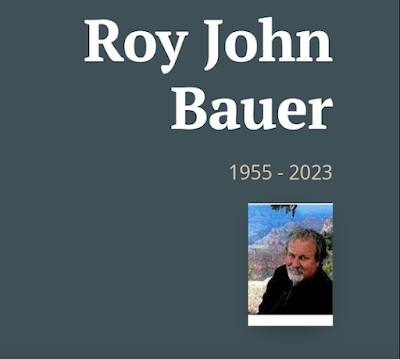
Roy's obituary in LA Times and Register: "we were lucky to have you while we did"

  This ran in the Sunday December 24, 2023 edition of the Los Angeles Times and the Orange County Register : July 14, 1955 - November 20, 2...