Monday, September 23, 2013

Read it and weep: "Where the money goes..." (Red Emma)


Or rage.

Red Emma read aloud most of Thomas Frank's Academy Fight Song to Rebel Girl over the weekend, just in case you wonder what their home life is like.  It's like that.

In it, Frank recounts the sad tale of the corporatization of higher education and its effects on students and faculty.  It can be found in the new issue of The Baffler.

Check out Rebel Girl's favorite section "Where the money goes":
Above all, what the masters of academia spend the loot on is themselves. In saying this, I am not referring merely to the increasing number of university presidents who take home annual “compensation” north of a million dollars. That is a waste, of course, an outrageous bit of money-burning borrowed from Wall Street in an age when we ought to be doing the opposite of borrowing from Wall Street. But what has really fueled the student’s ever-growing indebtedness, as anyone with a connection to academia can tell you, is the insane proliferation of university administrators.

Political scientist Benjamin Ginsberg tells the sorry tale in his 2011 book, The Fall of the Faculty. Back in the day, Ginsberg tells us, American universities were governed by professors, who would take time out from their academic careers to manage the institution’s business affairs. Today, however, the business side of the university has been captured by a class of professionals who have nothing to do with the pedagogical enterprise itself.
Administrators: Their salaries are generous, their ranks expand year after year, and their work requires no peer review and not even much effort. As Ginsberg reminds us, most of them don’t teach courses, they don’t squabble like English professors at the MLA, and no one ever suggests replacing them with adjuncts or temps. As tuition balloons, it is administrators who prosper. In fact, their fortunes are an almost exact reverse image of the tuition-indebtedness of the young.
According to Ginsberg, “administrators and staffers actually outnumber full-time faculty members” nowadays, even though it’s the faculty members who do the real work of education that we believe is so goddamned important. The numbers are startling. While the ranks of full-time professors have grown at about the rate of university enrollment generally since 1975—which is to say, about 50 percent—administrations have expanded at an amazing pace. Administrators proper are up 85 percent, Ginsberg reports, while the number of “other professionals” employed by universities has grown 240 percent. Their share of university budgets has grown by similar margins.
Naturally, an ugly new class conflict has begun to play out amidst the leafy groves. Administrators, it seems, have understood that the fortunes of their cohort are directly opposed to those of the faculty. One group’s well-being comes at the expense of the other, and vice versa. And so, according to Ginsberg, the administrators work constantly to expand their own numbers, to replace professors with adjuncts, to subject professors to petty humiliations, to interfere in faculty hiring, to distill the professors’ expertise down to something that can be measured by a standardized test.
It is not until you read Ginsberg’s description of the day-to-day activities of administrators that the light bulb goes on, however. The particular pedagogy that motivates this class of university creatures is . . . management theory. They talk endlessly about “process management” and “excellence.” They set up “culture teams.” They attend retreats where they play team-building games. And whole divisions of them are dedicated to writing “strategic plans” for their universities, which take years to finish and are forgotten immediately upon completion.
Political scientist Benjamin Ginsberg tells the sorry tale in his 2011 book, The Fall of the Faculty. Back in the day, Ginsberg tells us, American universities were governed by professors, who would take time out from their academic careers to manage the institution’s business affairs. Today, however, the business side of the university has been captured by a class of professionals who have nothing to do with the pedagogical enterprise itself....
To read the rest - and you should! Aloud! To each other! - click here.


REMINDER: board meeting tonight, at 5:30. The agenda is a large pdf. Check it out.

Sunday, September 22, 2013

Bugsy back in his element


     Got to the hospital this afternoon to pick up young Bugsy, whose numbers seem better or at least stable. The vet tech explained that the Bugster has been really “feisty” since the morning, meowing and even playing in his cage. When he was finally brought out to us, he was feisty all right—so much so that he pulled off the bandage over his IV wound. He started bleeding all over the place. But it was no biggie.
     As soon as Annie put the boy in my old jacket and against her chest, he went from feisty to calm and sleepy. It was amazing. He seemed to fall into a coma. On the road, we started to worry about the guy, tried to get him to open his eyes. He did a little, but opened them wide when we finally pulled off Live Oak to Lambrose Canyon, where the road gets bumpy and slow. He knew he was back home.
     When we let him inside my folks' home, he immediately owned the place. He stretched and checked out his old toys. My mom was ecstatic. “He’s so happy!” she kept saying. And he was. He soon made his rounds, rubbing his little tail on everybody’s legs, going from room to room, exploring the closet, inspecting his food bowl. He sure is an independent little guy.
     The boy was back in his element, and it was good. We all rejoiced quietly. We were very happy, at least for the moment.

BOT meeting: tomorrow and five years ago

     The September meeting of the SOCCCD BOT is tomorrow night (at 5:30). You can find the agenda here (a large pdf).
     For a little perspective on the here and now, you might want to view this brief video about the board meeting that occurred exactly five years ago:


BEFORE THE FALL*: Watch Fuentes beam about Mathur's efforts at providing "ethics training" for other districts.
Watch John Williams recall his football days at SC.
Watch Don Wagner genuinely praise the faculty (et al.) he worked with on the Accreditation Report.

*The massive falling out (between Wagner and Fuentes) caused by Wagner's sudden determination, incited by yet another obscene Mathurian connivery, to fire Mathur's ass.

Street, Bryson, Wagner, Fuentes, Williams--four years ago


     A typical scene, really, in OC politics: GOP candidates (and hopefuls) promoting GOP candidates (and hopefuls).
     As you can see, Anna Bryson, now running for 73rd Assembly District (against Wendy Gabriella, among others), was fraudster Chriss Street’s right-hand woman. But why is she here, with Street, at this board meeting? She doesn't actually say anything beyond her name and office.
     TV exposure. Bryson sought higher office (she was already an elected CAPO trustee and she remains so). And Street/Wagner/Fuentes were happy to oblige.
     Also on hand: John Williams, who soon went down in flames as among the most incompetent and sleazy elected officials in county history.

     Speaking of corruption and sleaze, check out this old chestnut from the OC Register, July 19, 2010:

     Chriss Street's travel bill: $60,000
     As trustee of a bankrupt company, Chriss Street got in trouble for using his client's money for his own self interests, including expensive dinners and resort hotels.
     As Orange County's treasurer-tax collector, Street and his top managers have spent more than $60,000 during the last two years attending conferences in such far-flung places as New York, Las Vegas and Washington D.C. -- with stays at the Waldorf Astoria and Venetian hotels.
. . .
     … Street was stripped of his investment duties by county supervisors in March. The action followed a U.S. bankruptcy court ruling that he wasted millions of his client's money in his former job as a bankruptcy trustee.
     Barred from investing, Street and his staff continue to travel and spend, with about six months left on his term as treasurer-tax collector.
     Expense documents reviewed by the Orange County Register show that Street and his human resources chief went to San Francisco for a "business process management" class in June at a cost of $11,462. Street's executive aide Anna Bryson is scheduled to go to South Carolina for a treasurer's conference later this month.
. . .
     [Street] Routinely made last minute flight arrangements and changes that boosted the cost of travel. In April 2008, Street and Bryson made so many changes that it pushed the cost of airfare for a San Francisco trip from $1,620 to $2,300….

Saturday, September 21, 2013

Bugs

     Bugsy’s still in the hospital. Visited the little guy yesterday, and he seemed really to want to get out of there. He had been given a whole blood transfusion, but still things weren’t turning around much. So the vet said he should stay, since his numbers were still pretty low (for red, white blood counts, platelets, and whatnot). Now (Saturday) they tell me he's a bit better but to call back by 3:00. Sheesh. I’m thinking of just goin’ down there and just grabbing him. Poor little guy!
     P.S.: Just got back from visiting Bugsy, who'll need yet another blood transfusion. He seemed pretty agitated--seemed desperately to seek a way out of the hospital--but I got him to calm down and sleep. The guys who brought him in the room and took him back seemed very nice. There's that. Let's hope the latest blood will help him rebound.

Amanda Ripley "The Smartest Kids in the World"

I encountered Ripley on Matt Miller's radio show and was very impressed.
I suspect that her book will be important and much discussed.
See New York Times review.

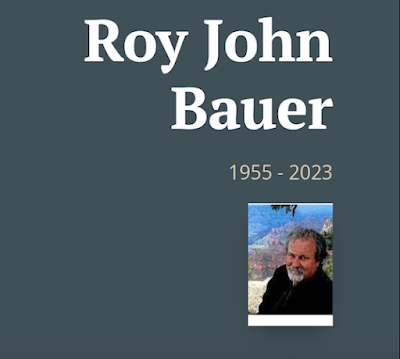
Roy's obituary in LA Times and Register: "we were lucky to have you while we did"

  This ran in the Sunday December 24, 2023 edition of the Los Angeles Times and the Orange County Register : July 14, 1955 - November 20, 2...