Saturday, September 15, 2012

Thursday, September 13, 2012
Busy Doing Nothing
This ditty was featured in "A Connecticut Yankee in King Arthur's Court" (1949) and Rebel Girl presents it here per the special request from a longtime IVC denizen. No word about which sector of the college inspired this request. You'll have to figure it out yourself.
Enjoy!
Yes, that's Der Bingle.
*
Enjoy!
Yes, that's Der Bingle.
*
Wednesday, September 12, 2012
Rebel Girl's Poetry Corner: "what world is this that makes our lives sufficient even as the horizon’s rope is about to snap"

Khaled Mattawa 's book, Amorisco, features a long poem, “East of Carthage: An Idyll.” Mattawa was born in Libya and has spent much of his adult life living in the United States.
Here's the opening.
EAST OF CARTHAGE: AN IDYLL
1.
Look here, Marcus Aurelius, we’ve come to see
your temple, deluded the guards, crawled through a hole
in the fence. Why your descendent, my guide and friend
has opted for secrecy, I don’t know. But I do know
what to call the Africans, passport-less, yellow-eyed
who will ride the boat before me for Naples, they hope.
Here the sea curls its granite lip at them and flings a winter
storm like a cough, or the seadog drops them at Hannibal’s
shores, where they’ll stand stupefied like his elephants.
What dimension of time will they cross as the Hours loop
tight plastic ropes round their ankles and wrists?
What siren song will the trucks shipping them back
to Ouagadougou drone into their ears? I look at them
loitering, waiting for the second act of their darkness
to fall. I look at the sky shake her dicey fists.
One can be thankful, I suppose, for not being one of them,
and wrap the fabric of that thought around oneself
to keep the cold wind at bay. But what world is this
that makes our lives sufficient even as the horizon’s rope
is about to snap, while the sea and sky ache to become
a moment to peel itself like skin off fruit, and let us in
on its sweetness as we wait, smoking or fondling provisions,
listening to the engine’s invocational purr. In an hour
that will dawn and dusk at once, one that will stretch
into days strung like beads on the horizon’s throat,
they will ride their tormented ship as the dog star
begins to float on the water, so bright and still,
you’d want to scoop it out in the palm of your hand.
*
( This poem - and this poet - was brought to Rebel Girl's attention by Forest Gander in his essay post, "Libya: Don't Look Away." Photo of Medusa Head by Forrest Gander.)
*
Tuesday, September 11, 2012
I have a dream (and faculty have a union)
 |
| "We're an organization, and we have tasks to perform!" said the rabbit |
Gosh, I woke up this morning from a terrible dream, and you know how that is: you’re in a twilight zone as your brain stumbles from sleep to wakefulness; it's like a trip in one of those Star Trek transporters, which means that, for all that you know, the old you is obliterated and a new you comes into being, oblivious that he’s just then started to exist, a fraud, a copy, with fake memories and a fake ID.
So maybe I’ve got nothing to do with this dream, but, anyway, in that dream I seem to remember going yesterday to a meeting of the AARP, which somehow was the faculty union, and it was just horrible, man. It was in some awful room at IVC where, on the wall, there’s a map of the world, but China and Indochina are obliterated by a handout. What’s that about?
I sat there, feeling unwelcome, like people with harry eyeballs kept expecting me to say something obnoxious, but I had no intention of saying anything, and, in any case, I remained silent and just sat there, marveling at the decrepitude and lunacy around me. Everybody seemed old or sick or demented. I wanted to get out of there, but I was frozen.
“We’ve got a new office!” screamed geezer #17, and then a group of oldsters suddenly ran to the white board and tried to pin up a poster of James B. Utt, but every time they got it up there for a second or two, it just fell down again, and the pins flew across the room causing everybody to duck and run, but in the manner of elderly folk.
Then somebody who was lying on the ground, sleeping, suddenly got up and started reciting a nursery rhyme followed by the numbers 30, 32, and 38. It was some kind of geezer mantra I guess, and it caused some of the old farts and lunatics to get mad and start tearing up chairs. “These are chairs,” they declared. “And they’re worth more than you think!”
OK. That was weird. But then some gal said we could rescue the whole situation if we just get everybody to give a quarter of their senses. But that didn’t make sense to me since we’ve got five senses, not four, but I’m pretty sure that everyone was agreeable nonetheless, and that worried me plenty, cuz I started to think that I was that quarter or that sense. You know dreams.
 |
| RG in England, years ago |
“Get your clingy car stickers!” shouted the lady from kindergarten. "Talk to your friends!" Don’t know what that was about. She drove a Honda, I think, but how would I know?
Somebody handed the guy with the head a sack of nickels, and he eagerly grabbed it, as he carped bitterly about his predecessor, a “political consultant” that “we paid for” through those cool automatic deductions that some people think are downright un-American.
It was all very Alice in Wonderland, complete with Mad Hatters and white weasels and a greasy fat guy sitting high above us on a wall, smiling and cracking and seeming to know something important.
Somebody scrawled “Meldau” on the whiteboard, and, just then, that Utt poster popped one of its two pins and started swinging across the room straight at me like some giant tractor blade. That’s when the Wizened Ones sauntered into the room, saying little but smiling at the fat guy up on that wall. “We’re here,” they said, and they started to cry. They invited Fat Boy to “come on down” and receive valuable cash prizes in the amount of just over $5,000—evidently, a gift from the AARP. But there were some oldsters there who were totally against the idea somehow, but, despite that, the appearance of the Wizened Ones and the Fat Boy caused the “Meldau” on the whiteboard to fade and disappear. Evidently, that was some kind of disaster, and some people started to moan.
That’s when a rollercoaster suddenly roared through the room, first threatening to kill the organization’s new Prez, who was oddly silent for a moment, but then it veered violently to the right into that greasy fat, stupid, and corrupt guy, who was clutching his $5K. He dropped and farted but hung onto his cash, still smiling. The Wizened Ones then commenced carping about their latest round of plastic surgery and the inconvenience of keeping tabs on their many investments. “Fuck Brown,” they chanted. “Long live the Tio Fountain.”
Sheesh. I’m getting too old for dreams.
 |
| A joker is not a devil, but a demagogue is a jackass |
“Well, we can make a motion that we’ll just sit here and wait,” said the blond robot with the glasses, but the guy sitting to my right said flatly, “You don’t need a motion to do nothing, stupid.” I looked over at ‘im with admiration, but then he, too, disappeared, leaving only a smirk and a late grade submission form.
“Breast implants!” screamed somebody, probably a woman. “We now get breast implants!” Everybody seemed to agree that that was a good thing. Guess so. “Didn’t we get those before?” I asked. “No!” screamed the crowd of oldsters in unison. “It’s your union at work,” they insisted.
Next, the Prez stood up and said that the “evaluation forms are written,” and that we’d all have to use them to get evaluated by our students. On the other hand, said geezer #5, after students take 'em, nobody gets to look at ‘em, and they’re just gonna be thrown into the trash along with collegial consultation and single-semester sabbaticals. That seemed to please everybody except the guy who wanted MySite evals.
Well, that’s about when I woke up, unless you buy into the "five second hypothesis," which, as you know, has never been disproved and that may well be true.
Rebel Girl's Poetry Corner: "Alabanza. In Praise of Local 100"
Alabanza: In Praise of Local 100 | ||
| by Martin Espada | ||
for the 43 members of Hotel Employees and Restaurant Employees Local 100, working at the Windows on the World restaurant, who lost their lives in the attack on the World Trade Center Alabanza. Praise the cook with the shaven head and a tattoo on his shoulder that said Oye, a blue-eyed Puerto Rican with people from Fajardo, the harbor of pirates centuries ago. Praise the lighthouse in Fajardo, candle glimmering white to worship the dark saint of the sea. Alabanza. Praise the cook's yellow Pirates cap worn in the name of Roberto Clemente, his plane that flamed into the ocean loaded with cans for Nicaragua, for all the mouths chewing the ash of earthquakes. Alabanza. Praise the kitchen radio, dial clicked even before the dial on the oven, so that music and Spanish rose before bread. Praise the bread. Alabanza. Praise Manhattan from a hundred and seven flights up, like Atlantis glimpsed through the windows of an ancient aquarium. Praise the great windows where immigrants from the kitchen could squint and almost see their world, hear the chant of nations: Ecuador, México, Republica Dominicana, Haiti, Yemen, Ghana, Bangladesh. Alabanza. Praise the kitchen in the morning, where the gas burned blue on every stove and exhaust fans fired their diminutive propellers, hands cracked eggs with quick thumbs or sliced open cartons to build an altar of cans. Alabanza. Praise the busboy's music, the chime-chime of his dishes and silverware in the tub. Alabanza. Praise the dish-dog, the dishwasher who worked that morning because another dishwasher could not stop coughing, or because he needed overtime to pile the sacks of rice and beans for a family floating away on some Caribbean island plagued by frogs. Alabanza. Praise the waitress who heard the radio in the kitchen and sang to herself about a man gone. Alabanza. After the thunder wilder than thunder, after the booming ice storm of glass from the great windows, after the radio stopped singing like a tree full of terrified frogs, after night burst the dam of day and flooded the kitchen, for a time the stoves glowed in darkness like the lighthouse in Fajardo, like a cook's soul. Soul I say, even if the dead cannot tell us about the bristles of God's beard because God has no face, soul I say, to name the smoke-beings flung in constellations across the night sky of this city and cities to come. Alabanza I say, even if God has no face. Alabanza. When the war began, from Manhattan to Kabul two constellations of smoke rose and drifted to each other, mingling in icy air, and one said with an Afghan tongue: Teach me to dance. We have no music here. And the other said with a Spanish tongue: I will teach you. Music is all we have. * (Here is Espada reading two poems. "Alabanza" begin at 1:38.) | ||
Friday, September 7, 2012
Narrow classrooms and existential/disappearing art galleries
 |
| The B112 Art Gallery that is no more |
SOME BACKGROUND. Recently, the Mold Monster was found lurking under that shitty temporary building that houses the bookstore in the parking lot. Apparently, if you find a Mold Monster under your building, you’ve just gotta move out and there’s no two ways about it.
The discovery, occurring I guess right at the start of the Fall semester, inspired administration to kick a bunch of ESL courses out of their B100 rooms (they were relocated to those shitty old CEC temps) to give the bookstore a safe new home. Moving the bookstore into B100 was already in the Master Plan, but this alleged emergency moved things up a few years. (Who knows why things really happen at IVC. Nobody ever explains anything.)
THE ART GALLERY AS VULNERABLE. Now, right from the start, some of our readers have grumpily speculated that the Art Gallery (B112), which has long been located just to the right of the B100 entrance, would also be a casualty of this latest and dubious round of facilities musical chairs. In fact, I was told by somebody who ought to know that, yep, the Art Gallery would be affected by this Mold Monster thing; it would be moved to
So, like I said, I headed over to B100 to visit the Art Gallery. I passed by that snazzy rusty humanoid sculpture out in the grass just outside the building and then headed straight to the room.
Something didn’t seem right. I couldn’t tell what. I grabbed the door handle and, to my surprise, the door opened.

She’s right. You’d walk in there and there’d be a little gal sitting at the corner desk, alone, in vaguely bizarre echoey silence. There’d be some stuff on the walls I guess.
Soon, you’d wanna escape to the sun and grass outside.
So, anyway, I opened the door and, to my surprise, I cast my eyes upon, not an Existential Art Gallery, but a classroom. Huh?
That’s right. There is no Art Gallery in B112. I’m sure it was there, but it ain’t there now. The room that once housed the gallery is now a classroom, and a weird one, cuz it’s seriously narrow. I kept thinking, how would you teach in here? You’d stand at one end, and the kids at the other end would yell, “we can’t hear you down here.” So you’d walk down to the other end, and then the other kids would yell, “we can’t hear you down here.” So you’d walk back. And so on.
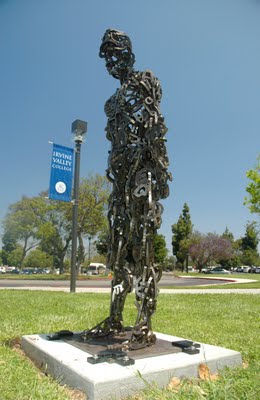 |
| Rust Man guarding the Art Gallery that Is Not |
Once in the hallway, I ran into a colleague who used to teach her ESL classes in rooms B101 or 102. She didn’t say so, but she obviously wasn’t too happy about the move. (Later, I spoke with RG, and she told me that some of these CEC boxes didn’t even have chairs in ‘em! I think the chairs arrived, like, yesterday.)
She showed me what’s become of the first three rooms (on the left) as you enter B100. The doors to those rooms were locked, but we could see through the little door windows. The walls are gone, and now there’s just this huge empty room, awaiting shelving and cheap pens and textbooks.
This big space is perfect for the bookstore, I guess.
“Wow,” I said. "It's big."
“I showed up to teach my class here, and they said I couldn’t go in,” she said. She looked right at me.
I took her outside to show her the room that used to be the Art Gallery. She slowly walked inside and muttered, “How would you teach in here?”
“I dunno,” I said.
Taking aim at the technical (vogue) term “rubric”

You should never use jargon for a general audience without first explaining it.Lately, I've been carping about the ubiquitous (in academia) word "rubric." It's cringeworthy.
—OWL
Here's a slightly more developed version of my carpage:

I consulted the Oxford English Dictionary, which famously provides the history of words used in the English language.
Evidently, in English, the word “rubric” was first used, circa 1400, to refer to a “direction in a liturgical book as to how a church service should be conducted…” (OED). Traditionally, these directions were written in red (the word seems to have derived from a French or Middle French word for ocher/ochre).
That initial meaning quickly gave rise to a prominent new meaning of “rubric” as a “heading” of a section of any book—again, written in red. One hundred and fifty or so years later, the noun “rubric” referred to the heading of a statute in a legal code (the color dimension drops out). By the early 19th Century, the word was used to refer to a “descriptive heading; a designation, a category” (OED).
Let’s call this the “heading/category” sense of the word “rubric.”
Also knocking around in recent centuries is/was a meaning of “rubric” such that it refers to an “established custom” or prescription—this strikes me as diverging significantly from the original textual meaning.
Let’s call this the “rule/prescription” meaning.
Also, “rubric” was used to refer to a “calendar of saints” or the names on such a calendar, written in red.
Evidently, by the mid-20th Century, academics (only in England?) used the term as an “explanatory or prescriptive note introducing an examination paper” (OED). This appears to be a very specialized meaning. Interestingly, it seems to derive from “rubric’s” initial meaning as a “direction,” though the color and religious dimensions are absent.
Meanwhile, back in the colonies:
My Mac’s dictionary* defines “rubric” as a “heading on a document,” but it also cites the original meaning (see above) and two more meanings: a “statement of purpose” and a “category.”
Merriam-Webster's account of the word starts with the word’s initial meaning: “an authoritative rule; especially: a rule for conduct of a liturgical service….” But it also lists “the title of a statute,” a “category,” a “heading,” an “established rule,” and finally “a guide listing specific criteria for grading or scoring academic papers, projects, or tests.” More on the latter meaning momentarily.
 |
| Want rubrics? I'll give yah rubrics |
* * *
Nowadays, some academics insist on using the word “rubric” or “rubrics” to refer to assessment tools. They're pretty unapologetic about this peculiar conduct of theirs. No doubt, such use of the word makes them feel special, but it tends to confuse the rest of us, including many academics. It seems clear that this particular usage is new and technical (in some benighted academic circles: education?) and, insofar as it is imposed on a wider (and bewildered) audience, it is classic “jargon,” in the most negative sense of the word. Perhaps the usage derives from the 20th Century usage referred to by the OED: an “explanatory or prescriptive note introducing an examination paper.” But I doubt it. It is a long way from that meaning to the current educationist jargony meaning.Wikipedia has an interesting article about “Rubric (academic)”:
In education terminology, scoring rubric means "a standard of performance for a defined population". The traditional meanings of the word Rubric stem from "a heading on a document (often written in red—from Latin, rubrica), or a direction for conducting church services". …[T]he term has long been used as medical labels for diseases and procedures. The bridge from medicine to education occurred through the construction of "Standardized Developmental Ratings." These were first defined for writing assessment in the mid-1970s and used to train raters for New York State's Regents Exam in Writing by the late 1970s….I briefly investigated the history of this entry. In one of its original iterations, the article stated:
. . .
...Rubric refers to decorative text or instructions in medieval documents that were penned in red ink. In modern education circles, rubrics have recently (and misleadingly) come to refer to an assessment tool. The first usage of the term in this new sense is from the mid 1990s, but scholarly articles from that time do not explain why the term was co-opted….
In education jargon, the venerable word rubric has been misappropriated to mean "an assessment tool for communicating expectations of quality." Rubric actually means "a heading written or printed in red" (see main entry for rubric). We may hope that some other term will soon replace the fad for this misuse of rubric.Well, whatever.
In educationese, rubrics are supposed to support student self-reflection and self-assessment as well as communication between an assessor and those being assessed. In this new sense, a rubric is a set of criteria and standards typically linked to learning objectives. [Good God, my eyes are glazing over.]....
The "technical terms are superior" fallacy:
Over the years, I have often encountered a particular fallacy that is available to those who learn the technical terms of a particular field or discipline. The fallacy is committed when one supposes that one’s technical meaning of word X is somehow the true and correct meaning of that word; accordingly, one supposes that that meaning eclipses (or should eclipse) the word’s ordinary meaning (what philosophers call the meanings of “natural language”).
Utter nonsense. In general, the meanings of words in our language do not require repair or adjustment or replacement. (Admittedly, they do require discerning and informed use.) Technical meanings arise relative to particular disciplines and their particular agendas and issues. Thus, for example, there is a very good reason for the technical term “valid” in logic, just as (no doubt) there is a very good reason for the technical term “mass”** in physics. (I'll stick to logic, which is a discipline within my field.)
Even so, it would be absurd for logicians to advocate (to the broader community) abandoning the ordinary meaning(s) of “valid” in favor of this technical meaning. The most that can be said in favor of the latter meaning is that our language (as English speakers) would be enriched by adding yet another meaning of “valid,” namely, the logician’s technical meaning. But if we seek to continue to speak (and write) well, we need to keep those non-technical meanings in our quiver.
It seems to me that it is exactly those fields that are least secure in their standing (in academia, or among intellectuals) that tend to produce “experts” who insist on imposing their technical meanings on the rest of the population. (SLOs, anyone?)
Education people (or whoever you are): in English, “rubric” means “heading” or “category.” It does not mean “an assessment tool for communicating expectations of quality.”
If you feel that everyone should adopt this particular technical meaning (shoving aside more venerable meanings), you need to make a case.
Good luck with that.
*New Oxford American Dictionary, 2nd Edition
**An argument is valid, in the logician’s technical sense, if, upon viewing the premises as true and the conclusion as false, a contradiction arises. Physics: mass is "the quantity of matter that a body contains, as measured by its acceleration under a given force or by the force exerted on it by a gravitational field." --NOAD
Subscribe to:
Posts (Atom)
Roy's obituary in LA Times and Register: "we were lucky to have you while we did"
This ran in the Sunday December 24, 2023 edition of the Los Angeles Times and the Orange County Register : July 14, 1955 - November 20, 2...

-
 Professor Olga Perez Stable Cox OCC Trumpsters/GOP A professor called Trump’s election an ‘act of terrorism.’ Then she became the vict...
 -
 Recently, I spoke with a veteran who’s been part of the vet community here at IVC for some time. He too has complained about Mr. Ma...
 -
 I don’t know how anyone could learn about the way our colleges are funded and how their budget decisions are made without thinking...