Sunday, August 1, 2010

From the archives

Mammoth Mountain
(Click on photos to enlarge them)


Sunny Girl and her two kittens (Kathie took this one)


North of Morro Rock


Bishop sunset


Felix, cat ("Fat Thing")


Santiago Oaks Park


My good pal Buster, cat


The magnificent Ildy Pie


Sunny Girl again

The elderly, wonderful Ildy

Friday, July 30, 2010

Special SOCCCD board meeting on Wednesday

     I just noticed that there is an announcement of a Special Board Meeting posted on the district website.
     The meeting concerns the districts's Advanced Technology and Education Park (ATEP) in Tustin.
     Below are the "notice" and the first of agenda item:


(Click on the graphics to make them larger.)

Oddly, the last and crucial line of the "background" is an incomplete sentence: "As construction activities come closer it is believed that seeking professional real estate brokerage services with firms with established national higher education experience and contracts...." 


     Presumably, the author meant to say that securing the services of such a company might lead to success after all of these years of failure. Something like that. (It will certainly lead to considerable expense.)
     All is made clear, I suppose, in the remainder of the agenda, including the Chancellor's recommendation: to approve an agreement with CB Richard Ellis, Inc., which claims to be the world leader in its kind of real estate business.
     CBRE has a satellite office in tony Newport Beach that is managed by Mark Prottas.
     I did a quick search, and the guy doesn't appear to be the Grand Wizard of the KKK or anything. I couldn't even link 'im to the Republicans!

“Ask God what your grade is”

LA college district tries to use UC Hastings ruling in its free-speech case (California Watchdog)

     When the U.S. Supreme Court endorsed a UC Hastings College of the Law decision to bar a Christian student group from receiving university funds last month, some free-speech advocates winced, saying the court's opinion would be used by colleges and universities to squelch offensive or unpopular speech.
     It looks like they might be right.
     The Los Angeles Community College District is trying to use the Hastings ruling to bolster its defense in a speech code case, in which a college professor mocked a student who was speaking about his Christian faith in class.
     The Los Angeles case began in fall 2008 when Los Angeles City College student Jonathan Lopez gave an impassioned talk about his Christian beliefs during a Speech 101 class. He spoke about his opposition to gay marriage in the wake of the passage of the controversial Proposition 8, which banned gay marriage in the state.
     According to the complaint, professor John Matteson interrupted Lopez, called him a "fascist bastard" and refused to let him finish his speech. Matteson left an evaluation form on Lopez's backpack that said "Ask God what your grade is."
     Lopez sued, seeking financial damages and a ban on enforcing the sexual harassment code, which prohibited "hostile" and "offensive" remarks in and out of the classroom.
     In a motion to dismiss, college district officials said they did not approve of Matteson's behavior and had put him through a disciplinary process. But Lopez's suit, they said, was a publicity stunt. The Speech 101 class was not a public forum and First Amendment rights could be limited in that setting, they argued.
     In July 2009, U.S. District Judge George H. King granted a preliminary injunction barring the enforcement of the harassment code at the district, the Los Angeles Times reported. The college district appealed....

College in Mississippi Withdraws Penalties Against Student Who Swore (Chronicle of Higher Education)

     A community college in Mississippi has dropped penalties against a student for using a profanity after learning he had received a poor grade on a tardy assignment. The student, Isaac Rosenbloom, said in an interview that Hinds Community College sent a letter on Tuesday stating that he would "not suffer any future consequences" related to the March 29 incident.
     Mr. Rosenbloom and a few other students had remained after a speech class one day to discuss their grades with the instructor, Barbara Pyle. Upon seeing that he had received a score of 74 on the late assignment, Mr. Rosenbloom testified in a recorded disciplinary hearing that he turned to a classmate and said, "This grade is going to [expletive] up my entire GPA." He said the instructor had told him his language was unacceptable and ordered him to detention.
     Hinds does not have detention, but it does punish students who use profanity through a system of fines and demerits, an arrangement that the Foundation for Individual Rights in Education, a free-speech advocacy group known as FIRE, contends is unconstitutional.
     Hinds found Mr. Rosenbloom guilty of "flagrant disrespect" and issued 12 demerits against him. The college also blocked him from finishing the course and placed a record of the incident in his student file, an action that FIRE says caused Mr. Rosenbloom to lose his student aid.
     Mr. Rosenbloom, who works as an emergency medical technician and is pursuing paramedic training at Hinds, appealed the decision twice and lost both times. His lawyers, Robert B. McDuff and Sibyl C. Byrd, persuaded Hinds to reverse its decision, according to a statement by FIRE….

Thursday, July 29, 2010

An "epic battle" at the North Orange County Community College District

     In this morning’s OC Watchdog (OC Reg), Teri Sforza reports on a controversy at the North Orange County Community College District. Check it out:

Irate professors rally to block new administrator

     Essentially, the issue is this: the district determined that it would pursue an eleven-month replacement of Kathy Hodge, Vice Chancellor of Instruction, now that she is retiring. (Hodge was an important player at the SOCCCD in the tumultuous years of the first “board majority,” ten or twelve years ago.)
     The district decided to find someone internal to the organization.
     But faculty, viewing the move as a continuation of a permanent VCI position, opposed this, arguing that the position is unnecessary and expensive:
     “In my twenty years at the District, this position has been used as a parking spot for College Presidents that had been relieved of their duties,” wrote Fullerton College business professor Marcus Wilson in a protest letter. “I understood the contractual obligations that required the District to use the position for Kathy Hodge, but to fill the position now in the middle of a budget crisis is difficult to understand. Last year numerous full time faculty positions were eliminated to balance the budget and an additional $4.6 million was cut from the extended day budget resulting in over 1000 classes being cancelled.
     “Dedicated faculty spoke at every Board meeting to share with you the impact these cuts were having on the students and asked that you would make students your number one priority. This year, Fullerton alone is cutting an additional $1 million of classes to stay within the budget limits. That is over 300 sections of additional classes being cut. What is the District’s priority?…Fullerton has done pretty well for almost one hundred years without a Vice Chancellor of Instruction at the District. I would think that we could go at least a few more.”
     Sforza says that this is an “epic battle” between professors and administrators and that it will continue. Probably so.
     But, for now at least, faculty have prevailed. Recently, NOCCCD Chancellor Ned Doffoney—as President of Saddleback College in the mid-90s, he was a casualty of the ruthless and lawless Frogue/Williams board majority—met with the faculty union president. Then things seemed to change. The hiring process seemed to be put on hold.
     Nevertheless, faculty went ahead with a protest at the district BOT meeting on Tuesday night.
     Doffoney backed down. On Tuesday, he made a statement:
“Due to the sudden resignation of Vice Chancellor Kathleen Hodge, the District advertised the position, Interim Vice Chancellor, Instruction, as an assignment for a period of eleven months. … [The] purpose [of this hire] was not made clear in the announcement or in subsequent communications and that lack of clarity has created uproar in the District. There is significant concern in the District about unjustified expansion of administration. While this was never the intent of the interim announcement in that the position was already filled by Dr. Hodge, this intent has been lost in confused communication for which I accept full responsibility. ¶ … The Board did not authorize, nor did the administration request the hiring of a permanent Vice Chancellor….”
     If I understand him correctly, Doffoney was suggesting that someone was needed to complete work on the “Educational Master Plan,” and the interim VCI was supposed to be that person. In his Tuesday statement, he declared that, in the “charged” atmosphere, hiring an internal candidate for the position was a bad idea. And so he withdrew his request for an interim VC of Instruction.
     Is this the end of the struggle? It’s hard to say.
     No doubt SOCCCD trustee Tom Fuentes and his minions will cite this controversy to support their apparent efforts to prevent the creation of a dean position at Irvine Valley College—a position that had been abolished in the early days of that nasty old Board Majority in the late 90s. (See earlier post, which reviews the case in favor of the position.)
     At Monday's meeting of the SOCCCD board, board president Don Wagner alluded to dark motives on the part of Fuentes and crew. He warned that, if the minority prevails, the district could face serious "legal challenges."
     On Monday, advocates of the new position, which would be housed in the Office of Instruction, made a strong case that the addition of the new administrator is needed because IVC is seriously under-administered and, further, recently, an administrative position has been abolished, its responsibilities having been effectively absorbed by an existing dean (the Dean of Fine Arts).
     My own observations over the years have long inclined me to believe that the "under-administered" assertion is manifestly true. I've made that assertion in DtB, going back many years, even before the current VPI (under whom the proposed dean would serve) was hired.
     (Yet another issue in the minds of some observers at the college is whether IVC administration is, or will be, proceeding with a particular candidate in mind. [Note that such proceeding admits of degrees.] Many of us feel strongly that all search processes ought to be as honest and professional as possible. I completely agree [an understatement!], and I share these concerns to some extent, but it seems to me that that issue is independent of whether IVC administration should be allowed this dean position.)

Wednesday, July 28, 2010

Streaming hostility

     To see “streaming video” of the SOCCCD board’s brief descent—re the proposed IVC dean position—into naked and fabulous hostility (at Monday's board meeting), follow these simple directions:
• Click here.

• Then click on the Video link for the July 26 board meeting.

• The “player” should then come up. If so, you can easily “jump to” item 6.5. Voila!
(Mac users, you might have best results with Firefox. The discussion of 6.5 occurs very late in the meeting.)

What the Bell (scandal) tolls: elected officials make it hard for citizens to know what they're up to

     One great thing about the “Bell” scandal is its tendency to direct our attention to what goes on in the halls of government—especially, small-town government.
     Shit happens, man.
     As somebody who attempts to keep tabs on the doings of the SOCCCD board of trustees—a tiny world, I know, though serious public money is spent in it—I know that groups with power will get away with things if you let ‘em—if, that is, nobody’s paying attention, which is pretty much the way it is with many city councils and school boards and community college boards of trustees.
     Today, in the Voice of OC, Terry Franke (general counsel for Californians Aware) explains that the Bell scandal was likely inevitable, “given the gaps in the Brown Act and the newspaper publishing tradition that once provided small towns with a watchful eye and a voice to be reckoned with.”
     That seems right to me. It’s harder and harder to get newspapers to cover district news—they’re spread too thin, as their reporting staff shrinks closer and closer to nothing. Newspapers sit in one spot; they are institutions. And so they have memories and understand context, relative to their town. Bloggers have a hard time achieving that kind of understanding, and so they’re not as prepared to keep watch. As Franke explains, this kind of reporting “must be done with the community memory and professional savvy almost unique to newspaper-trained journalists with experience watching small-town politics.”
     That's very plausible.
     --Now, the Brown Act, which was designed to lay the workings of government out in the open, to the greatest degree possible. It's about "transparency," as they say.
     I am proud to say that I was the petitioner in two successful Brown Act challenges to our lawless and secretive board of trustees (a dozen years ago). In fact, the district lawyer (his name was "Covert") referred to these lawsuits as Bauer I and Bauer II.
     California’s Brown Act is wonderful—except that many “legislative bodies” ignore it or work with dubious interpretations of its verbiage. That was part of the problem with our district in the late 90s. For instance, they claimed that a total reorganization of the district had been properly agendized—for a closed session—as an employee evaluation!
     So people don't always follow the law. Further, as Franke explains, the Brown Act ain’t perfect. It’s a decent net, but it's got some pesky holes in it. Writes Franke,
California's open meeting law …, even if perfectly complied with, does not make it hard for Bell-like excesses to creep in. ¶ For example, while the city council's approval of salaries … should have been done in an open meeting…, and while such an action should have been listed in clear language on the agenda for the meeting at which it occurred…, the Brown Act requires only that the agenda be posted in a single physical location within the city…. ¶ It does not require Internet posting, and while Bell's web page does display council agendas and minutes, they cover only the current year, and show no such action.

As for the three hyper-compensated [Bell] employees, their performance …is not required by the Brown Act to be reviewed in public, and the law also allows closed sessions for the council to consider the basis for any pay increase. Final action on any raises or benefit increases must take place in open session …, but needs be given public notice only on a single sheet of paper under a thumbtack … on some wall in the city.
. . .
In sum, the long absence of a community newspaper … left Bell … a perfect swamp. The Brown Act, cultivated … by the newspaper industry, virtually assumes that newspaper reporters will be on hand to use it in scrutinizing government behavior. But even reporters require a bit of periodic training to help them decode agendas and read between the lines of official meeting bureaucratese that the Brown Act is just vague enough to permit as barriers to ordinary citizens.
     You might want to examine one of the SOCCCD’s board agendas to see the latter problem. In many ways, it is as though some elements of our board’s agendas were designed to hide, rather than to reveal, what’s about to go down.
     I gave an example of this a day or two prior to Monday’s meeting of the SOCCCD board. I focused on the phenomenon of trustees attending conferences. If trustees seek to attend a conference—with all expenses paid for by the district—they must make a request. Such requests are to be agendized for an open meeting. The majority decides whether to honor these requests.
     On Monday, the board (minus trustee Nancy Padberg) voted to approve someone's “request” (if you can call it that) to attend a conference in Orlando, Florida.
     But, in truth, we don’t really know, though we can reasonably infer, that anyone actually requested attending that conference. And, in any case, we do not know who that trustee was! That’s largely because of the format in which the information was presented on the agenda. The agenda information (called “exhibit A”) sports a heading that implies that it is reporting a past event rather than indicating “requests” to attend an event some time in the future. The puzzling heading is followed by something even more puzzling. We see the phrase: “trustees wishing to attend,” followed by a colon. But we are given no list of trustees. Rather, we are then given the title of a conference (or multiple conferences) and the costs to the district per trustee.
     The last agenda’s “conference request” item listed two conferences and their cost. Also included was a column for “trustees currently registered,” where we found that “none” of the trustees fit that description for either conference.
     Does that mean that no trustees were requesting attending these conferences? Probably not, for, if there were no trustee requests to attend these conferences, then there would be no point in an agenda item. And so we can only guess, I suppose, that a trustee seeks to go to, for instance, that stupid Mickey Mouse conference in Goofyville (Orlando), Florida.
     During Monday’s discussion of this item, Trustee Padberg noted that the Orlando conference was expensive (about two grand) and provided nothing that could not be acquired locally and thus more cheaply. Nevertheless, the item passed, with six yays to Padberg’s solitary nay.
     (Why?)
     Meanwhile, the public has no idea, really, if anyone requested this conference. It certainly has no idea that it was John Williams (I’m guessing)—a fellow notorious for going to fancy hotels in Orlando (and sometimes other far-away locales) for weeks per year at the taxpayers’ expense. (He has family there. He's a county official, and he gets away from the pressures and burdens of scathing Grand Jury reports about his performance there.)
     As I was leaving the board room after Monday’s meeting, I happened to run into a group of administrators exhibiting worry or consternation. It is only because of that curious observation (I didn't talk to them; don't wanna get people in trouble!) that I eventually learned an important fact. The usual trustee signatory of the just completed college accreditation reports had refused to sign them. In fact, judging by the board meeting alone, with regard to the accreditation issue, everything was hunky dory: during the meeting, the reports (one per college) were presented and then “accepted” by the trustees. Unanimously. And that was that.
     But no. Evidently, that was not that. Not at all.
     How is a member of the community to learn this?
     (Well, they could read Dissent the Blog.)
     If I have time, in the coming days, I’ll provide other examples of curious factoids about what goes on in the SOCCCD that are hard to find, even for someone who scours those crazy agendas. (Quickly, another example: the curious fact that chief OC Republican shyster lawyer Phil Greer was paid a quick $25 grand for helping Chancellor Raghu Mathur negotiate his unhappy exit from that office and from the district. If I hadn’t reported that fact, I don’t think that many in the district would know about it. AND IT STINKS. Not that I can get any reporters to report on it!)
     With any luck, this “Bell” hullabaloo will last a while and will raise the profile of small-time government actions and deliberations. And maybe people will start paying attention.
     Probably not.
     Um, anyone out there? Hello?

Midnight memories (from the archives)


When we first arrived in California, Annie and I didn't speak English. But I listened to the radio and heard some great songs. Never forgot them. For me, if the early to mid sixties had a soundtrack, it was this: the Village Stompers' "Washington Square," Kenny Ball's "Midnight in Moscow," Horst Jankowski's "A Walk in the Black Forest," and Mr. Acker Bilk's "Stranger on the Shore"

My dad, somewhere in Canada, c. 1953.

My dad, going to town, c. late 40s (Germany)

My reputedly "wild" Aunt Ruth (second from right), in Germany, c. 1952

Peter the cat, Germany, 1940s.

My dad, southern Germany, c. 1949

Grandpa and Arco, c. 1950 (Boblingen, Germany)

Dad and pal

Dad, early fifties, Canada

Sister Annie, c. 1957

Annie, mom, me, c. 1958, British Columbia

Mom 'n' me, 1958

Still love this stuff


Yes, yes, I know. This is a dopey song. But I still thrill to the instrumental break, which is fairly hot, though by no means Armstrong's best.
Armstrong was touring and kept encountering audience members yelling, "Hello Dolly"! He couldn't understand it. Then somebody reminded him that he recorded this horrible song in the studio a few months earlier. Armstrong couldn't remember doing it. But the song was a huge hit anyway. That was OK by Louis.

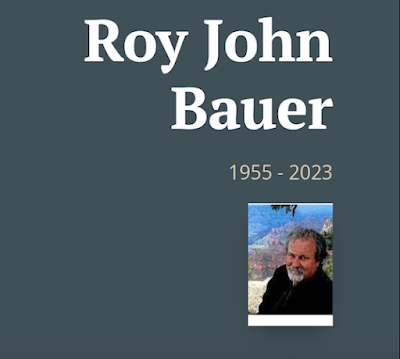
Roy's obituary in LA Times and Register: "we were lucky to have you while we did"

  This ran in the Sunday December 24, 2023 edition of the Los Angeles Times and the Orange County Register : July 14, 1955 - November 20, 2...