Thursday, July 8, 2010

Rebel Girl's Poetry Corner: "in the elegy country"

Early summer took Rebel Girl by surprise, one thing after another and now, today, she heads north, (Polish wedding! Poets! Writers conference! hot springs! hot cha!) back weeks from now on the eve of classes in August. She'll do her best to post poems, the occasional meditation and weigh in when she can on what B. Von Traven has to say.

Here's Howard Nemerov being moody for today.


Blue Suburban


Out in the elegy country, summer evenings,
It used to be always six o'clock, or seven,
Where the fountain of the willow always wept
Over the lawn, where the shadows crept longer
But came no closer, where the talk was brilliant,
The laughter friendly, where they all were young
And taken by the darkness in surprise
That night should come and the small lights go on
In the lonely house down in the elegy country,
Where the bitter things were said and the drunken friends
Steadied themselves away in their courses
For industrious ruin or casual disaster
Under a handful of pale, permanent stars.

*

The fine beasts of '86

     I found a large manilla envelope in the cupboard where my folks keep their "vacation slides." In it were, not slides, but many color negatives--mostly pictures taken by my mother starting in '86, when my dad bought her a Nikon. They'd never been processed into photos or slides.
     There's a lot there. So I started with these pics from 1986 of Sepl the wonderful German Shepherd pup.
     Sepl is quite legendary owing in part to his being my dad's pal and his "construction dog." Those two would go around together everywhere in dad's Toyota truck. Zep would even sit next to my dad when he ran his tractor, a small JD.
     When I found the negatives, I showed one of the strips to my dad, who has long complained of having no pictures of Sepl. He held the strip up to light and said, "These seem to be photos of a little pig."
     Nope. Not a little pig. Sepl the Wonderdog!

Not long after the great and noble Attila died, my dad brought home Sepl (or Zeppie), a truly wonderful little man. 

Mom loves puppies and kittens. She loved her "little boy" Sepl.

Ronnie was away at college back then. He loved to come home to play with little Zeppie.

One day, years earlier, brother Ray brought home a pregnant cat named "Bobbie."
Bobbie had seven or so kittens. Ray gave away one or two of 'em. The rest ended up living with my folks in the Santa Ana Mountains.
This is "Felix" or "Fat Thing" (don't ask). According to my dad, little Fat Thing was the queen of the cats. She pretty much ran things. Slept with my folks.

The lovely and royal Ildy, Attila's "mate," was still with us. Ronnie was very close to "Ildy Pie."
Ildy was pretty much an invalid by then. She tolerated young Zeppie. Barely.

Here's goofy young Zep, testing Ildy's patience.

Zep didn't have a single mean bone in his body.

Here's one of Bobbie's kittens, the aloof and beautiful Greyball. She lived to be twenty-two.

Nobody fooled around with Greyball.

Zeppie and the cats, chowin' down. That's Moon Unit on the left and Toby in front of her.

Fat Girl on patrol.

I do believe that my mom took these pictures with her fancy new Nikon (back in '86).
Mostly, though, mom's into pottery.

Wednesday, July 7, 2010

On that newly assertive loutish and abysmally ignorant political thinking

     Earlier this evening, two readers wrote angry remarks, evidently in reaction to things I have recently written on this blog:
(1) You people think you’re so smart huh? Just wait till Nov. and watch what happens. This social-economic justice thing ain’t going to fly for too much longer. That ought to wipe those lib-turd smirks off all your faces. Most Americans aren’t going to just sit back and allow our country to degenerate into a progressive free-for-all, because that’s not who we are and you know it. I think most Americans have had just about enough of the way this covert-communist administration operates. They sit around all day long thinking up new ways of how to fool and trick us into moving their unpopular agenda forward. Not only has the president failed to lead, he’s been working to destroy our constitution and our god-given protections against the tyranny of a government out of control. And who are you calling a racist? I happen to agree with the tea party. I think you’re a moron, Roy. And yes King George did force health care, in the form of moral orthopedics.

(2) Yeah Roy, if you can't stand it here in the US, why don't you go back to Canada? Even better, French Canada.
     The second comment is merely stupid. The first dips pretty low, too, but it does seem to express real outrage. The writer expresses a view that, I suspect, many others share. But I do think she misunderstands what I’m doing and what (over time) I've argued on this blog. So I’ll respond to her:

     There are different kinds of “fringe” thinkers, politically. Some offer criticisms of the status quo that are so radical (i.e., they attack at the root or foundation) that they have no clear role or power in mainstream politics. Libertarians are sometimes in this group. Anarchists can be in this group. Even communitarians. (I am at bottom a communitarian.)
     Such thinkers typically understand that a reform (or whatever one might call it) that addresses the deep problems or utopian possibilities that most concern them is nowhere on the horizon. (And do not imagine that they meet in secret and plot these changes. They are not idiots.)
     We of DtB are in this group, I believe, though I lean toward communitarianism while Reb and Red lean in a more traditional leftist direction.
     I’ll speak for myself. I was pleased with Obama’s Presidential candidacy, not because he shares my political vision—he doesn’t—but because he seemed (and seems) articulate and intelligent—and he refreshingly approaches at least some issues as decent and informed people approach them (i.e., with sensitivity to the complexities and subtleties and realities involved). I never took Obama to be a radical of my kind or any other kind. Yes, he is smart, knowledgeable, sophisticated, and capable of political brilliance. And he talks about "change." But he is essentially a mainstream pol who holds positions and values continuous with what we’ve already seen and heard in the Democratic politics of the last twenty or thirty years.
     I cannot see any basis whatsoever for viewing Obama as a “radical” or a “socialist” (in any meaningful sense of those words). In some sense, I am a radical. Obama is no radical. I wish he were! (And, in a way, I'm glad he isn't. A radical would be powerless.)
     The notion that he is a radical or socialist is an exaggeration or lie promulgated by some very cynical and ruthless demagogues on the political right (e.g., Dick Armey).
     The “Tea Party” movement appears to be the peculiar product of, (1), the aforementioned demagoguery (which serves the interests of a segment of the GOP) and, (2), the familiar American tradition of (mostly right-wing) "fringe" conspiracy politics, which is difficult or impossible to disentangle from the old American traditions of scape-goating racism and anti-intellectualism. (A classic work in this regard: Hofstadter’s Anti-Intellectualism in American Life, 1964)
     The conspiracy people are and have always been intellectually incompetent. Their theories invariably rely on the cherry-picking of evidence and similar gross fallacies. One can find virtually no academics who endorse their theories or even refer to them. Among the educated, they are irrelevant. (The “theories” of Steve Frogue and his pal Mike Collins Piper exemplify the usual crudity and sophistry of this crowd.)
     It is not surprising, therefore, that the mass of self-described “Tea Partiers” are ignorant of basic historical or general knowledge, and they never hold views that admit of subtlety or recognize complexity. It’s always, “arrest and deport the illegals,” “deregulate,” “no taxes,” “eliminate government services,” and the like. (Re the "tradition" of ignorance among American voters, see The American Voter, 1960. See also What's the Matter with Kansas? How Conservatives Won the Heart of America, 2004.)
     It does not please me to say that, in recent years, a kind of dam of political stupidity has burst: something has allowed many Americans to unashamedly express stunningly ignorant and absurd views that would be ridiculed in a basic Political Science course. I recall saying, at first, “Don’t these people read the paper or watch the news? How is it possible to think and say such ridiculous things!" (Do you recall the interviews of people waiting to attend the McCain or Palin rallies? It was stunning.)
     I now realize that, despite our nation's tradition of promoting and valuing education, many of these Americans are insulated from learning or facts (watching Fox News being one of the salient mechanisms for this odd self-isolation; for some people, going to church is another). These Americans have been allowed to “develop” their political thinking in the absence of challenge or debate; their “thinking” is almost entirely untouched by intellectuals or experts or even educated people. They gravitate to simple, loutish, and (if carried out) disastrous views.
     That is what I see. I might be wrong, but that is what I see.
     I believe that the Tea Party movement is beyond its peak and is headed for oblivion. But the crudity and unsophistication that can allow such a movement to arise, even for a brief time, is still with us. Assertive loutish and abysmally ignorant political thinking is an old and familiar phenomenon in this country; but it is increasingly "normal" and, for many, it is a kind of mainstream thinking. It is now embraced without shame or embarrassment.
     The ignorant rabble, convinced of their purity and virtue, grow. But for now, they remain unfocused.
     Whence this assertive new phenomenon? A very good and hard question.

Feel that one?

     Did you feel that one? A few seconds ago, I seemed to feel something. Then I definitely felt my couch move a bit. That was at 4:54. (I'm up in the Santa Ana Mountains/Orange County.)
     It's 4:56. KTTV is saying it's a 5.9 in the "Palm Spring area."
     4:57: KCBS is saying it's "near Borrego Springs." 5.9. The crew at the station claim to have felt it for "30 seconds." In my case, it lasted maybe five-ten seconds.
     KCBS's website asserts that the quake's epicenter was "13 miles north north-west of Borrego Springs." Further, it "was reported to be 28 miles south of Palm Springs." Hence:


Quake shakes O.C. hard (OC Reg)

Meddling trustees, Kaplan whistle-blowers, and general suckitude

Accreditor Places Peralta District Campuses on Probation (Inside Higher Ed)
The community college commission of the Western Association of Schools and Colleges has placed the four campuses of the Peralta Community College District on probation, citing concerns about the "fiscal solvency and stability" of the two-year institutions, the Contra Costa Times reported. The newspaper said that the letter from the head of WASC's Accrediting Commission for Community and Junior Colleges raised concerns about meddling by trustees and other leadership issues as well as financial problems in citing the four Peralta colleges: Berkeley City College, College of Alameda, Laney College and Merritt College….

Justice Department Weighs In for Whistle-Blowers in Cases Against Kaplan (Chronicle of Higher Education)
The U.S. Department of Justice weighed in Tuesday on the side of several whistle-blowers who have alleged in lawsuits that various colleges owned by Kaplan Higher Education defrauded the government of hundreds of millions of dollars by paying incentives to recruiters and lying to obtain accreditation….

'Brutal Toll' on State Budgets Will Have an Impact on Higher Education (Chronicle of Higher Education)
A new report by the National Conference of State Legislatures is another reminder of how the recession has taken "a brutal toll" on state revenues and of how states have relied on federal stimulus money to prevent major cuts in higher education in the 2009 and 2010 fiscal years. In addition to an overview of state appropriations, the report provides short state-by-state descriptions of legislation and policies that will have an effect on higher-education finance.

'Low-Income Students and the Perpetuation of Inequality' (Inside Higher Ed)
With a lingering recession sending Americans (back) to college in record numbers, and an administration determined to improve the country's record on degree attainment, higher education, more than ever, has plenty of public attention. But a new book argues that higher education in the United States is falling ever more short on a variety of fronts – particularly when it comes to those students who, theoretically, should stand to gain the most from it.

In Low-Income Students and the Perpetuation of Inequality: Higher Education in America (Ashgate), author Gary Berg uses both quantitative data and information gleaned from personal interviews with students and professors to show how students from poor families are shortchanged at every stage of their postsecondary education, from admissions practices that discriminate against them, to the numerous obstacles they face getting through college, to the lesser benefits they reap after graduation. There is a great deal to be done on each of these fronts, Berg argues, if higher education is ever to live up to its promise – to disadvantaged students, and to society at large….

Tuesday, July 6, 2010

1971: Mount Whitney


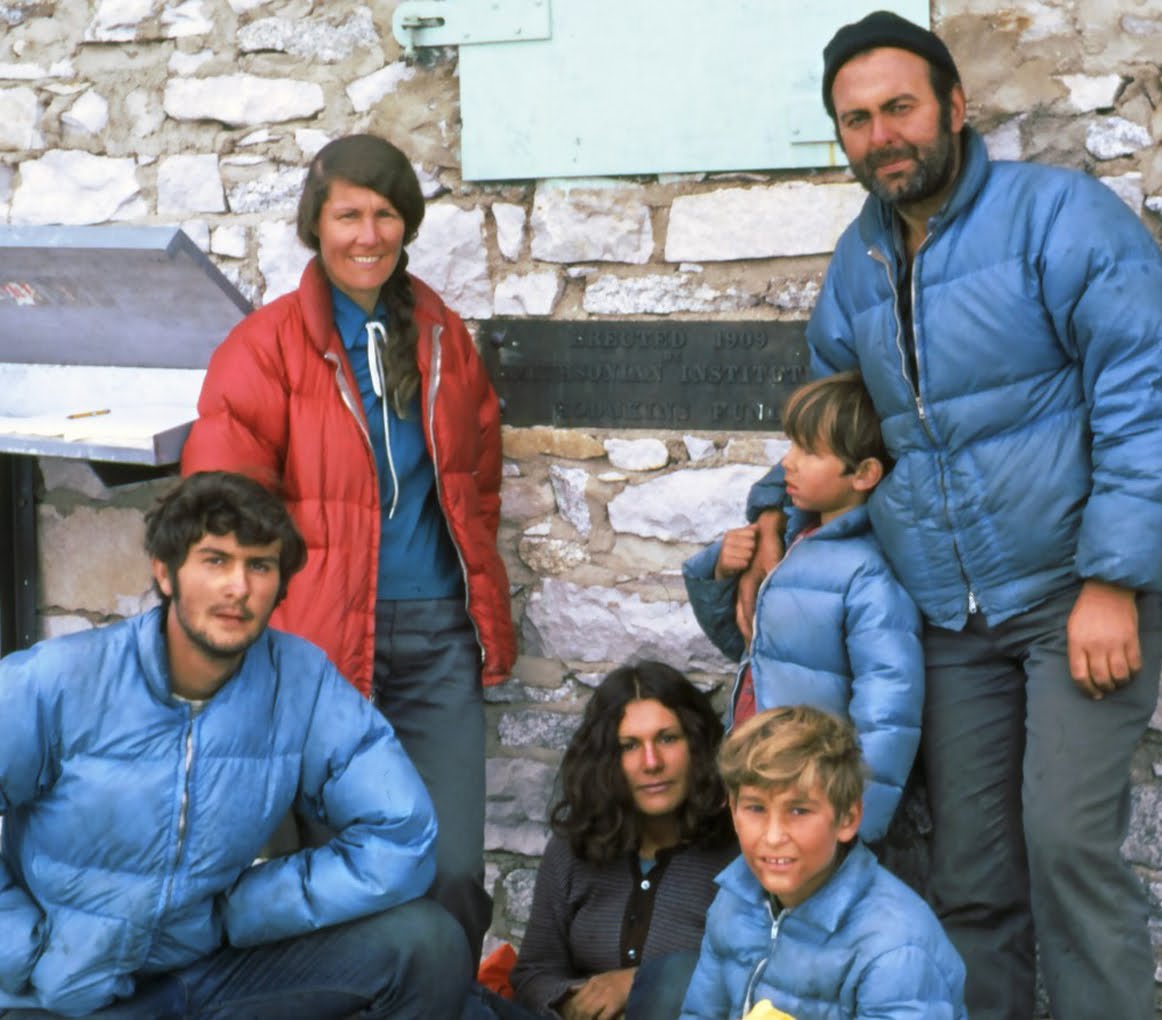
     Our two-week family backpacking trip of the summer of 1971 ended with a climb to the top of Mount Whitney, the highest point in the continental U.S. (14,496 feet; see not below).
     The peak is extraordinary. The top is somewhat flat, but the flatness ends in spectacular sheer cliffs such as the one above. As I recall, there are many places from which one could (if one were inclined to) throw a rock that would land thousands of feet below.
     The trail to the peak starts at a very high pass (well, you've got to hike to that, too) and continues along a "sawtooth ridge." As I recall, the ridge is very narrow, and one encounters sheer cliffs on either side. It's a very unusual and unusually dangerous trail. (Click on the photos to enlarge them.)

         Annie, sitting atop one of the "teeth," I guess, of the sawtooth ridge that leads to the peak.

     Looking west, I think. The weather was mercurial, and sometimes bad, though it could have been worse. At one point, there was a thunder storm. 
     You don't want to be on a high peak during a thunder storm. We got the hell outa there pretty fast.

     The highest point is (or was) marked by this metal plate.

     Not sure about today, but forty years ago, there was a rock structure on the peak, constructed, I believe in 1909. I do believe that it was permitted to exist (most such structures were destroyed by law) as shelter from the typically bad weather on the peak.

     Looking to the east (the Owens Valley)

     Looking down to Guitar Lake, just to the west of the mountain.
     My dad was still using his old Retina camera, which he bought while a teenager in Germany (c. 1948).

     At a camp later on our trip. We look pretty dusty. 

     Shelter from the rain or hail.

     Sun-bathing at some falls along the way.

     Annie takes the plunge. (She met her future husband on this trip.)

     At the beach, down in San Felipe, Mexico, I think

     A contemporary photo of the "Smithsonian hut." Wikipedia explains that, in recent years, the estimated elevation of the mountain has been adjusted to over 14,500 ft.


My dad's Retina camera, purchased c. 1948. He used it exclusively until the mid-1970s. (It has a Schneider-Kreuznach 50 mm lens.)

Dead Man


One of my favorite films. With Johnny Depp and Robert Mitchum (1996)

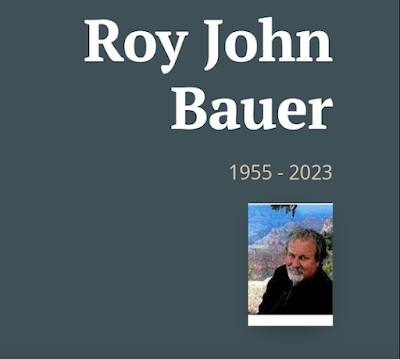
Roy's obituary in LA Times and Register: "we were lucky to have you while we did"

  This ran in the Sunday December 24, 2023 edition of the Los Angeles Times and the Orange County Register : July 14, 1955 - November 20, 2...