Tuesday, June 8, 2010

Back to basics—in praise of classical education w/o technical doohickery and reform folderol

.

Higher education is in a transitional state right now. The big changes that are happening often seem unguided, chaotic, even misguided. Outsiders may see "progress"; insiders—especially the well-educated—see cluelessness and folly.
     Here are three recent pieces related to our benighted transition.

     THREE WISE WOMEN AND A FISH. Stanley Fish’s piece in yesterday’s New York Times (A Classical Education: Back to the Future) discusses three new books about higher education and what it should be. The impressive authors of these books each recommend a classical or traditional education—and seem inclined to dismiss or ignore the new technologies and recent education reform philosophies (stressing endless testing,  maximizing idiotically defined “outcomes,” etc.).


Martha Nussbaum, philosopher, classicist, ethicist and law professor, starts from the same place. She critiques the current emphasis on “science and technology” and the “applied skills suited to profit making” and she argues that the “humanistic aspects of science and social science — the imaginative and creative aspect, and the aspect of rigorous critical thought — are . . . losing ground” as the humanities and the arts “are being cut away” and dismissed as “useless frills” in the context of an overriding imperative “to stay competitive in the global market.” The result, she complains, is that “abilities crucial to the health of any democracy” are being lost, especially the ability to “think critically,” the ability, that is, “to probe, to evaluate evidence, to write papers with well-structured arguments, and to analyze the arguments presented to them in other texts.”
. . .
For Nussbaum, human development means the development of the capacity to transcend the local prejudices of one’s immediate (even national) context and become a responsible citizen of the world. Students should be brought “to see themselves as members of a heterogeneous nation . . . and a still more heterogeneous world, and to understand something of this history of the diverse groups that inhabit it.” Developing intelligent world citizenship is an enormous task that can not even begin to be accomplished without the humanities and arts that “cultivate capacities for play and empathy,” encourage thinking that is “flexible, open and creative” and work against the provincialism that too often leads us to see those who are different as demonized others.
. . .

[Diane Ravitch’s] conclusions, backed up by exhaustive research and an encyclopedic knowledge both of the literature and of situations on the ground, are devastating. The mantra of choice produced a “do your own thing” proliferation of educational schemes, “each with its own curriculum, and methods, each with its own private management, all competing for . . . public dollars” rather than laboring to discover “better ways of educating hard-to-educate students.” The emphasis on testing produced students who could “master test taking methods, but not the subject itself,” with the consequence that the progress claimed on the basis of test scores was an “illusion”: “The scores had gone up, but the students were not better educated.” A faith in markets produced gamesmanship, entrepreneurial maneuvering and outright cheating, very little reflection on “what children should know” and very little thought about the nature of the curriculum. [The third author is Leigh A. Bortins.]

     DEFENDING THE HUMANITIES: ACCOUNTING FOR THE "BIG SHAGGY." Be sure to check out David Brooks’ brief and eccentric defense of the Humanities (History for Dollars) also in yesterday’s New York Times. Excerpt:

But over the centuries, there have been rare and strange people who possessed the skill of taking the upheavals of thought that emanate from The Big Shaggy and representing them in the form of story, music, myth, painting, liturgy, architecture, sculpture, landscape and speech. These men and women developed languages that help us understand these yearnings and also educate and mold them. They left rich veins of emotional knowledge that are the subjects of the humanities.

The Big Shaggy? Well, read Brooks.

     THIS WILL BE YOUR TEXT BOOK; WE ARE THE BORG. See also this peek into one telling difference between traditional “brick and mortar” institutions and the new for-profits: The E-Book Sector (Chronicle of Higher Ed)

…E-textbooks might be the most-talked about and least-used learning tools in traditional higher education. Campus libraries and e-reader manufacturers are betting on electronic learning materials to overtake traditional textbooks in the foreseeable future, but very few students at traditional institutions are currently using e-textbooks, according to recent surveys.

Not so in the world of for-profit online education. Online for-profits such as American Public University System and the University of Phoenix have for years strategically steered students toward e-textbooks in an attempt to shave costs and ensure a more reliable delivery method that, in the context of online education, might seem to make more sense. At Kaplan University's law school, digital texts account for around 80 percent of assigned reading. At Capella University, e-textbooks are an available and accepted option in nearly all 1,250 courses. In for-profit higher education, more than any other sector, the traditional book is becoming obsolete….


     One reason, of course, that the for-profits can manage to embrace e-textbooks is their top-down philosophy and reliance on vulnerable adjuncts. They can simply command that instructors use a particular book, an e-book.
     And that is that.
     Observe our benighted future. Another unpromising, confused unintended experiment.

Rebel Girl's Poetry Corner: John Wooden


That's right: John Wooden.

When he died last week at the age of 99, the legendary coach had just finished an essay for Poetry (the nation's oldest and most prestigious journal dedicated to the form) which will appear in the July/August issue.


excerpt:

At UCLA, where I was head coach of men’s varsity basketball for twenty-seven years, poetry was one of my favorite teaching tools. I have loved poems since I was a child, perhaps because my father, Joshua Hugh Wooden, introduced me to literature at an early age—reading to his four sons at night under a coal oil lamp in our Indiana farmhouse: Tennyson, Whitman, Longfellow, Whittier, James Whitcomb Riley, Shakespeare, and more...

...In 1962, UCLA came within a whisker of winning a national championship. A phantom foul called on Walt Hazzard perhaps kept us from the championship game against Ohio State in which we would have been the favorite. Our team had given it everything they had. And been outscored. I reminded them of George Moriarty’s poem:

Who can ask more of a man
than giving all within his span?
Giving all, it seems to me,
is not so far from victory.

A teacher never knows what stays with those he or she is teaching. You do your best using the tools at your disposal. Poetry was one of my many tools. Thus, even though I understood that Bill Walton, Kareem Abdul-Jabbar, and many others on our teams may have raised their eyebrows at some of my maxims and poetry at the time, things changed as they matured. In fact, when Bill had children of his own, he began writing down some of my maxims on their brown paper lunch bags before they left for school....


To read the rest, click here - or better yet, go out and buy a copy.


John Wooden! In Poetry! Yeah.

*

Monday, June 7, 2010

Update on Paul Wagner’s death

.
     Posted twenty minutes ago: you’ll want to read Erika I. Ritchie’s update, in the OC Reg, on the death of trustee Don Wagner’s son Paul. It's pretty clear that the kid had a heart of gold.
     The reason for his death remains undetermined.

Yard House vegges out; Chipotle goes natural; DtB is influential; Reagan ♥ unions!

     .
     1. VEGAN EARTH DAY. Today, the OC Weekly’s Matt Coker informs us that it’s gonna be “Vegan Earth Day” on the 27th of June in beauteous (and fountain-less) Fountain Valley. Actually, the occasion will be called “Southern California Summer-Fest.”

     2. FAKE IS GOOD. Meanwhile, the OC Reg’s Fast Food Maven today declares that "Fake meat use [is] on the rise in O.C./L.A." Actually, the article is a review of the Irvine-based “Yard House” chain (there's a YH at the Spectrum), which is adding 25 dishes to its menu, using gardein, “a brand of plant-based foods with the taste and texture of premium lean meat.”
     Is their food any good? According to the Maven:

I ordered the Spicy Thai Chicken Pizza … and the Chicken Enchilada Stack …, both with the gardein option. …[I]t did taste just like chicken. ¶ Besides a slight chewiness, I wouldn’t have known that the “meat” of my dishes wasn’t meat at all.

The Maven thinks the prices are high. Yeah, but this stuff is cruelty free (I think). That makes it very, very cool indeed.

     3. DISSENT IS #2: BNN has ranked DtB the 2nd most influential political blog in California. It's hard to believe, I know. (The "Orange Juice" blog is #1. Liberal OC is #3. )Check out the graph below.


     4. CHIPOTLE MOVES CLOSER TO EXCLUSIVE USE OF NATURALLY RAISED BEEF. A local blogger just sent me this press release issued by the Chipotle Mexican Grill chain:

     Chipotle Mexican Grill, the national chain of burrito restaurants, announced today that all of the beef it uses in its barbacoa, a spicy shredded beef, is now naturally raised, bringing its total of naturally raised beef to nearly 23 million pounds, including both steak and barbacoa. The increased supply allows all California Chipotle restaurants to now serve 100% naturally raised barbacoa and steak. The move solidifies Chipotle as the largest restaurant seller of naturally raised meat and underscores its commitment to serving Food with Integrity.
     In all, Chipotle expects to serve more than 75 million pounds of naturally raised meat in 2010, including all of its pork, more than 80% of its chicken, and 85% of its beef. All of its naturally raised meat comes from animals that are raised in a humane way, never given antibiotics or added hormones, and fed a pure vegetarian diet....

     5. REAGAN WASN'T HOSTILE TO UNIONS. Norberto Santana, Jr. of Voice of OC just posted a great little piece about whether Ronald Reagan would be acceptable to contemporary union-bashing Republicans: Who Brought Public Employee Unions To California?
     Plenty of Republican pols daily insist that the Dems (and Jerry Brown in particular) brought public employee unions to California.
     The upshot? They're flat wrong. It was Reagan.

     6. MILLER TIME COMING TO END? Today, Red County’s Chip Hanlon draws attention to a poll indicating that Rep. Gary Miller might be toast: Upset in the Making?. The poll was conducted by Phil Liberatore, Miller’s opponent. So who knows. But sending Sneaky Pete packing would be SO good. Hanlon calls Miller a "turd." Very succinct.

Scholarships established in Paul Wagner's name

.
     The district (SOCCCD) has sent an email message to the district community regarding the untimely death of trustee Don Wagner’s son Paul.
     The message is from the Deputy Chancellor Gary Poertner.
     In his message, Poertner notes that “This is a particularly difficult time for Don, his wife Megan, and daughters Stephanie and Kate. Although Don has been receiving support from family and friends, the thoughts and prayers of all of us in the district community would be appreciated.”
     (Is this suggesting that we should leave the family in peace for now? Thoughts and prayers are good. Feel free to express appropriate sentiments here at DtB.)
     Evidently, Irvine Valley College “has established a scholarship in Paul's name. Donations have already started to come in and are appreciated.”
     VC Poertner later wrote that “Saddleback College had also decided to establish a scholarship in Paul’s name.”
     It seems to me that making a donation to one of these scholarships would be a great way to honor Paul's memory and support the Wagner family. I think I'll do that.

* * * * *
     Unrelated: Also this morning, denizens of Irvine Valley College received this curious email message:

Dear Colleagues,

     On Friday a letter was sent to a number of IVC students regarding possible improper use of a limited number of student credit cards and personal information. We have taken this step to notify students so they can remain watchful and report any suspicious activity or suspected identify theft to the proper law enforcement authorities.
     The Irvine Valley College Police Department in conjunction with the Irvine Police Department are currently conducting an investigation....
Sheesh. What's this about?

* * * * *
BTW: last Friday's big "Broadway" shindig at IVC came off well and was a success. So I've been assured by three people who attended. It is not known yet how much the Foundation netted.

“A horde of illiterate, ignorant cretins” made more cretinous

.
Have Canadian Law Schools Become 'Psychotic Kindergartens'? (Inside Higher Ed)

Canadian bloggers have been buzzing in the last week about a harsh critique of the country's law schools, which are compared to "psychotic kindergartens" in a journal article published by Robert Martin, a retired law professor at the University of Western Ontario. The article was published last year in the journal Interchange, but has only recently been the topic of debate. The article portrays law schools as politically correct and focused on obscure issues. Martin closes his piece by suggesting that Canada's law schools all be shut down and turned over to the homeless as a place to live – thus in Martin's view solving multiple social problems at the same time. The article is available only to subscribers of the journal, and while its focus is law schools, it isn't much more kind to the rest of the country's universities. "Each fall, a horde of illiterate, ignorant cretins enters Canada's universities. A few years later, they all move on, just as illiterate, just as ignorant and rather more cretinous, but now armed with bits of paper, which most of them are probably not able to read, called degrees," he writes. The Canadian legal blog SLAW features a defense of legal education in the country and criticism of Martin's views.

The Kids in the Hall

Accreditation: the ACCJC again in the crosshairs

.
Angst for an Accreditor (Inside Higher Ed)

…The Accrediting Commission for Community and Junior Colleges [ACCJC]…placed 41 (or 37 percent) of the 110 California community colleges on "sanction" from 2003 to 2008. A study of other regional accreditors in the United States shows that, during this same period, the percentage of their community colleges being sanctioned, or warned that their accreditation could be stripped, ranged from 0 to 6 percent….
     The unusually large number of penalties for California's community colleges prompted an array of interest groups from the institutions to form a task force last year to study the accreditor's actions; its recommendations covered a wide swath of issues but can be summed up as urging the commission to focus on institutional "improvement rather than compliance."
     Leaders of the accrediting commission largely rebutted the task force's findings, saying that the agency, in taking a tougher stance on institutional performance, is responding to increased pressure (from the federal government and elsewhere) to hold colleges accountable. … The dispute escalated last month when California's community college chancellor, Jack Scott, writing on behalf of the task force, complained to the U.S. Education Department that the ACCJC was not following its own bylaws in its process for selecting commissioners.
     The issue at the core of the California clash – whether accreditation is designed to stimulate change within a college, or assure accountability to external audiences – is a fundamental one in the increasingly agitated national debates over higher education accreditation. And the dispute is the latest sign of tensions between the government, the agencies and their member institutions.
. . .
     After submitting their written recommendations in October and meeting with a small group of commissioners shortly thereafter, task force members were initially told that they were not allowed to speak before the entire commission at their next meeting in January. When that decision was eventually reversed, Scott was given five minutes to sum up the task force’s findings, after which there was no public discussion.
     Weeks after the meeting, ACCJC officials wrote a detailed critique of the task force’s suggestions and largely considered the matter solved. But, in March, the task force again asked to meet with the commission, this time at its annual retreat. Receiving no response to their request, task force members took offense, and have sought some intervention from the federal government.
. . .
     Currently, the ACCJC levies only “public sanctions,” or three distinct warnings that an institution could lose its accreditation. With each “public sanction,” local news media generally write articles that some community college officials believe unfairly worry students and their parents, who may not know much about the accreditation process.
     By contrast, some regional accrediting bodies send informal letters to troubled institutions letting them know how they can reverse their fortunes before they come up for formal review again, essentially helping many save face while they privately correct potentially worrisome institutional issues.
. . .
     “Administrators are scared of asking questions [about the accreditation process] for fear that, when they’re up for evaluation, there will be some backlash putting their accreditation at risk,” said Ron Norton Reel, president of the Community College Association, a constituent faculty union of the National Education Association, and a task force member. “The spirit that exists right now is one of punishment. We would like that to change to one of accomplishment.”
. . .
     “Accreditation is higher education’s system of self-regulation,” wrote Lurelean B. Gaines and Barbara A. Beno, the accrediting body’s chair and president, respectively. “It is a peer review process and [colleges' accreditation liaison officers], as well as faculty, college administrative leaders and trustees have a professional obligation to read, seek to understand, and apply the standards to their own institutions.”
     Still, they argue that “it often seems to be the case that those individuals and institutions that most misunderstand accreditation are those who don’t take advantage of existing accreditation training activities.”
     Defending the ACCJC’s use of “public sanctions,” Gaines and Beno argue that when the commission made use of informal warnings, they did not carry much weight and were easy to dismiss.
     “The genie is out of the bottle on this issue,” they write. “The [ACCJC] moved to all public sanctions many years ago in response to pressures from the Department of Education. The increasing public, student and government interest in institutional quality has created a climate in which more information about accreditation decisions is demanded.… In this time of increased expectations of transparency, it is not in the best interest of higher education’s system of self-regulation to try to regain privacy or secrecy of accreditor actions on institutions."


. . .
     “The institutions are our members, and we communicate through their presidents and their accreditation liaison officers,” Beno said in an interview. “These third-party analyses are important, but they can’t supplant the view of the individual institutions. Also, I don’t think our response to the task force was dismissive. I thought it was quite sincere. I just think their work could have been done differently.”
     Scott vehemently disagrees with Beno, arguing that he cannot think of a more representative body than the task force and that any suggestions, no matter their source, should be welcome by the commission.
     “Other commissions, including [the Western Association of Schools and Colleges], let people voice themselves at meetings,” Scott said. “I just can’t understand their unwillingness to sit down and talk. They should say, ‘come on in.’ But, to put up a barrier and say that they’re not willing to listen to recommendations that are designed to improve the process, I just don’t understand.”….

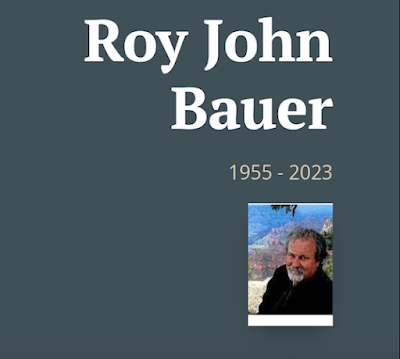
Roy's obituary in LA Times and Register: "we were lucky to have you while we did"

  This ran in the Sunday December 24, 2023 edition of the Los Angeles Times and the Orange County Register : July 14, 1955 - November 20, 2...