Monday, April 27, 2009

April board meeting: Notes, part 1


     I arrived at about 6:05, and the meeting had not yet started. Oddly, Trustees Dave Lang and Marcia Milchiker were sitting in their places over on the left, Trustee Bill Jay was in his chair way over to the right, and Chancellor Raghu Mathur was sitting alone and forlorn, somewhere in the middle. Somehow, the scene was grim, a partial and perverse Last Supper. Usually, the seven trustees emerge from their super secret buffet/lounge all at once, but not last night. After about ten minutes, Trustees Don Wagner, Tom Fuentes, and John Williams emerged very much in lockstep--like Cary Grant and Katherine Hepburn in that restaurant scene in Bringing Up Baby--and took their seats. (I lost track of Trustee Nancy Padberg.)


     The real fun starts about 4 minutes in. More grimness. I really don’t know what it meant. Maybe these people were at each other’s throats during the closed session. Maybe nothin’. Dunno. Our trustees love to do “resolutions,” and there were lots of ‘em last night. A middle-aged lady got a Rez for picking up a bag with $3,000 in it (at Saddleback) and turning it in. It was money raised in some charity. I guess these trustees are the kind who'd take the money and run, so they were stunned that anybody'd return it. They didn't seem to know what to make of her. Well, the woman got all teary-eyed and introduced her kids. Looking at them, she wimpered something like, “This is how I feel about you kids when you do the right thing.” More tears. Wailing. During “public comments,” Karla Westphal offered her usual objections to trustee prayers. She then held up prepared statements from two faculty who could not attend the meeting, and Board Prez Don Wagner said something like, “If they wanna speak, they can show up.” Karla explained that at least one of these instructors teaches on Monday nights. Wagner sniffed and then let her read for a bit, but when she got to the second letter, he just shut her down and sent her packing. Karla stalked off. I think she was steamed. When will Don learn that his petty and hot-headed ways are counter-productive? Never, it seems. Well, let's face it. That he acts like such a punk kid is his charm. Trustee reports were unremarkable. I don’t recall a thing that Bill Jay said. Padberg literally said nothing. Fuentes yammered like he does about his boy Mathur’s leadership on some task force. There was a “breakfast” at IVC on April 17, and lots of Republican pols showed up for that. A food fight broke out, evidently.

     Williams announced that he has discovered that textbooks are expensive. Milchiker reported that she has seen yet another version of “A Funny Thing Happened on the Way to the Forum”—this one at IVC. Didn’t she see this very play at Saddleback last month? Yup. Marcia seems to live in Wacky World. It was student Trustee Hannah Lee’s last night, and the board gave her some prizes for being pretty and causing no trouble, I think. Her replacement was in the audience, and she seemed to be the equal of Hannah in perkiness and cuddliness. Maybe she can think and speak, too, but that would appear to be unlikely. During his report, a subdued Chancellor Mathur said some obvious things about our “basic aid” gravy train being under threat. He seemed to be in a state of shock. Dunno why. Evidently, some education bills are likely to fail in the upcoming election, and that will make the budget situation even worse for education. Mathur quoted someone who said that “now is the time to clean up the barn.” Most just stared at him, uncomprehending. John Williams commenced yammering about textbook costs. I do believe he said that “we are moving to a virtual society.” I looked around. Nobody was laughing. Not even me.John has some ideas, he said. Instructors could scrape up stuff from the “public domain” and post that somewhere. Instant textbook. Free. Or, he said, we could get instructors together to write a textbook, which the district would own. Use that. Again, I looked around the room. Nothing. I saw a guy studying lint that he had found in his pocket. Next came a report about “Early College Program/K-12 Outreach.” There were three speakers, and they were brief. That's the way Don Wagner likes it. Marcia heard one of ‘em talking about Tiger Woods, and she was all over that. Somebody used the word “viral,” and Marcia didn’t understand that. She said she thought that “viral” things were “bad,” not “good.” She sported a quizzical expression. Suddenly, Tom Fuentes roared forth, “How about Home Schoolers!?” “From what I've seen,” he said, they are “excellent.” How odd to have a man who hates public education on the board of a community college district. IVC Prez Glenn Roquemore had spoken about some early college classes at local high schools, and that got Fuentes worried. How come these kids aren’t just taking online courses? he asked. Some are, said Glenn, but they’ve gotta get the principal’s permission. Yadda yadda. I stopped listening. Then: “Boundaries!” roared Fuentes. “We’ve got to keep boundaries!” He was referring to poaching done by some districts in other districts’ territories.


     Kumquats! There was a report concerning “opportunity for growth.” If we wanted to, said Gary P, we could grow 15%, but that would mean offering more courses, and it would be costly and deplete our Basic Aid bucks. We don’t receive any money from the state for growth, since, unlike everybody else, we’re on Basic Aid. Gary noted that the board, in its infinite wisdom, has decided not to pursue public bonds. That’s good, he seemed to say, ‘cause, owing to Basic Aid, we actually spend more per student than other districts do. I studied Fuentes’ face for tics or twitches. I studied the horizon for storm clouds. Gary said that the colleges want direction from the board concerning how to deal with this tension between building and maintaining good facilities (on the one hand) and offering more courses (on the other). The trustees started discussing the ongoing threats to our Basic Aid funding, which, up to now, has made us filthy freakin' rich. “Maybe we should circle the wagons,” said Fuentes, chewing on a hayseed. I’m not real sharp on fiscal issues, but I gather that the state might get out its six-shooters and plug our Basic Aid with led. Then they might pull a switcheroo on us and throw our local property tax money on a stagecoach for Sacramento. So our little SOCCCD posse was figuring out ways to thwart these varmints and head 'em off at the pass. I fell into a coma. Then Fuentes started yammering about how, maybe, we could have a summit of OC community college districts, and they could divvy-up online instruction. That is, Coast could do math, NOCCCD could do, say, underwater basket-weaving, and SOCCCD could do, like, writing and chemistry. “There’s no need for duplication,” declared Mr. Fuentes.He was staunch. Lang chimed in largely in agreement with Fuentes’ points about varmints and such. He noted that we’re about to spend shitloads of money on ATEP, and we gotta worry about that. And if we expand courses, what if we hit hard times? Can we sustain the level we’ve expanded to? It was right about then that Bill Jay woke up and started reminiscing about the old days, when, if a student in our area bolted for OCC, we’d have to send money up there for ‘im! I do believe that Nancy Padberg then rolled her eyes as though she were hearing the infernal bleatings of a dying mule. …to be continued.

Carona sunset?

IT COULD BE 5 TO 6 YEARS IN PRISON, $125,000 FINE FOR CARONA

Over at the OC Weekly website, Matt Coker reports that
R. Scott Moxley, reporting from the Santa Ana courthouse during an afternoon break, says the judge and lawyers for the defense and prosecution in Mike Carona's sentencing hearing on a felony corruption count, are talking about 63 to 78 months behind bars and a $125,000 fine for the man once dubbed "America's Sheriff."….

UPDATE:

MAYBE THIS WILL WIPE SMUG LOOK OFF CARONA'S FACE: 5.5 YEARS, $125,000 FINE, THE SHAME OF AN ENTIRE COUNTY
Carona gets 66 months in prison, $125,000 fine

Tonight's board meeting


The closed session commences at 5:00 p.m. and the open session is set to start at 6:00. (At Saddleback College: the Ronald Reagan room.)

The discussion items for tonight are (1) “Saddleback College and IVC and ATEP: Early College Program/K-12 Outreach” and (2) “Effect of Enrollment Growth on Basic Aid Funds.”

Mr. Sprite, Saturday night

The first general action item is “Faculty Association Academic Employee Master Agreement,” aka the faculty contract.

Oddly, given the discussion at last month’s meeting, another item offered for approval is “Award Printing of Class Schedules.”

It seems likely that, in the end, we will cease mailing out class schedules to all residents, opting to send small, cheap postcard reminders instead. (I’m just guessing, based on the buzz since the last board meeting.)

Pictured: the Tige, last night.

Sunday, April 26, 2009

This grotesque past, this troubled present


Sometimes I wonder whether common sense is worth a damn. My (alleged) common sense tells me to worry some about recent earthquake swarms to the north. See "Perilous fault might be causing quake swarm near O.C."

All this concentrated shakin’ tells me to hunker down. The OC Reg’s Science Dude says there’s no use worrying about earthquakes, though he also says that we'd better prepare for the Big One.

In an odd spasm of, um, common sense, the leadership of some local churches has been preparing for the Big One: "O.C. churches team up."

Yeah, on Friday, the OC Reg reported that “more than 30 people” gathered to learn about preparedness.

30 people. (Closet agnostics, all of ‘em, I bet.)

The Dude ("UCI finds racial bias in Internet dating") also reports on a UCI study about, well racial bias in Internet dating.

The two sociologists that conducted the study are quoted as saying,
“We argue that exclusion related to racialized images of masculinity and femininity, and shapes dating and marriage outcomes, and thus minority groups’ possibilities for full social incorporation.”

Please tell me that that sentence makes no sense. (A missing “is”?)

The missing verb is likely the Dude’s fault. But what about the hideous jargon? “Dating and marriage outcomes”? These outcomes are “shaped” by “exclusion,” I guess.

Bullshit, bullshit, bullshit (as Harry Truman used to say).

On the other hand, the female sociologist is photogenic.

These sociologists’ shitty way of speaking reminds me that I’m still pissed off about Friday’s de facto slam of Strunk and White’s Elements of Style in the New York Times ("Happy Birthday, Strunk and White!").

Happy birthday? More like, “FU.”

The OC Reg’s Rachanee Srisavasdi reports ("Carona") that former OC Sheriff Mike Carona “will be sentenced at 1:30 p.m. Monday by U.S. District Judge Andrew Guilford.”

Evidently, Judge Guilford can give "America's Sheriff" anything from probation to twenty years.

As you know, Carona believes in the Lord bigtime. When not making out with Russian bimbos or passing out deputy badges to morons, he does a lot of public praying and flag-pledging. He’s a typical right-wing OC politician: he’s pious and patriotic and corrupt, like his good pal and supporter SOCCCD trustee (and former OC GOP chair) Tom Fuentes, who, no doubt, will be at tomorrow night’s meeting of the SOCCCD board of trustees, praying and pledging and scheming and cheating. I can’t wait.

Did you read Frank Rich’s column yesterday? (See "The Banality of Bush White House Evil.") Naturally, it's about torture, and it responds to new info about the Bushies' motives for their disastrous and dismal embrace of it.

It ends with:
Five years after the Abu Ghraib revelations, we must acknowledge that our government methodically authorized torture and lied about it. But we also must contemplate the possibility that it did so not just out of a sincere, if criminally misguided, desire to “protect” us but also to promote an unnecessary and catastrophic war. Instead of saving us from “another 9/11,” torture was a tool in the campaign to falsify and exploit 9/11 so that fearful Americans would be bamboozled into a mission that had nothing to do with Al Qaeda. The lying about Iraq remains the original sin from which flows much of the Bush White House’s illegality.

[Senate Armed Services Committee report chairman Carl] Levin suggests … that as additional fact-finding plays out, it’s time for the Justice Department to enlist a panel of two or three apolitical outsiders, perhaps retired federal judges, “to review the mass of material” we already have. The fundamental truth is there, as it long has been. The panel can recommend a legal path that will insure accountability for this wholesale betrayal of American values.

President Obama can talk all he wants about not looking back, but this grotesque past is bigger than even he is. It won’t vanish into a memory hole any more than Andersonville, World War II internment camps or My Lai. The White House, Congress and politicians of both parties should get out of the way. We don’t need another commission. We don’t need any Capitol Hill witch hunts. What we must have are fair trials that at long last uphold and reclaim our nation’s commitment to the rule of law.

Meanwhile, Nick Kristof, a fellow well to Rich’s right, urges the institution of “an independent commission to investigate harsh treatment and tally its costs and benefits.” ("Time to Come Clean") He offers three reasons:

First, it could help forge a consensus against torture, for almost everyone in the national security world believes that the result would be a ringing affirmation that we should not torture….

Second, a commission could help restore America’s standing by distancing ourselves from past abuses. Alberto Mora, a former general counsel for the Navy, has said that some flag-rank officers believe that Abu Ghraib and Guantánamo constitute “the first and second identifiable causes of U.S. combat deaths in Iraq,” because they galvanized jihadis. An Air Force major and interrogator of prisoners who goes by the pseudonym Matthew Alexander told Harper’s Magazine that “hundreds but more likely thousands of American lives” were lost because of “the policy decision to introduce the torture and abuse of prisoners.”

Third, a commission could help counterterrorism efforts. Foreign governments have been wary of cooperating with us for fear of being tarnished by scandal. At home, Arab-American and Somali-American communities have been leery of reporting tips because they see the authorities as unjust and hostile to Muslims.

I do hope our new President gets out of the way of our doing the right thing!


Saturday, April 25, 2009

Republicans need to explain themselves

It’s odd, isn’t it? We are a people who believe in rights. We say that it is “self-evident” that all men are “endowed by their Creator with certain unalienable Rights".

But something's changed. Republicans, or most of 'em you hear from these days, seem to take the view that some of these rights are alienated in the case of humans who are also alleged terrorists.

Could you Republicans please explain to me how this works, logically? In particular, how does your position on torture square with how we, as a nation, have tended to approach torture in the last century or so?

About five months ago, Evan Wallach, a judge and a former JAG wrote a piece for the Washington Post entitled “Waterboarding Used to Be a Crime." There, he notes that the media usually describe waterboarding as “simulated drowning.” According to Wallach,
That's incorrect. To be effective, waterboarding is usually real drowning that simulates death. That is,

the victim experiences the sensations of drowning: struggle, panic, breath-holding, swallowing, vomiting, taking water into the lungs and, eventually, the same feeling of not being able to breathe that one experiences after being punched in the gut. The main difference is that the drowning process is halted. According to those who have studied waterboarding's effects, it can cause severe psychological trauma, such as panic attacks, for years.

Wallach notes that the U.S. convicted several Japanese soldiers for using this technique on prisoners of war. Evidently, it was called the “water cure”:
After Japan surrendered, the United States organized and participated in the International Military Tribunal for the Far East, generally called the Tokyo War Crimes Trials. Leading members of Japan's military and government elite were charged, among their many other crimes, with torturing Allied military personnel and civilians. The principal proof upon which their torture convictions were based was conduct that we would now call waterboarding.

As a result of such accounts, a number of Japanese prison-camp officers and guards were convicted of torture that clearly violated the laws of war. They were not the only defendants convicted in such cases. As far back as the U.S. occupation of the Philippines after the 1898 Spanish-American War, U.S. soldiers were court-martialed for using the "water cure" to question Filipino guerrillas.

Wallach describes more recent judicial events in the U.S., including a civil action
brought by several Filipinos seeking damages against the estate of former Philippine president Ferdinand Marcos. The plaintiffs claimed they had been subjected to torture, including water torture. The court awarded $766 million in damages, noting in its findings that "the plaintiffs experienced human rights violations including, but not limited to . . . the water cure, where a cloth was placed over the detainee's mouth and nose, and water producing a drowning sensation."

Then there’s this case:
In 1983, federal prosecutors charged a Texas sheriff and three of his deputies with violating prisoners' civil rights…. The complaint alleged that the officers conspired to "subject prisoners to a suffocating water torture ordeal in order to coerce confessions. This generally included the placement of a towel over the nose and mouth of the prisoner and the pouring of water in the towel until the prisoner began to move, jerk, or otherwise indicate that he was suffocating and/or drowning."

Wallach notes that the “four defendants were convicted, and the sheriff was sentenced to 10 years in prison.”

OK, Mr. and Mrs. Republican. Were we wrong in embracing this series of judgments? Were we wrong to suppose that waterboarding is torture and that it is a violation of human or natural rights? Were we wrong in embracing a regard for persons, all persons, such that there are things that should not be done to them, including torture?

If not, please explain how this all works.

There is a fascinating discussion of torture in the Stanford Encyclopedia of Philosophy: The Moral Justification for Legalised and Institutionalised Torture . It ends with:
So torture warrants are highly undesirable, indeed a threat to liberal democratic institutions. Moreover, torture warrants are unnecessary. As has been argued above, there may well be one-off emergencies in which the use of torture is morally justifiable. In those cases, the relevant public officials must bite the bullet and do what is morally required, e.g. torture the terrorist to save thousands of innocent people. In such an emergency, the military or police officers involved will need to break the law on this one occasion. But in itself this is a small price to pay; and a price the police, the military and the politicians have shown themselves only too willing to pay in situations that are far from emergencies.

One final matter. What should be done to the military officer, police officer, or other public official who tortures the terrorist if — after saving the city — their crime is discovered? Quite clearly he (or she) should resign or be dismissed from their position; public institutions cannot suffer among their ranks those who commit serious crimes. Further, the public official in question must be tried, convicted, and sentenced for committing the crime of torture. Obviously, there are (to say the least) mitigating circumstances, and the sentence should be commuted to, say, one day in prison. Would public officials be prepared to act to save thousands of innocent lives, if they knew they might lose their job and/or suffer some minor punishment? Presumably many would. But if not, is it desirable to set up a legalised torture chamber and put these people in charge of it?

This kind of position will be familiar to philosophers who have long discussed the so-called problem of "dirty hands." It focuses on extraordinary situations in which an indecent act seems in some sense to become morally necessary. To suppose that such events can occur and that, when they occur, persons in authority should do the indecent thing--with appropriate regret--is interesting and plausible.

Is this what Republicans are talking about in the case of torture in our "war on terror"? That would at least make some kind of sense. It could bring coherence where, prima facie, there is none.

But it means that the people who ordered the torture must be convicted and punished. They must accept this as necessary.

Right?

Please explain.

For an enlightening discussion of the (complex and controversial) concept of rights, see the article in the Stanford Encyclopedia of Philosophy.

Friday, April 24, 2009

Shep ain't so bad, I guess


Of all the "personalities" on Fox, the only one I just can't figure out is Shepherd Smith. I dunno. He just seems like a nice guy.

But he's on Fox, and so I don't often watch him.

And now he turns up droppin' the F-bomb while condemning the use of torture! (Click below.)

Hey, maybe he is a good guy after all. Go Shep!


Here's the Huffington Post's story:

Shepard Smith Uncensored: "We Are America, We Do Not F**king Torture!"
Fox News viewers witnessed a rather incredible scene on Wednesday as anchor Shepard Smith and Fox contributor Judith Miller (of CIA leak infamy) repeatedly and passionately condemned torture, with Smith declaring at one point, "We are America, we don't torture! And the moment that is not the case, I want off the train! This government is of, by, and for the people -- that means it's mine. That means -- I'm not saying what is torture, and what is not torture, but I'm saying, whatever it is, you don't do it for me! I want off the train when the government starts -- I want off, next stop, now!"

The full segment is worth a watch. And Smith felt strongly enough about the issue to speak out about it again as he was heading into commercial break.

"They better not do it," he said. "If we are going to be Ronald Reagan's Shining City on the Hill, we don't get to torture. We don't do it." Fade to black.

Professions for Women

That time has arrived in the semester when Rebel Girl commences to meditate upon the most canonical texts in her pedagogical repertory – Dr. Martin Luther King, Thomas Jefferson, Malcolm X and Virginia Woolf. She loves this quartet and has a giggle imagining them applying to teach at the little college in the orange groves.

Students, for the most part, recognize all these figures, though in a kind of cartoony way: Martin "I Have a Dream" King; Thomas "All Men are Created Equal" Jefferson; Malcolm "By Any Means Necessary" X and lately, Virginia "That Crazy Woman Played by Nicole Kidman" Woolf.

As these students work through the texts, Rebel Girl is consistently stunned at their optimism. So much has changed, the students assure her. It's all better now. King's dream has been realized. We are all equal. Malcolm was a movie and a hip-hop message. The angel in the house which so haunted Virginia Woolf has been defeated.

Rebel Girl is not so sure.

She hears things. Voices. Those stories which come to her. Like Woolf, the birds outside Reb's office window chirp in Greek. Reb studied Greek for one summer but found the Aegean and romance more attractive. Still, she can pick out some phrases here and there. The little college birds are urgent. When they speak, she listens, pulls out her dictionary and begins to translate.

What she has learned from her feathered friends prompts her to pose some questions:

Should membership in organizations disqualify one from employment as an instructor in public institutions of higher education?

Should one list those memberships on one's resume when applying for employment as an instructor?

Should the administrators who interview applicants for such a position ask after such affiliations and allow such affiliations to be part of their judgment?

Say, for example, if Virginia Woolf applied for a such a position and listed among her professional affiliations the Women's Service League or, say, the National Organization for Women, should that be reason for the administrators who sit in judgment upon her to disqualify her?


Little birds and students. The ghosts of writers who most likely would never, ever be hired as teachers at the community college in the orange groves.

Imagine the political affiliations of say, a Dr. King or a Thomas Jefferson or a Malcolm X. Those fellas belonged to some pretty radical organizations.

And Virginia Woolf? Well. Wasn't she married to a Jew who helped found the League of Nations? And she herself, a feminist? Can't have one of those. No. Not here.

"Even when the path is nominally open—when there is nothing to prevent a woman from being a doctor, a lawyer, a civil servant—there are many phantoms and obstacles, as I believe, looming in her way," declared Virginia Woolf in 1931 to the members of The Women's Service League.

She was right.

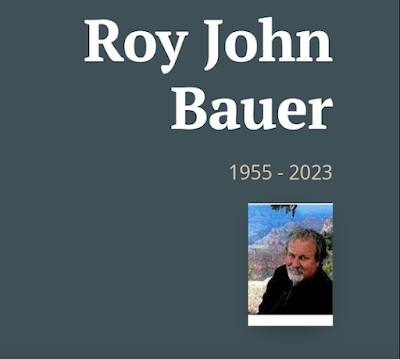
Roy's obituary in LA Times and Register: "we were lucky to have you while we did"

  This ran in the Sunday December 24, 2023 edition of the Los Angeles Times and the Orange County Register : July 14, 1955 - November 20, 2...