Thursday, March 19, 2009

Special board meeting today: the faculty contract

Sheesh.

You’ve gotta be on your toes in this district, boy. A few minutes ago, I happened to check the district website, and whadoo you know? The SOCCCD board of trustees is holding a “special meeting” this afternoon.

The meeting concerns the faculty contract.

They’ll call the meeting to order at 5:00. The public will then have an opportunity to address the board.

After that, the board will recess for a closed session discussion of:
A. Conference with Labor Negotiators (GC Section 54957.6)
1. SOCCCD Faculty Association
a. Agency Designated Negotiator: Dr. Raghu Mathur

They’re set to reconvene to an open session at 5:30 (wow, that’s fast). At that point, they’ll report any actions that will have been taken during the closed session.

The agenda outline is available here. (It's a small pdf file.)

Hey, this could be good. I've got my fingers crossed.


UPDATE:

3/20/09: I (and everyone else no doubt) just received a communication from faculty union Prez Lee Haggerty. It notes an error in a previous communication. Then, at the end, it states: "The contract went to the Board of Trustees on March 19, 2009 and was approved by them...." --That's it. No elaboration.

OK. I can take a hint. I won't elaborate either.

Boiled fish


Something in the March 10 Saddleback College Lariat that I came across, belatedly:

ASG to discontinue invocation at annual [Saddleback College] Scholarship Ceremony

The ASG decision was a reaction to last Spring's Wagnerian fiasco, it seems:

[Student Nick] Nikbakht attended the scholarship ceremony last year, and said that at the table where he was sitting, "a lot of the donors were offended when all of a sudden [they] just started praying without any warning."


Wednesday, March 18, 2009

The Partnership will at long last be exposed

This afternoon, OC Weekly’s Nick Schou posted about the big trial of former Orange Unified School District trustee Steve Rocco (The Great Ketchup Caper Trial).

As you know, Rocco was elected to the OUSD board in 2004 because the people of Orange are as dumb as dirt. Now that he’s gone, well, they’re still as dumb as dirt. Dumber maybe.

Rocco is accused of stealing a bottle of ketchup (or “catsup”) from the Chapman U cafeteria. The condiment has a street value of about $1.20. Rocco tried to make his (alleged) getaway on his bike.

As you know, Steve Rocco is alone in this world in his view that the country is actually run by something called the “Partnership,” a powerful and secretive group that evidently comprises, among others, Kodak Corp., Albertson’s, and Smokecraft Sausage.

Evidently, he stole one of Smokecraft’s wieners back in 1981. Whatever.

Schou reports that Rocco’s defense concerns his belief “that unrefrigerated ketchup is actually ‘garbage.’" Former OC Sheriff (now felon) Mike Carona has been subpoenaed by Rocco for reasons unknown. My guess, he’ll be testifying about wieners.

Rocco is serving as his own attorney. Natch, he has a fool for a client.

Related:

Air Force says it didn’t cause mystery shaking in O.C. (OC Register)

"No," "no," and "no."

OCC PREZ SAYS "NO" TO REMAINING.

Today, OCC’s Coast Report informs us that OCC’s President, Bob Dees, has announced his plan to retire.

Dees, who started at OCC as an instructor, told the Coast Report that he plans to do lots of writing. (A scholar? How refreshing!)

Leadership is definitely in transition at the Coast Community College District. As you know, in January, the district board “ousted” Chancellor Ken Yglesias. As far as I know, the community there is still in the dark concerning the board’s reasons. See Mystery surrounds Yglesias’ leave

(Some speculate that the ousting had something to do with Armando Ruiz, the trustee who lost his reelection bid in November when a Register columnist trained a spotlight on Ruiz’ record of unscrupulousness. But, in fact, we’ve heard nothing about the board’s reasons.)

OCC is another among many colleges that is in dutch with the accreditors. The college will hear from the ACCJC in June—just as Dees exits, stage left.

JUST SAYING "NO" TO IRVINE?

According to Cal State University Fullerton’s Daily Titan, the university's Academic Senate voted 16 to 12 not to support the new location chosen for its recently evicted Irvine campus. (It’s an advisory vote.)

According to the Titan,
The resolution's success is an indication of the growing dissent among vocal faculty members who are in opposition to the Irvine campus' existence, and who believe university administrators have not presented convincing evidence that Irvine has proven to be a success over the years.

The article goes into some detail concerning the fiscal issues that divide faculty regarding this satellite campus.

Naturally, some of our own plans (in the SOCCCD) depend on what CSUF ultimately decides.

See also Chapman University gets a new Irvine campus

TOP EL CAMINO ADMINISTRATOR SAYS "NO" TO RAISE

A couple of days ago, Dailybreeze.com reported (El Camino president says no to raise) that El Camino College President Thomas Fallo removed from the agenda (of the last meeting of the board of trustees) a proposal to “give Fallo a $36,000 pay raise, which with salary and perks would have given the college president an annual income of about $337,000”:

The package specifically called for a 12 percent annual pay hike, a $2,450 monthly stipend and a $550 monthly transportation allowance, which was to be paid retroactive from January.

After the meeting, Fallo explained that the “attention this has gotten has far outweighed the benefits."

Had the raise gone through, Fallo would have been among the highest paid college administrators in the state.

He’d be in Raghu P. Mathur’s league.

Fallo was at the helm when Compton Community College (in a contiguous district) lost its accreditation. The El Camino district came to the rescue, turning Compton into the “Compton Community Education Center.”

Evidently, the Compton center—which continues to be problematic—has taken up much of Fallo’s time and energy. That was cited by at least one trustee as a reason for the raise.

It appears that trustees had promised Fallo a raise to keep him from jumping ship to other college districts (he has been a finalist in two recent chancellor searches; he was persuaded to drop out of at least one of these processes).

Like many community colleges, recently, El Camino has run afoul of accreditors (the ACCJC). In January, that body slapped a “warning” on El Camino.

Community college trends

In this morning’s Inside Higher Ed:

Community College Surge
In economic downturns, community college enrollments go up, as those who lose jobs … seek to add skills or training, and as some students who might otherwise have gone away for college look to save money by living at home while attending classes. As the economic downturn hit hard last year, this trend was immediately evident, with many community colleges reporting a flood of students.

A survey released Tuesday here at a meeting of the League for Innovation in the Community College suggests that the early anecdotal reports of increased enrollment are in fact correct. Further, community colleges are reporting increases in just about every major type of program they offer – with notable increases online….

The director of LICC suggests that, owing to budget issues, community colleges are at risk of weakening their “infrastructure” (counselors, et al.) and putting themselves in a weak position to compete with for-profit schools:

For-profit higher education tends to be quite efficient at responding to students' information requests, processing forms, guiding people through programs and responding to inquiries, [LICC Director Kenneth C.] Green noted. And when for-profit colleges offer good service, he suggested, they set a standard that community colleges may have difficulty meeting – at least if they continue to cut positions outside the classroom.

These days, Green said, students have the view of "if I have one lousy experience with your college, to hell with you, I'll go to [the University of] Phoenix."

Figuring Out Freshmen

A new report suggests that many incoming community college students do not take advantage of valuable student resources simply because they are not aware of them. It argues that two-year institutions need to do a better job of personally assisting new students, especially within the "make or break" time period of their first few weeks.

The latest findings from the Survey of Entering Student Engagement (SENSE) were released today….

Kay McClenney, CCSSE's director and head of the department of educational administration at the University of Texas at Austin, said the survey’s data show the importance of the first weeks of a student’s college career. By analyzing student engagement at this point, she said community college administrators and instructors can make valuable changes to their approaches, applying proven techniques that make a difference in their students' academic outcome.

Most of the surveyed students reported that they “felt welcome” the first time they arrived on campus and that they were able to get the information they needed to register for class. Still, 76 percent of them noted that there was not a “specific person” designated for them to see if they “needed information or assistance.” The report suggests that more colleges should adopt personalized advising programs, matching students with mentors earlier.

Within this same short time frame, the report notes that most students adopt a number of bad habits that continue to plague them throughout their college career. For example, 32 percent of incoming students reported that they “turned in at least one assignment late.” Twenty-five percent said they “failed to turn in one or more assignment,” 47 percent said they “came to class unprepared” and 29 percent said they skipped class.

“Students do these things, and there are often no consequences,” said McClenney, noting that she believes students will respond to stricter guidelines. “Most of the time, nobody notices that they stop coming to class. If there are no consequences for bad behavior, it’ll continue.”….

Tuesday, March 17, 2009

A defeat for local Neanderthals

The OC Weekly's R. Scott Moxley reports that
At 10:05 this morning in the lawsuit brought by Newport Beach Police Sgt. Neil Harvey against his department and the city, the clerk entered and said, "We have a verdict." All of the parties were present, including Police Chief John Klein ... and Harvey. The 27-year veteran claimed he was repeatedly blocked for promotion because of false rumors spread among fellow cops that he is gay.
...
The jury voted unanimously for $1.2 million in damages for Harvey.

SEE ALSO:
Cretin culture in tony Newport Beach
Jury gives $1.2 million to sergeant who sued over gay rumors (OC Reg)
Jury awards Newport officer $1.2 million in discrimination case (LA Times)

KTLA video of people waiting for "Obama" tickets:


Alleged ketchup caper sends eccentric Rocco to court:

Steve Rocco, the cap-wearing, conspiracy-thinking mystery man once elected to the Orange school board, goes to trial Wednesday in a case that involves political intrigue, a shadowy group called the Partnership – or just a bottle of ketchup.

Controversial campus speakers and huge “security fees”
Fossil hunters find sea monster ... and a dinosaur the size of a skinny chicken

Seeming ducks

"I beseech you, in the bowels of Christ, think it possible you may be mistaken!"
—Oliver Cromwell

I teach philosophy. When I tell this to people—even to my learned colleagues at the college—they seem fuzzy about what I do. (Sometimes, when they tell me what they teach, I have the same problem. Kinesiology? What's that?)

So here’s a glimpse into what kind of thing we philosophers do—or at least what this philosopher does.

For one thing, we talk about logic and reasoning a lot. “Logic,” of course, is a field within philosophy and it is, one might say, the language of (Western) philosophy. In my intro courses, especially for the first few weeks, I talk logic, logic, logic. Just ask my students.

And what I teach them about logic applies to everyday events and news stories. Consider:

From yesterday’s New York Times:

Autism is terrifying the community of Somali immigrants in Minneapolis, and some pediatricians and educators have joined parents in raising the alarm. But public health experts say it is hard to tell whether the apparent surge of cases is an actual outbreak, with a cause that can be addressed, or just a statistical fluke.

[Comparison with cancer clusters:] It is “extraordinarily difficult” to separate chance clusters from those in which everyone was exposed to the same carcinogen, said Dr. Michael J. Thun, the American Cancer Society’s vice president for epidemiology.

Somali immigrants seem convinced that their community is experiencing a high rate of autism—even a “surge” in autism.

But (asks the logic-minded philosopher), is that even true? Unlike seeming ducks, seeming surges are often actual non-surges. Epidemiologists are now attempting to resolve the cluster/surge question re immigrant Somali kids. (Results will be available soon.) Anecdotal evidence seems mixed: possibly, there are high rates of autism among the Somali population in at least one other country, but not all cities in the U.S. with significant Somali immigrant populations report “surges” as does Minneapolis.

And what if there really are clusters (unusually high numbers) of autism in some immigrant Somali communities? That doesn’t necessarily mean that there is some environmental cause. As statisticians and epidemiologists like to say: correlation does not imply causation. (Here, “imply” is used in the strict logical sense, meaning, “is a sufficient condition for.”)

On the other hand, if (a big “if”) there really is a correlation, one explanation is that there is some cause afoot.

This puzzle will be particularly difficult since we don’t really know what causes autism in the first place. Some of the popular theories one encounters (vaccinations, etc.) are at best controversial or are simply disproved.

Hey, in my philosophy courses, I talk about this stuff (i.e., cum hoc ergo propter hoc, post hoc ergo propter hoc, etc.) all the time. It’s not all that I do, but it is something that I always do, each semester.

So, no, I don’t just talk about Plato's cave, Descartes' dreams, Berkeley's noisy forest, or Bertrand Russell's noisy love life.

—You know, the stereotypically philosophical things.

Tell us what YOU do (or don’t do) in YOUR courses.

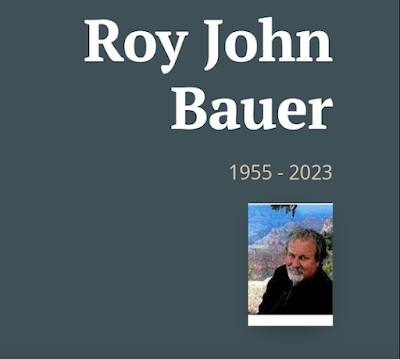
Roy's obituary in LA Times and Register: "we were lucky to have you while we did"

  This ran in the Sunday December 24, 2023 edition of the Los Angeles Times and the Orange County Register : July 14, 1955 - November 20, 2...