Thursday, October 3, 2002

"White paper" concerning the Early College program (at IVC)

[Sorry about the highlighting, which was not included in the original. -R]
To IVC Faculty,
Requested Action:
I ask that the Early College Program be placed on the Academic Senate agenda as an action item.  I would like the Senate to consider the following actions:
1. Creation of an Academic Senate committee to do the following:
a. identify, discuss, and clarify faculty concerns about the EC program. 
b. identify components of the EC program for which decisions should rely primarily on faculty expertise, and components that require both faculty and administrative agreement.
c. interface with the administrative to insure proper design, planning and implementation of the EC program.
2. Authorize the design and completion of an anonymous survey of all faculty who have taught in the Early College program. 
Analysis:
Lest you get the wrong idea from the following discussion, I think the idea of an ‘Early College’ program has some educational merit.  However, I have serious reservations concerning its initiation and implementation.  My concerns group into four general areas. 


Concern #1:  Implementation of the EC curriculum.
I have serious concerns about potential violations of the contract and the academic rights and responsibility of the faculty.  
1. Who makes decisions regarding inclusion of freshman and sophomores?   Faculty used to be able to say yes or no, but this choice seems to have been eliminated somewhere along the way. Our on-campus students can enroll in our classes if they are over eighteen or possess a high school diploma or GED.  So we must admit them and assume they have the skills and maturity to succeed. Not all high school students are guaranteed admission.  So why are the high school administrators, rather than our faculty, choosing who gets into our classes?
2. The decision to include young students seems to be made without proper evaluation of their reading, writing, math and critical thinking skills and with apparent disregard for their emotional maturity.  What evaluations are being made before enrolling students?  And why are appropriate evaluations made by high schools and not IVC? 
3. The scheduling patterns created by administrators without agreement with faculty often forces alteration of course curriculum.  For example, our lab exercises are designed to teach data collection, analysis, and evaluation.  To accomplish these goals, which are part of the course outlines of record, labs are schedules for three hours.  Scheduling labs that are 1.5 or 2 hours, often forces alteration or elimination of critical components of an exercises, disrupts continuity of lab exercises, and defeats the purpose of the lab within the course.  This seems to be a serious academic issue that projects further than a simple scheduling issue.
4. In many instances, discussion/tutor periods have been added to an EC course to compensate for the enrollment of students who cannot do college work.  This represents a change to the curriculum when this additional obligation is dumped on the teaching faculty. 
5. In some instances, alb what is alb? enrollments have been as high as 36 students, a lab size that no sane college would attempt on the college campus.  Who decides the max enrollment and how is it decided?  Isn’t this a curriculum issue and isn’t max course size set by the curriculum?
6. Courses have apparently been offered to area high schools before discussion with faculty.  Who decides which courses are appropriate for younger students who may not have the academic training to succeed? 
7. The college has decided in some instances to hold spaces in our on-campus summer classes for students who do not pass the EC version of the course.  What makes an administrator think that a student who could not pass a semester-length course is capable of passing the same course when offered in a 6-week format?  This issue alone tells me the administrators who are involved in this know next to nothing about how to teach or how student learn. 
8. In many instances, underage children are enrolled in night sections where the instructor has no access to emergency or administrative personnel.   
9. Although administration touts the success of students in this program, it has done nothing to validate the equivalency of the EC versions of courses with the on-campus versions.  In fact, all the anecdotal evidence I have received implies that instructors are badgered into lower standards so these students can succeed. If that is indeed the case, we are teaching high school classes that are not worthy of college credit. 


Concern #2:  What are the steps being taken to evaluate the program? 
What are the short and long term goals of the program?  How are these being evaluated and who does the evaluation?  If we MUST continue with this program then a much better organization of the program needs to occur along with well thought out program SLO’s and rubrics.

Concern #3:  There is an apparent mismatch between academic expectations and academic preparation of the proposed high school student.


This became apparent when our department was asked to teach Bio 1 to the students at Beckman High School.  Approximately 33% of the class was not prepared for the course and needed to drop.  There was considerable pressure given to the IVC instructor by the high school administration to ‘do something’ to prevent these students from dropping the course. (i.e. hand out extra credit).  In spite of this concern, we were directed to offer Biology 1/1L at El Toro High School (and apparently other local high schools) for a student population consisting primarily, if not exclusively, of high school freshman and sophomores.  I enumerate the expectation-preparation mismatches below.


1. Reading skills of the proposed student population do not match the reading level of course materials.  
The most glaring mismatch is between the language skills required by the course and those possessed by the proposed student population.  The Bio 1 course text and exams require a reading level appropriate to college freshman (grade 12-14); and lectures are presented with language appropriate to the same student group.  (I had the reading level of the Biology 1 text and lab manual evaluated several years ago by Jan Horn.)  However, the proposed student population of high school freshman and sophomores in all likelihood does not read at or close to a college level.    Thus, the ‘Early College’ group will have more difficulty reading the text and following lab instructions than our present adult student population.


2.  Critical thinking skills of the proposed student population are not commensurate with course expectations.  
As written and taught, our biology courses require critical thinking skills commensurate with the cognitive abilities of adults.  Success in the lecture component of the course requires the ability to synthesize, analyze and evaluate a large body of evidence to support modern biological theories.  In addition, lab exercises are experimental in nature.  They require collection and analysis of data plus subsequent evaluation of data relative to accepted theory.  Yet there is considerable literature supporting the argument that adolescents do not achieve an adult cognitive skill level until 17-18 years of age.  Thus, our biology courses, if truly college-level, are outside the cognitive abilities of most high school freshman and sophomores, and are border-line accessible for high school juniors. 


3.  The general science background of the proposed student population does not match the course expectations.
Biology is a metascience.  It invokes principles of other sciences, e.g. mathematics, chemistry and physics, to synthesize, analyze, and evaluate biological concepts and theories.  As such, our college-level biology classes assume an appropriate level of high school training in general science.  Even though most of our present adult student population (>18 years of age) has had high school science, they struggle in our Bio1/1L course.   However, the proposed freshman-sophomore student population will attempt this college-level course as a first science course, with essentially no prior training in science.
 
4. Writing skills of the proposed student population are insufficient to meet course expectations. 


The curriculum for Biology 1/1L not only requires college-level writing assignments but the exams must be 25% essay format.  To achieve optimal success, a student taking this course should possess writing skills similar to those of entering college freshman.  About 2/3 of high school students tested at IVC must enroll in WR201.  These data strongly suggest that high school freshman and sophomores are somewhat less skilled at writing than our on-campus student population and therefore at an extreme disadvantage with regard to written assignments and essay portions of exams.

Concern #4:  There seems to be an apparent mismatch between the role of community college courses in higher education and their present use in the ‘Early College’ program. 


Biology courses at IVC are written to satisfy general education requirements at CSU and UC.  As such, they are written to parallel CSU and UC courses with similar content, level of detail, and expectations of student academic performance.  While some faculty view this approach as erudite and pompous, it is in fact an attempt to provide our students with the same education they would receive at any California institute of higher education.  And, it is an honest effort to do what we claim to do - teach college-level transfer courses that equate to those taught at any UC or CSU.
 
We offer many advantages to students who opt to complete lower-division coursework at IVC rather than at UC or CSU.  The most obvious advantage is cost.  But there are significant educational advantages as well.  Our class sizes are 10-20% of typical UC and CSU GE courses; and faculty contact and availability are much higher at IVC.  For students who did not enter CSU or UC because they lacked the necessary academic credentials, we offer an opportunity to build skills and raise grades.  If our curriculum and faculty prepare our students properly and require the same level of academic performance as any UC or CSU, the students should be academically on par with college juniors upon transfer. We accomplish the task because we raise student expectations and focus on improving their ability to synthesize, analyze and evaluate information; we don’t get students through lower-division coursework by ‘dumbing down’ our courses to match student ability. 


Our biology courses also play an important role within the IVC curriculum.  They of course provide for both GE and major preparation for transfer.  But equally as important, each course reiterates concepts taught in other courses. Students must read and interpret a college-level text; read, interpret and complete lab instructions; and read the discipline literature to some extent.  Students must provide written answers on quizzes and exams; and they do considerable writing in the form of lab reports or lab notebooks.  Students must use their math skills for collection and analysis of data, presentation of data in graphic and tabular form, and interpretation of data.  And every course is designed to enhance student critical thinking skills in line with both state criteria and general academic expectations.
 
What role does our curriculum play in the ‘Early College’ program? During the last 30 years, I have interacted with many a parent who demanded admission to our Biology 1/1L course for their 8th, 9th or 10th grade child.  Some of these were parents who wished their child to take my class; many others were seeking admittance to courses taught by other instructors (back when Chairs fulfilled the role of academic Deans).  After letting each parent explain to me why their child was intellectually up to the challenge, I asked a simple question: “Would you enroll your child in this class at UCI or at CSUF?”  Unequivocally and without hesitation or exception the answer was no.  When asked why, the universal answer was that their child would probably not succeed at UCI.


The apparent contradiction raises an interesting question that has bothered me for years.  Why would a parent, who does not think their child can succeed at either CSUF or UCI, think they could succeed if enrolled in a transfer-level course at IVC – a course that is supposed to be equivalent in every way to the same course at UCI or CSUF.  Although the EC program could be successful for a limited number of high school students, at present it seems to be configured and implemented to assuage the egos of over-zealous parents, and do who knows what for high school and IVC administrators, many of whom seem to have little comprehension of either teaching or learning.  This group of administrators expects professors of these courses to start with students who are just out of junior high school - with commensurate academic skills in reading, writing, math and critical thinking - and elevate them to college-level students by course’s end.  This of course is an impossible task. 


Monday, September 23, 2002

TRUSTEE FUENTES: SOME BACKGROUND

Don Wagner and Tom Fuentes, pledging allegiance to the flag

From Dissent 64, 9/23/02

WHENCE CRAPULENCE?

It’s no secret that, contract-wise, the SOCCCD BOARD MAJORITY has adopted a tough and unsympathetic stance toward employees. Thus, negotiations between the district and the classified union reached an “impasse.” No one doubts that the district/faculty negotiations will be equally unpleasant.

How did this happen? Why the sea change? Whence crapulence?

The answer is simple: the Board is now dominated by three dyed in the wool anti-unionists, namely, Fuentes, Wagner, and Padberg.

And how did that come about?

Again, the answer is simple: the Faculty Association’s Old Guard—with the help of their ally John Williams—put these three on the board.

FUENTES’ “SUSPICIOUS” APPOINTMENT:

Fuentes’ appointment to the board in July of 2000 was fishy, boy. It all started with Steve Frogue’s abrupt resignation only 5 months before the election, which inspired the Irvine World News to opine: “Frogue’s actions…smack of back-room politics. Resigning from an elected board post just before a term expires is an old trick used to give a board majority the opportunity to hand-pick an ally for the seat. The handpicked successor then has the distinct advantage of running as the incumbent when the seat comes up for election” (6/29/00). Despite its suspicions, the IWN hoped that the Majority—by then, Williams, Frogue, Fortune, Wagner, and Padberg—would, for once, eschew “politics.”

No such luck. Within days, the ultra-conservative chairman of the OC GOP—a man who could advance the careers of the Majority’s political wannabes—announced his candidacy. Though there were other candidates, trustees opined that Fuentes was “the guy to beat.”

Now, obviously, Fuentes is about as unsympathetic to Labor as can be imagined. But on the night of the board’s Frogue-replacement decision, three members of the faculty union’s Old Guard, including SHARON MACMILLAN, showed up to urge Fuentes’ appointment!

Well, Fuentes was appointed. John Williams seemed especially pleased. He proudly told the Irvine World News that, back in June, he “called a circle of his friends in town to tell them of the vacancy, including Fuentes, looking for qualified referrals. He ‘jokingly’ asked Fuentes if he was interested in the job and Fuentes said he would consider it.” (7/20/00) Sure.

Conspiracy fans, I’ve got two facts for you.

(1) Six days before Fuentes’ appointment, there was a party at the Corona Del Mar home of Tom Phillips, a filthy-rich East Coast publisher who hoped to enter politics here in OC. The shindig was a gathering of the “Silver Circle,” an elite support group for the OC GOP. Guess who attended this soiree? Tom Fuentes, of course. But also Williams, Wagner, and Board President Padberg. (How unseemly!)

(2) Intriguing fact #2: Board Majority toady RAGHU MATHUR met with Fuentes about a month before Frogue’s resignation. Hmmm.

FUENTES & THAT OTHER “BOARD MAJORITY”:

Ours is not the only anti-faculty “Board Majority” in OC. Until its members were recalled last year, the Orange Unified School District’s board majority wreaked havoc on its teachers, and how. According to the OC Weekly,

The Orange Unified Board of Trustees, whose 6-1 conservative majority made it the darling of OC Republican and Christian education reform groups such as Tustin’s Education Alliance…gained nationwide prominence by winning the court battle to rid the OUSD’s…schools of bilingual education programs…[T]he board provoked the passions of…a bitterly resentful teachers’ union by slashing teachers’ benefits…and attempting to…dismantle the teachers’ retirement fund…OUSD teacher salaries are among the lowest in the county, and the district boasts a staggering turnover rate of 80 percent among teachers employed fewer than four years, according to district employment records… (3/26/99)

Now consider these facts:

(1) Tustin’ Education Alliance (EA)—a pro-voucher organization that authored and then promoted a measure (Prop 226) that was designed to destroy the political muscle of teachers unions--also supported Wagner and Padberg.

(2) During its reign of terror against faculty, the OUSD Board Majority’s key support came from HOWARD AHMANSON, Jr., a Creationist who provided Education Alliance’s seed money, and county GOP chairman Tom Fuentes.

Fuentes’ support of OUSD’s Board Majority continued even after the Recall, when he assisted Majoritarians in their failed bid to win back their seats. (See OC Weekly, 12/28/01)

FUENTES AND THE CLAREMONT INSTITUTE:

During a board meeting in ‘99, John Williams proudly reported visiting a place called the “Claremont Institute” (CI). After Fuentes’ board appointment, Williams mentioned CI again. According to the IWN, “Williams said [that, among candidates,] Fuentes rose to the top due to his broad range of experience and his roots in the community college system…‘He knows about policy making. He’s a member of the Claremont Institute’ …” (7/20/00).

Actually, Tom Fuentes is more than a member of CI: he’s on its board of directors.

I found a description of the Institute’s “policy making” on the “Americans United for Separation of Church and State” website:

The CI [is]…an ultra-conservative advocacy group with ties to the Republican Party and some of the most extreme elements of the Religious Right… Claremont’s board of directors includes Howard F. Ahmanson Jr., a California-based Religious Right activist…[He] personifies the Institute’s ties to the farthest fringes of the right. He has contributed significant sums of money to spread a radical philosophy known as “Christian Reconstructionism.” Reconstructionists believe the Old Testament’s harsh legal code should be binding on modern society. They advocate the death penalty…for a number of religious “offenses,” including apostasy [i.e., abandonment of one’s faith], blasphemy and “unchastity.” The Reconstructionist view is perhaps best summed up in a 1992 quote by Ahmanson: “My purpose is total integration of biblical law into our lives.” Ahmanson gave the Institute $185,000 in 1995…Claremont attacks the concept of a wall of separation between church and state. One Institute article labeled Thomas Jefferson’s metaphorical wall “imaginary.”…The CI believes homosexuality is an affliction that can be cured by therapy…Another Institute project is Doctors for Responsible Gun Ownership….

As near as I can tell, this accurately describes CI’s “policy making.” Good grief!

I invite you to explore CI’s own website; unquestionably, CI—and its man Fuentes—mean to promote the interests, not of Labor, but of Big Business and Big Authority. Their vocal support of Prop 226 is part of a pattern. The pattern’s pretty plain, dude.

It’s obvious what Williams is about. But why did the Old Guard help put the anti-union Fuentes (and Wagner & Padberg) on our board?

I dunno. Why don’t you ask ‘em?

And give ‘em my love! --CW

Consultin’ Collegially, Raghu Style

(with apologies to Calvin Trillin)
I’ll brief the Senates and the unions
and notify all classified employees
I’ll send out a lot of memos
Then do just as I please.
(Rebel Girl)

Fuentes' suspicious appointment

From Dissent the Blog, 9/23/02

     Fuentes’ appointment to the board in July of 2000 was fishy, boy. It all started with Steve Frogue’s abrupt resignation only 5 months before the election, which inspired the Irvine World News to opine: “Frogue’s actions…smack of back-room politics. Resigning from an elected board post just before a term expires is an old trick used to give a board majority the opportunity to hand-pick an ally for the seat. The handpicked successor then has the distinct advantage of running as the incumbent when the seat comes up for election” (6/29/00). Despite its suspicions, the IWN hoped that the Majority--by then, Williams, Frogue, Fortune, Wagner, and Padberg--would, for once, eschew “politics.”
     No such luck. Within days, the ultra-conservative chairman of the OC GOP--a man who could advance the careers of the Majority’s political wannabes--announced his candidacy. Though there were other candidates, trustees opined that Fuentes was “the guy to beat.”
     Now, obviously, Fuentes is about as unsympathetic to Labor as can be imagined. But on the night of the board’s Frogue-replacement decision, three members of the faculty union’s Old Guard, including SHARON MACMILLAN, showed up to urge Fuentes’ appointment!
     Well, Fuentes was appointed. John Williams seemed especially pleased. He proudly told the Irvine World News that, back in June, he “called a circle of his friends in town to tell them of the vacancy, including Fuentes, looking for qualified referrals. He ‘jokingly’ asked Fuentes if he was interested in the job and Fuentes said he would consider it.” (7/20/00) Sure.
     Conspiracy fans, I’ve got two facts for you.
(1) Six days before Fuentes’ appointment, there was a party at the Corona Del Mar home of Tom Phillips, a filthy-rich East Coast publisher who hoped to enter politics here in OC. The shindig was a gathering of the “Silver Circle,” an elite support group for the OC GOP. Guess who attended this soiree? Tom Fuentes, of course. But also Williams, Wagner, and Board President Padberg. (How unseemly!) 
(2) Intriguing fact #2: Board Majority toady RAGHU MATHUR met with Fuentes about a month before Frogue’s resignation.

Tuesday, August 6, 2002

Annie at the hospital, 8/06/07

Leroy and I arrived at Kaiser's San Francisco Hospital (on Geary) at about 1:30. I decided to bring along one of Annie's ukeleles, hoping she'd be up to playing.

The view from the hospital is pretty spectacular, when it isn't foggy or overcast, which isn't all that often.

Sure enough, her eyes lit up when she saw her ukelele. She grabbed it and commenced playing it. She was happy.

Somebody called with good wishes.


She was a regular Chatty Kathy today. It was amazing. It was a mighty wind.


I think she wanted you all to see her "booboos," but I can't show you the real ones, so I'm showin' her left arm, which looks like crap, owing to IVs and such. But her right arm looks pretty great. This stuff heals pretty quickly.

(I managed to see her incision when her surgeons visited, and it looks pretty good to me, but waddoo I know. They thought it looked great.)

This bit of tacit communication was entirely for my benefit. Annie went from being Ms. Grumpy to being Ms. Cheerful in the course of about a day (maybe a day and a half ago). She's been joking with the doctors and nurses. She's mighty cheerful.

Her room, 6321, is at the end of the hall, right up against the stairs. This was the view today just outside that window, at the end of the hallway.

The east end of the hospital, at about 6:00 p.m.

All is well!

UPDATERY: ANNIE IN THE HOSPITAL, 8/8/07

Leroy and I visited Annie today from about 2 until 6 p.m. It's a long haul, but somebody's gotta do it. This is how we found her:

She was all tuckered out from having showered earlier and from having some gizmos pulled from her body, a painful experience. If Annie has a painful experience, everybody hears about it, and they hear about it good.

But, in fact, she was in great spirits, and she seems to have made friends with all the hospital staff, from the Renal Twins (kidney doctors) all the way down to the candystripers--except for a couple of "hospitality workers" (i.e., janitors) that she squealed on for having spoken Vietnamese nastily and for having slopped water onto her from a mop.

I think she carped about that three or four times just when I was there. It turned into this big story with several chapters.

"I guarantee you," she pontificated, "you get one drop of water from one of those mops into your mouth, and you're dead!" she said. "I'm serious!" she shouted.

I smiled at her. I could see Leroy, in the background, smiling too.

She hates it when we do that. --Yes, yes, we mustn't be hard on the poor woman, she's been through a lot. But, my God, she's full of shit.

Above, you can see the view from her window. It's not too bad. The other shot is the view from the window at the end of the hall, just outside her door.

I often go there to get away from her incessant prattling.

I think she wanted you to appreciate her POV. So here are two shots from her bed. Note the cry for help on the whiteboard. (Click on the image to make it larger.)

The woman is obsessed with herself these days. She's quite insufferable.

I took a shot or two from above her. She seemed to like that. She smiled.

And that's when she got the idea of this next shot, which she insisted upon:

"That's inappropriate," we said. But it mattered not. She cackled hideously. Nurses came running.

She's got some blisters on her legs, about the size of a marble, a pretty small marble. Nothin' to sneeze at.

But when she's on the phone talkin' to one of her friends, that marble becomes an "egg."

The woman is shameless.

She kept telling everybody about her "kidney failure" and how she had a couple of dicey moments but came through, owing to her mindboggling bravery and resourcefulness.

That's our Annie.

Later, when we were about to leave, I nurse came in. I reminded Annie to remind the nurse to empty her pee bag, which was nearly full. "Wow, that's a lot," said the nice nurse.

"Yeah, she produces urine on one end, and Bullshit on the other," said I.

The nurse ignored my little joke.

We skulked outa there.

Once again, all is well, although I do believe that the woman would have us sit there like morons all day long, listening to her bullshit, auditing her phone conversations, watching her bowel movements.

But after four hours or so, I just say, "I go now" and leave. That seems to work OK.

P.S.:

Here's a shot I took of Annie on Tuesday--the day after her 8-hour surgery (yes, the doctor told me that it lasted that long). As I recall, she wasn't in the mood to smile, but she did manage one for the camera. I have no doubt that she was utterly miserable for a few days. She really did have to meet a challenge, and she met it very well. We should be proud of her. I didn't want to emphasize all the pain she was feeling, but I also knew that she was on top of it. She really was feeling terribly. I think we did a good job getting her focused on being patient for improvement, just around the corner. It took some doing.

I should explain, too, that Annie has been given loads of water (and blood), and that has bloated her like a watermellon.

She claims--and I believe her--that she's got many pounds of extra weight from all that water. (Naturally, it will all be eliminated in time.)

She says it's 60 pounds of extra weight. Could be, I guess. She had to do some figurin' to get that figure, so it's possibly, um, high. But she's definitely bloated from water. They gave it to her (via IV) to promote the creation of blood--part of the scramblage that occurred Monday night and Tuesday morning (last week) to raise her blood pressure when it tanked. (Blood loss during surgery caused that.)

Today, I saw that her BP was perfect. Better than mine. And she's in no significant pain. She's quite happy, and rightly proud of herself for getting through some very difficult days.

-R

From the window at the end of the hallway, 8/9/07

UPDATE: AUGUST 13


Leroy and I visited Annie today from about 2:00 until about 7:00.


She was in good spirits. The chief renal doctor was very positive about Annie's prospects, and that was good news.

We went for a walk (around the 6th floor), and that went well. I took a shot of Annie against the backdrop of the City (looking north). I said, "What don't you make yourself useful," and handed her my camera. So she took a couple of shots, too.


As per usual, we had fun.

We watched "The Closer" on TV, and then it was time for us to leave.


All is well. We hope that the kidney experts will allow Annie to go home soon.


UPDATE: August 15

Photos: following a Cadillac in the fog on Skyline late last night:


I spoke with Annie over the phone this morning, and so here's the latest:

* The holdup in releasing Annie isn't the cautiousness of her renal (kidney) team (as was supposed), but, apparently, the cautiousness of her surgical team (Littel/Savage).

* Annie's white blood cell count is "down," and that's very good. She's making good progress, kidneywise. So, according to the head kidney person (she's very good, it seems), as far as she's concerned, Annie can be sent home.

(Yesterday, I asked her exactly what the hold up is. We made clear to her that she needs to make sure that the surgical team isn't confused about her view re Annie's readiness for release.)

* Annie's incision has some minor problems (at one extreme of the incision), and that has the surgeons (primarily, Dr. Littel) concerned, but the problems are not serious, though they incline the surgeons to want to keep Annie around. We're hoping that Littel will judge that things are good enough today to send Annie home soon. One complication might be that she's being given a course of drugs, and it may be necessary for Annie to remain a few more days to complete that (unless there is an alternative to the IV).


In general, ANNIE is doing very well--she's been very brave, very patient--but I do believe that her emotional resources are nearly tapped out. The photos above may leave the impression that Annie's simply in great spirits, and, generally, she is, but they do not tell the full story. The first few days after the surgery were brutal, painwise, and various procedures along the way have been difficult for her to undergo.

Annie and I share a fair degree of claustrophobia, and Annie expects to be stuck in the MRI machine again today, which is nightmarish for a claustrophobic. (It takes all that I have to get through it. Large people have no room in there whatsoever.)

So, Annie is dealing with anxiety issues, and these are not insubstantial. They are very difficult to control. We stayed late yesterday just to get her through some tense moments brought on by more poking and prodding and the realization that she would have to enter the MRI again.

But BE NOT CONCERNED: we're on top of it. We'll be leaving for the hospital momentarily. Angela will be visiting today, too. Earlier, Kathie called Annie and was as chirpy as possible. All of that is helpful.

Later! --Roy

P.S.:

In case I have not already made this clear: Annie's radical hysterectomy has gone very nicely. No significant problems have emerged.

It now appears that she entered surgery with an unrecognized "minor chronic renal insufficiency." That is, her kidney had been slowly damaged (by something), reducing its effectiveness, but not to a serious degree.

That condition helped cause the "acute renal failure" that occurred during surgery or because of the surgery (specifically, the blood loss). "Renal failure" simply means that the kidney ceased to do its job. "Acute" cases are typically temporary--full function is often restored--though recovery of renal function can take weeks, even years. Annie's renal recovery has been stubbornly slow, though it now seems much better.

Two or three days ago, I asked the doctor (Littel) specifically what Annie's ailment is. He said that she experienced "acute renal failure" during, or owing to, the surgery. He did not use the word "chronic." I said, "not chronic, then?"

He said, no. But: because she had/has "chronic renal insufficiency," recovery from her kidney failure will not bring back complete kidney function. That's OK, for the amount she had prior to surgery is quite enough.

There are indications that Annie's doctor (who treated her until two months ago or so), failed to appreciate Annie's "renal insufficiency." There has been talk, too, of a failure to place the BP cuff properly on Annie during surgery (hence the failure to appreciate her low BP). But I can see no point in pursuing these matters right now (if ever).

In general, her treatment at the hospital has been outstanding. The nurses seem universally terrific, as do the doctors. Very impressive. -Roy

UPDATE, August 15:

Just got back from the hospital, and it's late.


Dr. Littel did come by, and I pressed him on releasing Annie. Sure enough, he was under the impression that the kidney specialist (the chief Renal Twin) had not yet given the go-ahead for release. He was waiting on her (the kidney specialist), he explained.

"No," I said, "she made herself very clear to us yesterday and the day before that, as far as she was concerned, Annie can go home now." I looked right at him.

Littel stared at me for a bit. Then he said: "That's not what she told us." I held my tongue. He's a nice guy and a good doctor, and I made my point. I also informed Littel that Annie is now experiencing severe anxiety--and that's serious--and it is liable to get worse for as long as she stays in the hospital. "Obviously," I said, "she should stay here as long as she needs to." But, I added, if she stays any longer, she'll have to be treated for her anxiety, which, I informed him, was pretty bad last night.

It was.

Again, Littel seemed a bit perplexed or surprised. After a while, he declared that Annie would be going home tomorrow, as long as the Renal Twin said it was OK. Well, we know she thinks it's OK, so there it is.


Not long after, Littel's junior partner, Dr. Savage, returned to remove all of Annie's stitches (plus two or three staples).

That was bad. Obviously, Annie was in lots of pain as some of the stitches were yanked on, then pulled out. She was in tears, holding her breath, bracing for each stitch, covering her face with a pillow. She didn't make a sound.

Maybe a fifth of the way into it, Savage stopped to give Annie morphine via IV. That took about twenty minutes. Then she continued. It was still pretty bad at times--it looked pretty bad too, watching especially the bigger stitches get pulled out. Some of 'em were about four inches long. You could follow them under her skin as they made their way out. It was odd.

Well, after about twenty minutes, the stitches were removed, and boy were we all relieved, Savage included. We quickly got Annie's mind on other things: her beloved Tiger-Ann, the crispy slice of pizza she will eat tomorrow night, the silliness of the Mythbusters episode that was on the TV.

Pretty soon, she was OK, and, when we left her, maybe two hours later, she was in good spirits. Sheesh.


Naturally, I got a good look at her incision (re the belly surgery). It is three feet long, circling three-fours of the way around her body. Some of the stitches were very large, but most involved thin nylon thread. There were staples, too. They looked like--staples. It was odd watching them removed. Each was bent into shape, then pulled out, as though Annie were a cardboard box.

The incision looks very good, except for a small zone in the middle, which reveals some drainage. There is a tube running into her belly (at about midpoint, maybe two inches below the incision) that continually drains "fluid" from the general incision area into a plastic container attached to her side. She'll be going home with that. No doubt it will be removed within a week or two. All of this is routine.

I've made no effort to inspect the "other" incision, of course. All indications are positive regarding the "radical hysterectomy." It's funny: the renal failure and its complications have utterly eclipsed the hysterectomy in the last two weeks, though the latter was the reason for the surgery.

They're still giving her drugs through the IV, but it looks like they'll be switching to oral drugs tomorrow. One hopes that they're done with the IV now, for the "entry" she has on her right wrist is barely working. I don't think Annie would be very happy getting another hole of that size poked into her.

Boy will it be great to get her back home. With any luck, that's just hours away! I'll be driving her in my big dumb American car. And loving it!

-R


UPDATE: August 16:

I got a call from Annie late in the morning. "They're letting me go home!" she said.


An hour later, we got there, and it was the usual "hurry up and wait" scenario. We waited for some mysterious paperwork to be completed. We knew that we had to visit the pharmacy down on the 1st floor before leaving too.


Annie spent some time with Pipa, a very nice head nurse, who explained to Annie what she must now do, I guess. I took a picture. I do believe that Annie and Pipa became pals. Pipa's name is pronounced, well, "pippa," but Annie has always referred to the woman as "peepa."


"I like dat," says Pipa.

There was some sort of SNAFU concerning the availability of the "renal shake" Annie is supposed to consume once a day. We waited around a bit for that to be sorted out. Eventually, Pipa got to the bottom of it. Finally, she said, "You should go to Walgreens, not here, to get dat," she said. "It's cheaper there."


OK. So we said our goodbyes and then headed down to the 1st floor. The pharmacy stop wasn't too bad.

Soon, we were outa there. The first stop: Tony's "Cable Car" Drive-in, across the street. We saw it during Annie's many "walks" on the 6th floor. "French fries," Annie would moan.


So we stopped to get an order, and we gobbled it up plenty quick. Annie was in heaven.

It's a beautiful day, and we drove along the coast. Took a few pics. Stopped at Ross for two King Size pillows. Then we headed home.


Tiger-Ann was weirded out, of course, by her mamma's arrival. But Annie was happy. She sat in the sun for a bit, then headed to bed.

She's back!

Wednesday, April 17, 2002

Re the quality of research in education

     In this article from 2002, the authors respond to the challenge to educational research created by a demand for more and "scientific" research coming from the public/politicians/legislators.
     Though sympathetic to the educational research community, the authors state, "We accept the diagnosis that a self-regulating professional community does not exist in education."
     The authors argue that the educational research community must act quickly and strongly to nurture a "scientific culture" within its ranks. (The assumption, it seems, is that it has failed to do so.)
     One reason for the failure concerns the unusual heterogeneous quality of educational researchers--they are found in many fields beyond "education."

Scientific Culture and Educational Research

by Michael J. Feuer, Lisa Towne, and Richard J. Shavelson

     In this article we make the following arguments:
1. Nurturing and reinforcing a scientific culture of educational research is a critical task for promoting better research. 
2. Scientific culture is a set of norms and practices and an ethos of honesty, openness, and continuous reflection, including how research quality4 is judged. 
3. Individual researchers and research institutions have the responsibility for developing a scientific culture. 
4. A federal educational research agency and the American Educational Research Association (AERA) can and must play crucial leadership roles in fostering, supporting, and protecting a scientific culture among their grantees and members.
. . .
     The federal government’s involvement of the National Academies reveals a number of underlying assumptions: First, educational research can or should be at least in part scientific. Second, the federal government specifically seeks scientific research for policy and practice decisions. Third, the quality of educational research is wanting. And fourth, consideration of the scientific basis of educational research is itself worthy of scientific attention and should be at least partly shielded from political influence.
. . .
     In crude terms, a culture typically grows naturally within a fairly homogeneous group with shared values, goals, and customs. Yet as we have described, researchers in education are quite heterogeneous, engaging in their craft from different disciplinary backgrounds, viewing the enterprise through divergent epistemological lenses, employing various methods, and even holding competing objectives.
. . .
     …It is vital to encourage stronger collective attention to ensuring rigor and objectivity and promoting consensus building, particularly at this unprecedented historical moment. Taking proactive steps to cultivate a “community of practice” (Wenger, 1998) in the profession can focus needed attention on guarding “against the dangers of compartmentalization . . . ” and developing “ . . . a sense of the big picture and how things fit together” (Schoenfeld, 1999, p. 170). It is in this sense that we argue for understanding and appreciating the multiple perspectives in education in the service of developing a strong, self-regulating culture.
     And we believe that a key part of this multifaceted task must include a focus on developing rigorous norms that ensure scientific principles are properly applied to the educational problems and questions that are the grist for the educational researcher’s mill. In short, researchers must have a clear, commonly held understanding of how scientific claims are warranted.
     We believe it is the failure of the field to develop such a community and to forge consensus on such matters as research quality and coordination of perspectives that has contributed to an environment in which members of Congress are compelled to impose them. And we are certainly not the first to suggest that attention to building a community is an essential task of the future for educational researchers (see, e.g., Pallas, 2001; Shulman, 1999). In stark terms, we believe that if the field is to argue convincingly that it is inappropriate for science to be defined by political forces—which we believe is true—then it is incumbent upon the field to cultivate its own form of life including, however difficult this may be, attention to bolstering research quality.
. . .
     A scientific culture begins and ends with people. Attracting and retaining qualified leaders, staff, board members, and peer reviewers is therefore critical to a healthy federal educational research agency. Unfortunately, however, the current federal educational research agency, OERI, suffers from a poor reputation, and meager resources have resulted in drastic reductions in staff in the last few decades (Vinovskis, 2001).
. . .
     Investing in the community is a long-term undertaking. Current scholarship in education is generated by investigators trained in schools of education as well as in, for example, psychology, history, economics, sociology, mathematics, biology, and public policy departments. In schools of education, students often pursue non-research-oriented goals (e.g., school administration) and may therefore reach the graduate level without research training. Beyond graduate training of educational researchers, publication standards and peer review also vary considerably in education journals as in other fields. These complex structural issues will require careful study and innovative approaches to address them effectively. These efforts on the part of a federal agency cannot be accomplished without the active cooperation of individual investigators in pursing these common goals.
. . .
     To its credit, AERA, an international professional organization with the primary goal of advancing educational research and its application, has taken important steps to improve the educational research infrastructure in recent years
. . .
     This is a unique time of possibility—and peril—for the field. We accept the diagnosis that a self-regulating professional community does not exist in education (Lagemann, 2000), but we believe the future holds great promise. The potential exists for developing a stronger sense of community among educational researchers. The current demand for scientific understanding of educational phenomena is unmatched in history. Now is the time for the field to move beyond particularized views and focus on building a shared core of norms and practices that emphasize scientific principles. We also encourage the field, and especially AERA, to engage in studies similar to that conducted by the NRC (2002) into the warrants for other forms of educational research.
     We hope that this article and the NRC report will provide a springboard for meeting the challenge.
. . .
     [Footnote]9 There is an exquisite irony in the way lawmakers and many education leaders seem to want more reliance on research even as they denigrate its quality and rigor. Heralding its promise in one breath, policymakers disparage its quality in the next. As one of the champions of an improved federal presence in educational research put it, “Education research is broken in our country . . . and Congress must work to make it more useful.
. . . Research needs to be conducted on a more scientific basis. Educators and policymakers need objective, reliable research. . . .” (Michael Castle (R-DE), as quoted in Viadero, 2000).

Monday, April 15, 2002

STUDENTS SUE DISTRICT OVER 1ST AMENDMENT

From Dissent 63(?), April (15?), 2002

Originally entitled:

BOOBERY AND BASTARDRY: The board confronts Collins’ decision

By Big Bill [Roy Bauer]

“Laura and I really don’t realize how bright our children is sometimes until we get an objective analysis.”

—George W. Bush, Meet the Press, April 15, 2000

Beijingpolitik:

The other day, I happened to view that footage of student protesters staring down tanks in Tiannamen Square in 1989. Amazing! At the time, people hoped that the protesters’ getting away with such stunts heralded a new era in China. What else can Chinese leaders do now, people said, but start to give these brave students the freedoms they deserve!

What else? Kill ‘em, that’s what. The students were massacred. After Tiannamen, Chinese leaders just hosed off the blood.

Our trustees here in the SOCCCD are something like those Beijing bastards. Thanks to the union Old Guard’s “Board Majority,” the last five years have been marked by lawsuits, accrediting warnings, state fiscal alerts, adverse judicial rulings, recall attempts, lunatic seminar fiascos, poinsettia theft, and more. With each fiasco, dissidents celebrated, dreaming of change.

But nothin’ changes.

The Board Majority do pay a price, of course: everyone in education—and not just in California!—sees our Board for what it is: a crew of ruthless and self-seeking reactionaries.

So what? In case you haven’t noticed, to the Board Majority, “people in education” are precisely the enemy!

Another fine mess:

[We should] create a TQM paradigm where…systems thinking is a model, …quality and continuous improvement are guiding principles, and…benchmarking and best practices are norm…[We should] establish ongoing feedback program for both internal and external customers….

—Chancellor Mathur’s “needs” survey

Well, here we go again. In March, surprising no one, U.S. District Judge Audrey Collins ruled the district’s speech and advocacy policy to be unconstitutional. That led to the usual bad press (Smack!) and harsh editorials (Thwack!). And so, as before, we dissidents now cheer and celebrate. The sound of spankage dinning in our ears, we espy the promised land.

But no. Even now, Raghu Mathur spins his daffy “needs” survey, which, you’ll recall, included such desiderata as: increased “monitoring” of faculty “performance”; introducing a “dress code”; offering “public relations” classes, and—my personal fave—the colleges’ becoming “more customer focused.” (Apparently, this involves setting up “Customer Care Call Centers” at the colleges and distributing “comment cards.”)

At IVC, the deans hired by Mathur are literally screaming at employees (this has yielded yet another lawsuit) or selectively enforcing absurd rules on faculty.

Meanwhile, in an effort to weaken—or simply taunt—the Academic Senates, the Board Majority unilaterally changed the policy requiring “delegation of authority to Academic Senates.”

To top it all off, Larry Oldewurtel has been named IVC’s “Teacher of the Year.”

Inevitably, Chancellor Mathur, his crew of administrative protégés, and the Board itself will generate further embarrassing media attention. There will be spankage. Nancy Padberg will complain about press bias. Once again, the trustees will take big PR hits, and dissidents will again cheer.

But it won’t change a thing. It’s the election, stupid. None o’ this will matter come November.

Mathur and free speech:

“A new President of the United States, in 1988, gained in popularity when he was found halting in speech and loose in grammar.”

—Jacques Barzun, From Dawn to Decadence

The latest court victory by students has a long history. It all started with Mathur’s imposition of arbitrary restrictions on peaceful student protesters back in the Spring of 1998:

…In a rare show of Orange County activism, students Delilah Snell and Diep Burbridge gathered nearly 100 of their colleagues for a series of campus demonstrations, the first in the college’s near-twenty-year history. They denounced the hiring of [Raghu] Mathur, demanded the recall of [Trustee Steven] Frogue and called attention to the possible loss of the college’s accreditation. The rallies attracted major media coverage. In response, the board, Mathur, and their cronies claimed the students were “misled” by a handful of “disgruntled employees” and “leftist” faculty. Even freedom of speech took a nosedive. Snell and Burbridge were initially told to give twenty-four-hour notice before each demonstration and to submit to college officials for review everything they would be passing out. After meetings with the president in which they were accused of “misleading” others and hostile encounters with board supporters, the students were at first permitted one hour a week to hold their demonstrations. Soon it was reduced to thirty minutes.

Now the students, represented by the ACLU, are suing Mathur and the board for violating their First Amendment rights. According to the lawsuit, filed this past summer, the demonstrations were relocated from the center of campus to an isolated area where students were told to keep their noise level down. When the limits were questioned, students were told it was not in the “best interest of the college” to hold a longer protest in a more visible part of campus, given the “political climate.”
(Sanaz Mozafarian; The Nation, October 5, 1998)

The suit ultimately resulted in the Board Majority’s adoption of Board Policy 5406 (the 5000 series concerns specifically students) in 1999. The policy was authored by clueless district lawyer Spencer Covert. Students (this time, Burbridge, Stephansky, and Caruso) sued again.

Then, in August of ’99, new VP of Student Services, Armando “Beyondo” Ruiz, at the behest of Mathur and citing BP5406, ordered faculty to remove all signs and posters from their windows and doors, an apparent ploy to eliminate signage critical of the President, a notoriously thin-skinned fellow. This produced howls of protest and embarrassing TV coverage. Reluctantly, the board rescinded Ruiz’s order.

In September of ’99, the court (U.S. Judge Audrey Collins) enjoined enforcement of substantial portions of the policy, citing their unconstitutionality.

That judgment led to the adoption, in May of 2000, of yet another policy, the 32-page BP8000, which was even more restrictive than 5406! (The Board Majority’s Don Wagner, a lawyer, did not support it.)

Consequently, in February of 2001, three students (this time, Burbridge, Irvine, and Khademi) sued again, charging that the policy violates the First and Fourteenth Amendments of the U.S. Constitution; Article 1, sections 2 and 3 of the California Constitution; and California Education Code S 66301.

On February 11, 2002, the students filed a “Motion for Summary Adjudication” (i.e., a motion to secure a judgment without a full trial). The hearing was scheduled for March 11—later “continued” to March 18, 2002 (i.e., last month).

Collins’ ruling:

On the 18th, Collins at long last issued her “Tentative” ruling, which, after brief arguments from the attorneys (Carol Sobel/Wendy Phillips and Allan Wilion), she declared to be her final ruling. In its “conclusion,” she wrote:

…[T]he Court finds that a number of provisions of Board Policy 8000 violate Plaintiff’s First Amendment rights. Because many of the unconstitutional provisions are not…severable from the rest of the policy, all provisions in BP 8000 applicable to students must be struck down in their entirety. (42)

She closed with this:

With [some exceptions]…, the provisions applicable to [not students, but] the general public…remain in effect. (CTR—Collins’ Tentative Ruling)

This last part concerned the “standing” of the plaintiffs—the three students. Some provisions of BP8000 applied, not to students, but to “members of the public.” The question was: did the students have standing as members of the public—who can, as such, rightly challenge the latter provisions?

Collins judged that, since the students “have not alleged that they personally have been or could be affected by these provisions of BP 8000,” they “do not have standing to bring a facial challenge to those sections as being impermissible time, place, or manner restrictions” (CTR, p. 9).

Prior restraint:

One issue raised by the suit concerned whether BP8000 involved impermissible “prior restraint,” i.e., “…‘when the enjoyment of protected expression is contingent upon the approval of government officials’” (CTR, p. 15). Put more simply, prior restraint is banning expression as opposed to punishing it, when offensive, after it has occurred.

Concerning that question, Collins ruled as follows:

…The Court…finds that four individual provisions [of BP8000] are unconstitutional. [One section] provides that “[u]se of any portion of the GROUNDS must be reserved. The decision whether to allow use of the GROUNDS lies solely within the discretion of the President.”…[Another section] provides that on the campus of IVC, “[n]o amplification of any type shall be permitted within Quad A or B or the Grounds without approval of the President.”…[Another section] provides that “[a]ny portion of interior SOCCCD property must be reserved. The decision to allow use of the interior of any SOCCCD property lies solely under the discretion of the President.”…Lastly, interior amplification must be authorized by the President.

These sections are prior restraints because they condition expression in certain areas of the District’s campuses upon approval of the administration. Accordingly, they are subject to strict scrutiny…[and, as such,] they “may not delegate overly broad licensing discretion to a government official.”

…The four sections identified here delegate completely unfettered discretion to the campus presidents to permit or prohibit expression. When a permit scheme is “completely discretionary, there is a danger that protected speech will be suppressed impermissibly because of the government official’s…distaste for the content of the speech.”…Because these provisions provide the presidents with absolutely no standards to guide their decisions, they are unconstitutional and must be stricken.
(CTR, pp. 16-17.)

Content of speech:

Another issue raised by the suit concerned the “content” of speech. The “state” can pursue “content-based” exclusion of speech, but only if it can show “…‘that its regulation is necessary to serve a compelling state interest and that it is narrowly drawn to achieve that end’” (CTR, p. 18).

Collins here noted, peevishly, that “BP 8000 purports to be content-neutral, but, in the same sentence, acknowledges that it is not….” (CTR, p. 19).

Further,

Plaintiffs identify fourteen sections and subsections [of BP8000] as content-based…For the reasons noted above, Plaintiffs do not have standing to challenge…provisions in [some of those sections]….With regard to the remaining…sections, the Court agrees that all but one are content-based…

[Several sections] require District administrators to examine the content of expression to determine if it violates section 76120 and then allow or require administrators to take punitive, disciplinary action based on that content…[The] District’s enforcement of that code section infringes on students’ First Amendment rights in that it requires District administrators to examine the content of the students’ expression. Defendant must proffer compelling reasons to justify each prohibition in section 76120…The Court can conceive of a number of legitimate state interests…But Defendant [i.e., the district] has not identified any such interests…More importantly, Defendant has not demonstrated that these interests are compelling…and has not demonstrated that the content-based restrictions are narrowly tailored to these ends…

[T]he Court finds that the District has a compelling state interest in preventing “the commission of unlawful acts on community college premises” and “the substantial disruption of the orderly operation of the community college”…But the Court cannot find that the District has a compelling interest in preventing the other types of expression that are prohibited by section 76120

…Given the interest of the faculty and student body in intellectual freedom, the Court cannot find that the District has a compelling interest in, for example, prohibiting obscenity that justifies these content-based provisions…Because the Court does not find a compelling interest justifying the examination of the content of student expression to root out all speech prohibited by section 76120, the blanket enforcement of section 76120 is not narrowly tailored to those interests that the Court finds compelling…Accordingly, the blanket imposition of the terms of section 76120 must be stricken.
(CTR, pp. 19-24)

Whew!

Written materials, reservations, banners:

BP8000 also bans certain types of written material. Collins judged that “This provision, too, must be stricken from the policy. [This section]…singles out certain kinds of commercial advertising based on its content. Defendant has offered no state interest in defense of the advertising ban.”

BP8000 provides for the denial of reservations for use of campus grounds—e.g., for concerts. Said Collins: “The provision as written gives the campus presidents unbridled discretion in choosing which music concerts to prohibit. Accordingly, this basis for denying reservations must be stricken…[The relevant section] also gives the campus presidents unlimited discretion to identify other types of expressive activities that create an unreasonable risk of harm. This unbridled discretion is impermissible and must be stricken.” (28; my emphasis.)

The district excepts itself!

Wrote Judge Collins, BP8000 “excepts the District and ‘all persons or groups who enter into contracts with SOCCCD’ from ‘the provisions pertaining to banners, posters, and/or distribution of material….’…Defendant asserts that it ‘has the right to exempt itself from the scope of the Policy since it is the enforcing entity’…Defendant cites no legal authority in support of this proposition…” (29; my emphasis.)

Overbroad?

An important part of Collins’ ruling concerned the question of whether BP8000 was “Unconstitutionally Overbroad.” A regulation is “overbroad” (relative to the Constitution) if it is drafted so broadly that it manages also to forbid constitutionally protected expression. Collins opined:

…Plaintiffs object to the sections of BP 8000 that prohibit students from distributing writings “inside all buildings including classrooms” and in “parking lots” as overbroad…[and] The Court agrees. These sections ban all writings…regardless of whether or not the school has any legitimate interest in banning their distribution. Like Plaintiffs, the Court conceives of a broad array of protected expression barred by these provisions, ranging from class notes to the campus newspaper to campaign materials. These sections are patently overbroad…[T]he provisions are so sweeping, Defendant will be unable to show that they are narrowly tailored to anything…. (CTR, pp. 37; emphasis in original.)

Well, that’s about it. In court, Judge Collins recommended to the district that it get “a good Constitutional lawyer” for advice.

Reportedly, steam could be seen streaming out of Allan Wilion’s ears.

The bad press bears:

The next day (3/19), the Times reported that

An Orange County community college district’s policy prohibiting students from engaging in certain free-speech activities without permission from administrators is unconstitutional, a federal judge ruled Monday. The judge found that South Orange County Community College District was exercising prior restraint in requiring approval for distributing leaflets in certain areas, posting information on a bulletin board, putting up a banner and using a loudspeaker at a rally.

It was the second time U.S. District Judge Audrey Collins found the district’s free-speech policy wanting…Collins suggested Monday that district officials consult a constitutional law expert when redrafting the policy. Allan Wilion, the district’s attorney, said the college district’s governing board would probably appeal the ruling.

“This case is not over,” he said. “We disagree with the court’s ruling vociferously.”

But Carol Sobel, who represented the three student plaintiffs, said the district’s track record on its free-speech policy indicates that it “is either getting bad advice [from its lawyers] or else the advice they want.”

….Sobel said the 32-page policy, adopted in May 2000, required written permission for students to hand out the student paper or to pass class notes to each other. The policy also allows anyone who objects to a bulletin board posting to remove it.

….The board passed the policy, 4 to 3. Board President Donald Wagner, a lawyer, voted against it.

“I thought it was trouble, so the [judge’s] decision makes a lot of sense,” Wagner said Monday.

But Wilion said the judge used the wrong legal standard. “There are certain legal rulings that are made,” he said. “It doesn’t mean they are correct.”…..


The OC Register offered a similar story, though, there, lawyer Wilion sounded relatively subdued.

By the time of the Irvine World News’ story on the 21st, Wilion had seriously cooled his jets:

Allan Wilion, the college district’s attorney, said the entire policy was struck down because the parts of the policy deemed unconstitutional could not be separated.

“The dispute comes down to a couple of areas,” he said. “We think the policy is reasonable, very moderate and student friendly. But the court made its decision and we respect the decision and will act accordingly.”

….Lawsuits from students and faculty members began in 1997 when Raghu Mathur began his tenure as Irvine Valley College president and established the administrative requirements for campus speech.

Mathur, who is now the district chancellor, did not return phone calls and referred questions to the district’s lawyer.
…..
Donald Wagner, district board president…said that the board has yet to discuss the judge’s ruling and no decisions will likely be made until the end of April.
“But the district should get some advice from a good first amendment lawyer before deciding what to do next,” he said….


Ouch!

In that same issue, the editors slammed the board with an editorial:

Free speech is everyone’s fight

It’s about time administrators and trustees for the South Orange County Community College District take the lead in advocating and protecting free speech rights on campus.

Students and faculty members for more than four years have had to fight chancellors, a campus president and members of the board of trustees simply to exercise their basic right to free speech.

Seeking to muffle dissent, policies have been passed down in those years attempting to clamp down on when and where students can gather on campus to protest and even how loud they can be.

Students aren’t the only targets. Irvine Valley College administrators once threatened to remove posters and messages placed on walls expressing teachers’ disagreement with actions of the board and Mathur, and one professor was unlawfully disciplined when he refused to stop publishing newsletters that lampooned district and college officials.

A federal judge…overturned portions of the policy that prohibit students from distributing written material inside buildings, classrooms and in parking lots. The onerous policy attempts to handle every campus speech situation, including when students can gather on the grass and how many inches a table can be away from a wall. The policy was criticized from many quarters, including the academic senates of both of the district’s colleges.

And Monday wasn’t the first time a court has ruled the district acted unconstitutionally. It was the fourth time since 1998.

Attempts to control free speech at Irvine Valley College began in 1997 when Raghu Mathur was appointed president of the college. Mathur recently was named chancellor of the district. A 1999 Superior Court ruling, incidentally, found that the board of trustees demonstrated a “persistent and defiant disregard” for the state’s open meeting law by staying behind closed doors to discuss Mathur’s appointment to president.

Administrators and trustees in the South Orange County Community College District have a history of acting too quickly to chill free speech and conduct the public’s business behind closed doors.

…In October 1999, 90 percent of 84 Irvine Valley faculty members responding to a survey said they could not “express their opinions about issues at the college without fear of retribution or retaliation.”

Those charged with governing institutions of higher education ought to be the first to champion free speech and open government.


Ten days later, the editors of the Times weighed in:

Meet the 1st Amendment

Free speech is a constitutional right. But the South Orange County Community College District has an unfortunate history of trying to limit how, where and when students can speak.

The district that operates Irvine Valley College and Saddleback College in effect wants students to raise their hands and ask to be recognized before speaking in settings outside the classroom on campus. A court this month struck down four provisions in the recently modified district policy governing when and where students can gather, the use of public address systems and access to buildings on campus.

The district knows it is heading down the wrong path because it now has lost two court challenges. The most recent rejection came March 18 when U.S. District Judge Audrey B. Collins sided with students who went to court to challenge district restrictions. Collins in 1999 sank another version of the policy because it wrongly limited the “time, place and manner of speech.” The district also withdrew its policy on two other occasions before a judge could rule. The district also has had its knuckles rapped for trying to rein in free speech by faculty members. Irvine Valley College professor Roy Bauer in August won another round in a long-running court fight sparked by a faculty newsletter that takes district officials to task. The court ruled that district officials acted unconstitutionally by reprimanding Bauer for the content in his newsletters.

Pourya Khademi, one of the students who filed the most recent lawsuit, knows firsthand the dangers of heavy-handed regulation. As a child in Iran, Khademi saw his parents jailed for reading a banned newspaper. Khademi’s attorney complains that the board keeps banging its head against the constitutional right to free speech because it is “either getting bad advice [from its lawyers] or else the advice they want.” But the board should understand instinctively the value of spirited debate in an academic community.

The district maintains it simply wants to protect students from unnecessary noise, reduce litter and ensure that college lawns and parking lots are well-maintained. Those are logical goals for administrators, but universities have an obligation to balance important real-world concerns against the overriding right to free speech.

At least, that’s what students are being taught during introductory political science classes at Irvine Valley College. “Politics in America,” the approved textbook sold at the college bookstore, underscores that “universities have a very special responsibility to protect freedom of expression.... A free and unfettered exchange of views is essential to the advancement of knowledge.”

The district should go back to school and practice what it teaches.
(Times editorial, 3/31/02)

WHAT’S NEXT?

No word yet on whether the Board will appeal the decision.

Big Bill

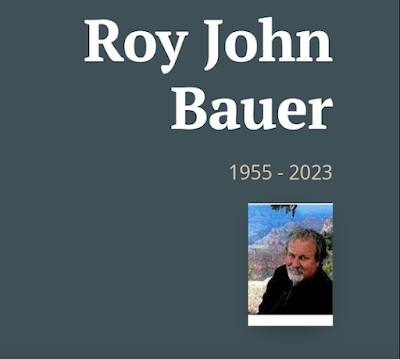
Roy's obituary in LA Times and Register: "we were lucky to have you while we did"

  This ran in the Sunday December 24, 2023 edition of the Los Angeles Times and the Orange County Register : July 14, 1955 - November 20, 2...