Thursday, January 14, 1999

The District accuses Roy "Dissent" Bauer of violence and discrimination

From Dissent 15, 1/14/99

ORIGINALLY ENTITLED:

A DISSENTER’S TALE 
by Big Bill [Roy Bauer]
[See also How to inspire administrators/trustees to go after you]

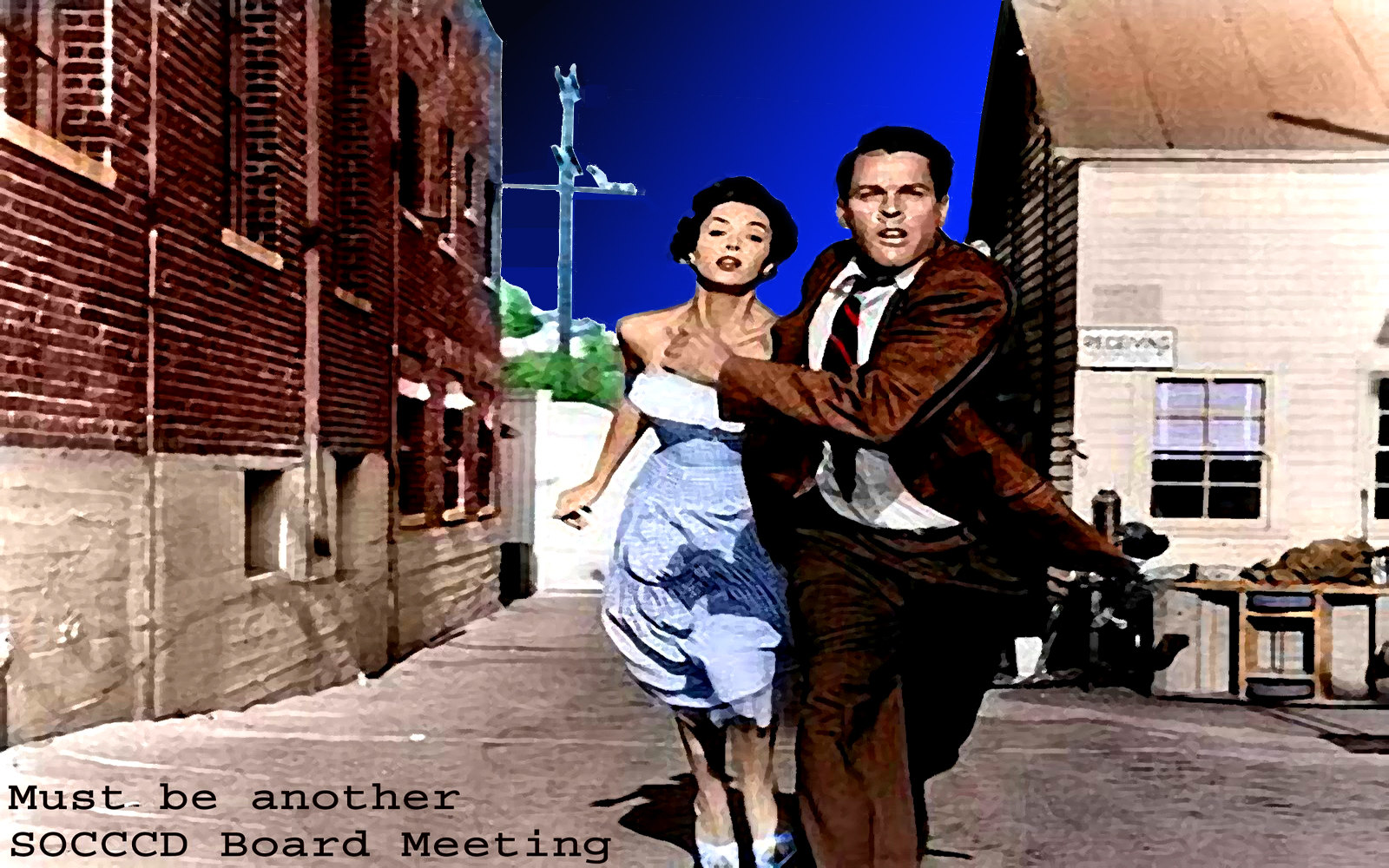
In Dissent XIV, I reported that I had received a letter from the Chancellor that said that I was causing a “hostile work environment” “as a result of statements written and distributed” by me—namely, “statements” (and graphics) that appeared in the ‘Vine and the Dissent. Astonishingly, the Chancellor takes the position that some elements that appeared in those newsletters—he cited, among other things, a goofy 50s sci-fi movie still depicting three miniature people scrambling atop a chair to aim an enormous gun at returning “downsizers”—constitute “threats of violence.” Further, the letter charged that one of the newsletters’ monikers for IVC president RAGHU P. MATHUR—Mr. Goo—is racist. Inexplicably, it also referred to “statements” allegedly made by me “which members of the Christian religion experience as interfering with their work environment.”

Huh?

Most ominously, perhaps, the letter “strongly urged” me to seek counseling to assist me in dealing with my “feelings of anger.”

The letter, dated Dec. 2 and received by me on Dec. 8, was the first I had heard about any such complaints. Nevertheless, as I later learned, the document was immediately placed in my personnel file. Observe that the Ed Code specifies that any disciplinary action taken against an instructor must refer to items already in his or her file.

Naturally, I took the letter to be the first step in a process designed to result in my dismissal. I spoke to my lawyer, Bill Shaeffer—he helped in the Brown Act lawsuits—who told Sampson that he would be attending the meeting with me that the Chancellor had demanded in the letter. We arranged to meet in Sampson’s office on the 18th of December, a Friday.

* * * * *
The meeting started at about 11:10. Shaeffer, Sampson, and I were joined by Robina Husting, the Chancellor’s assistant and our note-taker, VP of Human Resources Georgiana Sizelove, and her replacement, Harry Parmer.

As we seated ourselves, Sampson looked at me and asked whether I was taping the meeting. “Taping?”, I asked. Yes taping—you know, with a tape recorder. I assured him that I wasn’t. I pointed to my pen and said, in jest, that that was the only recording device I needed.

Sternly and somewhat cantankerously, the Chancellor proceeded to explain the purpose of the letter and the meeting. As he spoke, he used the first person plural: “we.”

I politely interrupted him. “Who’s ‘we’?”, I asked.

“‘We’ refers to the district, to the Trustees,” said Sampson.

“Have the trustees been informed of the existence of the letter that was sent to me?”, I asked. Sampson seemed flustered. “No,” he admitted. I said: “So the trustees—and you—are taking this action against me, but they haven’t even heard about it yet. Is that right?”

Sampson looked annoyed.

At some point, Shaeffer noted that, as far as Sampson knew, I was not the author or the sole author of the elements of the newsletters that were at issue. Shouldn’t an effort be made to determine whether I am the author before these extreme steps are taken?

Sampson explained that “everyone knows” that Roy Bauer is the author and publisher of the ‘Vine and Dissent, that he is responsible for their elements. Then he turned to me and asked, “Are you?” He had never bothered to ask the question before. No one had. I refused to answer. Shaeffer referred to the 1st Amendment.

* * * * *
Eventually, the Chancellor got to the heart of the matter, insofar as it had a heart. Administration Regulation AR-4000.3, section 7, lists 15 “early warning signs of the potential for violence in the workplace.” Oddly enough, I had read through that list only two hours earlier. I remember telling Shaeffer that none of these “signs” applied to me, although I expected Sampson to claim that maybe one of them did.

Boy was I wrong. Sampson proceeded to go down the list, declaring in eight instances that the “sign” in question applied to me.

But not “warning sign” A, which is “any history of violent behavior.” Sampson turned to me and rudely barked, “Do you have a history of violent behavior?” “Of course not,” I said. We moved on.

“Warning sign” B describes

An extreme interest in or obsession with weapons; e.g., paramilitary training, weapons collections (often including semiautomatic weapons), and compulsive reading and collecting of gun magazines.

That’s me, said “doctor” Sampson: I’m obsessed with that stuff. Clearly.

Shaeffer and I looked at each other. Then we looked back at Sampson and asked: “And how does that one apply?” Answer: the newsletters have images of military aircraft, etc.

Now, in fact, literally hundreds of images have appeared in the ‘Vine and the Dissent, but only a handful have depicted weaponry. (I checked.) True, during the last days of the recall effort, a Dissent graphic placed Mr. Frogue in the pilot seat of a crashing W.W.II Nazi warplane. And for the December 7 issue, Mr. Frogue was depicted piloting a Japanese Zero. (Dec. 7 is Pearl Harbor day—and it is also the date of a board meeting in which many of us expected the trustees to “drop a bomb” on Pauline Merry, which they did.) These images have obvious meanings relative to the issues of the district, and those meanings fully explain the images; no reasonable person would cite the “warplane” graphics as evidence that their creators have an “obsession” with weaponry.

And consider: I own no guns and have never purchased a gun publication; I display no images of guns or weaponry at school or at home; and no one will say that I am in the habit of discussing weaponry in class or in any other setting.

Sampson’s “diagnosis”—that I am obsessed with weapons—is ludicrous.

It would be tedious to go through Sampson’s entire list of “warning signs” supposedly applicable to me. Suffice it to say that, according to “doctor” Sampson, I make threats, intimidate employees, have “failed” or “strained” relationships, hold grudges, am fascinated with incidents of workplace violence, disregard the safety of co-employees, and am under great stress.

(In tagging me with “sign” F—failed relationships, etc.—Sampson implied that my personal life is somehow extremely troubled. “What do you know about my personal life?”, I asked. “Well, you went through a divorce, didn’t you?” —Oh.)

* * * * *
At the end of the “warning signs” portion of our little meeting, Sampson declared that “referal to counseling is indicated.”

In his letter, Sampson had “urged” me to seek counseling. Now, without explanation, Sampson was upping the ante: he announced that I am “directed” to seek counseling. “‘Directed’ means ‘ordered,’” suggested Shaeffer. Sampson gestured affirmatively. Wow.

I was also “directed” to cease and desist in making “violent threats” and discriminating on the basis of race by referring to President Mathur as Mr. Goo.

How, we asked, is using the phrase Mr. Goo to refer to Raghu an instance of racial discrimination? Well, explained Sampson, Goo sounds like “gook,” and “gook” is a term of disparagement for Asians. “President Mathur,” explained Sampson, “is an Asian.”

I responded by noting that never—I mean never—had I associated the phrase Mr. Goo with the term “gook.” I said that I intended the term Mr. Goo as an allusion to “Mr. Magoo” and perhaps to, well, goo, the sticky substance. Besides, isn’t the term “gook” usually associated with Vietnam and the North Vietnamese?

“No no!”, said Sampson. “The term was used in World War II against Asians in general!” Sizelove nodded in solemn agreement: “Yes, it is applied to Indians, too,” she pronounced. Shaeffer guffawed. “But,” I said, “it isn’t World War II. It’s 1998, and nobody associates the term ‘gook’ with people born in India.”

Sampson made clear that he rejected my account of the term Mr. Goo. When he first encountered the moniker, he said, the first thing he thought of was “gook.” His reasoning seemed to be: “Goo is three-quarters of the way to ‘gook,’ and that clinches it! RACIST!”

Gee. I gave Sampson a collection of ‘Vines and Dissents in August, and I’ve been supplying him with new issues ever since—and he has happily taken them. They’re filled with references to Mr. Goo. If Sampson thought from the very beginning that our use of the phrase Mr. Goo is racist or offensive, why did he wait until now to say something about it?

* * * * *
Shaeffer then asked an important question: is the letter in Professor Bauer’s personnel file? “Yes.” He asked when it was placed there. Sampson referred to the date on the letter: Dec. 2. He said that the letter was placed in my file on Dec. 2 “or soon thereafter.”

Now, in fact, I did not receive the letter until about a week later. That means, Perry, that the letter was placed in my file before I knew of its existence—before, therefore, I had any chance to contest its assertions.

It is worth mentioning, I suppose, that section 4 of AR-4000.3 refers to the rights of the “accused”:

The supervisor in consultation with Human Resources and the college police should decide how to approach the accused. Fairness and due process require that the perpetrator’s side of the story be told.

No opportunity to tell my side of “the story” was provided before the accusatory letter was placed in my file. Further, during the meeting, Sampson did not ask me for my side of anything. Clearly, the point of the meeting was to explain what I had “done” and what I needed to do about that.

Shaeffer asked if Sampson knew who the author is of the various elements of the newsletters. Sampson said he “assumed” that I am the author. Shaeffer asked whether he had considered the possibility that there are multiple authors, editors, and distributors. Sampson said that I am “seen by everybody” to be the distributor of the newsletters and that it is “assumed” that I am the author of their elements.

A quick perusal of the newsletters quickly reveals, however, that at least one frequent contributor to the Dissent is a part-timer (I am not a part-timer) and that at least one other frequent contributor is a woman (I am not a woman). Further, obviously, that Sampson and others see me distributing the newsletters (I do indeed hand him a copy each week—and he always pleasantly thanks me) establishes neither that I am the sole distributor nor that I am the sole author or editor. Finally, that people commonly assume—if they do—that I am solely responsible for the newsletters hardly constitutes evidence for that belief. I have never made that assertion, nor am I inclined to make it.

Shaeffer suggested that, in truth, this whole “hostile work environment” business is just a way to get around the 1st Amendment. In reality, the Chancellor—and perhaps a certain trustee who gives him his orders each morning—are trying to stifle dissent, and charging a ‘Vine/Dissent contributor with “violent threats” and “racial discrimination” will serve that purpose. Or so they hope.

Sampson explained that I am threatening to people, and that, if the district does not take steps, it will later be held liable. “Look at it from our point of view,” he said. “People will say: ‘you had all these warning signs, and you ignored them.’”

Shaeffer suggested that no reasonable person would interpret the contents of the newsletters as violent or threatening. Sampson said, “Oh, yeah. Well, I’m not a reasonble person!” –Well, no.

Shaeffer asked what Sampson envisioned “counseling” to be. Answer: I am to seek a counselor through the Employee Assistance Program. I am to lay out for the counselor what I think my problem is, and I am to show him the letter.

“Why would he do that?”, asked Shaeffer.

It is an “opportunity,” said Sampson, to show that I have examined my “hatred and anger and resentment” concerning Mr. Mathur. Sampson added that, if I choose not to do these things, then that will be part of the record.

Shaeffer asked if this would be a district-wide policy. After all, perhaps dozens or even hundreds of employees are upset and frustrated these days. So will all these employees be ordered to seek counseling? “Blah blah blah,” said Sampson.

* * * * *
Things were winding down, but I really wanted to know what that “interfering with Christians” stuff was all about. I had no clue whatsoever. I pointed to the relevant section of his letter and asked the Chancellor to shed some light on the charge. “Surely, if I am going to be accused of such things, it is not unreasonable for me to ask what the accusation refers to,” said I.

Sampson thought about the matter a moment and then said he “didn’t know.”

“You don’t know?”, I said. “You put this accusation in the letter—a letter that is now placed in my personnel file—but you don’t know what it’s about?”

I honestly don’t remember how Sampson responded. At no point did he explain the nature of the accusation. He did explain that my accusers shall remain “anonymous.”

* * * * *
After the meeting, Shaeffer and I talked. We decided that Sampson had blown chunks.

Later in the day, I heard the following rumors from a friend: that (1) the district had already hired a law firm to deal with me—a request would be made for retroactive approval of the hire at the January 25 meeting—and (2) the district’s plan was to use my acceding to the counseling order—my going to a counselor to deal with my “anger” and “hatred”—as evidence that I am indeed disturbed—and the evidence would form the basis, or part of the basis, for my dismissal. “On no account,” said the friend, “should you accede to the order.”

Of course, if I don’t accede, they’ll try to dismiss me on the grounds that I’m insubordinate.

On the following Monday, I received another letter from the Chancellor, dated Dec. 18. It reiterated the “direction” I received the previous Friday. I am to see a counselor, it said, “for the purpose of addressing the anger and hate so openly displayed against the President of Irvine Valley College and other employees.”

I’ll keep you posted.

* * * * *
Like everyone, I am capable of flashes of anger and stupidity. But I hate no one. I suppose that’s true of a lot of people.

Though I can be unpleasantly and even boorishly direct, I have never been violent and am in fact gentle by nature. I don’t hate Raghu P. Mathur and I never have; and I certainly don’t mean him any harm. Am I opposed to his presidency? Yes. Do I oppose his conduct? Absolutely.

But opposition, even rude opposition, is not hatred. Neither is it violence. —BB


[AT ABOUT THE TIME I WROTE THE ABOVE ACCOUNT, I SECURED THE SERVICES OF ATTORNEY CAROL SOBEL OF SANTA MONICA.

I REFUSED TO GO TO COUNSELING.

I SUED THE DISTRICT. I WON. THE DISTRICT APPEALED. I WON THE APPEAL.]

Monday, January 11, 1999

It's a bad, bad, bad, bad world! (Dissent, 1/11/99)

ATEP's official "opening": some time in the last dozen years
This piece describes events in the district at the opening of the Spring 1999 semester

IT’S A BAD, BAD, BAD, BAD WORLD!
By Big Bill [i.e., Roy Bauer]
[Dissent 16, 1/11/99]

January 7, 1999

“News at eleven!”:
     What a week it’s been.
     Last Thursday (the 31st), I spent much of the day hanging out with Buster and my sister Annie—she was down for a visit—and intermittently communicating with my lawyer [Carol Sobel] and Kimberly Kindy of the Register [nowadays with the Washington Post]. Kindy, fearing scoopage by the Times, insisted on putting out a story about the Chancellor’s recent action against me. We filed in Federal Court that day, naming Cedric “Spanky” Sampson. Other names will be added. (See Bauer v. Sampson, 2001 for the final disposition of the case, upon appeal.)
     The next day, Friday, the excrement hit the fan. Kindy’s story appeared, not only in the Register, but in the San Francisco Chronicle and who knows where else. It was picked up by the Associated Press, and so a truncated version of the story appeared in other outlets, including the LA Times and various radio and TV newscasts around the country. These truncations yielded a version of the story that, to my mind, seemed to say: VULGARIAN’S RIGHTS VIOLATED!
     In fact, in about 35 issues of ‘Vines and Dissents, seldom if ever has anything like the inelegant “beemer up the butt” paragraph appeared. Nevertheless, the press seized upon that example, ignoring all else. Heimat Land!
     By Monday, I was talking to a reporter with the Chronicle of Higher Education, among others. I told her the facts, as usual. She seemed to say, “You’ve got to be kidding. What kind of ***holes run your district?” I got that reaction from more than one reporter, and that made me feel better.
     Monday night, I dropped Annie off at the airport. It was great having her around during those crazy first few days of unwanted fame. We have much in common. Long ago, quite independently, we decided to become vegetarians, for we like animals, including the human kind, and so, naturally, we do not want to participate in hurting them. Have I mentioned that we were raised by wolves in the mountains of British Columbia? Arf, arf.

El Ced:
     Tuesday morning, I attended Chancellor Sampson’s address down at Saddleback in the cavernous McKinney Theater. On my way there from the parking lot, I stepped in some disgusting goo, and I noticed, too, that the campus was redolent of sewage. (Later, I encountered some workers who were pumping stinkwater from out of a manhole near the Library.) Despite these obstacles, I found my way to the theater and entered.
     It was nearly empty. Eventually, I counted about 100 people, nearly all seated in the back and along the sides. John Williams was there, looking as disgruntled as usual. He walked in with Raghu P. Mathur and Glenn “Dandy” Roquemore, the latter looking as gruntled as usual if not more so. The three seated themselves in awkward proximity, creating a grotesque little cluster of loutishness and ambition. Nice suits, though.
     At 9:17, the Chancellor began to speak. “Good morning,” he said. And then, absurdly, he added: “Nice to see so many happy faces here,” a line that bounced around the walls of the empty hall for several seconds. I sat smack dab in the middle of the audience, nearly alone, affecting a lugubrious expression. Sampson tried hard not to see me.
     Next came introductions of some visiting bigwigs, starting with Williams and then moving on to Nancy Padberg, one of the new trustees. Marcia Milchiker was introduced last for some reason. I seem to recall that Sampson also mentioned Trustee President Dot Fortune, who was not actually present, though she was there in spirit, a kind of moral stinkwater that covered the ground and filled the air. Dot gives Cedric his marching orders each morning. Despite her zany past (witchcraft, professional wrestling) and her manifest looniness and boorishness (she drives everyone nuts), she is now the Empress of SOCCCD, the “brains” of the operation. Good Lord. (I was just kidding about the professional wrestling.)
     At about that time, a confused-looking Lee Walker waddled into the building and sat himself down about 5 seats to my left. As he sat down, he seemed to hunt briefly for a seatbelt.
     Simpering Sam commenced speaking to the empty room; he told it that he wanted to share his thoughts and impressions. Though he professed wanting badly to hear from faculty, paradoxically, on this occasion in which an opportunity clearly presented itself, he failed to solicit comments and questions, borrowing a well-worn page from the Raghu P. Mathur playbook.
     Alas, our image in the educational community and beyond has gone south, said Sampson. Everyone seems to be focusing on our problems, not our accomplishments, said he. Not that we don’t have problems. But, he suggested, many of us are excessively devoted to “internal struggles.”
     He was saying, in effect, that we should just stop complaining. According to the Chancellor, then, when the board repeatedly violates the Open Meetings law, we should say nothing. When a college president flouts shared governance requirements and harasses faculty critics, we should say nothing. When the union leadership declares an election “null and void” because it doesn’t like its results, we should say nothing. When the Chancellor places an accusatory letter in an instructor’s file without bothering to make inquiries about the justice of the charges—or providing the instructor a chance to contest them—we should say nothing. And when faculty critics are ordered to seek counseling, we should SAY NOTHING.
     Imagine a population inclined to take such advice. Just add water, and you’ve got a Holocaust.
     The Cedric next spoke of fiscal matters; he seemed to want to deny that we have financial problems any longer. His reasoning seemed to be: “Since money is no longer a central problem for the district, it isn’t really any problem at all!” We’ve moved from level 2 to level 3 on the state’s fiscal watch list, he said. Maybe, by next year, he added cheerily, we won’t be on the list at all!
     Then came my favorite Sampsonian remark of the morning: “No one is to blame for where we are today.” I do believe he meant to say only that, “if we focus entirely on blame, we won’t progress.” But, in fact, he said no one is to blame.
     Isn’t that obviously false? Personally, I’m in favor of people being accountable for the messes they make. Could it be that our new Chancellor is into New Age psychology?
     Having listed the board’s goals for the district, Sampson proceeded to explain that each of us has the power to affect enrollments positively. For instance, he said, we should reassure students about our accreditation, for it isn’t threatened.
     Now just what is the Chancellor suggesting that we do? For instance, soon, the Accreditation Reports will be released. They will say, “Get your acts together, you idiots, or else!” Is Sampson advising us to hide this from students? Guess so.
     He moved on to the issue of student access, describing the Tustin “Learning Village” and facilities at the El Toro base. He displayed a slide labeled, “The airport and open space plan/year 2020 concept C.”
     Airport? Weren’t the two new trustees elected on the basis of a promise to fight the airport? Boy, things sure do get complicated in the SOCCCD.
     The Chancellor then described the second district technology initiative, which will go beyond providing mere “communication” and will provide s “pedagogical tools.” “We need to press the use of technology in the classroom,” he said. That’ll take money.
     Sampson, who stammered through much of his address, seemed relieved to turn the mike over to the lively and articulate Dr. Sam Chan.


“EK” cetera:
     Professor Chan’s address sported one of those “colon” titles—“Virtual Diversity: Responding to California’s Changing Population.” According to the Flex Week schedule, “Dr. Chan is recognized for his expertise in diversity issues and the design of training models to promote intercultural competence.”
     The guest speaker—half Chinese, half Scotch/Irish, he said—seemed aware that our district suffers from internal conflicts, for he went out of his way to explain that conflict is not all bad. In the Eastern Tradition, he said, conflict is viewed as a “gift of energy.”
     Eventually, Chan settled into discussing diversity. By the year 2040, he said, California’s population will be very different. He spoke of “the browning of America,” and he discussed how “cultural competence” issues will be increasingly forced upon us. The likeable Dr. Chan showed a video clip to illustrate differences in communication styles between cultures. It depicted a (clearly staged) exchange between a white male professor and a student from the nation of Cameroon. The white guy acted like a dope. At the end of the clip, the video commanded: “Pause for reflection. Discuss.” And we did.
     Chan said that the communication conflicts depicted in the video “play themselves out in the classroom.” I have no reason to doubt it.
     For a moment, there were signs of life in the audience. Someone way in the back (where almost everyone was) asked Chan whether immigrants should be made to adjust to “our” way of doing things or “we” should accommodate the immigrants. Chan sagely suggested that the situation should be a “two way street.” Students need to gain “survival skills,” but educators need to find “common ground” with these students.
     The otherwise articulate Chan is a member of “team EK cetera”—those educators who seem unable or unwilling properly to pronounce the phrase “et cetera.” I mention this only because, as the week wore on, I found that, goddamit, virtually all the flex week guest speakers that I encountered spewed numerous EK ceteras at the audience.
     Nevertheless, Professor Chan’s presentation was pleasant and helpful, a mild success, if success is possible in a nearly empty room down at Stinkwater Junction, the House of Dot. When we broke for lunch, I ventured down to the stage to thank Chan for his efforts. Sampson and Williams stood directly in my path, and so I said “Excuse me,” and walked between them. (More violence! More intimidation!) I saw Williams involuntarily reach for his Colt. Sampson hissed into my ear.
     Not really. In truth, everyone was terribly pleasant. It was as though we were at a college or something—you know, where people get to express their opinions without being sent to the loony bin.

     Outside, I spoke briefly with Margaret Hoyos, the local CCA (CTA) rep. Twice, we were heckled by a certain instructor, who did his best to impersonate a wandering and disheveled schizophrenic. “Who’s that?”, she asked. “Why, it’s just the odious Mr. P,” I said. “He’s one of the union regulars!”
By the way: some instructors at Saddleback—Old Guard union cronies all—have been involved in truly ugly episodes involving hitting and even injury. I wonder if they were ordered to seek “anger management” counseling? I wonder if anything appears in their personnel files?


“Going Nowhere”:
     On Wednesday at about 8:00, I attended IVC’s “President’s Welcome Address and Breakfast,” where the following was projected upon a screen:

President’s Address
Welcome Back to the Spring Semester 1999[?]
Raghu P. Mathur, Ed.D.
President, IVC

     Observe the letters after Raghu’s name. Raghu now refers to himself as “Dr. Mathur.” Evidently, he found a diploma in a box of Cracker Jack and decided to go with it. Good for him, I say. At one point, he announced his new title and then waited for applause. Feeble clappage washed over him. He feigned humility.
     Raghu thanked us for the excellent work we do and have done. He seemed flustered—evidently, he expected trustees to be present, but none could be found. He settled for President Bullock, whom he described as a “true professional.” She walked up and said Bla Bla Bla Bla Bla.
     Various other people in the room were identified, including new hires. As usual, Raghu forced us to applaud twice for each person, a truly, deeply annoying practice, reason enough to demand his resignation. [Since this piece was written, I’ve learned that this odd practice originated with Tom Fuentes, chairman of the OC GOP. Fuentes joined the board in July of 1999—seven months after the event reported here.] He thanked Tom Mucciaro, too. This time, Tom didn’t arrange for his Scoutmaster to speak. I think we should go back to the Scoutmaster.
     When I first arrived, I found a table near the front at which Tamara C. was seated. I asked her if she minded my sitting there, and she said no. I sat down, leaving an empty chair between us. Soon, a good looking fellow wandered in and sat between us. He was Robert Barr, the main “keynote speaker” for the occasion. (There were two “keynote” speakers.) I introduced myself, as did Tamara. He seemed like a nice guy, and we talked.
     I happened to leave a copy of Dissent XV in front of me. (It’s just possible I put it there on purpose.) Barr kept craning his neck to read it, so I handed it to him. “Here. For you.” He was enthralled by it. And why not? He read it while Herr Doktor Mathur spoke. (Everyone’s been saying that our Chancellor looks good in a dress. [See Dissent XV.] I wondered if Barr agreed.)
     After the introductions, president Mathur, who suffered from a cold, explained that he would comment on several things. He spoke of the organizational review on which the board will take final action on the 25th. Bla Bla Bla.
     Raghu then espied John “Strict Accountability!” Williams and Nancy “No Airport!” Padberg, and his spirits palpably improved. Williams came up and explained that our financial situation looks good, thanks to the diligent efforts of the trustees, those staunch fiscal conservatives. As usual, he failed to mention that he was as responsible as anyone—and more responsible than most—for our fiscal woes. “We hope to be off the watch list by fall,” said he. Gee, thanks, College Boy.
     Raghu made trustee Padberg speak, too. She indicated that she is impressed with the personnel she has met at the college.
     Back to Raghu. He explained that the college will be advertising 9 new positions though, realistically, we can only expect to get 2 or 3. It’s “a good way to go,” he said.
     I don’t think so. If we are advertising 9 positions despite knowing that (very probably) only 2 positions are real, then, in the case of 7 positions, we are advertising in bad faith, causing hundreds of people to apply and dozens to be interviewed—for nothing. No decent institution would do that.
     Trustee Don Wagner showed up, and, naturally, Raghu made him come up to speak, which he was more than happy to do. Wagner said that he has enjoyed meeting and talking with faculty and others. He acknowledged, refreshingly, that the trustees are far removed from what’s actually going on in the colleges, and they need to work against that. He invited us to call him at work to express our concerns. He was impressed, he said, that everyone with whom he has met is concerned about students. He suggested that concern for students is perhaps our unifying factor.
     Mathur went back to his blathering. He crowed about the many avenues of communication he has allegedly opened—new and different ways for him to express his autocratic will. He expressed hope that communication with the Academic Senate would improve. (As things stand, IVC Senate officers, who are now compelled to perform their duties as overload, don’t have the time to do the work. The upshot: the Senate may essentially shut down this semester. That, of course, should streamline Raghu’s communication with the Senate considerably.)
     Eventually, he spoke about the Tustin Base. Our role there, he said, is “up to us.” Evidently, we have been informed by the Chancellor that the process whereby a college is selected for involvement at Tustin is “competitive between the two colleges.” Raghu, of course, has allowed IVC to fall way behind in this competition. He will never admit this. He never acknowledges discrete errors of his own.
     After a while, Raghu spoke of “greatness” and commenced comparing himself with Abraham Lincoln. Having read a book about the man, Raghu decided that there are “three qualities of greatness”: being focused on self-mastery, fixity of purpose, and malice toward none. These are, he said, “my goals.” Achieving these goals is a “tall order,” he added.
     Then things got really weird. “I’ve been here for 20 years,” he said. “I know where we’ve been, where we are now, and where we’re going.” We can make things better if we work together, he offered. We need to work together “for the students,” “not our egos.”
     He discussed his critics. He has heard a lot from them, he said. “They are my best teachers.” Still, he wanted critics to know that he is “undeterred.” The critics want to deter him from his direction, but that won’t work because he, Raghu P. Mathur, is not going anywhere. The election and the recall are over, he said. “I’m here.” “So what’s the problem?” (The answer to that question can be found in this issue’s “Mathurian Candidate” column. Please see p. 10)
     There is, he said, no need to stand on the sidelines and criticize, to bring people down. We should be able to rise above that, to be constructive.
     There is, he added, no need to run to the newspapers. If you do, he continued ominously, “I won’t stop you.” He never has, he said. (Apparently, Raghu thinks that stopping us is an option, but one that he generously chooses not to take.)
     Go ahead and keep filing lawsuits and talking to the state chancellor, said Raghu. It won’t solve any problems. We need to quit dwelling on the past. We need to engage in compromise, give and take. “Where there’s a will, there’s a way,” he said. “I’m not going anywhere.”
     Ain’t he gracious? Ain’t he wonderful?

“A wonderful, gracious man”:
     The first “keynote” speaker was Michelle Bonds, President of the California Student Association of Community Colleges. She offered only one memorable remark, namely, her description of Raghu P. Mathur as a “wonderful, gracious man.”
     Obviously, she hadn’t read Dissent XV, which revealed the “epistolary” Raghu, a malicious scribbler who is perfectly happy to criticize and to “bring down” those whom he perceives as obstacles to the satisfaction of his enormous ego. (He is, he wrote, “the best qualified to do the job 100 times better than Clella Wood or any other dean in this position...on any day of any week, month, or year.”)
I missed the first few minutes of Dr. Barr’s address, for I was in the parking lot trading cat stories with Nancy Padberg. When I returned, he was explaining his view according to which things in education will continue to deteriorate until we force ourselves to go through a “paradigm shift” from “teaching” to “learning.”
     Barr obviously borrows heavily from Thomas Kuhn’s Structure of Scientific Revolutions, a book whose concepts, though influential, have by no means achieved general acceptance within the philosophical community to whom the work was addressed back in 1962. But the scholars in the education department don’t know that. With them, phrases like “paradigm shift” sound new and thrilling and can be counted on to promote measurable pants wettage outcomes.
     Hours (it seemed like hours) later, Glenn gave a presentation concerning enrollments, among other things. “We’re adding classes where there are wait lists,” he said. (Thus requireth Empress Stinkwater.) He seemed defensive about the Spring enrollments picture. Students are waiting until the last minute to enroll, he suggested. Everything looks good, he seemed to say. Really, really good.
     In fact, as I write, IVC’s enrollments are down 10%, and the ad hoc measures that Mathur and company are taking have never worked in the past. Though things may improve, it now appears that we are witnessing the beginning of the Big Slide, the inevitable result of the Big Incompetence.
     As always, Raghu had placed Q&A dead last in the schedule for the program, and when, as always, time ran out, he explained that, regret-tably, there just isn’t time for questions.

     With that, the Mathurian Era lurched miserably into its fourth semester and into history. God save us all.
—BB [Roy Bauer]

Thursday, January 7, 1999

Professor, college leaders at odds over newsletters


THE IRVINE WORLD NEWS, January 7, 1999

Professor, college leaders at odds over newsletters
By Laura Hayes

Oo, violence!
     It’s no secret that Irvine Valley College philosophy professor Roy Bauer has long opposed actions of South Orange County Community College District trustees and administrators and he is not alone in his dissension.
     But as the plaintiff in lawsuits against those authorities and as the creator of two underground newsletter, “The Vine” and “The Dissent,” Bauer may now become the lightening rod for possible district action.
     Chancellor Cedric Sampson warned Bauer in December that aspects of his writings and artwork in issues of “The Dissent” has caused concerns of potential workplace violence to arise. The chancellor advised Bauer to seek counseling. [Note: on the 18th of Dec., Bauer was “directed” to seek counseling.]
     In response, Bauer filed a lawsuit against the chancellor and the district on Dec. 31, claiming violation of his First Amendment rights. Carol Sobel, a Los Angeles attorney specializing in First Amendment issues and lawyer to two Irvine Valley students who filed a case with the ACLU against the district last spring, is working on his behalf. Bauer is also seeking legal representation from the California Teachers Association.
     Sampson, in his letter to Bauer, said that individuals have complained the newsletters are creating a hostile work environment and fear among district employees. Cartoons, fantasy stories and commentary from “The Dissent” were extracted as examples of violation of district policies pertaining to workplace violence and discrimination and harassment. One citation was the metaphorical account of a trustee’s demise.
     Sampson’s letter said, “It’s like a person going on an airplane and making a joke about a bomb. This is not a First Amendment issue, it relates to district policy.
     “Employees of the district have certain responsibilities,” he said. “We’re not interested in restricting the freedom of speech.”
     Sampson said the district uses a checklist of warning signs to determine actions concerning employees, but he did not comment further on Bauer’s case or the impending lawsuit.
     “I haven’t seen the suit, but we will respond,” he said. According to Sampson, the district is taking action now because of a change in the tone of the newsletters.
     Bauer is a graduate of the UC Irvine department of philosophy and has taught at the community college district since 1986. He said his personnel file contained nothing but a perfect record and glowing evaluations until now.
     He claimed his newsletters have not changed and one issue among 35 has been held up as the only criteria by which he is being judged.
     Debbie Burbridge, a Cal Poly Pomona student who attended Irvine Valley last semester and is still a part time student there, started a student rights club on campus last spring. She questioned the district’s timing and singling out of Bauer.
     “He’s been writing it for 18 months and only now they’re reprimanding him. I’ve been reading it for six or seven months and it’s always been that way. For me, it was really informative, because I couldn’t go to all the board meetings and I relied on “The Dissent” for what was going on. I find his sense of humor satirical. I didn’t take it very seriously at all. If anyone knows Roy he’s the most soft-spoken and non-violent person you can imagine.“
     Jody Hoy, a professor in the humanities and languages department, said, “People say he’s creating a hostile working environment, it’s not true. It’s a response to a hostile environment. It’s a refusal to accept a hostile environment.”
     Pam Zanelli, acting district public affairs officer, said. “It’s a workplace. Whether you agree with him, or disagree we all have to work here. Some of it is political lampooning. It is very clever, very creative. But over time you see different people react. It ranges from uncomfortable to fearful.”
     Wendy Phillips, Irvine Valley instructor and Bauer’s attorney in two other cases against the district involving alleged violations of state laws requiring open board meetings, said the singling out of Bauer is retaliatory. “Very, very clearly, the newsletters are not creating a hostile working environment.”
     By claiming to enforce a policy, Phillips said, the district is abbreviating an employee’s rights. “Employees are still citizens of the United States.
     “In my opinion, Roy’s cartoons and writings are just like those you find in the L.A. Times. They are just trying to drum up a case against him,” she said. Phillips said the actions against Bauer could represent a serious threat to the rights of other faculty members as well.
     Bauer said “The Vine” and “The Dissent” have their origin in a newsletter he once co-wrote for faculty members in his role as academic senator and later as chair of the Department of Humanities and Languages at Irvine Valley. When an administrative reorganization occurred in July 1997, and chairs were replaced by deans from Saddleback College, Bauer’s writings went underground and the publications were widely distributed.
     Bauer takes most of the heat and credit for the news sheets, but they often are compilations of information from public and not-so-public sources. Various writers with pseudonyms contribute humorous, straight and satirical commentary. The publications also contain excerpts or whole articles from newspapers.
     “My primary intention is to keep members of the district community informed. Also to express the frustrations they themselves feel about the place,” said Bauer.
     “I got into this whole thing because I take seriously principles and ethics. When I see good people being fired or being pressured to leave the district, violations of procedures, violations of state law, corrupt politicians lying to communities, I feel an obligation to throw in with others.”
     Bauer said accurate accounts of events are important to him. In-depth descriptions of public board meetings in his newsletters are coupled with background information and Baueresque editorial touches. The juicy stuff—confidential letters, memos and conversations—don’t remain in the dark long once Bauer publishes them.
     What about the extras? Graphics include Bauer’s favorite targets, Irvine Valley President Raghu Mathur and “board majority” members Dorothy Fortune, Steven Frogue, John Williams and former trustee Teddi Lorch, with a host of other district characters. Their photos are stretched and distorted in often unflattering poses. Mathur, a favorite Bauer target, has been cast as Napoleon, Alfred E. Newman and Elvis shaking hands with Richard Nixon.
     “The Vine” and “The Dissent” emerged as an unsanctioned outcry from some on the Irvine Valley campus after four trustees voted down their three colleagues to make major changes in the district over two volatile years.
     Lawsuits were brought against the board concerning two specific actions. The board set aside traditional hiring practices in appointing chemistry professor Raghu Mathur as president and they changed the administrative structure of the district and the college, replacing faculty chairs at Irvine Valley with deans from Saddleback College. Faculty chairs were tenured professors and enjoyed a certain degree of independence. Deans and vice presidents do not. As newly elected Trustee Don Wagner stated in a recent letter to the editor of the Irvine World News, “administrators at institutions of higher education do not have tenure, but serve at the pleasure of their superiors.”
     Wagner said he is not familiar with Bauer’s publications. In one issue he read, Wagner said, Bauer made some substantive points about college and district problems. But Wagner added, Bauer’s “rhetoric” won’t accomplishes his purposes and won’t win him any friends.
     “If his purpose is to air legitimate grievances, I think he could go about it in a more measured way,” said Wagner.
     “He has very definite opinions. He’s a player and he’s involved in these problems. He’s someone I’d like to work with,” he said.
     But Wagner said from what he’s seen, the newsletter is not persuasive to those outside Bauer’s audience. “He’s preaching to the choir.”

Monday, January 4, 1999

Classic Raghu Mathur: "I feel discriminated!"

THE MATHURIAN CANDIDATE: “I FEEL DISCRIMINATED!”: RAGHU’S REMARKABLE LETTER TO CHANCELLOR SNEED, OCT. ’89; by Chunk Wheeler [Dissent 15, 1/4/99]


Theorists of the origins of our calamity inevitably point to, among other things, the remarkable career of one Raghu P. Mathur, the president of Irvine Valley College, and the only person in the history of the institution to have been censured for lying (4/5/94).


Raghu has been a player of sorts in our district almost from the beginning of IVC’s existence in 1979, when he began his single-minded quest for administrative glory. The fellow’s penchant, however, even in those early years, for duplicity and connivery earned him the enmity of IVC’s first president, the forthright and unforgiving Ed Hart. Hart moved on in ‘86, but Raghu still failed to “advance,” and, owing to his paranoia and narcissism, he necessarily blamed the situation on others, most notably Terry Burgess, who, like Raghu, was hired as an instructor during IVC’s early days, but who, unlike Raghu, successfully made the shift to administration, where he flourished.


Raghu being Raghu, he responded to the situation by constructing a private reality in which he was continually thwarted by racists and those who envied his supposedly superior abilities. This fantasy was the germ of a conspiratorial Weltanschauung carefully fashioned by Raghu to appeal to some of his more insecure colleagues—people who do virtually no “shared governance” work on campus but who resent the “undo influence” of those who do. This world view is evoked and invoked even now by Raghu and his Mathurians. Naturally, when asked to defend it, these people have nothing of substance to offer. In this respect, they are like Mr. Frogue, with whom they are allied, and like conspiracy fans everywhere.


By 1989, Raghu’s self-promotional labors had profited him nothing, and so he appealed, not for the last time, to the Chancellor--this time in a letter. As you’ll see, the letter, which is reprinted below, is remarkable in many respects.


Judge for yourself. [See blue highlighting below.]

October 9, 1989...
Dr. Richard Sneed, Chancellor…


Dear Dr. Sneed:

I wish to document certain issues of interest and concerns [sic] to me and others at Irvine Valley College. I realize this is a long letter; however, I would appreciate your indulgence in full consideration of issues presented herein in the best interests of students of Saddleback Community College District.

Spring Schedule Development Process


With respect to the development of chemistry schedule [sic] for spring 1990, I received a memo during my summer vacation, in mail in late August, from Seth Hochwald, Chair, School of Physical Sciences, Math, and Technologies, that our input for chemistry schedule was due to him within a couple of days which I found to be suspiciously short notice for such vital task [sic] of schedule development. So Walter Floser and I, two full-time chemistry instructors at Irvine Valley College, promptly called in our input to the school secretary. Within a week or so when the college opened for instruction, I received a spring schedule from the school secretary seeking staffing recommendations. Frankly I couldn’t even recognize the schedule as compared to what we had proposed. This obviously meant that our input was ignored. On friday, September 1, I met with Seth and asked him if this was indeed his recommended schedule to the administration. He said yes. I asked him if he had seen our input. He said no. I couldn’t believe that he was recommending only one section of Chem 1A for spring 1990 whereas we could fill 3 sections of Chem 1A considering a) what we have generally offered in the past and b) ensuing growth this year. Incidentally, we could have filled three sections of Chem 1A during fall ’89 but only two were allowed by Terry Burgess. We literally turned one section full of Chem 1A students away during Fall ’89 even though he had given me his word of honor last May that he would open an additional section of Chem 1A if needed which, of course, he did not. This proved to me that Terry Burgess is neither trustworthy nor responsive. On monday, September 4, I asked Seth again if this was indeed his recommended chemistry schedule for spring ’90. At this time he said he had nothing to do with it and, in fact, the schedule was pre-determined by Mas Hayashi, School Chair for Spring and Summer ’89 only, and Terry Burgess last May. So obviously Seth lied to me on friday, September 1. Furthermore, we are infuriated on why did Seth seek input from us in the first place when he knew that the chemistry schedule was already determined? Obviously Mas and Terry had predetermined chemistry schedule for spring 1990 without any input or consultation with chemistry instructors. We find this extremely insulting. We would like to know why was it so? We have inquired about this but we have gotten no answers from Mas Hayashi or Terry Burgess.

A Classic Conversation with Area Dean


Subsequently I met with Dr. Clella Wood, Area Dean, and asked her if she was at all aware of the Chair’s proposed chemistry schedule for Spring ’90. She stated no. This shows lack of communication and coordination between school chair and the area dean. In the meantime, she talked with Seth and then a few days later the following conversation occurred between her and me:

Raghu: Are you supporting one section of Chem 1A as proposed by Seth?

Clella: Yes, however, I could go along with offering two sections of Chem 1A if we cut Chem 2B as proposed by Terry. (Chem 2B is a course for nursing majors.)

Raghu: Do you know what the enrollment was in Chem 2B last year in the spring before you have apparently agreed to cut Chem 2B with Terry?

Clella: No. (In fact it was 21).

Raghu: Do you know how many sections of Chem 1A were offered last spring and what the enrollments were in those sections before your making a decision for next spring?

Clella: I believe 2 sections of Chem 1A were offered (when in fact three sections were offered). No, I haven’t checked the enrollment in those sections of last spring.

Raghu: Considering the fact that schools have historically received augmentation for new courses and/or programs, did you present our need for 18 hours of organic chemistry sequence of Chem 12A and 12B to the Instruction Council so that we could offer organic chemistry courses in our organic laboratory in this new physical sciences building in which you sit as dean?

Clella: I didn’t know that you needed OSH or that you needed to offer organic chemistry courses (for science majors) or that we have organic chemistry laboratory in this B200 building. You have never told me this.

Raghu: I had so informed the school chair about the augmentation need last spring. Didn’t he inform you as he should following channels of communcation?

Clella: No.

Raghu: Do you know if the augmentation issue for organic chemistry was ever brought up by the school chair in the Instruction Council meeting?

Clella: No (when in fact it was brought up but the dean was absent as I used to find her absent quite frequently when I attended these meetings regularly as school chair).

There you have it! This conversation exemplifies the existence of an utterly dysfunctional administration at IVC. You have an area dean who is not in touch with what’s going on in her building, in her division, and in instructional council meetings. I, as a past candidate for the dean position, cannot help but honestly feel that she was hired for the position not because she is knowledgeable and competent but because she is white. I feel discriminated. I feel extremely disturbed and angry. She is literally out to lunch several days each week for extended periods of time. She claims that she goes out to lunch meetings with business/industry leaders to develop contacts for IVC. Give me a break. If so, where are the results of such meetings? How many new vocational programs has she singlehandedly [sic] brought on line at IVC? There doesn’t seem to be any accountability of her whatsoever. Is this the kind of knowledge and performance expected and accepted by her bosses?

With respect to resolution of issues surrounding chemistry schedule for spring 1990 with Terry Burgess, certain characteristics of his leadership and management style have made significant impressions and have, in fact, painfully grieved me about the tremendous lack of instructional decision-making processes, trust, and respect at Irvine Valley College. It is with great reluctance and after much soul searching that I bring these concerns to your attention for deliberation and resolution, perhaps through better administration.

Administration By Misleading


Terry Burgess stated in a memo to Dr. McFarlin (see attachment II) that Seth Hochwald and Clella Wood had advised him that he cut the single section of Chem 2B (for nursing majors) from spring schedule and, therefore, he concurred with it. In fact after receiving the memo, when I inquired Seth and Clella if they had indeed so advised him, they denied it and stated that the recommendation had actually come from Terry and they (Seth and Clella) simply agreed with the recommendation. Incidentally, the agreement occurred without any consultation or discussion of the program by any of these three people with the full-time chemistry instructors and Chem 2B was summarily cut from the spring schedule. When I confronted Terry in the presence of Dr. McFarlin, Seth and Clella, he admitted that he had indeed lied in the memo and had deliberately mislead [sic] us. Furthermore, this shows that he is advancing his own bias against Chem 2B course by using Seth and Clella. He needs to learn to stop using people in this manner and instead institute a mechanism through which school chair and dean could work with faculty, discuss issues honestly and professionally, providing recommendations through win-win approach to problem solving that would best serve the short term as well as the long term educational needs of students in a globally equitable manner considering all departments and schools at IVC. In my judgement when administrators facilitate decision-making in this manner, they can help build a strong and productive team.

Administration By Hypocricy [sic]

Terry Burgess repeatedly states that he welcomes input from subject experts but, in this context, when we had given him our highest professional judgement to best serve student needs, I feel that it has met with direct criticism, immediate dismissal and indifference rather than deliberation, accomodation, and genuine compromise. Needless to say that his such behavior is clearly perceived as hypocritical.

Regarding Chem 2A/2B program for nursing majors, we, the chemistry instructors at IVC, have repeatedly asked him that he and Ev Brewer should jointly call a meeting of all the biologists, chemists, and nursing faculty in the district to evaluate and revise, as necessary, chemistry requirement for biology courses which serve as pre-requisite for entrance to nursing program but, not once, have we heard from him that he, as vice president of instruction, would be willing to provide leadership in this vital curriculum and instructional area. We have proposed that, in the meantime, Chem 2B be offered just one more time in spring ’90 as a continuation course for students in Chem 2A this fall semester. We feel that we have a moral obligation not to shortchange students who are already, so called, in the pipeline.

He has provided a lot of leadership in quadrupling the biology program in the last ten years at IVC whereas chemistry program has not been allowed to grow proportionately. Apparently it does not occur to him that a vast majority of biology students must take chemistry simultaneously to persue [sic] their educational goals. As vice president of instruction, I believe that it is his duty to provide leadership in strengthening all viable programs at IVC and if some programs are not growing as they should, he should investigate by working with concerned faculty and rectify the situation. Instead, so often (approximately 80% of the time) in the last three years, I have found him sitting in front of a computer terminal in his office managing data, which is important, but he needs to know that the real curriculum and instructional business occurs in the classrooms where he is rarely to be found. It is well known among faculty at IVC that he is not a people’s person.

When Annie advised us all to get together, discuss, and compromise, he sent his compromise proposal to me through Seth with the idea that the chemistry instructors should either accept it or forget it. No meeting of all concerned parties was called by him. Yes, I had discussed the issues with him earlier but to no avail and that’s why I had requested Annie’s intervention. After our meeting with Annie and all concerned parties, she had advised me to continue to meet with Terry to help resolve scheduling issues. In response to this, I scheduled a meeting with Terry for October 2 at 4:30 p.m. When Walter and I arrived for the meeting, we were told by Lorraine, his secretary, that Terry felt that the case was closed and there was no need for any further meetings and thus, he refused to meet with us. We were appalled. What a blow to communication! Is this the kind of behavior expected and accepted by his bosses? Such practices would reflect negatively on the Chancellor if they are allowed to continue. I believe that the communication should have still continued since the deadline for schedule to go to press was still a week away.

In a subsequent meeting on tuesday, October 3, called by Annie at my request, Terry Burgess states that he has “lost patience in dealing with chemistry schedule issues”. I reminded him that the schedule deadline was still a week away and I, for one, had not lost patience and was still available and willing to discuss and resolve the issues. Once again I asked him at this meeting that I would like to see the final chemistry schedule before it goes to press so that I could help ensure that the classes were scheduled in appropriate labs and times without any conflicts. He agreed to do so but he NEVER sent me a copy and the schedule was sent to press on October 9. Please ask him why was this so? I would like to know.

Administration By Unilateral Proclamation of Compromise


The compromise Terry suggested regarding spring schedule was unacceptable to chemistry instructors because just last May when the school was planning schedule of classes for the current school year, we had experienced a cut of 42 hours (approximately 30%) in chemistry program and his compromise proposal contained yet additional cuts. Thus, with his proposed additional cuts in Chem 2B and Chem 106, nursing chemistry and general chemistry programs faced significant destruction. In fact we have been concerned that his line of thinking would lead to total elimination of chemistry program for nursing majors, from Fall and Spring semesters, at IVC.

In fact, when I suggested a viable compromise in meeting with Annie and Terry on October 3, it was immediately discarded by Terry. Terry Burgess would be happy to tell you that he proposed compromise [sic] that the chemistry instructors would not accept; however, he fails to give any significant credence to our compromise proposal. Incidentally, Webster’s dictionary defines compromise as an “agreement between two parties”. In fact Terry has insisted on prevailing on his compromise “proposal” and has arrogantly walked away from the discussion table.

Administration By Arbitrary Decision Making Process


We have advised Terry Burgess repeatedly that he should not increase chemistry lab CAP from 28 to 30 students but he has done so arbitrarily with no regard for creating an overcrowded situation in laboratory [sic] where chemicals, which are inherently dangerous, are used for experimental purposes and, therefore, would endanger the health and safety of students, staff, and the instructors. I must state uncategorically [sic] to you that if this overcrowding situation is allowed to exist, Saddleback Community College District will be liable. Existence of dangerous conditions for chemistry may pose potential embarrasement [sic] to the Chancellor if IVC administration is allowed to make decisions with disregard for necessary checks and balances.

Terry Burgess states in a memo dated October 4 (see attachment III) that Seth, Clella, and he have agreed to raise the CAP from 28 to 30 students. As of friday noon on October 6, Seth told me that he did not support such an increase in CAP and had indeed told Terry so. Well, to me, this amounts to another lie from Terry. This is just another example of Terry using school chair’s [sic] name to advance his agenda. I wonder what he is advancing using the Chancellor’s name and possibly in the name of Board of Trustees.

Administration By Violation of District Policy


Chemistry instructors had proposed a section of Chem 106 (2 LHE class) for spring ’90 which Terry Burgess, Seth, and Clella had deleted without any consultation with us. We have offered Chem 106 for the last ten years to assist Chem 1A students with problem solving skills. When I asked Terry as to why he had deleted Chem 106, he stated that the course could be taught by us in our office hours. Upon our further insistence that the course was indeed a necessity for Chem 1A students (for example, Saddleback College is offering 5 sections of Chem 106 for its five sections of Chem 1A this Fall semester), he agreed to offer one section of Chem 106 on TBA basis, not so recommended by us and apparently set up for failure with a requirement that the class must have 25 students in it to go which, I believe, is in violation of district policy of 18 students. See attachment V in this regard.

Administration By Lack of Logic


Terry Burgess has scheduled 3 sections of Chem 1A on T Th; two of these sections are scheduled on 5:30 - 10:00 p.m. on T Th. Furthermore, Terry has scheduled 2 sections of Chem 1B on MW. Common sense would seem to suggest that it is preferable to spread out like classes over different week days and times to target different student populations as we had initially recommended. Apparently the classes were so scheduled so that they will not fill and then be cancelled later. I continued to question the wisdom behind offering same classes on same days and, especially the same times but logic is no where [sic] to be found. Now, all of a sudden, he has deleted the third section of Chem 1A without any discussion or notification to us. We had to send him a registered letter by mail asking that Chem 1B be scheduled in the appropriatae [sic] lab room before that was corrected. His such tactics amount to unnecessary harassment of professional people.

Administration By Failed School Chair Model


As far as I am concerned, the whole discussion and approach to schedule development and decision-making had been extremely deficient and rather chaotic and stressful. It has taken a lot of positive energy away from faculty working with their students in classrooms. Is it acceptable for school chair to abandon his responsibility for schedule development and transfer it to another faculty member? I believe not but it is being done in the School of Physical Sciences, Math, and Technologies at IVC. Do you know who is in-charge [sic] of school operations when a given school chair is teaching part of his/her load and/or overload classes? It is the secretaries who are serving as administrators by default. It points out clearly that the school chair model has failed miserably and should be immediately abandoned. Department chair idea can work in a large college or university, like, Saddleback College, along with division deans in the governance structure. A small college like IVC does not need school chairs and division deans. Different faculty members in a given school are being asked to serve as school chair on a rotational basis. School chairs are coming and going through a revolving door and, I feel that it is so because many of these faculty members cum school chairs have had absolutely no educational background in administration, are not experienced in performing administrative duties, and have not even had any aptitude for such responsibilities but they serve as school chairs because the position is rotational and it is now their turn to get burned out. Furthermore, it has had divisive influence, pitting faculty against faculty within the same school which would have its own far reaching consequences for the future. I understand the whole situation exceedingly well because I have served as school chair and have observed and discussed the situation with other school chairs. It is unfortunate that even though IVC is now aproximately [sic] 10 years old, its administrative channels of communication and decision-making processes are still rather primitive and urgently need professionalism, sophistication and class.

Administration By Lack of Leadership


I have found that even though Terry and I have discussed chemistry scheduling issues a few times, his positions on a vast majority of issues remain totally unchanged and nonetheless he wishes to embrace his self-proclaimed compromise. Such stubborness on one hand and the concept of compromise on the other hand just don’t match. In fact, such behavior shows arrogant abuse of power. Is this the spirit of AB 1725 in which faculty and administration are expected to mutually resolve academic issues? I ask once again is this the kind of behavior expected and accepted by his bosses?

Furthermore, to compound the complexity of the situation, chemistry schedule was sent to press without our knowledge and signing off on the final version. In other words, we knew of several discrepancies in the schedule and we have no idea whether they were adequately resolved but the schedule was sent to print. I ask how would such a schedule best serve students? We have asked Terry, Clella, and Seth repeatedly about our seeing the final copy but our requests have apparently been either ignored or denied. As of noon on friday, October 6, I stated to Seth that Walter and I have not yet seen the final chemistry schedule. He was surprised that Terry had not shared the schedule with us. I was surprised to hear from Seth that even he had not seen the final copy. The schedule went to print either that afternoon or was so scheduled to go on monday, October 9, 1989.

Administration By Lack of Instructional Support


This semester we are offering Chem 12A: organic chemistry course for science majors at IVC which is supposed to have 6 hours of lab component each week. Each week, since the semester started, no experiments are being done in this class because the school chair, area dean, and vice president of instruction have failed to plan adequately to get all needed chemicals and supplies for the course. It is evident that these students are not getting an education, they are getting a shaft! IVC stands to get a bad name as a result. Saddleback Community College District stands to get a bad name as a result. Does anybody care? We have tried to work with Terry Burgess for the last three years regarding equipping organic chemistry program but this is where we are today.

Conclusion


As you know, last year Clella Wood and I were candidates for the position of Dean of Physical and Business Sciences. When we both made it as finalists, the process was stopped because, I was told, that the interviewing committee did not recommend 3 candidates to College President as the district hiring procedures had required. I firmly believe that the process was stopped not so much because of the hiring procedure requirement but because Terry Burgess and his personal friend, Honorable Shirley Gellatly, didn’t want me selected with no regard to qualifications, competence, and the best interests of the college. This reflects negatively on the Chancellor. This was a pure and simple case of racial discrimination against a professional educator, who all his life has worked hard to earn people’s trust, confidence, respect, and affection. There is absolutely no question in my mind even today that I am the best qualified to do the job 100 times better than Clella Wood or any other dean in this position at IVC on any day of any week, month, or year. In fact, I felt honored when Riverside Community College, through their own objective hiring procedures, offered the same kind of dean position to me that the Saddleback Community College District had denied. However, the IVC position was readvertised, the interviewing committee (which was this time unquestionably stacked against me by Terry Burgess) recommended once again only two people to the President but this time selection was made with total disregard for hiring procedure requirement of recommendation of three finalists to the President. From my perspective, selection was intended to be made when I was not part of two finalists. Is this because Terry felt threatened with my competence? What a blow to justice! I feel strongly that injustice has been done to me and, as far as I am concerned, the entire Board of Trustees and the Chancellor are now as much guilty of this as remains Terry Burgess. I would have had no problem accepting that I was not selected if I have had a clear perception that people involved and procedures used have been reasonably fair. Furthermore, my perception of unfairness in selection process is shared by many other faculty members at IVC. Under the current environment of dysfunctional administration at IVC, I would not accept any administrative position and, in fact, I consider myself fortunate to have been excluded from such an utterly failed administration, whose reputation for failure and problems seems destined to grow and spread like a cancer which, if allowed to continue unchecked, may envelope [sic] the Chancellor.

IVC faculty’s general perception of Terry Burgess is that he is not a fair player. There is no question in my mind tht [sic] he would ruin the college in the long term. Even the last accredditation [sic] team saw it through and stated that he was trying to transform IVC from community college to a liberal arts Reed college at the expense of the need for a comprehensive community college and he is apparently succeeding in it in subtle ways with perhaps your blessing. I realize that we don’t live in a perfect world but, at the same time, I don’t believe that deliberate unfairness should be promoted or tolerated as normal behavior. IVC deserves a vice president of instruction who tries to be fair and truly is vice president of “instruction for all disciplines”. IVC deserves a vice president of instruction who would not sit in front of a computer terminal almost whole day long [sic]. I encourage you to talk with each full-time faculty member at IVC and look around carefully to find out what’s really going on. Let me be very candid that if you believe everything is running smoothly at IVC, you are operating under great illusions.

In summary, there is general perception among faculty at IVC that Terry Burgess is a pathological lier [sic]; is a person who uses names of other administrators to advance his own personal agenda filled with biases and prejudices; and is a person who lacks the appropriate breadth and depth of administrative experience and personal characteristics of even-handedness, patience, team building, and knowledge of necessary strategies for conflict resolution. If you were to examine all the circumstances of his instructional management, I feel most confident that you will wonder whether he is indeed best suited for the position of vice president of instruction at IVC. I would contend that IVC is growing partially because of him but mostly in spite of him.

In the meantime, I ask for your intervention in resolution of all issues, including the ones surrounding chemistry schedule for spring 1990 as outlined in this letter. I request that you investigate the instructional budget allocation at IVC. I contend strongly that various schools and their departments have been given inequitable instructional budgets through faulty and rather deceptive mechanism established by Terry Burgess.

Let us create an environment of true collegiality and shared governance with mutual respect and cooperation among professional educators. It can be done. There has to be a better way. I have worked extremely hard to contribute positively and to do my part. I have never believed that I am perfect. I am always willing to listen, learn, and improve. I have bent backwards to work with Terry Burgess but each time he has failed me. In my 22 years of experience in education, I believe that IVC currently has the worst instructional leadership that I have ever seen.

I would appreciate a written response from you to all issues presented herein. I would be most delighted to clarify and discuss these matters with you in greater detail if you wish. Hope to hear from you soon.

Sincerely,
RAGHU P. MATHUR

cc Ed Romeo
Mike Runyan
Lee Walker

BURGESS RESPONDS:

Editor’s note: I contacted Terry Burgess in Hayward about the Mathur letter. He stated that he vaguely remembers it, but that Mathur had authored so many similar polemics over the years that one letter virtually ran into another.

Upon reflection, he did recall that the primary precipitant of this particular letter was a dispute over the offering of a section of Chem 2B (Nursing Chemistry) and Chem 106 (Problem Solving in Chemistry) in the spring semester of 1990. It seems that Burgess had warned Raghu and Walter that, if the fall semester enrollments for Chem 2B were low (as predicted by the 1989 decision by the Saddleback Nursing faculty to remove the course as a requirement for program admission), then the class, which was slated to be among Mathur’s overload assignments in the spring, would not be offered.

Similarly, Burgess had argued against offering multiple sections of Chem 106, when fall section enrollments has been in the single digits. Mathur had promised strong fall enrollments, but they hadn’t materialized. Hence the cancellation decision. As this melodramatic episode unfolded, it became clear to all involved (including Chancellor Sneed and President Annie McFarlin) that the real issue was Mathur’s overload—an issue not particularly burning for anyone but Mathur’s banker.

The closing diatribe about the “travesty of justice” in Mathur’s failed attempt at administrative appointment is particularly curious. Then President Kong made the initial decision to suspend the search process when an insufficient number of finalists (fewer than three) were identified. Later, in the second search process, then President McFarlin decided to proceed with final interviews of two finalists, one being Nick Kremer, who was ultimately appointed.

The “minimum of three finalists” requirement was President Kongs’, not President McFarlin’s.

As to Burgess’ “stacking” the committee in the second search process, he was actually on vacation for eight weeks in Europe when the search process was conducted. He didn’t even participate with President McFarlin in the final interviews leading to Nick’s selection!

Burgess also remarked that his so-called “failed leadership” in guiding the growth and prosperity of IVC for nearly twelve years certainly does contrast starkly with the current IVC leadership. He directed me to the web site for IVC’s spring 1999 enrollment to illustrate the difference.

* * * * *
Should anyone else desire an opportunity to respond to Mr. Mathur’s letter--or to defend the president--please contact one of the persons associated with the ‘Vine or the Dissent. Or email us at Unabauer@aol.com

Monday, December 28, 1998

ARCHIVES: THE INFAMOUS "PTEDDIDACTYL"

     Teddi threatened to sue the district, I guess, cuz we were puttin' her head on this dinosaur. I think she was once a "Breck Girl" or something. Or was that a "Beck's Girl"?
     Boy was she ever steamed about this graphic. She seemed to regard it as some kind of violence or something. I think it's cute. I've got a video somewhere of Teddi coming to a BOT meeting just to express her horror at my alleged infamy. [P.S.: here it is:]

Tuesday, December 15, 1998

MATHUR’S INFAMOUS “CLAP” AND POINSETTIA EPISODES by Big Bill

From Dissent 14 12/15/98 
     [Editor: here's a typical factoid re the "conservative Board Majority." The article below refers to Trustee Fortune or "Dot." Fortune eventually resigned from the board amid allegations that she had for some time been living hundreds of miles to the north, in central California.] 

 This article was originally entitled: 

THINGS COMING UNHINGED: THE INCIPIENT CRACKDOWN; CLASSIFIED GET THE “CLAP”; PURLOINED POINSETTIAS; AND MORE! 
By Big Bill [Roy Bauer]
clap
n. Vulgar Slang 1. Gonorrhea. Often used with the.

     Is it just me, or have things finally started to come unhinged around here? 
     Yesterday (the 9th, I think), I sought to duplicate something for one of my classes but found that the A200 copier was down for repairs. So I ventured into A100—IVC’s Administration Building—to use its copier, but, when I entered, I found that THE PRESIDENT, Raghu P. Mathur, was conducting a bizarre ritual. He stood before a crowd of perhaps thirty people; he said something—“Bla”—and then the audience responded with a single CLAP. Then he said something else—“Bla Bla”—and, again, a single, loud CLAP. These antics pleased him enormously, though his audience seemed disturbed, like that kid who had to hop on Saddam’s lap. 
     What, I asked myself, could this possibly mean? 
     Unfortunately, Raghu had chosen to stand on a spot that was only five feet from where I needed to stand in order to run the copier. This meant, of course, that I could use the copier only by sharing the “stage” with Raghu. Worse than that, it meant that I could use the copier only by joining Raghu in his bizarre clapfest, accompanying it with a rhythmic round of Xeroxing. 
     No matter; I had duplicating to do. So, to the horror, I’m sure, of Raghu and everyone in his audience, I entered, stage right, and commenced Xeroxing, while the clap-a-thon continued. Bla bla. CLAP. Bzzzzz-woosh (copier noise). Bla Bla. CLAP. Bzzzzz-woosh. Bla bla. CLAP. Bzzzzz-woosh. 
     It was like performance art, only stupider. 
     It gets better. Later, I was told that, minutes before I entered the building, an enthusiastic Raghu had referred to this curious activity as “the Orange County Clap.” Really. 
     What could the poor man have been thinking?

 * * * * * 
     On Friday, the 4th, I met with Trustee Wagner over coffee. I told him that I had arranged our meeting (Nancy Padberg was also invited), not to lobby him but, rather, to urge him to visit the campuses, getting to know the people who work for the district. It was unfortunate, said I, that some trustees never seem to mix with instructors and classified employees and deans—or at least they never mix with the ones in my building. If only they would speak to us and get to know us, they might actually learn how things work in the district. Such knowledge would preclude all manner of folly, such as groundless suspicions of nefarious intrigues, as were expressed at the last regular board meeting. 
     Wagner agreed, and so we began to plan his visit with faculty and staff at IVC—maybe on the following Tuesday. It was like we were pals or something. We did high fives and then exchanged dirty jokes. 
     Well, not really. 

 * * * * * 
     Later that day, I got a call from a very worried friend. The friend had heard that the board (or was it the chancellor?) was about to lower the boom on me. 
     Boom lowerage was already in the air, of course, for we had heard that Pauline Merry, our popular VP of Student Services, was about to be canned—or, at any rate, such was the recommendation of our president, Raghu P. Mathur, puppet of the Board Four. 
     Pauline’s tenure as an administrator during the Mathurian Darkness has been punctuated by her refusals to accede to the Imperial One’s unreasonable demands. When, last summer, Raghu heard a story according to which—get this!—I had “called a student a whore”(!), he instructed Pauline to pursue the matter. She talked with me about it, and I assured her that no such event had occurred. Raghu pressed her to pursue the matter further. “How do I do that?” she asked, for no complaint had been filed, and Pauline had no idea who the student was supposed to be. “Call up Bauer’s students,” suggested Raghu. 
     As anyone with half a brain knows, such inquiries would have been grossly inappropriate. (Imagine the calls: “Uh, has Professor Bauer been callin’ anybody a ‘whore’ lately? A ‘strumpet’ maybe? How ‘bout a ‘trollop’?”) Understanding this, Pauline told Mathur that, no, she would not make the calls. She pursued the matter no further. In the absence of a student complaint, what else could she do? 
     I have learned, however, that, both in his evaluation of Pauline and in his remarks to the Board during discussion of her contract, Mathur distorted the facts concerning this matter. According to the President, he alerted Pauline that there was a sexual harassment complaint, he instructed her to pursue it, and she refused to do so. Her conduct, thus misdescribed, was among the grounds for her negative evaluation by Mathur. It was also among the grounds for the board’s decision not to renew her contract. (During the Dec. 7 closed session discussion, Mathur’s remarks presupposed that the ‘whore’ incident had actually occurred. But if his complaint against Pauline is that she refused to investigate the matter, on what basis could he assume that the incident occurred? In fact, it did not occur.) 
     Are others as troubled as I am by the curious pattern of President Mathur’s reprimands, negative evaluations, admonishments, and the like? These things are visited only upon his critics—Kate, Bob, Bill, me, et al.—and those, such as Pauline, who fail to pursue his unprofessional and unseemly directives with enthusiasm. Others, no matter how venal or incompetent, entirely escape the Imperial One’s notice. 
     Padberg and Wagner—are you listening? 

 * * * * * 
     On the 7th, I drove down to Saddleback College for the public comments portion of the 5 o’clock closed session. Earlier, I had asked Pauline what I could do on her behalf. Since Frogue, Fortune, Williams—and, evidently, the Chancellor—view me as the anti-christ, my addressing the board was out of the question. I opted for silently auditing the public comments. 
     Those who spoke on behalf of Pauline spoke well. The always-marvelous Julie Willard listed Pauline’s many achievements. She was followed by Jerry Rudmann and Peter Morrison. The Irvine World News described the scene as follows: 

      Peter Morrison…spoke in Merry’s support before the board made its decision. 
     “On behalf of the faculty, the senate urges the trustees to reject this recommendation, which can do nothing to improve conditions at the college and will in fact inflame a situation that can only be described as deplorable,” said Morrison. 
     “Dr. Merry is highly regarded by the faculty, and the recommendation for her dismissal is, in our view, not only unwise but unwarranted. The consequences of such an action are certain to be adverse and will yet further polarize the faculty from the administration at the college.” 
     Jerry Rudmann, director of matriculation with the Student Services Department, presented the trustees with a vote of confidence in Merry by full-time faculty and staff members in the department. Forty-five out of 58 department members voted in the survey, and all supported Merry, Rudmann said. The survey, he said, included a definition of performance including effective leadership, service to students, promotion of student success and transfer compliance to board policies and other regulations seeking funding for student services activities and support for the spirit of shared governance. Participants were asked to vote confidence or no confidence in Merry, he said. 
      Rudmann, a psychology professor and one of the original 13 full-time faculty members of the college, said he has worked under five vice presidents of student services, including Merry. 
     “She’s the best. She’s an inspirational leader and has brought all the people in student services together,” he said. 

     T. Leon Berry of the NAACP also appeared, speaking of a “conspiracy” to remove Pauline. 
     And that was about it. Harry Parmer shooed us out of the room. 
     Outside, I ran into a friend who had heard the rumor that the board was “going to get” me. Maybe tonight. 
     I drove home to take care of my ailing cat, Buster. By then, I half believed—irrationally, I suppose—that, when I returned at 7:00 for the regular board meeting, I would discover that I no longer had a job. I looked at Buster and told him that I don’t need no stinkin’ job. The pragmatic Buster looked back and said, “Oh yes you do.” 

DIGRESSION: The Board Meeting: “Dear Heavenly Father” 

     The regular board meeting started about a half hour late. John Williams, who, owing to his new mustache, looks just like Adolf Hitler, said the prayer: “Dear Heavenly Father,” it beguneth. The room was filled with people, many of whom covered the left and right walls. They weren’t the usual crowd; they prayed in earnest. 
     Soon, the Trustees held their “organizational” meeting. Fortune was elected President. Padberg was elected Vice President. Wagner was elected Clerk. I think Lang and Milchiker were elected pencil monitors. Hearts sunk. Someone said, “It’s the Board Five.” 
     The new board hit the ground running. Fortune sought to move up the meetings’ start time to 6:00. Padberg wanted to end all meetings by 11:00. Lang suggested that we return to the accommodating format whereby the public made all of their comments at the start of the meeting. Milchiker and Padberg agreed. Williams, who authored the current, idiotic two-stage public comments innovation, became peevish. He glowered unpleasantly. 
     Fortune suggested that Board member reports be limited to 3 minutes. Everybody liked that one. 
     Mr. Wagner explored ways to allow more public seating in the room. Board members converged on the idea that, from now on, the table would seat only the trustees and the chancellor. Everyone else—college presidents included—would sit in the audience with the hoi polloi, the riffraff. I saw smoke coming out of Raghu’s plebian ears. 
     Maureen Smith noted that it is not practical for a Senate President to sit in a chair in the audience cradling a bulky agenda book. President Fortune’s curt response—“You’ll be dealt with!”—evoked laughter. 
     Eventually, we returned to the regular board meeting. Closed session actions were announced. I had already guessed that no action had been taken against me, for none of the trustees was afraid to look me in the eye. The news about Pauline wasn’t so good. We learned that the board decided that she should receive a notice of non-renewal of her contract. The vote was 5-2. 
     More heart sinkage. 
     Chief Saddleback cop Harry Parmer was made the (Interim?) VC of Human Resources. Someone said, “Harry Parmer? The cop!? Wha?” (At least he’s a nice guy.) 
     Next, Teddi Lorch was given a plaque, signed by the odious Bill Morrow, which lauded her “fiscal responsibility” and her determination to “downsize administration.” No mention was made of her help in promoting the district’s insolvency and overseeing the district’s placement on the state’s fiscal watch list. Joan Hueter, too, received a plaque, from the California State Assembly. 
     Williams, the out-going president, also received a plaque. I think it was a turd nailed to a board. The audience seemed unenthusiastic. Williams glowered some more. Meanwhile, Padberg studied the audience like a hawk. 
     During the first round of public comments, the director of the Emeritus Institute explained that, thanks to the Board’s recent innovations, “things are now a bit fractured.” Speaking of the older students who give to the Foundation, she said, in closing, “they don’t want to be jerked around too much.” Nicely said. 
     Retiring senior secretary Alice P. started to read a letter that she had sent to the new trustees. It spoke of the “formidable task” faced by the new members in stopping the “decline” of the district and its two colleges. Before she could finish, however, President Fortune reversed herself and decided that Alice’s presentation did not concern an agenda item, and so she was told to siddown until the next opportunity for public remarks. 
     Kurt English (?), the president of the Orange County Young Republicans, welcomed Mr. Wagner. Apparently, fifteen members of the group had come out to witness Mr. Wagner being installed as trustee. 
     An absurdly clean-cut young man named Mathew Harper—Trustee elect of the Board that oversees Huntington Beach Union High School—explained that Mr. Wagner had been his inspiration. 
     The next speaker had evidently been on the search committee that chose Carol Ziehm (sp?) as the new Lariat advisor, replacing Lee Walker. The message: please approve Carol. Later, another speaker made the same plea. 
     But then Walker spoke. You will recall that, as Lariat faculty advisor, he has essentially destroyed the paper, turned his students against him, and has even inspired the enmity of his union pal, Ken “I only want to teach!” Woodward. The story is that, after the reviled Walker announced his imminent retirement, Woodward, Walker’s dean, with the support of President Bullock, acted to find a replacement student advisor. But Walker had a sudden change of heart, and even though a search committee had already identified his replacement—the excellent Carol Ziehm—he now demanded his advisor job back. 
     His fight, he said, is for full-timer rights! 
     Classy guy. I kept expecting Ziehm to burst into tears, but she never did. 
     The Board voted to table the Lariat advisor issue. (An attempt was made to approve Ziehm, but it failed.) This means, I think, that Lee, a member of the union Old Guard, is again the advisor, and Carol Z is left twisting slowly in the wind. Later in the evening, other speakers urged the Board to replace Walker and approve Ziehm, but the Board was unmoved. 
     The hiring lists issue came up again. In the course of the discussion, a speaker referred to WSCH (weekly student contact hours), a central organizational concept used by administrators. Naturally, Dot Fortune, the President of the Board, asked, “Would you explain what WSCH is?” 
     “It’s weekly student contact hours,” said someone. Dot looked confused. 
     John Allen explained the process that yielded Saddleback’s proposed hiring list. Though it is based on objective data, he said, it does have a “subjective element.” 
     “So there is no formula,” said Dot. 
     “There is no precise formula,” said John. 
     During the second round of public remarks, the Walker issue came up again. Josh Prizer seemed to say that, in effect, Walker actually teaches students to break the law and violate journalistic principles. 
     Carol Ziehm asked the Board to please make up their minds. She is the only care giver of her ailing mother, and she—Carol—needs to know now what she’ll be doing in the spring. 
     Alice P. read her bezingered letter for the second time. President Dot set her jaw. 
     During his report, IVC Academic Senate President Peter Morrison described an analysis he had written of Ms. Fortune’s assertions, in an LA Times article, regarding cost savings yielded by the reorganization. Evidently, Morrison’s findings do not support Fortune’s assertions. Whatever cost savings that were achieved by the reorganization, he said, were realized at Saddleback, not IVC. 

 * * * * * 
     The next day—the 8th, a Tuesday—I arrived at 10 o’clock in order to show Mr. Wagner around. We started in the Administration Building and then wandered over to A200. Eventually, I took the new Trustee over to B200, where Rich Z was waiting to continue the “tour.” 
     Wagner’s visit was, by all accounts, a grand success. It was obvious that faculty and classified were more than happy to speak with him, to begin to work with him. It is hoped that he and Ms. Padberg will come to campus often, getting to know the people who make the district work. 
     Later that afternoon, after my 12:30 class, I was hailed by the VC of Human Resources, who handed me a certified letter. Evidently, the letter, which was dated Dec. 2—only a few days after the appearance of my Register “Guest Column”—had been sent to my old address and then returned. I wondered if Georgiana had driven all the way up to IVC just to hand me the damn thing. 
     I went to my office and opened it. 
     It was from the Chancellor. The fellow seems to think that my publications have created a hostile work environment. He encouraged me to seek counseling. Evidently, the letter will go into my personnel file. 
     Hey! Whatever happened to process? I have never been advised that my publications are creating a “hostile work environment” for anyone. No one has even asked me if I am the editor of the ‘Vine or the Dissent or if I write for those publications. (In fact, one of the remarks cited in the letter by the Chancellor was penned by someone else.) No one has sought to discuss possible changes in the newsletters with me. No one has discussed with me the possible meaning of any elements of my publications. No. Instead, I am suddenly informed that I am creating a hostile work environment and that a letter asserting that “fact” shall be placed in my personnel file. Wow. 
     My best friend—an attorney—just received the latest issue of California Lawyer. It contains a piece called, “Lawyers who make us go postal.” 
     Pretty hostile, boy. Sounds just like Bauer. I wonder if Sampson will send the editors of that magazine a reprimand, too? Hope so. They need a good laugh. 

 * * * * * 
     Late Thursday, the 10th, everyone seemed to be buzzing about President Mathur’s latest outrage. He had imposed himself on a lunch for classified employees at around noon. Each table held a lovely potted poinsettia. The idea was to give the thing to the classified employee who had been with the district the longest. 
     Since she had been with the district for nineteen (?) years, classified employee Linda R was identified as the recipient of the plant for her table. But the President—Mr. Raghu P. Mathur—put a stop to that. He announced that he had been with the district for nineteen and one half years, and so, as he left, to the astonishment of everyone, and despite his never having been a classified employee, he took the plant. 
     “Can you believe it!” people said. “Who does he think he is?” “What next!” Some among the classified staff who had witnessed the infamy offered suggestions as to where Raghu might plant his poinsettia. (Oh, how they hate him.) My inveterate commitment to peace and loveliness precludes saying more. 
     At about 2:30, I briefly visited a Burrito picnic out by the temporaries that had been arranged by students. Naturally, people were still buzzing about the purloined poinsettia. Then someone appeared holding two plants that he and others had purchased at Ralph’s—poinsettias, of course. A group of about ten faculty and staff—I was told to stay behind by my self-appointed handlers—took the plants and entered the Administration Building. As they walked past the President’s open door, they loudly hailed Linda R and presented her with the replacement plants. Everyone clapped and cheered. Then one of the group halted the applause. “No,” he said. “One clap.” 
     Then, in unison, loudly: CLAP! 
    Again, smoke could be seen exiting Raghu’s riffraffian ears. —BB

Roy's obituary in LA Times and Register: "we were lucky to have you while we did"

  This ran in the Sunday December 24, 2023 edition of the Los Angeles Times and the Orange County Register : July 14, 1955 - November 20, 2...