Tuesday, December 15, 1998

EIGHTY POUNDS OF CHAIRMAN MAO by Red Emma

[From Dissent 14, 12/15/98] 
  “He always hurries to the main event and whisks his audience into the middle of things as though they knew already.” --Horace 

     Writing an occasional column for and about part-timer instructors raises interesting existential problems pertaining to audience, this due in no small part to the nearly inestimable layers of full-time irony available in our divisive environment. To Horace’s critique of overeager dramatization, Red pleads guilty. Whisking is in fact a concern Red often explores with his beginning composition students, sitting in the Humanities Center on a Friday morning. To whom, I ask them, are you writing? What kind of readers? What do they know? What do they imagine? Who, finally, are they? Predictable political riddles often evolve from these queries, often paralleling that curious puzzler offered by newly elected SOCCCD Trustee Donald Wagner’s confusion over why a union local would actively support him, a rabid anti-unionist backed by the reactionary Christian Coalition and the Education Alliance. 

     Distance Learning Update: Sitting behind the desk at the Humanities Center last Friday morning, Red Emma observed the following: at about eleven thirty, soon-to-be ex-VP Pauline Merry arrived with, of all people, newly elected Trustee Nancy Padberg in tow. Merry seemed to wear on her face the official smile required of her position, though Red Emma sensed an effort on her part to disguise what must have felt like having a small knife stuck in her skull. 
     “Hi, Pauline,” offered Red Emma cheerily, sensing a perhaps singular opportunity to congratulate Ms. P. on her election and ask her my own funny puzzler about politics. On a televised debate, Padberg, you may recall, offered voters complete bewilderment re Frogue as her campaign’s defining platform point. Perhaps wisely, Ms. Merry steered Padberg away from your profoundly untenured part-time Ace Reporter and shuttled Trustee Padberg instead over to an admirably restrained senior faculty member who, although deeply involved with a student, was forced to shake Nancy’s hand and smile demurely.
      From a distance of only ten or twelve feet, Emma learned yet another important lesson about audience: an observer of this little scene might have seen nothing at all to suggest the staggering drama transpiring, yet all four players (Pauline with knife in her head, your glib red reporter, senior faculty shooting darts from her eyes, and Padberg as Garcia-Marquez’s General) understood completely the purpose of the spectacle. In short, you cannot make this stuff up. 
     Though Red Emma has in recent weeks delivered various provocative membership appeals in Adjunct Faculty mail boxes, only God and Ray Chandos know for sure what’s resulted from this effort, a campaign completely unaffiliated with the local. An urgent telephone call from CTA/CCA suggested “somebody complained” that the incorrect membership application form had been offered for processing. Upon double-checking with HQ, Red Emma confirmed this complaint to be baseless. However, in his continuing effort to locate his actual audience, Red Emma requested and soon received by mail a packet of different membership applications, these shiny brochures featuring a fetching group color photograph of either the King Family or typical union members, prominently displayed among them “President for Life” Sherry Miller-White. 
     Although recently promised a list of active part-time local members, Red Emma can only guess that perhaps a half-dozen of you have responded. Please let me know if you’ve joined, attempted to join, or met any obstacles in joining. My phone number is (949) 497-8776. Ask for Red. 
     Adjunct faculty union members should be aware that nominations for Rep Council and Alternate are open through January 6 for both IVC and Saddleback—one Rep from each campus. Red Emma nominated himself immediately and, thanks to management of the election by the CTA Board Saddleback Team, received hand-written confirmation of his candidacy within days, a response unheard of in the annals of the current local leadership’s election protocol. 
     Finally, there goes the neighborhood: Chile’s most unlikely export sits in a shabby manor outside London, upsetting the locals. For those of you unable to make the trip to the despot’s winter retreat, don’t overlook the General’s political and spiritual sponsor’s permanent residence in Yorba Linda. The Nixon Museum offers “Wassail Wednesdays” all month long and—be still my anarchist heart—Bruce Herschensohn’s “special” lecture. 
     Disappointingly, the General, beneficiary of RN’s CIA largesse, is noticeably absent in the life-size convocation of world leaders assembled in the library rotunda. Also absent are statues of the Shah of Iran, Franco, Somoza, Marcos, Duvalier. You say you’re struggling to find a fun holiday family outing? A jolly docent bragged to me over the telephone that the bronze statues weren’t really bronze at all, just papier-mache and epoxy sprayed with paint. “They only look like bronze. Why,” she explained, “Chairman Mao only weighs about eighty pounds!” —R.E.

Andrew Tonkovich

"ENOUGH!" by Rebel Girl (Clocktower incident)


From Dissent 14. 
Originally entitled: 
Rebel Girl Says: “Basta!”—Or Tales of “Bad” Behavior and Nobel Prize Winners 

     Rebel Girl knows a demonstration when she sees one. And at 1:30, on Thursday December 3, Rebel Girl saw one at Irvine Valley College. 
     All parties involved stood in the shadow of the IVC clock tower, in an odd snake-like formation, beginning at the perimeter of the A-Quad and leading to the large floor to ceiling tinted window of the august IVC presidential office in nearby A-100. 
     Rebel Girl knows that every demonstration needs props (related to propaganda, from the Latin for propagate or to spread)—how else to communicate a message to the masses? So while concerned faculty and staff arranged themselves in an impressive conga line, Rebel Girl ran to her faculty office and located a half-sheet of poster board stashed between the wall and a bookcase for just such an occasion. The placard was, she decided, large enough for just one word. But, she wondered, what single word would best communicate the nature of the crisis? 
     Granted, one particular event had galvanized the crowd forming outside the President’s office window, but the incident had not occurred in a vacuum. No. During the last months, indeed the last week, conditions at the little college in the shrinking orange groves had worsened. Withheld accreditation reports, reprimands, curious summonings of a select few for Presidential audiences and now, a rumored transfer of beloved staff member. What single word would best capture both the current miscarriage and the parade of past injustice? That was a tough one. 
     Rebel Girl is a seasoned veteran of demonstrations. She cut her activist teeth in the 80’s, when Ronald Reagan championed “constructive engagement” with South Africa and Rebel Girl learned how to spell “Apartheid” and “Free Mandela” and was a regular, if unwelcome, visitor to the South African embassy, located on Wilshire Blvd in Los Angeles. She marched, she chanted, she sat down, she stood in groups. 
     Together with a lot of other people, she made noisy demands. Free Mandela. Free South Africa. She was told, by many people, that none of this made any difference. —By President Bonzo. By the media. By her family. Indeed, she was informed, not only was her behavior foolish, it was embarrassing, uncivil, extreme. It would amount to nothing. 
     But Rebel Girl knew her history. Thirty years earlier, another black man languished in jail. Rebel Girl read the letter he composed during his incarceration. It was written in response to criticism received from his colleagues, fellow clergymen who did not approve of the activities that had landed him in jail. The critics called his actions “unwise and untimely.” They deplored the campaign of demonstrations and marches he led. They asked the question, “Isn’t negotiation a better path?” They counseled “patience” and “moderation.” 
     The jailed letter writer pointed out that his critics deplored the demonstrations taking place—but not the conditions that brought them about. He answered the questions “Why direct action? Why not negotiation?” by pointing out negotiation is “the very purpose of direct action.” Indeed such action “seeks to create such a crisis and foster such a tension that a community which has constantly refused to negotiate is forced to confront the issue. It seeks to dramatize the issue that it can no longer be ignored.” 
     Then, in 1990, Rebel Girl was part of the audience that greeted a recently freed Nelson Mandela in the LA Coliseum. Had her actions, her noisy and outrageous demands, and the same behavior by others across the globe made a difference? Nelson Mandela himself said they had, citing the student movement in Los Angeles for special recognition. 
     Years later, in her cluttered office, the crowd of tension makers outside growing by the minute, Rebel Girl decided what exact word would serve. Six letters, plus the ubiquitous exclamation point. 
     Rebel Girl, an English professor, generally frowns on overuse of exclamation points. The practice is, she feels, often used to make an argument more convincing or to add force to a weak statement (witness the recent spate of exclamatory official emails clogging our virtual mailboxes). 
     Rebel Girl agrees with her associates in the English department that emphasis is better provided through word choice, sentence structure, and reasoning. However, this occasion was, after all, a demonstration, or as they say below the US border, a manifestacion, a term Rebel Girl thinks is a more accurate description of the true spirit of the activity. In such cases, deploying exclamation points is appropriate. 
     Finished, she returned to the clock tower picket with her sign. It was well received and passed along from one hand to another until it reached the window glass, where it was pressed so all inside could see it. 
     Our message? Enough! 
     Rebel Girl invokes the proud legacy of direct action, of Martin Luther King, Jr. and Nelson Mandela and countless others who learned the lesson that, as King wrote, “Freedom is never voluntarily given by the oppressor; it must be demanded by the oppressed.” She invokes this tradition because she was forced to reconsider it in light of the recent manifestacion. 
     Shortly after the sign was affixed to the window by willing hands, the Chancellor [Samson] concluded his meeting with the President. Intercepted by Ms. J, the Chancellor was steered toward our group, which promptly surrounded him. Accounts of what followed have appeared previously in Dissent and the Irvine World News Weekender, so Rebel Girl will not bore her readers with transcripts of the passionate speeches and entreaties made by some in the crowd, which numbered at this point perhaps fifty. Instead, Rebel Girl will focus on what disturbed her most about this encounter. 
     The Chancellor cast his eyes upon us and declared that this assembly was no way to conduct business. He did not respect the angry and fearful people surrounding him. He felt that our assembly was, in the words of the clerical critics from 1963, “unwise and untimely.” He counseled moderation. He called us extreme. He exclaimed at one point, with obvious disdain, “Look at you!,” the implication being that had we the ability to see ourselves at that moment, we would be as repulsed as he was. 
     Before excusing himself, he pointedly reminded us that we had no power. Rebel Girl is, of course, paraphrasing here, but she has checked her account with others in attendance and they agree that her characterization of the Chancellor’s remarks seems faithful enough. Rebel Girl is, however, more than willing to revise or retract her account if the Chancellor wants to suggest that he did indeed respect the gathering, that he understood that these were, indeed, people of good faith gathered to express their outrage over yet another pending outrage, people who felt that all other channels had been exhausted and they had little choice but to stand, on a cold day, in front of the office window of the college president—who, tellingly, kept his back to them for the demonstration’s duration. 
     The Chancellor’s reaction reminds Rebel Girl of a similar response—this one generated from Steven Frogue. Some months ago, Rebel Girl’s alter ego authored an essay for the O.C. edition of the Los Angeles Times. The essay discussed the efficacy of recall efforts in general and the Frogue recall campaign specifically. 
     Two weeks later, Frogue responded with a letter to the editor, in which he attacked the author: “One would have to see her screaming and chanting at a Board of Trustees meeting to be reminded of the old adage, ‘One may smile and smile and yet a villain be.’” 
     Rebel Girl sees nothing shameful (or villainous) about indictments of “chanting” and “screaming”—though she remembers doing so at only two of dozens of Board meetings the Rebellious One has attended. Like exclamation points, Rebel Girl advises using chanting and screaming sparingly, only when the situation truly warrants it. 
     Other than the two occasions, Rebel Girl believes that her deportment at Board meetings is exemplary. When possible, she sits, listening, quietly grades papers. Of course, with her “screaming and chanting,” she is participating in a process older than the Boston Tea Party, a process of which Frogue, a history teacher, perhaps “the best history teacher...in the country” according to him, might be aware. It’s a tradition that helped abolish slavery, establish women’s suffrage (Rebel Girls all!); end child labor, gain workers’ rights and, yes, as in the case of the misbehaving man in the Birmingham jail, advance civil rights. 
     Of course, Rebel Girl knows that the problems of a little community college district in this county don’t amount to a hill of beans in this crazy mixed-up world, nor do they compare in deed to other infinitely more risky and necessary battles. Or do they? An injustice somewhere is an injustice everywhere. 
     Rebel Girl very much likes her sign. She has returned it to her office and stashed it between the wall and the bookcase. It will be there to be used when needed. 
     Upon reflection, she realizes the sign sports an all-purpose go-anywhere kind of message. She’s considering retiring her gallery of aging placards and relying solely on this one in the future. Short, simple, to the point, no matter who you direct it at: college president or chancellor; corporate exploiter or union-buster; developer or polluter; white supremacist or fervent nationalist; Bill Clinton or the House Judiciary Committee; Augusto Pinochet or Slobodon Milsosevic. Enough already. Enough! --RG

[Editor's note: I found this piece having lost its paragraphing, so I supplied that. No doubt the original paragraphing would have been better! -RB]

Monday, December 7, 1998

THE CLOCK TOWER INCIDENT by Big Bill

[From DISSENT 13, 12/7/98]

[Originally titled:]

THE GOOLAG ARCHIPELAGO—or “HOW THE GOO NEARLY STOLE CHRISTMAS BUT WAS FOILED BY THE PEOPLE OF WHOVILLE” by Big Bill

Chancellor Sampson
Mid-Wednesday afternoon, I began to hear about Mr. Goo’s latest outrage. Reliable sources told me that he had set about to replace and transfer his executive secretary, the recently widowed Ms. B. Naturally, Goo had done this without having discussed the matter with her. Neither had he informed her of his action.

B, the consummate professional, is universally loved and respected at IVC. When word leaked about Goo’s action early Wednesday afternoon, the news spread like wildfire, and by 5 o’clock, it seemed that there was no one on campus who was not aware of the situation. “Something must be done,” people said.

It had already been a grim week at Stalag IVC. We learned that Mathur had informed a popular administrator, the unworshipful Pauline Merry, that her contract would not be renewed; another administrator, similarly unadoring of the Imperial Goo, was issued a letter of reprimand for reasons that made little sense; and yet another administrator was scolded by the Gooster for reasons unknown. As you know, the week before, I had received a letter from Goo objecting to my uttering the phrase “rat bastard” in the A100 building while speaking with friends there. IVC seemed suddenly to be lurching into the final stages of tyranny, and the atmosphere was miasmic. (Well, no.)

* * * * *
The next day, Thursday, I entered the miasma at about 12:20, where I saw three of my colleagues, including Ms. L, huddled in an office in A200. “What’s up?” I asked, though I already guessed. L was furious, of course, about Goo’s latest infamy, and so, she said, she (they?) had hatched a plan according to which all work on campus would cease for fifteen minutes starting at 1:30. Everyone would gather by the Clock Tower and then march right into Goo’s office demanding that, for once, he behave decently. We should not wait to take action, she said. If we waited, it would soon be too late.

At 1:30, I arrived at the designated spot, where a group of fifteen or so people had gathered, but something was amiss. Ms. P was explaining that our Ms. B, though very appreciative of our efforts on her behalf, had asked that we not carry out the plan. We were of course inclined to honor her wishes, but somehow this failed to disperse us. Instead, our group continued to grow, despite the efforts that had already begun across campus to call off the “protest.”

After a few minutes, I went into the nearby A100 building, where I was told that Chancellor Sampson had recently arrived and was speaking with Goo in his office right that minute! I went outside and advised everyone that, if we were going to stand around and discuss things, we really ought to do it where Sampson and his Gooster can see us, and so everyone walked toward the area visible from Goo’s large office window, which looks out onto the Clock Tower. Ms. J insisted that we stand as close to Raghu’s window as possible for maximum effect, and many complied.

At that point, there were perhaps thirty people in the group, which formed an odd queue trailing outward from the window, an arrangement so awkward that dissipation threatened. Someone, however, suggested that we approach Sampson as he exited Goo’s office—an event expected at any minute—to ask him to speak with us about the Ms. B matter or perhaps other matters, and that seemed to halt the disintegration. Someone—Ms. LD—had brought a sign that said “ENOUGH,” and displayed it so that it could not possibly be missed by Sampson and Goo. Others—classified, faculty, students, et al.—continued to join us.

Just before 1:45, J emerged from the A100 building with a faintly foppish Sampson in tow. (One senses that our new Chancellor cares more about his haircut than about, say, the Brown Act.) A circle immediately formed around him while Mathur, the consummate unprofessional, still in his office, scribbled at his desk with his back turned to us. Later, a friend told me that she kept watching him, and he never once turned around.

What happened next was amazing. For the next half hour, as the crowd grew to perhaps sixty (others stood off to the side and watched), Sampson was peppered with challenges from this disparate group of people who nonetheless agreed that we had had enough. At least a dozen people spoke; they spoke eloquently and passionately and unanimously about Mathur’s arbitrary and autocratic ways. It was a proud, if rare, moment in the history of the Goolag.

Sampson, for his part, though not quite unfriendly, consistently expressed dismissal or repudiation of what we were doing and saying, infuriating many in the crowd, who nonetheless remained polite to the end. He seemed to say that our feelings and views were wrongheaded, and he trivialized our concerns. We had taken on the Board and lost, he said, and we needed to recognize that the “Board is the Board.”

IVC’s student newspaper, the Voice, whose office was only fifty yards away, covered the event. In the issue distributed the next day, reporters John Bean and Sam Stimson described the scene as follows:

…Cedric Sampson, district chancellor, came out to address the group. As students looked on, emotional faculty members confronted Sampson on the problems that have been plaguing the district for years.

Sampson defended the actions of Raghu Mathur and the board majority, saying that the demonstrators had no reason to be there. He told the demonstrators that they were in a war, that they had friends and enemies, and that they should remember that.

“You think you’re all aware and enlightened,” Sampson said. “I don’t think you are. You took on the board of trustees. I think there has to be some recognition that the board is the board.”

Sampson said that the board is the board when it has four votes, but that there was no board majority. Several in the crowd of demonstators emphatically disagreed.

“And we call that the tyranny of the majority,” said Traci Fahimi, Political Science Instructor. She said that the system of checks and balances to prevent tyrannical control of the colleges had broken down.


At one point, Sampson, who seems unable to recognize that a knave is a knave, defended Mr. Frogue and his incompetent reasoning according to which we ought to hire English professors, since there exist, in the early days of the semester, long wait lists for English classes. An incredulous Mr. L looked him in the eye and stated, “You know better than that.” As a chancellor, surely he knows that hiring a full-time instructor does nothing to add new sections. Hence, it does nothing to reduce wait lists.

At no point did Sampson acknowledge that this board has repeatedly violated the California Open Meetings Law, that it has violated its own hiring policies, and that the Accrediting Teams were so appalled by the conduct of the Board and its toady, Raghu Mathur, that the Commission is about to smack these people hard upside the head.

* * * * *
Later, a friend speculated that someone had gotten to Sampson—had successfully demonized the IVC critics—for, on this day, the benighted chancellor persisted in speaking to us as though we were the merest of disgruntled knuckleheads who did not know what we were talking about. Among the “unenlightened” who were thus received were several “teachers of the year” and a number of senior employees with sterling reputations for wisdom and reasonableness. These “unaware” persons, and others, consistently rebutted Sampson’s remarks with passionate statements of compelling reason.
But it did not matter. He heard nothing.

Later that evening, a friend who had witnessed the chancellor’s performance called me and confessed to having cried intermittently since the event. “We’re screwed,” she said, pithily. Another friend called and made a similar pronouncement, though she also expressed her pride in her colleagues, who would not put up with Sampson’s specious rhetoric and strained defenses of the indefensible. On Friday, two friends told me that they had had a sleepless night. “Sampson’s as bad as the Board Majority,” said one. “He’s utterly clueless, or he’s a coward who will do anything to keep the Board Majority happy.”

* * * * *
The Clock Tower Incident, as I shall call it, had perhaps one very positive result. By Friday morning, there was talk of an email from Mathur that offered a “clarification” concerning Ms. B’s status. It appears that Ms. B shall remain among us at IVC after all. Friends in A100 tell me that Goo is leaving the impression that he himself had had no role in any processes designed to remove her.

Oh, how they hate him. —BB

See also

Monday, November 30, 1998

THE "RAT BASTARD" INCIDENT plus MORE LIES by Big Bill

[From the ‘Vine 12, 11/30/98]
[Originally entitled:]

THE MATHURIAN CANDIDATE: MY LIFE AMONG THE WEASELS by BIG BILL

You hand in your ticket
And you go watch the geek
Who immediately walks up to you
When he hears you speak
And says, “How does it feel
To be such a freak?”
And you say “Impossible”
As he hands you a bone.
And something is happening here
But you don’t know what it is
Do you, Mr. Jones?


—Bob Dylan

Glenn and Glenda

On Tuesday, at about 1:45, I had finished my Intro lecture in A400 and then, after speaking briefly with one or two students, I headed out the west door on my way to a press conference over in the temporaries that I had heard about that morning. But there were no signs of any such event—and then I realized that it would be at Saddleback College, not IVC. I turned around and headed back to my office.

Fifteen minutes later, I was standing in front of the duplicating machine in A200, reading an article that someone had taped to the window. Suddenly, I heard my name.

Who can say why some events seem so utterly strange? I looked to my left, and, to my great surprise, there stood Glenn Roquemore, the acting VP of Instruction, sporting an insincere smile and an envelope marked “Confidential.” Somehow, in my mind, I saw Flipper, offering a sardine. I stepped back, nearly falling into the sea.

Glenn and I have never been friends, but I had spoken with him once or twice over the years and then, in the summer of ’97, together with Howard “Boom Boom” Dachslager, we began our ill-fated tenurette as new school chairs. As was her custom, Dean Pam Deegan provided a series of seminars to get the Newbies up to speed, and so, for a brief period, this cozy little group—Pam, Glenn, Howard, and I—met on a regular basis.

During one session, I challenged Glenn and Howard to explain to me the basis of their evident distrust of the School of Humanities and Languages, an attitude shared by many, it seemed, at their end of campus. I assured them that, in my experience, and contrary to what they seemed to think, I had never encountered nor even heard about plots against them or against anyone else by the School of H&L. As far as I could tell, I said, H & L has always pursued its goals and agendas openly and directly. (I could have added: without the use of anonymous petitions, enemies lists, or secret backroom deals.) I added that, whatever anyone else had allegedly done, I was determined to be completely open about anything I was contemplating doing as chair.

I suggested—naively, I suppose—that the troubled relationship between the faculty of the two “poles” of campus stemmed in large part from the failure of both groups to get to know and trust each other. Unfamiliarity had bred suspicion, said I.

I challenged both Glenn and Howard to spend time with me—perhaps on a Saturday—so that we might come to understand each other and our motives and agendas.

Upon hearing this, Glenn and Howard seemed at a loss for words. As my father, an earthy fellow, might say, “They didn’t know whether to shit or go blind.” As I recall, however, they neither shat nor went blind; instead, they agreed that our getting together informally was a good idea.
Naturally, Glenn and Howard responded to my conciliatory pass with ball droppage. I never again heard from them. After a time, I left messages with Glenn and, I think, Howard to try to set something up, but they failed to respond.

Which is fine. But a few months later (Jan. 1), Glenn had a letter in the OC Metro in which he defended Mr. Frogue and Mr. Goo. He blamed the controversy surrounding them on “political left-wing activists that have lost power as a result of the reorganization.” Here, Glenn revealed his preferred fighting style: slimy, dishonest, sophistical. Never mind his opponents’ position or their arguments; better to attack their alleged motives and pander to the prejudices of the Metro’s entrepreneurial readership.

Then Glenn became a key participant in last summer’s efforts to harass me. Flouting district procedures, he actually shopped around for a dean—ignoring my own dean—to help him to pursue alleged “complaints” against me—such as my failure to take daily attendance!

So it was this duplicitous colleague who now confronted me with a smile and a fishy envelope. Overcoming his tight cetaceous grimace, he used both lips to explain that Richard P., my latest dean, would have been the one to hand me the document, but the fellow simply could not be found. It was up to Glenn, then, to perform the task. He said that he waited for me to exit the east door of A400 after my class, but I had confounded him by exiting the west door.

Yeah, sure. I took the letter and opened it. I realized that it was from Raghu and concerned the Nov. 4 “rat bastard” episode, and so I smiled, thanked Glenn—I had no fish—and then walked to my office.

Here’s what the letter said:

On Tuesday [sic], November 4, 1998, at approximately 9:25 A.M., you were talking with my Executive Assistant…right outside my office. During this conversation, you were overheard making the following comment in a loud and disruptive manner: “I feel like saying something loudly. Rat bastard. Of course, I am not talking about anyone around here.” Your comment was meant to be overheard by me.

Hmmm. How could Mr. Goo possibly know how my remark was meant? Actually, it was meant to be overheard, not by Raghu, but by friends in the vicinity. As for its being “disruptive,” I deny that anything or anyone was thrown into confusion or disorder by my utterance. At most, one or two employees in the building heard it, and they seemed to respond by going about their business as though nothing out of the ordinary had occurred. “Rat bastard? Yeah, sure.”

Sure, you can “screw” a guy; but don’t use the word!

Mr. Goo’s letter continues as follows:

I would like to state that such comment is unbecoming of a professor, and is therefore unacceptable.

It is amusing--and disturbing--to encounter people who conceive “acceptable conduct” entirely in terms of decorum and civility—“small morals.” It is as though they don’t even recognize larger, more significant, morals—the standards of conduct that concerns justice, fairness, weal and woe. As far as these people are concerned, you may screw a guy—falsely accusing him of a hate crime and then running for the protection of an administrative “privilege”—but you may not say “screw a guy.”

Within my field (Ethics), “right conduct” refers generally to larger morals. Here, misconduct refers, not to violations of protocol, but to violations of decency such as: schemes and deceptions born of a need for glory and a willingness to treat others as means, not ends. Or: having people fired out of pure vindictiveness or insecurity. Or: acting to secure personal goals at the expense of the community and its institutions. But not: saying “rat bastard” in the A100 building.

Do I contradict myself?

The next part of Raghu’s letter is particularly interesting:

I would like to remind you of my admonishment placed on your last evaluation on November 26, 1997 that “It is recommended that Professor Bauer assist with the establishment of a positive, healthy, and professional environment which will be most conducive for faculty and staff to serve our students.” [My emphasis.]

About a year ago, Raghu had inserted the above “recommendation,” or something very like it, in the teaching evaluations of several instructors. Curiously, each of the instructors—some of them quite decorous—was a critic of the Mathur administration.

When I met with Raghu last fall to discuss the matter, he denied that the remark was critical. It was only a “recommendation,” he said. I am told that, in the course of a grievance procedure on behalf of one of the other instructors, he again stated, addressing a CTA official, that the remark was not critical.

But, in his letter to me, he describes that same remark as an “admonishment,” that is, he implies that it is critical.

So, Raghu, were you lying then, or are you lying now?

Now you see this one-eyed midget
Shouting the word “Now”
And you say, “For what reason?”
And he says “How”
And you say, “What does this mean?”
And he screams back, “You’re a cow;
Give me some milk or else go home.”
And you know something’s happening
But you don’t know what it is.
Do you, Mr. Jones?


—BB

Sunday, November 29, 1998

How to inspire administrators/trustees to go after you

     Starting in May of 1997, I participated in an effort, largely organized by instructor/lawyer Wendy Phillips (later, Wendy Gabriella) to urge the South Orange County Community College District board of trustees to observe California's open meetings law, called the "Brown Act." In May, we provided the board with a "demand of cure and correct," but they ignored it. In July, the board plainly violated the Brown Act again by reorganizing the entire district in closed session. (They had not agendized the matter; further, such a matter is not permitted in closed session.) Again, we issued a "demand." In August, the board violated the Brown Act again. We prevailed throughout the process. The judge opined that the board had engaged in "persistent and defiant misconduct." Naturally, the board was very angry. 
     Meanwhile, I had distributed a newsletter that included satirical graphics and writings. It was harshly critical of the "board majority," the union leadership that got them elected, and the board's toady, Raghu P. Mathur. This, too, angered the board, et al.
     In November of 1998, the Orange County Register printed a brief essay of mine that, again, was very critical of the board and the union leadership. See below.
     Very soon thereafter, I was handed a letter from the Chancellor that accused me of violating two board policies in my newsletters. I hired a lawyer and we met with Chancellor Sampson, who reiterated the accusations and ordered me to anger management counseling. 
     I hired another lawyer (Carol Sobel) and sued the district for violating my 1st Amendment rights. I prevailed.


BAUER on SUNDAY (uh-oh)

The piece below appeared in the OC Register in late November, 1998, a Sunday. I was pretty critical of the "Board Majority." Within days of its appearance, I was handed a letter from the Chancellor. I was ordered to meet with him. He informed me that I was being ordered to go to "anger management" counseling, owing to elements that had appeared in Dissent and 'Vine. Further, I was told that I had been violating the district's "workplace violence" and "discrimination" policies. A letter was placed in my personnel file. I fought the letter and these actions and prevailed. That story is told elsewhere in the Archives (early 1999), etc. I still think the letter accurately portrays the Board Majority. Click on the image to make it much larger.

Monday, November 23, 1998

Frogue on a nut roll; Lorch's "straight productivity model"; Raghu's finger

[Dissent 12, 11/23/98]

[Originally entitled:]

THE NOVEMBER 16 BOARD MEETING:

Bullock and Sampson show gumption! Frogue calls for list of “class sizes” per district instructor! Lorch urges use of “straight productivity model” for faculty hires; a new era of super-duper micromanagement!


by Chunk Wheeler [Roy Bauer]

Were a stranger to drop on a sudden into this world, I would show him, as a specimen of its ills, a hospital full of diseases, a prison crowded with malefactors and debtors, a field of battle strewed with carcasses, a fleet foundering in the ocean, a nation languishing under tyranny, famine, or pestilence. To turn the gay side of life to him and give him a notion of its pleasures—whither should I conduct him? To a ball, to an opera, to court? He might justly think that I was only showing him a diversity of distress and sorrow.

—DAVID HUME

I arrived at IVC’s Student Services Center at about 7:30. I thought I had arrived early, for this board has consistently started late—sometimes very late—for many months. On the other hand, evidently, I hadn’t missed much, except for Marcia Milchiker’s “Invocation,” which, by her own account, was rambling and “philosophical,” and the pulling of item #24: “Irvine Valley College: Costa Rica Study Abroad Program.”

What’s that about? Board observers will recall that, on Dot Fortune’s first night as trustee two years ago, she expressed the groundless suspicion that the Costa Rica program was, in reality, a mere “surf party.” Perhaps that incompetent notion has struck her again.

I arrived in time for item #7: “SOCCCD ADMINISTRATIVE REORGANIZATION.” According to the agenda, “The district, Irvine Valley College, and Saddleback College have reviewed the current administrative structure as directed by the Board of Trustees, and are submitting for review and study their recommendations for realignment of units to best serve the administrative needs of the district and colleges.”

Now, I don’t recall our college having participated in this effort. Evidently, the document, which is a draft, recommends, among other things, nine deans each for Saddleback and IVC. Wow. Later, during his report, Peter Morrison, president of the IVC Academic Senate, stated that “we [the IVC Academic Senate] are not a party to the recommendations discussed tonight.”

Fortune complained about the document’s charts. Evidently, she’s not a chart person; she’s a list person. She complained about the quality of the information being submitted, and, naturally, Mr. Frogue, who suspected intrigues, concurred.
Ms. Lorch indicated that we’re “behind” on the Tustin base project, and so she favored moving ahead with the Tustin “Provost” position. (Some have speculated that the board is contemplating moving the Gooster out to Tustin. Someone asked me, “Do you suppose Lorch’s support for the Tustin position has anything to do with that?”)

Fortune expressed her dissatisfaction with the number of deans “cropping up” in this recommendation. For reasons unknown, soon thereafter, we broke for 20 minutes.

After the break, we moved on to item #8: FACULTY HIRING. The board was being asked to accept “for review and study” the 1999-2000 “Position Request Lists” from the two colleges. As you know, these lists reflect much discussion, compromise, Sturm und Drang. Naturally, the Board Four, showing their usual low regard of every other group in the district, approached the lists with suspicion and disdain.

Ms. Milchiker noted that the district should hire the “best and the brightest,” which has been a district desideratum, she said, from its beginning. Mr. Lang asked how many positions we can expect to fill. Answer: maybe 5 for IVC; maybe 7 for Saddleback. Saddleback must fill many vacancies created by retirements, said president Bullock. Chancellor Sampson urged the board to approve the lists.

At about this time, Mr. Frogue launched into his familiar rant about “wait lists.” “Wait lists, wait lists, wait lists,” he seemed to say. He noted that no business instructors appeared on the lists. He asked if students had had input.

Chancellor Sampson was quick to respond. He assured the board that enrollments and student demand were certainly taken into account in creating the lists. He asked the two Senate presidents to comment. Saddleback’s Maureen Smith explained that a mathematical formula concerning demand, etc., was used early in the process.

Then, Mr. Frogue, surprising no one, demanded “raw meat.” (Or was it “raw data”?) He seemed to suggest that the hiring lists reflected not true need, but a “slant.” As I recall, at some point, Ms. Fortune, too, implied that these hiring lists reflect the desires of those who exert the most influence on the process.

Did they offer any evidence for these suspicions? They did not.

Mr. Frogue was very concerned that five PE hires were on the lists (or Saddleback’s list). John “PE Boy” Williams began to hiss. Smith indicated that, among other things, the list reflected retiree replacements, and that accounted for some apparent oddities.

“I’ve heard,” said Mr. Frogue, that there are PE courses “with 2, 3, 5 students.” (The hissing grew louder.) We should stress class size, he said. He brought up wait lists again.

Thus began the career of the Board Majority’s idée fixe of the evening: WAIT LISTS = HIRING PRIORITIES. The notion metastasized; despite everyone’s efforts, it spread outward and left no survivors.

Eventually, Ms. Hill, the student trustee, weighed in. “I’ve waited sometimes three semesters to get a cornerstone class” in computers, she said.

Ms. Lorch stated that we need to use more of a “productivity model.” (Later, this became a “straight productivity model.”) As things stand, we follow a “program based” model, and, for that reason, we are losing revenue. She said that she did not see “productivity” reflected in the hiring lists. There are long wait lists, she said, for human development classes, and yet no human development instructor is being hired! Thus students will go elsewhere, and we’ll all go to hell in a handbasket.

Mr. Frogue commented that, from the beginning of his long teaching career, he has always been bothered by this talk of a “formula” used to hire new instructors. We need to consider students as more than just a factor in a formula, he said, idiotically. He added that the trustees need to understand the formula that’s being used, for “things have become unglued.”

Chancellor Sampson looked desperate. He noted, lamely, that the trustees’ comments were “appropriate,” that productivity is indeed important. He confessed that he was remiss in not including in his report the elements used—including productivity—in arriving at the lists. He explained that each college had a different way of doing the formulas, but their intent was to respond to productivity concerns. “I think it’s here,” he said. “I just haven’t got it out.”

Ms. Fortune claimed to be quoting former fiscal VC Newmeyer when she proclaimed that if something could not be explained in a paragraph, then something’s wrong. Evidently, she judged that the process by which the hiring lists were determined remained unclear. Showing momentary intelligence, she noted that the issue of class demand does not necessarily imply a need for full-time hires, since part-timers can be used to staff added classes. (I believe that Lorch and Frogue responded to this by forming puddles of drool.) She even commented on the lack of rooms for additional classes. (More drool.)

Mr. Williams then awoke from his dogmatic slumber. He indicated that what he wanted to say had already been said by others. He added, however, that the presence of so many PE instructors on the list reflected the large number of retirees in PE. This was not the only time this night that Mr. Williams and Mr. Frogue seemed to disagree.

It was President Bullock, I believe, who noted that, if we don’t replace the retirees, we will thereby do away with some programs. Earlier, someone had noted the presence of a Fashion instructor on the list and was doubtful; in fact, said Bullock, the Fashion instructor is our last, so if we don’t replace him/her, that’s it for Fashion.

Raghu “the Beav” Mathur asked IVC Academic Senate president Morrison to explain IVC’s list. Peter stated in no uncertain terms that IVC’s list is based on productivity. One element among the considerations was the need to reach the 55% standard. (I believe this refers to the following situation: when the ratio of full-timers to part-timers is below a specific number, the state fines us for being out of compliance.) Peter added that, in arriving at the list, it was left to areas (e.g., Humanities and Languages) to make specific decisions (e.g., Philosophy vs. History). These decisions were examined by the Senate, and if they made sense, we went forward with them.

Saddleback’s Maureen Smith explained that Saddleback is a “comprehensive college.” In fact, Fashion is a vital program. Further, by failing to replace the retiring Fashion instructor, we would end that program, and, she said, you don’t discontinue programs without going through a process.

Lorch

Ms. Lorch insisted, against all evidence, that she understood the special case of retiring instructors. She now seemed to say that IVC evidently uses a productivity model but, it seems, Saddleback does not. “I am correct, then,” she announced peevishly. Sure enough, somebody isn’t using a “straight productivity model.”

Bullock pointedly reiterated that Saddleback is a “comprehensive college,” and that, therefore, we simply cannot follow a straight productivity model.

Lorch snippily declared that, in pursuing this comprehensive college business, we are doomed to bankruptcy! She fell back into her chair as if to express disgust.

Ms. Miller-White, whose love of fashion is manifest, stated that she had problems with a straight productivity model.

Thereupon Mr. Frogue went into “nut” mode. “Who,” he asked, “has control of the hiring process?” He implied that we don’t always hire the “best and the brightest” because there are people who control the hiring process, and these nasty characters—Communists? Zionists?—make sure that their people get hired.

Frogue was on a nut roll. He launched into his favorite topic: the fate of information as it travels in bureaucracies. He spoke once again of the “universe of information” and “thrice selected samples.” (Mr. Frogue never says anything he hasn’t already said in exactly the same way many times before.) The last time he spoke of these things, he accused administrators of deleting and manufacturing information as it traveled to the board. This time, he seemed to say that the board couldn’t trust the process whereby the hiring lists were assembled. Once again, he demanded raw meat.

“Wait lists, wait lists, wait lists!” he said. And then, a new thought: “I’d like to see a list of class sizes for every teacher in the district!” (You can bet that Mr. Chandos and his friends will soon put a stop to that. I do believe that Mr. C has recently crossed into “negative students” territory.)

The Chancellor gently expressed skepticism of the value of the “class sizes per instructor” list. Perhaps class size lists per area or discipline, he offered. And he was doubtful about this “PE classes with two students” business. Somewhat pointedly, he asked: “What was your expectation [in receiving these lists]?” Did Mr. Frogue expect only Math positions and the like to be on the list?

“Yes,” said Frogue, inspiring laughter. “I need this data to do my job,” he added.

Lorch had evidently used her brief time away from the mike to create a demeanor of utter stupidity and condescension. She now lectured: “We are in a new era.” There is an “industrial revolution in education.” We need to compete with other schools, and that requires being productive. Concerning productivity and its role in the hiring process, she was hearing one thing from IVC, another thing from Saddleback, she said. She just wanted to know whether the colleges were using a “straight productivity model.” “I don’t need more data,” she concluded, once again sinking into her chair with an air of peevitude.

Someone near me muttered that, after 5 1/2 years, Lorch had learned absolutely nothing. Another person just shook his head, saying, “She’s an idiot.”

Not to be outdone, Dot Fortune suggested that what might be happening in these hiring processes is that “the biggest chum” is being hired. Of course, as we all know, there is truth in this. There is truth exactly insofar as we focus upon the subset of hiring processes that involve some of the Board Majority’s supporters among the faculty. Indeed, among that unsavory crowd, the practice of seeking to hire someone you sleep with is not unknown. But never mind.

* * * * *
During public remarks, Jack Drummond, the Frogue-friendly Lariat reporter, spoke on behalf of the similarly deserving Mr. Walker, advisor to the paper. It is not true, said Drummond, that Mr. Walker threw furniture across the room. Blah blah blah, he said.

At that point, the board had heard testimony (a month or two ago) from about a dozen former and current editors of the Lariat, all of whom judged Walker to be doing a strikingly lousy job. Now, upon having heard this solitary dissenting voice, Mr. Frogue proclaimed, “This is what I suspected all along!”

I wanted to burst into peals of laughter. I did, inside. My eyeballs spun.


Mr. Frogue explained that he has known Walker for many years, and he’s a great guy. He said that he wanted to “draw a parallel here.” We see people bent on destroying the reputations of their leaders, using the newspapers to spread lies, and all for selfish ends. Frogue confessed that he never understood that behavior. It is “gang” behavior, said Frogue, and he has always fought against that.

Eventually, Lee Walker spoke “from his heart,” he said. The charges against him are all untrue, he insisted. He said that he would be happy to compare his credentials as a journalist with those of any instructor in the community college system—indeed, in the state university system. After all, he has even taught in the Sudan.

At one point, Walker expressed disappointment that administrators hadn’t come to his defense. “I would think some administrators would stand up to defend me!” he said. For three semesters, said the Walk Man, he has been “brutalized.” Speaking to the board, he said: “I expect you to support me.”

(This is not the first time that Mr. Walker has demanded support in this fashion. He was the Lariat’s advisor many years ago, but when he returned from his epoch-shattering trip to the Sudan, the job had been given to someone else. He thus threatened to resign, but the board pleaded with him to stay.)

Ms. Fortune opined that the attacks against Mr. Walker were “unconscionable.” She noted that none of these students had ever bothered to pursue a written grievance.

Mr. Frogue provided an analysis of the situation. People feel that they own the “vehicle,” the “animal,” he said. Their emotional commitment is so great that they think they own the place.

Somehow, that point inspired Mr. Frogue to denounce the professional reporters (from the LA Times and the OC Register) who had criticized those hapless student reporters who spoke on his behalf during a notorious press conference. It was that old gang behavior again, said Frogue.

“People should be stood up for,” offered the Froguester. “I’ve known Lee for two decades.” He’s a “fine man, a fine teacher.” I detected laughter coming from somewhere in the building.

Frogue concluded by saying that the attacks on Walker were, “un-American” and “disgusting.”

* * * * *
This brought us to the Board members’ reports. Marcia wished Lorch and Hueter well in their “future endeavors.” She also explained that the Irvine Spectrum area will become the “new Silicone Valley.”

Mr. Lang expressed special thanks to Joan Hueter. He congratulated Nancy Padberg and Don Wagner on their recent election victories and expressed hope that they would, as promised, be independent. He also expressed hope that the board would heed the advice of the Accrediting Teams by accepting its policy-making role and ceasing to micromanage.

Mr. Frogue thanked Ms. Lorch profusely, saying that she was “head and shoulders above others” with respect to her knowledge. (No, she’s an idiot.)

He added that, though they often disagreed, he always respected Ms. Hueter. Something tells me the feeling isn’t mutual.

Frogue asked for “extended time” to make his remarks, which were, despite his efforts, bitter and bilious. He has been the subject of two recalls, he said. He feels bad more for the people who pursued them than for himself. They started to believe their own lies, said the Froguester, believing his own lie. He condemned those who play on the fear and ignorance of others. These remarks seemed to be directed to, among others, certain “members of the board.”

He listed some of the officials and institutions that joined the recall effort. But the “people,” he said, rejected the recall “wholesale.” (Well, no.) I may be mistaken, but I believe that he said that those who signed the recall petitions were “stupid.”

At one point, Mr. Frogue displayed cartoons that people had sent him. He seemed especially fond of a cartoon that depicted reporters all drinking from the same toilet bowl. “I beat ‘em with one hand tied behind my back,” said Frogue.

Nevertheless, he added, it is “a time for healing.” He urged the Chancellor to put together a “reconciliation committee.” We should watch to see who refuses to back off from the hostilities—and then we can place blame where it belongs, said the Froguester. Yeah, that’ll promote healing all right.

Ms. Hill said that she learned “how to ask questions” from Ms. Lorch.

Inexplicably, Mr. Frogue interrupted Hill’s report to present John Williams with what appeared to be a broom wrapped in newsprint (issues of the Irvine World News). “I’m supposed to tell you it’s a two-seater,” said Frogue. Williams looked as though he had just been handed a sack of excrement. Everyone else just looked puzzled.

Ms. Lorch, apparently running for office, offered an odd report that referred occasionally to an essay by a part-timer. Lorch seemed to be saying that part-timers are exploited. What had she done about that situation in the last 5 1/2 years?

Nothing.

She closed by urging others to pursue community service. For the community’s sake, I would like to urge her to please stop pursuing community service.

Ms. Fortune blathered about her being unclear whether the reorganization saved money. We never have been able to get a definitive answer from the “fiscal authorities,” she said.

She took a swipe at the Academic Senates, saying that she wanted minutes of their meetings. She said something about wait lists.

Evidently, Dot has just heard about this hot new thing called “distance learning.” Could we have a forum on distance learning? she asked.

Mr. “Goo” Mathur’s report was emotional. He explained that things have been tough for him in the last 16 months, but his “faith” has sustained him. At the end of his remarks, he stated, as is his custom, that when one points one’s finger at others, three fingers point right back.

After the reports, item #38 came up for discussion: CLASSIFIED EMPLOYMENT AND STATUS CHANGES. Teddi Lorch seemed to object to the recommendation. After a fairly unpleasant exchange between Bullock and Lorch, the latter stated that “either I was lied to or I don’t get full information. I’m not real happy.”

Chancellor Sampson took Bullock’s side. He seemed to suggest that Lorch’s questions were of such a nature that they should have been asked much earlier in the process. He advised her—and the board—not to pursue issues at this level of detail, at least at this late stage. I seem to recall that Sampson urged the board to focus on issues of policy.

Near the end of the meeting, the issue of “Review of Academic Administrative Evaluation” came up. Peter Morrison pointed out that, according to the Ed code, faculty are to have a role in the evaluation of administrators.

Ms. Fortune simply rejected his point. --BB

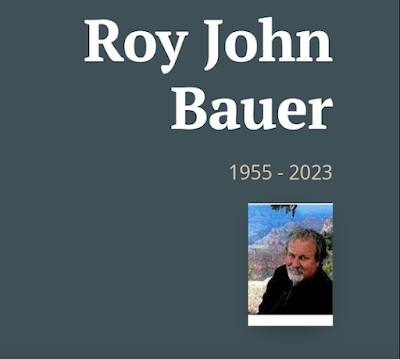
Roy's obituary in LA Times and Register: "we were lucky to have you while we did"

  This ran in the Sunday December 24, 2023 edition of the Los Angeles Times and the Orange County Register : July 14, 1955 - November 20, 2...