Showing posts sorted by date for query loophole. Sort by relevance Show all posts

Sunday, May 22, 2016

Veterans and the deceptive "for-profits" — Are you listening, Glenn?

From the 2014 report: students withdrawing within a year of enrolling
Veterans Groups Seek a Crackdown on Deceptive Colleges (New York Times)
WASHINGTON — Some of the nation’s largest veterans and military organizations sent letters last week to the Veterans Affairs Department asking it to crack down on colleges that prey on veterans by charging exorbitant fees for degrees that mostly fail to deliver promised skills and jobs.
     The letters were signed by top officials at the American Legion, the National Military Family Association, the Military Officers Association of America and nearly 20 other groups. They called on the department to improve its oversight of colleges that have engaged in deceptive recruiting and other illicit practices but that continue to receive millions in funding under the G.I. Bill.
     “We encourage you” to take steps against the dozen or so colleges facing “federal and state action for deceiving students,” one of the letters says.
     The career training and for-profit college industry has been accused in recent years of exploiting veterans, poor people and minorities. Veterans are an especially enticing target because, under a loophole in federal law, money from the G.I. Bill does not count against a cap on federal funding to for-profit schools.
. . .
     Education advocates say the veterans department’s unwillingness to police a program that costs taxpayers billions is difficult to understand.
     “The veterans we serve are understandably angry when they discover that the very consumer fraud they faced at a predatory school is one the V.A. knew about but approved for G.I. Bill benefits anyway,” said Carrie Wofford of Veterans Education Success, a nonprofit group…..
     Among the deceptive colleges: The U of Phoenix (owned by Apollo).
     As you know, IVC President Roquemore has made noisy efforts to help connect students to that dubious organization. See

Clueless IVC Prez Glenn Roquemore smiles as he makes nice with the enemy


     See also Is the New GI Bill of Rights Working? For-Profit Colleges Increasing Veteran Enrollment and Federal Funds, 2014

Vice President, Western Region, Workforce Solutions/University of Phoenix, Chuck Parker, President, Irvine Valley
College, Dr. Glenn R. Roquemore

Wednesday, April 22, 2015

Listen! & "Let us now praise infamous men"

Tim Jemal
     Went to the trustee “listening session” today at Irvine Valley College. It was held in the Café, that silly space at the north end of the library.
     Four trustees were in attendance: Marcia Milchiker, Dave Lang, Tim Jemal, and Jim Wright. No one—including Chancellor Gary Poertner—accompanied them. Part of the idea of the session, of course, is to ban managers and administrators from the session, “to encourage frankness,” as Lang explained.
     (Nancy Padberg and Bill Jay had really good reasons for not showing; Board President TJ Prendergast evidently couldn't attend because of his teaching duties at his high school.)
     The session started a few minutes after 3:00. Attendance was so-so. The first three rows of chairs remained empty (shyness), but most or all of the chairs circumscribing the room were taken, as were the chairs in back (I was smack dab in the middle, in an otherwise empty row). The middle of the seating area was sparsely occupied.
Marcia Milchiker
     The room stank (sorry) of coffee from the contraptions lined along one side of the room. There were cookies too. No punch.
     I didn’t count heads but it seemed to me that there were more classified employees than faculty in the room.
     Things got started. Tim Jemal took charge. He went over the rules: two minutes to a customer, but the trustees would accommodate anyone with something to say, even, I guess, if it took longer.
     A classified employee was the first to speak up. She carped about having to attend training sessions during lunch, thereby interfering with her lunch break.
     There was a feeling in the room (or so it seemed to me) that getting comments out of this crowd would be like pulling teeth.
Dave Lang
     Next came a complaint from a faculty member concerning the new manner in which repairs are made (or not made) on campus. Stuff breaks and it is no longer possible just to call a local vendor to fix the dang thing tout de suite. Gotta fill out forms three months in advance (I think that was the figure).
     Jim Wright asked questions, and it came to light that these absurd constraints are not in place down at Saddleback College. Blah, blah, blah. I think the instructor implied that VC Deb Fitzsimmons had imposed these new and absurd procedures, but that seemed to conflict with the fact, if it was a fact, that they have not been imposed down south. Whatever.
     Next comment? Silence.
Jim Wright
     At about that point, it occurred to me that my sitting in the middle of the room with pen and paper might discourage the desired loose lips. (I recalled abandoning a similar session a year ago for the same reason.) So I just grabbed a cookie and got out of there.
     It was maybe 3:15 or so.
     So, how did it go? Did things, um, pick up? Hope so.
     Let us know.
     UPDATE: a reader writes:
After you left all the seats filled and it was standing room only. It definitely picked up. There were a mix of faculty and classified staff feedback.
* * *
     About a week ago, the district put out an email “sadly” reporting the death of Armando “Muggins” Ruiz.
     According to the district release, Armando was a helluva guy: “Armando was known for his generosity and was respected by many as a model of unconditional love….”
     Gosh. I remember when similar things were said about Tom "Prince of Darkness" Fuentes when he passed.
     Predictably, IVC’s permanent president, Glenn Roquemore, chimed in:
“He was a very good friend and colleague. We served together as Vice Presidents for a few years. He was a talented professional and an excellent father and husband.”
     This sort of spin does no good. Decent people are pained by it, discouraged, demoralized. There are some admirable people among us. Often, they go unappreciated. Meanwhile, creeps are lionized and eulogized.
     So what's the problem with singing the praises of "Muggins" Ruiz? Well, Ruiz was a rat bastard. An unscrupulous jerk.
     Under the circumstances, the best thing to do is to say nothing.
     Instead, we were told that “Armando spent 40 years devoted to education….” What a public servant!
     The OC Register didn't see it that way. According to the Reg, "Politics is a selfless job; then there's Armando Ruiz…."
     Here in DtB, we often reported Ruiz’ misdeeds. About five years ago, we finally wrote:
     One of the minor characters in the epic “SOCCCD and the Neanderthals” saga is Armando "Beyondo" Ruiz, who, while counseling at Saddleback College, managed to get elected on the Coast Community College District board of trustees. That started back in the 80s, I believe.
     Ruiz is coarse, stupid, spectacularly incorrect (around women), and dishonest. Naturally, therefore, about a dozen years ago, in his desperation to gain allies [among faculty, only Glenn Roquemore showed up all greased up for the ol’ quid pro quo], then-IVC President Raghu Mathur cut a deal with Ruiz; he had "Boots" transferred from Saddleback College to Irvine Valley College for the purpose of grooming him for an administrative career, despite Boot Boy's manifest shititude.
     Not a problem.
     Soon, Ruiz was indeed an IVC administrator, eventually achieving his Mathur-contrived apex as the Vice President of Student Services. Besides Mathur, he was the least popular person at the college. [His role in the ruthless attempt to block the tenure of a Mathur critic didn't help.]
     That Ruiz was a creep wasn’t a problem for Mathur—after all, Mathur’s creepitude at least matches Ruiz’. That he kept f*cking up was slightly more bothersome. But the worst thing about Ruiz was his manifest disgruntlement, in 2002, when he wasn’t chosen to replace Mathur [loyal Mathurite Glenn Roquemore got the nod], who, natch, was awarded the district Chancellorship right after having sued the district. (He sued the district for not having protected him from my suing him in response to his suing me for reporting the truth about him—namely, that he had once violated a federal law protecting students' privacy rights.)
     So, after that, Ruiz bailed, i.e., he retired.
     That’s when he performed the sleazy maneuver upon which his wider infamy rests. Exploiting a loophole in the law, he resigned his trusteeship just days before getting reelected; he thus contrived to enjoy an enormous pension. (As Frank Mickadeit once explained: “He was taking advantage of a loophole that allows a person who exits two state jobs on the same day to count the highest-paying of the two as the salary for both jobs for the purpose of calculating his pension. …So, Ruiz "retired" ... as a part-time trustee of the Coast district and as a full-time counselor at Irvine Valley College. Even though the trustee gig pays just a $9,800 annual stipend, he was able to calculate his state pension as if he had been paid $106K a year for that "job'" plus the $106K a year he got for his real job at Irvine.")
     It was a spectacular flimflam, proving once again that stupidity and craftiness easily fit inside the Neanderthal’s ample cranium.
     A local journalist took up the cause of getting rid of the odious Ruiz. Eventually, Ruiz lost reelection in 2008.
SEE ALSO:
The sad Armando Ruiz saga (OC Register; 11/4/04) -
Politics is a selfless job; then there's Armando Ruiz….

Saturday, December 21, 2013

Yet another FUBAR: the "commencement prayer" issue at IVC


     As you know, Karla Westphal, a math instructor at Saddleback College, has for many years urged the board to back off of its practice of prayer, especially sectarian prayer, at district and college events. She has enjoyed the support of academic senates and other groups. (The prayer issue in this district predates Karla's efforts of the last dozen or so years. It actually goes back at least 22 years.)
     Naturally, in defiance, the Wagner- and Fuentes-dominated board, with then-Chancellor Raghu Mathur, started laying on the religion mighty thick, which led to the “Westphal v. Wagner” litigation, of which I was a part. (See Prayer in the SOCCCD.)
"Loophole" Boy
     In the end, a settlement was reached according to which a “commencement committee” (actually: the group of "event planners") was supposed to decide independently—i.e., without the influence of trustees or college presidents—whether or not to have an invocation or prayer during commencement ceremonies. (See actual "resolution" below.)
     As you know, Saddleback College’s Tod Burnett immediately defied the prima facie demands of the agreement (evidently on the basis of an alleged “loophole” in the "resolution" produced by the settlement), overriding the commencement committee's decision not to have an invocation.
     Folks complained, but it didn't matter. Not to this board.
     Ah, yes. Exploiting a loophole. Reminds me of the conniveries of such heroes of yore as Steve Frogue and Tom Fuentes, always lyin' and cheatin' for the Lord.
     Meanwhile, at IVC, friends close to the action informed me that the relevant IVC committee was indeed making the determination regarding prayer according to Hoyle. So I backed off and let them be.
     By late Spring (2013), however, I decided to pursue the matter more vigorously. Was the “commencement committee” at IVC, assuming there was such a thing, duly deciding the prayer question—and without undue influence?
     But first thing's first. Is there such a committee? Is there a committee, anyway, that is charged with raising and answering the question of whether there would be a prayer at commencement? Just who are the "event planners"?
Rumored to be Glenn's
"spiritual guide"–or possibly
Glenn's "spirit animal"
     On June 25, 2013, I wrote the Academic Senate President, knowing that she, if anyone, would be able to answer my question. In a friendly email, I wrote
     [A]s you know, the "Wagner v. Westphal" settlement essentially requires that the "commencement" committee will decide, independently of outside influence, whether to include an invocation/prayer. ¶ I do not recall how it is that the membership of that committee is determined. No doubt you do. Do we (the AS) appoint faculty members? I suspect that we do. ¶ If not, we need to consider changing that. ¶ Hope to hear from you. ¶ In either event, perhaps we can make this a higher priority next school year.
     The divine Miss S is known and celebrated for many things, but she is not known for speedy responses, and so I waited.
     On August 31, I received this response:
Hi Roy,
     There are several Commencement-related committees [she then notes the unclarity this situation creates]…. ¶ Scholarship awards (that’s the group that decides who gets what) Commencement speaker – for next year; this year (May 14) should already be decided but I don’t know the answer  ¶ Scholarship “oversight” TF [task force]– that is the one that started/restarted last summer to try to figure out how to make the system work. When that group was initially brought together, I thought that it was to look at scholarships and commencement issues, but apparently not. ¶ … and none, as far as I can tell, to look at the actual commencement exercises and how we arrange them. …[I]t appears that the commencement ceremony and associated [folderol] is a Helen L[ocke] - Glenn R deal. ¶ I will ask [IVC Prez Glenn Roquemore] about this at our next regular meeting.
     On that day (Aug. 31), I responded:
     Wow, if there is no "commencement committee" that oversees/plans the commencement, that's a problem. ¶ Do let me know how Glenn answers your question.

     I didn’t hear from Ms. S again (on this matter) for nearly four months—until today, Dec. 21:
"Let us pray" (& cheat) 
Hi Roy,
     It has taken many repetitive inquiries to ferret out an answer, because I kept getting partial answers. My response to you was further delayed because I tied together my notion of addressing what we see as a problem with this answer. I have not “fixed” it, but I think that I’m chopping away, and I did want to answer you in the same calendar year, even with a less than satisfactory answer. ¶ It seems to be “Student Services Council”, which in turn, has no faculty representation. In and of itself, no faculty is OK (parallel to, for example, Dean’s Council), but the problem, obviously, is that this group has purview over events in which faculty have interest and should have standing. So far, I have only been able to insert myself into these things informally and personally, which is a band-aid, not a fix. It is on the list for my first official meeting with GR next semester, to try to ‘convince’ Linda F of the virtues of inclusiveness…. ¶ Commencement is untied from scholarships, and we’ve been focusing on the latter since its timing is more critical. Thank you for your participation and voice in that discussion; I hope we can resolve those issues soon.
     —Well, I guess you’ll just have to stay tuned.
     So typical here at IVC. Everything's either encased in mud, obscured by fog, or operating (in a manner unknown & unhinged) behind closed doors in haunted and hollow A100.
     I think I'll contact this "Student Services Council" and ask how their "prayer" deliberations went last year. What do you suppose they'll say? (Normally, I'd contact Helen, but somehow I don't think that will work.)
     Here's my prediction. They'll say, "huh?" 
     Wanna bet?


Click on graphic to ENLARGE
     For an overview of the prayer saga at SOCCCD, see socccd prayer

Monday, June 24, 2013

Contra SOCCCD prayer: it's all about who's appointed to those "commencement" committees!

     Here's some interesting background on the “Prayer” issue here at the South Orange County Community College District.
     As you know, Karla Westphal, a math instructor at Saddleback College, has for many years urged the board to back off of its practice of prayer, especially sectarian prayer, at district and college events. She has enjoyed the support of academic senates and other groups. Naturally, in defiance, the Wagner- and Fuentes-dominated board with then-Chancellor Mathur started laying on the religion mighty thick, which led to the “Westphal v. Wagner” litigation, of which I was a part.
     In the end, a settlement was reached according to which a “commencement committee” was supposed to decided independently—i.e., without the influence of trustees or college presidents—whether or not to have an invocation or prayer during commencement ceremonies.
     As you know, Saddleback College’s Tod Burnett immediately decided to defy the prima facie demands of the agreement (evidently on the basis of an alleged “loophole” in the "resolution" produced by the settlement), overriding the commencement committee's decision not to have an invocation. I suspect that the difficulty he has had in the last year finding another gig—his contract with our district is not liable to be renewed—has something to do with that peculiar action and news coverage concerning it. (Go ahead; Google "Tod Burnett.")
     I just wanted to remind everybody that the “prayer” issue actually has a long history in our district and that one needs to consider that issue against the backdrop of larger OC politics and trends.
     Consider, for example, the following:

1. WITHOUT A PRAYER (LA Times, Dec. 10, 1992)
     Trustee Harriett S. Walther has finally won her fight to cut the invocation at meetings of the Saddleback Community College District, a 25-year-old tradition. Walther has long worried about the potential illegality of mixing prayer with government meetings. . . . "We should err on the side of caution in dealing with the Constitution, which we have been sworn to uphold," she says. The vote was 4 to 3 on Monday—after that meeting's opening prayer.
     Harriett Walther (who, by the way, remains active) was an uncommonly independent trustee (1977-1996), though she was undoubtedly liberal on most issues. Her refusal to cater to the Faculty Association (faculty union)—at a time when that organization made unprincipled alliances with explicitly anti-faculty and conservative trustees purely for the sake of securing high salaries and benefits—made her unionists' public enemy #1.
     That was ridiculous. In truth, Harriett's values were likely closest, among trustees, to those of most faculty.
     Well, among her issues was her discomfort with “invocations” at BOT meetings. She prevailed.
     Alas, the heedless and irresponsible (and overtly political) right-wing board created by the faculty union (the FA supported Williams, Frogue, Lorch, Padberg, Wagner, Fuentes–until it was reformed in the early 2000s; even then, it continued to support the rat bastard Williams, a sore point among many of us in the Association) undid that bit of progress. Those people just did what they wanted, regardless of decency, best practices, tradition, or law. (Don't forget their repeated Brown Act violations.)

2. Prayer and being "out of the picture" at the South Orange County Community College District (Nov 4 06)

     The above 2006 DtB post referred to a Times article that reviewed the tenure of Joyce Greenspan, chief of the local (Long Beach/OC) ADL. Owing to my telephone call to her, Greenspan became involved in the flap over trustee Steve Frogue’s notorious “JFK Forum” back in 1997. (I won't go into all that.)
     Previously, she had come to the defense of an instructor (Richard Prystowsky) whose Holocaust course caught the lunatic attention of Frogue, an apparent Holocaust denier. (See also Froomkin.)
     In the Times article, Greenspan was asked about conditions in OC in 1981, when she took on the ADL job, and whether things had improved with regard to tolerance of minorities, etc.:
     In 1981 there was just a hint, a beginning of diversity in Orange County. But it was not a very diverse community, and looking at church-state issues, there wasn't a lot of tolerance for understanding that everybody was not looking at religion the same way. There were a great many issues having to do with local government, having to do with schools, having to do with any public area in which people were speaking as government representatives—teachers, principals, elected officials—and felt that they were speaking to people just like them….

     For instance, if you look at a number of city council meetings of those days, there would always be a prayer before a council meeting. Those meetings would begin with a very Christian prayer. It's a discomfort that people feel if you aren't Christian and a meeting is beginning with the invocation of a Christian prayer, it kind of leaves you out of the picture.

     Now, people are very careful. If they do a prayer, it's nonsectarian—not just nonsectarian Christian but nonsectarian.
True enough, I wrote at the time,
—except at the South Orange County Community College District, where, routinely, Christian or Christianesque prayers are offered by the very theatrical Mr. Tom Fuentes. If you've ever heard one of his invocations, you know what I mean.

Her stalking off in a room of silence is sad, disturbing, and 
invigorating. You can't do much better than that!

     As I said, at one point, the board decided to turn up the heat and to up the religion factor. That provoked the lawsuit.
     As you know, invocations were given at our recent commencements. It is not clear to me whether the decisions to include these prayers was reached "independently" by the committees. It is important to notice, however, that at least in the case of IVC, the vast majority of committee members are directly answerable to the college President.
     So what do we do? Faculty (and classified) who believe in the First Amendment's anti-establishment clause need to consider getting on those committees and bringing our district in line with the more enlightened practices of institutions all around us.

     THE SETTLEMENT STATUS QUO: The board's all-important "resolution" regarding invocations is reproduced below (read especially the "therefore" half):

Click on graphic to ENLARGE
     For an overview of the prayer saga at SOCCCD, see socccd prayer

Sunday, July 15, 2012

OC's "win at any cost" political ethic: Butcher-Forde, Tom Fuentes, & James Lacy

Butcher & Forde united during
the first Caspers campaign

From the "Trustee Tom Fuentes files" [Fuentes got his start working for corrupt OC supervisor Caspers; Caspers' chief crony was the corrupt Fred Harber]: 

     “Some of these consultants regard a campaign as the equivalent of warfare, in which anything goes, short of overt violations of the law. Deceptions and misrepresentations, especially unleashed at the last minute through computerized mailings, seem to have become, for some, a standard campaign technique.”

—Orange County Citizens' Direction
Finding Commission report, 1978
     OK, this one’s for the “It’s a small world” file—and for those of us who love to see “connections” between people and events, especially surprising or interesting ones.
     A couple of days ago, our old pal Matt Coker (NavelGazing/OC Weekly) reported about some seriously sleazy campaigning in San Diego that bore the fingerprints of OC dirty-tricksters.
     You’ll recall that, in the past, I have noted that OC has been on the cutting edge of political methods, including sleazy and dishonest campaign tactics. One entity that figures importantly in that story is the consulting firm “Butcher-Forde,” which early on (c. 1970) exploited computer-assisted campaigning and direct-mail approaches. Butcher-Forde definitely wasn’t into the “truth” or "honesty" thing; they plainly adopted an “end justifies means,” win-at-any-cost approach.
     Such language has been used to describe Tom Fuentes' approach as chairman of the OC GOP. Tom, of course, worked with Butcher-Forde and people close to the firm during its beginning.
     One such person was political consultant (and Shooting Star yachtsman) Fred Harber. You'll recall that Harber was crucial to the success of “Dick and Doc” and such candidates as Ron Caspers, for whom Tom Fuentes worked at the start of his political career.

Gary Kreep
     Now back to Matt’s post about San Diego political sleaze:
     Birther and San Diego County judgeship candidate, Gary Kreep, it seems, survived the recent primary and will be on the ballot in November. But reporters down south have been looking into his campaign, and they smelled a rat:
     After Kreep, a very right-wing candidate with Minuteman leanings, received the majority of votes in the primary for the Superior Court seat, the Voice of San Diego analyzed precinct data and discovered he did very well in southern San Diego, which is composed mostly of Democrats, Latinos and Democratic Latinos. [!]
     Tipped by an anonymous source, San Diego City Beat's Dave Maass is reporting last-minute robocalls were made by a political action committee (PAC) called Taxpayers for Safer Neighborhoods against Kreep's opponent, Deputy District Attorney Garland Peed. Maass includes in his online report [an] audio of such a call, which claims Peed would be "the worst kind of county judge" because he used plea bargains to put a drug dealers back on the streets.
     The call cites the case of a criminal named Brian Moore, but as Maass reports the group conflates the prison sentences of two inmates with the same first and last name. Robocalls in elections are outlawed in California anyway if they are not introduced by a real person. The one slamming Peed was not, according to the City Beater.

     
Matt goes on to explain that this sure smells like OC sleaze. And that’s because it IS OC sleaze:
     The PAC [viz., Taxpayers for Safer Neighborhoods] lists as one of its directors James Lacy, a former Dana Point city councilman, constitutional-law attorney and onetime national chairman of Young Americans for Freedom. Lacy is also chairman of Western Conservative Political Action Conference, whose vice chairman and counsel is . . . drum roll, please . . . Gary Kreep!
     Lacy … is one of campaign-finance reform's most lethal enemies.
James Lacy
     DtB readers will recall that we’ve mentioned Mr. Lacy many times before. I do believe I first encountered his name back in the days when I worked with Wendy (Gabriella) on our (successful) Brown Act lawsuits against the SOCCCD BOT. As I recall, Lacy had contacted Wendy and wanted to speak with her. I don’t recall if she and he ever got together, but I do know that Lacy went on to represent a client who sued the Capo Unified School District Board for its egregious Brown Act violations.
     In DtB, Lacy’s name has come up in connection with The American Conservative Union, the conservative CPAC conference, and the Young America’s Foundation. It has come up, too, in connection with the worst kind of political dirty tricks—the kind that make one think of Lee Atwater and Karl Rove. (As chair of the OC GOP, Fuentes established the annual "Republican Party of Orange County Lee Atwater Award"—an action not unlike establishing a "Machiavelli" prize for "excellent ruthlessness.")*
     And, of course, Lacy was very friendly with late SOCCCD trustee Tom Fuentes.

Butcher, c. 1982
     But let’s get back to Matt’s recent article, which next cites Nick Schou’s report on Lacy of ten years ago. That article revealed that Lacy is an old hand at the tactic used against Mr. Peed.
     I decided to read Schou’s article: Slate Nailer, Dec. 12, 2002.
     Schou reported Lacy’s slate mailings in support of prominent liberal Democrats in Santa Monica. The mailings also directed voters to vote “No on JJ.” JJ was the city’s living-wage ordinance, which would have forced employers to pay bottom-wage employees more. These anti-JJ slate-mailings were paid for by hotel owners who had hired conservative consultant Jim Lacy.
     It is likely (evidently) that JJ failed (by a small margin) because of the confusion among liberal voters created by these crafty slate-mailers.
     Schou contacted Lacy and spoke with him. It is here where the name William Butcher comes up:
     In a recent interview at his Laguna Niguel law office, Lacy acknowledged that he was asked to help defeat Measure JJ by his old friend William "Lord" Butcher, who is listed on election paperwork as the person who "authorized" the contents of the mailer.
     Butcher and Lacy previously teamed up to produce slate mailers for "Save Proposition 13," having first met in the late 1970s when they worked for the Howard Jarvis Taxpayer's Association, which sponsored the controversial statewide property-tax initiative. [The Jarvis organization used Butcher-Forde.] Prop. 13 prohibited any new property taxes on existing homeowners. It had the effect of starving California of cash for welfare, education and other social programs.
     Butcher, who moved to England in the 1980s and changed his name to Lord Butcher even though he is neither a British subject nor of noble birth, is even more famous for his right-wing direct-mail campaigns. He formed a Newport Beach consulting firm with Arnold Forde; the pair liked to call themselves the "Darth Vaders of Direct Mail." They raised money for conservative political causes by, among other things, scaring elderly voters into thinking they were in danger of losing their Social Security checks or that Prop. 13 was about to be overturned.
     Meanwhile, they got rich, allegedly pocketing much of the money they raised. A 1996 Los Angeles Times story reported they kept as much as $5 million per year of their firm's $12 million in earnings in the mid-1980s.
     Lacy doesn't find it ironic that he and Butcher, two lifelong pro-life Republicans, were the only officials of a phantom group calling itself the Pro-Choice Voters Committee. "The irony is I'm a lawyer," he said. "I work for Democrats and Republicans, but I happen to be a conservative Republican."
     Because he's a lawyer, Lacy is a double threat. He helps organize deceptive slate-mail campaigns on behalf of private developers, anti-abortion groups and other conservative causes. Then, when voters pass campaign-finance laws to regulate deceptive slate-mail campaigns, he uses his legal expertise to get those regulations overturned in court.
. . .
     Lacy is still trying to overturn a county-approved $1,000 cap on individual contributions—a limit that also applies to slate mailers and, thus, his pocketbook. The ordinance, which the Board of Supervisors passed in July, was authored by good-government activist Shirley Grindle.
. . .
     On [Lacy’s point that slate-mailers can’t be ignored], if on nothing else, Grindle says she completely agrees with Lacy. She has spent the past three decades trying to reform campaign-finance laws, only to see much of that work overturned by legal challenges, as most recently occurred with Props. 134 and 208—both of which Lacy helped orchestrate.
     "Every time we close a loophole, it seems like they find a new way to get around it," she said. "I'm just about ready to give up."
Bill Butcher today
     Grindle also battled the influence of professional lobbyists—such as Thomas Fuentes, Lyle Overby, and Frank Michelena. But though her TINCUP legislation has helped, lobbyists, too, have found ways to get around existing regulations. (See.)
     You'll recall that Mr. Butcher was involved in the trial of Dr. Louis Cella. Cella's business dispersed large sums of money through means seemingly designed to obscure the money trail. Butcher was a major beneficiary of such funds. (See here for Lord-Butcher's response to Schou and Schou's response to that response.)
     Immediately after the SOCCCD BOT acted to appoint James Wright and not Jolene Fuentes as Tom Fuentes’ replacement on the board, a James V. Lacy wrote a piece in the California Political Review in which he expressed puzzlement over the board’s action. (I wrote a response, correcting some of his misconceptions.) 
     It seems likely that the piece was part of a concerted effort by those close to Tom (including the OC Reg's Frank Mickadeit) to stir up anger in hopes of fueling a petition drive or support for Jolene Fuentes’ run in November.
     Today, I realized that that James Lacy is the same one discussed above in connection with William Butcher.

* * *
     "When Butcher and Forde brought professional management and a fierce competitive drive to Orange County campaigning, they were challenging decades of friendly, folksy clannishness. They have been called amoral and their campaign tactics deceptive. And the accusations have not been hurled exclusively by their candidates’ opponents."

 — "Butcher and Forde, wizards of the computer letter," California Journal, May 1979.
Lacy's Robocall

*From New York Times:
Forde, c. 1982
     Friends said Mr. Atwater spent his final months searching for spiritual peace. The man renowned for the politics of attack turned to apologies, including one to Michael S. Dukakis, the Massachusetts Governor who was the 1988 Democratic Presidential nominee. ¶ Mr. Dukakis was the target of a campaign advertisment about Willie Horton, a black convicted murderer who escaped from the Massachusetts prison system while on a weekend furlough and raped a white woman and stabbed her husband. The advertisement became a central focus of the 1988 campaign. ¶ "In 1988, fighting Dukakis, I said that I 'would strip the bark off the little bastard' and 'make Willie Horton his running mate,' " Mr. Atwater said in the Life article [about his battle with cancer]. ¶ "I am sorry for both statements: the first for its naked cruelty, the second because it makes me sound racist, which I am not." ... ¶ The Bush organization, which campaigned relentlessly on the Horton case, was widely criticized as appealing to racial fears.
     (One of Jim Lacy’s former partners, Floyd Brown, was directly responsible for the Horton ad.)

Wednesday, May 30, 2012

Plagiarism is a form of theft, Glenn (but all is well, really)

Chris Mars: "Community Pillars"
     Here’s a story we’ve held back for a week and a half, not wishing to spoil students’ big day:

     You’ll recall that we’ve offered some, um, perspective on IVC President Glenn Roquemore’s curious approach to choosing commencement speakers. (See Too political and That’s some leadership!)
     This year, as usual, the Commencement Speaker Committee, comprising wide representation, selected three speaker candidates from a master list that they had assembled. They sent those names forward to the President for consideration.
     But, for whatever reason, Roquemore didn’t secure any of those three. Without conferring with the committee, he went back to the Committee’s master list and chose Mr. Keith Rhodes, CEO of Big Brothers Big Sisters of Orange County—a “safe” choice, I guess, among the embracers of the GOP world view (according to which, essentially, all is well and patriotism—combined with cheerful "getalongitude"—are the chief moral virtues).
     Well, whatever. Process Schmocess, I guess.
     Rhodes was entertaining, if manifestly unoriginal. (I barely listened to him, occupied as I was by my photographic efforts. I do remember his bit about marrying somebody smarter.) But, immediately after the ceremony, I started hearing from faculty who found Mr. Rhodes’ address—oh, kinda familiar.
     Since that day, several faculty have sent us a link to a recent article in which NPR lists advice from the book The 10 Things You Won't Hear At Commencement by Charles Wheelan.
     Gosh, that advice does seem awfully familiar.
     Oh my.
     Draw your own conclusions.

• D.A. won't charge accused coaches (OC Reg)
…Saddleback College in Mission Viejo, meanwhile, disciplined one athletic department employee in the Lapes Athletic matter, while Irvine Unified completed an investigation but determined no wrongdoing on the part of its employees….
• Attorneys General Urge Congress to Close Military 'Loophole' at For-Profit Colleges (Chronicle of Higher Education)
Attorneys general for 21 states have called on Congress to close an "apparent loophole" that they say encourages for-profit colleges to use "high-pressure recruiting tactics" on military veterans….

Wednesday, March 7, 2012

The Saddleback College Academic Senate pushes back against Prayer Boy

Burnett: exploiting an alleged "loophole"
in the Westphal/Wagner settlement
     A friend at Saddleback College writes:
     Last week our Academic Senate approved the attached resolution. I’m not … sure how the decision to invite a Rabbi for the invocation this year was made—I know Tod wanted to invite him last year but he was unavailable then….
     If you could check and see how the decision is being handled at IVC, that would be great. I know last year, the [IVC] committee voted [i.e., was allowed to make the decision whether there would be an invocation], but I’d be curious to see whether they’ve been “allowed” to again this year. Do you think there’s any chance that IVC’s Senate would consider a resolution backing up ours?
     Feel free to use the resolution on Dissent the Blog. …[W]e tried to keep the focus on shared governance and not on the prayer issue itself. ... This resolution was passed recognizing the legal reality that currently the “Event Planners” are supposed to make the decision about whether or not to have an invocation.
     Here’s the resolution:
     Whereas, Commencement is an important event for all members of the Saddleback College community, be they students, faculty, classified staff, or administrators, and
     Whereas, the College Commencement Committee includes representatives from all of these groups to ensure that their voices are heard in planning this ceremony, and
     Whereas, the principle of shared governance is that all constituent groups should have a real role in the decision-making process, and
     Whereas, President Burnett’s decision in 2011 to override the Commencement Committee’s unanimous vote to offer a moment of silence instead of an invocation in that year’s ceremony is inconsistent with the principle of shared governance, and
     Whereas, such top-down decision making has repeatedly caused problems for our College in the Accreditation process,
     Therefore, be it resolved, that
     The Saddleback College Academic Senate affirms that the College’s Commencement Committee is the best group to decide whether or not to include an invocation at the annual Commencement ceremony,
     And, resolved, that
     The Commencement Committee as a whole should be explicitly charged with making this decision and their decision should be final,
     And, resolved, that
     This should go into effect beginning with the 2012-2013 academic year, as an invitation for a speaker to deliver an invocation has already been issued for the 2012 Commencement ceremony.
     So. What say you?

Tuesday, May 10, 2011

Who does Tod Burnett think he is? Saddleback Prez imposes prayer at commencement

     (See update HERE)
     AS YOU KNOW, recently, the district settled “Westphal v. Wagner,” the lawsuit that challenged the board's arrogant imposition of prayer at college and district events. According to the settlement, invocations would cease at Chancellor opening sessions and at Scholarship awards ceremonies. Further:
The decision on whether to select a speaker to deliver personal remarks in the form of an invocation, moment of silence, or opening and/or closing message, not to exceed two minutes, at important District and college events [e.g., commencement] shall rest within the sole discretion of the event planners, whether they be students, faculty, administrators, classified employees of the District, or a combination thereof. (From the resolution)
     I have made inquiries, and it is clear that, at Irvine Valley College, the terms of the settlement have been followed with regard to the decision whether to have an invocation. The committee (I’m assured) was in no way pressured or instructed to choose an invocation. (They did choose an invocation and a speaker, Mark Whitlock.)
     I have it on good authority, however, that matters are quite different at Saddleback College. I’m told that President Tod Burnett views himself as the ultimate decision-maker regarding commencement and that the preference of Saddleback’s commencement planning group (reportedly to go with a “moment of silence” instead of an invocation/prayer) is a mere recommendation that, evidently, he feels he need not follow.
     But read the above verbiage. Decide for yourself.
     To see the actual Settlement Document and its Resolution, go here.
* * *
     A few days ago, a Lariat article made a cryptic reference to an alleged “loophole” in the settlement (see The future of invocations at college ceremonies after settlement). The article did not make clear what that loophole is supposed to be.
     In the very same article, Ayesha Khan, chief attorney for plaintiffs in “Westphal v. Wagner,” denied that there is any “loophole” in the settlement:
"There's nothing ambiguous here about graduation; the Agreement is clear that the decision is no longer up to the Board of Trustees, but will be made by the planning committee at each college."
     Somebody better tell Tod Burnett.
* * *
     The notion of a “loophole” first arose in an April 12 OC Register article:
     Though a settlement has been reached, [defendants’ attorney, John] Vogt pointed out a potential loophole.
     Language in the settlement prohibits the colleges from holding invocations at scholarship ceremonies, but it's possible for the tradition to continue if the colleges' foundations – private, nonprofit entities who were not party to the lawsuit – resumed planning the events, Vogt said, since "nothing in the settlement would preclude the foundations." Vogt said the foundations historically planned the ceremonies until 2008.
     [Ayesha] Khan disagreed with Vogt's interpretation of the settlement agreement.
     "Neither the South Orange County Community College District, nor its colleges ... shall include an invocation on the program at any future scholarship ceremonies," Khan said, reading from the agreement. "I think they'd be skating on really thin legal ice."
See update HERE

Tuesday, April 12, 2011

More on the "Westphal v. Wagner" (prayer lawsuit) settlement

Don Wagner: dramatization of his unconstitutional scholarship rant
Plaintiffs'
Ayesha N. Khan
Colleges agree to discontinue some prayers (OC Register)

MISSION VIEJO – Saddleback and Irvine Valley Colleges have agreed to discontinue the use of invocations at scholarship ceremonies and faculty training sessions like the Chancellor's Opening Ceremony as part of a lawsuit settlement with a group seeking to prohibit prayers at college events.
     According to the settlement, the colleges may continue to hold a nonsectarian prayer or moment of silence during graduation ceremonies if the event's planning committee chooses to do so.
     The federal lawsuit, Westphal v. Wagner, was filed in November 2009 by Americans United for Separation of Church and State on behalf of Saddleback College professors Karla Westphal, Alannah Rosenberg, Margot Lovett and Claire Cesaero-Silva, Irvine Valley College professor Roy Bauer, Saddleback College graduate Ashley Mockett and two anonymous Saddleback College students.
     The lawsuit named as defendants the district's trustees, former South Orange County Community College District Chancellor Raghu Mathur and Saddleback President Tod A. Burnett.
     Lawyers for both sides said they were pleased with the settlement.
     "Our hope was to have all of the prayers discontinued, but we recognized that we stood on stronger legal ground with respect to some events than other events," said Ayesha Khan, the plaintiffs' attorney.
     "I think this was a fair compromise."
     Legal counsel for the defendants said the district got "exactly what it wanted."
     "The main goal in the litigation from the defense side was to preserve the ability of the district to have invocations at college graduations. This settlement does exactly that," said attorney John Vogt from Jones Day.
Mathur: showed a patriotic slide
show with a "Jesus saves" message
     Americans United challenged the use of prayer and other religious content at all college-sponsored events, claiming it is a violation of the First Amendment rights of those in attendance. The plaintiffs named several instances where they thought religious content was inappropriately used at college events.
     In February, U.S. District Court Judge R. Gary Klausner determined that nonsectarian invocations at events like graduation and scholarship ceremonies do not violate the Establishment Clause of the First Amendment, which enforces the separation of church and state. The judge denied the plaintiffs' request to prohibit invocations because they could not show irreparable damage would result from continuation of the tradition.
     However, Klausner also determined two incidents named by the plaintiffs – one involving Mathur and another involving former SOCCCD trustee Donald Wagner – did violate the Establishment Clause.
     The incident related to Mathur occurred during the Chancellor's Opening Session in August 2009. A slide show of patriotic images set to "God Bless the USA" was played during a faculty training session, ending with two slides picturing flag-draped coffins of U.S. soldiers.
     According to the court order, the images were superimposed with the message, "Only two defining forces have ever offered to die for you. Jesus Christ and the American G.I. ... One died for your soul, the other died for your freedom."
Defendants'
John A. Vogt Jr.
     The slide show had been approved by Mathur. The defendants contended Mathur had only seen the first few slides before approving the presentation.
     The incident related to Wagner occurred at a May 2009 scholarship ceremony, which Wagner opened with an invocation.
     In the invocation, Wagner mocked "the special interest group that has contacted this college to pursue its agenda of driving God from public square" by calling out the group's efforts and reminding the audience that "America's founders invoked the name of God, and encouraged and participated in religious ceremonies in government facilities."
     Both parties were required to meet for a settlement conference after Klausner issued the order in February. Vogt said the settlement was reached on March 31, eliminating the need for Klausner to issue a final judgment in the case. Before the settlement agreement, Khan had previously said the plaintiffs had planned to appeal to the state Supreme Court the portion of Klausner's ruling against them.
     Though a settlement has been reached, Vogt pointed out a potential loophole.
     Language in the settlement prohibits the colleges from holding invocations at scholarship ceremonies, but it's possible for the tradition to continue if the colleges' foundations – private, nonprofit entities who were not party to the lawsuit – resumed planning the events, Vogt said, since "nothing in the settlement would preclude the foundations." Vogt said the foundations historically planned the ceremonies until 2008.
     Khan disagreed with Vogt's interpretation of the settlement agreement.
     "Neither the South Orange County Community College District, nor its colleges ... shall include an invocation on the program at any future scholarship ceremonies," Khan said, reading from the agreement. "I think they'd be skating on really thin legal ice."

     In a recent post, DtB calculated the amount of money the district has paid Jones Day thus far. See A point of information.
     The amount: $1,041,150.00
     In the settlement, the district agrees to pay Americans United for Separation of Church and State $250,000 (plaintiffs’ attorney fees). (See.)

Judge Klausner: actually, Don, we need a bit less than you're providing

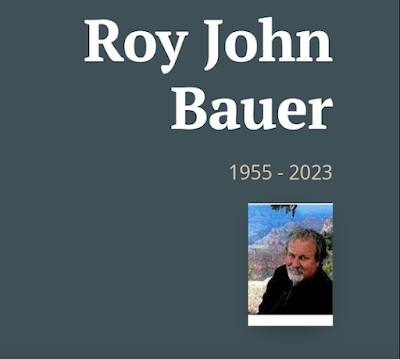
Roy's obituary in LA Times and Register: "we were lucky to have you while we did"

  This ran in the Sunday December 24, 2023 edition of the Los Angeles Times and the Orange County Register : July 14, 1955 - November 20, 2...