Thursday, December 26, 2013

What will Saddleback's new Science Bldg. look like?

Rendering 1
Rendering 2
Saddleback College will break ground on new sciences building Monday
     The 51,244-square foot, three-floor building will house 26 modern laboratory spaces for academic programs in earth sciences, life sciences and chemistry. The new building will be Leadership in Energy and Environmental Design (LEED) certified and will include sustainable design features like a courtyard with a themed demonstration garden planted over an underground element to provide onsite detention of storm water, reducing the impact on the campus storm water system.
     The new sciences building will be located at the college’s northeast end next to the Student Services Center. Saddleback College is at 28000 Marguerite Parkway.
Saddleback College breaks ground on new sciences building

Wednesday, December 25, 2013

New Agery in the SOCCCD: inane antimatter to academic matter

     What’s with SOCCCD college presidents and fuzzy-brained, New Age self-help philosophies?
     Some will recall that Raghu Mathur, whilst President of IVC, routinely employed the ludicrous methods and concepts of Helice “Sparky” Bridges, founder of “Who I Am Makes A Difference”® and IGNITE WHAT’S RIGHT™.
     Nope, I’m not making this up (see Raghu’s Wildfires of Inanity). Raghu really does have a thick “New Age” streak running down his back, right between his narcissism and his piety. No doubt such fuzzybrainedness was encouraged during his years acquiring his Ed.D. degree from a Cracker Jack box he found in Florida.
     And now we learn that Saddleback College’s Tod Burnett is the “Education Editor” of Legends and Legacies Magazine, a publication evidently guided by some seriously flaky martial arts gurus, namely, Frank Dux and Gordon Richiusa.
     According to Wikipedia,
     Frank W. Dux (pronounced "dukes") is a martial artist and fight choreographer. Dux established his own school of Ninjutsu in 1975, called "Dux Ryu Ninjutsu". He was the inspiration for the 1988 film Bloodsport starring Jean-Claude Van Damme [which featured exciting adventures in Southeast Asia]….
According to the LA Times,
     Military records show that Dux never ventured closer to Southeast Asia than San Diego. His only known war injury occurred when he fell off a truck he was painting in the motor pool.
     Dux's trophy from the Bahamas event was at least partially made in the San Fernando Valley, the trophy maker said. The ceremonial sword he won in the fights was sold, Dux said, in a failed attempt to buy freedom for the Philippine orphans.
     Dux argues that his claims are difficult to prove or disprove because of the secrecy surrounding both his military record and the clandestine tournament. He said his life story can be verified by a few witnesses who say they saw the blood-gushing fight in the Bahamas and received top secret messages from him while he was in the military.
     The real story of Frank Dux, say many who know him, is one of a bright but undistinguished young man who, using cleverness and chutzpah, re-created himself as a super-hero a decade ago, painstakingly authenticating his new persona with military medals, trophies and newspaper clippings of questionable origins.
     Through the years, his story has flourished amid the hazy braggadocio of the American martial arts industry, a field peculiarly vulnerable to fakery, according to several experts.
     Gordon Richiusa appears to fit the same mold: an under-educated self-promoter and self-help entrepreneur. A New Age opportunist and flimflam man, martial arts division.
     He’s an odd one. In a badly written (odd punctuation errors) essay entitled Why English?, Richiusa seems to suggest that English is somehow the best language in the world. He also seems to suggest that second generation members of immigrant communities ought to forget their native tongues in favor of the supreme language, English:
     U.S. citizen, Jhoon Rhee, listed as one of the 203 greatest immigrants in United States history, … writes in his autobiographical/philosophy book TRUTOPIA that most of his own 21 Miraculous Achievements are directly or indirectly related to his desire to proficiently speak, read and write English…
. . .
     To those who are native English speakers we have this advice: Consider how lucky you are to have been blessed with learning English as your first language! There are indeed many freedoms and blessings of living in the United States. Speaking English is just one that most of our forbearers … knew the value of achieving. Many immigrants in the past (and most today) know that the first order of family business when migrating to the U.S. is to assimilate the language of English….
     My grandparents, and my wife’s grandparents were Italian immigrants and, like many others from the Old Country, did not allow their children to speak Italian. This is true of many of the older generations of immigrant Americans. However, many of my generation feel that something was lost in the translation. We must be careful not turn our back on those values that produced a successful assimilation! Discipline, respect for others (especially elders) and the belief that the good of the “family” was greater than the good of the individual, are all pointed to as things that we may have lost (or are in danger of losing) by focusing solely on our base, individual survival needs.
     Richiusa can’t seem to help himself; he inevitably returns to daffy New Age notions, his and others':
     Remember, Jhoon Rhee’s originally wrote his book and promoted it in English (his second language), in the United States (his adopted country). He later translated his inspirational text back into his first language, but conceived his entire book in English, where he created the following Trutopian Pledge: When I am truthful, my heart is beautiful. When my heart is beautiful, people love me. When people love me, I am happy.

Tuesday, December 24, 2013

The Five Principles of Corpses: saying no

Legends & Legacies Mag
     Did you know that Tod Burnett, President of Saddleback College, is the “Education Editor” of Legends & Legacies Magazine?
     Yep. But what’s L&L Magazine?
     Good question. I'm not sure, but it looks pretty flaky.
     L&L Magazine explains itself on its website. There, we learn that it “seeks to both entertain and inform with a clear understanding that there is a difference between the two goals, but that one should not be compromised for, or confused with the other.”
     Uh-oh. Sounds like horsesh*t.
     It gets worse. Evidently, the editors of L&L follow a strategy that “can be found in the book, The Five Principles of Everything.” (Run!) The latter is pretty damned New Agey, I’m afraid. It’s author, Gordon Richiusa, happens to be one of L&L’s editors. He’s also a part-time English instructor at Saddleback College. Richiusa’s first novel was called SHIDOSHI: The Four Ways of The Corpse.
     Yeah, he’s into martial arts malarkey, as is another of L&L’s editors, Frank Dux – Editor At Large. So L&L looks pretty damned wacky, I’m afraid.
     You payin' attention, Grasshopper?
     The December issue of L&L sports an interview with Burnett, who's just full of things to say. Here are some excerpts:

     (Dr. Tod Burnett): …While the goal of free online education is noble, it’s never going to replace the human interaction of the classroom, and it’s harder to teach online than in a classroom….
     (L&L) Do you think that some students these days are reluctant to go to college, because of the high cost?….
     (Dr. Tod Burnett): Yes, and that’s sad. That’s where the community college comes in, because we need to turn that around. We need to redefine what education is, what it means to have an advanced degree. We know that for a student to say, “I’m not going to go to school because there’s not going to be a job,” that’s absolutely not true. Even if you take the most under-employed degree there is, it will help you one way or the other in your career, whatever job you want to do.
     …Unfortunately, the way our society is today, whether culturally, socially, definitely politically we tend to gravitate toward—I don’t want to say the lowest common denominator—I want to think of how to say this right. I’m going to coin a phrase here–the individual oppression. It used to be … that we wanted to protect the minority from majority oppression. Now it’s no longer about the minority being oppressed, it’s about the individual being oppressed. I use the term loosely. It could be related to a very small group of people also, or just an individual. When we are making decisions, we are not going to get anything done if we are going to try and appease. satisfy [sic] every small group or individual. ... How in the heck do you do something that doesn’t offend somebody, or isn’t in the best interest of one person against another when it comes to public policy? It’s impossible. So, what happens is that there are stalemates. The press, the media and even the public places it all on our wonderful two party system. How our country can all of sudden be divided up into two camps is beyond me. We’re the most diverse country in the world, and everybody is suddenly a Republican or a Democrat? I guess there is a third party, the Independents, but even at that, how can there be three? This is just the front of the opposition and problems that everybody focuses on. The real issue is that we don’t say no to anybody. If we don’t say no to anybody, then we don’t get anything done. So, things stifle.

Go big or go home: "the orderly and proper workings of the universe"

     (L&L) And, yet that’s the core of community college.
     (Dr. Tod Burnett): Yes and no. How we have to operate under that structure, we have that problem, we have to navigate it all the time, but we’re also the solution because we provide an opportunity for everybody. We were talking about the value of a degree of higher education. There is something for everybody. Anyone who thinks that education ends at high school is completely false, and incorrect. They are doing themselves a big disservice. They may not need to go to some liberal arts college and get a degree; I agree with that.
     … [W]e have to ask, “Who is going to survive in higher education and who is not?” The Harvards, USCs, Stanfords, the top 100 institutions of the world will be fine. The community colleges, the trade schools and technical schools are also going to be doing pretty good. They are positioned well, but it’s the colleges in the middle, the liberal arts colleges, some of the state colleges one might argue, the middle of the road colleges are the ones which are already showing decreases. What it comes down to is that you have to show what your value is in the education and training that you have. We either have to change our institutions to keep up with these environmental, social, cultural, physical, political changes or we’ll be left behind. We’ll become obsolete, or scale down to become almost irrelevant. That, in a nutshell is what’s going on.
     So, when we talk about degrees, we need to take that into account. I am passionate about community colleges, because we are the most comprehensive. ... I love the term, K-through-Career. It needs to be seamless, and a pathway all the way from kindergarten and preschool. With that, we’ll get to your common core, that’s exactly it. We keep focusing on common core, math and English preparedness, which is very important for the common core, but we need to think about the bigger picture and the holistic method of getting students to be good citizens, to have the work skills that they need. When we talk to the business community, for instance, we are hearing them say, “Yes, we need them to know math and English. We completely agree, but we need them to have analytical skills, critical thinking, communication skills. How do you work in a team? How do you come to work and dress properly? What’s proper etiquette? When I went to school, I was in the Boy Scouts, team athletics. I studied fine arts. I was in student government. Our college did activities. We were all active in PTA and our parents were involved. Our communities were involved, and it all happened naturally. Now, we’ve gotten rid of it all. Not only have we gotten rid of it in our educational process and what’s important, but we focus so heavily now on grades and, we’ll call it Back To The Common Core that we’ve lost sight of all these other skills that are important. Then, of course there are also environmental changes, the new technology changes.


     We laugh about video games. I was a TV generation, so they said it about us too. We seemed to be o.k. with TV, because what we did was all sit around and watch TV together. With video games you don’t have to. With texting and everything, this is the most knowledgeable, the most worldly, the most skilled, in a way, generation of all time, yet the most disconnected. Isn’t that odd? They don’t have the basic skills—and I’m not talking about English and math only. I’m talking about communication, interaction, people and governance. With Generation Y, the Millenials, we’re having a hard time finding students who want to be leaders.
     With all the leadership training, with all the stuff we talk about, we’re finding for whatever reason that young people are not stepping forward and being leaders. Part of that is the herd mentality. They’re in groups, together and they’re online and texting, but they are not ever out there alone. They have to be with the group. Today is 9/11 and it is said that mentality has to do with an insecurity that was instilled at that time. They are also the generation that has parents who have done everything for them….

Monday, December 23, 2013

Her chocolate voice

when alex was sixteen he growled that famous vocal for "the letter" and got told where to sit and where to stand … tired of that … did this music a couple of years later, in New York, kicking around … couple years later, ended up in Memphis with some talented pals; a great young band with a great sound; they had the bad luck that young musicians often have, and then some, and it destroyed them. 3 albums; a record of disintegration and collapse… alex lived on, sort of, and died, a hero, without a bank account, in Louisiana, 2010, 59 years old … his song always playing in my head
I always think of lonely rural nights, barns, and always that bit of reverb. Band of Horses. So very very cool and American, through and through

I know time's gonna take its toll
We have to pay for the love we stole
It's a sin and we know it's wrong
But our love keeps comin' on strong

Steal away to the dark end of the street

Her chocolate voice and love of stark instrumentation and subjects gets to me every time --rb

Saturday, December 21, 2013

A screen door on a submarine


     Did you know that IVC’s eternal President, Glenn Roquemore, is on the “Political Action Committee” of the Association of California Community College Administrators (ACCCA)?
     At the ACCCA website, Glenn is listed along with seven other PAC members.
     Golly.
     What’s the ACCCA, you ask? Well, according to the website, “Established in 1975, ACCCA is a non-profit organization dedicated to the advancement of administrator's rights” [sic]. It is, they explain, “the premier association for community college administrators in California.”
     I guess these administrators have it pretty bad. Much put upon. So they've got this lobbyist organization to give 'em a little muscle so they can protect themselves. Like a can of Mace.

* * *

     Turns out, Glenn is on the ACCCA board. He’s the organization’s "Second Vice President."
     Gosh.
     David Bugay, the SOCCCD Vice Chancellor of Human Resources, is also on the board.

* * *

     Looks like the ACCCA and its PAC are nakedly political. They unapologetically play the lobbying game up in Sacramento.
     Elsewhere on the site, we’re told:
     The ACCCA Political Action Committee is the only PAC among administrative organizations, and gives ACCCA the ability to support political campaigns and legislators through direct contributions. The PAC ensures that ACCCA has the means to cultivate relationships with legislators, influence legislation, and contribute to significant initiatives and statewide campaigns that benefit administrators. ACCCA also employs a lobbyist to achieve these goals, and uses PAC money to support his efforts.
     They advocate pension reform.
     They provide salary surveys to their members. (Aren't paid enough, I guess.)
     They’ve got a newsletter with ads and everything.
     Evidently, they have strong views about the mess at City College of San Francisco. Some administrators are under threat there 'cuz CalSTRS thinks they aren't "performing creditable service." Imagine.

* * *

     Like I said, the ACCCA is all about promoting administrators’ rights. They're pretty focused on that. The organization’s PAC
is ... solely dedicated to advocating for your administrative rights in Sacramento. The PAC ensures that ACCCA has the means to influence legislation and contribute to statewide campaigns that help administrators throughout the California community college system.
     I wonder how the ACCCA feels about the growing sense,* across the country, that higher education is being overrun, even ruined, by administrators? And that said administrators are more useless than ever, which is really saying something?
     I wonder if ACCCA have a mascot? 
     I’ve got a mascot idea.
     How about a screen door on a submarine?

Glenn's the Captain.

*Regarding this sense, see 'The Fall of the Faculty'
Very top down
“I wanted to emphasize a major shift that’s been underway for several decades. Deans have an academic background. Years ago, they were part-time and always part of the faculty. This is extremely important because, like the faculty, they saw the university as an instrument of teaching and scholarship. Today, we have a cadre of professional administrators. I called them deanlets to give emphasis to the difference. They either have no faculty background or they decided early in their careers that their talents lay elsewhere. To them, what used to be the means is now the end. Instead of an institution serving teaching and scholarship, teaching and scholarship serve the institution.”
See also • REMARKS ON BENJAMIN GINSBERG’S FALL OF THE FACULTY • Book review

Yet another FUBAR: the "commencement prayer" issue at IVC


     As you know, Karla Westphal, a math instructor at Saddleback College, has for many years urged the board to back off of its practice of prayer, especially sectarian prayer, at district and college events. She has enjoyed the support of academic senates and other groups. (The prayer issue in this district predates Karla's efforts of the last dozen or so years. It actually goes back at least 22 years.)
     Naturally, in defiance, the Wagner- and Fuentes-dominated board, with then-Chancellor Raghu Mathur, started laying on the religion mighty thick, which led to the “Westphal v. Wagner” litigation, of which I was a part. (See Prayer in the SOCCCD.)
"Loophole" Boy
     In the end, a settlement was reached according to which a “commencement committee” (actually: the group of "event planners") was supposed to decide independently—i.e., without the influence of trustees or college presidents—whether or not to have an invocation or prayer during commencement ceremonies. (See actual "resolution" below.)
     As you know, Saddleback College’s Tod Burnett immediately defied the prima facie demands of the agreement (evidently on the basis of an alleged “loophole” in the "resolution" produced by the settlement), overriding the commencement committee's decision not to have an invocation.
     Folks complained, but it didn't matter. Not to this board.
     Ah, yes. Exploiting a loophole. Reminds me of the conniveries of such heroes of yore as Steve Frogue and Tom Fuentes, always lyin' and cheatin' for the Lord.
     Meanwhile, at IVC, friends close to the action informed me that the relevant IVC committee was indeed making the determination regarding prayer according to Hoyle. So I backed off and let them be.
     By late Spring (2013), however, I decided to pursue the matter more vigorously. Was the “commencement committee” at IVC, assuming there was such a thing, duly deciding the prayer question—and without undue influence?
     But first thing's first. Is there such a committee? Is there a committee, anyway, that is charged with raising and answering the question of whether there would be a prayer at commencement? Just who are the "event planners"?
Rumored to be Glenn's
"spiritual guide"or possibly
Glenn's "spirit animal"
     On June 25, 2013, I wrote the Academic Senate President, knowing that she, if anyone, would be able to answer my question. In a friendly email, I wrote
     [A]s you know, the "Wagner v. Westphal" settlement essentially requires that the "commencement" committee will decide, independently of outside influence, whether to include an invocation/prayer. ¶ I do not recall how it is that the membership of that committee is determined. No doubt you do. Do we (the AS) appoint faculty members? I suspect that we do. ¶ If not, we need to consider changing that. ¶ Hope to hear from you. ¶ In either event, perhaps we can make this a higher priority next school year.
     The divine Miss S is known and celebrated for many things, but she is not known for speedy responses, and so I waited.
     On August 31, I received this response:
Hi Roy,
     There are several Commencement-related committees [she then notes the unclarity this situation creates]…. ¶ Scholarship awards (that’s the group that decides who gets what) Commencement speaker – for next year; this year (May 14) should already be decided but I don’t know the answer  ¶ Scholarship “oversight” TF [task force]– that is the one that started/restarted last summer to try to figure out how to make the system work. When that group was initially brought together, I thought that it was to look at scholarships and commencement issues, but apparently not. ¶ … and none, as far as I can tell, to look at the actual commencement exercises and how we arrange them. …[I]t appears that the commencement ceremony and associated [folderol] is a Helen L[ocke] - Glenn R deal. ¶ I will ask [IVC Prez Glenn Roquemore] about this at our next regular meeting.
     On that day (Aug. 31), I responded:
     Wow, if there is no "commencement committee" that oversees/plans the commencement, that's a problem. ¶ Do let me know how Glenn answers your question.

     I didn’t hear from Ms. S again (on this matter) for nearly four months—until today, Dec. 21:
"Let us pray" (& cheat) 
Hi Roy,
     It has taken many repetitive inquiries to ferret out an answer, because I kept getting partial answers. My response to you was further delayed because I tied together my notion of addressing what we see as a problem with this answer. I have not “fixed” it, but I think that I’m chopping away, and I did want to answer you in the same calendar year, even with a less than satisfactory answer. ¶ It seems to be “Student Services Council”, which in turn, has no faculty representation. In and of itself, no faculty is OK (parallel to, for example, Dean’s Council), but the problem, obviously, is that this group has purview over events in which faculty have interest and should have standing. So far, I have only been able to insert myself into these things informally and personally, which is a band-aid, not a fix. It is on the list for my first official meeting with GR next semester, to try to ‘convince’ Linda F of the virtues of inclusiveness…. ¶ Commencement is untied from scholarships, and we’ve been focusing on the latter since its timing is more critical. Thank you for your participation and voice in that discussion; I hope we can resolve those issues soon.
     —Well, I guess you’ll just have to stay tuned.
     So typical here at IVC. Everything's either encased in mud, obscured by fog, or operating (in a manner unknown & unhinged) behind closed doors in haunted and hollow A100.
     I think I'll contact this "Student Services Council" and ask how their "prayer" deliberations went last year. What do you suppose they'll say? (Normally, I'd contact Helen, but somehow I don't think that will work.)
     Here's my prediction. They'll say, "huh?" 
     Wanna bet?


Click on graphic to ENLARGE
     For an overview of the prayer saga at SOCCCD, see socccd prayer

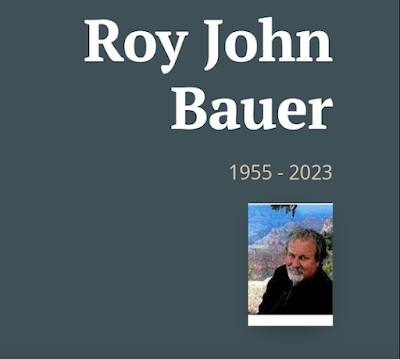
Roy's obituary in LA Times and Register: "we were lucky to have you while we did"

  This ran in the Sunday December 24, 2023 edition of the Los Angeles Times and the Orange County Register : July 14, 1955 - November 20, 2...