Tuesday, January 17, 2012

Are we doing Early College wrong? Part II

     Recently, I described my one-and-a-half hour stint teaching “Early College” at a local high school. I described that episode in relation to long-standing faculty worries about this sort of program.
     The piece elicited a comment from the director of a large Midwestern Early/Middle College program, who suggested that IVC’s “direct credit” approach—that is, an approach in which groups of high school students are thrust all at once, and with little preparation, into college classes (at the high school)—is unlikely to succeed. According to the Director, a proper and viable “Early College” program brings pre-college students to the university or college and works with them extensively until they are prepared to join college courses.
     I wrote him, asking for a fuller explanation. This morning, he wrote back. He provided me with impressive data that suggest that his program is highly successful. Beyond that, he made these points:
  • Many schemes around the country are called “Early College,” but the successful programs comprise “colleges” created by secondary schools on college/university campuses, that are tightly aligned with those institutions and that see themselves as part of them.
  • In these successful programs, students are not brought into college courses until they demonstrate the academic and life skills necessary for college success. (He cites the work of David Conley.)
  • In general, one cannot plop high school students into a college course setting and expect them to succeed. Successful programs are mindful of typical high school student deficits and entail faculty working with students as coaches as well as instructors.
  • IVC’s sort of “Early College” program puts high school students into instructional circumstances that “do not taste, feel or smell like college.” Thus, many institutions of higher learning are unwilling to view such instruction as college instruction. Colleges and universities tend to require that EC courses be taught at colleges, on a college course time schedule, with most of the students in the class being actual college students.
     I also heard from a college employee who reported that, in the early days of IVC’s EC program, he sought to gain a sound grasp of how the scheme prepared students for degrees or transfer, but that eluded him. His probing questions to those in charge were poorly received and generally unwelcome. This employee found himself sometimes recommending to students that they try OCC.
     Another employee described tense and uncomfortable sessions with immature high schoolers and their parents who seemed incapable of understanding the importance of student maturity for college success.

See also ABC’s and PhD’s: Early College (Mama PhD, Inside Higher Ed)

Monday, January 16, 2012

Ignorami

How many ways can you be wrong? Mitt hits 'em all
The Campaign and Higher Ed (Inside Higher Ed)
   [MITT ROMNEY] …Romney's views on for-profit higher education were the focus of an article Sunday in The New York Times. The article described statements by Romney in New Hampshire, where he suggested that students concerned about the high cost of higher education consider enrolling at for-profit colleges, and in Iowa, where he specifically praised Full Sail University. Also in Iowa, Romney said that for-profit colleges "hold down the cost of education." And in an interview with The Ames Tribune editorial board, Romney said that for-profit higher education would force nonprofit colleges to cut costs, and eliminate "unnecessary" departments.
     The Times article noted that when Romney endorsed for-profit higher education and Full Sail, he did not mention that the university's chief executive, Bill Heavener, is co-chair of Romney's Florida fund-raising team. Nor did he mention contributions from the chair of the private equity company that owns Full Sail, or from Todd S. Nelson, chief executive of the Education Management Corp., which is currently facing a suit from the U.S. Justice Department over its recruiting practices.
     While Romney praised for-profit higher education as a financially practical alternative to traditional colleges, the Times noted that Full Sail is not inexpensive….
     [Notoriously, for-profits account for most student loans, which are federally insured; and their students' default rates are very high, and, when default occurs, tax-payers end up paying off the loan.]

Foot in mouth again
   [JOE BIDEN] ...In Pennsylvania, Biden responded to a question about why college costs keep going up by noting that it was a "puzzle" and that there was "no one thing" responsible. But among the factors he identified were increases in faculty salaries. "Salaries for college professors have escalated significantly," he said….
. . .
     Most experts would agree that labor costs (faculty members and all other employees) are a large part of college budgets. But nationally, during the past few years when double-digit price increases at many public institutions have frustrated so many students, parents and politicians, it would be hard to point the finger at escalating faculty salaries. According to national data from the American Association of University Professors, the average salary for continuing faculty members increased by 1.4 percent in 2010-11, just under the rate of inflation. The figure the year before was a 1.2 percent increase, well below inflation. And these figures are for full-time faculty members, and so don't reflect the increased reliance of colleges in recent years on adjuncts, who are typically paid much less than others, and who frequently lack benefits….
. . .
Won't eat French fries either
   [NEWT GINGRICH] A new ad on behalf of Newt Gingrich, after accusing Romney of being a moderate, of supporting government mandated health care and more, raises a new scandalous charge: Romney speaks French. There is even a clip (toward end of the ad) to verify the charge.
     Rosemary G. Feal, executive director of the Modern Language Association, was not impressed with the ad. Via e-mail she said: "That Mitt Romney speaks French is probably great news for the million and a half U.S. residents whose first language is French, and it might also influence others who value knowing more than one language. Campaign strategic message fail!"

Price of Success (Inside Higher Ed)

     If low graduation and student transfer rates at City Colleges of Chicago don’t start improving, the system’s leaders could lose their jobs. That’s because the formal job responsibilities of the chancellor, presidents and even trustees include graduation rate goals.
. . .
     “You cannot continue with a 7 percent graduation rate,” said Rahm Emanuel, Chicago’s mayor, at news conference last summer. “We owe the taxpayers – and most importantly the students – a better community college system.”....

IVC's "Early College Program": doing it wrong?


     Last Monday, I wrote about my experiences holding a class (as a substitute) in Irvine Valley College’s benighted “Early College Program,” a program foisted upon IVC faculty that has been the subject of many complaints by faculty participants. The latter led to an Academic Senate (limited) inquiry, which seemed to bear out the notion that the program was problematic (student immaturity, a pattern of violations of instructor autonomy, obnoxious pressures from deans/parents, etc.).
     (One suspects that top administration views the college's ECP as a shiny, if meretricious, political showpiece that no quantity of pedagogical negatives cited by mere faculty could ever outweigh.)
     In the piece, I once again opined that the ECP, as presently configured, is a bad idea, at least for some college courses, owing to the immaturity of students (otherwise wonderful though they may be).
     For what it’s worth, this morning, we heard from one David Dugger:
David Dugger said...
     As the Director of the Early College Alliance @ Eastern Michigan University, former Dean/Principal of the Washtenaw Technical Middle College and President of Middle College Consultants I must whole heartedly agree with the post and the associated comments.
     This [i.e., IVC's ECP] is not an Early/Middle College Model, but a Direct Credit Model. Often Direct Credit Models are "packaged" as Early/Middle Colleges, but their design, structure and pedagogy are rarely, if ever, consistent with the tenets of Early/Middle College programs.
     Direct Credit models have some value and they should be evaluated as such, but to market them as Early Colleges does a grave disservice to the students and the Early/Middle College movement.
     -- 7:20 AM, January 16, 2012
     I checked, and a David Dugger is indeed the Director of the Early College Alliance, whose “about” page explains that:
   The Early College Alliance (ECA) is a public, early/middle college program located on the campus of Eastern Michigan University and exists in partnership with local school districts, including Washtenaw Intermediate School District. [My emphasis.]
. . .
   ECA is recognized by the Michigan Department of Education as a four plus one program. . . .
   The program gives students an opportunity to earn college credits while still in high school and offers strong, academically focused students a chance to enroll in advanced, college-level coursework. It also provides an option for students who are either struggling or don't feel connected to their school an alternative.
   ECA allows students to:
  • Graduate from high school with a diploma and up to 60 college credits.
  • Attend classes on a university campus with support.
  • Learn in a college environment that fosters maturity and academic growth.
  • Gain vital skills for college success.
     I'll see what I can find out about these two "models" to which Dugger refers.

P.S.:

     I did some looking, and it appears that, normally, an “Early College” or “Middle College” program comprises instruction at college campuses that are “structured” to permit participating K-12 students' simultaneous completion of high school (grad requirements) and a college Associate Degree (or satisfaction of college/university transfer requirements).
     Clearly, IVC’s ECP is not of this type (with the exception of high school seniors in the program; see IVC statement below), for its courses are held at the high school.
     “Direct Credit” programs seem typically to involve high school students taking “college” courses at the high school. Instructors are often “deputized” high school instructors, although, sometimes, they are college instructors imported from the local college. Often, direct credit schemes, like the above programs, are structured to allow students to prepare for college transfer and high school graduation simultaneously. (Some early or middle college programs target "struggling" students as well.)
     As Dugger suggests, IVC’s ECP seems to fall into the “direct credit” category, for its courses are held at the high schools, not the colleges. The instructors, however, are typically IVC adjuncts and hence they are college instructors, not high school instructors.
     Here’s how IVC describes its Early College Program:
     The purpose of the Early College Program is to provide the opportunity for academically qualified high school students to ... transfer to one of the UC or CSU campuses with almost two years worth of transferrable college credit, saving thousands of dollars in tuition and valuable time that can be directed toward a career or graduate work. ...[A]fter the initial cohort of students, the project has scaled back to provide for the IGETC Certification only. Students complete their high school diploma while taking IVC courses for both high school and college credit.
     The classes offered at the high school are Irvine Valley College courses taught by Irvine Valley College professors....
     Professors from IVC ... have access to high school principals and vice principals to deal immediately with student/school issues and parental requests for information as they arise, and the IVC’s Office of Instruction is responsible for overall coordination of this program. [These features reflect an attempt to address the adverse findings of the Academic Senate inquiry, I believe.]
     ECP classes are held in the morning before the first period at the high school for 9th through 11th graders…. Seniors take their college classes at IVC in the early morning. Classes are open to other college students in addition to ECP students.
     This May we look forward to our first Early College graduating class of 23 students from Beckman High School….
     One wonders what Dugger had in mind when he wrote that "Often Direct Credit Models are 'packaged' as Early/Middle Colleges, but their design, structure and pedagogy are rarely, if ever, consistent with the tenets of Early/Middle College programs." And what is the "disservice" done to "early college" students when "direct credit" schemes are labelled "early college"?
     I'll see what I can learn. (I've emailed Director Dugger.)

More on Utt the Nut: "Extensive experiments in hypnotism and rhythm"


     Saddleback College’s library is named after Congressman James B. Utt, who died in 1970. I’ve been posting about the fellow and his views and pronouncements.
     This morning, I scraped up a few new factoids:
     There are several references to James B. Utt in the excellent Suburban Warriors: The Origins of the New American Right, by Lisa McGirr.
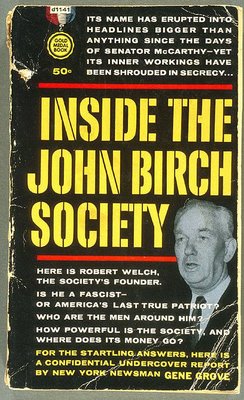
     On p. 120, McGirr quotes from a letter by Utt to Richard Nixon, complaining that Nixon’s denunciation of the John Birch Society (owing to leader Welch's remarks) was “ridiculous.” Later, Ronald Reagan, whom Utt championed, refused to disown Birch support, again distinguishing between leader and followers (p. 311).
Utt liked Birchers but
didn't like leader Welch
     As near as I can tell, Utt was never actually a member of the JB Society, but he certainly agreed with many of the views with which that organization is associated and he defended it often.
     Utt seemed to have a fondness for nutty "scientific" theories. Historian and journalist Rick Perlstein quotes from a speech by Utt in the Congressional Record:
“The Beatles and their mimicking rock-and-rollers use the Pavlovian techniques produce artificial neuroses in our young people. Extensive experiments in hypnotism and rhythm have shown how rock-and-rock music leads to a destrtuion [sic] of the normal inhibitory mechanism of the cerebral cortet [sic] and permits easy acceptance of immorality and disregard for all moral norms.”
     The speech is also quoted in part in Perlstein’s Nixonland: The Rise of a President and the Fracturing of America.
     According to journalist Howard Blum in Wanted!: the search for Nazis in America,
Sometime before his ominous pronouncements about Operation Water Moccasin and just after his discovery of "a plot to centralize the Girl Scouts," Representative James B. Utt became involved in the case of Andrija Artukovic.
James B. Utt
     Utt helped Artukovic fight extradition to Yugoslovia for war crimes. Artukovic was known as the “Himmler of the Balkans.” Eventually, the extradition occurred (in the 80s). (Evidently, “Operation Water Moccasin” was a planned U.S. military maneuver in Georgia. At the time [1963], the far right was convinced that the operation was a cover for a move to disarm the U.S. and make it subject to the U.N.)
     James B. Utt on Space Travel (1963). Pretty goofy. Evidently, Utt supposed that, someday, a Star Trek-like transporter would be invented, though it appears that he wouldn't want to use it. Smart.
     Utt on muckraker Jessica Mitford. Utt was really down on Mitford’s famous exposé of the funeral industry (The American Way of Death, 1963). Called her a Commie, owing to her long-ago membership. I think she appreciated the publicity. Utt was a big supporter of HUAC.
     Utt on Medicare. Yeah, he was down on that sort of thing. Civil rights, too.
     Although I haven't been able to verify it, Utt reportedly once warned that Chinese soldiers were massing on the Mexican border. He wrote that in his notorious newsletter. The rumor was widespread among the far right in those days.
     Gosh, if anybody had kept those newsletters, they'd be gold now!

Sunday, January 15, 2012

James B. Utt: conspiracy theorist, whack job

Cleon Skousen
     Yesterday, I posted a recording of a 1969 conversation between a right-wing radio evangelist and Congressman James B. Utt. In it, Utt worries that our great nation is on the brink of anarchy—or dictatorship, and so on. Too much attention, he says, is paid to “dissident minorities” and not enough to the “moral” people of America.
     I had never heard Utt speak before. The radio interview makes clear that, despite his gentlemanly demeanor, the fellow was every bit the Neanderthal that he is reputed to have been.
     Without doubt, James B. Utt, after whom Saddleback College’s library was named (in 1973), was a full-on conspiracy nut of the lunatic fringe variety. At one point in the recording, Dr. Burpo (the radio evangelist) refers to a remark recently made to him by yet another Congressman. That Congressman evidently expressed the view that it “mattered not” who is in the White House or Congress, for there’s an “establishment” that is really running the country.
     Does Utt agree with that view?
     Utt answers that his colleague is “a long way toward being right.” He goes on to say
The Council [on] Foreign Relations dictates—they together with the international bankers who actually are in the Conference of [sic] Foreign Relations—dictates the moves of this country. I’m inclined to agree with [the Congressman]. But it doesn’t have to be so. ….We should be an independent and free country. … When the people want a change they should get the change they want and not still be subject to a hidden government such as the Council of Foreign Relations [sic]. I’ve put out newsletters on the CFR, …and they are controlled by the international bankers. (Interview)
     So Utt embraced a conspiracy theory according to which the country was actually run by “international bankers,” who control, among other things, the old New York/Washington think tank known as the CFR—the Council on Foreign Relations, which Utt variously refers to as the “Conference” or “Council” “of” Foreign Relations.
     The CFR is old and established, like the Washington Monument, though it is probably too secretive for its own good. It is often on conspiracy theorists' radar. According to Wikipedia,
The Council has been the subject of debate, as shown in the 1969 film The Capitalist Conspiracy by G. Edward Griffin, the 2006 film by Aaron Russo, America: Freedom to Fascism and a 2007 documentary Zeitgeist: The Movie, as well as the book The Naked Capitalist which reviewed Carroll Quigley's book Tragedy and Hope from a less supportive standpoint.
     You’ll recall that Mr. Griffin was also the author of The Fearful Master, for which Utt wrote a glowing introduction (see yesterday's James B. Utt in his own wacky words).

Utt's G. Edward Griffin on Beck's old Fox show
     Griffin’s film (says Wikipedia) was “inspired by Cleon Skousen's book The Naked Capitalist.”
     And who was Cleon Skousen (1913-2006)? Evidently, he was a conspiracy nut, Mormon division. According to Wikipedia, Skousen was a “notable anti-communist and supporter of the John Birch Society.” By the early 60s, “Skousen founded a group called the All-American Society, which Time magazine described in 1961 as an ‘exemplar of the far-right ultras’” (ibid.).
     One of Skousen's better known works was The Naked Capitalist (a companion, I guess, to The Naked Communist):
   In 1970, he wrote The Naked Capitalist based on the book Tragedy and Hope by Carroll Quigley, which claimed that top Western merchant bankers, industrialists and related institutions were behind the rise of communism and fascism around the world. Skousen's aim was to summarize the ideas in Quigley's books and thus make them accessible to a wider audience, however, Quigley disavowed Skousen's interpretations of his work. Skousen states in the work that the purpose of liberal internationalist groups such as the Council on Foreign Relations, is to push "U.S. foreign policy toward the establishment of a world-wide collectivist society." The Naked Capitalist has been cited by many, including Cleon Skousen's nephew Joel Skousen, as proof of a "New World Order" strategy to create a One World Government. (Wikipedia)
     Though Skousen died several years ago, he remains influential, at least in some circles:
   In the 1990s, Arizona law enforcement veteran Russell Pearce became a disciple of Skousen's views. Pearce became an influential Arizona State Senator and was sworn in as President of the Arizona State Senate in 2011.
   In September 2007, a year prior to the 2008 U.S. presidential election, Jan Mickelson of Iowa radio station WHO and Republican Iowa caucus presidential candidate Mitt Romney discussed Skousen in an off-the-air conversation during a break in Mickelson's broadcast, which Mickelson recorded. In the conversation, Mickelson touted Skousen's American Constitutionalism and Romney cited Skousen as an expert on Mormon theology. In commentary about this exchange, the National Review's Mark Hemingway termed Skousen an "...all-around nutjob," and described The Naked Communist [another of Skousen’s works] as "so irrational in its paranoia that it would have made Whittaker Chambers blush," adding, "to be fair Skousen wrote on numerous topics with wildly varying degrees of intellectual sobriety....
   In fall of 2007, political commentator Glenn Beck began promoting The 5,000 Year Leap [a 1981 Skousen work] on his show, describing it as "divinely inspired".... Leap argues that the U.S. Constitution is infused with Judeo-Christian virtues as well as Enlightenment philosophy. Skousen's son Paul Skousen asked Beck to write the foreword for a new edition of the book. Texas Governor Rick Perry has also promoted the book.
   After Beck began promoting Skousen's The 5,000 Year Leap in March 2009, it went to number one in sales on the Amazon.com charts and stayed in the top 15 throughout the following summer....
. . .
   In a November 2010 article in Canada's National Post, Alexander Zaitchik, author of Common Nonsense (a book critical of Glenn Beck), described Skousen as a "whack job" with "decidedly dubious theories.” (Wikipedia)

Fuentes sends chicken feed to chicken man


'Goldenrod 6': Pet chickens flap heads to City Council (OC Reg)

     This story is about some guy in Corona Del Mar who keeps chickens in his yard. One of his neighbors is none too pleased--there's a city ordinance that back her up--but the rest of the neighborhood is pro-chicken, I guess.
     Tom Fuentes sent the guy a bag of chicken feed. Down on regulations, I guess.

Full Sail Ahead


On the front page of today's Sunday New York Times, Eric Lichblau writes about Mitt Romney's abiding affection for for-profit colleges, especially Florida's Full sail University whose CEO is a major campaign donor.


excerpt:
At a town-hall-style meeting in New Hampshire last month, listeners pressed Mitt Romney on the soaring cost of higher education. His solution: students should consider for-profit colleges like the little-known Full Sail University in Florida.

A week later in Iowa, Mr. Romney offered another unsolicited endorsement for “a place in Florida called Full Sail University.” By increasing competition, for-profit institutions like Full Sail, which focuses on the entertainment field, “hold down the cost of education” and help students get jobs without saddling them with excessive debt, he said.

Mr. Romney did not mention the cost of tuition at Full Sail, which runs more than $80,000, for example, for a 21-month program in “video game art.”

Nor did he mention its spotty graduation rate. Or, for that matter, that its chief executive, Bill Heavener, is a major campaign donor and a co-chairman of his state fund-raising team in Florida.
...
Mr. Romney has received financial support from other segments of the for-profit college industry as well, and he was quick to praise the industry as an affordable alternative to traditional colleges.
...
[Romney] said schools like Full Sail and the University of Phoenix, a much larger and better-known nationwide system, offer students an alternative.

When students look at such schools, Mr. Romney said, “you’re going to find students saying: ‘You know what? That’s not a bad deal. I’m not willing to come out of college with a hundred thousand dollars in debt.’ The alternative is to say the government is going to pay for that.”

He added: “I just like the fact that there’s competition. I like the fact that institutions of higher learning will compete with one another, whether they’re for-profit or not-for-profit.”

The remarks appeared intended to draw a sharp divide between Mr. Romney and President Obama, whose administration has imposed tighter regulations on for-profit colleges and limited the role of private companies in student lending....

To read the article in its entirety, click here.

*

Roy's obituary in LA Times and Register: "we were lucky to have you while we did"

  This ran in the Sunday December 24, 2023 edition of the Los Angeles Times and the Orange County Register : July 14, 1955 - November 20, 2...