Thursday, September 2, 2010

Public higher ed: "a narrower and more hollow mission"


Public Higher Education Is 'Eroding From All Sides,' Warn Political Scientists (Chronicle of Higher Education)

     The ideal of American public higher education may have entered a death spiral, several scholars said here Thursday during a panel discussion at the annual meeting of the American Political Science Association. That crisis might ultimately harm not only universities, but also democracy itself, they warned.
     "We've crossed a threshold," said Clyde W. Barrow, director of the Center for Policy Analysis at the University of Massachusetts at Dartmouth. "Higher education is no longer viewed as a public good in this country. As tuition at public universities becomes more expensive, middle-class parents say, 'I'll bite the bullet and pay this for four years, but I don't want to pay for it a second time with taxes.' And families who are frozen out of the system see public universities as something for the affluent. They'd rather see the state spend money on health care."


     The mid-20th century suddenly appears to have been a golden age for higher education, said Wendy Brown, a professor of political science at the University of California at Berkeley.
     "That era offered not only literacy but liberal arts to a mass public," Ms. Brown said. "But today that idea is eroding from all sides. Cultural values don't support the liberal arts. Debt-burdened families aren't demanding it. The capitalist state isn't interested in it. Universities aren't funding it."
     The danger, Ms. Brown said, is that the public will give up on the idea of educating people for democratic citizenship. Instead, all of public higher education will be essentially vocational in nature, oriented entirely around the market logic of job preparation. Instead of educating whole persons, Ms. Brown warned, universities will be expected to "build human capital," a narrower and more hollow mission.
     And faculty members are unlikely to resist those changes at a time when two-thirds of them are on contingent appointments instead of the more secure tenure track, said Cary Nelson, president of the American Association of University Professors. They simply do not have enough power within the institution.
     During a plenary lecture earlier Thursday, Mr. Nelson, who is also a professor of English at the University of Illinois at Urbana-Champaign, said he believes that the era of "incremental state funding for public higher education is basically over." For the foreseeable future, he said, the traditional battles for higher state appropriations are bound to be losing ones….

Photos: tonight, Huntington Beach

Manifestering corruption

Streaming Video of the August 30 meeting of the SOCCCD board of trustees is now available at the district website (here). Scroll down to “archived videos”; click on “video” for August 30.

Then “jump to” item 6.3—“institutional memberships.”

Then: Enjoy the clash between social conservative/libertarian Don Wagner and the IVC (and Saddleback) faculty, who have the temerity to seek to maintain their membership in the Academic Senates for California Community Colleges, which, um, leaves headless bodies out in the Arizona desert. Or something.

Have you enjoyed our recent submersion in the MANIFESTERING corruption that is OC government? It’s fun—isn’t it?—connecting the dots between John and T-Rack and Mike and Chriss and Michael and Tom and John again and Phil and Raghu and Peggy and Susan and Tonya Harding.

As I was leaving campus today, I saw a kid walking and phone-talking whilst wearing his pants just below cheeks, revealing much square yardage of blue underwear. I quickly readied my camera, but, alas, he hiked up his pants several inches before I could take a shot. Here’s what I got.

Behold the future.

Wednesday, September 1, 2010

Life among devices

The weather's been good. Irvine Valley College looks pretty sharp. The place is buzzin'.
But absurdities abound.
Some absurdities concern the many gizmos that punctuate the environment. Old gizmos.

#1. There's a room in the library that is full of VCRs. You remember them. They play those big, stupid, boxy things called VHS tapes. Students occasionally wander into this room, puzzling over these dopey machines.
"What could they be?" they ask.
Even the staff doesn't know.
Sometimes they all stand in silence, contemplating these machines and their peculiar ugliness.

Recently, an inventory was taken of the IVC Library's VHS tapes. After considerable effort, it was determined that (1) there is precisely one huge shitload of them and they're taking up considerable space and (2) students almost never check them out or play them. Students wouldn't even know what to ask for. "Weird shit," maybe.
Recently, the Dean and the Vice President of Instruction moved to rid the Library of these cloddish and forlorn artifacts. Immediately, Luddites among the faculty commenced caterwauling.
"No! No! Our instruction depends on these things!"
Years ago, I recall attempting to get our old Art History instructor to give up his Carousel projector and his set of slide trays. He had, like, two or three of 'em. It was his whole Pedagogy. "Why doncha digitize this stuff?" I said. "Maybe get some new stuff!"
Nope. Not him. He retired.

#2. Faculty came back after summer break only to find a new duplicating machine in building A200.
I was told that it is vaguely sinister. It sends emails and faxes. It makes breakfast.
It is not to be trusted.
Today, I took some pics.
There was an eerie silence.

Naturally, it's broken.

A technology launched nearly 35 years ago.
(IVC Library and Antique Emporium)

DVDs are a fifteen-year-old technology.
Try 'em; you'll like 'em!

“Not before known, heard, or seen”

• Check out the Voice of OC’s John Williams' Strange (and Very Brief) Turn in the Media Spotlight

• The latest: Rackauckas Will Seek Re-election in 2014 (Voice of OC)

• Spitzer reveals that there's nothing in his personnel file: Spitzer opens up personnel file (OC Reg)

• Mickadeit offers an overview: Spitzer stops by Register to make case (OC Reg)

Durbin: a "federally subsidized rip-off”

• Key Senator Calls for More Federal Oversight of For-Profit Colleges (Chronicle of Higher Education)

     Continuing Congress's scrutiny of for-profit colleges, Sen. Dick Durbin, Democrat of Illinois, argued at a forum he held in Chicago on Tuesday that "there are too many schools taking advantage of students and making money hand over fist."
     The forum, which featured testimony from two former students and the leaders of three major for-profit higher-education companies and two traditional colleges, covered much of the same ground as recent hearings held by the Senate education committee in Washington, according to Wall Street analysts who attended the event. The two students described being misled about their programs' accreditation status and their job prospects, while the corporate executives defended their institutions and warned against a rush to regulate the for-profit sector.
     A recording of the forum is available on Senator Durbin's Web site.
     Like Sen. Tom Harkin, Democrat of Iowa, the chairman of the Senate education committee, Senator Durbin voiced concerns about the sector's aggressive recruiting tactics and heavy dependence on federal student aid. He dismissed the colleges' argument that the higher-than-average default rates for students of for-profit colleges are due to the sector's demographics and expressed outrage at the high costs of for-profit culinary programs.
     During the question-and-answer period, Senator Durbin grilled the chief executive of the Career Education Corporation about the morality of charging $40,000 for culinary programs that prepare students for $10-an-hour jobs, calling the programs a "federally subsidized rip-off." He also confronted the president of Kaplan University and the chief executive of DeVry Inc. about their students' low loan-repayment rates.
     "The loser is not only the student, but the taxpayer," Mr. Durbin said, according to an analyst with the investment-banking firm Signal Hill who attended the hearing. "You are enticing students into debt where they lose and you win," the senator said.
     Mr. Durbin proposed that for-profit colleges be required to bear some of the risk on government loans made to their students and called for an end to the practice of allowing for-profit colleges to acquire accreditation by purchasing nonprofit institutions. He also proposed an examination of how much federal aid the colleges spend on marketing campaigns.
     It's unclear how much influence Mr. Durbin will ultimately have in the debate over for-profit colleges, however. While the senator holds a key leadership post in the Senate, he does not serve on the committee that would consider any legislative changes for the sector.
     For-profit colleges got some moral support at the hearing from a group of students from the Illinois Institute of Art, who stood outside the forum carrying signs that read "'Gainful employment' rule discriminates against my school." The Education Department's proposed gainful-employment rule would cut off federal student aid to programs where students have high debt-to-income ratios and low loan-repayment rates.
     During the hearing, Mr. Durbin said he had approached one of the students and asked how much his program cost and what he thought he could make at his first job out of college. The student told him that his two-year culinary program would cost $54,000 and that if he was lucky, he could make $30,000 in his first job.

• The Williams-Spitzer episode. It only gets stranger:

The latest in the Todd Spitzer firing (OC Reg)
     …Unbeknown to Spitzer, the same public administrator case Spitzer had been looking into had been brought to the attention of Supervisor John Moorlach’s office more than a week earlier. And that Assistant Public Administrator Peggi Buff had been corresponding with Moorlach’s office.
     Buff also happens to be Rackauckas’ fiancé.
     Rick Francis, Moorlach’s chief of staff, confirmed that he sent an e-mail to Public Administrator/Guardian John S. Williams on Aug. 16 asking about the status of the case.
     Francis also confirmed that he received an email the following day, on Aug. 17, from Buff informing him that there was an investigation and that investigation was confidential.
     At that point, Moorlach’s office stopped looking into the case, Francis said.
     About a week later Spitzer began asking questions about the case after being told of a domestic-violence victim may have been targeted inappropriately for prosecution by the county’s bad check program. Once he was told there was an investigation underway, he said he called the citizen back and informed her of the ongoing investigation….

Tuesday, August 31, 2010

From the archives


     Recently, my mother told me that the woman she called mom—in reality, she was mom's aunt Martha—worked for many years with people in the garment district of her little town of Bärwalde. The people she worked with were Jewish, and they were friends.
     When mom was christened in about 1935, one of these friends was in attendance and gave her a gift: a handmade macramé lace bag (I’m only guessing it’s macramé and lace; what do I know?). Its flap sported a star of David. In its center were my mother’s initials: ES (Edith Schultz).
     I asked mom what became of this friend and the other Jewish friends. She was sure they made it out of the country to safety, probably to Switzerland. I pressed for details. She said that they had stayed very long—until maybe 1941. But they did get out. (This late date strikes me as implausible; mom was a young girl when these events occurred, and maybe she has her dates wrong.)
     Aunt Martha must have greatly valued the little bag, for she took it with her when, late in the war, they fled west to evade the Russian advance. She was able to take very few things, and what she did take she struggled to preserve (they fled on an open train car, which was strafed by Russian planes).
     Evidently, my mom took it with her when she headed for North America six years later, alone, at age seventeen. (She lied about her age.) Martha died ten years later. By then, mom had finally made it to the U.S.A.
     Today, on my way to work, I ran into my dad who said that mom had found the bag. I said I’d drop by to take some pictures. And so I did.


     What follows is an account of Martha and my mom's exodus from Bärwalde in 1945 that I wrote several years ago. It was based on taped interviews from 2004 of my mother, Edith, and my dad, Manny:


     By early 1945, the collapse of Germany had begun, and, in the eastern part of the country, the Russians advanced. 
     Edith, who was 11 or 12 years old, lived with her mother in Bärwalde, Pommern, in the eastern part of Germany. The woman Edith calls her mother was in reality her aunt, who, along with her husband, took Edith in when her real mother died in the late [?] 30s. [Her death is somewhat mysterious.] In 1941, her uncle died as well. Edith was very close to him. (Her actual father died in 1939.)
     In those days, in Germany, no child was legally permitted to be without two parents, and so, when Edith’s uncle died, the town’s chief of police—a family friend—was assigned the role of father-guardian.
     At the time of her real mother’s death, Edith’s sister, Ilsa, was sent to live with other relatives nearby.
     Edith recalls that Ilsa was somewhat “gung ho,” a patriot. So was Edith, in a way, she now says, for she was an avid athlete, an ardent competitor, and, as we know, the Nazis promoted athletics. Edith remembers attending the 1936 Olympics in Berlin. She loved that sort of thing.
     In the days before the Russian invasion, Ilsa moved in with Edith and her mother. They lived in a beautiful home on a hilltop—the last house on the eastern side of town, and thus the dwelling that would first encounter the advancing Russians. Already, local soldiers occupied it: ammunition and weaponry was stored in the garden, and men were billeted inside. Now, as the Russians drew close, the local soldiers selected this particular home for their defensive stand.
     “It would be like a fort,” says Edith.
     Edith’s mother stubbornly refused to abandon her home, protesting, repeatedly, that she had worked too long and hard on it simply to abandon it. The soldiers tried to tell her what the Russian troops would do to women, even to little girls, but she wouldn’t listen. Finally, the soldiers commanded: “Take the two girls and leave here, now!” And so, on the 28th of February 1945—Edith recites the date without hesitation—Edith, her “mother,” and her sister, along with several relatives, abandoned their fine home.
     Most of Edith’s relatives lived on farms and thus owned wagons, but Edith and her mother lived in town, and they lacked transportation. The soldiers told them to go the railroad station to await the westbound military trains, so Mom and the girls and a few other relatives packed their most cherished belongings in suitcases and put them on a little wagon—Edith remembers that it was like the little red wagons kids have here in the U.S.—and rolled their stuff to the station.
     They waited there for days, enduring strafing and bombing. Edith remembers the siren’s howl and the noise of bombs and guns. At one point, the station [?] suffered an attack that killed fifteen hundred people, including most of their neighbors and relatives, who were also waiting for the trains. (Apparently, German papers ardently covered such events.)
     Finally, the trains arrived, and so the refugees hurriedly secured possessions, and themselves, to the open flatcars. Then, at the end, there came another attack. Some people hid by the flatcars, while others dove under nearby wagons. Edith ran clear of the trains and into a hole somewhere. All of a sudden, a portion of one train blew up, killing everyone aboard it.
     Edith remembers that, about then, the engineer of her train yelled, “the Russians are closing in on all sides; everybody get on the train; we’re leaving now!”
     The engineer was a Pole. Polish prisoners had worked and lived in the town since the invasion of Poland years earlier. People from conquered territories manned much German industry during the war, and, evidently, they did other work as well. Edith recalls that Polish women and girls worked as domestics in her town.
     Edith’s mother ran the family lumberyard across the street from their home, and that business relied on thirty or so Polish workers who slept on bunk beds in a barn-like structure. Edith says that her mother prided herself in treating her prisoners with kindness, and, in general, prisoners were not mistreated in the town, though she recalls that there were exceptions.
     Manny explains that, on the eastern front, many “German” soldiers were in fact Poles, Ukrainians, and Finns who had decided to join the Wehrmacht [army]. They wore the regular German army uniform, but with a thin armband indicating their non-German nation of origin. (Manny lived in southern Germany.)
     Evidently, during the Russian advance into collapsing Germany, some Poles stayed, hoping to be embraced by their new masters; others feared the Russians no less than did the natives and, alongside Germans like Edith and her little group, they fled to the west. Many Poles thus eventually ended up in barracks-like housing—at first, along with German refugees—in what became West Germany, and lived in those conditions well into the 50s.
     Edith says that the non-German refugees were often mistreated, though she adds that the German refugees, too, were not treated well, since, wherever they showed up, they represented an added burden on already burdened locals.
     Some of Edith’s relatives, including Oma Losa, didn’t make it out of Pommern. Later, Edith learned that the younger girls who remained behind—not Oma Losa, who was older, but virtually all of the younger women, including toddlers—were raped. That was the fate of Edith’s sister-in-law, Frida. Years later, says Edith, Frida refused to acknowledge the event, though what had happened to her was no secret at the time. There was no doubt that it had occurred and that it was traumatic. (See Red Army atrocities. See also Every German female raped.)
     The invading soldiers had diseases, and so, says Edith, it was necessary for rape victims to do all sorts of awful things to themselves. Terrible bubbling liquids were used, she says.

Polikarpov I-16 "Rata" (rat)

     Frida was raped, but her husband was killed. He had worked for the diplomatic service, and, when the Russians entered and ransacked his and Frida’s home, they found pictures of him in uniform with his ribbons and medals. They assumed that he was a dignitary, an official. He had built a hiding place behind a false wall, and he and Frida were there when the Russians entered the house; but these Russians were no fools: they tapped on the walls and found the two. They dragged Frida’s husband to the front of the house and hanged him there.
     Edith’s little group of refugees learned these terrible facts only later; they learned about the rapes and killings and about the burning of all the homes of the neighborhood; they learned, too, that all the younger people were forced by the Russians into work camps.
     For some reason, says Edith, after about two years, the Russians allowed Germans to leave, and so they did, traveling west. That was before the Wall had been erected to prevent emigration.
     During that exodus and before, people were scattered throughout the country and had no way to find each other. Agencies such as the Red Cross organized efforts to reunite family and friends. Thus, they would announce that former citizens of town X were to meet in town Y at a certain date. People arrived there, carrying signs with their names on them. This went on for years.
     Edith remembers one day—this was years later, when she lived near Hamburg—coming home from work and noticing the smells of cooking wafting from her family’s small apartment. She was alarmed, for she knew that, at that moment, her mother and sister were elsewhere. When she entered, she was astonished to find that the mystery cook was none other than her Oma Losa!
     Manny hastens to add that, before Edith and her group left Pommern by rail, they had the option of travelling north, instead, to a Baltic harbor, where a ship awaited refugees. But travel by ship would mean abandoning various larger things that they hoped to take with them. Edith’s mother therefore insisted that they take the train.
     That was fortunate: later, they learned that the Russians sank that ship, killing most on board. (After this taping session, my father read an issue of National Geographic that described the sinking of the Steuben. See National Geographic: Ghost Ship Found.) 
     I have done further research, and it appears that three refugee ships (part of a massive evacuation project) were sunk by a Russian sub at about that time, killing perhaps 20,000 people. It is possible that the ship that my mother almost boarded was one of the other two. See also Sinking of the Wilhelm Gustloff. See also Tragedy at Sea.]

Monday, August 30, 2010

SOCCCD board meeting—live and direct!

August 30:
6:15 p.m.:

     OK, dang. I'm sitting just outside the "RONALD REAGAN BOARD OF TRUSTEES ROOM." I got here at 6:00 for the August meeting of the SOCCCD board of trustees. As it turns out, however, tonight's meeting is scheduled for 6:30, not 6:00.
     If they start at 6:30, that means that they expect to spend more time than usual in closed session (just prior to the open session). Hmmm. Don would have decided that. I bet he's expecting sparks to fly.

6:23:

     OK, since I'm just sitting out here like an asshole, I've decided to throw you some factoids. Here's a fun one: exactly one board member is requesting travel money for a conference. Guess who.
     But wait a minute! In the past, these agendas read like one of those redacted memos from the CIA--essentially, you get nothin'. But, this time, it's clear that it's our own Orlando Boy who seeks to travel (all the way to San Diego, I think) on the taxpayers' dime. Do you suppose that this is a sign of change?

6:47: meeting starts.

     Marcia: No actions to report from closed session.
     Bugay pipes up: what about… Wagner cuts him off: “the lawyers told us this is not something to be reported out.” Oh. Don glares, subtly. The death glare.
     Marcia introduces a lady who explains a service called "OC 2-1-1." It's like 9-1-1, only minus 7. It's a three digit number when you need help in human services, evidently.
     Todd Spitzer is quoted: it's “a valuable asset," says Todd.
     “Whatever happened to him?” asks Don, smiling at John.

Public comments:

     Lisa Davis Allen on behalf of the IVC Academic Senate: she reads a statement on behalf of the senate in support of continued membership in ASCCC (the Academic Senates for California Community Colleges, aka the "state senate"). Evidently, there is concern that the board will pull our membership in ASCCC tonight.
     Wagner: “can I ask a clarification?”
     Evidently, a document, submitted by Allen, says “articulation” where it should say “accreditation.” Oh. A typo.
     This item will come up tonight: 6.3. Will be discussed further then, says Wagner.
     Housekeeping details: advance the budget items. Students will be up pretty quickly to present their (student government) budgets.
     A retired faculty member named Cromwell passed away. Will adjourn in memory of her (him?).

Board Reports:

     Jay: the semester opened with a bang, says Bill.
     Williams: took a tour of the ATEP campus… Toured buildings to tear down. Big areas, big job.
     Milchiker: remembers Cromwell… Attended flex week, Chancellor’s Opening Session. Refers to Bugay’s corny “This way to the top” motif. “My debut as an actress,” jokes Marcia.
     Wagner: refers to success of Bullock and Bugay’s “opening session.” There’s “a bug or two still to work out,” jokes Wagner. Groaning. "Great job," says Don.
     Fuentes: visited Reagan Ranch in Santa Barbara. Celebrated anniversary of the "greatest tax cut in American history." Tiny American flags popped out of his ears. It was a very special day, he says. Mentions naming this room after the guy. Takes credit for it. Looks like shit.
     Lang: refers to successful opening session. Refers to trustee Wagner’s “almost stinging performance,” the second lame joke about bees of the night. Didn’t know that Bob Bramucci is such a “frustrated rock star," says Lang.
     Padberg not present.
     Students present budgets. IVC kids pithy, efficient. Saddleback kids halting, but cute.


Item 6.2: adoption of final budget (waiting for Padberg).

6.3: institutional memberships.

     Fuentes pulled this item last time. All of his questions answered, evidently.
     Not Wagner’s.
     Wagner: “How is the amount of the membership decided?”
     Allen: a predetermined calculation we have no control over. Once again, she notes that the ASCCC helps senate be helpful in Accreditation, SLOs, hall monitors, etc.
     Wagner: what about things you do that are not helpful. Seven items mentioned here that “senates find themselves involved in.” What is the benefit to us for the other things they [the dang state senate] help you with.
     “It seems to me there are other activities the senates get involved in that are either not on this list or the benefits to local academic senates are not apparent. How do you figure out how much money goes to each of the pursuits?
     How about political agendas?
     Not us, says Carmen. But state senate yes. S’pose so.
     How is this a good deal for the taxpayers? asks Don. Not necessarily in the best interests of taxpayers.
     Lewis Long: we all fund the legislature, even if we don’t agree with its legislation. By and large, as a body, they are there to advocate for students….
     Wagner: members of the legislature are elected. That’s where the comparison breaks down, dude. Also: I agree that they do good things. But what about their political decisions? They pursue a political agenda too. What ability does this board have in giving or not giving taxpayer dollars in assisting this organization in pursuing a separate agenda that may or may not have the support of this board (and this community)? How do we get a handle on that?
     Carmen D: well, we can take your message and bring it to the state senate. Carmen uses example of lawsuit of senate vs. district re development of faculty hiring policies (4011.1). (Pretty useful, I guess.)
Don didn’t like that example. Smiled it off as if to say “let’s not go there.” No freakin' wonder.
     Wagner: You're not answering the question, says Don. There are issues that are contentious in the community. So why do we have to support their pursuit of that?
     Don suggests: “What if we just give half of it.” Carmen directs Wagner to a section of a document, but Don tags her for not answering the goshdang question.
     Wagner: we don’t want the full services of the (state) Ac. Senate. Their political agenda is not consistent with policies of this board. Why can’t we give something less than 100 cents on the dollar because of some of the “services” they are providing … Example (of how to do this): state bar. You do not have to pay 100% of the membership if you don’t want to support certain political actions of the state bar.
     What’s wrong with that?
     Lewis Long: challenges assumption that senate is pursuing policies that we do not agree with. Wagner says: “They're pushing a pretty political agenda in the courts right now.” (I’m guessing this is a reference to the state Ac. Senate’s decision to provide an amicus brief for plaintiffs in the “Westphal v. Wagner” “prayer” lawsuit.)
     Lang: I call for the question.
     Underlying item voted upon: Carries on a 5 to 2 with one absence. (Four trustees, plus student trustee; Padberg absent.) So I guess this means that we get the money for membership in the ASCCC.

Item 6.4: Five year construction plan, ATEP.

     Fuentes: at the recent special meeting, I expressed the end of my patience with ATEP. Do not favor going forward: it's a white elephant; a deep, dark hole. So it’s important that we can still vote against these ATEP projects in the future, despite accepting this item (five year construction plan). Passes unanimously (Padberg is now present).
     So now they go back to 6.2: adoption of the final budget. David Bugay, then Beth Mueller, present.
     Good grief. Half a billion dollar budget! Am I seeing that right? That's, like, the budget of a tiny country in Europe.

     Much discussion about remaining unfunded liability. (Unfunded amount, $5 million.) Fuentes is very concerned/surprised about that. They are proposing to use basic aid for eliminating remainder. Marcia says “that’s fantastic.” Fuentes is surprised that we’ve got this unfunded liability at all, I guess.
     Marcia asks: do I have this right? The budget is close to half a billion dollars? Beth and David nod. An absurd moment. I sense the coming apocalypse.
     Gosh, our expenditures sure have increased over the years, says Marcia. Yep. I stare at the gold-plated screws on the crummy plastic chair in front of me.
     Jay: gives an evidently accurate review of the liability issue, the tanking economy and investments, etc. Recent investments have turned out well, he says. The current unfunded amount is “certainly acceptable” compared to other districts. It’s huge in other districts. He grins.
     Williams: blathers, echoing Jay.
     Wagner: troubled by an apparent discrepancy (again). Numbers don’t quite add up. Why are you asking for $8 million? Answer: we have to add blah blah blah. (You know me and fiscal stuff. I'm hopeless.) Wagner remains perplexed. You have to set aside 2.5 million, says Beth. Don's still perplexed. Fuentes: attempts to make sense of the numbers. (There’s obviously some sort of miscommunication here. Beth and David don’t seem to understand Don’s confusion. It’s not clear to me that other trustees share his confusion or are being patient with it. Probably the former.) Fuentes: offers what appears to be a knowledgeable question concerning how we might act prudently. Bugay says something that doesn’t seem to help. Jay has been trying to help. Finally, he speaks: “These are moving targets,” he says. He gives his Turbotax story. Jay gets a figure of $5 thousand owed in taxes. But the tax guy says it's $11 thousand. The numbers are mysterious. Deal with it. Beth nods. I am bewildered.
     It’s voodoo community college district economics, I figure. Waddoo I know.
     Lang says: yeah, there are lots of moving parts here. Mixing apples and oranges. Blah blah blah. He seems to be saying, "Yeah chill. Numbers get zany, wacky, goofy. Blah."
     Item passes unanimously. Don has a look of resignation. (He'll go to Sacramento not knowing what the f*ck these people are talking about.)

Republican art

Item 6.6: ATEP: agreement for real estate services....

     Lang says it seems a little "generous." Some suits came up and blathered a bit. Gray, expensive. Nice cut. Good hair. They had a look like they might lose some money.

Item 6.7 Board policies for review and study. Passed Unanimously.

     Boom, boom, boom—to the end of the agenda.

8.0 reports (now 9:00 p.m.)

     Blah, blah, blah
     Burnett rings bells, blows whistles
     Roquemore: presents the mystery of the low number. Everybody on campus reports that the campus is a third more crowded, and yet the number of students we're getting is 14,400 (I forgot the exact number; something like that). Trying to figure out the discrepancy. (I think they just stopped counting the rabbits.)
     Peebles: golly things are swell.
     (God, will it never end? Do these people actually want to be here?)
     Davis Allen: preparing for accred visit. Whoopee cushions at the ready. Stink bombs almost completed.
     Carmen D: blah blah blah site visit blah blah blah accred blah. Passes out cards. Some kinda BS.
     Lewis: no report. Etc.
     Gotta go home. Tired of this. It continues: infernal, endless. Adjourned at 9:14. I'm outa here.
     (For the record: the trustees were not at each others' throats tonight. As I left, three or four of 'em stood around and laughed about something, just like regular people. Go figure.)

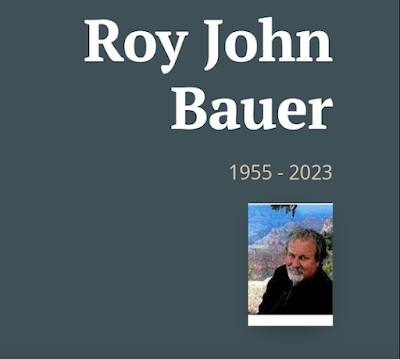
Roy's obituary in LA Times and Register: "we were lucky to have you while we did"

  This ran in the Sunday December 24, 2023 edition of the Los Angeles Times and the Orange County Register : July 14, 1955 - November 20, 2...