Saturday, August 21, 2010

An outrageous conflict of interest at Southwestern College

     Our old friend “100 Miles Down the Road” (aka “Miles”) sent us an article about Southwestern College administrators and trustees. It’s a real hair-raiser.
     You’ll recall that, last Spring, Southwestern College President Raj Chopra placed several faculty on leave, banning them from campus, after they participated in a student rally voicing objections to the board and administration’s massive cuts in course offerings. After considerable media attention and criticism, Raj and his Bullies essentially backed down. The faculty are back to work.
     But these thugs are still in power. And they’re still rotten.
     Now, some of these people are engaging in (or benefiting from or defending) outrageous campaign activities that feature a flashing neon sign that says, “conflict of interest.”
     And they aren’t in the slightest bit apologetic about it.

College VP raised money from contractors he oversees (San
Diego Union Tribune)

     The vice president of Southwestern College hosted a political wine-and-cheese fundraiser at his home, at which many of the invited guests represented companies that do business with the college under contracts he oversees.
. . .
     The fundraiser was to support two incumbents on the college district board who are facing a robust challenge from union-supported candidates displeased with the current administration.
     Nicholas Alioto, the vice president for business and financial affairs, said he invited a broad range of contacts to the May 20 fundraiser for trustees Yolanda Salcido and Terri Valladolid in an effort to get them re-elected.
. . .
     “I think it’s highly unethical for Vice President Alioto to host a fundraiser for contractors who are doing business with the college,” said trustee Nick Aguilar, who has clashed with the other board members and is supporting one of the union-backed challengers.
     “The incumbents have either approved or are going to approve contracts.”
     Donors included Seville Construction Service, which has been awarded $2.7 million in construction management services for a $55 million Southwestern bond project. Seville contributed $2,500 to each candidate.
     Christopher Rowe, who owns Echo Pacific Construction and attended the Chula Vista fundraiser, donated $1,000 each to Salcido and Valladolid. A month later, the two joined a unanimous board vote to approve a $4 million contract with his firm.
     Both trustees raised the same amount from Jan. 1 through June 30: $17,550. All of the contributions landed on May 20, May 21 and June 2 and included the same donors. Of 24 donors, at least seven have or had contracts with Southwestern College, according to a review of campaign forms and district documents by The Watchdog.
. . .
     Alioto and his boss, college president Raj Chopra, said they see nothing wrong with the fundraiser. Alioto said it was important because there is so much at stake in the upcoming election, in which union-friendly candidates are trying to unseat those who support Chopra and Alito.
     “If they take over the board, they will fire Chopra and me,” Alioto said. “I did something on my time on my dime to support candidates that I feel are good for the college.
. . .
     Alioto said he did not see a conflict with the fact that he oversees the business contracts donors have with the college because the board has the final say on those contracts.
. . .
     Anyone bidding on construction jobs funded by the bond proposition must go through a competitive bid process and must be vetted and interviewed, Valladolid said. Then Alioto and Chopra make a recommendation to the board for final consideration.
     Both Valladolid and Salcido said they did not base their votes on who contributed to their campaigns.
. . .
     Calls to contributors at Seville and Echo were not returned.
     Both Salcido and Alioto said they are more concerned with an incident on campus Monday, when teacher’s union members promoted their slate of candidates before a mandatory back-to-school event on a day they were paid to work.
     Andy MacNeil, president of the Southwestern College Education Association, said union members handed out T-shirts and other items promoting candidates Norma Hernandez, Tim Nader and Jesseca Saenz-Gonzalez, but that it was before the official work day started so they were not interfering with college business.
     MacNeil said it was inappropriate for Alioto to host the fundraiser.
     “When the person who is vetting all of the bids and the vendors here on campus is throwing a fundraiser and inviting them to support the candidates who will be voting on those bids, I find it a huge conflict of interest.”
. . .
     “I think any time you deal in government, you have to be concerned about the appearance of impropriety,” said Jeffrey Joseph, associate dean and general counsel for Thomas Jefferson School of Law. “It might appear to some people as pay-to-play. Even if your actions are innocent, they are susceptible of being misinterpreted.”
     Joseph previously ran the San Diego legal office for Caltrans, where he advised officials who work on millions of dollars of transportation contracts every day. He said inviting contractors to a political fundraiser could suggest a future payback.
     “The appearance is that if they contributed that perhaps they will be granted a favor that perhaps someone who didn’t contribute would not,” he said.
     Robert Fellmeth, a professor of public interest law at University of San Diego School of Law, said Alioto’s situation is a symptom of pervasive problem.
     “It’s a regrettable offshoot of our campaign finance system,” Fellmeth said. “I’ve been lobbying in Sacramento for 35 years. We don’t get in to see the members. The campaign contributors do. The agenda is being set by access, and access is determined by campaign contributions.”….

Southwestern College board policies, including "conflict of interest."

Friday, August 20, 2010

ABC News stings U of Phoenix


     Above is a segment of Good Morning America in which ABC reporters do their own sting on a U of Phoenix recruiter.
     I zipped over to the Saddleback College Lariat website, where I found this:


     Vanguard might not be a "for-profit," since it is affiliated with a church. Months ago, when I checked the Lariat website, I found several ads for notorious for-profits. I couldn't find those ads today.

UPDATE: 

     We received the following comment:

I'm David Wescott and I'm working with University of Phoenix. Given that you shared the video, I hope you're willing to let me share this link to get the University of Phoenix response to it. Let people see all the facts and then come to their own conclusions, yes?

      Here's the link that Wescott provides:

University of Phoenix Responds to Recent Media Criticism

     The above U of P response does not address the concern that the rate of student loan default is considerable higher at the U of P than it is at the average public college or university — and yet the "for-profits," including the U of P, get a disproportionate share of federally guaranteed loans. The  response is full of the sort of distortion and flummery (it repeatedly refers to being "fully accredited"— there is no such thing; it implies that an accredited institution ipso facto produces graduates qualified for desired employment; clearly, that is not so) that one might expect from a business that is focused on, well, profit, not education.
     In the U of P’s response, the following remark holds a place of prominence:

However, we’re disappointed that these media reports ignore the thousands of success stories from University of Phoenix students and alumni, the overwhelming majority of whom are successful in their career and proud to be a Phoenix.

     This is mere deflection. Instead of dealing with the disturbing actions of, and facts about, the U of P (keep in mind that the U of P was ordered to pay $277 million dollars in a recent legal decision that concerned recruitment practices), this writer changes the subject: "yeah, but what about the good things that happen at the U of P!"
     I wonder if the U of P offers logic courses.
     One might suppose that an institution of higher learning would offer a defense that rises above gross fallacies and specious rhetoric. But consider this paragraph:

     Our degree programs are fully accredited and prepare students to thrive in today’s job market. For example, since 2004 we have graduated more than 25,000 teachers and 15,000 nurses. Our teaching program is accredited by the Teacher Education Accreditation Council (TEAC) and is recognized by the Council for Higher Education Accreditation and the U.S. Department of Education. Each state has its own state teacher credentialing examination and standards and graduates of our teaching program must pass the necessary state examinations and student teaching requirements in order to become credentialed to teach in their state of residence.

     Having read this, a reader might suppose that U of P graduates are credentialed, but that’s not quite what this writer says, though he may seem to. In response to the complaint that graduates are often NOT prepared to compete in the marketplace (for teaching jobs, etc.), the above writer notes that “Each state has its own … credentialing examination … and graduates of our … program must pass the necessary examinations … in order to become credentialed to teach in their state of residence.”
     In other words, earning a U of P degree does NOT guarantee that its graduates will become credentialed and employed, for they must still past the state's examinations.
     So how again is this a response to the complaint? No how.
     Further, as the ABC segment revealed, even U of P graduates who do pass the tests in Texas and New York are not ipso facto qualified to teach in those states.

* * *
    Cat lovers will enjoy the following video (no doubt I’m the only Fan o’ Felines in the world who hasn’t already seen it a thousand times):

Thursday, August 19, 2010

Family war stories

     I had a chance to speak with my father about Opa—his father, my grandfather—and Opa's association with Hanns Klemm, an important aircraft innovator and entrepreneur who, in 1943, was arrested by the Gestapo for the crime of resigning from the Nazi Party. (In May of '43, he wrote them, "I consider my membership of the NSDAP to be no longer compatible with my belonging to the Christian community." Six years earlier, owing to his constant objections to party meddling in his business—including removal of valued Jewish employees—the Nazis had declared him to be "unreliable.")
     As I’ve explained previously, Opa, who had been a communist, was a noisy denouncer of Hitler and the Nazis and, in 1943, was rushed, by friends, into the Wehrmacht (army) to keep him out of the reach of the Gestapo. Today, I asked my dad if there was any connection between Klemm’s famous "death sentence" resignation and Opa’s sudden military recruitment at the age of 36.
     He wasn’t sure. Indeed, he had never thought about the matter before. In 1943, he was eleven years old and so he does not have a clear memory of chronology or even an understanding of major events at the time. Most families, of course, need only refer to other family members for clarifying information, but our family lacks that resource. My grandparents are now long dead, my dad’s sister died a year ago, and no other knowledgeable family member lives in this country. There are some relatives in Germany, even some who are elderly, but only my dad knows them, and he is disinclined to pepper them with such questions. I’m trying to arrange an email, in German, to family there in hopes of getting more information.
     “Now that you raise the question,” says dad, “it does seem very likely that the two events were connected.” He was pleased that I was pursuing the matter, and he was very happy to receive the results of my initial research into the career and fate of the legendary (for him) Hanns Klemm. He had thought that the memory of Klemm, an important figure in his hometown up through the war, had fallen into obscurity, as so much has done.
     But such is not the case. As it turns out, Klemm is remembered and honored, both for his contributions to aviation and related technologies and, to a far lesser extent, his stunning resignation letter, which he would have known would have lethal consequences. (As it turns out, the allies invaded Germany just in time to save Klemm, who was in prison.)
     My father reminded me that, in about 1932, Klemm had asked Opa to manage a new factory, but Opa turned down the job, which infuriated my grandmother.
     "Really? Opa would have been twenty-five years old at the time. Klemm [who would have been 47] asked such a young man to run a factory?"
     "Well, yes he did."
     Dad explains that Opa was a supreme technician and a master of the kind of work he did, which generally involved the making of models as part of the design and fabrication process. His official title was "model maker."
     But Opa didn't want the responsibility of running a factory. "He was strictly a Number 2 man," says my father. "He didn't want to run the show."
     My father grew up in the shadow of this peculiar act of unambitousness, the resulting bitterness of which permeated Opa's marriage and indeed his family. I knew Oma, and I can well imagine the ferocious hectoring she would have unleashed on her husband. I knew Opa, too. He was remarkably stubborn. There is no stubbornness like German stubbornness, which is far deeper and more inveterate than any species known anywhere in the New World.
     Despite Opa’s decision to remain a mere R&D man at Klemm, he and his boss evidently remained friends and maintainted a close working relationship. My father recalls serving as a messenger boy for his father in his town of Böblingen (and its sister town Sindelfingen), and he is sure that he often encountered Klemm; this experience left him with the impression that Opa and Klemm were friends and routinely worked together.
     According to dad, Opa used to tell the story of how the Gestapo would come to Klemm’s place of business, demanding the aircraft maker's attention. Opa would go to the door, open the little view window, and shout “state secrets!” He’d then slam it shut and return to the business at hand. Evidently, Klemm was always pleased by such antics. “So, what did you tell them this time, Otto?”
     (During the war years, it was understood that the open expression of “state secrets” was punishable by death, and so there were many jokes and stories focusing on that phrase.)
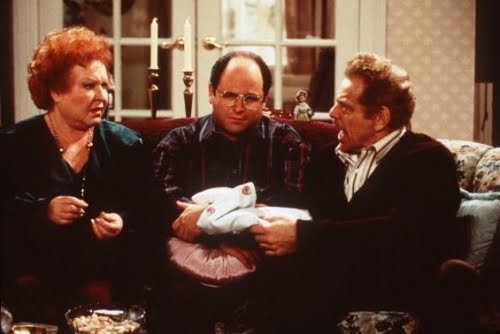
     The information I have about my family's war and pre-war history (both sides) is largely provided by two people who were just kids when the war ended—my parents. Naturally, their accounts of events do not always square perfectly with the facts available in history books. But, in my experience, their stories always ultimately check out as essentially accurate. Talking with my parents is indeed a hellish or absurd thing, a cross between dinner with the Costanzas and conversation with Gracie Allen. They’re pretty zany.
     But they’re no liars.


     I recalled that my mother’s father (who was actually her stepfather and uncle) was often described as a “Marxist.” So I asked my mother about that today. Despite the “Gracie Allen” factor, I did learn a few things. He was a well-educated man from Berlin, and, along with most of his college friends, he was a Marxist. He often talked politics, and his politics were decidedly left-wing.
     So did this cause problems for him during the Nazi years?
     He died of tuberculosis in about 1941. He was indeed outspoken in his hatred for Hitler and the party until the end. But he was liked and respected in the little town of Bärwalde. Friends and other town leaders did routinely implore him to keep his views to himself, for they feared that Nazi authorities would not tolerate his defiance forever. But he ignored such entreaties. In the last few years of his life, he was clearly ill and then dying, and so, evidently, the authorities left him alone.
     “Were these friends and others Marxists?”
     “Oh no, not all of them” says mom. “Some of them were even Nazis!”
     I should mention that not all Nazi-era family members shared my two grandfathers’ hatred for the Nazis. My mother tells stories of her older sister’s haughtiness and contempt for the Polish prisoners, who  performed various jobs in towns and in businesses, including in the family lumber business. (The engineer of the train my mother ultimately took to flee the Russian invasion was a Polish prisoner.) On one occasion, Ilsa was in town and demanded of a Polish man that he step aside to make way for her on the sidewalk. That got back to her mother (by then widowed), and, well, there was hell to pay.
     “Our family does not do such things," she declared. Nazi notions of superiority and inferiority were strictly verboten among the Schultzes.
     Neither of my parents strike me as rebellious in any way. They voted for Bush.
     Maybe it skips a generation.

From the archives


Wednesday, August 18, 2010

From the archives: photos and the case of Dr. Hanns Klemm

I'm still working on that archive project. It never ends!
This is a picture of a snowy Böblingen road, circa 1948, taken by my father with his Retina.
(Click on photos to enlarge them.)

Back in 1997 or so, my brother Ron and I took a trip up 395 and then west across the Sierra Nevada. This is a photo of Bodie, California, a very cool ghost town near the Nevada border, not far from Bridgeport.

My late grandfather, Otto, was a friend of an aircraft designer and manufacturer named Hanns Klemm. Opa, a wood worker, was with the R&D unit (Klemm was a great believer in wood construction and made significant contributions to wood construction and glue). Like my grandfather, who was a communist, Herr Klemm badmouthed the Nazis, and that finally got him into trouble. I do believe he was arrested toward the end of the war. I seem to recall coming across an article about Herr Klemm's fate. I'll try to dig it up. (See below.)
According to my father, Klemm asked Opa to run a factory for him, and Opa decided not to take the job, a decision which created problems for his marriage.
This photograph seems to be from about 1928.
I'm guessing that the plane is the L20. It's predecessor, the L15, was powered by a Harley-Davidson motorcycle engine! (Klemm's first plane, conceived when he worked for Daimler, had an Indian engine.) After the war, Germany was not allowed to develop aircraft with motors, and it was reasoned that the addition of a little 12 hp motorcycle engine wouldn't count.

Grandpa is the guy on the far right. Yeah, this is an L20 all right. Probably an L20b1. The L20 was first flown in 1923 and was in production until 1928.

Yep, that's me, circa late '57 or early '58.

My Aunt Ruth, in Germany, c. 1955

Crossing the Sierra Nevada, Nikon in hand

The view from Mono Lake


Opa, late 30s?

Re Opa's friend and employer Hanns Klemm, I found the following brief biography:

Hanns Klemm: the man who resigned from the Nazi Party and lived to tell about it 

     …[T]he Klemm company [which developed out of Hanns Klemm's association with Daimler, in Böblingen, in the mid-twenties] earned the reputation of being very innovative and commercially very successful.
     Hanns Klemm's vision was to build aeroplanes which, like cars, would allow a much wider circle of people to buy and run a plane.
     That meant a plane which was easy to manufacture and cheap to maintain, and ideally also fit in a garage. All development had to be subordinated to this primary goal.
     For this reason Klemm aircraft were not spectacular as far as horsepower and speed are concerned, but they were spectacularly economical and practical. Almost every flyer in Germany in the 20's and 30's learned to fly in a Klemm.
     In 1932 production reached 25 planes per month! Subsidiaries were formed abroad, among other places in the USA, Great Britain, and Sweden.
     In 1933 the National Socialists came to power in Germany and Hanns Klemm too, enthused by the spirit of national resurgence, joined the Nazi party in 1933.
     In 1934 the influence of the Nazis over the economy was growing. As an entrepreneur, Hanns Klemm was no longer free to determine his company's fortunes, and the Air Ministry set a starkly reduced monthly salary.
     A new factory was built in Halle on the Saale in 1934/1935 under pressure from the Air Ministry, and Director Klemm had to transfer to it a number of employees and the design of a two-engined machine, the FH 104. It then, after Hanns Klemm transferred this factory in 1937 to his one-time friend and company representatitve Friedrich W. Siebel, again under pressure from the Air Ministry, became the Siebel Flugzeugwerke.
     The Nazis interfered more and more in the running of the company and in the appointment of top positions, valued Jewish employees had to be dismissed, and piecework for other companies, for example the fuselage of the Messerschmidt Me 163 jet [sic; it was a rocket plane], had to be built at Klemm. Hanns Klemm refused the directives from Berlin, was subjected to an investigation for sabotage, and had to resign as head of the company -- Hanns Klemm was no longer boss of his own company.
     Hanns Klemm was a practising Christian and regular church-goer, and his growing distaste at the goings-on immmediately around him and in Germany made his membership of the Nazi party appear increasingly perverse. Also his inability to keep quiet about incidents which came to his notice meant that in 1937 he was considered politically unreliable, and declared to be "unfit to occupy a party position".
     In june 1943 Hanns Klemm dared the unimaginable, he resigned from the NSDAP [the Nazi Party]. The reason he gave on 26th May 1943 was: "I consider my membership of the NSDAP to be no longer compatible with my belonging to the Christian community". [Note: this was about the time that my grandfather was secreted to the Wehrmacht, keeping him out of the reach of the authorities.]
     The reaction to this resignation from the NSDAP was not long in coming.
     Hanns Klemm, to save his fortune, had to transfer his company to his wife. The Böblingen Tax Office, assessing Gift Tax at 330%, demanded 50,000 RM.
     Hanns Klemm was arrested by the Gestapo and after a fierce interrogation was delivered to the Bürgerhospital lunatic asylum in Stuttgart. The doctors, however, didn't consider him mad and so let him go home.
     On the 12th of June 1944 his company was requisitioned and a commissar appointed.
     In March 1945 he was arrested again by the Gestapo, interrogated, beaten-up, and his case handed over to a summary court. Only the arrival of the French army on 28.4.1945 saved Hanns Klemm's life.

Klemm next to a KL26

Charles Lindberg, flight testing a Klemm L20 in New York, 1928

Tuesday, August 17, 2010

Two factoids re the SOCCCD trustees race

     #1. Orange Juice’s Allen Wilson reports endorsements made by the Orange County Republican Party Central Committee last night in races for “Mayor, City Council and School Boards.”
     Guess what? Among those endorsed: Kevin Muldoon, a Republican candidate for trustee, Area 2 of the South Orange County Community College District. It was already pretty clear that he was the GOP's Anointed One. (See Another right-winger?)
     That’s Don Wagner’s trustee seat, which he is abandoning in order to run for Assembly in the 70th.
     No surprise, I suppose. Also endorsed were Anna Bryson and Larry Christensen, two clueless and incompetent incumbents at the Capistrano Unified School District. Both have been supported by Tustin’s Education Alliance, on whose board (as far as we know) sits our own Don Wagner.
     (Bryson is also an assistant to OC Treasurer and fraudster  and pal o' Fuentes Chriss Street.)
    
     #1.2. I checked the OC Registrar of Voters site for the Assembly race (70th), and there is no longer a link to Don's candidate's statement: see.

     #2. I looked again at Muldoon's "candidate's statement" on the OC Registrar's website, and I noticed a web address at the bottom of the page.
     So I went there.
     Guess what? It's a Go Daddy ad page, advertising a cluster of legal firms specializing in bankruptcy!
     Muldoon is a bankruptcy attorney. Oddly, none of the ten links on the page directs us to Muldoon's firm.

Board President Don Wagner harassed by bumble bee


     If you’ve been following our reports of board meetings throughout the summer, you know that the administration/trustees of the SOCCCD are in a weird place right now. There’s open hostility between Board Prez Don Wagner and his camp (Padberg, Milchiker, Jay, Roquemore, et al.) and Tom Fuentes and his gang (Lang, Williams, bees, roaches).
     That’s the bad news, I suppose. The good news is that today’s “Chancellor’s opening session” was the best such session to be seen in many years.
     It really helped that Fuentes and Williams were absent. No sulfur stink. No milk mustache.
     Lang, pretending not to be the kind of guy who will sell out his friends for career opportunities, gave an "invocation" that seemed to be entirely unreligious. So it really wasn't an invocation, if you ask me. Is that good? Not sure.
     Wagner was on hand, of course, looking pretty strong for a guy who’s been through hell. He even managed to be funny (albeit still a bit dark; he provided the only rays of darkness during the 90-minute event; he can't help being just a tad menacing).


     Marcia Milchiker, Dave Lang, and Wagner were the only trustees to show, which is a first. It’s been a while since Williams has missed one of these things. He’s seriously into milk and cookies, I guess.
     Here’s a quick rundown of what happened today. I missed the first minute or so. Don’t know what happened then. Like I said, Lang gave an invocation that didn’t seem to invoke anybody, but it was nice, if bland. (To the extent that it was an invocation, it was non-nice.)
     Mr. Bob Bramucci did his usual whizbangery in what he called a “Tech Check.” We’ve been upgraded to Blackboard 9.1, he said, and it is packed with fabulous prizes. If you’ve got an iPad, you can connect to all sorts of things of importance, district/college-wise, said Bob.


     He showed us some “IVC aps” for the iPhone that seemed pretty cool. You can look up anybody and get their contact info. You can search the schedule of courses; you can get directions—complete with GPS that tracks you like some kinda perp.
     There’s something called PUSH BI, which seemed pretty good, if you’re into WSCH and that sort of thing. Evidently, our district, along with the usual suspects (Ivy League colleges, UCI) were honored for being really good at something. Tech stuff I guess. Not sure. Big applause.
     Bramucci did his usual thing with funny pics from off the web: cats, dogs, drunk people. It was all in good fun. No Elvis sightings.
     Then he strapped on his eeelectric guitar and did his schtick, which is pretty schticky, if you ask me, but still pretty dang entertaining. He managed to find excuses to play riffs from “Seven Nation Army,” “Day Tripper,” “Smells Like Teen Spirit,” “Walk This Way,” “Purple Haze,” “More Than a Feeling,” and so on. He was like one of those old K-Tell commercials. A cavalcade of super-hot riffulosity!
     He must be a seriously hammy guy. The audience gobbled it up. The jokes were corny and the audience loved that too.

     Prez Burnett and Prez Roquemore took turns introducing new faculty. All in all, about twenty-five of ‘em got up there to take their bows and get their grin 'n' grips. They didn't drag it out, which is good. Nice pacing.
     Next came Vice Chancellor of Business-Whatever David Bugay—seems like a great guy—and another one of his eccentric-yet-homespun but highly entertaining showlettes. He called it, “Going to the top: a living mosaic.” That didn’t sound good.
     But I think it was good. In his odd way, he is a bold fellow.
     He started with images concerning the issues of our day, our worry and uncertainty, etc. He moved on to issues in the district: What’s with ATEP? Facilities funding. The Chancellor search.
     But then he offered a series of “encounters” with clusters of students, faculty, classified, administrators, et al., as a janitor swept in the background and the screen displayed big letters and goofy images.
     Bugay is good at this sort of thing. He puts on a good show.
     The running gag was his asking students, as they walked away, “Where you goin’?”, and the kid always says, “Why, I’m going to the top!” Then said kid walked over to some stairs to nowhere on the right side of the stage.
     “It’s about students going to the top," chirped the Vice Chancellor, repeatedly. That sounded uncomfortably close to one of Mathur’s mantras. But the series of charmingly fake encounters (including one with his own son, who asked for twenty bucks) seemed to work very well anyway.
     Wagner then came up to speak, and he was a little menacing (it’s a subtle thing), as he always is, but he was funny, too. (You don't need to be menacing, Don.) He started off with a dig at Raghu Mathur: “Remember when the Chancellor’s opening session was all about Elvis? What do you think of this?”
     Don and Co. pulled it off, I think. It was indeed a new kind of opening session. A friendly one. A “great step up from Elvis,” as Wagner put it. And it was.

     Wagner was keenly aware that this was his last opening session (what with his big Assembly race and likely victory in November). He made a point of thanking everybody. He said it was an “honor and a priviledge” to be involved in a “small way” in what the district does. I think he meant it.
     That’s when David Bugay kept gesturing at Wagner, annoying him (you know Don). I almost ran over to do a body block, but, finally, it became clear that the Wag-Man was being investigated by a persistent bumble bee, who had lit on his shoulder. The bee soon took flight, but then commenced buzzing around Don’s head. He/she seemed especially interested in Don’s hair. The dang thing seemed intent on buzzing the fellow--just like those old planes surrounding the Empire State Building in "King Kong." It was way cool.
     But Don rolled with the punches. “It didn’t happen in rehearsal!” he joked, good naturedly. The bee finally went off to bug somebody else.
     Next, we were entertained by a fake live conversation with Acting Chancellor Dixie Bullock, vacationing in St. Petersburg, Russia. She filled the screen, standing on the banks of a river. It looked like Russia all right. Pretty dreary. We could hear traffic noise. Dead Russians floated by.
     Naturally, the whole thing was taped, but Wagner (and Bullock) did a pretty good job seeming to have a live conversation, just like on CNN. “Yes,” said Dixie to Don’s first question, “I started as a faculty member.” But he hadn’t asked a yes/no question. Pretty funny.
     What are your plans?, asked Don.
     Stability and civility in the district, said Dixie.


     There was a big technical snafu. Don ad libbed: “No, Dixie, go on, really!”
     Fortuitously, the signal was then restored, more or less. She talked a bit about the value of civility, a theme touched on earlier by Bugay. She said we oughta so hello when we pass people on campus. “A pleasant verbal greeting will make our day going right!” she chirped. (She sounded exactly like Sue-Ann Nivens.)
     Just then, the technical glitch returned, and, for a brief second or two, she sounded just like a freakin' chipmunk. She’s already a very popular gal, but, owing to this chipmunk episode, her popularity will no doubt reach new heights.
     Don smiled a winning smile.
     We can be Number 1. We’re not far from it now!, said Dixie.
     Well, then came the “issuing of pins,” an absurd ritual the premise of which is: the longer you maintain your job in the district, the more impressive you are. I don't get it. Some people seem actually to enjoy this exercise, including the recipients, who often beamed with pride.
     And that was it.

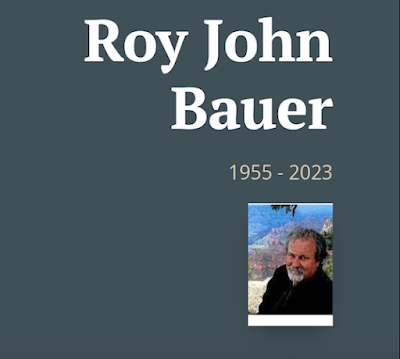
Roy's obituary in LA Times and Register: "we were lucky to have you while we did"

  This ran in the Sunday December 24, 2023 edition of the Los Angeles Times and the Orange County Register : July 14, 1955 - November 20, 2...