Tuesday, March 23, 2010

"One Classroom, from Sea to Shining Sea"

Last week in the New York Times Susan Jacoby made a case for real national educational reform in her essay, "One Classroom, From Sea to Shining Sea."

It's a provocative piece that zeros in on local and state control as the root causes that promote inequality of instruction and achievement across the country - along with a "lack of a national curriculum, national teacher training standards and federal financial support to attract smart young people to the teaching profession."

She points out the recent case in Texas:
...the Texas board’s social studies revision forms a blueprint for bad educational decision-making. Chosen in partisan elections, the board members — most lacking any expertise in the academic subjects upon which they are passing judgment — had already watered down the teaching of evolution in science classes when they turned their attention to American and world history. Thus was Jefferson cut from a list of those whose writings inspired 18th- and 19th-century revolutions, and replaced by Thomas Aquinas, John Calvin and William Blackstone. This is certainly the first time I’ve ever heard the “Summa Theologica” described as a spur to any revolution.

No Frenchman could conceive of a situation in which school officials in Marseille decide they don’t like France’s secular government and are going to use textbooks that ignore the Napoleonic code (and perhaps attribute the principles of French law to Aquinas).
Here are her solutions to a problem that is so obvious to all of us who work in higher education:
First, even though a national curriculum cannot be imposed, serious public intellectuals of varying political views need to step up and develop voluntary guides, in every academic subject, for use by educators who do not disdain expert opinion. The historians Diane Ravitch and Arthur Schlesinger Jr., who disagreed politically on many issues, advocated for just such a set of national history standards in the late 1990s. These guidelines met with approval from just about everyone but the extreme fringes of the left and right.

Second, the federal government must invest more in training and identifying excellent teaching candidates. France, faced with a teacher shortage in the early 1990s, revamped its training system so that aspiring teachers would receive a partial salary in the last year of their studies. Prestigious institutes for teacher training were also set up to replace less rigorous programs, with admission based on competitive national examinations. Which makes more sense — investing resources upfront in attracting the brightest young people to teaching, or penalizing teachers who fail further down the road, as No Child Left Behind attempts to do?

Finally, the idea that educational innovation is best encouraged by promoting competition between schools and pouring public money into quasi-private charter schools should be re-examined by both the left and the right. One of the worst provisions in the Obama administration’s $4.3 billion “Race to the Top” program strongly encourages states to remove restrictions on the number of privately managed charter schools. Here again, we have the worst of both worlds: a federal carrot that can lead only to a further balkanizing of a public education system already hampered by a legacy of extreme decentralization.
Yes, now that the reform of our health care system has begun, let's take on the classroom.

To read Jacoby's essay in its entirety, click here.

Monday, March 22, 2010

What’s with South County trustees and the Brown Act?

Capo district violates open-meeting laws for 5th time (OC Reg)
An Orange County judge has ruled that Capistrano Unified's school board violated the state's open-meeting laws in August 2008 when it held a closed-door evaluation of its then-superintendent, the fifth time the governing body had been reprimanded in the past three years for Brown Act violations.

Superior Court Judge David McEachen ... said last week that CUSD did not properly prepare the agenda for the closed-door meeting and thus failed to inform the public that it was holding a discussion about whether to put then-Superintendent A. Woodrow Carter on paid administrative leave. The agenda referred only to a "performance evaluation," not disciplinary action.
. . .
McEachen also ruled that trustees should have provided notice they were bringing in a non-district employee for the evaluation session – school-law attorney Spencer Covert – who served as a one-time, pro-bono consultant during the meeting.

Capistrano Unified's school board has been sternly reprimanded five times for repeated Brown Act violations, the first four by the Orange County District Attorney's Office.

The board was reconstituted entirely between the first four violations and the most recent one, with the new "reform" trustees pledging a new era of accountability and transparency.
. . .
Trustee Mike Winsten stressed that the most recent Brown Act violation was not of the same magnitude as in the past, when the D.A.'s office issued four consecutive stinging reports, the last of which said some former trustees had exhibited "disturbing disdain, if not outright contempt" for constituents when meeting behind closed doors. (Continued)
About a dozen years ago, the SOCCCD board engaged in "persistent and defiant" misconduct re the Brown Act--the anti-secrecy in government law. Or so said the judge.

Their lawyer? That would be CUSD's attorney: Spencer Covert.

CUSD's attorney these days? Phil Greer. Yep. Mathur and Williams' recent advocate.

BTW: The Capo district's current board is dominated by trustees affiliated with Education Alliance. Our own Don Wagner sits on EA's board.

A Greer is a Greer, oh dear, oh dear

$25K for sleazy lawyer.

This story concerns the agenda for Thursday's board meeting, which is available at the district website home page; find the blue box at right (on the home page); click on the link to the agenda.

Back in early February, I reported that the district was paying ethically-challenged attorney Phil Greer (see at left) $25,000 for his recent efforts on behalf of Raghu P. Mathur.

Naturally, I explained who Greer is:
A big fat card on [Tom Fuentes’] Rolodex is dedicated to one Phil Greer, attorney to the right-wing OC stars, such as the ethically challenged OC Treasurer, Chriss Street, the junket-loving and incompetent OC Guardian/Administrator, John Williams, all but one of the brainless OC Supes, and—well, Raghu P. Mathur.

Greer is the OC Republican mafia's consigliere. He's a total creep.

I’ve been assured by a reliable source that the SOCCCD recently paid the fellow $25,000. What for? Well, for participating in that heart-warming endeavor called the “Mathur settlement,” aka the Twilight Zonean saga of Mathur playing every desperate card up his sleeve (and one or two cards that he only imagines) while determined former admirers hustle him forcefully out the door, and for good
.
I went on to ask, “Now, what manner of ethics do you suppose [Phil Greer] has?”

The answer: none. I directed readers to a Times article about Greer’s ethical lapses: Rebuked O.C. lawyer keeps busy (H.G. Reza)

Well, anyway, I just glanced over the agenda for the March meeting of the South Orange County Community College District board of trustees (Thursday night). Item 5.12 is the usual “purchase orders/confirming requisitions”:


Well, the $25,000 "Greer" item has finally appeared! Here’s how it appears on the agenda:

I think it's odd, to say the least, to have this particular attorney working for the district.

Beyond that, it is scandalous that the district is paying a lawyer $25,000 just to help Raghu Mathur negotiate his exit.

Too bad they can't just drop him off somewhere on the San Diego Freeway.


Pictured: Greer, Supervisor Moorlach, Treasurer Chriss Street (from OC Reg)

Take a Letter, Maria

Rebel Girl can no longer remember just how it came up but in the days immediately preceding Spring break, talk in the A-200 building turned to letters of recommendation.

To be more specific, letters of recommendation for the IVC Foundation Scholarship program.

You know, those handy email notifications that arrive in our virtual mailboxes with cheerful hot links and helpful reminders as the the deadline approaches. She likes the system. It works.

Rebel Girl writes about a dozen letters a year. She's happy to do so. She was a scholarship student herself and knows what kind of difference a few bucks can make. She's happy to advocate for those who may not be able to make their best case themselves -and perhaps add a bit of sobering assessment of others who might, ahem, exaggerate their own charms and abilities. You know.

She attends the scholarship program so she can see her students get big checks and meet their families and congratulate them. (Though no, for the record, she does not bow her head and pray. Never has.)

This year, she had no requests.

She thought it might be due to the fact she was on sabbatical in the fall and perhaps all her former students simply forgot about her. She is pretty forgettable. Out of sight, out of mind. Not like some.

But then she asked around. An informal survey revealed that no one she spoke to in the halls in A-200 had been asked to write a single letter. Not a one. (Check out our poll on the sidebar.)

Maybe all our students are losers, someone quipped.

We groaned. Not likely.

Something else then.

But what?

A change in policy? Letters of Rec no longer required? Or needed?

But wouldn't that undermine the integrity of the process that facilitates the dispersal of thousands of dollars to deserving students? But wouldn't we be informed of such a change in policy?

Or???

Who knows?

We certainly don't.

Stay tuned.

*


Lucky Canada

Canadian University Warns Ann Coulter (Inside Higher Ed)

Ann Coulter, whose past statements have offended a wide range of groups, has been warned by a Canadian university where she will appear today that Canada has different views about free speech and hate speech than does the United States. Francois Houle, vice-president academic and provost at the University of Ottawa, sent an e-mail to Coulter that was obtained by The National Post. "Our domestic laws, both provincial and federal, delineate freedom of expression (or "free speech") in a manner that is somewhat different than the approach taken in the United States. I therefore encourage you to educate yourself, if need be, as to what is acceptable in Canada and to do so before your planned visit here.... Promoting hatred against any identifiable group would not only be considered inappropriate, but could in fact lead to criminal charges.... I therefore ask you, while you are a guest on our campus, to weigh your words with respect and civility in mind." Coulter was not available for comment. But the Post noted that her targets have – in addition to Muslims – included Canadians. She once said that "they'd better hope the United States doesn't roll over one night and crush them. They are lucky we allow them to exist on the same continent."

Adjuncts Are Committed to Teaching, Despite Work Conditions, Survey Finds (Chronicle of Higher Education)

A national survey released today by the American Federation of Teachers reveals that a majority of adjunct professors hold their jobs mainly because they like teaching, not for the money, a finding that echoes the results of a similar survey conducted last year byThe Chronicle. Yet responses from the 500 adjuncts who participated in the federation's survey confirm that their working conditions leave much to be desired. For instance, about 41 percent said their job security did not meet their expectations, while just 28 percent said they received health insurance on the job. The federation will discuss adjunct-faculty issues and more in a joint meeting with the National Education Foundation in San Jose this week.

Sunday, March 21, 2010

Who you callin' an "assh*le"?!!

In my last post, I presented a small portion of my deposition last week in connection with the “Westphal v. Wagner” prayer case.

At one point, the district’s attorney, Mr. V, seemed to want to say that, in DtB, I tend to call people “assholes” and “idiots.” In response, I noted, first, that my occasional use of these terms was mitigated by the satirical nature of the blog. Second, I noted that I only call assholes “assholes.” Third, I noted that, insofar as I “call” people the a-word, the frequency of the phenomenon has decreased over the years.

I decided to look at the bare-assed facts. I searched for appearances of the word “assh*le” in the blog posts since the beginning of 2009 (that's a period of about fifteen months). Here’s what I found: the DtB posts in which the word "asshole" appears.

In each case, I present, in red, my assessment of whether the given occurrence of the a-word constitutes my calling my opponents assholes. Feel free to disagree!

• Another beer ~NO.
• The Stupid People revolt ~NO.
• Dissent gift ideas ~NO.
• It is what it is ~NO.
• Chapman U: from selflessness to selfishness ~NO. 
• Loutish self-celebration: the annual A**hole Parade ~NO. 
• "A-Hole" at the Radisson ~MAYBE or "YES, but."
• So Damn Happy ~NO.
• Americans: counting our losses with a super-multiplier ~NO and MAYBE. 
• Embarrassing perversitudinal dissonance. ~NO. 
• The Chancellor’s opening session: "dead, completely dead, and dead forever" ~MAYBE. 
• The boy who cried "wolf!"—and then got et ~NO.  
• Russian roulette, American Style ~NO. 
• We'll "prosper through doors"—and experience the Fall of Peevitude ~PLAIN YES. 
• Dick's grandson, Cox ~YES, BUT 
• Tuesday's board meeting—Roy's report ~NO. 

Standing for invocations

I thought some Dissent the Blog readers might enjoy reading transcripts from my recent deposition in connection with the “Westphal v. Wagner” prayer lawsuit.

The organization “Americans United for Separation of Church and State” is assisting a group of faculty and students (I was the last to join), challenging some of the South Orange County Community College District’s “religious” practices, such as trustees giving invocations at commencements, etc.

For my depo, Mr. M (of Mayer Brown) was my attorney. Mr. V (of Jones Day) represented the district (a group that includes the seven SOCCCD trustees, Chancellor Mathur, and Saddleback College President Tod Burnett).

What follows is a small portion of a seven-hour deposition:


MR. V: . . . Did anyone require you to stand during the invocation?

A I've never been given that directive.

Q Okay. It's true, is it not, as an adult you can make your own mind up and decide to sit during the invocation if you wanted to, that was within your ability?

A Yes, but you do pay a price when you feel that you're among the very few or perhaps the only person sitting.

Q What price do you pay?

A Well, you are made to feel that . . . you're somehow different and excluded from the standard.

Q Okay. And how is sitting during an invocation different than writing in your blog your views on invocations? How does one . . . point yourself out any more than the other?

A I just don't understand your question at all.

Q Sure. Let me ask it – you say, if you sit you feel like you're an outsider and you may show other people that you're an outsider?

A Well, I think life is complicated and things can sneak up on you. And you find yourself not wanting to participate in religious rituals or things that partake of religious rituals, and you suddenly find yourself punctuating your behavior in a way that you don't even understand by standing or by sitting and you … aren't able to immediately reflect on what all that means. And it's an annoying burden to have to go through that. And the reason I have to go through it is because [the district] impose[s] religiousness through these prayers.

Q But my question was: You can sit if you want to sit; right?

A At a price.

Q Right. And the price is?

A It's hard to say. I wish I had an opportunity to write you an essay about it because that's what it would take to express my view about that. I would say at the very least I feel that [public] institutions [that engage in invocations] … are saying it is normal to be religious and that offends me because I think our society is based on a kind of agreement to disagree about religious questions.

Q And how is sitting during an invocation more of a – or singling yourself out if you sit during an invocation than writing in your blog your views on invocations to the whole world?

A Well, I don't know the answer to that question. I have no feel for what you are getting at. But when I write, it is a practice. It is a well understood practice, writing. Writing is taken in certain ways. Writing is one thing. Being in a room with other people is quite another thing, depending on what room it is, what the occasion is.

I feel strongly that if I were to sit when everyone is asked, “please stand up for the invocation,” for me to remain seated, I feel [it] would be like waving a red flag. That's the way it feels to me. It's not that I want to participate. But I know I don't want to wave a red flag in the face of these good people that are standing around me. To me it comes out of a sense of community and politeness.

And so I really don't know … what you're talking about. I can't compare the two at all. They are dramatically different things, writing an essay to be published in a newspaper or a blog or standing with people in a room.

Q Well, … the concern is, as you said, singling yourself out, waving a red flag. I mean, how is that act where only the people in the vicinity of you could see you sitting, less of singling – less singling yourself out than writing a blog and telling the world how you feel?

A Again, I don't understand your comparison. When I write on the blog I am participating in an institution of dialogue and discourse and there's a whole etiquette attached to it. There's a sense of what it means to do something like that. There's a sense of “if you don't want to read it, you don't have to.” You have to actually go out of your way to read my blog. It doesn't come to you. I can't even begin to compare the two situations.

I can tell you this: I feel that I'm very polite on my blog the way I write. The kinds of editorial judgments I have made, and I think that it strikes me as a difficult, almost a dilemma, when I'm at a board meeting and I'm asked to stand up to participate in an invocation because I don't want to participate and I don't want to wave a red flag. I feel that I have to choose. And what I usually do in that situation is I just stand and … to the extent that it's possible for a person to stand without joining in prayer, even though everyone else is apparently doing the same thing, joining in prayer. But, again, it's a dilemma forced upon me and it doesn't seem to be … right….

Q You're not concerned about singling yourself out, Professor?

A I am. I am.

Q I mean, you write a blog where you express your views on invocations?

A In that sense, I am not at all bothered about singling myself out. I have no problem expressing my views and even knowing, which I sometimes do I suppose, not often, that they're unusual views. I have no problem with that, but when you're standing with people in a room, many of whom you know and you respect and you like, for some of them the prayer is a meaningful thing, for some of them. And for me to sit there might seem offensive and I'm aware of this and I don't mean to give offense. I don't like it that the only option I have is to stand up, but I do. I'm not happy with it because I think by standing up I am, in some sense, participating in this event and I don't wish to do that but I'm given no alternatives, I'm stuck with a dilemma.

Q You can sit, that's an alternative

A Well, maybe you can but I try to be polite around people and I feel that – I don't want to upset people who are just there to do something that's meaningful to them. I don't have the time to explain to them that I respect that, but I must now not participate in this. I don't have the opportunity to do that. So I'm stuck in a kind of – a kind of rhetorical dilemma where I cannot express myself. I don't have the occasion or the time at the moment. It's in the middle of a meeting and so it seems to me, for me, a matter of civility and politeness.

Q Well, you can express yourself, you can talk to them after the meeting, you can talk to your colleagues after the meeting; right?

A Well, I can't talk to all of the people who see me sitting there.

Q Right. Well, you can write it in your blog if you wanted to?

A Well, … most of them do not read the blog.

Q How do you know that?

A Well, I'm guessing.

Q Right. In fact, your blog is – the intended audience of this blog is the Saddleback faculty?

A No.

Q And the Irvine Valley faculty?

A That's right, it is the district community. That's the intended [audience]. Now, I'm perfectly aware that not everyone in the district community reads my blog.

Q And, in fact, before your blog, you would deliver in their mailboxes … your views. And so – and you understood that your views may be offensive to some of your colleagues?

A I was not, of course, attempting simply to express my views. Again, I was attempting to improve discourse and making people more informed. And, again, my views are secondary at best in my publications.

Q And, in fact, you're not concerned when you put the "Dissent" in your colleagues mailbox about whether they may disagree with what was written; right? That wasn't a concern of yours, anymore than it was a concern whether you would stand or sit during an invocation?

A Well, I don't understand why you're telling me what I think. I know what I think. And it was – it is a concern now and has always been a concern to me when I am with people that I know that in some cases are my friends and some cases they're [just] people I respect. Yeah, I am aware of how my actions will seem to them and especially when I might perform an action that might be misinterpreted in a way that causes them offense. You and I may be very different, but to me that would be on my mind. Now, there's an institution, there is a practice of discourse and it is such that people are aware that you can express your position and your views and people have a right to do that, and they do it in this kind of setting [blogs, newspapers] exactly and if you don't want to read it, you don't have to.

Q And, in fact, you said earlier that pretty much everyone knows your views; right?

A Those who are aware of the issues and the history, recent history of the district, yes.

Q And your friends know your views, your friends in the faculty?

A They do.

Q Right. Then why would it be a concern for you to sit if your friends already knew your views and you didn't want to offend one of your friends?

A When we have district events they are district events, they are not IVC events and many of them occur at Saddleback College where I have fewer friends. Nevertheless, though I know … few of these people I respect them.

Q And then you said you are always polite in your blogs, you try to be polite?

A In my opinion, I offer views that … I try to argue for a position. I think that there are some people who are so unaccustomed to the traditions of discourse that they fail to perceive satire and things like that.

Q You call people “assholes” and “idiots” in your blog?
. . .
MR. M: Objection; only to assholes and idiots.

BY MR. V:

Q Do you call people “assholes” and “idiots” in your blog, yes or no?

A Oh, I'm trying to remember. I think that I have attributed assholery and idiocy to people, yes. But you have to understand that that's done in the context of a publication that has long dabbled in satire.

Q Okay.

A I have a personal ethic about it. I only call people “assholes” when they are assholes.

Q And “idiots” when they're idiots?

A “Idiots” understood in a way when you use that term in everyday language.

Q And you don't think that sets you out – your blog doesn't set your views out for the world to read when you call someone an “asshole” or an “idiot”?

A I don't think I call people that. I would say that I use that terminology in a subtle satirical setting that would be understood by a sophisticated reader who has read the blog over time. I would also say that I have done less and less of that if we look at the spectrum of time from '97 to the present.

Q Okay. We'll look at some of the recent ones. I mean, what would you say less and less? When did you think you – when did you think you stopped the practice of calling people “assholes” and “idiots”?

A Well, I never stopped the practice because it has never come to me as an issue in that way. I just have a vague perception, a sense, that I have engaged in that kind of satire less.

Q Okay.

A And, again, I have always followed in my mind the principle that you only call an “asshole” an asshole and a non-asshole shall never be called an “asshole.”

Q Now, is it your view, Professor, that if you had your druthers you would not have to hear invocations at public events?

MR. M: Well, objection as to vagueness of “public events.” I think you mean government-sponsored events.

MR. V: Sure. That's fine.

BY MR. V:

Q Let me adopt your counsel's question. If you had your druthers would you like it not to have to hear invocations at government-sponsored events?

A I would not ever put it in the language of “druthers.” I think it's a violation of the sense of civility that's at the core of our society that we agree to disagree about religious matters—for the government to be establishing or imposing religiousness.

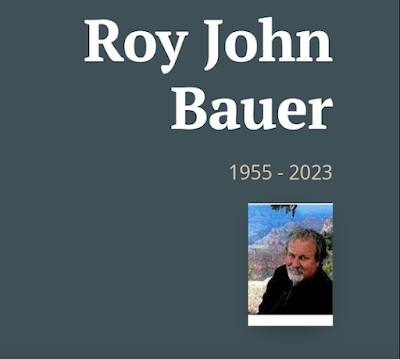
Roy's obituary in LA Times and Register: "we were lucky to have you while we did"

  This ran in the Sunday December 24, 2023 edition of the Los Angeles Times and the Orange County Register : July 14, 1955 - November 20, 2...