Monday, November 30, 2009

Nonbelievers are going to Hell


Today, the district sent the following statement “to all employees of the South Orange County Community College District on behalf of our Board of Trustees and Chancellor.”
You may have heard that a lawsuit has been filed against the South Orange County Community College District challenging the practice of opening important District and college events with invocations. Invocations at public events represent a tradition that goes back to and before the founding of the country and continues into the present. You may recall the invocations, for example, at President Obama's inauguration earlier this year. The District wants to continue this time-honored practice by offering invocations and the Pledge of Allegiance at significant District and college events in order to call attention to the solemnity of these occasions in the lives of students, their families and our educational institutions, to invoke divine guidance and blessing, to show respect for beliefs widely held among members of the community, to promote patriotism, to honor America's heritage, and to reflect on the meaning that service and sacrifice give to every human life.

Americans United for Separation of Church and State, which represents the plaintiffs in the lawsuit, opposes invocations at all public events. The District recognizes that church and state must remain separate, but this should not require an attitude of hostility toward religion or exclude recognition of religious beliefs in public life while neither promoting nor disparaging anyone's religious faith or nonbelief.

The lawsuit points to some unintentional flaws in the District's practice that the District was already aware of and was in the process of taking corrective action when the lawsuit was filed. But these flaws do not include the practice of invocations itself. The District intends to defend the use of invocations at District events. The two federal Courts of Appeal decisions that have considered invocations at special university events both upheld them as constitutionally proper.

It should not take national tragedies such as the terrorist attacks of September 11, 2001, to make public recognition of religious faith temporarily acceptable when religious faith represents core values in the everyday lives of so many people in our community.

The matter will now go before the courts to review and decide. Meanwhile, we will continue to work together despite differences of opinion we may have on this important topic. Differences of opinion always exist on significant issues of public policy in a democratic society, and yet we can still work together in harmony for the common good of the District and our students.
In many ways, the statement is remarkable.

But before I explain, let me remind readers that the lawsuit (Westphal v. Wagner) appeals to the First Amendment of the Constitution:
Congress shall make no law respecting an establishment of religion, or prohibiting the free exercise thereof; or abridging the freedom of speech, or of the press; or the right of the people peaceably to assemble, and to petition the Government for a redress of grievances.
1. Those (e.g., Don Wagner) who are inclined to regard such lawsuits as an attack on free speech ignore the 1st Amendment itself, which declares the right of free speech while, at the same time, it prohibits the governmental establishment of religion, an action that one reasonably supposes is occurring when government officials, qua government officials, engage in speech of a religious—and especially a sectarian religious—nature. The right of free speech does not entail that all speech is protected. For instance, the speech of government officials, qua government officials, must avoid establishing a religion (or religiousness).

2. The district’s statement engages in obvious sophistry when it implies that the lawsuit challenges “patriotic” speech and rituals. It does not.

3. The district’s statement engages in obvious sophistry when it implies that the suit is to be identified with the goals of Americans United for Separation of Church and State (AUSCS) and not specifically with the objections of the actual plaintiffs of this complaint, who are making specific charges relative to specific events and actions. (See lawsuit.)

4. The district’s statement engages in obvious sophistry when it attributes to plaintiffs (and AUSCS) a “hostility” toward religion. In fact, some of the plaintiffs are religious and, as far as I know, none has expressed any hostility toward religion. Plaintiffs (and AUSCS) do not object to religion; rather, they insist on observance of the First Amendment and its prohibition against “establishment of religion,” a posture entirely consistent with non-hostility toward and even embrace of religion.

5. With regard to “unintentional flaws” in the district’s practice: this seems to be a reference to the Chancellor’s patriotic video shown during his Fall “opening session,” which ended with the words:
Only two defining forces have ever offered to die for you. Jesus Christ and the American G.I. One died for your soul, the other died for your freedom.
If this sectarian message (offensive to Jews, among others) was presented by mistake, then it is very odd indeed that, two weeks later, during the subsequent board meeting, upon hearing public objections to the video (and prayer), Trustee Wagner (who MC’d the “opening session”) and Chancellor Mathur failed to mention it. On the contrary, Trustee Wagner declared the session to be a "job well done." Chancellor Mathur made a "statement": he was not offended by the prayer/video.


Readers, I strongly suggest that you actually read the lawsuit. (See lawsuit.) Upon doing so, you will discover that, when parties who were offended by the district’s actions—including offensive comments made by a trustee during a scholarship ceremony that recipients were required to attend—presented their objections, the district responded with defiance, actually increasing the frequency and obnoxiousness of religious content during district and college events. (See especially § 48-84.)

For instance, consider this comment made by Trustee Williams at a recent opening session, introducing his invocation (prayer):
Before the invocation, I thought I’d tell a little Biblical story. Today’s story is about Jonah. In grade school one day, a little girl spoke to her teacher about Jonah and how he was swallowed by a whale. The teacher said it was physically impossible for a whale to swallow a human because even though they’re a large mammal they have very small throats. The little girl said, “But how can that be? Jonah was swallowed by a whale, and the Bible says so.” Again the teacher said it’s physically impossible for a whale to swallow a human. Undaunted, the little girl said, “When I get to heaven, I will ask Jonah.” To this the teacher replied, “What if Jonah has gone to hell?” The little girl replied, “Then you can ask him.” Please join me in the invocation now.
That’s right. Trustee Williams was suggesting that nonbelievers in Biblical stories are going to Hell. Prior to this occasion, Trustee Wagner had encouraged Williams, who was set to give an invocation, to "give 'em hell."

And so he did.

To see video of the Chancellor’s Opening Session (August 2009), click here.
Williams’ “Jonah” story/invocation: go to 07:20. (video)
The “God Bless the U.S.A” video: go to 2:47:20. (video)
The message about Jesus Christ: go to 2:50:10. (video)
Don, having just seen the video, betrays no indication that anything is amiss with the video:   2:50:31. (video)
Don Wagner's notorious Saddleback Scholarship event remarks.

COMMENTS:

Anonymous said...
Leave it to people who are so sure of their righteousness to pose arguments that aren't based in fact. Typical.
7:39 PM, November 30, 2009

Anonymous said...
Yes. Typical, and typically pathetic. Please enroll these people in a critical thinking class!
8:09 PM

13 Stoploss said...
what is Microsoft Silverlight? The only MS I trust on my machine is Office.
10:47 PM

Anonymous said...
nice~...................................................................
11:39 PM

Anonymous said...
I like how they invoke Obama's inauguration - ha! And Glenn wouldn't even let us watch the event unless we had it in writing from our supervisor!
9:47 AM, December 01, 2009

Anonymous said...
That story of Williams is just priceless - as is he smug, self-satisfied sniggering.
9:51 AM

Anonymous said...
People should watch that "God Bless America" video – just drag the timer toward the end and then let it roll. The soundtrack is that country song – "I'm Proud to be an American."
Then, at the end, we are indeed told only two people have ever died for us -- Jesus Christ and the American soldier -- one died for our souls and the other for our freedom. 

When Don Wagner steps out moments later, he doesn't say "ooops" or "I'm sorry" -- he just looks pretty pleased with himself.
9:58 AM

Anonymous said...
I think Williams was really saying that smart aleck teachers are going to hell -- ha ha ha. So so funny. Especially in front of an audience of teachers. Ha ha ha. 
On another note:
Why'd they bring 9/11 into it in that email?
10:11 AM

Anonymous said...
Please note that the memo blatantly states: they offer invocations "to invoke divine guidance and blessing." So, in other words, they are calling on the Christian god to speak directly to the district, which will be god's little hand puppet. 

If that is not a violation of the establishment clause, then what is?
11:04 AM, December 01, 2009

Anonymous said...
They've gotta be pissed at John Williams. What was he thinking? And I looked at that "opening session" video. Wagner doesn't seem to be bothered at all about the "Jesus Christ" message at the end of that patriotic video. How do these people expect to prevail in court?
12:31 PM

Anonymous said...
Quote "It should not take national tragedies such as the terrorist attacks of September 11, 2001, to make public recognition of religious faith temporarily acceptable when religious faith represents core values in the everyday lives of so many people in our community."
So if I don’t believe in religion I have no core values?
This district has pissed me off for years. Who are they to impose their faith and religion on me? I have seen things in my life that have shaken my faith and no I don't want to be saved and no I don't want you to pray for me. 
They stand up on their soap and boxes wave the American flag. They support each other regardless of immoral behavior and then Dan behind them as long as they follow a certain religious faith. I believe a man stands on his own and hiding behind the tragedy of September 11 or hiding behind your religious faith is for cowards.
2:04 PM

Anonymous said...
Does anyone have information on the two federal Courts of Appeal decisions that have considered invocations at special university events and upheld them both as constitutionally proper? What relevance,if any, do these cases have to the one filed against the District?
6:06 PM

Sunday, November 29, 2009

Who is the sexiest man in the world?

“How was your trip to the mountains?”
“Oh, pretty good, except for some of the people….”
Silence.
“Yeah. But Limber Lou had fun, right? Snow and everything?”
“Sure. He had great fun. He watched every episode of Pirates of the Caribbean.”
“Are those good? Never seen those.”
“Without Johnny Depp, there’s nothing there. Nothing.”
“Guess so.”
“Johnny Depp is the sexiest man in the world.”
“Is he?”
“That’s what they say.”
Silence.
“Yeah, but is he?”
Silence.
“Does Don still have that facial hair?”
“Don Wagner? Nope. Nowadays, he's gone for that clean-shaven, fleshy-faced, middle-aged look. Looks like shit. He’s gotta do that to get elected, I guess.”
Silence.
“How about a poll?”
“A poll?”
“Yeah. Sexiest man alive.”
"On the blog?"
"Yeah, on the blog."
Silence.
“Go for it. But use your byline, OK?”

The story of Orange County (still astounds me)


THOSE INTERESTED in, but unfamiliar with, local history might want to view the six-part TV documentary, “The Story of Orange County,” produced twenty years ago by KOCE-TV for the Orange County Centennial. It's available on YouTube; see the links below.

Production values for the series are not high (the music seems to say: aren’t we silly?), and the philosophical perspective is far from critical, but there are lots of great old photos and a more-or-less coherent story.

As always, the story astounds me. Only two hundred years ago, the region saw Spanish colonization on the cheap, with mission settlements, not soldiers. Then came the ranchos. Next came the Mexican war of independence, followed by secularization and pushy gringos from the east and their pursuit of Big Money. As Mexico skedaddled, ranching gave way to farming, and, by the 1860s and 70s, OC became a entrepreneur’s freakin' playground.

The Story of Orange County (in 2 episodes)

Episode 1: Birth of a County (in 3 parts)
Part 1: Native Americans, Spanish colonization, and Mexican independence

Factoid: European diseases--chicken pox, etc.--nearly wiped out the natives. The population, once about 125,000, shrunk to about 5,000.

Event: Mexico became independent of Spain by 1821 and secularized the area. Ranchos flourished, missions declined, gringos welcomeD.

Part 2: Drought, vulnerability, and opportunistic European & American Moneymen

John Forster, hailing from Liverpool, bought huge tracts of land, lived in the SJC Mission, died with huge debt. From ranching to farming. Plus: those wacky Germans.

Part 3: trains (1870s) and then more trains;—the boom of the 1880s

Locals got sick and tired of dealing with and sending their taxes to far-away LA. Spent twenty years trying to get their own county. “Orange County,” sans oranges, came into existence in 1889.

Factoid: in the 1860s, they tried to create the “County of Anaheim.” It was a no-go.
Episode 2: “Dawn of a New Era” (in 3 parts)
Part 1: Chapman and his valencias make OC orange after all; electric “Red Cars” pull things together, and commerce thrives

Factoid: nobody marketed oranges in the summer until Charles Chapman showed up (1894). All-out marketing made America orange-happy.

Part 2: the arrival of cars, the Great War, and the “oil boys” in Huntington beach

Factoid: owing to a grassroots “Good Roads” movement, the coastal “State Highway” was completed in 1914. (They didn’t even have to give it a number!)

Part 3: coastal development, the crash, and then WWII

Factoid: in 1925, former Seattle mayor Ole Hanson promoted the crap out of San Clemente, imposing a master plan and tiles and stucco. The crash ended development, and H lost his dang house (Casa Romantica). He went off to found Twenty-Nine Palms.

Factoid: seems like every dogface who was processed at the “Santa Ana Army Air Base” (aka OC fairgrounds) hoped to come back to OC for good. Each one did, I guess. That helped fuel the super-duper post-war boom.

Saturday, November 28, 2009

The First Amendment and Time Machines

RE THE "PRAYER" LAWSUIT: Nope, on my last post, I didn’t include the “debate” going on at the OC Register, preferring to concentrate on the remarks and views of academics. That was no guarantee of quality, it seems.

But the Reg’s readers are very interested in the lawsuit. The Reg article, which appeared on the 23rd, has thus far attracted 90 comments!

I perused them and found most of them to be pretty predictable.

There are exceptions, but, mostly, here’s what passes for debate among the OC Reg’s readers:
At 11:45, alleykat1 wrote:
Keep religion out of public schools, okay? Thanks.

At 11:54, kakalaki wrote:
Keep homosexuality, and liberal indoctrination out of our public schools, okay? Thanks.
Gotta love the old Reg and its Neanderthal “base.”

The Reg has run a poll, asking, “Should prayer be part of community college events?”

The results so far:
Yes. It's a longstanding tradition that should be upheld. 58%
No. It's a violation of the separation of church and state. 42%
That’s better than I expected.

Evidently, some readers—including some who wrote to Inside Higher Ed!—are unfamiliar with the 1st Amendment of the Constitution. No, it isn’t only about free speech. It includes the famous “establishment clause,” followed by the “Free Exercise Clause,” etc.:
Congress shall make no law respecting an establishment of religion, or prohibiting the free exercise thereof; or abridging the freedom of speech, or of the press; or the right of the people peaceably to assemble, and to petition the Government for a redress of grievances.
As many (though, evidently, not all) know, the phrase “separation of church and state” does not appear in the Constitution/Bill of Rights. The phrase seems to trace back to a letter written by Thomas Jefferson, the author of the Declaration of Independence. (He was a Deist.)

There is a decent discussion of the 1st Amendment and differing interpretations of the Establishment Clause in Wikipedia.

I’m struck by the popularity of the odd notion that we can entirely settle questions regarding the meaning of the rights enumerated in the Constitution/Bill of Rights by identifying what their authors intended—as though the notion of “intention” were simple.

Naturally, I am very interested in the question of what the “founding fathers” were thinking. But I am equally interested in the conversations and convictions inspired by their words in the subsequent two centuries. The Constitution—and our ideals as Americans—are a tradition that necessarily adjusts and seeks relevance and meaning as time passes.

And so a reliable jaunt in a Time Machine is not the sine qua non of answering the crucial questions.


Santa Ana Canyon, 1887

THE YORBAS, PART TWO:


I had lunch with my folks today. I mentioned the Yorba Cemetery to them and, to my amazement, they knew something about it.

Turns out back in the old days—when our family first moved to the States—my folks loved to take the family to historical sites. In about 1962, they somehow heard about the Yorbas and about their cemetery and Adobe. So, one Saturday, we drove up the Santa Ana Canyon to find ‘em.


Back then, evidently, there was no freeway—I vaguely remember the old two-lane highway winding up the canyon, mostly hugging the south side—and the road to the spot where Bernardo Yorba established his ranch was pretty much in the middle of nowhere. (Now, it's wall-to-wall suburbia.)

My folks found the monument commemorating the enormous adobe structure—it was demolished in the twenties—and then they drove to the cemetery that was close by.

It wasn’t locked up. We strode inside and took a look around.

“Did you take any pictures?”

“No.”

In 1970, my dad (and I) started a Boy Scout Troop (#536) at Trinity Lutheran Church, which sat atop Nohl Ranch Road in Anaheim Hills, about where the road crests. (We had been with Troop 850 in Villa Park.) As it turns out, an “important” part of the Yorba family lived in that neighborhood, just up from the canyon floor, and so we got to know “the Yorbas.” --Some of ‘em, anyway.

My dad launched into stories about meeting Mr. Yorba’s mother at the “Yorba compound.” Evidently, she was very nice, very old world. She always insisted on giving him a bag of oranges when he visited.

I kinda remember ‘em. Sheesh.

Picture: Bernardo Yorba II, 1880.

P.S.: I looked up my old Church—Trinity Lutheran—and learned that, in 1985, "the church voted unaminously to withdraw its membership in the ALC [American Lutheran Church] because of theological liberalism and the synod's abandonment of the doctrine of Biblical inerrancy." Trinity is now a member of "The Conservative Lutheran Association." Gosh.

Discussion about the prayer lawsuit


I'VE BEEN monitoring comments to recent articles in the academic press on the SOCCCD “prayer” lawsuit (Westphal v. Wagner). They’ve been pretty much what you’d expect, I suppose.

We’ll start with the Chronicle article, which attracted only seven comments. (I've selected only two of these.)

CHRONICLE OF HIGHER ED

● The first commenter was pithy. “Geoz32” said “good.”

● Another commenter who goes by the handle “22218459” scolded both sides of the suit:

It is a reproach to ALL sides in this argument that it continues to go on. If the plaintiffs and defendants in this suit would consistently follow the ideals they cite, they would communicate sufficientl [sic] to accomodate, rather than litigate.

INSIDE HIGHER ED

For some reason, there were many more comments on the article that appeared in “Inside Higher Ed.”

● “Ind2002” of Pace University opined:

I have always been baffled by the obsession with public prayer, whether within the context of school ceremonies, football games, etc. I fail to comprehend why people who wish to pray cannot do so in their church, or the privacy of their home, or within themselves. Why the need for this type collectivism?....

● But Thomas M. Ratliff, an administrator at Indiana Wesleyan, offered a very different perspective:

Every human should be allowed to say whatever they want. Americans are supposed to be free to do so, even if someone else doesn't like it or agree. It is not suppression of other's rights to say something they do not want to hear, it is fundamental to the growth experience we are to have as living beings. 
I commend the college officials for consistently making their stand and speaking what they believe is appropriate in their hearts. May others be so bold as to continue to believe that we are actually free in this country and not enslaved to censorship.

● Meanwhile, Mike Landry of Northern State U wrote:

Wow! Not only does Saddleback College have the best jazz station I've ever heard (I listen online), but they have an administration with courage and common sense. There was ... a Western/County music dinner theater kind of thing in Colorado Springs. Each evening before the dinner, one of the cowboys would begin the meal by saying something like: "Before we eat, around here we pray. If you don't pray, that's fine. It won't hurt you." Glad to see Saddleback standing for a tradition deep within Western civilization.

● RSP expressed a different view:

… I too fail to understand why so many people insist on imposing their views on others in public settings. Those individuals with differing views are forced to listen, they cannot walk away. They are also, in a very real sense, forced to respond in the way that the speaker is wishing them to respond--forced to participate. If they don't, they risk being viewed as an outsider and subject to discrimination (even if that discrimination is subconscious). It's my understanding that the constitution, in part, was designed to protect the minority viewpoint....

● “pg” wrote:

I find it interesting that many individuals in the US who criticize theocracies elsewhere have no problem advocating public prayer and occasionally other acts of religious fanaticism. … In this so-called melting pot where all different races, ethnicities, and faiths reside, why can't religion be kept a personal matter?....

● Dale pounced on the appeal to tradition:

Tradition...tradition....tradition.... I keep hearing this plea for tradtion. Please. We're an educated people. Once upon a time, it was tradition to own slaves and burn witches at the stake. Can't we do better than that?
....

● Diogenes opined:

Courage? Seems more like bullying. "Hi. I'm your fundamentalist Christian administrator and we are now going to pray to my exclusive god. Sorry about yours…."

● Don Heller at Penn State weighed in with:

[Ratliff wrote:] "Every human should be allowed to say whatever they want. Americans are supposed to be free to do so, even if someone else doesn't like it or agree."

…[T]he courts have consistently ruled that public agencies - such as Saddleback Community College - have to tread lightly in their use and promotion of religion. The actions reported here tread very closely to the line the courts have delineated in ruling that public agencies not promote religious views. Ultimately, it will be up to a court to decide, but in the meantime it appears that SCC will spend a lot of money defending its actions, money it obviously cannot spare given the budget situation in which California finds itself.

● G. Tod Slone opined:

Bravo to the five brave professors for engaging this lawsuit and to Karla Westphal, in particular! They bring hope to the heart! Students, however, shouldn’t be encouraged to speak anonymously. Instead, they need to be encouraged to “go upright and vital, and speak the rude truth in all ways” (Emerson). ... 
It is mind-boggling to think that, at a public California college, such religious séances occur during mandatory faculty attendance events. Rather than be “baffled by the obsession with public prayer,” as one anonymous entity stated, we need to stand up and decry it openly! Without separation of church and state, we’ll end up like one of those islamist nations, where butchering women who leave their husbands is the order of the day….

● Sue Donna Moss wrote:

Perhaps the solution for all these people who think that it's fair to the rest of us to open events at public institutions with prayer would be to follow them up with an obnoxious, sarcastic three minute lecture from a secular humanist. Maybe the religious wouldn't be so quick to cram their ancient superstitions down our throats react when they discover that turnabout is fair game?

● Marcus Timbaugh, a prof. of Economics, said he liked prayer:

I like prayer. Whether or not you let me do it in public will not stop me from praying for you. 
Do me one favor though. Stop being hypocrites and playing the victim everytime someone prays in public, when your institutions systematically cram your atheistic views down students throats every day. There is an undeniable truth that thoughout [sic] most non-religious campuses, it's OK to be of ANY group, so long as it's not Christian. It's time to drop this double standard....

ADDED AT 6:30 p.m.:

● Bradley Bleck, who teaches English at Spokane Falls CC, asked

… [T]here might be religious freedom in theory, but there is certainly no freedom from being bullied by those who can't follow the dictates of Christ: 
“And when you pray, you must not be like the hypocrites. For they love to stand and pray in the synagogues and at the street corners, that they may be seen by others. Truly, I say to you, they have received their reward. But when you pray, go into your room and shut the door and pray to your Father who is in secret. And your Father who sees in secret will reward you" (Mathew 6 5-6).


● A fellow oddly named “Charles Darwin” offered this unpleasant comment:

Well, Saddleback college, it's nice to hear from you. Things have been a bit boring in the old grave lately, the Bears suck this year, and the Cubs, well, don't get me started.
 So imagine my delight in reading that you adminstrators at a publicy-funded institution of higher education get to decide what color God your good people get to pray to. Good for you!
 When I get Power, I think i will make everyone pray to science.
 You slobbermouthed, brainless, Faux-Noose watching idots [sic] are going to join me in hell for this. I can't wait.

● MathProf noted that

Many members of this opposition [to trustee prayer, etc.] are not opposed to religion, or the public expression of religion. We are opposed to the privileged position given to one religion -- Christianity -- at the expense of other religions: Islam, Judaism, Buddhism, Hinduism etc….

● Diogenes came back, looking for Marcus:

Actually Marcus I don't know what's more amusing: your straw man stereotypes or the weakness of the rest of your "argument."
 I tend to follow the teaching of an inspired man who said, "Do not pray in public as the hypocrites do..." You ought to read his book someday instead of slapping people with it.

● TT saw thing very differently:

… Just how far are we going to allow PC to dictate our lives[?] In this issue some speak of tradition, there is nothing wrong with tradition, and by the way I don't think the concept of tradition applies to slavery.
 Bottom line is Saddleback has an average enrollment of 39,000+ students and staff/faculty 2,000+ and 8 people are objecting to the this practice. Stop the world, I want to get off!

● Meanwhile, according to Hannha,

…[H]ow reasonable is it to expect the non-christians to just tune out or put up with it? What if it were a hebrew or muslim or wiccan or buddhist prayer; would christians be OK to just "go along"? 
I say, keep it simple--no prayers at all at public school functions. The cultural demographics and dynamics that made it easy for such prayers to go unchallenged in decades past have radically changed--for the better….

● CL expressed an unpopular view concerning democracy:

…We live in a democracy where the majority rules. If the majority want prayer at an event, then prayer occurs. For those opposed to prayer, don't pray. If you find it offensive, plug your ears….

● Predictably, others, including CC Prof, rebutted CL

…The Bill of Rights ... specifically limits or constrains majority rule. A majority of Americans could decide that everyone must be Catholic (or agnostic, etc.), but any legislation to that effect would be unconstitutional because of the 1st Amendment….

● And Jason said:

Actually, wer're not a democracy where "the majority" rules. We are a REPUBLIC, where the rights of the minority get protected in the consititution.…

● Don Rucker of Azusa Pacific U said:

… First, Thomas Jefferson made it clear to the Danbury, Connecticut Baptists that the "wall of separation" between the government and religion was for the protection of religion. In fact, that wall was to prevent the establishment of a national religion. It was not intended to prevent prayer anywhere. Also, it was intended by our founders that Christianity was fundamental in the founding of our nation….

● Annoyed PhD was amused by Sue Donna Moss’s crack about religion and superstition:

…God have mercy on all of us and the BS we have to put up with that flows out of "educated" people's mouths on college campuses. I hope your research is comforting to you in times of need and sadness.

● Jeremiah thought that believers should heed the Bible:

Consider the words of.…Jesus…: "When you pray, do not be like the hypocrites, who love to stand and pray on street corners and in public so that others may se them…..” Enough, already! Forget the ACLU, the Constitution, and all earthly law! Heed Matthew 6: 5-8 and get over it!!!

● Robert at Multnomah suggested:

… I'm not advocating for defense of public prayer like this or not, I just think that common sense and pragmatism demands that we step back and honestly ask ourselves if it's really hurting anyone. … Also, bare in mind that people with religious "rituals" have to mind far more rules in society to avoid offending others than most of us are willing to acknowledge… Remember folks, everybody is being repressed and oppressed by somebody in some circumstance somewhere if you look hard enough...you're not the only one….

● Dr. Anonymous said

The First Amendment says only that there shall be no Established Church and no law relating thereto. That is all. I grew up saying the Lord's Prayer every day in school. It hurt no-one, and no-one complained. Christianity is the religion of the American nation; it also has been at the heart of the American experience since 1620.  So: Jews, Muslims, and the various brands of atheism feel "on the outside" when prayers are said at public functions. Well: They ARE on the outside. And in their hearts they know it.

Well, for today anyway, Dr. A gets the last word.

COMMENTS:

Anonymous said...
The poor oppressed Christians, all so worried about others' viewpoints being "crammed down their throats." 

The rest of us have to put with their mythology on a regular basis, and it often creeps into legislation. They long for the next auto-da-fe while they whine about how put upon they are.
12:54 PM, November 28, 2009

Anonymous said...
I send my kid to community college to be educated, not prayed to. I have the option of sending my kid to a private faith-based college, but chose to send him to a public institution. I suggest your Board of Trustees stick to the issue of educating kids and stop wasting hard earned taxpayer money defending their "right" to force their christian beliefs down the public's throats.
6:03 PM, November 28, 2009

Anonymous said...
Good lord; who knew that the Chronicle had such neanderthal readers?----but also some thoughtful and educated ones, thankfully. 

¶ What an impasse we seem to have reached in this bizarre country. It's hard for me not to think that a certain LACK OF INTELLIGENCE keeps the Christian-types from seeing who is really being bullied in this country, from legislation and proposed health care "reforms" (let's take away any real legal right to abortions for women who can't afford them) to public prayer everywhere we turn. 

¶ Reminds me of noisy jerks at the movies: when you ask them to be quiet, they'll say, "hey, live and let live." Uh--yeah; that was MY point.

I mean: some of it is just plain stupidity. Very depressing.

Thanks so much for pressing the lawsuit!

  --MAH
6:32 PM, November 28, 2009

Friday, November 27, 2009

Yorba Cemetery


Has anyone been to the Yorba Cemetery in Yorba Linda—inside tiny and obscure Woodgate Park?

In the late 80s, I actually lived about 1,500 feet from it—in an apartment complex at Orangethorpe/Imperial—but I was barely aware of the cemetery then. Kept meaning to check it out. Never did.

It was established by Bernardo Yorba in 1858, about a quarter mile from his family adobe to the east. He had deeded the land to the church.

He then died at age 57.

The cemetery served the communities of the Santa Ana Canyon (along the Santa Ana River) until 1939, when vandals defaced and stole many markers and headstones. It was closed. And that was that, I guess. They put a fence around it, let it deteriorate.

SAVED! (NOT QUITE)

In 1967, the OC Board of Supervisors accepted the cemetery from the church as part of a larger effort to preserve OC’s history. But they dithered, I guess, and so it wasn’t until fairly recently (!) that the county made efforts to restore the cemetery, which, of course, has deteriorated further.

In 2002, just as the cemetery was finally undergoing a restoration, vandals struck again, breaking and knocking over 25 headstones “for no apparent reason.”

The “Yorba” connection to Orange County began with José Antonio Yorba, who was born in San Sadurni de Noya, Spain, in 1746. Twenty-three years later, Yorba was a member of Portola’s famous expedition, which came through Orange County in 1769.

Thirty-two years after that—when he was 55—Yorba was living in San Diego, when he had a son, Bernardo.

"BERNARDO LIKED YOUNG WOMEN"

Thirty-four years later, Bernardo Yorba received over 13,000 acres of land as a grant from the Mexican government . (It was in present-day Yorba Linda.) Soon thereafter (in 1835) he began building his adobe home, named “Rancho San Antonio.”

According to Find-a-grave(!), the adobe
had over 100 rooms with the rancho having hundreds of employees to tend the vineyards, crops and cattle fed by water from the Santa Ana River marking the first large irrigation system in California.


Sounds good. But then we’re told that “Bernardo liked young women.” His first wife (Maria) was 16, and, during the five years of their marriage (it ended with her death), they had four children.

Then came 15-year-old Felipa, who died when giving birth to child number twelve.

Wife #3, Andrea, was also young, and she bore Bernardo four sons.

The dude had twenty kids when he died.

For some reason, the Yorbas were all planted in LA (Calvary Cemetery), but they were reinterred in Yorba Cemetery in 1923. (Evidently, “His last wife, Andrea Avila, remarried and she is buried along with her second husband in an unmarked grave at the Yorba cemetery.”)

For what it’s worth, I found the following article, by Maria Leano, in the June 2008 edition of the OC Catholic:

Annual Mass at Yorba Cemetery Celebrates County’s Beginnings
A cemetery might not be the first place that comes to mind for a celebration. Yet for the past 12 years, one group of people has gathered the Saturday before Mother’s Day at a small burial site tucked in the hills of Yorba Linda to joyfully commemorate a shared heritage of discovery, perseverance, and achievement. Their surnames include Peralta, Dominguez, Yorba, and Grijalva, and they are the descendants of some of the earliest settlers of what is today Orange County.
On May 10, 2008, generations of descendants from the 20 Spanish families who first settled this northeast corner of the county gathered at the historic Yorba Cemetery (the oldest private cemetery in the state) for the annual memorial organized by the Santa Ana Canyon Historical Council….
Spanish pobladores began arriving in Orange County in 1769, after news of English and Russian settlements in Northern California spurred the Spanish government to solidify its claim to the land by populating it.
The first Yorbas, Grijalvas, and Peraltas arrived in the Southland with the military and missionary expeditions that followed….
Living in what were essentially remote outposts, the early settlers weathered disease, drought, and frequent territorial and political conflicts. (In a span of less than 100 years, the land on which the cemetery sits successively changed hands from the Gabrielino Indians to the Spanish Crown, the Republic of Mexico, and then to the United States.)
While the challenging conditions decimated many ranchos, Bernardo Yorba—the city of Yorba Linda’s namesake—rose to prominence. He was the first to introduce irrigation farming to the area, and his 50-room hacienda, complete with barbershop, general store, and private chapel, became a focal point of life in the canyon. The visits of missionary priests traveling through the area allowed canyon residents to celebrate Mass and receive the sacraments.
Before his death, Don Bernardo saw to the spiritual welfare of future canyon residents, donating the land for San Antonio de Padua Church and the cemetery plot…..

 Yorba Cemetery, 2007


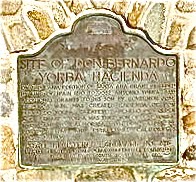
There's absolutely nothing left of the Yorba adobe--except this monument, by the side of a busy road.
Supposedly, the monument was made from pieces of the original structure.

A brief history of the Yorba family
The Yorba Family Cemetery

SOME O' "THE GIRL'S" (ERIN'S) PHOTOS


Thursday, November 26, 2009

Pleasant, gaudy, uncanny IVC


The A-quad. We used to have a clock tower here. Rot.
We saved the clock's hands. Metal.


The new commencement zone, between Biz-Tick and PAC.
Nice, but, here, the sun is all wrong in the late afternoon, when the ceremony occurs.
Photographers grumble and fume.


Biz-Tick at left; PAC at right.
Once were orange groves. Strawberry fields.


Late afternoon, long shadows.
Two people converse, saying nothing.


"Physical education." Odd phrase, that.
Is the physical educable?


More "physical education."
You hold the racket like this.
"Don't forget to breath."


We call this building Biz-Tick. It's cold and new inside. They teach here, in rooms. So do we. We know not what they do. They know not what we do. Whiteboards always erased, leaving no clues.

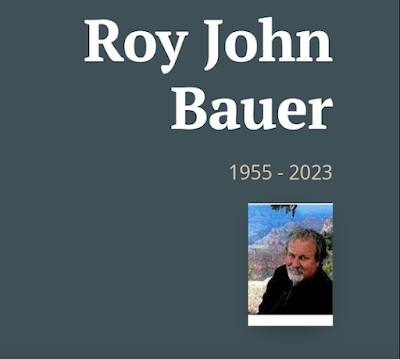
Roy's obituary in LA Times and Register: "we were lucky to have you while we did"

  This ran in the Sunday December 24, 2023 edition of the Los Angeles Times and the Orange County Register : July 14, 1955 - November 20, 2...