Saturday, September 12, 2009

Images from my childhood

VILLA PARK IN THE EARLY 60s
A couple of pictures of the neighborhood (Villa Park/Orange) of my childhood. My family bought oranges at the Santiago packinghouse for many years--starting in the early 60s. This pic looks c. 1961.

Nearby Wanda Rd. I just barely remember that little store.

Got these pics from the OC History Roundup blog.

Photo taken in 1957. My family didn't move to OC (from British Columbia) until two or three years later.


This is downtown Orange, 1920s—long before my time. But I did live near there c. 1990 in a house built in 1903.

This, too, is before my time: Peters Lake (near Irvine Park), 1949. Evidently, in January of that year, it snowed! (Got these next ones from the OC Public Library archive.)

OK, this one's just weird. El Toro Rd. 1970

I cropped it to maximize weirditude

Newport Pier, turn of the century

The aggregators are coming! The aggregators are coming!

Structural disintegration of the Academy
I read an article in this morning's  Washington Post by law professor Zephyr Teachout that neatly expresses an increasingly common view about the future of higher education. If this view is correct, we’re now entering a Brave New World. (A Virtual Revolution Is Brewing for Colleges.)

(What is a Zephyr Teachout?, you ask. Well, according to her Huffington Post biography, Zephyr Teachout “teaches Election Law at Duke University School of Law. She is the former National Director of the Sunlight Foundation, Director of Online Organizing for Howard Dean's Campaign, and Researcher at the Center for Investigative Journalism in Bosnia-Herzogovenia”.)

Excerpts:
Students starting school this year may be part of the last generation for which "going to college" means packing up, getting a dorm room and listening to tenured professors. Undergraduate education is on the verge of a radical reordering. Colleges, like newspapers, will be torn apart by new ways of sharing information enabled by the Internet….

The real force for change is the market: Online classes are just cheaper to produce. … Distance-learning technology will keep improving. Innovators have yet to tap the potential of the aggregator to change the way students earn a degree, making the education business today look like the news biz circa 1999….

This doesn't just mean a different way of learning: The funding of academic research, the culture of the academy and the institution of tenure are all threatened.

Both newspapers and universities have traditionally relied on selling hard-to-come-by information. … A student can already access videotaped lectures, full courses and openly available syllabuses online. And in five or 10 years, the curious 18- (or 54-) year-old will be able to find dozens of quality online classes, complete with take-it-yourself tests, a bulletin board populated by other "students," and links to free academic literature.

But the demand for college isn't just about the yearning to learn – it's also about the hope of getting a degree. Online qualifications cost a college less to provide. Schools don't need to rent the space, and the glut of doctoral students means they can pay instructors a fraction of the salary for a tenured professor, and assume that they will rely on shared syllabuses. Those savings translate into cheaper tuition, and even before the recession, there was substantial evidence of unmet demand for cheaper college degrees. Online degrees are already relatively inexpensive. And the price will only dive in coming decades, as more universities compete.

Taking the newspaper analogy one step further, college aggregators will be the hub of the new school experience. In the world of news, the aggregators have taken over from the newspaper as the entry point for news consumption. Already, half of college graduates attend more than one school before graduation. Soon you'll see more Web sites that make it easy to take classes from a blend of different universities.

Because the current college system, like the newspaper industry, has built-in redundancies, new Internet efficiencies will lead to fewer researchers and professors. Every major paper once had a bureau in, say, Sarajevo – now, a few foreign correspondents' pieces are used in dozens of papers. Similarly, at noon on any given day, hundreds of university professors are teaching introductory Sociology 101. The Internet makes it harder to justify these redundancies. In the future, a handful of Soc. 101 lectures will be videotaped and taught across the United States.
When this happens – be it in 10 years or 20 – we will see a structural disintegration in the academy akin to that in newspapers now. The typical 2030 faculty will likely be a collection of adjuncts alone in their apartments, using recycled syllabuses and administering multiple-choice tests from afar.

So how should we think about this? Students who would never have had access to great courses or minds are already able to find learning online that was unimaginable in the last century. But unless we make a strong commitment to even greater funding of higher education, the institutions that have allowed for academic freedom, communal learning, unpressured research and intellectual risk-taking are themselves at risk.

If the mainstream of "college teaching" becomes a set of atomistic, underpaid adjuncts, we'll lose a precious academic tradition that is not easily replaced.

A friend found this -- 37th in healthcare:

Friday, September 11, 2009

Americans: counting our losses with a super-multiplier

The IVC 9/11 event
Cops

At noon today, Irvine Valley College held a fine 9/11 Commemoration Ceremony in its Performing Arts Center. Lots of local VIPs were on hand, and a few of them spoke before the audience of 80 or so.

Despite the massive dollop of PR horseshit inevitably baked into this kind of event, it was a good thing, I think. Everybody behaved (although there was the inevitable invocation), and the speakers were pretty good—although I don't understand why our 9/11 events always emphasize cops.

Hutchins

After Board President Don Wagner’s brief address, Irvine Police Chief David L. Maggard, Jr., spoke, followed by new OCFA Fire Chief Keith Richter, and Orange County Sheriff-Coroner Sandra Hutchens, who, like Maggard, attended last year’s IVC ceremony.

IVC’s Matthew Tresler, accompanied by piano, sang “America the Beautiful” and “God Bless America.” Pretty impressive.

All of the speakers were good, albeit subdued, as befitted the occasion.

Yes, they were good. In fact, as they spoke, I was struck by the oddness that people hired presumably to run large and complex and trouble-prone organizations happened also to be photogenic and decent-to-good public speakers.

Maggard may be a nice guy, but he looks and sounds like he’s the star of a TV show about a former FBI man who now heads the Agrestic PD. --That is, to me, when he shows up, he's ready-for-prime-time, and he offers a performance. I’d much rather he got real—maybe talked about how people aren’t always good and you’ve got to struggle to get 'em to straighten up and fly right. (The Irvine PD has a, um, colorful history, you know.)

Richter

As usual, Hutchens was intelligent, but she also seems too nice to kick ass, and surely, given her job, she’s got to do lots of ass-kicking. She did fire a bunch of people recently, so maybe.

But I wanna see a woman who conveys how tough and even nasty her job often is, dealing with all those cops, some of whom are serious assholes (I assume you read the paper).

Richter seemed genuine and smart. It’s easy to imagine him actually being good at his job. Hope so.

Maybe some of you think these observations are inappropriate. After all, this is a special day, commemorating a UNIQUE catastrophe in history. This is no time for peevishness and nickpickery.

Really? Obviously, 9/11 was a terrible day. 3000 or so people were killed on our soil (by “fanatics,” according to one of today’s speaker). Everybody seems to think that that day 8 years ago “changed the world” (as one speaker today put it). Everybody seems to view it as an evil of outstanding enormity.

Trustee Tom Fuentes

Yeah. But we Americans have killed many more than that number of civilians in the Middle East since 2003—in an invasion and occupation instigated by leaders that we had every reason to think might cook the books. And, as it turns out, they did.

I just watched a show on the Military Channel. In Tokyo during WWII, Curtis LeMay’s B-29 crews killed between 80,000 and 200,000 people, mostly civilians, in one night. Burned ‘em alive.

Obviously, I could go on: Dresden, Vietnam, Iraq sanctions, etc.


I don't get it. We're a nation that kills hundreds of thousands of foreigners and we pretty much refuse to think about that as any kind of moral burden. "How many died in the Vietnam War?" I ask my students. The smart ones say, "58,000."

But what about the 1-2 million Vietnamese? What, they don't count?

OK, in 2001, we lost 2 or 3 thousand in one day. That's a terrible thing. But, unless we get to count our losses with a super-multiplier, that toll just doesn't rate compared to the horrors that occur routinely in this world, including horrors we have ourselves perpetrated (or, anyway, that we have brought about).

Please tell me where I've gone wrong in my thinking here.

As you know, some SOCCCD trustees seem to think that we, as a community, have gotta keep touching base with God (an entity who they take to be distinctly Christian, evidently). Well, OK. But it seems to me that, when we send him messages, we'd better be careful. For if there is a God, He’s gotta think that we Americans, especially we comfortable and staunch OC Americans, are some seriously thoughtless assholes.

Next time, I want somebody to talk about that.

Trustee Don Wagner
Reporter Lesley Stahl (asking about U.S. sanctions against Iraq): We have heard that a half million children have died. I mean, that's more children than died in Hiroshima. And, you know, is the price worth it?
Secretary of State Madeleine Albright: I think this is a very hard choice, but the price—we think the price is worth it.

Sorry about that

Just keeping the world safe for democracy, I guess
PM's apology to codebreaker Alan Turing: we were inhumane (Guardian)
[Britain's Prime Minister] Gordon Brown issued an unequivocal apology last night on behalf of the government to Alan Turing, the second world war codebreaker who took his own life 55 years ago after being sentenced to chemical castration for being gay.

Turing is most famous for his work in helping create the "bombe" that cracked messages enciphered with the German Enigma machines. He was convicted of gross indecency in 1952 after admitting a sexual relationship with a man.

He was given experimental chemical castration as a "treatment". His criminal record meant he was unable to continue his work for the UK Government Communications Headquarters (GCHQ) because his security privileges were withdrawn. Two years later he killed himself, aged 41….
Among those who had signed a petition for an official apology are novelist Ian McEwan and scientist Richard Dawkins.

Thursday, September 10, 2009

"The Long Memory...

...is the most radical idea in America." So said Utah Phillips. He attributed the sentiment to Claire Spark, a radical historian while others have said it was all Emma Goldman's. Whatever the source, it resonates.

Enjoy this excerpt from this week's Tom Tommorow cartoon. Rebel Girl did.


Moose Turd Pie

Torture Boy John Yoo encounters a special student at Chapman U


From an old Wired story. But new to me!

OC Register sports bozos: 2nd worst "person" IN THE WORLD!


See original article: Many odd things have happened in sports the past 18 years

More cut classes, sliced tofu, etc.

3 O.C. colleges cut classes for 2,000 students (OC Reg)
The Coast Community College District—which has already cut the number of classes it offers this fall—has decided to suspend Intersession, a concentrated period of learning held each January. ¶ The classes—which some students needed to graduate on time or transfer to a four-year school—would have served about 2,000 students.

The Rancho Community College District (Santa Ana College, Santiago Canyon College) recently cut about 400 class sections, affecting thousands of students. And nearby Cal State Fullerton, which accepts a lot of transfer students from the community colleges, eliminated roughly 150 class sections this fall.
Taking the misery out of meat-eating? (Guardian UK)
Researchers into genetics and neuroscience are working on creating livestock that are immune to pain by trying to locate and eliminate the pain gene. This, according to philosopher Adam Shriver, is the very least that should be ethically done as we consume almost 300m tonnes of meat a year – a figure that only looks set to rise.

Vegan restaurant makes animal-lovers happy (Lariat)
Ladera Ranch has jumped on the vegan bandwagon with the opening of its latest restaurant, Loving Hut, whose mantra, “Be Veg, Go Green…Save the Planet,” is clearly reflected in the restaurant’s vegan menu.
OCC campus administrator is set to retire (The Coast Report)
After nine years of service to Orange Coast College, Vice President of Student Services Jess Craig is throwing in the blue and orange towel….

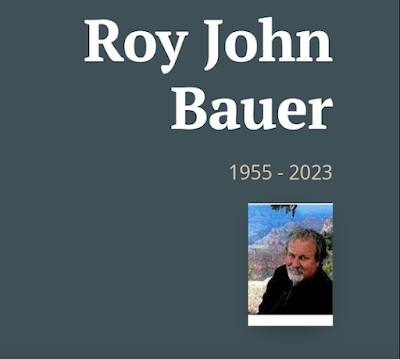
Roy's obituary in LA Times and Register: "we were lucky to have you while we did"

  This ran in the Sunday December 24, 2023 edition of the Los Angeles Times and the Orange County Register : July 14, 1955 - November 20, 2...