Sunday, August 30, 2009

PART TWO: Has student writing ability declined over time? (YES.)

Two things.

First, when, yesterday, I posted about the increase in writing abilities of American students from 1998 to 2007, for some reason, in my haste, I read “1998” but thought, um, “1970.”

Don’t know why I did that. Getting old, I guess. D'oh!

Had I been aware that we were looking at this recent and puny 8-year span (from '98 to '07), I would not have declared, as I did, that the “Teeth Gnashers” were likely in error (in their view that student writing ability has seriously declined in recent decades).

Second, I briefly researched further and I’ve come across what would appear to be much more relevant data: it tracks student verbal performance from 1967 to 2006. Yes! (It might be the closest thing to definitive data that we are going to find.)

More on that in a minute.

That's the good news. The bad news is that those data tend to support the perspective of the Teeth Gnashers (and undermines the perspective of the "oldsters always be carpin' about youngsters, so forgetaboutit" perspective).

I came across a site called the “Humanities Resource Center Online,” which is “a project of the American Academy of Arts and Sciences” (AAAS). That brought me to their Humanities indicators (for charting trends). That, in turn, led me to their data for “primary and secondary education in the Humanities.”

I clicked on “Indicator I-2 Writing Proficiency.”

There, the AAAS states that

NAEP findings are mixed….

Twelfth grade performance slipped between 1998 and 2002, with the percentage of students scoring at the basic achievement level or better declining from 79% to the 75% figure mentioned above. In 2002, fewer than one in four soon-to-be high school graduates were assessed as writing at the proficient level or higher. Students scoring at the proficient level demonstrate a grasp of writing skills that are essential for success in most walks of life; these skills include the use of transitional elements and the ability to select language appropriate for the intended audience….

Again, those data concern the brief period between '98 and '02—hardly the basis for conclusions about long-term trends.

But something caught my eye: “Indicator I-5: Performance on SAT Verbal/Critical Reading & Writing Exams.” There, the AAAS states

Although controversy over the SAT [i.e., the "Scholastic Aptitude Test"] persists on a number of fronts, the verbal portion of the SAT (renamed “critical reading” in 2005) is a valuable measure of college-bound seniors’ linguistic skills because the test has been administered for several decades and thus permits comparison over a fairly extended period of time. The SAT data reveal a steep decline between 1967 and the early 1980s in mean verbal scores, followed by a leveling off, with mean scores ranging between approximately 500 and 510 ever since ….

That's right: 2006 "verbal" scores can be compared to 1967 scores. The SAT is an imperfect measure of verbal abilities, but I suspect that it has significant validity. (No doubt some disagree.)

The trend in verbal SAT scores ain't pretty. The AAAS folks present the chart below. Check it out. That's some serious decline, baby.*

Click on image to enlarge

So, I’m back to being a Teeth Gnasher. Bigtime.

*SAT math scores were the same in 2006 as they were in 1967, although these scores dipped precipitously in the 80s and then rebounded.

Tomorrow’s board meeting: rode hard and put up wet


Hey, it’s time for another meeting of the SOCCCD board of trustees, starring Don Wagner and featuring Tom “sourpuss” Fuentes. —Monday night, same time (6:00 p.m.), same place (the “Ronald Reagan” room). (The agenda, a large pdf, is available here.)

As you know, board president Wagner has announced his intention to run for State Assembly, and so it seems unlikely that he’ll remain at the helm of the good ship Agitprop starting December (just 3 or 4 months away).

So, who’s gonna replace him?

Maybe Tom Fuentes?!

We keep hearing, mostly from trustees themselves, that the board is a group of unhappy campers these days, divided by—well, I dunno. For her invocation in July, given only minutes after the board’s closed session, trustee Marcia Milchiker alluded to the need for civility, but since everyone in the audience was genial to the point of comatositude, it seemed clear that she was referring to rank trusteecular kerfufflery.

Don Wagner has made similar allusions.

Kerfufflery? What about? I’ve been studying Chancellor Raghu P. Mathur’s lower lip-language. Judging by that and the perpetually rosy, red glow of his ass, it seems clear that he spends half of his time in the woodshed.

So, just maybe, tomorrow’s board meeting will be interesting. But I wouldn't bet on it.

CLOSED SESSION:

First, the board will hold a brief closed session, starting at 5:00 p.m. As usual, one agenda item refers to possible litigation.

For once, I looked up the section of the code to which the item refers (54956.9). That part of the code concerns legislative bodies (e.g., a board of trustees) and the appropriateness of meeting in closed session concerning “pending litigation.” (“3 cases” are involved, says the agenda.)

The specific parts of the code referred to in the item are:

…[L]itigation shall be considered pending when any of the following circumstances exist: … (b) (1) A point has been reached where, …, based on existing facts and circumstances, there is a significant exposure to litigation against the local agency.

(3) (A) Facts and circumstances that might result in litigation against the local agency but which the local agency believes are not yet known to a potential plaintiff or plaintiffs, which facts and circumstances need not be disclosed. [My emphasis.]

Well, whatever. (Republicans, of course, will recognize a fine business opportunity.)

OPEN SESSION:

The open session “reconvenes” at 6:00 p.m.

Early in the open meeting agenda, mention is made of a trustee request for a “report on Salaries of College Professors in Orange County.”

That’s gotta be our old friend Tom. He hates educators, y’know. He thinks they're lazy and wicked.

The “discussion item” for the evening will be each campus’s “strategic planning process.”

Among “consent calendar” items (that, therefore, likely will not be discussed by trustees) is a study abroad trip to Salamanca, Spain. No word yet whether Tom plans to pull the plug owing to some new Spanish treachery.

Looks like the board will approve an agreement between Saddleback College and “Lake Forest Beauty College.” Have you seen the people of Lake Forest? Most of ‘em look like they've been “rode hard and put up wet”—to use an expression my friend Marion used last night.

She’s from Texas. I asked her, hopefully, whether there’s any chance her state will secede soon.

She was not amused. She gave me the South Texas stink-eye.

As usual, the board will approve payment to a trustee who missed a meeting. They never discuss these freebies. They just approve ‘em. That's 'cause they're "fiscally responsible" Republicans, every one of 'em. Very staunch.

“General” action items include approval of final budgets for the district and the two student governments. That could get wacky, but it's more likely to get snoozy.


Item 6.2 is approval of the “basic aid project priority list” for 2009-10. It’s a significant agenda item.

ATEP (the Tustin campus) will get $5.5 million, including $2 million for “Negotiations,” $1 million for “development,” and $2.5 million for ATEP’s “operating budget.”

District IT projects will get $5 million.

Saddleback College will get $8 million, including $5 million for ventilation system upgrades, $1.5 million for “pool deck replacement,” and $1.5 million for “roof replacement.”

IVC will get a paltry $650,000—that's 8% of what its sister college gets—including 240K for various publications, 150K for “new signage and monuments,” 150K for parking lot repair, 90K “A200 & B200 secondary effects and library copy center,” and 20K for “landscape replanting.”

Including a few more odds and ends, it all adds up to about $22 million.

Gosh, IVC seems to be on somebody's shit list.

There’s the usual slew of new and improved board policies, including BP-4011.3, “Weapons on Campus.”


It is my understanding the Police Chief Harry Parmer is finally gonna get that M2 Browning machine gun that he loves so much. It’ll be installed in a fine nest atop the Ronald Reagan Room. (Well, no. But it is a cool weapon.)

Item 6.10 is the “elimination of one categorically funded position due to the termination of funding.” Ouch. (Reference is made to an “exhibit A,” but it doesn’t seem to be attached. What gives?)

That’s about it. Not too promising, but you never know.

Did you miss the Chancellor's "opening session"? It is now available here.

Saturday, August 29, 2009

Has student writing ability declined over time?

Some of our recent posts have generated considerable commentary, and much of it has been quite good. Great!

For instance, my brief discussion (School of Fish) of Stanley Fish’s latest NYT column inspired scores of remarks.

One of the issues that has arisen is whether students’ writing abilities are worse today than they once were. Many of us who write for or to DtB are under the impression that student writing ability has definitely gone in decline in recent decades. At least one Dissent reader, however, took issue with that perspective and has reminded us that always elders have bemoaned the alleged decline of young people’s abilities and knowledge.

Well, you know me. “Let’s get empirical” is one of my mottos. So what’s the relevant data (re writing ability)? Who's got the info we need?

I suppose an obvious place to start is the National Assessment of Educational Progress (NAEP), which is sometimes referred to as "the nation's report card." According to Wikipedia, the NAEP "is a periodic assessment of student progress conducted in the United States by the National Center for Education Statistics, a division of the U.S. Department of Education."

I know. No doubt there exists controversy about the quality of the NAEP’s data or tests. But I’m going to proceed on the assumption that NAEP’s data and findings are more or less sound. We can return to the issue of quality later, if necessary.

Here’s what those folks have to say:

The Nation’s Report Card: Writing 2007:

This report presents the results of the 2007 National Assessment of Educational Progress (NAEP) writing assessment. … To measure their writing skills, the assessment engaged students in narrative, informative, and persuasive writing tasks. NAEP presents the writing results as scale scores and achievement-level percentages. … The 2007 national results are compared with results from the 2002 and 1998 assessments. At grades 8 and 12, average writing scores and the percentages of students performing at or above Basic were higher than in both previous assessments. … Compared with 2002, average writing scores for eighth-graders increased in 19 states and the Department of Defense schools, and scores decreased in one state. Compared with 1998, scores increased in 28 states and the Department of Defense Schools, and no states showed a decrease….

The Nation's Report Card: Writing 2007—Executive Summary:

The average writing score [at grade 12, in 2007] was 5 points higher than in 2002 and 3 points higher than in 1998. ¶ The percentage of students performing at or above the Basic level increased from 74 percent in 2002 to 82 percent and was also higher than in 1998. ¶ The percentage of students performing at or above the Proficient level was higher than in 1998 but showed no significant change since 2002.

State (California) snapshot report 2007 (Nation’s report card: writing):

In 2007, the average scale score for eighth-grade students in California was 148. This was not significantly different from their average score in 2002 (144) and was higher than their average score in 1998 (141).

• California's average score (148) in 2007 was lower than that of the nation's public schools (154).

• Of the 45 states and one other jurisdiction that participated in the 2007 eighth-grade assessment, students' average scale score in California was higher than those in 4 jurisdictions, not significantly different from those in 6 jurisdictions, and lower than those in 35 jurisdictions.

• The percentage of students in California who performed at or above the NAEP Proficient level was 25 percent in 2007. This percentage was not significantly different from that in 2002 (23 percent) and was greater than that in 1998 (20 percent).

• The percentage of students in California who performed at or above the NAEP Basic level was 83 percent in 2007. This percentage was greater than that in 2002 (78 percent) and was greater than that in 1998 (76 percent).

It seems to me that that above information provides an impressive prima facie case that the Teeth-Gnashers (such as yours truly) are mistaken.

Naturally, it may still be true that students in a particular sector of higher ed (e.g., community colleges) are worse. For instance, despite the picture painted above, it may also be true that great middle of high school graduates are worse than they used to be and the well-performing outliers (those who qualify to enroll in the better institutions) are much better than they used to be.

Seems unlikely though. (See part IIof this post.)

Friday, August 28, 2009

Yorba Linda, California: When Past is Prologue, and Pickled (Red Emma)

Dissenters Attend George McGovern Book Event at Nixon Library…’Cuz We Like Irony…and Gore Vidal, Too (as the Egyptian God Ra)
By Red Emma
Photo: OC Weekly

     HARD TO KNOW whether to envy or pity the poor boob who stood up Wednesday night and interrupted Gore Vidal’s introduction of former Senator George McGovern, there to promote his book on Lincoln.
     Red Emma and Rebel Girl and the apple of their eyes sat in the front row of the mock East Room of the White House with sexy Ace Reporter Gal. Careful observers will notice that the Authentic has trouble, always, overcoming the Spectacular. 
     There we sat, in Nixon's Library in Yorba Linda while also sitting in the elegance of D.C., where the genuine struggled, but triumphed. 
     We waited an hour, with my seven year old, clever lad, passing the time reading “Calvin and Hobbes,” his latest passion. Golly, he is a smart boy. Takes after his mother.

      Suddenly a young, handsome man wheeled in an old, handsome man and somebody, I think it was me, stood up and began an ovation which lasted at least 3 minutes. 
     Gore Vidal was recognized immediately by it seemed a majority of the audience beyond this fan, and the others either thought, boy, George McGovern isn’t doin’ too hot these days or maybe just went along for the hurrah. 
     It was exciting. The Grand Man of Letters seemed to enjoy the reception, wanting to stand to acknowledge it. He couldn’t raise himself from the wheelchair, which he’s been in for some years.
     Happily, weirdly, he was soon lifted three feet in the air by a sturdy little ADA-required elevator right there in the pretend finery, Teddy Roosevelt’s portrait on the wall, up to the riser where he sat until McGovern and director Timothy Naftali arrived to more applause. 
     T.R. only looked on, bull-moosely.
     As an aside, I’ll observe that Naftali, a gifted scholar and seemingly really nice guy, bears an uncanny resemblance to, no, not Nixon himself, but to Harry Shearer, humorist, “Saturday Night Live” writer and NPR “Le Show” host and hard-core Nixonophile doing the Tricky One. Weird. But…fun! 
     After his generous remarks, including noting the death of Senator Kennedy and the half-mastery of Old Glory and the need to celebrate the work of the Library (governmental, nonpartisan, based on fact) and also the Nixon Foundation (private rich people, partisan, silly — my words, not his), Naftali explained that he had indeed invited Gore Vidal, Lincoln scholar and McGovern contemporary and remarked (the evening’s theme, sort of) on the lovely irony of these two liberals right here in Nixonland. 
     Vidal accepted more applause and offered his own reliable drollery and wit, which got big laughs and then suggested he would read “some pages” from Bernard Shaw, proceeding to read the (no surprise here) ironic and instructive (if you were listening) prologue to the Fabian Socialist’s play “Caesar and Cleopatra.” 
     So, to review. We were assembled forty years later in a faux East Room in Yorba Linda, at the real and yet also phony library with the liberal anti-war candidate McGovern who was victimized by Nixon and his gang and voted down by the frightened and not at all silent majority of ’72 AND with the essayist-novelist-playwright-candidate Vidal, two legends who survived to reappear together on the day Ted Kennedy died, as the USA killed on and on in Iraq and Afghanistan and a moderate First Black American President struggled with Blue Dogs and gun nuts and “birthers” at town hall meetings on health care “reform” of a system which is basically a gift to the industry.
       I could go on, but you get the idea. (And if not, you never will, pal.) 
     Oh, and did I mention that I was wearing my “I Don’t Care if He’s Dead, I Still Want to Impeach Nixon” t-shirt? And that Ace Reporter Gal wore a vintage button, “Kiss Me…I Voted for McGovern”? 
     In case you haven’t read “Caesar and Cleopatra” lately, I’ll summarize, briefly. Old Ra, wearing his funky Egyptian hawk’s head helmet appears. We are in Memphis. He talks to us, his modern audience, scoldingly. It’s a warning, a cautionary tale based on the political choices of old and new Rome, between the soldier Pompey (“The way of the soldier is the way of death”) and Caesar, whom the gods seemed to dig. Pompey, who represents “Mammon” (and, for our purposes, Northrup Grumman and McDonnell Douglass) makes war on Caesar, who runs away to learn a lesson from the gods, eventually gathers his wisdom and beats Mammon’s army, which runs off to Egypt, which is basically a colony of Rome.
     Afghanistan, Iraq, Bush-Cheney, get it? Hubris, war, empire. 
     Lucius Septimius seems to embrace Pompey in Sphinxville, but instead “welcomed him with one hand and with the other smote off his head, and kept it as it were a pickled cabbage to make a present to Caesar.” Wow, sauerkraut!

     Now, friends, if you were lucky enough to be sitting in the audience at this remarkable occasion on a summer evening in the waning days of our own pickled empire, waiting to hear from the man who should have beaten the war criminal, and were, yes, being read to by one of the greatest thinkers, writers in the history of our republic, wouldn’t you, like me, count yourself a pretty lucky duck, soak it up, be enthralled and feel just a little bit of, okay, hope for us all? 
     Not the boob. He stood up from the tenth row, and interrupted Gore Fucking Vidal! 
     “With all due respect, Mr. Vidal…” he began. Some members of the audience, expressing their own boobery, applauded in seeming consent. 
     Vidal only smiled, as if he had organized the whole thing, as if he had orchestrated not only the moment that we saw, but the moment, now, of the silly man, and what would follow. 
     The sly and wise old dude waited for the crowd to settle back down, and resumed. He just kept reading, as, of course the Big Moral had arrived, Bernard Shaw’s timing and Vidal’s own seeming to anticipate the chucklehead:
“Are ye impatient with me? Do ye crave for a story of an unchaste woman? And what I am about to show you for the good of your souls is how Caesar, seeking Pompey in Egypt, found Cleopatra; and how he received that present of a pickled cabbage that was on the head of Pompey; and what things happened between the old Caesar and the child queen…All this ye shall see; and ye shall marvel, after your ignorant manner, that men twenty centuries ago were already just such as you, and spoke and lived as ye speak and live, no worse and no better, no wiser and no sillier.”
     I kid you not. That’s how it happened, with Vidal completing the passage and the goof revealed as a sort of unknowing actor in the Great Man’s dramaturgy. Vidal is a playwright, after all. 
     He got another big applause at the end. Some people got it, some didn’t, and then McGovern took the podium. 
     He made some good cracks himself, including thanking Vidal and noting that, of all the events he’d read at lately, it was this one, at the Nixon Library, where circumstance and history conspired to get the introducer a standing ovation. I looked over in the direction of Mr. Interrupter, lost in the crowd but gifted at least with an embarrassing story to tell his friends and family, about being both a player and an object lesson. 
     Senator McGovern offered his thoughts on Lincoln, all solid and entertaining and thoughtful, including his observations about Lincoln’s own personal challenges (clinical depression, as the South Dakota senator’s own doomed daughter) and pointed out all that Abe got done while trying to save the union, and admired Lincoln’s writing, too. I think C-SPAN might have got all this for broadcast, which you can view I hope after reading my color commentary. 
     Then, during the Q & A, sexy Ace Reporter Gal sprang up to ask a question about McGovern’s recollections of Ted Kennedy. She got him to tell some pretty darn sweet stories. And afterwards, we three waited while she got in line to get McG’s signature. 
     I watched the crowd assembled around Vidal’s wheelchair, a dozen people wanting to shake his hand. I wondered if Interrupter might apologize, but he had gone off to audition for some other performance as stooge in life’s rich pageant, perhaps to ask Yo-Yo Ma not to play so loud.
 
Sexy Ace Reporter Gal peppers the speaker with sexy, ace questions

     My little boy shook the old peace candidate’s hand while I tried to identify all the names of “benefactors” of the foundation and library (more fun) and tried to make sense of the weird shit for sale in the gift shop, including a t-shirt with Tricky Dick’s face and the question “What Would Nixon Do”? I wondered who bought that, and I wondered about the occasion when they might find themselves looking down at their chest to ask themselves that. 
     Answer: Smear Jerry Voorhees, red-bait Helen Gahagan Douglas, develop a racist “Southern strategy,” bomb a country illegally, start an enemies list, beat up Pat, spy on Dan Ellsberg, get drunk with Kissinger, resign in disgrace, like that. Hmmm.
 
Limber Lou meets B-17 pilot and great guy George McGovern

     We stuck around long enough to take in the fountain outside and enjoy the warm night, congratulating ourselves on being part of a generous civic moment, then went to Mimi’s for dinner. I had fish’n’chips and a cold Newcastle Brown Ale in a tall glass. 
     At the intersection of Yorba Linda Boulevard and Imperial Highway on the way home we read the flashing Cal-Trans-style sign which warned, over and over, “Coyote Alert.” (They have, it seems, pretty alert coyotes out there in the Yorba that’s linda.) And what, friends, is that stretch of Imperial (SR 90) called, which we were helpfully reminded as we departed to our canyon home? 
     The Richard Nixon Parkway.
     From the conclusion of the “Caesar and Cleopatra” prologue:
“And fear not that I shall speak to you again: the rest of the story must ye learn from them that lived it. Farewell; and do not presume to applaud me.”
     Peace out!

The Rands love Randi


I'm not a fan of Ayn Rand (1905–82), but the Ayn Rand people share my admiration for James Randi--the "Amazing Randi."

Check out this tribute to the little fellow made by the AR people.

Thursday, August 27, 2009

Wendy's new assignment

About five minutes ago, the IVC community received this email from Vice President of Instruction Craig Justice:
Colleagues:

I am pleased to announce the appointment of Wendy Gabriella, Professor of Anthropology and Academic Senate President, to Instructional Coordinator of Academic Programs, Office of Instruction, for the 2009-2010 academic year. Wendy will continue to co-chair the 2010 Accreditation Self-study Steering Committee. She will coordinate numerous operational projects for the Office of Instruction, including the Basic Skills Initiative grant program, Early College Program (Instructional Planning), some research projects conducted by the Office of Institutional Research, and will assist the Vice President of Instruction with enrollment management, program review, strategic planning, as well as other important projects.

According to the Academic Senate Bylaws, Professor Lisa Davis-Allen, Academic Chair of Visual Arts and Academic Senate Vice President, will become the President of the Academic Senate.

Please join me in extending our enthusiastic support for Wendy and Lisa as they serve in their new assignments.

It is my understanding that Wendy is receiving 100% reassigned time (i.e., reassignment from her regular teaching duties) to serve in this capacity and that she is not teaching any courses this semester.

It is no secret that VPI Justice, who has a reputation for intelligence and hard work, has been encumbered by startlingly numerous responsibilities since he came to IVC two or three years ago. (At IVC, deans, too, seem chronically overburdened.) That problem led to a proposal, last spring, to create a new IVC deanship—a Dean of Academic Programs, Student Learning, and Research. The proposal, however, was rejected by the SOCCCD board, perhaps owing in part to the need for frugality (or, anyway, its appearance) during this period of fiscal stress. (See April board meeting.)

A champion of openness and "process":

Wendy Gabriella has long been a faculty leader, but particularly starting in late 1996, with the emergence of a controversial conservative "Board Majority." (Arguably, the controversial "board majority" era continues to this day, though with somewhat different players.) In 1997, she and I twice sued the district board for its violations of the Open Meetings Law, when, repeatedly, the board met in closed session to make decisions that should have been made openly and with clear notice to the public.

(In those days, many objections to the board's conduct boiled down to the charge that the trustees and chancellor violated or circumvented established and legal "process"—something that nowadays is sometimes expressed in the demand for "transparency." It was during this period that the board violated its own policies and "best practices" (or so said the accrediting agency) in promoting the administrative career of Raghu P. Mathur over seemingly far more qualified candidates, especially in selecting him as chancellor of the district. Mathur continues to be chancellor of the district.)

Wendy also assisted in district students' repeated and successful challenges to the board's restrictions on student protests (initially with regard to administrative and board behavior that jeopardized the colleges' accreditation) and adoption of new "speech and advocacy" policies that violated student speech rights.

Most recently, Wendy led the effort to challenge the district over its disregard of a state statute giving faculty (i.e., the Academic Senates) the right to mutually develop (along with the district) a faculty hiring policy. That effort was successful and, by some accounts, constituted a landmark victory for faculty governance rights in the California community college system.

Epoch-shatteringly delightful!

Recently, I posted about a district almanac page that presents the distribution of grades given to students at our two colleges (during the Spring semester of 2006). The upshot: the faculty of our colleges—and especially Saddleback faculty—give lots more A’s than any other grade. (See What we have here is failure to evaluate.)

I’ve done a little research since then, and, as it turns out, this kind of grade information is fairly readily available, owing to such entities as the website Pick-A-Prof (PAP). According to Wikipedia,
Pick-A-Prof is a pay-to-use online website found at www.pickaprof.com that hosts professor reviews and other academic tools and services for university students and professors. …

The site posts grade histories of professors. The grade history graphs display the distribution of grades from A’s to F’s.

This feature displays the semester(s) a professor teaches a particular course and the average GPA each professor gives in that course. While searching for a course, the site shows the professors teaching the course, a 5-star rating system ..., the number of student reviews submitted for each professor and the percentage of students who dropped the class.

Many professors say the website portrays their courses unfairly and students will hesitate to take their classes if the grade distribution reported on Pick-A-Prof does not match their definition of earning an “easy A.” ….

I found a year-old article in UC Santa Barbara's Daily Nexus (New Web Site Evaluates Professors) that reports that

Pick-A-Prof won a lawsuit against University of California, Davis in 2006 that opened the gateway for the widespread publication of professors’ grades. The site sued the school claiming that professors’ grades were public record after the university had originally given out the grades but then refused to release them.

I’ve been told (but need to verify) that our own district has handed over grade distribution records per instructor to Pick-A-Prof.

So I visited PAP, and, sure enough, PAP has the data, at least for IVC. (One must register to access PAP's data, but there's no charge.)

I looked up Professor Roy Bauer and found that the fellow gives lots of A’s but many more B’s and his “G.P.A” (i.e., the average grade he gives) is slightly below 2.0 (C) for “Intro to Philosophy” and slightly above 2.0 for “Ethics.”

Bastard!

Naturally, I provided a review of this fine fellow. I gave him five stars (the maximum) and wrote that he is “epoch-shatteringly delightful.”

And it's all true.

For those youngsters who were mystified by my earlier allusion to Cool Hand Luke:


I think I'm beginning to like this Anderson Cooper fella:

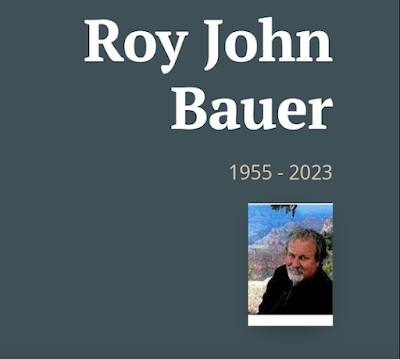
Roy's obituary in LA Times and Register: "we were lucky to have you while we did"

  This ran in the Sunday December 24, 2023 edition of the Los Angeles Times and the Orange County Register : July 14, 1955 - November 20, 2...