Saturday, February 17, 2007

Misbehaving trustees, groundless charges of tightwaddery, and perverse enjoyments!


AS YOU KNOW, Saddleback College got spanked during its last go-round with the Accreds. Like Irvine Valley, Saddleback must now produce a “Focused midterm report [FMR] on issues of Commission special concern.”

Unlike Irvine, however, Saddleback College will be subjected to yet another team visit!

Ouch!

According to the Accred commission’s January 31 Action Letter, the FMR should especially emphasize Recommendations 2 (start planning!), 4 (dump unprofessional hiring procedures for execs!), 5 (cease board micromanagement!), and 6 (overcome hostility and despair!).

The Action Letter is based, of course, on the November ’06 Progress Report Visit Findings. Have you read them?

Recently, a colleague suggested that I read through that document carefully. I recommend that you do the same.


I am particularly struck by the section of the document concerning Recommendation 6: to overcome the plague of “hostility, cynicism, despair, and fear.” It is literally the end of the document.

Here, in its entirety, is the “conclusion” of that section. (I have added the section headings.)

Conclusion:

[DIFFERENT SIDES:]

It is difficult for the team, as outsiders, to fully assess the cause of the climate issues in the district. These issues are of long duration and have produced many scars that run deep. On the one hand, the faculty and classified leadership present a picture that depicts them as being downtrodden and overworked. The board and the administration tell another story. There are probably any number of individual variations and takes on these themes that fall in between these two poles. So where is the cause of this problem?

[THE COLLEGES VS. THE DISTRICT:]

By their own admission, a primary source of the hostile climate that has plagued this district and its two colleges is the chronically strained relations between the colleges and the district. It is not unusual in a multi-college district to have tension between the desire for autonomy at the colleges and the need for accountability or oversight by the district.

[THE GROUNDLESS CHARGE OF PARSIMONY:]

There is a perception by faculty, staff, and administrators at Saddleback College that the district is sitting on a pile of money and doesn’t share it sufficiently with the college. The team did not find evidence for that assertion. The district has funded numerous construction and modernization projects at both colleges. The district has negotiated generous contracts with the bargaining units such that they are among the best paid in the state. The list of positive district actions could go on. The point is that the district has shared resources with the college and is supporting the college in an appropriate manner.

[THE CULTURE OF CONFLICT, INCLUDING FACULTY:]

The chancellor, to a certain extent, appears to be a lightning rod for much of the blame for strained relations. However, after seeing firsthand and hearing anecdotal evidence about the actions of constituent leadership, especially the faculty leadership, the constituent groups must own up to their part in causing and sustaining a negative environment. It is almost as if there is a culture of conflict that is relished by some parties in the district, not for any great principle, but for the sport and enjoyment of conflict itself. This culture of conflict is fueled by a power struggle between the various groups. There are many secondary problems generated by this type of culture. One is that it is unproductive and wastes valuable time that could be spent on more important issues. Another is that the power that is being contested is illusory in that in this day and age there are myriad limitations on the power of any group, including the board. The worst problem is that such conflicts take the focus from students and they cause people to look out for their own interests rather than the interest of students.

[“WHEN THE BOARD BEHAVES BADLY”:]

It is apparent that the SOCCCD Board and the chancellor would like more credit for the positive actions that they have taken on behalf of the colleges. Unfortunately, when there are still examples of micromanaging or examples of board members disrespecting individual managers (or others, including one another) in open session meetings before the public, it has the opposite effect. When the board behaves badly, it sets a negative tone and message throughout the district. It tends to undo whatever good has been done as they are not given equal weight in most people’s minds. While there is sufficient blame to go around to all parties for contributing to the climate described in this recommendation, it remains the board to show the way in moving the district and the colleges to a better place.


Friday, February 16, 2007

What's our mission?


Site Meter
OK, NOW BEAR WITH ME HERE. This morning’s LA Times has a story about Tustin Unified School District. According to the story, the ACLU has charged that “Too few Latino and African American students are enrolled in gifted programs” at the TUSD. They’re threatening a lawsuit:

"The district is not doing enough to identify talented students from different racial and ethnic groups and different income levels," said Hector Villagra, director of the American Civil Liberties Union's Orange County office. "We've looked at other districts in Orange County, and a number of them are also doing a poor job, but Tustin is really off the charts." (ACLU targets Tustin Unified's gifted program)

It seems to me that Villagra's point concerns the "mission" of a public school district. What are we to make of a district that emphasizes assisting the especially prepared while neglecting the especially unprepared or disadvantaged? And is TUSD doing that?

MEANWHILE...

Back in January, the OC Register got excited about IVC’s expanded partnership with Tustin Unified, as we then reported ("Offhand" question). According to the Reg,

Tustin high school students will be able to graduate with a high school diploma and a college associate's degree at the same time after the district and Irvine Valley College agreed Monday on a program that will start in the fall.

The program will put college professors in high school classrooms to teach college courses, giving students a chance to earn college credit throughout high school without paying college tuition.

…The early college program will launch in the fall at Beckman High School, and will be brought to Tustin High and Foothill High schools soon after.
(See.)

The Reg goes on to explain that “The district is targeting students in high school honors and college preparation courses.”

Uh-oh. There's that pattern again.

FACULTY OUT OF THE LOOP

I week or so earlier, during an IVC Academic Senate (faculty) meeting, senators expressed surprise and consternation when they learned about the Tustin/IVC program. Few were aware of it, and yet, evidently, it was already a “done deal.” Senators generally felt that they’d not been kept in the loop. (They often feel that way, these days. Consider how ATEP has developed--until now without significant faculty input, despite the faculty's authority over program & curriculum development, etc.)

But other issues arose during that meeting. I recall senators expressing reservations about participating in a program that singles out the “best and the brightest” among students. Targeting those students isn’t the community college system’s mission, they said. (For a statement of the California community college system's mission, see Mission.)

Since then, administrators have been making the rounds explaining and defending the program to faculty. In the course of that effort, faculty learned that early college programs are increasingly popular. It appears that we’re faced with another one of those “this may suck, but it’s inevitable, and so we’d better get on board” situations.

On the other hand, the Tustin/IVC program is unusual. For one thing, its courses will be held at the High Schools, not at the college.

Well, that’s no biggie, I suppose.

But then there’s this: early college programs typically target "underrepresented" students. That makes them especially attractive. (It also makes them eligible for huge chunks of "Bill & Melinda" cash.)

But, as I say, the Tustin/IVC program is not that kind. It's special. It focuses on "honors" and "college prep" students--students who are already assisted by the school district in other ways.

And now there’s this ACLU business.

See also the Reg's ACLU critical of gifted program.

(Note: by law, all CA community college courses are essentially open to all. This means that non-TUSD students--e.g., my Aunt Fanny--can enroll in the Tustin/IVC courses. In reality, however, most students will be from the High School.)

Tuesday, February 13, 2007

Milder climate—ceptin’ for Wayne’s World


HEY, things aren't so bad around here. Raghu's miles away, Owen's been chased outta town, and the IVC Big (and little) Cheeses mostly mean well.

Ceptin' for Wayne. I have no idea what he means, but it ain't well.

While we’re on the subject of WAYNE WARD: you should read the ACCJC’s "Progress Visit Report" of 11/30/06, which was recently made available on the IVC website.

It paints a reasonably good picture of the college. Yep, things are looking up, moralewise. But there's a big exception. Consider this passage found under the heading “Findings and Evidence”:

Members of the college community describe the climate at IVC as more relaxed with greatly diminished fear and hostility on the campus. They describe faculty and administrators, and student leaders and the college president working together effecively; and report more trusting relationships. Among classified staff it is important to note, however, that while they view things as going in the right direction and are very pleased with the increased involvement they have in college and district governance leadership and committtees and councils, the[y] reported that how well things are going depends upon who their supervisors are. They described one unit of the college in which in their view a hostile work environment still exists. This information was shared with the college president, so he could invistigate their concerns. (9)

MEANWHILE, THE WORLD LOOKS PURTY

Took some snaps on my way home this afternoon. It's lookin' pretty moody up by the twin peaks:

These are taken from in and around Rancho Santa Margarita:


This is Live Oak Canyon Rd. very near my place:

Be For Me, Like Rain: Rebel Girl's Poetry Corner (Rebel Girl)


TOMORROW is Valentine's Day - get ready. Here comes the love.

Few do it better than Robert Creeley, in my humble opinion. Here's the poem that helped Rebel Girl land (or at least confuse) Red Emma way back when in 1984. Those were the days.

The Rain
- Robert Creeley

All night the sound had
come back again,
and again falls
this quiet, persistent rain.

What am I to myself
that must be remembered,
insisted upon
so often? Is it

that never the ease,
even the hardness,
of rain falling
will have for me

something other than this,
something not so insistent—
am I to be locked in this
final uneasiness.

Love, if you love me,
lie next to me.
Be for me, like rain,
the getting out

of the tiredness, the fatuousness, the semi-
lust of intentional indifference.
Be wet
with a decent happiness.


Piling on the U of P


Didn’t Wayne Ward get his BA from the U of P? Yeah, I think he even took its advanced “5 minute” seminar on Employee Relations.

Got a C!

As you know, the University of Phoenix is an EPOC (i.e., an evil pile o’ crap).

This morning’s Inside Higher Ed mentions an “article on Sunday in The New York Times reviewing problems at the University of Phoenix.” The scathing article has evidently inspired the praise of many academics. According to IHE, the U of P issued a response yesterday, “calling the piece ‘ridden with factual errors and misrepresentations.’”

Yeah, sure.

Check out the NYT article. It reports that the U of P’s “reputation is fraying as prominent educators, students and some of its own former administrators say the relentless pressure for higher profits, at a university that gets more federal student financial aid than any other, has eroded academic quality.”

Didn’t I see a 60 Minutes episode about this a couple of years ago?

According to the NYT,
[M]any students say they have had infuriating experiences at the university [of P] before dropping out, contributing to the poor graduation rate. In recent interviews, current and former students in Arizona, California, Colorado, Florida, Michigan, Pennsylvania, Texas and Washington who studied at University of Phoenix campuses in those states or online complained of instructional shortcuts, unqualified professors and recruiting abuses. Many of their comments echoed experiences reported by thousands of other students on consumer Web sites.

Monday, February 12, 2007

More harrumphitude


OH, MY. The OC Register has been thinking again. Its latest commentary concerning California community colleges is sure to piss off lots of us: Community colleges get 2nd failing grade. Some excerpts:
…Unsurprisingly, a new study concludes that by increasing access to the two-year public schools, the 109-campus California Community College system's good intentions also resulted in the unintended consequence that three-fourths of students seeking degrees and certificates fail to obtain them.

…The policies adopted to increase access are blamed, in part, for the failure of students to earn two-year associate of arts degrees and certificates and bachelor's degrees after transferring to four-year colleges, according to the study, "Rules of the Game: How state policy creates barriers to degree completion and impedes student success in the California community colleges."

…The "troubling trend ... could have profound repercussions for the future of the state," according to the study by the Institute for Higher Education Leadership & Policy, at Cal State University Sacramento. One consequence, the study asserts, is that growing demand for information-age workers will be unmet.

…The study recommends removing "policy barriers to completion," by funding community colleges based on students' completion of courses, not merely enrollment, beefing up remedial instruction with part-time instructors and setting "clear standards" for incoming students "about what it takes to be college-ready."….
For the State Chancellor’s response to "Rules of the Game," go to: Reaction.

Sunday, February 11, 2007

What is the meaning of "right to first consideration"?


Gensler's notorious Avenger of Blood

I FINALLY HAD A CHANCE to read the entirety of the Appellete Court's recent (1/30/07) DECISION to uphold the OC Superior Court's rejection of instructor HOWARD GENSLER's writ. Gensler, acting as his own attorney, sought to have the courts override a decision by his dean (Pat Flanigan) not to grant him six summer courses (2006). The Superior court rejected Gensler's claim. A few days ago, the appellate court upheld that decision unanimously.

For those interested in the rights of full-time and part-time faculty with regard to course assignments, the court's decision makes for interesting reading. Here's the crucial paragraph:
At bottom, Gensler confuses the right of full-time faculty to first consideration in selecting courses with a right of first refusal, which does not exist. And he also overlooks the Dean’s right to decide the appropriate workload for faculty members. The evidence shows Gensler’s course requests were fairly considered before any courses were given to part-time faculty, and the Dean’s decision to give him only three classes was reasonable, so no basis is shown for issuing a writ of mandate.
See also: The Howard Hilton

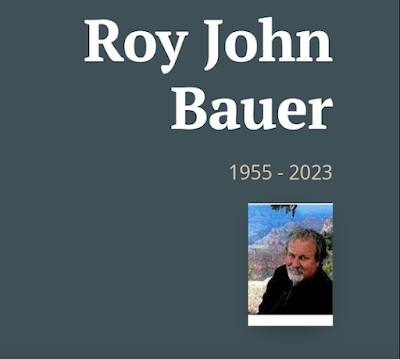
Roy's obituary in LA Times and Register: "we were lucky to have you while we did"

  This ran in the Sunday December 24, 2023 edition of the Los Angeles Times and the Orange County Register : July 14, 1955 - November 20, 2...