Wednesday, April 17, 2013

Board Forum: don't nobody ask the obvious questions

Nobody gave a crap
     Naturally, there was no chance of my attending today's Trustee Forum. These Presidential and Board extravaganzas are invariably scheduled when I teach. Such was the case today, for the forum started at 12:30, the start time of my Philosophy 2 class.
     Undeterred, immediately after class at about 1:50, I walked over to the A100 Building, hoping to find the meeting--or at least a few stragglers and cupcakes. I found three or four people standing around. I got nowhere.
     Later, I ran into one or two people who could fill me in on the event. "There was a Monopoly Game about ATEP," said one wag. Not sure if he was kidding. But I wouldn't be surprised if some version of that proposition were true. ATEP is, of course, the Eternally Amorphous Kollege (EAK). It was once slated to become the new home and headquarters for a band of young performers called the "Young Republican Hoofers" or some such thing. The Young Hoofer idea fell through, though, and, since that time, ATEP has lacked any discernible identity or vision or Zip Code. Last I heard, it was still an enormous Money Pit, sporting three or four tin shacks and the sad sawdust residue of a chapel that had been built for soldiers back in 1942. (I tried to get people interested in saving the chapel, but nobody seemed to give a crap.)
     "Was it well attended?" I asked. Well, yes it was, I was told, "though there were only two or three faculty."
     Oh. I guess maybe they were teaching. Classified employees get brownie points for attending, I bet.
The Plastic People of the Universe
     As you know, recently, the state promulgated the result of an effort to collect factoids per college regarding "success." It's called the "student success scorecard." "Completion" and "success" are, of course, the buzzwords de jour. Generally speaking, our two colleges did OK, completion-wise, though, on some measures, we were way behind other local colleges or districts. For instance, the SOCCCD was in distant last place with regard to the ratio of full-time instruction to part-time instruction (aka "reliance on slave labor"). It was kind of embarrassing. A debacle even.
     That's not about completion, I guess, but it sure is about something important.
     "Anybody talk about the recent State Scorecard for the colleges?"
     "Nope."
     "Nobody? ... Nothing?"
     Head shake.
     "What did they talk about then?"
     "I dunno. ATEP, I guess."
     Someone else told me that five of the seven trustees showed up. Only PJ Prendergast and Bill Jay were no-shows. I wonder what these trustees made of the "Scorecard." Were they embarrassed? Concerned?
     Maybe they've never heard of it. I mean, nobody brought it up today at IVC. Could be nobody in the room heard about it. It somehow fell between the cracks, like oversight of evening classes.
     Maybe, here, in the SOCCCD, we're in one of those Bubbles. Could be.
     Hello? Anybody out there? HELLLOOOOOOOO!


Gone forever

Tuesday, April 16, 2013

Night Beat: The Case of the Empty Classroom


Where to start?

Rebel Girl teaches Thursday evenings 7:00 - 9:50. She almost always has for the last twenty years or so.

The class meets once a week and is populated by students who are happy to be there and who often are on campus only on that evening. Rebel Girl generally makes herself available after class to talk to students about their work—and she does this in the classroom in which she teaches for obvious reasons: there they are, after all and usually by the time 10:00 has been reached, the A-200 building is already locked down—or sometimes is simply too far across an increasingly dark and deserted campus—especially when, upon arrival, it is locked down. At most, this time after class is 15-20 minutes.

Dissent readers have long endured Rebel Girl plaintive wails about the lack of oversight and resources in the evening at the college. How classes ending early rather than being the exception are the norm. How the place—which should be buzzing until ten and shortly after—is often deserted shortly after 9:00. She's brought it up in department meetings, school meetings—and even, in the distant past, senate meetings. There are issues here related to good teaching practices, curriculum, compensation, safety and liability.

So, since Rebel Girl has already complained ad nauseum about this—why is she at it again?

Here's why.

Increasingly this semester, the building she teaches in becomes empty much, much earlier than 9:50. For example, the classroom next to Rebel Girl's, B-110, regularly empties out at 8:30—about the time when her class is returning from break to prepare for the next hour and twenty minutes of state-mandated instruction. Rebel Girl and her students meet the students and the teacher leaving as they return. That class is supposed to meet until 8:50.

She knows, she knows, what is 20 minutes?

But the other classrooms also empty out early. How early? Early enough for all the classrooms and the hallway to be clean by 9:50—if not earlier.

Since the other classes empty out early rather than later, this allows the single custodian assigned to clean the building to do just that—increasingly more quickly and earlier so that he is waiting, hovering—in the hallway, often noisily because of the nature of his work—for the class to finish and as soon as the first few students do leave, he enters and begins his work before, frankly, their work is fully done. Rebel Girl has tried to talk to him—but he has a job to do. That's what is important to him. She understands this.

But she can no longer talk to or answer student questions as she wishes to do and as they need her to do. The situation has grown increasingly uncomfortable and distracting. Last week most of the class was aware that by talking longer (and they were having an important discussion regarding a very moving student story) they were keeping the custodian from his work. His presence right outside our door was clear as was his repeated and impatient looks inside the door windows which interrupted discussion. This was unfortunate as the subject matter needed special attention and care.

She knows she could complain about him but the real issue that allows this situation to occur is the simple fact that evening classes all too often end early. How else to explain an entire building of clean, dark classrooms at 9:50?

Indeed, as the class leave, the other classrooms are dark, with tied-up trash bags waiting outside the building's doors. Clearly everyone else has been gone for a long, long time—enough time for the custodian to clean every classroom in the building (interior classroom and exterior ones) except Rebel Girl's.

At least a couple other classes should be present until 9:50—but they are not. And haven't been.
So—there's her problem.

As she encountered students from that class this week, she queried them. Their answers were uniform: they feel pressure to leave; they feel their classroom is not theirs. One student (a top student by the way, an award-winning student involved in other campus activities whose name appears in various college press releases) said that she has had problems for weeks after the class is over because the restroom is locked up—and she must track down the custodian to open it, which he does not want to do. She makes him do it.

Again, Rebel Girl thinks the custodian is just doing his job—but the real underlying problem is that enough people are not doing theirs. (For the record, Rebel Girl thinks this is a campus-wide issue—not a specific building issue, not an over-eager custodian issue—but a systemic issue.)

As Rebel Girl taught her day-time classes this week, she asked them about their evening classes: in your experience, do your classes get out early?

The responses suggested a popular pattern.

How early do your 7-10 classes get out? 

8:30, 9:00, 9:15, 9:30. 

There was discussion of the 50 minute "hour" and what that means or doesn't mean.

There was acknowledgement that both teachers and students liked these "brief" classes. Some said they took evening classes because they knew the classes ended early.

Night Beat FilmPoster.jpegOne student said the teacher told them that he taught so well and they were so smart they didn't need to have that "extra" time.

Ouch.

Why should we care? 

Let Rebel Girl count the reasons (she thinks she did so above)—but perhaps the college might consider the bottom line issue of liability. Some of these evening students are part of our specially recruited sector—high school students. What do they do during the 30 minutes, hour, hour and a half when the instructor lets the class out—and their parents pick them up? Who knows?

*

D'ya think?

Ethics Commission Proposed for Orange County Government (Voice of OC)

     County Supervisor Todd Spitzer says he agrees with the grand jury on the need for an ethics commission and will push for an ordinance while also taking aim at DA Tony Rackauckas for a lack of focus on official corruption....

Wednesday, April 10, 2013

The dreaded comparison! (IVC and the SOCCCD get some high—and some low—marks)


     From the Student Success Scorecard (SSS) at the State Chancellor's Office:
"In its commitment to increase transfer and degree and certificate attainment, the California Community Colleges Board of Governors has established a performance measurement system that tracks student success at all 112 community colleges."
     Below, I provide SSS data in five categories (I only excluded the "college profile" category) for the following local community colleges:
Irvine Valley College (SOCCCD)
• Saddleback College (SOCCCD)
• Orange Coast College (CCCD)
• Santa Ana College (RSCCD)
• Santiago Canyon College (RSCCD)
     I've also included data re the full-time/part-time faculty ratio per college (district)

SEE ALSO Community colleges to offer Web data on their performance (LA Times)


1. "PERSISTENCE":
     (% students sticking with it, 3 terms)

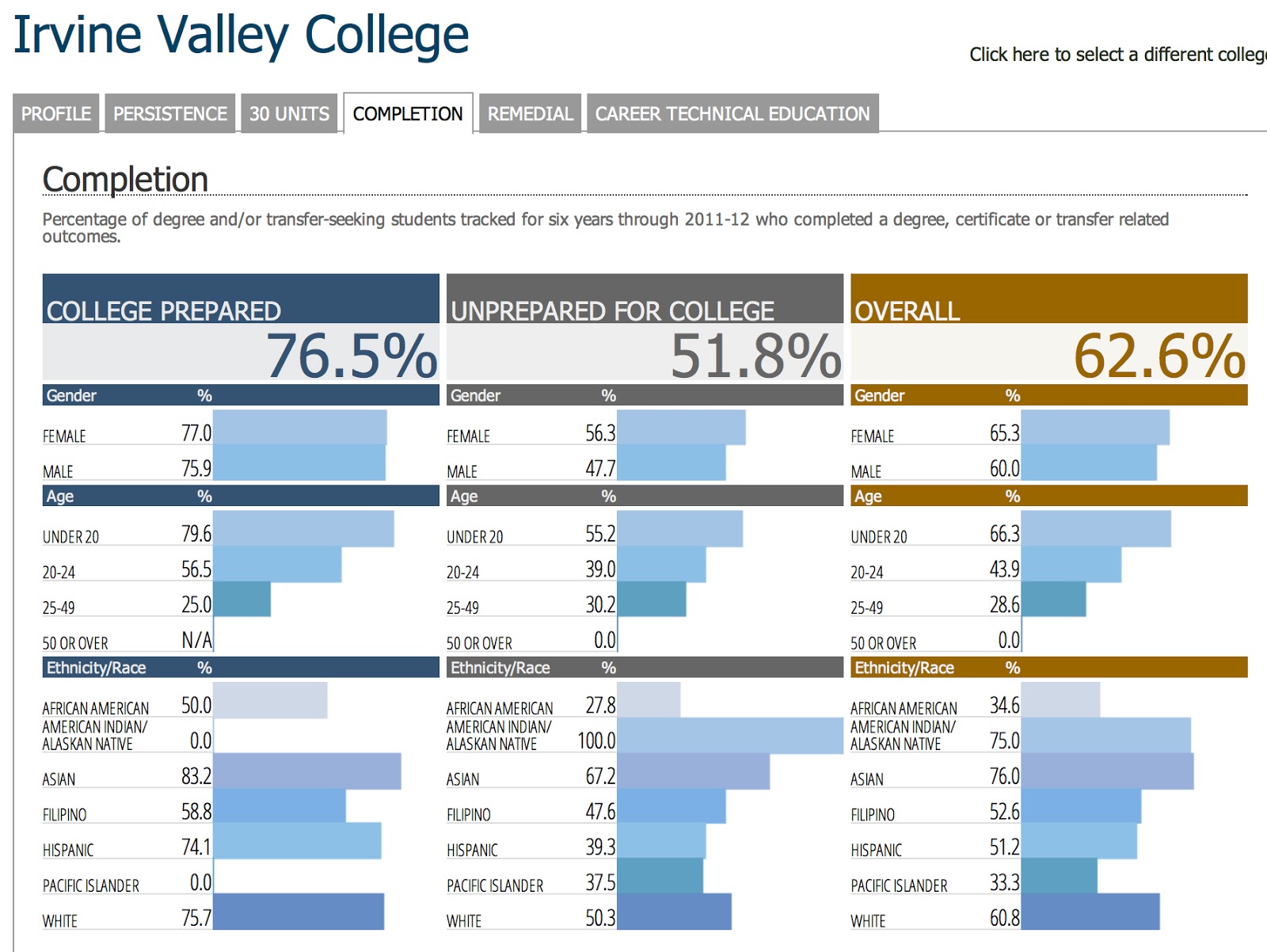
IVC gets the lowest score for "persistence" (among these five colleges) and yet it gets the highest score for "completion." (See below.) Go figure.


2. "30 UNITS":
     (% students earning 30 units within 6 years)


3. "COMPLETION":
     (% students completed degree [or...] within 6 years)


4. "REMEDIAL":
     (% of initially remedial students to achieve college-level credits)


What's with the spectacularly high ESL figure?

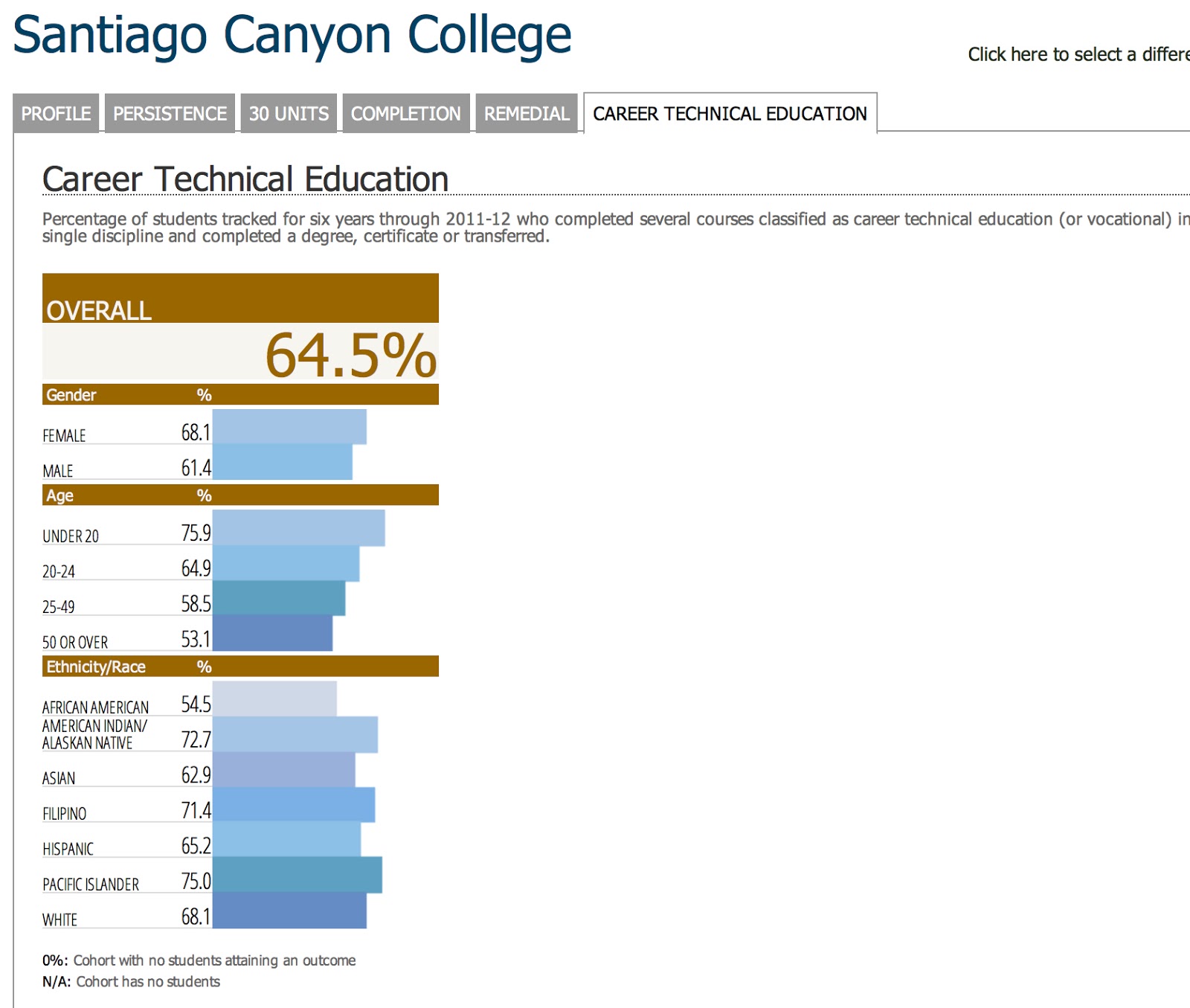
 5. "CTE":
     (% CTE/vocational students successful within 6 years)


Percentage of faculty who are full-time (Uh-oh):

IVC: 51.2%*
Saddleback College: 51.2%
Orange Coast College: 59.4%
Santa Ana College: 65.3%
Santiago Canyon College: 65.3%
Fullerton: 68%

     *It appears that these figures—re F-T/P-T—are for the entire district of which the college is a part. Evidently, no effort was made to identify the ratios per college.
     These data are taken from the same "Student Success Scorecard" website per "college profile." Specifically, these percentages concern "Percentage of Full-Time Faculty."

     Why is the figure for SOCCCD so low?
     As a friend reminded me today, unlike most local districts, which have been strapped for cash, our district has not let go many part-time instructors in recent years and that likely makes our FT/PT ratio unfavorable compared to other districts'.
     Also:
     Recently, despite a fiscal "emergency" (flat revenue combined with rising costs) Saddleback College decided to go forward with numerous full-time faculty hires; meanwhile, faced with a similar fiscal crisis, IVC administration sought to reduce the planned full-time hires. (Why? Because part-time instruction is cheap "slave labor.")
     Years ago (see below), legislation was passed according to which the state's goal was 75% full-time instruction. Districts were directed to expend resources in securing that goal:

Re the full-time/part-time "faculty ratio," from Chancellor’s Office Legal Opinion, 2/23/11
     Presumably, the state's various recent fiscal crises have interfered with efforts to secure the ratio and to compel recalcitrant districts to move toward compliance with it.

Graph by DtB
Graph by DtB

Prof. to student: "Get your *!%$ together."


Forwarded to Rebel Girl by a few hundred fellow instructors (this copy is from Deadspin):
A student at NYU's Stern School of Business sent a complaint email to a hard-headed professor about his class's lateness policy. The professor emailed back, eviscerated the student David Mamet-style, and now it's gone viral.
Sent: Tuesday, February 9, 2010 7:15:11 PM GMT -08:00 US/Canada Pacific
Subject: Brand Strategy Feedback
Prof. Galloway,
I would like to discuss a matter with you that bothered me. Yesterday evening I entered your 6pm Brand Strategy class approximately 1 hour late. As I entered the room, you quickly dismissed me, saying that I would need to leave and come back to the next class. After speaking with several students who are taking your class, they explained that you have a policy stating that students who arrive more than 15 minutes late will not be admitted to class.
 As of yesterday evening, I was interested in three different Monday night classes that all occurred simultaneously. In order to decide which class to select, my plan for the evening was to sample all three and see which one I like most. Since I had never taken your class, I was unaware of your class policy. I was disappointed that you dismissed me from class considering (1) there is no way I could have been aware of your policy and (2) considering that it was the first day of evening classes and I arrived 1 hour late (not a few minutes), it was more probable that my tardiness was due to my desire to sample different classes rather than sheer complacency.
I have already registered for another class but I just wanted to be open and provide my opinion on the matter.
Regards,
xxxx

xxxx
MBA 2010 Candidate
NYU Stern School of Business
xxxx.nyu.edu
xxx-xxx-xxxx
The Reply:
—— Forwarded Message ——-
From: scott@stern.nyu.edu
To: "xxxx"
Sent: Tuesday, February 9, 2010 9:34:02 PM GMT -08:00 US/Canada Pacific
Subject: Re: Brand Strategy Feedback
xxxx:
Thanks for the feedback. I, too, would like to offer some feedback.
Just so I've got this straight...you started in one class, left 15-20 minutes into it (stood up, walked out mid-lecture), went to another class (walked in 20 minutes late), left that class (again, presumably, in the middle of the lecture), and then came to my class. At that point (walking in an hour late) I asked you to come to the next class which "bothered" you.
Correct?
You state that, having not taken my class, it would be impossible to know our policy of not allowing people to walk in an hour late. Most risk analysis offers that in the face of substantial uncertainty, you opt for the more conservative path or hedge your bet (e.g., do not show up an hour late until you know the professor has an explicit policy for tolerating disrespectful behavior, check with the TA before class, etc.). I hope the lottery winner that is your recently crowned Monday evening Professor is teaching Judgement and Decision Making or Critical Thinking.
In addition, your logic effectively means you cannot be held accountable for any code of conduct before taking a class. For the record, we also have no stated policy against bursting into show tunes in the middle of class, urinating on desks or taking that revolutionary hair removal system for a spin. However, xxxx, there is a baseline level of decorum (i.e., manners) that we expect of grown men and women who the admissions department have deemed tomorrow's business leaders.
xxxx, let me be more serious for a moment. I do not know you, will not know you and have no real affinity or animosity for you. You are an anonymous student who is now regretting the send button on his laptop. It's with this context I hope you register pause...REAL pause xxxx and take to heart what I am about to tell you:
xxxx, get your shit together.
 Getting a good job, working long hours, keeping your skills relevant, navigating the politics of an organization, finding a live/work balance...these are all really hard, xxxx. In contrast, respecting institutions, having manners, demonstrating a level of humility...these are all (relatively) easy. Get the easy stuff right xxxx. In and of themselves they will not make you successful. However, not possessing them will hold you back and you will not achieve your potential which, by virtue of you being admitted to Stern, you must have in spades. It's not too late xxxx...
Professor Galloway
Again, thanks for the feedback.
Fewer community college students completing degrees, transferring (LA Times)
     Fewer than half of California’s community college students transferred to a four-year school or earned an associate’s degree in 2011-12, the lowest level of completion in five years, according to data released Tuesday by the chancellor’s office.
     Statewide, 49.2% of students who enrolled in 2006 achieved those goals after six years, compared with 52.3% of students who enrolled in 2002….

New science standards call for teaching climate change and more (LA Times)
     The politically touchy topic of climate change will be taught more deeply to students under proposed new national science standards released Tuesday....

Roy's obituary in LA Times and Register: "we were lucky to have you while we did"

  This ran in the Sunday December 24, 2023 edition of the Los Angeles Times and the Orange County Register : July 14, 1955 - November 20, 2...