Monday, June 25, 2012

TJ. Special BOT meeting today at 3:00

     Of all people, OC Register food columnist Barbara Venezia wrote about Tom Fuentes’ son TJ a couple of days ago: Venezia: TJ Fuentes a chip off the old block.
     Venezia met the kid on her cooking show (At Home on the Range) with John Crean twenty years ago. Crean and the elder Fuentes were pals.

REMINDER: there'll be a special board meeting today at 3:00 p.m.:


     It appears that TJ's mother, Jolene, will be one of two applicants to be interviewed. The other is Jim Wright, Saddleback administrator (now retired).

Saturday, June 23, 2012

1954: "Shooting Star" was Caspers' second boating tragedy. The first was also a doozy

The entire “Fuentes/Shooting Star” saga can be found here.

     As you know, I have occasionally noted the high incidence of violent death in the unfolding Caspers/Cella/Harber saga—a lurid fabric into which the young Tom Fuentes was thoroughly woven. The “Shooting Star” disaster and the murder of Arlene Hoffman are but two extraordinary examples. There are several others.
     Here’s one that I haven't mentioned.
     We know that Ronald Caspers perished when the “Shooting Star” went down off the coast of Baja in 1974. But, as it turns out, that was not the first odd boating disaster that involved Caspers. The first occurred nearly twenty years earlier, when Caspers was a 23 years old rich kid.

     ALOHA MEANS GOODBYEAccording to former OC GOP chairman (1969-72) Thomas C. Rogers in his Agents’ Orange (2000),
     Caspers had made headlines prior to ... [1970]. He and his wife Beatrice had been cruising in coastal waters south of Port Hueneme in the ketch Aloha on the night of October 1, 1954. With Caspers at the helm, the Aloha veered in front of an oncoming Coast Guard cutter. The Aloha sank and the remains of Beatrice Caspers were never found, despite an intensive search by Coast Guard vessels and aircraft. An investigation by the U.S. Coast Guard of this tragedy at sea never resulted in any criminal proceedings.
     Why did Rogers choose to mention a 1954 Ventura County boating accident in a book about Orange County politics?
     Perhaps Rogers had his doubts about Ron Caspers, a man who, according to him, later had a great impact on OC politics.
* * *
     In a Nov. 8, 1970 LA Times article (“Freshmen supervisors: a study in contrasts”), Caspers described himself as a “Reagan conservative." Guess so. He seemed to like Richard Nixon, too.
     And he was rich: according to the Times, he spent $81,695 winning his supervisor seat—an astounding sum at the time—including $46,984 of his own money.
     The Supe gig made him $15K per year.
     The Times described Caspers’ education:
     The son of the late R.W. Caspers, founder and head of Mutual Savings and Loan in Pasadena, Caspers managed to enter Menlo College at the age of 16, attended UCLA, was graduated from San Jose State College as a business administration major and did graduate work in marketing and financing at USC.
Ron Caspers, c. 1973
     —OK, I’ll say it: how does a guy start his education at a fancy private college, transfer to a UC school, and then end up getting his Bachelors at a state college? What's that about?
     The article goes on to explain that Caspers did indeed make a big success of Keystone Savingswhich he founded in 1957, in Anaheim, when he was about 26 years old. 

     THE CASPERS TENENBAUMSI did a little looking, and it turns out that Caspers came from a rich and perhaps peculiar family. As indicated above, his father, Rudolph, an avid yachtsman, ran Mutual Savings and Loan. By the mid-50s, he seemed to spend much of his time traveling about the world with his photographer wife. He died in 1958 at age 64.
     I do believe that Ron Caspers’ mother had some sort of TV show—perhaps a travelogue.
     I've found references to the “residuary trust under the will of Rudolph W. Caspers.” Not sure what that's about. Ron Caspers' father was named Rudolph, but so was his grandfather.
     There was a Rudolph Caspers in show biz in the thirties and forties. Same guy? Not sure.

* * *
     MOWED BY A CUTTERI did find some old articles about the “Aloha” tragedy, which, to authorities back then, warranted investigation.
     The ramming and sinking of the Aloha by the Coast Guard cutter Morris occurred on October 2, 1954. The Aloha had five passengers, two of whom perished, including Caspers' wife. Within a few days, there was an official inquiry. In the end, the Coast Guard investigation concluded that the actions of those piloting the two ships—Ron Caspers (age 23) and an Ensign James Frost (age 25)—were responsible for the tragedy:
     …Out of the Coast Guard’s board of investigation and military inquiry yesterday came the tragic knowledge that the Morris and the Aloha both altered direction a few minutes before they collided.
     Ensign James A. Frost, 24, on the Coast Guard cutter Morris, ordered a change to port [left]. Ronald Caspers, 23, at the wheel of his father’s $55,000 racing ketch Aloha, adjusted to starboard [right].
     And the two alterations, each made to avoid a possible collision, accomplished just the opposite. They made for a near perfect collision course. (“Double shift of course blamed for sinking of yacht Aloha by cutter,” LA Times, Oct. 9, 1954)
     The details, however, are worth reviewing.
     On it's face, the incident was strange. On that dark but calm and clear night, the Coast Guard cutter Morris spotted the Aloha when it was still three miles away. The officer on deck of the Morris, Frost, kept an eye on it, for it kept coming at the Morris. He sought to avoid a collision, but the Aloha seemed to change direction to maintain a course directed at the Morris.
     It’s clear that Caspers was to some degree negligent in the incident:
The CG cutter Morris
     …[Attorney] Keith Ferguson … seized on Caspers’ horn testimony during cross-examination.
     “Are you aware that two blasts of a horn is a signal to denote that the ship is to change course to port [i.e., to their left]?” asked Ferguson.
     “No, I did not know that,” Caspers answered.
     “Do you know the rules of the road?” the attorney asked.
     “Not all of them,” Caspers admitted.
     Caspers, far from shifting course to port, altered gradually to starboard [to the right, from his perspective] for approximately five minutes before the crash, according to his testimony.
. . .
     “I thought the craft was stationary,” he said, “and I wanted to give it plenty of room.”
     “Didn’t it mean anything to you that your bearing on the other boat remained the same even though you had changed your course?” Ferguson, an admiralty lawyer, asked.
     “It would now,” Caspers replied, “But my mind wasn’t working that way then.”
     Caspers pointed out that he would not have acted differently even had he known the Morris was moving.
     “The other boat, being on my port [left] side, would have to change course,” he explained.
     Later in the article, testimony provides a dramatic account of the Aloha's actual sinking, an account that seems designed to make Caspers appear heroic:
A ketch
     [Survivors] Caspers, Boisot and Miss Kurz all testified to their almost miraculous escape from going down with the Aloha.
     Caspers said he stood up [when collision became imminent? occurred?] in the cockpit and moved to go below.
     “I kept thinking that I had to get the people out,” he said. “But by the time I got there, the cabin was almost full of water.
     “Then I saw some hands rise up through the debris. I reached down and grasped them and pulled up on them. It was Miss Kurz. I finally managed to pull her out and then we were in the water.
     “The ship went down immediately—almost instantaneously. The Dinghy was floating free and we swam to that. We didn’t see anybody and then we heard Boisot calling out. He swam over and hung on with us.”
     Miss Kurz testified that she was asleep on the starboard side of the cabin, aft. She said Mrs. Caspers was asleep in the port bunk of the same cabin.
     “I was either thrown or I vaulted from the bed,” Miss Kurz recalled. “Then I was standing in the middle of the room. I yelled and yelled for Bea. I felt in her bunk but I couldn’t locate her.
     “I had no time to spare. I started up the ladder and somehow got myself caught in the hatch. Then Ronald reached down and pulled me out.”
     Obviously, there are at least two possible hinky Caspers scenarios. First, Caspers was simply grossly negligent—scandalously ignorant and careless. Second, Caspers deliberately collided with the Morris.
     Why would he do that? Well, you can use your imagination. One possibility would involve collusion with the two other survivors (Boisot, a 32-year-old "manufacturer" and Kurz, a 25-year-old secretary). There's no evidence of anything like that. (But it's hard to find any information at all about so distant and obscure an event.)

* * *
     AN OFFICER AND A GENTLEMANThe best account of the Coast Guard hearing that I could find appeared in an article in the Oct. 8 Long Beach Press-Telegram (“Cutter officer tells of crash”). According to that article, the crash occurred just before 5:00 a.m. Ensign James Frost was in charge of the cutter while the captain was sleeping. He testified that he spotted the Aloha when it was 2 or 3 miles away:
     “The young officer said that as the two craft approached one another visual bearing indicated the other vessel steadily moved from 20 to 30 degrees to his starboard.
     “At that time I considered the vessel to be passing me well to his starboard [i.e., to my right],” Ensign Frost declared.
     He said he went into the wheelhouse contemplating making a navigation “fix” but had been in only a few seconds when he looked out toward the other vessel and saw both running lights, indicating that it had turned toward him.
     “I took the binoculars and stepped out on the wing of the bridge,” he said. “I saw the green light only again. Then both lights again.
     “At this time I gave an order to the helmsman “left five.’” He explained he meant left five degrees rudder. He said the command was acknowledged and carried out.
     For a period of 10 seconds, Ensign Frost said, he could see alternately one navigation light and then both as the other vessel appeared to waver back and forth. [Presumably, Frost's seeing both lights suggested Aloha's course directly toward the Morris.]
     “Approximately 20 seconds before the collision,” he said, “I saw the port running light. I realized the other vessel was trying to cut across my bow. I gave the command “all back full.”
     “We hit the vessel approximately with our prow. We hit amidships on the port side” [the side where Mrs. Caspers was sleeping, aft].
     Ensign Frost said he did not sound any whistle signals prior to the impact and heard nothing from the Aloha at any time. At the time of the impact he sounded a series of four or more three-second whistle blasts. He said the Morris backed off about 50 yards and he gave orders to stop all engines.
     The whistles, general alarm signals, and shouting awakened the captain…. Ensign Frost said the skipper was on the bridge between 30 seconds to one minute of the collision.
     Ensign Frost said the Morris put searchlights into operation to seek survivors, but that he had seen no one on the deck of the Aloha at time of impact.
     The skipper of the Aloha, 23-year-old Ronald W. Caspers of Pasadena, told the board Thursday his version of events leading up to the collision.
     The victims of the tragedy included his 25-year-old wife, Barbara [she went by “Bea”], and Harold Kelly, Jr., 61 of New York and San Bernardino. Caspers and two other passengers were rescued.
     Caspers’ testimony brought out that the sounding of an electric horn may have contributed to the accident.
     Caspers testified that [Aloha passenger] Emile K. (Kelly) Boisot, 32, of Arcadia waked him by sounding the boat’s electric horn “two or three times” about 13 minutes before the Morris rammed the Aloha.
     The witness was asked by Atty. Keith Ferguson, San Francisco, special assistant to the U.S. Attorney General, if he was aware “that two blasts of a horn is a signal to denote that a ship is to change course to port?”
     “No, I did not know that,” said Caspers, son of Altadena sportsman Rudolph W. Caspers, owner of the Aloha.
     Caspers said he altered course gradually to starboard for about five minutes before the crash.
     Earlier, the young skipper said he had seen the Morris and thought it to be one of other fishing boats he had noticed.
     “I thought the craft was stationary,” he continued, “and I wanted to give it plenty of room.”
     It’s all very odd, if you ask me. I mean, the collision could have gone down because of a perfect storm of incompetent maneuverings by the two skippers. Speaking as a non-sailor, and given the testimony above, that seems implausible. Maybe experienced seamen see it otherwise. Dunno.
     Why was Bea Caspers' body never found? You'll recall that none of the bodies of the ten passengers of the Shooting Star were ever found either. 
     What's it all mean? Maybe nothing. Bodies get eaten, lost.

* * *
     THE HAWAIIAN YARN. Earlier, I said that we "know" that  Ron Caspers perished with the "Shooting Star" in 1974.
     Do we? There's a reason, perhaps a very slim one, to wonder.
     In his excellent 1984 article "The Sinking of a Political Machine," published (in Orange Coast Magazine) exactly ten years after the "Shooting Star" sinking, journalist Larry Peterson considered the possibility that the yacht was deliberately sunk. One theory that had been proposed at the time, by a private detective and ex-cop named Neal Graney, involved the idea that one of the ten passengers of the "Shooting Star" helped sink it and survived:
     There is some support, however slender, for Graney’s belief that someone got off the boat alive. One former west Orange County elected official told me he thinks he saw a member of the ill-fated party about three years ago in Hawaii.
     At the time, the former official says he was on the beach near the Pacific Beach Hotel in Waikiki, and the supposedly deceased man crossed the street nearby.
     “It looked so much like him that I just yelled his name without thinking that he was supposed to be dead,” said the vacationer, who was well-acquainted with the Shooting Star passenger he thinks he saw. “He took off and disappeared into the crowd….I’m sure that, when I yelled out, he would have recognized me….It seemed deliberate.”
     Scenarios just as bizarre as Graney’s based more on conjecture than provable fact, have been widely circulated and are passed on by Cella, Battin and others to anyone who asks.
     Details vary, but the essentials are this: Somebody hired either organized crime-related figures or a right-wing paramilitary group to blow the Shooting Star out of the water.
     Implausible as that may seem, there is some evidence that the boat would not normally have sunk, even with the pounding it took from heavy seas.
     Peterson was referring to the repair history of the boat and evidence that it had undergone modifications that would make it virtually unsinkable.
     Peterson raised the question of why anyone would want to sink the ship. He turns to Richard Jordan's allegations, in a sworn declaration, that Caspers and his pal Harber (who was also on the boat) were attempting to shake him down—a highly plausible suggestion, given the histories of those two men, as explained recently here on DtB. Perhaps, suggests Peterson, Jordan wasn't the only target of shakedowns? Perhaps some of these others were violent people?
     And maybe Caspers believed that the DA was closing in on him (Jordan's declaration indicates that) and he couldn't face the fall that would result.
     Admittedly, there's a huge problem with the "Caspers did it" theory: two of Caspers' sons were lost with the ship (apparently). Of course, they might have been "in on it" and survived, along with dad, but that makes the whole yarn ridiculously complex and unlikely.
     Would a guy kill his own sons? Don't think so.
     Of course, we don't know who that former elected official thought he saw that day in Hawaii. Maybe it was Fred Harber.
     We'll never know.

Fred Harber

Friday, June 22, 2012

The story of "Baby Peter"—update

Young Peter, c.1947
     Nearly a year ago, after my trip to Europe, I posted about a curious wartime episode of family history on my mother’s side: French Kiss: the sad story of baby Peter (July 11, 2011). The events of this story occurred largely in the northeaster section of then-Germany (from Berlin to the east—much of that territory is now in Poland).
     My post told the story of a relative—young Edith Martha Hänfler*who, during the war, fell in love with a French prisoner-of-war, Frederic. These two had a baby. It’s all very Hogan’s Heroes—and a bit cloak-and-dagger. And, yes, it’s all true.
     For reasons I explained a year ago, the baby, Peter, was left by his parents with my mother’s people in the east—what was left of themand, in particular, he was in the care of my mother’s Aunt Else, who loved children but who could not have her own. In the end, the child was taken from Else—to relocate him with his parents in France. The impending event resulted in Else’s suicide (c. 1950).
     "There are many such stories," as they say. (A line from Vertigo.)

Edith Martha Hänfler: fell in
love with a French POW in Berlin
UPDATE: 
     Yesterday (6/21/12), I was contacted by one of Peter's daughters in France. She identifies herself as Edith Hennion, and she was born, oddly enough, on Peter's birthday—February 28—in 1966, which would make her Ron's age (46).
     She had Googled her grandmother's name ("Edith Hänfler") and found my post. Amazed by what she found, she left a comment and her email address. I contacted her yesterday.
     She has already sent me several photos, including the one at left of her grandmother, Edith Martha Hänfler, who, Edith tells me, died in 1960, at age 42. (I do not know whether she remained married to Frederic.) She also sent a roughly written "family tree," which indicates that Peter's father was Frederic Francois Hennion, who was born on October 26, 1915. She tells me that he died of cancer in the early 70s.
     Peter's name is given as Peter Frederic Remo Hänfler (Hennion). For some reason, Peter's wife's name is not indicated. (In a more recent correspondence, Edith indicates that her mother's name was Josiane.)
     Edith indicates that her father, Peter, died ten years ago at age 58. That was news to us. (Sad news to my mother, who dearly loved the young Peter.)
     Edith also sent three old photos that she could not identify: one of a man by the beach, another (perhaps at the same beach) of two young children, and one of the two young children, slightly older, with a dog. She writes that she does not know who these people are. Do I know?
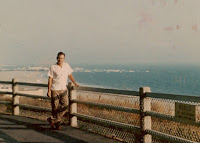
     I've already emailed her, informing her that the man is my father, Gunther "Manny" Bauer, and that the two kids are Annie and me. The dog, of course, is Prince. These photos were taken in 1960 and about 1961 (in Santa Monica and Orange).
Santa Monica, 1960
     Ma (our Edith) is very excited about this turn of events. She is surprised that Peter and his family had photos of our family, since, as she understood it, her sister Ilse was unwilling to part with any family photos and give them to Peter. (She and Peter were in contact, though Ilse, who is in declining health, has not contacted Peter for many years.) Maybe she did relinquish some photos afterall.
     Edith (the one in France) writes that, when she was twenty (c. 1986), she actually lived in Mission Viejo for a while as an au pair. At the time, her father suggested that she visit "his relatives" there in Orange County, but, she now says, she was young and independent and free—and she never got around to looking us up.
     Too bad. But now at long last we can connect, trade photos, stories, etc.

     For those who are interested, these old “Bauer” tales—lots of 'em—can be found on the Bauer family blog. (Baby Peter)

*Related how? Starting in 1934 (when her birth mother died), my mother lived with her father's sister, Marthe (Martha)--i.e., her aunt (whom my mother always refers to as her "mother"). Martha was married to Otto Hänfler (whom my mother would call her "father"), who had a brother living in Berlin. That brother's daughter, Edith Martha Hänfler, fell in love with the French POW, Frederic Hennion.

TigerAnn, cat, in the Santa Ana Mts., one half hour ago

Click on the photo to enlarge it


Cats


A friend sent these.
They're pretty good.
If you know any cats, then you will understand.

Thursday, June 21, 2012

Tom Fuentes qua student—Rumored Clips & Actual Clips, c. 1967-8!

From the OC Weekly's website: DtB graphic of Tom
LA Times, Dec. 8, 1967
     Perhaps inspired by our recent mention of the late Tom Fuentes’ support of John Schmitz during the former's student days, Gustavo Arellano writes today about Fuentes' predictable writings (opinion pieces), 45 years ago, in the Chapman (College) Panther
     One letter is a rebuttal to criticisms of Schmitz. The other is a rant against war protesters.
     Wadja expect?

See
Commentaries Written By Tom Fuentes While a Student at Chapman University Unearthed!

     (Please note that Gustavo borrowed our very own “Tom as devil” graphic for this piece. You're welcome, dude.)
     Check it out.

     I’m especially interested in what Gustavo doesn’t provide about Tom Fuentes’ Chapman College years.
     It concerns a rumored artifact. One about Tom.
     At the start of the piece, Gustavo writes:
A rumored newspaper clipping
     Next to a picture of Walt Disney and Walter Knott together, one of the most famous OC historical artifacts that may or may not exist is a newspaper clipping detailing something that former OC GOP head Tom Fuentes was involved in during his student years, something that dares not speak its name. That clip, if it does indeed exist, is in the bowels of some Orange County archive or other, or in the safe of current GOP boss Scott Baugh, so in the meanwhile Fuentes observers will have to content themselves with two op-ed pieces Fuentes wrote while a student at Chapman College (now University, and my alma mater) during the late 1960s showing that even then, Fuentes was a raging wacko.
     Gracias, source, and cue the microfilm!
     OK, I’ve heard about this article/clip before, but it never seems to surface, if it even exists. More specifically, I’ve heard rumors about something that occurred during, or at the site of, Tom’s college job at a motel in Anaheim, near Disneyland. A prominent political journalist in these parts once told me that there was an article in the Times, or maybe the Register.
     But, again, nothing’s ever turned up, not in my world.
     I think Gustavo’s hoping that somebody will leave something special in his mailbox.
     Do not hold your breath, dude.

STUDENT TOM BACKS COMMUNITY COLLEGE TUITION IDEA:

LA Times, April 17, 1968
     A somewhat related matter:
     I found an old Times article entitled, “Orange County JCs Oppose Tuition” (Oct. 18, 1967). At the time, evidently, State Finance Director Gordon Smith suggested that it might be a good idea to start charging community college students with tuition. (Yes, there was a time when Cal kids paid no tuition at CCs. It was all part of the grand vision of everybody getting an affordable college education. —RIP)
     Naturally, various educators cried foul.
     At one point, the story briefly turns to students and their opinions. The first kid they talk to says, if they charged tuition, he couldn’t attend. Sure.
     Then there’s more “educators,” including “Saddleback Junior College” superintendent Jack Roper, who roars that the question of tuition ought to be left up to the local board. Harrumph!
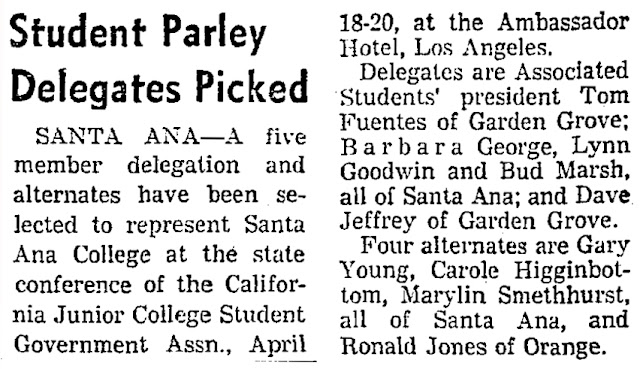
     Lemme cut to the chase. Eventually, they interview a young Santa Ana College student.
     Guess who?

     Spoken like a politician Tom. 
     I love the blarney about how most students would agree with him.
     Don't think so.

More artifacts:
LA Times, Oct. 26, 1967
LA Times, 3/17/68

The Fuentes file: Puppets and Puppeteers

 
Buena Park politicos, 1958. That's Fred Harber,
left of center
     Orange County Supervisor (1969-1977) Robert Battin was an early beneficiary of the now-notorious political funding operation known as the “Dick and Doc Show” (Dick O’Neill and Louis Cella). Oddly enough, Fred Harber, who was very senior in the larger D&D operation (what Battin, then scrambling to avoid prosecution, later termed the “Coalition”), and who had already served as a Mayor (of Buena Park) and City Manager (of Cypress), briefly served as Battin’s “executive assistant” in 1969, making $12,300 per year.
     According to an old LA Times article (“Battin a Puppet, Ex-Aides Claim; He Denies It,” June 20, 1972), in June of 1972, there was a special press conference down at the county courthouse:
     Two recently fired aides of 1st District Supervisor Robert Battin showed up to publicly accuse their ex-boss of being only a political puppet to his campaign manager and former aide, Fred Harber, a man they described as “Orange County’s kingmaker.”
     Afterward, says the article, Harber showed up, proclaiming, “I am just a lowly worker in the vineyard … of good government.”
     Then Battin himself showed up, stating that the aides’ assertions were “complete bullshit.” (The Times characterized Battin’s remark as “earthy.”)

* * *
     According to the Times, the aides were Steve Polatnick and John Abbott, both 27. The firings were described as an “aftermath” of a recent primary in which Battin had come in second (among Republicans), forcing a runoff in November. (Battin prevailed.)
     The aides claimed that Battin “sat in his inner office with orders that no constituents be allowed to speak to him … or see him.” Polatnick is quoted as adding, “An exception was always made, of course, for big-money contributors.”
     The two said they were fired on Harber’s orders because they didn’t agree that they should work full time on Battin’s reelection campaign. They further asserted that, in Batton’s office, Harber was in charge and that Harber was “behind a school busing ‘smear’ letter aimed at” the candidate who had come in 1st.
Ralph "Super D" Diedrich
     It gets better. They also claimed that Harber controlled Supervisors [Ronald] Caspers and [Ralph] Clark and that “He’s working to get a fourth vote on the board right now.” That would be Ralph Diedrich, who did in fact prevail over incumbent Bill Phillips in November of ’72.
     (Diedrich, known as “Super D” owing to his strong personality, became the leader of the pro-development board; he was indicted for bribery in 1977.)
     Polatnick went on: “It is my impression that Harber sees himself as the most powerful man in Orange County—a real kingmaker.” For Harber, such hegemony wasn’t about money but about “political power,” the two men said.
     And so, a few hours later, Harber showed up at the pressroom, denying those claims, chalking them up to the disgruntlement of fired employees.
     “Bob Battin has a respect for my advice and counsel…and many times he will follow that advice, but not always. But I think you will find some other supervisors who will bitterly resent any allegrations [sic] that I control a whole stable of them….”
     Harber asserted that, as he understood it, Polatnick and Abott could not communicate with community groups that had not been represented by their Supe in the past.
     Had he “ordered” Battin to keep his trap shut?
     “That’s not true. I only advised him not to lose his temper and to be careful to explain what he was saying…I would like him to be more urbane but I’ll settle for his honesty and forthrightness. I’m really just a lonely worker in the vineyard….”
     According to the Times, that last sentiment produced “chuckles in the audience.”
     Harber added: “I just strive to help my friends bring better government to Orange County.”
     At that point, Harber left and Battin came up to speak. He said: “Sometimes he [Harber] calls the shots … sometimes he doesn’t. But, if I’m a puppet, how come he left just now?”
     That's pretty lame, dude.
     But what about the alleged orders not to talk to constituents? –That’s when Battin got “earthy.”
     According to the Times,
     Battin denied other allegations that Harber had determined which companies would get county contracts on the basis of compaign contributions to Battin, or that he was favorable only to firms which gave such contributions.
Bob Battin
     On Monday, I wrote about the 1972 bribery trial of the mayor of Westminster, Derek McWhinney (who was ultimately convicted and served time). In that caseHarber and Tom Fuentes’ names came upa farmer alleged that McWhinney and an associate were shaking him down for $10,000. According to the farmer, McWhinney had told him that six people, including he and Fred Harber, “ran” Orange County.
     According to yet another Times article that I have recently discussed, years earlier, Harber had agreed to testify to his part in a bribe scheme in which a developer paid him and a member of the Cypress City Council $2,000 a month.
     These facts never came to light because the City Councilman—Mr. Job Denni—perished in a plane crash in 1966, necessitating abandonment of the case.
     (The "$10K" amount and the "$2K per month" angle were repeated in the bribe story—about a Harber/Caspers shakedown in 1974—that Richard Jordan told in a 1975 deposition in connection with his lawsuit of the County. The County settled, paying Jordan $700,000.)
     The day after Battin’s press conference, supervisorial candidate Ralph “Super D” Diedrich issued a press statement, denying connections with Harber.
     “I want everyone to know that I am my own man,” it said.
     It is clear today that Caspers, Clark, Battin, and Diedrich were indeed in Dick and Doc's stable. And D&D's main man was Harber.

* * *
     Harber’s name comes up again in a 1973 Times article about the OC supervisors’ “unsung” executive assistants (“7 Supervisors’ Aides Fill Vital but Unsung Role,” April 8, 1973).
     Supervisor Clark was quoted as saying,
     “The EAs … are the only ones we can depend upon to give ... [research] to us. Compared to the days when I was a city councilman, I am much better prepared to make decisions. I feel a lot more comfortable and confident, because I have been given the facts by my staff.”
Ronald Caspers
     Evidently, Clark’s view was more or less shared by the other supervisors.
     According to the Times article, in recent memory, the role of the EAs had expanded:
…[I]t is the assistants who act as primary advisers, researchers, office managers and alter egos of the five board members…. Their roles … generally revolve around researching issues, handling constituent problems, checking the weekly board agendas and monitoring the political pulse of the superbvisor’s district. … At other times, it might mean representing the supervisor at a meeting, talking to homeowner groups, working with county department heads and developing and maintaining liaison with city representatives and state legislators…. …[T]he assistants are considered by many to be among the most important persons in county government.
     Naturally, this state of affairs—immense power in the hands of persons unelected and hired and fired at the whim of supervisors—caused worry among watchdog groups. Thus, in 1972 (says the Times article), the OC Grand Jury handed down “a warning that the EAs should not overplay their parts”:
“Since ... [the EA's] advice concerns so many county decisions,” the jury wrote, “each assistant must be chosen carefully with emphasis on practical experience, ability and character as well as personal loyalty to the supervisor for whom he works. … His briefing is invaluable but unless it is reliable and accurate, many problems may result. In any case, the final decision should come from the supervisor and not from the assistant.”
     "Many problems" indeed. What if, for instance, the EA is closely aligned with people—not the supervisor—who have one of those goshdarned nefarious "hidden agendas"? (That's my question, not the Times'.)
     Tom Fuentes, one of Supervisor Caspers’ assistants at the time, explained that his boss is “highly complex” and an introvert. Still, he’s easy to work with, he said.
     Fuentes has lots more to say:
     For Fuentes, the job of an EA is more that of a political adviser, liaison man and personal assistant, since those are his fields of expertise.

     Fuentes offered his description of the perfect assistant:
     “He is a public relations man, a press agent, a protocol officer, political adviser and strategist, budget expert, a strong researcher and devil’s advocate and has master’s degrees in public administration, finance, engineering, social work and government. In addition, he can work 28 hours a day without tiring.”
     Fuentes’ boss, Ronald Caspers, evidently told the Times that
he sees the EA as the supervisor’s protector who minimizes his mistakes and guides him away from pitfalls.
     “They also have to evaluate and make recommendations on agenda items, although I reserve the right to go a different way at times….”
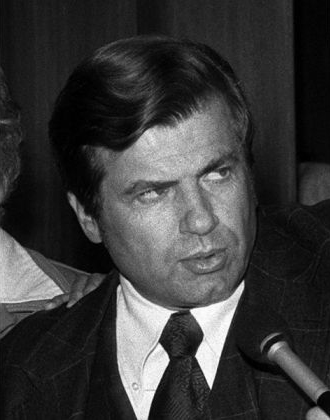
Tom Fuentes, c. 1973
     That seems awfully understated. 
     I don't know about you, dear reader, but it seems to me that, back in the Roaring 70s, depending on the supervisor, an EA could be pretty much anything, including the real brains of the operation. No wonder the Grand Jury fretted!
     The article ends with a focus on former Battin EA Fred "lonely vineyard worker" Harber:
…[U]ndoubtedly, the best-known former EA of all is Fred Harber, a one-time Buena Park city councilman and Cypress city manager, who managed Battin’s winning campaigns in 1968 and 1972.
     Harber, considered by many as a major behind-the-scenes political power in Orange County, recently was picked by former Assembly Speaker Jess Unruh to manage his campaign for Los Angeles mayor [against Sam Yorty].
     Many observers felt that Unruh’s decision was based mostly on Harber’s guidance of Battin’s campaign from what appeared once to be sure defeat to a victory.
     No EA—or former EA—could have been asked to do any better than that.
* * *
     It's pretty obvious that, in truth, Harber was much more than Battin's assistant. He was the guiding force behind, not only hot-headed Battin, but a whole stable of politicians.
     And he was crooked, like so many of his "horses."
     And what about young Tom Fuentes? DtB readers will recall from our extensive "Shooting Star" scribblings that, in the days and weeks following the yacht's disappearance off the coast of Baja, Fuentes had extraordinary authority and staturefor a twenty-five year old "assistant." He seemed to have run the search operation (from Santa Ana), and, at one point (reportedly), it was he who called off the search. 
     Throughout, he was plainly very close to Caspers' wife. (Unsurprisingly, he handled the press.)
     And, even though he had already announced plans to leave Caspers to study to become a priest (see LA Times, May 23, 1974), in the weeks after the tragedy, he was clearly preparing himself to be appointed as Caspers' successor. In fact (evidently), Ronald Reagan had expressed his intention of selecting Fuentes, but then a one-year residency requirement knocked him out of contention. (It's clear that many pols came out of the woodwork, interested in the appointment. At the time, it struck some as unseemly.) So he went back to his original plan: he headed north to St. Patrick's seminary. (A year later, of course, he was back, lobbying for Bein & Frost, hanging with fellow Republicans on the Central Committee, investing in singles bars, etc.)

* * *
     According to the Times ("Caspers Tops Spending Limit, Bents Says," May 14, 1974), two months before the "Shooting Star" tragedy (and a year after the EA article), one of Caspers' Republican primary challengers, Marcia Bents, publicly objected to Caspers' "heavy campaign spending tactics." At the courthouse, accompanied by former OC GOP chief Tom Rogers, she "claimed that Caspers' campaign finance figures show he has broken his promise to hold spending to a limit of 50 cents for each registered voter."
     Oddly, the person on hand to rebut Bents' charges wasn't Caspers. It was Fuentes. 
     Caspers isn't even quoted.

* * *
     Two weeks later, Bents was at it again. According to the Times ("Fund-Raising Tactics by Caspers Criticized," May 31), Bents charged that "Ronald Caspers has 'strong-armed' firms into contributing to his campaign":
     Mrs. Bents, referring to Caspers' latest financial report showing more than $222,000 in contributions, said the firms made contributions "because they were afraid not to give."
     Once again, it is not Caspers who rebuts these charges but Fuentes:
"...[These charges] are only an indication of her own floundering campaign," Fuentes said, "and are unsupported by facts. The people and firms who contribute to Ron do so because they support what he is doing."
     Ignoring the ad hominem, Bents made her case:
     ...Mrs. Bents handed newsmen a list of 26 firms and individuals who have donated or pledged $1000 or more to Caspers' campaign. All of these donors are involved in subdivisions, zone changes, variance use permits, tracts, special projects or contracts with the county.
     "I want to make it clear," she added, "that I am not making the charge that these firms or individuals sought out Caspers and made a donation ... to get an improper concession. I am saying that some of these firms have expressed to me, privately, that they felt they were being forced into making substantial contributions to Caspers' campaign."
     Wow.
     She also presented a signed statement by a former Caspers aide, H. Ronald Jones. Evidently, in the statement, he "charged that he had worked on county time to address and stuff envelopes for a Caspers' testimonial dinner in September, 1971." He also charged "that he had also used county time and a county car to drive to Los Angeles County to pick up materials for Fuentes' campaign for the County Republican Central Committee."
     For Fuentes? The "assistant"?
     Naturally, Fuentes countered with a mere ad hominem, characterizing the former aide as a "disgruntled former employee...."
     Caspers is not quoted in the article.
     [Note to self: McWhinney contributed to Ronald Caspers' campaign in 1970. See Times, 7/8/70.]

See also Mr. Bagman—I spoke with my father and we both remembered a guy who, it turns out, was a close associate of Ronald Caspers before he got the Supervisor gig in 1970. The way my dad remembers it, this guy, Chas. Bottomley, who was one of the adults in our old Boy Scout Troop (#536), was "Caspers' bagman."—Yep, my dad said that without any prompting! Bagman. Or so he was told at the time by a pal at work (I knew that guy, too: Jim C) who part-timed as a bartender in a place Caspers owned next to his S&L. [Actually, I'm not sure my dad understands the connotations of "bagman." Maybe not sinister after all.]
     It's a small world. And darker than you imagine.

BATTIN: the "COALITION" HARBER'S "BRAINCHILD

OC Reg Feb 18 1976

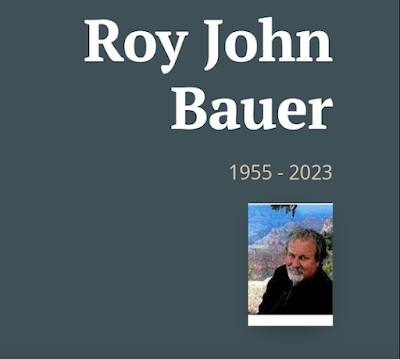
Roy's obituary in LA Times and Register: "we were lucky to have you while we did"

  This ran in the Sunday December 24, 2023 edition of the Los Angeles Times and the Orange County Register : July 14, 1955 - November 20, 2...