State community colleges set to ration classes (San Francisco Chronicle)
During World War II, there was food rationing. In 2012, California's community college leaders are poised to approve education rationing for thousands of students.
The proposal is controversial, with many students and educators critical of a shakeout that could end free courses offered for generations, including classes such as music appreciation and memoir writing. Also squeezed out would be students who linger at college for years, sampling one class after another.
The problem is as basic as a butter shortage. Essential classes are in critically short supply as the state's economic crisis lumbers on. Last year, 137,000 students couldn't get into at least one class they needed, including first-year English and math. And many who are entitled to financial aid never apply for it because there aren't enough counselors to help them navigate the complex process.
60% dropout rate
The result is a dropout rate of 60 percent among students who expect to transfer to a four-year university or earn a vocational certificate, according to a 2010 study by the Institute for Higher Education Leadership & Policy in Sacramento.
Fixing the problem will require overhauling the vast community college system, according to a task force of 20 academics and college advocates who have wrestled with the issue for a year. Established by the Legislature in 2010, the Student Success Task Force wants campuses to do a better job of helping students reach academic goals, and it wants students to move more quickly and efficiently through school.
But it won't be done with more money. Lawmakers cut $502 million this year from the system's $5.9 billion budget, on top of hundreds of millions withheld since 2009.
Instead, the task force wants to change how colleges spend the money they already have. Or, as Chancellor Jack Scott plainly put it, "It's not joyful to have to ration."
The backbone of the panel's 22 recommendations is to focus community college resources on students seeking degrees or vocational certificates. All students should have an education plan and make steady progress on it. Those who don't would lose registration priority. Those who qualify for a tuition waiver – 47 percent of students – would lose it if they are unfocused and take too many random classes.
. . .
California's college system is the nation's largest, with 112 campuses and a mandate to admit "any student capable of benefiting from instruction," according to the state's Master Plan for Higher Education, established in 1960. Its main mission is to provide academic and vocational instruction "through the first two years of undergraduate education."
The plan also points to colleges' role in providing remedial classes, community service courses, workforce training and free, noncredit classes, including English as a Second Language.
Last spring, 203,500 students statewide took noncredit classes, and 1.5 million took classes for credit.
Fee waiver overhaul
Nearly half of students taking classes for credit are poor enough to qualify for a waiver of fees: $540 a semester for a full load of 15 credits, at $36 a credit. The price rises to $46 next summer.
The task force wants to rescind fee waivers after students accumulate 110 credits, well beyond the 60 required for transfer….
. . . .
"You shouldn't be a professional student," said Scott, the state chancellor. "You're taking up space needed by first-time students."
But complaints that such a policy would unfairly punish low-income students led the panel to leave the ultimate decision on fee waivers up to individual campuses.
. . .
Centralize testing
At first the task force recommended changing state law to prevent colleges from spending public funds on such classes. But a public outcry led the panel to soften that stance. Now it directs colleges to verify that funds are spent only on classes that "advance student education plans" and says the law should only change "if necessary."
The panel also recommends strengthening the power of the state chancellor and implementing centralized testing….
The SOUTH ORANGE COUNTY COMMUNITY COLLEGE DISTRICT — "[The] blog he developed was something that made the district better." - Tim Jemal, SOCCCD BoT President, 7/24/23
Sunday, December 25, 2011
Friday, December 23, 2011
Thursday, December 22, 2011
GOP: the “just say ‘no’ TO SCIENCE” party
Maybe you’ve been following the OC Reg’s series comparing the positions of the Republican Presidential hopefuls on various issues. The latest entry focuses on the “environment” (Presidential candidate comparison: Environment).
I’ve edited the Reg comparison down to focus on the issue of global climate change in particular.
Of the seven Republican candidates mentioned by the Reg, all but Huntsman are some sort of “global climate change” skeptic.
Mitt Romney
…In June 2011 said, “I believe the world is getting warmer, and I believe that humans have contributed to that.”
Now says, “My view is that we don’t know what’s causing climate change on this planet.”….
Newt Gingrich
…Supported tougher environmental regulation early in congressional career.
In 2008, Gingrich made an ad with Democrat Nancy Pelosi urging steps to address human contribution to climate change, including cleaner forms of energy. “We do agree our country must take action to address climate change,” Gingrich said.
Soon after the ad – and criticism from some conservatives – Gingrich said, “I don’t think that we have conclusive proof of global warming. And I don’t think we have conclusive proof that humans are at the center of it.”….
Ron Paul
In 2008, said “human activity probably does play a role” in global warming and part of the solution should be to stop subsidizing the oil industry and let prices rise until the free market turns to alternate energy sources.
Now calls the science on manmade global warming a “hoax.”….
Rick Perry
Manmade global warming is a “scientific theory that has not been proven and from my perspective is more and more being put into question.”
Proposes repeal of EPA’s authority to regulate greenhouse gases and elimination of all EPA programs to restrict carbon dioxide emissions….
Michele Bachmann
Open federal lands to economic activity by “repealing radical environmental laws that kill access to natural resources.”
Voted to bar Environmental Protection Agency from regulating greenhouse gases….
Rick Santorum
Says the science establishing human activity as a likely contributor to global warming is “patently absurd” and “junk science.”
Jon Huntsman
End the EPA’s “regulatory reign of terror.”
Acknowledges the scientific evidence that humans contribute to global warming.
As Utah governor, supported regional cap-and-trade program to reduce greenhouse gas emissions and urged Congress to cap them.
“I will break down barriers to the continued, safe use of fracking,” an environmentally risky technique for extracting natural gas.
[All emphases my own. --BvT]FOR THOSE WHO NEED A CLUE:
• The position of scientists regarding this issue: see Climate change at the national academies (including the conservative National Academy of Sciences)
• That skepticism is driven by politics, not science: Poles apart: The international reporting of climate skepticism
• Respected scientific magazine takes on the challenge: Seven Answers to Climate Contrarian Nonsense (Scientific American)
Wednesday, December 21, 2011
Community college enrollment boom over
Top of the Mountain? (Inside Higher Ed)
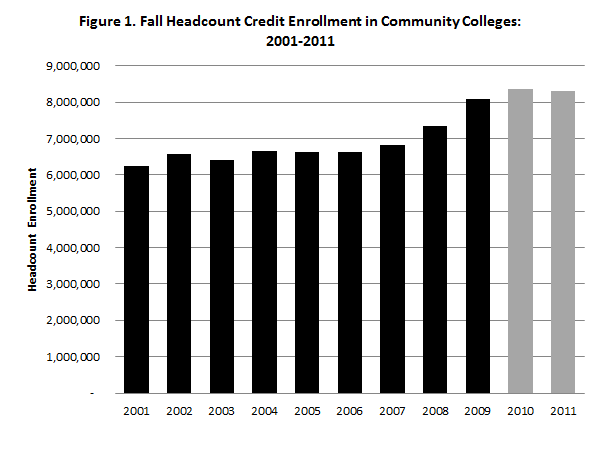
The enrollment boom at community colleges may be over, according to a new analysis that found a nationwide decline of almost 1 percent since the fall of 2010. But two-year colleges remain crowded, as enrollment remains up by about 22 percent since 2007.
“It’s not that enrollment is down. It has essentially stopped growing,” said Kent Phillippe, a senior research associate for the American Association of Community Colleges. The association prepared the analysis jointly with the National Student Clearinghouse, drawing data from at least 700 public, two-year institutions. So while the figures are not a comprehensive look at the sector, they do provide a reliable snapshot.
Phillippe, a co-author of the report, said community college enrollments have “stabilized at a high number.”….
The enrollment boom at community colleges may be over, according to a new analysis that found a nationwide decline of almost 1 percent since the fall of 2010. But two-year colleges remain crowded, as enrollment remains up by about 22 percent since 2007.
“It’s not that enrollment is down. It has essentially stopped growing,” said Kent Phillippe, a senior research associate for the American Association of Community Colleges. The association prepared the analysis jointly with the National Student Clearinghouse, drawing data from at least 700 public, two-year institutions. So while the figures are not a comprehensive look at the sector, they do provide a reliable snapshot.
Phillippe, a co-author of the report, said community college enrollments have “stabilized at a high number.”….
Samantha Brown shoots Anthony Bourdain with "Paula"
| Deceptively perky |
Despite my vegetarianism, I am a fan, I guess, both of Brown’s perkiness (which, I'm sure, disguises complexity and darkness) and Bourdain’s edginess (which, I'm convinced, disguises simplicity and a love of Cher), and so, well, I love it:
Subscribe to:
Posts (Atom)
Roy's obituary in LA Times and Register: "we were lucky to have you while we did"
This ran in the Sunday December 24, 2023 edition of the Los Angeles Times and the Orange County Register : July 14, 1955 - November 20, 2...
-
Professor Olga Perez Stable Cox OCC Trumpsters/GOP A professor called Trump’s election an ‘act of terrorism.’ Then she became the vict...
-
Richard O'Neill c. 1950 Richard O’Neill (1924-2009), a wealthy Orange County land owner, wanted the Democratic Party to be...
-
The "prayer" suit: ..... AS WE REPORTED two days ago , on Tuesday, Judge R. Gary Klausner denied Westphal, et alia ’s motion f...