U. S. Appeals Court Throws Out Suit Over Religious Speech (Chronicle of Higher Education)
A federal appeals court on Friday threw out a case brought by a Los Angeles City College student whose Speech 101 professor shouted him down and called him a "fascist bastard" while he was giving a presentation about his Christian faith.
The student, Jonathan Lopez, sued the Los Angeles Community College District last year. He said that the professor, John Matteson, retaliated and discriminated against him because of his religious beliefs. The lawsuit asked the court to strike down a district sexual-harassment code that forbade students and employees from creating a "hostile or offensive" educational environment. A federal district judge later issued an injunction preventing the college district from enforcing that code, saying it was overly broad and violated free-speech rights.
But a panel of the U.S. Circuit Court of Appeals for the Ninth Circuit unanimously found that Mr. Lopez failed to show he was harmed by the sexual-harassment policy and that he lacked standing to bring the case. Despite "the disturbing facts of the case," Mr. Lopez did not show how his speech, or his intended speech in the future, would have violated the policy he challenged, the judges ruled.
"No LACC official or student invoked or even mentioned the policy, nor did anyone suggest that Lopez's ... speech constituted sexual harassment," the ruling says….
For-Profit Higher Ed Rewards Those Who Oppose New Rules (Inside Higher Ed)
Members of Congress who have signed letters opposing proposed tougher regulations for for-profit higher education have seen their contributions from the sector increase, according to an investigation by ProPublica. The nonprofit journalism organization found that members who signed letters opposing new rules have received $94,000 in 2010. For some of the lawmakers, this means much more money than they have received from the sector in the past. Rep. Donald Payne, a Democrat from New Jersey, received $6,000 in campaign contributions from for-profit higher ed from 2005 through 2009. In 2010, he received more than $20,000....
Monday, September 20, 2010

From the archives: wartime documents, etc.

I came upon this 1902 certificate concerning my father's father's father, Karl Bauer (1880-1959). It certifies Karl's "honorable discharge" from the Wehrmacht (army) after service from 1900 to 1902. Evidently, Karl was a cannoneer, though the army designated him a "Musketier."

This certifies Karl's service during the latter days and aftermath of "the Great War," from 1918 to 1919. Bear in mind that he was 38 years old in 1918. I have another document that seems to indicate that he served earlier in the war as well. My grandfather, Otto, joined the Wehrmacht at age 36 (in 1943).

This is a certificate of inheritance issued to my mother's aunt (Martha) upon her husband's death, of TB, in 1941. The official seal sports the German eagle and swastika.

The man who raised my mother (Edith) from 1934 until his death in 1941, was her uncle, Otto Hänfler, who worked as a potter for the famous manufacturer of porcelain, Meissen. Here are two pages of a book he kept in which he recorded important facts about his family. The handwriting is impressive, eh?

In Niagara Falls (Canada), evidently, marriage certificates were issued along with these odd "negatives," which feel like wax paper.

Here's the same document--my parents' marriage certificate (1953)--reversed and inverted.

This, of course, is my certificate of citizenship, issued in 1965.
Sunday, September 19, 2010


Not “serious enough”

In an interview for that story, John doesn’t answer key questions and takes refuge in the old “I can’t talk about that” ploy.
This morning, our old friend Pen Pal wrote me to say that OC Supervisor John Moorlach appeared on KOCE’s latest airing of “Inside OC with Rick Reiff.” (See here. For some reason, on my Mac, it takes several minutes for the video to load up. You might start at Rick Reiff.)
Moorlach is asked to give his perspective on the Mike Spitzer firing, which came about after his alleged (by Williams) “inappropriate” inquiry into a case at Williams’ Public Administrator/Guardian office. It's the same case at the center of the revenue-enhancing charge against Williams.
During the interview, Moorlach, like many observers, notes that Spitzer’s phone call would seem to be a weak reason to fire a guy:

“Todd must’ve gotten a call that, ‘oh, my goodness, I’d better jump on this.’
"I don’t know what was said between he and the personnel at the PAPG, but it doesn’t seem like it was serious enough to be the incident to justify a termination.”
--I.e., things are not what they seem. They never are with this crowd (i.e., Rackaucas, Schroeder, Street, Carona, Williams, Fuentes, Mathur, et al.).
How can anyone support these people? Why would anyone trust them?
I keep hearing rumors that big changes are in store for Williams in the coming months. I’m betting that’s true.
SPEAKING OF FOOLS:
Saturday, September 18, 2010
Bernal’s housing-covenant case, 1943

Cal State Fullerton Grad Student Grad Finds Missing Link Between Alex Bernal Housing Covenant Case and the Supreme Court (OC Weekly)
It was a pleasure earlier this summer to report on the story of Alex Bernal, the longtime Fullerton resident who successfully fought off a lawsuit filed by racist white neighbors in 1943 that wanted him out of their neighborhood solely because he was Mexican. My sole frustration with the article was that I couldn't establish a direct link between the Orange County Superior Court case (Doss v. Bernal) and any of the more-famous housing-covenant cases that followed it, and that I couldn't find any proof that legendary civil rights attorney Loren Miller had any knowledge of the case.
Thank, God, then for the ever-curious mind of Luis F. Fernandez…. (continued)

Friday, September 17, 2010
Williams answers questions on TV; looks like jackass

As you know, in the last year or so, Williams has been the target of two highly critical OC Grand Jury reports and has faced criticism over his top-heavy management and his failure to cut costs as promised (when his combined position was created). More recent complaints charge him with inappropriately imposing guardianship on elderly citizens as a desperate effort to generate income to overcome severe budget shortfalls caused in part by court reversals.
VOC provides a link to a six minute KOCE report that includes an interview of Williams.
Check it out!

"Um, yeah. I used to play football."

"I'm not sure I like where you're goin' with this."
INVASION OF THE TEA PARTIERS:
Kevin McCarthy (1914-2010)
• For-Profits Give Thousands to Politicians Who Oppose 'Gainful Employment' Rule (Chronicle of Higher Education)
Members of Congress who signed letters to Education Secretary Arne Duncan that expressed concern about the Education Department's proposed "gainful employment" rule received nearly $94,000 in campaign contributions from for-profit colleges from January to late July, according to ProPublica, an independent, nonprofit news outlet focusing on investigations. In the face of the new rule, which would cut off federal student aid to programs whose graduates have high debt-to-income ratios and low loan-repayment rates, and attacks from Congress, for-profit colleges have spent hundreds of thousands of dollars lobbying Congress and federal agencies, nearly doubling their lobbying expenditures over the past year.

• Pope's astronomer says he would baptise an alien if it asked him: An alien – 'no matter how many tentacles it has' – could have a soul, says pope's astronomer (The Guardian)
Thursday, September 16, 2010
Chula Vista's Southwestern College: still “a culture of fear and intimidation”

Southwestern College Halts Publication of Student Newspaper (Chronicle of Higher Education)
Southwestern College … has temporarily halted the student newspaper from issuing a print edition, and student journalists allege it did so to prevent them from publishing articles before a heated election for the college's governing board. But the college denies any attempt at censorship and says the holdup is an administrative issue unrelated to politics.
The paper, The Southwestern College Sun, won several national awards last year from the Society of Professional Journalists for stories that were critical of the college's president and board members. One board member, Jean Roesch, sharply criticized the paper last month and asked for more positive coverage.
Staff members said on Thursday that college officials had barred them from publishing a paper before three members of the board face re-election on November 2. "We've been told we can't publish before the election," said Max Branscomb, the paper's faculty adviser. "It's outrageous, it's inexcusable, and it's flimsy."
 Southwestern has suffered from a revolving leadership and nasty battles between administrators, faculty members, and students. Last year, the college suspended four faculty members who participated in a campus protest against cuts to course offerings. In February, Southwestern's accreditor put the college on probation, citing a "culture of fear and intimidation," among other factors.
A spokesman for the college, Chris Bender, said the allegations of censorship were "flat inaccurate." The college stopped publication of the The Sun because officials discovered this summer that the paper is in violation of a campus purchasing policy requiring administrative approval for printing costs, he said.
Once the newspaper obtains proper approval for its printing costs, the paper can resume printed publication, he said. Until then, the newspaper is free to publish its stories online, he said.
"It's not an issue of free speech or freedom of the press," Mr. Bender said. "It's a purchasing problem."
SEE ALSO: Student Journalists Say College Trying to Squelch Them (Inside Higher Ed)
UPDATE:
Our friend Philip Lopez commented as follows:
Thanks for the coverage. Here's copy of a letter I wrote to the San Diego Union-Tribune. I'll bet they don't print it.
RE: College newspaper threatened with publishing roadblock
Taken out of context, the decision by Southwestern College administrators to halt the publication of our award-winning student newspaper because a contract with a printer hasn't gone out to bid might seem a reasonable, responsible protection of taxpayer money. But the big picture reveals something much different.
First, the shennanigans and dubious ethics involved in awarding multi-million dollar construction contracts to firms who later kick back thousands of dollars to re-elect incumbent Governing Board members shows that District officials aren't particularly concerned about protecting taxpayer money. Giving a $100,000 contract to a public relations firm whose job is to "isolate extremists" reveals the mindset of the SWC Governing Board and administration: Anyone with a differing opinion must be silenced.
This latest attempt to retaliate against the Sun is simply part of a long pattern of retaliation. The faculty advisor, who last year received the most prestigious national award possible for college and university journalism instructors, had his reassigned time eliminated. Just a few days ago, student journalists were threatened with criminal charges because they were taking school-owned laptop computers off campus to do their work.
Criminal charges are not laughable, but administrators' logic is. Laptop computers are designed to be portable. Student journalists routinely cover stories outside the boundaries of the campus, and laptop computers--and school-owned digital cameras, as well--are the tools they use to do their jobs. If all students were forbidden from using school-owned equipment for off-campus school activities, then the the football team would have to leave its helmets and pads behind when it travelled on the road.
Finally, the timing of this latest move against the Sun is curious. The student paper--containing articles critical of administration and the Governing Board--will not go to press just a few weeks before elections involving a majority of Governing Board members take place. Dusting off a decades-old policy, one which has never been enforced, to justify this action is simply another way of silencing dissent.
Philip Lopez
Southwestern College faculty member
Chula Vista, CA
Subscribe to:
Posts (Atom)
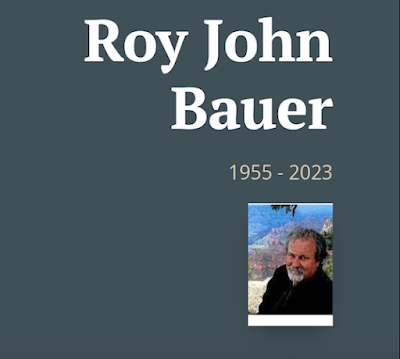
Roy's obituary in LA Times and Register: "we were lucky to have you while we did"
This ran in the Sunday December 24, 2023 edition of the Los Angeles Times and the Orange County Register : July 14, 1955 - November 20, 2...
-
 Professor Olga Perez Stable Cox OCC Trumpsters/GOP A professor called Trump’s election an ‘act of terrorism.’ Then she became the vict...
-
 Recently, I spoke with a veteran who’s been part of the vet community here at IVC for some time. He too has complained about Mr. Ma...
-
 I don’t know how anyone could learn about the way our colleges are funded and how their budget decisions are made without thinking...