Friday, January 6, 2006

Friday wrap-up

“Some scientists claim that hydrogen, because it is so plentiful, is the basic building block of the universe. I dispute that. I say there is more stupidity than hydrogen, and that is the basic building block of the universe.”

—Frank Zappa

1. DIVINE RETRIBUTION.
From the latest edition of Bob Park's "What's New?"

...Television evangelist Pat Robertson had previously called for hurricanes to be unleashed on sinful Florida, and told residents of Dover, after they voted out the school board, not to bother turning to God if disaster strikes, because "you just ejected him from your city."

Yesterday, Robertson suggested to his audience that Ariel Sharon's stroke was divine punishment for "dividing God's Land." Meanwhile, Iran's president Mahmoud Ahmadinejad, who had already declared that the holocaust never happened and Israel should be wiped off the map, told a group of Muslim clerics that he hopes Sharon perishes.

[re a new & effective HPV vaccine:] ...[H]uman papillomavirus (HPV) is the most common sexually transmitted viral infection in the U.S., and the cause of almost all cervical cancers. At least half of U.S. adults have been infected....

Nevertheless, New Scientist magazine quotes Bridget Maher of the Family Research Council, a leading Christian lobby group: "Giving the HPV vaccine to young women could be potentially harmful because they may see it as a licence to engage in premarital sex."


2. THE MOLD MONSTER.
Reportedly, the private company that tested the environment of building A200 at Irvine Valley College has submitted its report to the college.

You'll recall that, a month or two ago, some biologist denizens of A200 tested the air in that building and found some truly nasty spores. Not long after, administration had the air tested and declared (reportedly) that the building (or just it's air?) is clean. The biologists, however, noted that tests of the air mean little re health threat. You've gotta test the surfaces too. These bio people are pretty good about things biological. Not so good on fashion.

Evidently, subsequently, another company (?) did more thorough testing--not just of the air, but of various surfaces, including A/C units--and its report is in (as of Dec. 5). Those who have read the report tell me that its results are "eye opening." No doubt, by next week, I'll be able to tell you exactly what the report found.

3. HALF OF THE HIGHLY-EDUCATED ARE, UM, BONEHEADS
Have you heard about the literacy study that was conducted by the "National Center for Education Statistics" (of the Department of Education)? The L.A. Times reported its findings:

When adults with higher-education degrees were asked to compare the viewpoints in two newspaper editorials...or interpret a table about blood pressure, less than half could do it successfully...Among the most significant findings is that among adults who have taken graduate courses or have graduate degrees, 41% scored as proficient, compared with 51% a decade ago." (12/16/05)

4. WHAT'S GOOD FOR GENERAL MOTORS....
My report on the "Chancellor's Opening Session" (Tuesday) did not include mention of the rest of that presentation, i.e., beyond Raghu's curious performance. So here's a little catch-up.

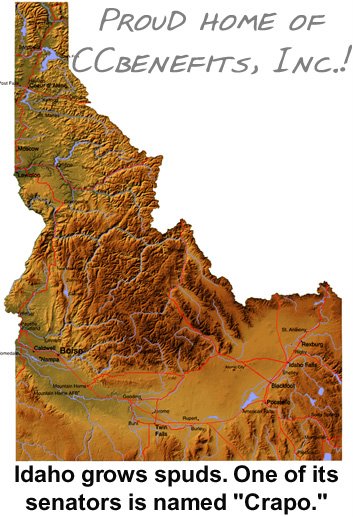
The keynote speaker was an economist from northern Idaho who makes his living assessing the impact of community colleges on local economies. Evidently, the results of his studies--which were instigated by the Association of Community College Trustees (ACCT)--have consistently shown that community colleges are great for the local economy. The Spudster's company was asked to study OC in particular, and, as you know, the resulting report has been much balyhooed by Raghu and Co., who seem to think that it proves that our colleges are even better for the economy than are tax-breaks for George Argyros.

This expert--one Kjell Christophersen of CCbenefits, Inc.--sounded competent and knowledgeable. I'm in no position to assess the worth of his study. But isn't it a tad hinky for trustees nationwide to rely on the results of one research organization? And from friggin' northern Idaho? (They've got potatoes and that's it; I checked.) An organization that has much to gain by providing consistently rosy findings?

I have no reason to doubt Christophersen's conclusions or methods. But have none of the leaders of community colleges heard of the need for replication? What's the difference between Bushian "cherry picking" and the community of CC trustees relying on only one research entity? Tell me that! (I'm sure some of you will set me straight. Please do.)

Plus Dr. Christophersen's report and approach seem uncomfortably simpatico with that retrograde right-wing philosophy according to which students--conservative students, anyway--are consumers and colleges should give the consumer what he or she wants.

You might wanna check out the ACCT's website. (ACCT) There, the words "corporate" and "business" come up a lot.

5. WE'RE EVEN STUPIDER THAN WE THOUGHT
On Tuesday, Jim Gaston gave a fine presentation called "Reading & Teaching the iPod Generation." Essentially, he explained that we teachers are mostly in the Stone Age while our students live and breath all things digital. As Gaston put it, students are digital "natives" and we teachers tend to be digital "immigrants" at best.

He recommended that we teachers increase student "interaction"--online and in person. Plus we've gotta satisfy students' desire for "customization" and "personalization." This Gaston fella is a good speaker.

One thing though. What's an iPod?

6. HERE'S YOUR PRIZE
On Tuesday, I forgot to mention that about half of the audience (for the Chancellor's Opening Session) was asked to climb up to the stage to receive a prize. At one point, I do believe I was nearly the only person left in the audience. I waved.

7. FACULTY ASSOCIATION FEED-BAGGERY
I attended the FACULTY ASSOCIATION luncheon too. Highlights:

Lewis explained about some MOUs that dangle hideously from the rear end of the recently approved faculty contract. One MOU concerned the form used to evaluate instructors. The new one will be a big improvement, said Lewis.

The President of CCA (that's the higher ed part of CTA), Carolyn Inmon, gave a nice little speech about the "challenges" faced by the California community college system. She mentioned a "hidden tidal wave" of about 100K extra students who will be in need of remedial instruction. Evidently, these students won't be awarded High School diplomas owing to their failing a (very simple) exit exam. At the same time, the CFU system is giving to community colleges an increased roll (more specifically, a large cinnamon roll) in educating their students. So, as usual, the mission of the CCs is expanding in all directions.

Inmon, who resides in Irvine, inspired laughter when she engaged in snidery, as when she referred to the Bush Administration's "No Child Left Untested" program.

Later, Lewis underscored the importance of the next election, which includes races for trustee seats now held by Wagner, Milchiker, and Padberg. (Word on the street is that the FA PAC will recommend supporting Milchiker and Padberg and going after Wagner. That's little more than a rumor, but I hope it's true!)

Lewis also noted the agedness of faculty leadership and the importance of encouraging young faculty to step up to the plate. And, sure enough, I looked around the room, and it appears that, with few exceptions, denizens of the chow hall on that day had all received applications from the American Association of Retired Persons. --CW
Wednesday, January 4, 2006

THE CHANCELLOR’S OPENING SESSION: stinkeroo (Raghu does Carnac)

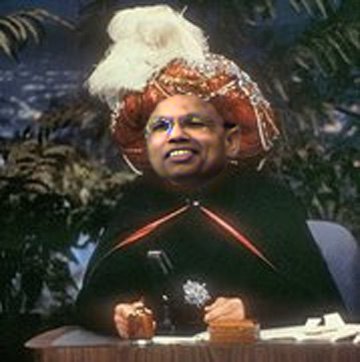
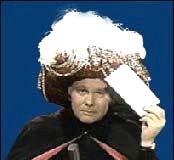
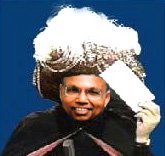
"A little song, a little dance, a little seltzer down my pants." drove to Saddleback College this morning to attend the “Chancellor’s Opening Session,” which was held, as always, in the William McKinley Theater, just down wind from the Spiro T. Agnew Memorial Library. “Where the hell is everybody?” thought I, as I drove into the nearly-empty parking lot and then trudged up to Fine Arts. I was relieved to find about sixty or seventy people drinking coffee and eating muffins. I spotted Dennis White and talked to him a bit. He said, “Where’s your camera?” “D’oh!” I spotted Howard Gensler too. I saw a rat turd. After a while, we all took our coffee and muffins and walked past the “no food or drink” sign to enter the Theater and find a seat. I do believe that this was the most poorly attended “Chancellor’s Opening” ever—I don’t think there were even one hundred people in that big room. I shouted a coupla times to hear my echo. Walter spun around in confusion, and I snickered. Soon, things got rolling. A woman named Cindy came up to the microphone to tell us that she was an IVC student and mother. Apparently, she was there just to introduce a speaker, and, judging by all her superlatives, I figured she was talking about somebody like the Pope or maybe Jesus. But no. Turns out she was talking about the Chancellor, an unaccomplished fellow who recently gave Trustee Lang a prize, evidently on the grounds that he, Lang, had spotted Raghu’s “excellence.” It was a classic Raghu moment. Right from the start there were technical snafus, e.g., somebody was shining a spotlight on Mr. Goo’s head, leaving everybody else in the pitch dark, but that was no good, ‘cause Raghu sought to identify all dignitaries in the audience, like he always does. He identified Trustees Lang, Padberg, and Milchiker, among others. Applause. Tedium. Raghuian baskage. With Raghu, everything that seems to be about somebody else, is really about him. Remember all the fuss he made about the “One year tuition waiver” he would provide for victims of Hurricane Katrina? He was Johnny-on-the-spot, boy. In the district’s press release (Raghu rescues hurricane victims), Raghu proclaimed, “We are pledging to work with the Governor and legislators to make educational provisions for victims of this terrible disaster. The colleges want to make sure our fellow citizens can continue their education during the emergency.” Hmmm. See me. Hear me. Feel me. I made some inquiries. To date, a grand total of two students have applied for the waiver. But of course! This waiver thing wasn’t about them! It was about the Gooster! Raghu next led us in the Pledge of Allegiance. It was a pledge, he said, to “the flag of the greatest nation on earth.” Garsh. Anybody leading a pledge to that must be mighty important. Dave Lang said a few words. He talked about the Board’s goals, especially “avoiding micromanagement.” He mentioned various spiffy construction projects, including the new IVC “Police Maintenance Annex” plus the Ronald C. Caspers memorial Mold Depository. Lang briefly explained our district’s “basic aid” funding, which skims from local property taxes. The latter are kinda high, owing to high home prices (and County law-breaking) and so we’re swimmin’ in dough, but, said the Langster, we’ve gotta spend the extra moola on “one-time” projects. We don’t wanna grow dependent on this money, which might dry up real soon. Dave was counting beans mostly, but he also talked about the need to avoid the “perception and instances” of micromanagement. He asked for our assistance in that regard. I think he said that we can call him any time. Or maybe he said we better not call him. It was one of those. Raghu then popped up again in his spiffy new grey suit and snazzy tie. He did some more introductions. Apparently, Beth Mueller is now the district fiscal services person, replacing Katie Slavin. Sheesh. Somebody better buy a calculator. Raghu ploughed on. “I compensate for being short by giving long speeches,” he said, waiting for laughter. The audience laughed, but it laughed a tad too much, know what I mean? I spun around and looked at the people in the room. It was a friendly crowd all right. They glared at me. I glared back. Do you remember when Raghu received 6.5% “confidence” from faculty back in 2004? Well, all 12 of those people were in the William McKinley Theater, laughing like hell. Pretty soon, Raghu said something about Johnnny Carson and “Carnac the Magnificent.” Huh? What? He then disappeared behind the curtain, and then, all of a sudden, the big screen displayed the opening of the old Tonight Show, with Johnny Carson. (Remember that music?) Then we saw a minute of Carson’s “Carnac the Magnificent” routine—you know, the one in which he held an envelope to his head and divined the answer to the question the envelope contains. The joke came when he read the question in the envelope: Carnac (holding the envelope by his head, divining the answer to its question): “Piggly Wiggly.” Ed McMahon: “Piggly Wiggly!” (Carnac now opens the envelope and reads the question:) “Describe Kermit the Frog’s wedding night.” Har har har! OK, while that was projected on the screen, some guy—Ken Patton, I think—came out and proceeded to make like Ed McMahon, addressing the audience with his best “announcer” voice. Only there was a problem: his mike wasn’t turned on. (D’oh!) Plus: the volume of the video was too high. (D’oh!!) I cringed. After Ken was clued in to all that, he spouted his lines again. “Welcome to the Tonight Show,” he boomed. He then introduced the “all-seeing, all-knowing…Carnac the Raghubansh!” (That flashed on the screen.) With that, Raghu, wearing a fey powder-blue cape and some kind of swami headdress, emerged from behind the drapes and danced across the stage! I couldn’t believe my eyes. But wait! It gets better! I was, like, the only guy in the room who wasn’t sitting up against the back wall. There I was, by myself, in front, near the right side of the stage. And so, to the accompaniment of hip hop music, Raghu danced across the stage and right up to me and—I swear—the fellow proceeded to flirt! Good Lord! I think he was waiting for me to stick a $5 bill in his pants, but I wasn’t goin’ there nohow. I very nearly bolted. Luckily, he soon turned around and headed for a chair behind a desk, while “Ed” sat over to his right, a la Ed McMahon. “You have come to the right place!” announced Carnac the Raghubansh. Now, the idea was that Ed/Ken would introduce each of the district’s goals and then he and Carnac/Goo would go through one of these “Carnac” routines, and hilarity would ensue. That was the plan, anyway. Raghu Carnac held the first envelope to his head. He pondered it and then gave the answer: “Just say ‘yes.’” “Just say yes,” repeated Ed. Carnac then tore open the envelope and read the question: “How can the board avoid micromanagement?” Har har! They continued: The Answer: “Who knows? Who cares? The Question (rip, rip): “Who will be the first ATEP president to greet the students?” Hardy har har har! The answer: “Limit TV to watching Board of Trustee reruns.” The question (rip, tear): “What is the most effective behavior modification for children?” D’oh! You’re killing me! The answer: “At least two.” The question (rip, rip, tear, tear): “How many Vice Chancellors does it take to plug in a light bulb?” Stop it, I’m dyin’! Guffaw!!! —Well, this went on for a while, and, like I said, the audience was pretty friendly, so there was laughter, but mostly, I think, people laughed ‘cause they couldn’t believe their friggin’ eyes and ears. To Raghu’s credit (I guess), one of the routines poked fun at his inability to pronounce some letters. (It’s a good thing I’ve never attempted such pokage. Imagine!) Another one alluded to high employee salaries, and another spoofed the Board’s disinterest in planning. Plus, the envelopes were sealed, said Raghu Carnac, by “the Faculty Association.” Yuk Yuk. Raghu and Ken did their best, but the jokes were lame, and, on several occasions, the order of questions and answers was reversed, or an answer went without a question. Sometimes, both the question and the answer were flashed on the screen before the routine started. And so on. It was pretty bad. It was strictly stinkeroo. As soon as that became clear, Tracy jumped up to take a snap! Then, with music blaring, Raghu danced back behind the curtain, and hilarity again ensued. Soon, an almost sullen Raghu reemerged, sans costume. “I hope you liked that,” he said, sounding exactly like Elmer Fudd. Well, speaking for myself, I’ve just gotta say “yes!” --CW

Sunday, January 1, 2006

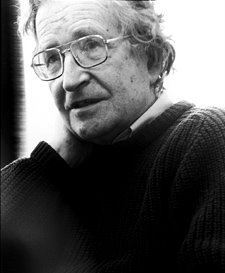
CHOMSKY on Academic Freedom--an interview


ecently, I mentioned an interview of linguist and philosopher Noam Chomsky (M.I.T.) that appeared in an edition of the journal Thought & Action. (Chomsky interview Note: a pdf file)

Below, I offer a few brief excerpts of that interview. The headings and edits are my own (CW).

I have appended some related links. (I cannot resist highlighting one of them here:

On the stunning ignorance of Bush voters:
U of Maryland poll)

* * * * *
A NEW OPENNESS:

THOUGHT AND ACTION [T&A]: How would you describe the intellectual climate on the nation’s campuses…[especially after 9/11]?

CHOMSKY: In general, I think the campuses are like the country as a whole. [Ours]…is a very insular society. Most people don’t pay much attention to anything beyond…[our] borders.

But one effect of 9/11, which was very striking, was that there was enormous increase in people’s interest…in learning something about the outside world….

...People like me, who are giving talks all the time, can see it very dramatically. The number of invitations to give talks—political talks—shot up after 9/11. And audiences became much larger than they were before, all over the country. And the same is true of books…And that reflected itself on college campuses too….

THE EXTREMIST RIGHT-WING:

T & A: Were there other, perhaps different, reactions to 9/11?

CHOMSKY: There is an effect in the opposite direction, coming from an extremist, right wing that is trying to stifle discussion on campuses by imposing standards on what people are allowed to talk about. I think maybe 20 or so state legislatures are considering legislation—maybe some have passed it—…organizing students to monitor whether things that happen in the classroom meet the doctrinal standards of the right-wing extremists. A lot of this is focused on the Middle East departments…They’ve been more under attack than anyone, with the demand that they satisfy the orthodoxy of the doctrinaire right-wingers. [See The New McCarthyism in Academe (warning: this is a pdf file)]

These [right-wing] groups say they’re concerned about academic freedom, but it has nothing to do with academic freedom. It has to do with shutting down discussion…You can see that at Columbia right now, which is a striking case…. [See Debate on Academic Freedom]

WHO IS ACTUALLY HARASSED AT COLLEGES?:

T & A: What about the argument that conservatives are being discriminated against on the nation’s campuses?...

CHOMSKY: …[Conservatives] have not one particle of evidence for that. In fact, what they call “conservative”…[is really] “far right.” And it’s the far right that wants to discriminate….

Take one of the issues the right wing is focusing on, the claim that Israel’s right to exist is being threatened. [C. the recent right-wing worry that Christmas is under attack!] Is the right wing arguing that students and faculty who claim that Israel should have the rights of all other states are being silenced on campus? There’s an easy way to test that. And they don’t test it, because they know what the answer is going to be. Just do a poll of college faculty and see if more than .001 percent disagree with the simple proposition that Israel should have all the rights of any state in the international system. Everybody agrees with it.

The harassment on the nation’s campuses goes…[against leftists & radicals, not conservatives], and it is massive. Take Columbia University again. Edward Said, whom the right wing…hated, was subjected to ongoing harassment. He had to have police protection at his office, at his home. He had to have a buzzer in his home so he could call the police station. That went on all the time. I’ve been under police protection when I gave a talk on college campuses about the Middle East. But nobody’s complaining about that…. [See Wiki on Edward Said]

THE “THIEF! THIEF!” STRATEGY:

Actually, there’s a name for what the right wing is doing. It’s called the “’thief, thief!’ technique.” The idea is [that,] when you’re caught with your hand in somebody’s pocket, you point to someone else and…[shout], “Thief, thief!”...

The fact is, there has been extreme discrimination on campus, and very serious harassment, but it’s of anyone who questions the orthodoxy. [It’s] not against conservatives.

T & A: What is the orthodox consensus, what does it mean to deviate from it, and what are the costs of deviating?

CHOMSKY: The orthodoxy, as is usually the case, supports the U.S. government position. And the U.S. government position happens to be extremely rejectionist in the case of the Middle East. Since the mid-1970s, the U.S. alone has blocked the overwhelming international consensus that there should be a two-state settlement of the Israeli-Palestinian question. And anyone who points out this rejectionist stance or wants to discuss it often faces serious harassment.

…The nation’s intellectual leaders are intimidated.

…I’ve gotten to know a fair number of the police on campus and…[in Cambridge] because they’re often present when there’s a talk on campus. And it’s not just me. It is anyone who deviates marginally from the overwhelming orthodox consensus.


IS OUR FEAR OF TERRORISM UNREASONABLE?
WHY ARE WE A TARGET OF TERRORISTS?


T & A: …[M]any Americans, including large numbers of our students, are afraid of the possibility of terrorist attacks being carried out against civilian targets—

CHOMSKY: I’m a lot more afraid than they are, because I’ve been reading and writing about it for many years before 9/11….

…What students ought to be taught is what the reasons are for…[the very real threats we face]. For example, they ought to focus on the fact that…[U.S.] government policy is…increasing that threat….

[T]ake the invasion of Iraq. The U.S. intelligence services…informed the President a few weeks before the invasion that the invasion was likely to increase the threat of terror. It wasn’t unique to U.S. intelligence; this was being pointed out by intelligence agencies everywhere. And…that turned out to be correct. It did substantially increase the threat of terror….

T & A: Aren’t a lot of institutions, even the government, using that fear to chill debate on these issues?

CHOMSKY: …[T]hat’s not just true of the U.S. government. In the first interviews I had after 9/11,which were a couple of hours after the terrorist attacks took place, one thing I pointed out…is that every power system in the world is going to use this as an excuse to increase repression if they’re carrying out repression, or to control their own populations…So the Russians used it to step up their atrocities in Chechnya, and Israel used it to step up its repression in the West Bank….

[O]ther governments that weren’t carrying out violent repression used it to institute things that they call “protection against terrorism acts,” or something like that, to discipline and control their own populations. That’s the way power systems react….

…But, as I mentioned at the outset, another of the effects—and a major effect—of 9/11 in the United States, was quite the opposite. It was to open people’s minds, to make them think they’d better raise questions about what’s going on in the world….

DEMOCRACY AND FREE INQUIRY:

T & A: You’ve written about how institutions like the press—and presumably the academy—are used to control the population and to thwart democracy. But you’ve also paraphrased [early 20th-Century philosopher] John Dewey as saying that education is one means of combating the undermining of democracy. [See "Media Control" (Chomsky on Dewey, Lippman, and Democracy)]

CHOMSKY: That’s what John Dewey was hoping: that education would promote democracy. So, yes, in a free society, universities ought to be, schools too, for that matter, should be places where…faculty and students are encouraged to challenge, question, press the borders of inquiry, to be completely open to challenging received and accepted ideas. In fact, that’s the way the sciences work. The sciences wouldn’t survive if that wasn’t the atmosphere. And it should be the atmosphere throughout education.

But when you get to areas that reflect public policy, the hammer comes down and you get repression of challenges to authority. As in the cases we were discussing.

T & A: What can concerned faculty and staff do to further democracy and the open debate that you’re talking about?

CHOMSKY: Our colleges and universities can do exactly what is done necessarily in the sciences, [namely,] encourage faculty and students to question, to challenge, to press the borders of inquiry, to be quite open to asking questions about established doctrines.

I’m not suggesting that nobody does this. Many people do it. But there is pressure to conform. Sometimes it’s extreme, as in the…attacks on the colleges that we were talking about before. But it’s always there, more or less.

I can give you plenty of cases from personal experience…where dissident questioning faculty were essentially informed that they’d better shape up and keep to doctrinal orthodoxy or they’ll be out. Anyone in most universities can tell you about this—and it’s done in subtle ways…. It’s not, “I’m going to kick you out,” but, “You’re lacking in collegiality,” or something like this….

T & A: Is the intellectual community on college campuses challenging orthodoxy and promoting open discussion?

CHOMSKY: It varies with the institutions. In the sciences, I think it’s done very well, as far as I can see…In the sciences, you have to…[challenge orthodoxy], or the sciences will die….

FOCUSING ON OUR OWN ACTIONS:

…All of us are responsible for our own actions. That’s the most elementary moral principle you can imagine. So therefore there should be a focus on our own actions—what they were, what they have been, what we can do about them, and so on. But, on the contrary, overwhelmingly…[examination and criticism of our own nation’s actions] is marginalized, put to the side, and when it’s brought up it does elicit considerable hysteria….

T & A: …[A]re you worried that the national security state will curtail freedom of expression?

CHOMSKY: Well, it’s going in both directions. There is greater and greater success in marginalizing people and in reducing the formal democratic system to empty forms. The November election was an example. Very few people even had an idea what the stand of the candidates was on issues. For example, a majority of Bush voters thought that he supported the Kyoto Protocol on global warming, which is overwhelmingly supported by the U.S. population. [See U of Maryland poll]

That’s true in case after case, as careful studies have shown. All of that shows that the United States is becoming a kind of a failed state in which it has democratic forms but many pressures that converge to ensure its orderly function. That’s one tendency.

On the other hand, there are opposite tendencies: concern, engagement, openness on the part of the general public, and very surprising attitudes when you look at the polling results….

USEFUL & RELATED LINKS:

On Chomsky:
Wikipedia on Chomsky

On Academic Freedom and the so-called “Academic Bill of Rights”:
Wiki on Academic Freedom
Wiki on AAUP/Academic Freedom
Debate on Academic Freedom

On Edward Said:
Wiki on Edward Said

On the stunning ignorance of (Bush) voters:
U of Maryland poll

On Columbia U and attacks on its “Middle East” department:
The New McCarthyism in Academe (warning: this is a pdf file)

On Dewey and Democracy:
"Media Control" (Chomsky on Dewey, Lippman, and Democracy)

Saturday, December 31, 2005

PATRIOTIC CORRECTNESS vs. THINKING


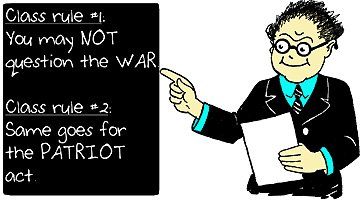
“It has come to my attention that several faculty members have been discussing the [Iraq] war within the context of their classrooms. We need to be sure that faculty do not explore this activity … unless it can be demonstrated, to the satisfaction of this office, that such discussions are directly related to the approved instructional requirements and materials associated with those classes.”

—IVC’s Vice President of Instruction, 3/27/03

ttention fans of free speech and academic freedom! You really should check out the Fall 2005 edition of the NEA’s higher education journal, “Thought & Action.” (Thought & Action)

It focuses on “Higher Education and the National Security State,” and it includes an interview of Noam Chomsky.

You’ll recall that, back in 2003, IVC’s VPI, Dennis White, banned talk of the Iraq war in the classroom. Evidently, some IVC instructors dared to question the war--imagine that!--which upset some students. So Dennis took action. It wasn’t that he was trying to sanction unquestioning patriotism. It was more that he was trying to keep our customers satisfied. Bleccch.

Normally, anybody would see the folly of this kind of censorship. In this case, however, Dennis seemed to be on the side of, as Trustee Tom likes to say, “our fighting men and women,” and that’s good, isn’t it? To do otherwise is bad, right?

So, without qualms, Dennis issued his ban. No doubt, he also issued a sigh of satisfaction.

His satisfaction didn’t last long. The ban produced yet another in a long series of embarrassing and wacky media storms, though most of the criticism in this case seemed to come from academics.

To make a long story short, the administration’s bumbling and contradictory efforts at damage control eventually produced an equivocal recanting of the ban, whereupon some members of the IVC Academic Senate asked for clarification of the administration’s policy on war talk. Senators were then warned to leave the matter as it was, which they did. (The tale is told in our Archives, War Talk Ban at IVC.)

The larger issue—of threats to academic freedom and free speech arising from fear—is very real and very disturbing, as you know. I recommend that you peruse the Fall 2005 edition of “Thought & Action.”

Read especially the article by John K. Wilson. It is entitled “Academic Freedom in America after 9/11.” (Academic Freedom. Warning: it's a pdf file.)

In the article, Wilson writes:

College Campuses around the country reacted to the September 11, 2001, terrorist acts with rallies, vigils, discussions, and a wide range of debates about the causes and cures for terrorism. Yet the story told about academia in the media was often quite different.

According to Wilson, the news media portrayed academia as a place that suppressed, in particular, support of our nation’s endeavor to respond to the terrorist threat. But is the portrayal accurate? Wilson writes:

There is no factual basis for the claim that supporters of war faced more suppression [than critics faced] on college campuses. To the contrary, opponents of the war on terror reported many more threats to academic freedom.

Back in 2003, when Dennis issued his ban, many of us at IVC were very aware that college classrooms are among the very few places in our society that permit and even embrace a genuinely open and free discussion of our government’s military adventures and anti-terrorist policies. Wilson notes:

Far from being the center of repression, college campuses were often the only places in America where the U.S. response to terrorism was seriously analyzed and debated. Indeed, conservatives attacked academia because, at a time of flag-waving and national unity, colleges were the one place in America[n] society where a debate about public policy occurred and dissent from the Bush Administration’s foreign policy was permitted.

Think of it in this way: if our nation were a group of, say, ten people, then Mr. Academy would be the guy (or gal) in the corner who thinks before he acts. That’s an important guy to have around.

Or, more accurately: the other nine people should be, but aren’t, like that guy.

Isn’t it clear by now that the problem with our invasion of Iraq was that too few of us were like that guy? Inside the academy, there was plenty of thought and open discussion and skeptical questioning. It was flyin' all over the place.

But it didn’t seem to matter very much, since, outside of academia, almost nobody really asked whether this thing made sense.

It sure didn't happen in the White House. It didn’t happen in Congress. It didn’t happen in the news media. Again, if our nation were that group of ten people, then Congress, the President, and the media are the three dolts in the middle--the one's with their heads up their asses.

Does Unflag-wavery exist as a kind of political correctness in academia? Sure. But if you’re looking for where the rubber meets the road, oppression-wise, then you need to consider the plight of Unflag-wavers, not Flag-wavers.

Or so says Wilson:

[M]y extensive survey of academic freedom and civil liberties at American universities found…[that] left-wing critics of the Bush Administration suffered by far the most numerous and most serious violations of their civil liberties. Censorship of conservatives was rare, and almost always overturned in the few cases where it occurred. Patriotic correctness—not political correctness—reigned supreme after 9/11.

I won’t review Wilson’s impressive litany of incidents, which includes Dennis’ ban (see page 127). And I sure don’t want to pick on Dennis, who is a nice guy and who, otherwise, really tries to do the right thing.

Unlike some persons I know.

But I do want to say that criticism and discussion are very valuable things, and, at real colleges, they occur without apology.

Happy New Year.

P.S.:

Here's an old memo from the President of Irvine Valley College to "all faculty":

I understand that some students have asked instructors to allow them to speak in their classes about campus political matters. In light of professional sense and matter [sic] of good practice, I would like to caution and advise all faculty to maintain the integrity of the classroom instruction [sic] by adhering to approved curriculum and course outlines of record for their day-to-day activities. It is not a good practice for faculty to allow campus politics to interfere with the educational interests of the students in the classroom. Discussion of political matters, for example, in political science classes is certainly appropriate. Students are welcome to use other forums and avenues to exercise their freedom of speech without interfering with educational interests of other students.

I appreciate very much your professional consideration of this matter. Thank you.


The date?:

April 2, 1998.

The author?:

RAGHU P. MATHUR


P.P.S.:

From Bob Park's newsletter (What's New?), yesterday:

DESIGNED LIES: THE DOVER SCHOOL BOARD DID IT "TIME AND AGAIN."

"It is ironic that these individuals, who so proudly touted their religious convictions in public would time and again lie to cover their tracks and disguise the real purpose behind the ID Policy." --From the Jones opinion in Kitzmiller v. Dover school Board.

--I'm not sure how ironic it is. I'd say it's predictable. --CW

Friday, December 23, 2005

Just what I wanted!

1. THE ANTI-INTELLECTUALISTS LOSE A BIG ONE. Yes! Like many of the rest of you, I peeked under the X-mas tree (not the "Holiday" tree, the "X-mas" tree) and found that I got exactly what I wanted! --NAMELY: Judge Jones' marvelous decision in the Dover school board case.

Bob Park, a U of Maryland physicist, has a wonderful Science/Politics weekly newsletter called "What's New?" (You can subscribe to it for free.)

It comes out on Fridays. In today's edition he reports

INTELLIGENT DESIGN: DOVER DECISION DESTINED TO BE BESTSELLER.
"Our conclusion today," wrote United States District Judge John E. Jones III, "is that it is unconstitutional to teach ID as an alternative to evolution in a public school classroom." You must read 137 pages to get to that line, but it's time well spent. Jones, a conservative Republican appointed by George W. Bush, reviews the "legal landscape" of church-state separation, and then addresses the key question of whether ID is science or religion. He does so, "in the hope that it may prevent the obvious waste of resources on subsequent trials." Science, he observes, "rejects appeal to authority in favor of empirical evidence," whereas, "ID is not supported by any peer-reviewed research, data or publications." Not only does he enjoin Dover schools from teaching ID, he says the parents who brought suit are entitled to damages. That may cool the ardor of other school boards thinking of hopping in bed with the Discovery Institute. In the Senate, Rick Santorum (R-PA), who had earlier praised the Dover School Board for "teaching the controversy," was so moved by the Jones decision that he severed his ties to the Thomas Moore Law Center, which had defended the Board. (My emphasis throughout.)

Bob goes on to say:

Having just read Judge Jones "passionate paean to science," I turned on "Heaven: Where Is It? How Do We Get There," a two-hour special on ABC. The only hard information was that 90 percent of the public believes in it, whatever it is. That's scary, but how could ABC spend two hours on something for which there is no evidence whatever? Easy, have Barbara Walters interview experts, from mega-church evangelist Ted Haggard, who explains Heaven is only for born-again Christians, to a failed suicide bomber in a Jerusalem prison who was certain it's only for Muslims.

Do yourself a favor and subscribe to Park's newsletter! He's often funny and always tough-minded.
What's New?

2. ONWARD CHRISTIAN SOLDIER: TOM FUENTES' FAREWELL SPEECH ('04). You might be interested in reading Tom Fuentes' "farewell" speech of March 14, 2004--when he stepped down after twenty years as chairman of the local GOP. To read the whole speech, go to SoCal Law Blog:
Farewell to Fuentes

Here are some brief excerpts:

Now, some have asked me what is it that gives me most joy in twenty years as Chairman of this County Party. It is a little thing. It is the fact that anywhere in this county, whenever Republicans gather, we begin our time together with prayer. You may pray in your way, and I may pray in mine, but, my friends, Republicans in this county always acknowledge a power higher than ourselves as did our Founding Fathers. And, the values, principles, and ideals that flow from the acknowledgement of the divinity, guides our conservative social agenda. It gives us pause to reflect on what is really important in life and society. It motivates us to defend causes that are so critical in the cultural war that today engulfs our nation and its society. Because you have allowed me to serve as your Chairman, I have been able to enjoy the opportunity to give encouragement to countless young activists to become involved in the leadership of our party.
.....
No matter how strong the winds blow from the left in places like San Francisco and Hollywood, you my friends, are committed to a higher and nobler calling. I want to thank President Bush for his kind appointment of me to his Administration. I greatly enjoy my current service in Washington, D.C. and around the nation, on the Board of Directors of the Legal Services Corporation. With an annual budget of some $350 Million, our task is to provide equal access to justice in America.
.....
In 1984, when I first spoke as the newly elected Chairman of our County Party, it was 150 years after my great, great, great grandfather arrived in Orange County in 1834. He walk[ed] north from Old Mission San Juan Capistrano through this land that you and I call home. Today, now in 2004, it is 170 years since his arrival and his walking. My colleagues, I want you to know that I will continue to walk with you, to visit our neighbors, and to welcome them into our party. Thank you very much.

Tuesday, December 20, 2005

“Good people” vs. Bad people

As you know, Trustee Tom Fuentes, along with notorious Christian Reconstructionist Howard F. Ahmanson (see ARCHIVES: 11/30/05)—is on the Board of Directors of the “Claremont Institute," an eccentric neoconservative think tank. (See Wiki on CLAREMONT INST.)

Today, at the CI website, I ran across an April 2005 interview of Fuentes by CI's Ken Masugi. For those of you who are interested in Mr. Fuentes’ politics—especially his views on teachers at public institutions—the interview is worth reading. Otherwise, I’d skip it.

I have provided brief excerpts below. To read the entire interview, go to

http://www.claremont.org/projects/
local_gov/Newsletter/fuentesinterview.html


Or click on:

INTERVIEW

THE MASUGI INTERVIEW (Excerpts):

Tom, …What is the California Dream? Is it in danger, or simply changing?
…..
My great-great-great grandfather arrived in San Diego aboard a ship from Mexico in 1834. He was born aboard another ship that came from Spain in 1810. Both he, and his parents before him, suffered hardships and trials so that he could reach this magnificent place we call California….

Today, I see ever growing government and more restrictions on our freedoms as Californians. Our state capital is infested with special interests and the average Californian has to pick up the tab to support the government and special interest elites…We need less government in California, not more….

California was the place from which came Proposition 13 and Ronald Reagan. This state gave to the nation a conservative agenda of reform. I hope that vision is not lost.

How does the November [2004] Republican victory nationwide reflect on the American/California Dream?

I liked the county-by-county, red versus blue map of the nation that was published after the election. It showed that most of California is red. That is to say, most of the communities of our state voted for President Bush. The Kerry victory in California came from the blue urban core areas.

I believe that the map demonstrates that the good and morally motivated people in most of California's towns and communities share common values with the vast majority of their countrymen.
…..
Is California out of step on moral issues that many cite as giving Bush the edge over Kerry and the Democrats in the last election?

I think that most Californians are good people who share noble ideals.

On the other hand, California is home to Hollywood and its violence and vulgarity…..

Are there…things you liked about [Governor Schwarzenegger’s recent] speech?

I am impressed by the Governor's candor in identifying the government worker labor unions, especially the teachers, as key elements of the problem [of over-spending]. The entitlements of money and benefits, especially retirement, will eventually bankrupt California if not soon checked.
…..
Your career has been marked by devotion to following principle and at the same time expanding the base of the party. What advice can you give to young politicians and those who are cynical about politics and how to match principle and electability?
…..
The Republican Party must outreach with a conservative message. Nationwide, the campaign found success in reaching Hispanics and Catholics, for example. In 2004, Catholic support for Bush was up to 52%--six points higher than in 2000….

But reaching these constituencies in California will be a real challenge. The state party today is in the hands of moderates, not conservatives. Many from big business, and moneyed moderates, do not want to encourage a more conservative party.
…..
On what local government issues should Republicans consider uniting? How should conservatives link local issues to state and national ones?

I have the privilege of serving as a trustee of a large community college district. As a local elected official, I am always amazed at how often local elected officials, who are registered Republicans, forget conservative ideals in their local decision-making. I know many a local elected official who has never met a new government program he or she did not like. We must teach what it is to be a conservative to those who serve in city, county and school posts.

As an example, the labor unions are as aggressive in the cities and school districts, as they are in Sacramento. I see self-identified Republican city council members and school trustees voting for outlandish salaries, retirement benefits and entitlement programs for public employees with little regard for the taxpayer. I see property rights challenged by these same people.


Tell us about your work for the Claremont Institute in its new Orange County Office.

I am delighted to be serving the Institute at its new offices in Newport Beach. Orange County has always had a warm spot in its heart for The Claremont Institute. The Institute has so many able and articulate scholars. I want to help get out their message to the people of Southern California and to recruit neighbors to support the work of the Institute in sharing the message of the American Founding in our contemporary political life. We have begun to have some fine showcase events to get more exposure for the work of the Institute. It's an exciting time. [END]

NOTES

1. I added the italics. --CW
2. Thomas L. Phillips of Phillips International is on Claremont Institute's board of “advisors.” See ARCHIVES: 9/23/02.

3. In the interview, Fuentes argues for the need to engage in state redistricting to make political races more competitive. Evidently, the Rose Institute of Claremont McKenna has produced studies that support such a reform. Eric Norby--who was appointed by the Board to replace Dorothy Fortune but who quickly resigned--works for the Rose Institute.

4. Here's a fun fact: one of Claremont Institute's projects is:

Doctors for Responsible Gun Ownership -- "a group of health professionals familiar with guns and medical research, is the antidote to those who twist science to serve a misguided anti-gun ideology."

Don't believe it? Click on the link below:

CI PROJECTS

Monday, December 19, 2005

Cronyism & Mirthulence

As you know, at the last board meeting (Dec. 12), Trustee Tom Fuentes, former Big Cheese of the OC Republican Party, expressed a concern that the faculty hiring process up for approval that night might permit faculty “cronyism.”

Ha! I say "HA!"

That Trustee Tom is pointing the fickle finger of Fuentes at faculty “cronyism” is Ha!-worthy in two big respects—beyond, that is, there being no evidence that cronyism taints our faculty hires these days. (Let me know if I’m wrong about that.)

REASON FOR MIRTH #1: First of all, it is yet another instance of the pot calling the kettle black.

Remember when Supervisor Chris Norby's brother Eric (who works at Claremont McKenna College, which has close ties to the Claremont Institute, on whose Board sits TOM FUENTES [Correction: there may be no connection between CMC and CI]) popped up as the Board’s choice to replace Trustee Dorothy Fortune? Fuentes and his Republican cronies tried to pull a fast one, appointing Norby and setting him up for an easy win in the next election. But our faculty union out-maneuvered the Fuensters and forced a special election, scaring Norby off (hence, Bill Jay).

In an article that appeared in March of 2004 concerning an "envelope" irregularity in that election, the OC Register explained that

The envelope flap [who says Marla Jo isn't funny?] is the latest wrinkle in controversy over who will be the new trustee for the district, which operates Saddleback and Irvine Valley colleges. The election is to replace former Trustee Dorothy Fortune, who moved.

Trustees appointed Eric Norby, chief of staff to his brother, Orange County Supervisor Chris Norby, to fill the position, but faculty and students complained that the process smacked of cronyism. [Yes, CRONYISM.]

They gathered signatures on petitions to trigger a special election--a move that caused Eric Norby to resign, saying he didn't want the stress of running for office.
(OC Register, 5/27/04)

If you're in Tom Fuentes' circle, you have a way of poppin' up now and again in the world of power and politics that I call the Fuentesphere. And, without cronyism, there is no Fuentesphere, and there is no Fuentean Big Cheesery.

Just look in any corner of our benighted district that involves power or money—say, the IVC Foundation (money). Go to its website-- IVC Foundation --where the organization’s Board of Governors is listed. Oddly, many members of the board have close ties to the local and state Republican Party machine.

Why do you suppose that is?

For instance, “Governor” Anthony Kuo, a former IVC student and Mathur apologist, has for years been closely tied to the County GOP. These days, he’s an alternate on its central committee and a leader in the “Young Republicans.”

“Governor” John S. Fleischman served as the Executive Director of the state GOP. Presently, he is the Deputy Director for Public Affairs for the Orange County Sheriff’s Department--that would be Fuentes crony Mike Carona's Sheriff's Department.

“Governor” Adam Probolsky is a long-time Fuentes associate—indeed, he was on hand to orchestrate Fuentes’ “coronation” as Trustee Frogue’s replacement in 2000. (It appeared that he wrote the spontaneous answers that Fuentes gave to the board's questions that night.)

Naturally, Fuentes was hand-picked by some of his Republican cronies on our board. (Prior to Frogue’s resignation, certainly Williams and Mathur, and possibly Wagner, had close ties to Fuentes.)

Former Foundation director William Christiansen served for eight years as the Executive Director of the Republican Party of Orange County.

Then there’s current Foundation Director Al Tello (admittedly, a very nice guy) and Fuentes’ wife Jolene, and—well, you get the picture.

In the Fuentesphere, crony-impacted organizations create prizes for extra-organizational cronies. IVC's Foundation is no exception. Hence, this sort of thing occurs:

IVC press release (4/4/03): Sheriff Mike Carona to be Honored at Irvine Valley College Foundation Awards Dinner...The Board of Governors of the Irvine Valley College Foundation announced today that Orange County Sheriff Mike Carona will be the guest of honor at the annual IVC Foundation Awards Dinner, to be held at the Irvine Marriott Hotel on Wednesday, April 23, 2003 at 5:30 p.m. The theme of this year’s dinner will be “Securing the Future.”

“We are proud to announce that Sheriff Carona will receive our Hometown Hero Award and will be acknowledged for his contribution to the community,” said Board Chairman Duane Cave.


Natch, sleaze-ball Carona is a Fuentes crony. (According to the OC Weekly (10/6/05), these days, Carona is "struggling through embarrassing revelations about his incompetence, connections to felons, fund-raising irregularities and a sordid mess involving an alleged series of extramarital affairs....")

REASON FOR MIRTH #2. Our Board—or at least it’s various incarnations of the conservative “Board Majority”—has often been accused of cronyism. For instance, who can forget Matt Coker’s colorful description of our board?:

Anyone who has attended meetings of local boards…is used to the superfluous public ass-kissing elected officials give one another. Taking such manufactured passion to new depths is the South Orange County Community College District board of trustees, which governs Saddleback and Irvine Valley colleges. At a recent meeting, board president Don Wagner paused at one point to congratulate trustee Tom Fuentes for being re-elected to a 10th term as Orange County Republican Party chairman. Fuentes had earlier toasted fellow trustee John Williams for being sworn in as Orange County’s new public administrator—the part-time elected official who oversees conservancies for feeble-minded folks who can’t care for themselves and have no next-of-kin. But what Fuentes did next says a lot about Orange County Republicans, county government and that particular school board: he congratulated fellow trustee Nancy Padberg for being appointed to Williams’ professional staff. The same board awarded a plum district administrative job to the trustee Padberg replaced [namely, Teddi Lorch]—even though her qualifications were questionable. The funny thing...is Williams was first swept into his trustee seat as a reformer who would protect South County taxpayers by ending rampant cronyism on the part of faculty and administrators. Dissident trustee David Lang has long complained of cronyism practiced by Fuentes, Williams, Padberg, Wagner and Dorothy Fortune—Republicans who cast identical votes so often you’d think they trained at the old Soviet Politburo. We would have asked Padberg if she foresees any conflicts, but she was too busy nominating her new boss Williams to a seat on the California Community College Trustees board of directors. (OC Weekly, 3/14/03)

What, one might ask, does Coker mean by referring to David Lang as a “dissident”? Well, before the Langster joined the Fuentes-dominated Board Majority, he could be counted on to point out Board Majority wrongdoing, including BM cronyism.

Back in June of 2000, the Irvine World News ran an article entitled: “David Lang…alleges cronyism in college district.” According to the article,

David Lang...told his colleagues Monday he objects to the continued recruitment of friends and political allies for jobs in the district…The trustee said he was appalled at the lack of ethics he contends is damaging the reputation of the district. “One can only hope we can avoid being dubbed the Tammany Hall community college district,” Lang said.

In the same article, Board Majoritarians such as Don Wagner seemed disinclined to accept the “cronyism” charge, demanding that Lang produce a list of names.

THE POSTER CHILD FOR HIRING IRREGULARITIES:

At the last board meeting, Trustee Fuentes seemed to be concerned about wrongdoing and irregularities in connection with hiring in general. (Something tells me he thinks teachers are lazy and corrupt money-grubbing rat bastards. No?)

Perhaps he is unaware that, for many years, our board was the poster child for hiring process irregularities.

To understand this, you need to go back to the late 90s, before Fuentes entered the picture at SOCCCD. In September of 1997, the selection process that had just yielded Raghu Mathur’s permanent appointment as President of IVC was sufficiently irregular that Trustee Lang was moved to write the district attorney about it. Wrote Lang,

A national search was conducted by the board for a new President of Irvine Valley College. Several internal candidates (including Mr. Raghu Mathur, illegally appointed interim president on April 28, 1997, according to Judge McDonald…) applied for the position along with more than 30 others comprising the initial pool of candidates. In establishing the selection process, the historical method was completely discarded, whereby a screening committee was appointed consisting mainly of the shared governance groups at Irvine Valley College to interview and present to the board the top handful of candidates, with their ratings and recommendations. The current process is a complete “white-wash” since the screening committee neither rates the candidates nor eliminates any candidates, and the entire remaining pool (several applicants [voluntarily] dropped out of the process) of 18 candidates were reinterviewed by the full board of trustees, with no consideration of the committee’s input. The reason the majority of the board prevailed upon the chancellor to adopt the revised process, in my view, was so Mr. Mathur would not be eliminated from the pool. Since I am writing this letter prior to the final candidate interviews, I am predicting that Mr. Mathur will be selected on a 4 - 3 trustee vote to be the next president at Irvine Valley College. It should be noted that during the initial interviews the board majority—consisting of the trustees Frogue, Williams, Fortune, and Lorch—purposely upgraded Mr. Mathur’s raw interview scores while downgrading those of the other candidates to insure his position in the final round. It should be further noted that although my disclosure of same would ordinarily be a closed session matter that I would not be permitted to discuss, both initial trustee interview sessions were also illegal under the Brown Act, due to the fact that the board president failed to open these sessions as public meetings and request public comment before adjourning these meetings to executive session. In summary, the entire appointment process was a complete sham, wasting the time of the entire board and, more importantly, all of the interview candidates. From a letter to Mr. Bruce Moore of the District Attorney’s Office, Sept. 3, 1997


All true. But nothing came of this, of course (the OC DA’s Office is a Fuentespherian nightmare), and the board simply went on to add insult to injury. Six months later (3/26/98), the Irvine World News reported that:

The board of trustees of the South Orange County Community College District voted 4-3 Monday to change district policy on the hiring of administrators.

Trustees Dorothy Fortune, Steven Frogue, Teddi Lorch and John Williams [i.e., the Board Majority] voted for the changes despite recommendations from acting Chancellor Kathleen Hodge…to study the issue further.

The new policy allows trustees to review all candidates for top administrative positions even if they have been eliminated by a screening committee [i.e., the search committee]. Fortune added an amendment to include vice presidents in the policy.

In effect, the board majority made official the controversial actions they took last year in appointing Raghu Mathur as president of Irvine Valley College….


But I kinda like that list idea that Wagner came up with. I think we should ask Fuentes for his list, make 'im hold it up in the air. What do you think?

NOTE: I don't know much about Eric Norby--haven't had time to research him. But it appears that he's smart and that he is some sort of scholar for the Rose Institute at Claremont McKenna. The latter organization does research and, it seems, has provided friendly data or analyses for the movement to redistrict the state. As it turns out, redistricting (to make races more "competitive") is one of Tom Fuentes' big issues. (See Fuentes interview, 12/20/05).

Here are some factoids about his brother, OC Supervisor Chris Norby. Evidently, Chris owes his victory (over C. Coad) to his opposition to the airport (that would associate him with Fuentes, who battled big-money Republican moderates on that issue). He is a long-time opponent of eminent domain, which seems to lead him to oppose all sorts of projects that big-money Republican support (I think). Finally, he's "famous" for suggesting that we rename John Wayne Airport "the OC Airport"--you know, after the popular Fox TV show. He had to recant that one. Norby recently lost a harrassment suit--he lost big. No doubt, he's appealling. Norby seems to have close ties to the Claremont Institute (a neoconservative think tank), on whose board sits Fuentes.

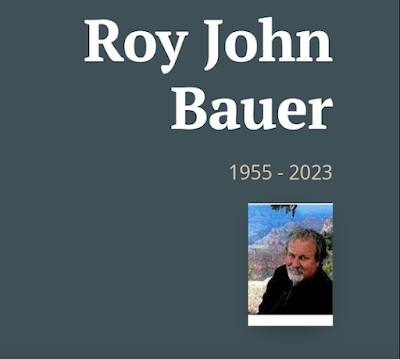
Roy's obituary in LA Times and Register: "we were lucky to have you while we did"

  This ran in the Sunday December 24, 2023 edition of the Los Angeles Times and the Orange County Register : July 14, 1955 - November 20, 2...