Monday, October 4, 1999

Frogue's witch hunt; Fortune thinks she smells nepotism; Johnny & Steve visit Claremont; fee hikes


[From Dissent 32, 10/4/99] 

     I arrived at Saddleback College for the “open” portion of the board meeting at about 6:00 p.m. Outside room 105, five or six grim souls sat around the solitary cheesy plastic bench, while cop Harry Parmer and some of his pals leaned against the cement wall, sporting cop-like attitudes of stoicism and resignation. Parmer also sported a wicked new beard; I told ‘im that it was obvious to all that he was trying to look just like me. Someone pulled out a gun and pointed it at me, and we all laughed. (Just kidding, Ced.) 
     As we waited for 105’s door to open, more of the usual suspects gathered, and buzzage commenced about that day’s federal court hearing on the “students’ lawsuit”—the one that challenges the Constitutionality of the district’s speech and advocacy policy, a policy intended for students but extended to faculty during the summer months by a ruthless Raghu P. Mathur, prevaricator extraordinaire. Earlier, I had been told that Raghu and his booted boot-licker, Armando, had left for court in the morning and had returned in the afternoon with poker faces and sweaty suits. Now, the word was out that the students had essentially won. To everyone’s delight, a story about the lawsuit was running on OCN, which, as usual, made district officials look like real assholes. 
     The door finally swung open at about 6:40, and, after a few minutes, the board meeting “reconvened” to open session. Marcia M led us in a pledge “to our great country.” Meanwhile, I espied Pam Zanelli standing around in the back room; she was wearing a pink outfit and big hair and chewed gum like a $5 flack. No pledge for her. 
     The Froguester’s prayer included the usual snide remarks and unpleasant allusions. (He evidently thinks the Lord is a Republican.) Everyone was aghast, regarding Frogue as they might regard a turd in a glass of milk. 
     Next, Board President “Dot” Fortune begrudgingly invited speakers to come up to the podium to make public remarks, if they must. Bob C went first. He complained of the Board’s failure to honor “process” in its pursuit of its new dream of soccer at Saddleback, a dream for which no shared governance groups at the college had even the slightest enthusiasm. (Bob reminded the board of its earlier dream of a minor-league baseball team, which proved to be a costly fiasco.) 
     Then someone named Kent spoke on behalf of the Costa Rica summer program at IVC. Remember Dot’s first time out as trustee in December of ’96? That night, she gave early indication of her loutishness, implying, groundlessly, that, in actuality, the Costa Rica program is just a “surf party.” 

Trustees’ reports: 

     The Trustees’ reports were mostly unremarkable. As usual, John Williams talked of sports, the only thing he knows. (Has anyone else noticed that his once boyish manner has been replaced by inveterate peevish disgruntlement? Also, he now looks like hell.) Our future is “bright,” he said. By the fall, he added, we’ll be off that darned fiscal watch list! Plus the accreditation thang is gonna be swell, you watch. 
     Jeepers! 
     Johnny Boy [Williams] mentioned his having attended something called “Constitution Day” at the Claremont Institute, which, I’m told, is a right wing think tank. During his report, Frogue said he showed up for that one, too, and he even asked questions. I bet the people at the Institute were impressed by these two dolts from south OC, one bouncing a soccer ball on his head, the other quoting Spotlight. 
     Frogue also reported that he had attended “Club Day” at IVC, where he brought flowers to the MECHA table. (He said they were intended for Professor Alvarez.) He had also visited the tables of the Christian Club, the Chinese Club, the Student Liberties Club, and the Hair Club for Men. He signed rosters. A couple of days later, he said, he actually showed up for the Student Liberties Club meeting. The club, he noted, flirting with incoherence, is affiliated with the American Civil Liberties Union, though its name didn’t have the word “civil” in it. No one had a clue what he was talking about. 
     Marcia M talked about her visit with the generous American Association of University Women, an organization that, despite having given many thousands of dollars in scholarships to our students, was recently attacked by Trustee Wagner, owing to its association with that Commie Rat Bastard, Jane Fonda. 
     Wagner, who, despite his right-wingedness, has been pretty darned good at meetings in recent months, reported that he had met with various governance groups, especially at IVC. He noted that enrollments are up, which is good, but that the colleges had budgeted for a far greater increase, which is bad. He noted that other colleges experienced much higher growth rates, so what are we doing wrong? Everybody stared at Raghu, whose jowls twitched involuntarily. 
      Lang spoke of the need for the district to institute various financial reforms, including an outside legal review of contracts and the like. 
     Padberg spoke of beautification. 
     Fortune, true to form, prefaced her remarks by saying, “Last but not least.” She then demonstrated that her report was not only last but least. At about that moment, the vivacious and charming Sabrina R, Director of HR, introduced herself to me as we sat in pain in the audience. When I explained who I was, she said, “Promise you won’t write about me!” She was kidding, I guess. 
     The Chancellor had nothing to say. Ditto for President Bullock. Mathur furiously patted himself on the back about something that someone else had done. For some reason, he insisted on pronouncing “Irvine” as though it were spelled “Irwine.” Nobody cared. He noted that Ray “Whitewash Willy” Chandos is once again in charge of writing the report for the Accweditation Commission. 
     Soon, Marcia objected to the minutes of a previous meeting. The minutes said that she had voted for some measure; in fact, said Marcia, she had abstained. Dot, exhibiting her usual graciousness, then suggested that, during the meeting in question, Marcia had blundered by failing to speak up. Nope, it’s not that she had failed to speak up, said Marcia. Rather, it’s that Dot had failed to ask if there were any abstentions. Dot hissed unpleasantly. Just then, a rat ran across the lens of a light fixture immediately above her head. 

Fee hike: 

     After a while, the trustees discussed the proposed 3% fee schedule hike at IVC’s Child Development Center. As Raghu’s jowls drooped, Wagner explained that this is the second 3% hike in two years. He complained that no “background information” to justify the hike had been provided. (Background information? You’ll recall that, back in June, Mathur had submitted a tentative budget for his college without mentioning its failure to include a $4,000,000 expenditure! Thanks to IVC’s senate, this “background information” came to light in August, whereupon Wagner expressed consternation at Mathur’s failure to inform the board.) Wagner noted that, during the ’98 campaign, voters had often expressed concern about the cost of child care. 
     Fortune responded by saying that the Child Development Centers of both campuses lose money, and so the hike is justified. Lang expressed concerns about access to the services of the centers. Is preference given to some parents? (Yup.) 
     Wagner suggested that perhaps now is the time for the district to step back to ask some basic questions about our purpose or purposes with these centers, which are expensive. The Chancellor, fresh from sticking a wet finger in the air, acknowledged that the centers are “historical legacies,” and that it is perhaps time to raise these fundamental questions. He simpered. 
     Williams then began to speechify idiotically. “We’re here to serve our students,” he intoned. He endorsed child care centers. He declared that the district’s centers provide plenty of “bang for the buck.” (Later, it was revealed that only about 100 children per year are “served” by IVC’s center. So much for buck bangage.) 
     Wagner, looking desperate, made a point of logic: the wonderfulness of IVC’s Child Development Center doesn’t imply that the board has been given enough information to make the decision at hand, namely, whether to approve this goddam 3% fee hike. (Wagner may be a right-wing lunatic, but he’s smart.) It was hopeless. An oblivious Padberg joined Williams in singing the praises of child care centers. Frogue joined in, warbling, irrelevantly, that he’s heard only good things about the Center. The motion passed 5-2, with Wagner muttering “morons” in his head. 
     Soon, Alan M spoke about the district’s Y2K readiness plus a minor snafu in that department. Marcia said that the head of the FAA will be in the air to usher in the new millennium—apparently a ploy to reassure the public; would Alan be on campus manning the district’s computers when the clock strikes twelve? Yuk Yuk Yuk. Yuk Yuk Yuk. 

Soccer moms: 

     Everyone expected the discussion of item 31—“Declaration of intent to develop women’s and men’s intercollegiate soccer teams at Saddleback College”—to be contentious, and so Dot declared a ten-minute break. 
     After the break, Sampson, as usual, tried to bland everyone into a stupor, for he dislikes controversy . With utter indifference to the truth, he declared that, in his opinion, there’s widespread support for soccer at Saddleback College. He denied that there has been a failure to consult with governance groups. Contrary to the language appearing before us on the agenda, he now implied that the resolution entails no decision to introduce soccer at Saddleback College. So what’s the big deal? 
     Taking no notice, the monomaniacal Williams spoke passionately in favor of soccer at Saddleback. Presenting his entry in the evening’s “blatant obfuscation” derby, he said that a vote for soccer is a vote for gender equity. Huh? 
     Frogue referred, as always, to his 33 years as an instructor. “I remember soccer when it was still a little ball,” he seemed to say. He couldn’t imagine our not supporting soccer for Saddleback. You can’t argue with logic like that, no-sir-ree. I sat in a state of stupefaction. So did Armando Ruiz, who, sporting pointy gray boots, sat next to me, but he’s always that way. 
     Marcia Milchiker said that she would not be supporting the resolution. She had heard no requests for soccer from her constituents. Besides, the district already has soccer at IVC, and, even there, there isn’t enough interest to sustain a full team, she said. She worried that, by chasing after soccer balls, the district might be spreading its dollars too thin. 
     Next, the redoubtable Anne Cox, president of Saddleback’s Academic Senate, stepped up to the podium, an outrage that inspired an outpouring of Dottular peevitude. According to Dorothy, Cox should have made her intention to speak known at the start of the discussion. Anne had. (During the break, I believe.) But that didn’t matter to Dot, who grunts and thunders and pounds her fists just to keep in practice. 
     Anne noted that the soccer resolution had nothing to do with “gender equity.” The issue here, she said, is the curriculum process. Where there’s a new program, there’s need for curriculum, and in this district, there exists a long-established curriculum process, approved by the board, in which faculty take the lead. The board’s soccer initiative “stands the curriculum procedure on its head,” said Anne. 
     Trustee Padberg seemed to take these remarks—and Bob C’s earlier remarks—to heart. She suggested changing the language of the resolution to make clear that the board isn’t bypassing the shared governance process. El Ced then insisted, inexplicably, that passage of the resolution would not bypass that process. 
     Saddleback’s President Bullock noted that, in some areas of athletics, her college is underfunded. She asked: Shouldn’t we cover those holes before initiating a new program? She seemed to disagree with the Chancellor’s peculiar interpretation of the resolution, which she read as a plan to pursue soccer at Saddleback. 
     Padberg reiterated her “shared governance” worries, whereupon Fortune grunted a stupid remark. Then Williams again began to speechify. He said he had pledged to streamline bureaucracy. Besides, the senate represents a handful of faculty while he, an elected official, represents tens of thousands of goddam voters. So let’s “move this item along.” 
     At about that point, Anne Cox offered a remarkable display of gumption, a trait that is rare among south campus personnel. Without the blessing of the Dotted One, who runs meetings with an iron fist and an empty head, Anne now spoke, saying that the faculty were only asking that the board follow their own policy. Dot, who could not believe her eyes and ears, shouted into her mike, “You’re out of order! You’re out of order!” But Anne calmly continued, saying, “It’s your policy.” 
     The effrontery! 
     Soon, the Froguester, who had been daydreaming whilst twiddling his thumbs, harrumphed himself into consciousness and then expressed concern about the emphasis on the part of “certain groups” on “process over product.” Inexplicably, he cited the case of wait lists. “I have looked in vain,” he said, “for governance groups to say, ‘we’ve got to do something about these wait lists!’” Finally, he added, the board was forced to take the initiative on wait lists. 
     Wait lists! Wait lists! Wait lists! 
     Someone got the discussion back on track. In the end, Padberg’s amended resolution, which added the phrase “through appropriate processes,” was approved. Fortune declared that the discussion demonstrated the board’s magnanimity and openness. Sensing a need to undercut herself, she then bellowed that the board is “within its rights” in initiating and pressing this soccer business. 

Trouble understanding “nepotism”: 

     Eventually, the board moved on to “Academic Personnel Actions.” Padberg noticed that, somewhere, a husband was about to be hired where his spouse was already working. Good Lord! Fortune suggested that, as things stand, all sorts of unseemly things occur when part-timers are hired. She implied, falsely, that cronyism and nepotism were the rule and that the hiring of adjunct faculty follows no process. She declared that open positions ought to be “properly advertised.” (They are.) 
     Williams opined that the hire of this person should not be held up just because the board hasn’t adopted an adequate nepotism policy. Fortune then painted a portrait of part-time hiring in the district according to which “only relatives” know that positions are open, and so they snap them up. Sampson noted that the two employees in questions are part-timers, and that nepotism, as he understands it, concerns abuses of power by one employee in favor of another. No such power relationship is involved here, he said. Fortune, ignoring such twaddle, again bellowed that current practice is “improper.” Wagner suggested that it is unfair to discuss these two people as though they’ve done something wrong. We have no reason at all to think that. 
      As this went on, new Director of HR, Sabrina R, had been standing at the podium to answer questions. She had had her hand raised for some time, hoping to shed light on this matter. Noticing this, El Ced alerted Dot to Sabrina’s raised hand, but Dot wasn’t interested in hearing from someone who might actually know what she’s talking about. El Ced then looked straight at Sabrina; he shrugged and then winked, as if to say, “What can I do? The woman’s an idiot.”

Failed witch-huntery:

     Item 35 concerned reports that had been requested by board members back in July. Vice Chancellor Hodge presented them, one at a time. You’ll recall that Frogue had asked whether faculty are doing their committee work as their contract requires. Hodge now reported that every faculty member is assigned a committee. Indeed, she said, the data suggest that faculty are exceeding their committee obligations. 
     Frogue, who had hoped to uncover massive misconduct, was clearly disappointed. He asked: Are faculty actually showing up to these committee meetings? Is there access to chairships by faculty who are not part of the elite group? And what about these stipends for chairs! If faculty are required to serve on committees, then, in providing stipends, aren’t we “double tipping”? Frogue concluded these stupid and offensive remarks by saying that he needed “more information.” 
     Padberg, who seems to share Frogue’s weakness for conspiracy theories, concurred. At one point, Frogue’s purpose in asking for this kind of information was questioned. Someone said that some committees meet just once a semester—what about that? Fortune said she had heard “a lot of complaints” about the way in which committee assignments are made. There are certain people who always seem to be on interesting and powerful committees, she said. She implied that the senates should not have the only say in committee assignments. At that moment, she reached up through the lens of the light fixture above her head, pulled out a rat, and bit off its head. This seemed to calm her. 
     Sampson noted that faculty don’t “punch a clock.” Further, if you wish to track the activities of individual faculty, you need to leave that to deans. 
     Frogue said that in his seven years on the committee, no such request for information has ever been made, and so it isn’t asking too much to for staff to provide the information now. He said that the “same six people” are on every major committee and that they dominate everything. Everyone talks about shared governance, he said, but these people don’t want to share it at all. 
     Hodge repeated that the faculty in fact exceed the committee requirement. She noted that no effort by the district is made to “take roll” regarding committee meeting attendance. She acknowledged that the Academic Senates have a key role in determining committee assignments and the like, but, she added, recommendations can come, and often do come, from other sources. 
     The next report concerned “demand-driven class offerings.” The trustees seemed to like that one. Frogue said that he’s glad he finally got the report that the board had been asking for for years. He said he was “puzzled” that it had taken so long to get it. Mathur, with jowls aflappin’, chimed in to sing his own praises. 
     Dot Fortune asked about wait lists. Are there wait lists for all classes? Are these lists archived? Have we been using all this fancy new equipment we keep buying to keep track of this stuff? 
     Another report concerned “employment of relatives” and the district’s nepotism policy. That’s Padberg’s baby. She was disappointed to learn that the data in the report involved only full-time faculty. Sampson explained that the district might not be able to get the information that Padberg wanted concerning part-timers, since the forms filled out by prospective part-timers don’t ask about relatives and such. Until recently, even the forms filled out be full-timers haven’t asked about that. Padberg insisted that the requested information be provided. 
     Frogue made one of his “general comments.” Nepotism lowers morale, he said. So do witch hunts, Steve. 

Clown: 

     Eventually, the board turned to the customary “special reports.” Saddleback’s Christian Berrera spoke of recycling bins. Anne Cox gave a report on behalf of Saddleback’s Academic Senate. She objected to the way “Partnership For Excellence” funds are spent, for faculty have no say. 
     Sharon M, a candy-colored clown, got up to speak of recent favorable press for the district. (Huh?) Apparently on the verge of tears, she said that the majority of faculty are pleased to provide good instruction, or some such blather. She forgot to mention that she and her friends, including Frogue, Williams, Fortune, and Mathur, have nearly destroyed our once-great district. 
     Pleased with herself, Sharon sat down. And that was about it. —CW

Wednesday, September 29, 1999

RAGHU’S DEPO: he keeps secret files on faculty


By Chunk Wheeler [D31 9/29/99] 

     Yesterday, in Los Angeles, IVC President Raghu P. Mathur was deposed by attorney Carol Sobel in connection with IVC philosophy professor Roy Bauer’s First Amendment lawsuit against Chancellor Cedric Sampson, who, in December, without warning, and in violation of the faculty contract and board regulations requiring fairness and due process, placed a reprimand in Bauer’s personnel file accusing him, preposterously, of violations of district “discrimination” and “workplace violence” regulations and, even more preposterously, ordered him to seek counseling. (At that point, Bauer had been a petitioner in two successful “Brown Act” lawsuits against the Board and had been the editor of two “underground” newsletters that routinely criticized the Board Majority, IVC President Raghu P. Mathur, and the corrupt Old Guard union group that put them all in power.) 
     Soon thereafter, U.S. Judge Nora Manella characterized the “counseling” order as “Orwellian” and, in a preliminary injunction, judged the six elements of Bauer’s newsletters cited by the Chancellor to be constitutionally protected free speech. 
    On Monday, Judge Feess of the Federal Court is scheduled to consider a “summary judgment,” which, if granted, would obviate a trial. Mathur has publicly criticized Bauer, among other IVC faculty, even suggesting that Bauer and other members of a supposed nefarious “core group” have sent him “mail threats” and threatening voicemail messages. Mathur has never offered any evidence that he has received these threats. 
    During his deposition last summer, Chancellor Sampson acknowledged that he had failed ever to ask for such evidence when Mathur reported the threats to him, thereby revealing a disturbing degree of stupidity and incompetence. During yesterday’s deposition, Mathur, who often seemed to have trouble understanding Sobel’s questions, referred to as many as seven or eight “threats” against him. When asked whether he kept any of the alleged threatening letters, email messages, and voicemail messages, he indicated that he had not. Further, when questioned regarding the timing of the threats, he began to speak of events occurring as long ago as 1990, many years before his tumultuous and disastrous tenure as IVC president, which began with an illegal board action in 1997. When asked to describe the content of one email message, Mathur explained that it was so disgusting that he could not repeat it. When pressed, he said he could not remember its content, for he is unaccustomed to the language it used. At one point, he described a threatening voicemail message in which the voice was “altered.” When pressed for details, he indicated that it was a “medium” voice. 
     Bauer’s ‘Vine/Dissent has reported various Nixonian episodes, including one in which Mathur offered then-President Dan Larios a list of troublesome faculty—an enemies list. During the deposition, Mathur protested that Bauer got this episode wrong. He seemed to suggest that the Chancellor (Lombardi?) instructed Mathur to prepare such a list and provide it to Larios. (I know. Go ask Lombardi!) 
     During the summer of 1998, Mathur had tried to pursue an alleged student complaint against Bauer, who has no history of student complaints. (Evidently, Mathur was inspired to launch this investigation, not by an actual student complaint, but, rather, by a rumor of a complaint that had been passed on to him by an instructor during a one-minute conversation.) In the course of questioning regarding that episode, Mathur acknowledged that he keeps what amounts to personnel files in his office, files evidently distinct from the official personnel files kept at the district, which are available to faculty for inspection upon request and which are subject to district regulations and contract language. Sobel was surprised to learn that a “report” on Bauer is being kept in Mathur’s office. When asked whether he has ever shown the report to Bauer, Mathur answered, “No.”

Monday, September 20, 1999

He’s Baaaack...!; Being “controversial” and just being Steve--by Red Emma

[From Dissent 30, 9/20/99]

Steven Frogue would—if he imagined it might make him a player, part of a community, a person of some social stature—eat a bug, much as attention-craving playmates of mine did on a dare in grade school days. Oh, the respect and esteem those little boys secured upon downing that little critter. Unfortunately for the rest of us, Frogue has done more than swallow insects. He has voted to attack student liberties, shared governance and, well, you know the rest.

Yet these accomplishments are not his real area of, if you will, expertise. These are small projects easily enough realized by his less complicated colleagues on the board. Where Steven J. Frogue really shines is in the realm of controversy or again, what passes for controversy in our sensation-driven postpolitical environment. He likes to play with Nazis, pretend to be an intellectual bad boy, defend populist-seeming causes, and generally do what will draw attention to, who else?—himself.

Frogue did this most recently last week, attending Club Day at IVC, an event held, ironically, in an on-campus location it had taken a judge to protect (with an injunction) from the board majority to which Frogue belongs.

The former Board president arrived early afternoon with flowers for the MEChA co-advisor, an outspoken Frogue opponent whose editorials in the LA Times have assailed his policies. After spookily asking after her, he sidled over to the Student Liberties Club table and inquired about the next meeting. Why the sudden interest in student organizing? Why the creepy interest in one specific female Mexican-American professor? Why focus on these two student organizations?

First, because he (correctly) surmises that these groups oppose him, and second, because that’s where the action is. That’s where the excitement of civic participation, political engagement, and, yes, controversy occurs just now (not that Frogue could articulate the real issues informing those controversies: shared governance, academic integrity, racism, anti-Semitism...).

“Controversial,” I should note, has become the singular defining watchword of IVC administration. Stacy Pniewski, Director of Student Affairs, unable or unwilling herself to make a decision on official approval of a recently submitted Student Liberties Club informational flier, passed this grave stamping decision to Vice President of Student Services Armando Ruiz, who, based solely on his judgement of its content, refused approval. The reason for Pniewski’s timorous, confused reneging of responsibility to her erstwhile boss? As explained to SLC President Deb Burbridge, the flier was “controversial.”

Harassment

At Club Day, Pniewski approached Red Emma, who was gregariously handing out copies of the recent LA Times article (unstamped, unapproved and, I guess, “controversial”) on the current student lawsuit and his latest political screed (also controversial), suggesting that Red’s actions were prohibited because they might be interpreted as “harassment” of innocent passersby.

Red Emma quickly identified himself as an instructor, presented his hand in introduction, and unshyly offered Ms. P. that walking up to people on a college campus, or anywhere in the U.S. of A, and offering them a flier was a Constitutionally protected political act and that he would not be retreating to the confines of his cozy table anytime soon. At this, Ms. P. turned ashen, scurrying away to huddle with Armando, the two of them standing there seeming to admire his shiny dead reptile boots.

All of the above schweinerei is behavior caused, of course, directly and indirectly, by Mr. Frogue and his relation to controversy; directly because he voted to support Draconian restrictions on expression and indirectly because the SOCCCD board maintains that it is passing these laws to protect itself from—vocabulary quiz here—controversial actions. One notes that these have, thus far, been limited to actions of Holocaust deniers, race-haters, and homophobes, i.e., that group I call Friends of the Board.

If, by the way, you look up the word “controversy,” you’ll be reminded that it means: “a dispute, especially a public one, between sides holding opposing views.”

If you look up the word “irony” in the dictionary it now reads: “See SOCCCD.”

Love/hate relationship

The day after Club Day, Frogue did indeed attend the SLC meeting and Ice Cream Social, introducing himself proudly as a “long-time civil libertarian,” offering a few lame jokes, awkward chuckles, and eating plenty of free ice cream. Imagine this: a board member attends a student group meeting formed, in large part, because of his tenure as the Constitution-loving/hating leader of the board majority which appointed President Mathur, wrote a speech policy, and attacked one of its advisors for publishing an underground newsletter that combines I.F. Stone’ s Weekly and Mad magazine.

It wasn’t until the end of the SLC meeting that Frogue made his characteristic and awkwardly corny play for controversy. —Not for content. --Not for political meaning. For spectacle. For Steve. “Wouldn’t it be neat,” offered Frogue, “to have an SLC fundraiser where, like Timothy Leary and G. Gordon Liddy, Roy Bauer and I had a debate?”

This ironic and unhelpful proposal was met with silence by students, but received reasoned and calm explanation from Roy, who reminded Frogue patiently of UCI Professor Jon Wiener’s excellent IVC talk on the difference between protected free political speech and speech offered in academic settings, a talk which Frogue heard. The Froguester didn’t get it—or didn’t want to. He was there to play, after all. He was there to turn the meeting into a Steven Frogue Club Meeting. And his attempt almost worked, except that we adjourned and Frogue was left to try to insinuate himself into individual conversations amid the melting ice cream.

Asshole

Later, co-advisor Wendy P. pithily explained Frogue to me. After all the confusion about this man’s “politics” (he has none), his pathetic ambitions, his strangely warped understanding of political expression, Wendy’s characterization seems apt: “He’s the kind of person,” she says, “who would let you call him an ‘asshole’ for an hour just so you’d hang out with him.”

Bug Swallowing

And, yes, Frogue’s been out of the news for awhile. No seminars. No high school detention duty. No recall. No goofy theories, not lately anyway. So? Craving attention, he uses his official position as an elected official to (1) re-enter the “controversy” and (2) intimidate students. By intimidate I do not mean that Frogue was trying to hurt or threaten students. I mean, rather, that he was flexing his power, being creepy, abusing his position as an elected official; spraying on us, as it were, like the neighborhood tomcat. I can do this, Frogue seems to say. I am in charge. I am important. You will pay attention to me, whether I am talking Kennedy-killing Jews or swallowing bugs.

Of course, Frogue is not, technically, even permitted to attend club meetings, not according to official IVC Inter Club Council school rules. He knows that. But Frogue imagined that he’d get a rise out of SLC members, that we’d disallow his attendance or wouldn’t let him speak. He spoke. About himself. He proposed a potentially controversial event.

Frogue attempts to insinuate himself into every situation, including, now, student politics. He has, it’s important to note, yet to use his right to speak against George Kadar (producer of the enchanting film “Wetbacks”) and his “Friends of Steven Frogue,” the Institute for Historical Review, the Spotlight and its reporter Michael Collins Piper, or the board majority. Why not? Because, for Steven Frogue, even bad press is good press. There are no consequences, only more press conferences.

Yes, soon we’ll have what passes, unconvincingly, for a board election. I propose now that, in a coordinated effort of community concern, we save everybody the pain of another run by the controversial candidate. I propose we provide Frogue a way to secure the attention he so needs and deserves, an action of potential controversy and outrage so compelling and satisfying that he’ll abandon education politics and usher himself into retirement. We have an obligation to Frogue, and to ourselves. To that end, Red Emma announces a citizen-action campaign combining vector control and, well, vector control. As you walk the lovely IVC grounds, take a moment to pick up a bug. Collect a few. Place them carefully in an envelope and mail them to Steven Frogue, Trustee. —RE

Andrew Tonkovich

Monday, September 6, 1999

The "Clocktower" incident (Mathur to fire an insufficiently worshipful executive assistant?)

What follows is an excerpt from a much longer article that presented much of Chancellor Sampson’s deposition (in Roy Bauer’s successful 1st Amendment lawsuit against Sampson and the SOCCCD).


Also excerpted: Lisa Alvarez's deposition (she was asked about the incident).


HATCHET MAN: EL CED’S JULY DEPOSITION
Dissent 28 (9/6/99)

In December, without warning, Chancellor Sampson placed a letter in philosophy instructor Roy Bauer’s file that accused him of violating “workplace violence” and “discrimination” policies (six items from Bauer’s newsletters were cited) and that ordered Bauer, who had been successful in two Brown Act lawsuits against the district, to seek counseling.

In March, U.S. District Judge Nora M. Manella issued a preliminary injunction that stated: “The court finds the six statements/illustrations at issue in this case constitute protected speech and enjoins [the chancellor] from enforcing [district regulations] on the basis of [Bauer’s] past speech or any similarly protected future speech. The court also enjoins [Sampson] from ordering [Bauer] to undergo psychological counseling of any sort….”

Eventually, the suit will be settled through a summary judgment or, if necessary, a trial. The district has taken the position that Bauer is a violent bully who, owing to his activities, is responsible for much, if not all, of the rancor and chaos in the district. According to Bauer, however, the rancor and chaos exists independently of him; his newsletters (which are the work of several people) simply report what officials would rather keep hidden.

What follows are excerpts from Sampson’s recent deposition in connection with this suit. Attorney Carol Sobel asked the questions; David Larsen (of the fancy-pants lawfirm of Rutan and Tucker) appeared on Sampson’s behalf.

Chancellor Sampson
THE CLOCKTOWER INCIDENT
(a peaceful event in which Bauer was only an observer--and yet, somehow, it’s cited as an example of Bauer’s “threatening” behavior):

[12/12/2009: As I recall, President Mathur disliked his secretary, the much loved and respected Bobbie W. Evidently, she was not sufficiently worshipful of Mr. Goo. Word spread that she was about to be demoted or even fired. And so a kind of demonstration (i.e., people were standing around grumbling) spontaneously erupted near the old IVC Clocktower, which was only twenty yards or so from the President’s large window. Someone learned that, just then, Chancellor Sampson was meeting with Mathur. As I recall, one “demonstrator” went into the administration building and, somehow, the Chancellor became aware that people were outside unhappy about Mathur’s imminent action. In fact, I (RB) was present, but I did not organize the “demonstration,” nor did I do anything but stand back and watch. The bearded fellow mentioned by Sampson was in truth former Art History instructor Jim Dobbs, not Bauer.] The “Clocktower” incident was cited by the district to illustrate Bauer’s alleged menacing ways.

…Who were the employees you recall complained to you that they felt threatened by Mr. Bauer’s publications prior to the time you wrote the letter of December 2nd, 1998?

President Mathur, acting dean Woodward, GR, members of the board.

Which members of the board?

Dorothy Fortune, Mr. Williams, Mr. Frogue, who were all concerned about security in the boardroom, discussed with me the need for increased security. [Note: in recent months, Trustee Frogue has on at least two occasions invited Bauer to his home for dinner.]

Anybody else; do you recall?

No.

Okay. When was the first thing you recall Raghu Mathur saying to you about the articles?

He was concerned about his own personal safety in his office….

Did-—go ahead.

I’m sorry. I recall being in his office one day when Mr. Bauer and a group of faculty members stood outside his window, you know, and in a threatening manner attempted to get my attention—his attention.

…[W]hen was this that Mr. Bauer and…a group of faculty stood outside Mathur’s window?
…..
It would have been October, November, I think.

And who else was in the group?

Mr. Bauer and approximately 15, 20 other faculty and staff members. Many of them I don’t know.

Who did you know?

I had met the English teacher. I have forgotten his name.
…..
And who else did you recognize?

I didn’t recognize—I don’t know many of the faculty members or the staff members that I was seeing.

When you saw this group, where were you standing?

I had gone to Mr. Mathur’s office for an appointment on another matter.

Did you look out the window?

Yes.

And how did the group first come to your attention?

They all came—Mr. Mathur’s office has a full length window. The blinds were open, and the group gathered outside of his office. And I have forgotten—the issue related to rumors that had spread on the campus that he was going to transfer his executive assistant. And there were people, you know, highly agitated. One of them was actually coming up to the window. I don’t know who it was.

Can you describe the person?

Age 55, male, beared or gray hair. I forget who it was. He was actually very aggressive in coming up to the window and looking in and, you know, the group was attempting to make a point.

Well, when this group appeared outside of President Mathur’s window, did you say anything to President Mathur about it?

Yes. I asked him what is going on.

And what did he say?

He said there was a rumor going around that he was going to transfer [his executive assistant], and we discussed it.

Did he tell you who was in the group outside his window?

I didn’t ask. I went out myself. They obviously wanted our attention, and so I went out and talked to them.
…..
Did Mathur go out with you?

No, he did not.

And when you went outside, who did you—did you talk to anyone specific in the group?

I talked to the English chair.

He was L [probably Lewis Long]?

L. Yes. And I had met L because he had been nominated as an outstanding teacher, so I know him from a ceremony that we had been to. And, you know, I addressed the issue of are you going to transfer [the executive assistant], and I think I responded to that, “No, that wasn’t going to happen.” And his comments related to wait lists and how stupid it was for the board to be concerned about wait lists and how bad wait lists were and that sort of thing. We had an exchange about that.
…..
Other than the individual who you described—male, 55, gray-haired, beard…

I don’t remember that beard part exactly. I forget who it was.

—But coming up to the window, putting his face close to the window…

Yes.

What other action in this group were threatening in your perception?

Well, it was intended as a demonstration of concern, and there were a number of people visibly agitated and upset.

You used the word “threatening” before, and are you equating a demonstration of concern with the term threatening?

No.

So…specifically what conduct, what expression did you observe that you believed was threatening, other than what you have described about the person coming up to the window?

Nothing other than that.

And there was nothing you observed Professor Bauer do that was threatening; is that correct?

No.

Okay.

[Evidently, our little demonstration worked, for Bobbie was not demoted or transferred. Not long after, she retired.]
From Lisa’s Deposition

From Dissent 35, 11/1/99

On Tuesday, October 5, 1999, IVC English professor Lisa Alvarez was deposed in regard to Roy Bauer’s First Amendment lawsuit. She was represented by attorney Bob Myers, formerly City Attorney of Santa Monica. Also present were Bauer’s attorney, Carol Sobel, and the Chancellor’s attorney, David Larsen.

Essentially, Bauer’s lawsuit was a response to an action perceived by him as a first step toward termination. The district (Chancellor Sampson, the Board Majority, Raghu Mathur) was sick and tired of Bauer’s newsletter, which was highly critical of those in power and the ruthless unionists who put them there. And so Sampson and the board went after him. Bauer and his contributors’ satirical writings suddenly were labeled “violent” and “racist.” Bauer was told to cease his violence and discrimination and to seek anger management counseling.

Bauer refused to go to counseling or to change his publication. Instead, he and attorney Carol Sobel went to federal court.
…
3. The “clock tower” incident

Q Now, you say you were surprised at a characterization of a college gathering that you attended. What college gathering are you referring to?

A It was a rather spontaneous gathering of faculty and staff in the A quad by the clock tower, and I’m trying to remember the date, but I cannot. My sense is it might have been last spring, but I’m not sure.

Q Outside the president’s door/window?

A Yes.

Q A spontaneous gathering—How many faculty gathered?

A I believe the student newspaper indicated it might have been 40 faculty and staff.

Q This was spontaneous? Everybody just happened to be there at the same time?

A Perhaps “spontaneous” is imprecise…I was not on campus last year. I was on sabbatical, so I don’t know the nature of communications around this particular event. I received a phone call at home.

Q So somebody invited you to be there?

A Yes. [They] suggested that something was happening.

Q Okay. Who made the phone call?

MR. MYERS: I object to that question. If you want to ask about comments [people made] about the deposition, that’s fine. Now, you’re inquiring into a political event on campus—who organized it, who was involved with it. And as a state institution, I don’t believe that your client can inquire into these political matters. This is getting pretty far afield.

MS. SOBEL: I’m going to interpose an objection, too, on behalf of a third party who is not present, but because the First Amendment permits third-party protections to be raised by someone who is present in a proceeding such as this, I’m going to interpose a “First Amendment right of association” objection for whoever it was who telephoned Professor Alvarez.

MR. LARSEN: Was it Roy Bauer?

MR. MYERS: Objection to the question.

MR. LARSEN: Are you going to instruct her not to answer?

MR. MYERS: Yes. If you want to sit here and violate the constitutional rights of my client, we will object and instruct her not to answer.

MR. LARSEN: You and I obviously have disagreement—

MR. MYERS: Let the judge decide.

MR. LARSEN: Okay.
…..
Q What surprised you about the chancellor’s characterization of this gathering when you read his testimony?

A His rather casual dismissal of the concerns of a large [group] of my colleagues.

Q So you…disagreed with how he viewed the gathering?

A. …[His] attitude…became obvious.

Q Now, you said that you were surprised by the characterization of a colleague as “menacing”?

A Yes.

Q And what colleague were you referring to?

A In the deposition, the chancellor mentioned a bearded man in his fifties, I believe.

Q Okay. Who did you understand him to be referring to?
…..
A At first, I assumed it was biology teacher and later I revised my…assumption to…the art history professor.

Q Was Mr. Bauer involved in this gathering?

A Mr. Bauer was in attendance at the gathering.

Q And did Mr. Bauer say anything or do anything that you noticed?
…..
MR. MYERS: What is the relevance of inquiring into people’s political activities at a political event?

Q This was a public gathering, correct?

A It…was a public gathering, political in nature.

Q …Your understanding was the purpose of the gathering was to communicate something to the chancellor?

A Not necessarily to the chancellor, no. I believe the chancellor happened to be in the college president’s office at the time. It is my recollection that people were surprised to have discovered that Dr. Sampson was in the college president’s office at the time we gathered at the clock tower.

MS. SOBEL: Counsel, I’m going to object to inquiry about my client’s [i.e., Roy Bauer’s] political activities. I don’t believe this gathering is in any way the basis of any of the charges the district made against Professor Bauer regarding discrimination, harassment, or violent overtones in his writings.
…..
Q Did Professor Bauer say anything at this gathering?

MR. MYERS: Objection on the basis that you’re inquiring into areas that are clearly outside the scope of the litigation and designed to inquire into the political activities of a professor at Irvine Valley College. And it’s inappropriate and I instruct the witness not to answer.
…..
MS. SOBEL: …the chancellor did not observe anything done by Roy Bauer at that event…the district has absolutely no contentions that…anything Professor Bauer did at that incident was in any way part of the charges against him.

MR. LARSEN [to Lisa]: Well, are you going to refuse to answer the question?

MR. MYERS: If you would like to ask a question that’s related to her observations of any conduct that might be within the scope of your lawsuit, I’m certainly going to allow her to respond to that question. But these open-ended questions that inquire into political beliefs don’t seem to be narrowly tailored to getting at the information that you need. Since the First Amendment is at stake, it seems to me that you have some duty to narrowly tailor your inquiries to get at the information you need without trampling [on] Professor Alvarez’s First Amendment rights.
…..
Q What do you recall Professor Bauer doing at this gathering?

A Standing around.

Q Was he in any way close to the window?

A Not to my recollection, no.

Q Do you recall anything that he said at this gathering?

A I believe I noticed he said nothing.

MR. LARSEN: That wasn’t so bad, was it?

MS. SOBEL: But it took you a long time to get to a direct question.

MR. MYERS: [To Larsen:] If you ask the narrow questions, we’ll try to accommodate you.
…..

[I’ve included section 4—just for fun. The district was attempting to blame me for all of our accreditation woes.]

4. The Accrediting Team’s report:

Q Have you ever read the evaluation report [of the accrediting team or commission]?

A I’ve read sections of the evaluation report…I recall reading the cover letter….
…..
Q Did you agree with it?

MR. MYERS: Hold on a second. What is the relevance of whether or not a faculty member agrees with the evaluation report of an outside entity to this litigation?

MR. LARSEN: Well, Counsel, it’s an exhibit in these proceedings. She’s a witness—potential witness—in these proceedings. I’m entitled to know if she’s read [the Accrediting report]. Are you going to instruct her not to answer?

MR. MYERS: You need to do a little better than that, Mr. Larsen…Professor Alvarez is not a party to this litigation. The college, I don’t believe, has a right to use this deposition as an opportunity to find out what faculty members believe about the organization that they work for. So can you do a little better in explaining what the purpose of this inquiry is?…We’re trying to be fair and reasonable here. This is a professor of a college institution. You are representing her employer. You cannot use a deposition as a fishing expedition into Ms. Alvarez’s beliefs about matters unrelated to the litigation….
…..
MR. LARSEN: [I want to ask Ms. Alvarez about] the summary of the evaluation report, which happens to consist of three and a half pages, which she testified she read. My question is, was there anything in the summary that she disagreed with?

MR. MYERS: The college has no right to know about her beliefs concerning the summary report.

MR. LARSEN: Are you going to instruct her not to answer, Counsel?

MR. MYERS: Yes, I am.

Q [To Lisa:] Are you going to take the advice of your counsel?

A Yes, I am.

Q Going to page 4 of the document, [it says] “Though the team was aware of the trouble[d] times.” Did you agree [with the Accreditation team] that there are divisions between factions of the faculty?

MR. MYERS: Objection…Until you provide a reasonable explanation as to why you want to subject a member of the college faculty to a general inquiry about her political beliefs and other opinions, …I will object.

MR. LARSEN: Well, this has nothing to do with political beliefs. It has to do with the comment and impact of the comment on the college, and if you’re going to instruct her not to answer—

MR. MYERS: Why don’t you take the deposition of the evaluation team if you’re interested about their opinions? [Lisa’s] opinions are irrelevant to this litigation. You couldn’t ask this in court. She’s not an expert witness. Ms. Sobel couldn’t ask her questions about this evaluation report. Nor can you, and particularly you can’t because [you represent] her employer. And to have her sit here and respond to these questions seems to be completely unreasonable and in violation of her constitutional rights.

So why don’t you move forward in the areas that might be relevant?

MR. LARSEN: I’ll ask more questions and we’ll let the judge decide [whether my questions are relevant].

MR. MYERS: Fine.

Q The last paragraph talks about divisions paralyzing governance, shattering collegiality, and adversely affecting students. Both current and future. Do you agree with that?

MR. MYERS: Once again, I object to the question.

MR. LARSEN: Are you going to instruct her not to answer?

MR. MYERS: She’s not going to be answering these questions.
…..
Q Are you aware of any hate mail on the campus?

A Yes. I received one.

Q What’s your definition of “hate mail”?

A I actually don’t have a definition that I carry around with me.
…..
Q I’m going to direct your attention to page 25 of Exhibit 5. Under “Recommendations,” item number 3, it says, “The team feels strongly that all players need to cease their negativism and focus on constructive steps toward building a future.” Do you see that?

A Uh-huh.

Q Do you agree with that?

MR. MYERS: Why is it relevant whether she agrees with it or not? Why do you need to know what her beliefs are concerning this report?

MS. SOBEL: I would object to its inquiring into political beliefs about the negativism of Mathur…, Sampson, and other public officials in the district.

MR. LARSEN: Well, Miss Alvarez, is there negativism at Irvine [Valley] College?

MR. MYERS: Once again, why is her opinion relevant to this litigation? And you have to have a compelling showing of relevance to overcome her First Amendment interests that are at stake.

I just don’t understand why you think you can have a deposition and call in a faculty member and start asking a faculty member about [her] opinions.

If you want to ask about observations, statements made by Mr. Bauer, things that might be relevant to this litigation, please do so. But to use this as part of the college’s strategy to harass faculty members seems to me to be inappropriate.
…..
MS. SOBEL: We would disagree strongly that what you’ve asked are questions about what is at issue in these proceedings.

What is at issue in these proceedings is a letter issued by the district in December delineating six writings and graphics in [Bauer’s] newsletter that the district contended evinced discrimination and harassment by Professor Bauer as well as a violation of the district’s policy on workplace violence.

And what is at issue is whether the district then lawfully sought to discipline Professor Bauer and direct him to psychological counseling…That’s the scope of this lawsuit, whether they had a basis for doing that. Not whether any individual faculty member believes that there is negativism on the campus…It is not a field day for you to inquire about everyone Professor Bauer interacts with and what their views are of what’s going on [at] the campus based on your client’s narrow reading[]—the contention you’ve made to the court, which the courts have squarely objected [to], that Professor Bauer is single-handedly responsible for every problem identified in the accreditation review—which would, as I indicated earlier, include the financial irregularities of district officials, the factionalism of the board of trustees, the problems of the union at both campuses.

…Professor Bauer would probably love to believe that his newsletter is so extraordinarily forceful, but since many of the issues raised in the accreditation review predates his newsletter by five to six years, it is highly unlikely he has any relevance [to these issues], and many of them have not been covered in his newsletter…If you’re going to get to the newsletters, that’s fine. That’s what we’ve said all along. But you’re not asking about that, Counsel.
…..

Monday, August 30, 1999

A typical episode: the SOCCCD in 1999—discussing the budget, pointing fingers


From ‘Vine 17, September 9, 1999

Title: 

VIGOROUS FINGER POINTAGE: MATHURIAN SHENANIGANS AT THE 8/30[/99] BOARD MEETING

1ST, VICE CHANCELLOR [Gary] POERTNER EXPRESSES DISCONTENT; HAS AN IDEA:

Wagner and Poertner, more than a decade later
[Vice Chancellor Gary] POERTNER: [We had some] conversations at various board meetings asking questions about, well, “How does the ending balance look?” We had budgeted 3.8 million. Are we going to have 3.8 million? The answer is, we have 6.3 million. So I...want to make a couple of statements about that.
            Number 1: what were the kinds of things that occurred during the year that resulted in this ending balance being larger?…There’s been some initial enrollments above what was projected in the original budget a year ago. And that brought in an additional $559,000. Lottery brought in an additional $171,000. Partnership for Excellence brought in another $104,000. Interest was $275,000 more. A part of the Orange County bankruptcy payment that went into our general fund—some of the money, by the way, went to other funds…so the general fund got an additional $315,000…[Inaudible] enrollment fees and a prior year adjustment of $1,086,000. The total of all those…is two million and seven, which, added to the 3.8, which is roughly the 6.5 million that we have in the unrestricted ending balance.
Now the point that I want to make about this is that—I’m new to your district and reporting like this is not the kind [of reporting] that I’m normally used to—waiting till the end of the year and then popping this kind of information out at a board meeting…
What I had in mind is that, every month, when one of these kinds of piece of information come along and we’re alerted to them, then we’d like to come to the board with a statement and (revise) the budget for whatever it is that occurs in that month. It may be positive and it may be negative. And it’ll be confusing to you because sometimes it’s up and sometimes it’s down…but at least what you’d have is the best information that the people in the district administration know about what’s being changed…So if we change the reporting to you and change the budget every month you’ll know at all times what the projected ending balance is and you won’t have a surprise like we were looking at this year.

[Trustee Dave] LANG: …I for one would welcome that kind of ongoing reporting and changing of the budget to update us on what’s happening…
…..
[Trustee Dorothy] FORTUNE: …We now need to recess for a public hearing on the proposed 1999-2000 final budget…Comments? [Peter M. raises his hand.]…We have a representative of a shared governance group. Mr. Morrison [IVC academic senate president], would you please go to the podium?…

P[eter]. MORRISON NOTES $4 MILLION UNDERREPORTING AND A FAILURE TO CONSULT:

P. Morrison at his retirement party,
several years ago
MORRISON: First, we were, to say the least, quite surprised to be notified of an increase in the income balance which you just heard about from an estimated 3.8 million dollars—that was reported to us last on July 19th—to the estimated 6.4 million dollars reported this evening, and actually we would have not known about that other than a chance phone call I happened to make—not to district offices, by the way.
            Although this is obviously extremely welcome news to this district and to the college, we must ask that the trustees duly appreciate the havoc this causes for any efforts at rational budget planning and timely development of the budget. It’s a very serious matter. We do understand and appreciate very much that Vice Chancellor Poertner agrees with this and, as he indicated to you, [he] is hoping to bring forth to you some recommendations for how this might be better addressed in the future, and we are very very supportive…The import of this can hardly be overstated….
Secondly, we are not only surprised but we are frankly dismayed at the process by which recommendations for the college FINAL BUDGET have been brought to you this evening—[namely,] without benefit of any consultation by any members of the faculty or the administration (inaudible) excepting, so far as we can determine, the vice presidents. Despite repeated efforts this summer on our part to secure copies of the college budget during the process of budget development—from the time you adopted a tentative budget until this evening—we have yet to receive a copy of the college budget, and we have been unsuccessful in getting any information to this effect.
We particularly want to call your attention to changes in the college budget…and among them I call your attention to a change in excess of 4 million dollars in the projected cost of academic salaries and benefits from the time you adopted a tentative budget for IVC to the final budget presented to you tonight, which occurred, not as a result of matters you might reasonably anticipate, but because the tentative budget you adopted in June excluded the salaries of hourly faculty [part timers] at the college. That’s like balancing the household budget and forgetting to include the mortgage.
            We appreciate and we are relieved that the unexpected windfall that we are suddenly facing has brought about an increase in the (inaudible) fund balance. In our particular case [at IVC]…this means we’re dealing with, suddenly, over night, an additional $870,000 that we have to (inaudible) back into the budget that we had cut out and now we have to turn around and put back in.
            Now, we do expect in this process that the [academic] senate will be involved in all phases of recommending how these monies will be restored to the budget, as we were not involved in the reduction proposed to you—and I will remind you that both Title V and the board policy delegating authority to the senates makes us [the senate] primarily responsible for the process of budget development at the colleges. We further ask the board to appreciate that, even with the increase of 1.86 million, the college will be obliged to reduce its budget in response to very large cost increases…imposed upon the college by this board.
Thank you.

FORTUNE: We are looking at item 41, the final budget. Um, President Mathur, would you like to address any of the comments that Mr. Morrison brought up?

PRESENTATION OF THE SCAPE GOAT; CONFIRMATION OF MORRISON’S CHIEF ASSERTIONS:

Mathur loved to point
a finger of blame
MATHUR: I would like to call upon the college manager to respond first—to see if she would like to respond. Beth Mueller, please?

FORTUNE: [The chancellor and various trustees speak. Chaos prevails.] Tell me, what’s the right thing to do here? [Board members fret about the legality or propriety of the proceedings.]

[IVC beancounter Beth] MUELLER: I’d like to respond to Mr. Morrison. Number 1, he is correct that it does create budget havoc when we have a pleasant surprise like this because we’ve been trying to deal with how to balance the budget with much fewer funds. It’s made it much easier at this point, knowing that we have the additional revenue.
            Second, the budget process that he was talking about—that was not complete at the time of the tentative budget. That’s correct, we did not have the, um—I think I skipped one point, but I’ll go to the part-time salaries: they were omitted. When I came to IVC, I came in the middle of May and had two weeks before the tentative budget was adopted. Many things had been put into the budget; the part-timer salaries had not. That was, I guess, done at a later date. Um, there just wasn’t enough time for somebody who was brand new, [to do it] in 2 weeks. Since then, we have recalculated; I’ve worked with the Vice President of Instruction and they’re completely funded for this year.
            As far as the budget process: I believe there were budget—I know there were budget committee meetings throughout the year by my predecessor, Judy Christensen, and when I came in, you know, I had a lot to learn and a lot to work with, plus dealing with the summer process—a lot of people gone. So I did pretty much deal with the vice president and the president in making those decisions. [I.e., no one else was consulted.]
We have our budget committee set up for the new year. It will convene in about two weeks in the middle of September. I hope to open that up to everyone, get their input from the college. I want to learn everyone’s needs and get their input so we can address those in the upcoming year. But I’ve not been there very long to absorb all of this and get the job done.

FORTUNE: OK, thank you. Any additional comments?

MATHUR POINTS A NASTY FINGER AT MORRISON/THE SENATE; OFFERS ONE OR TWO RED HERRINGS:

            MATHUR: I’d just like to add that, as you know, in the past years, we’ve had four individuals in the budget office. We started out with the budget development for 98-99—was Bob Loeffler, and he served as vice president of Business Services. Subsequent to that we had Dr. Bob Mathews, who started out as the acting VP of Business Services at IVC and then moved on to the district. At that point, we had Judith Christensen, who was the Acting (VP) of Business Services and she chaired the budget committee and was the person at the time when the budget development process started. And, subsequently, toward the end of the year came Beth Mueller that you just heard from. Judith Christensen solicited input from all the schools, from all entities of the college. All of that input was received and considered.

[NOTE: On her last day as Acting VP (4/29/99), Judy Christensen visited the IVC Academic Senate, where she acknowledged that the budget development process was going very poorly. She referred to the “vacuum” in which budget decisions seem to be made at IVC. She recommended broader input.]

 Dr. Morrison is totally wrong to suggest that the faculty input was not sought. And I want to make that very very clear. And, if anything, I’m determined to make the budget development process more open in the coming years than it has ever been. In fact, I’ve asked Dr. Morrison if he would provide to me a copy of the budget development process that’s [inaudible] been used in the past. He has (refused?) to do so. And he provided me with this document which consists of many spread sheets, but not the process. “Process” means that there will be text to it. There is no text. I’ve been misled. So we need to work in the spirit of collegiality and honesty and openness and without attacking each other, and so I’m very disappointed with his approach to all of this.
            But, again, I would just like to emphasize that we have sought faculty input and administrative input, classified staff input, through the deans, through the (inaudible), and will continue to do that and build on it to make the budget development process more participatory. To say anything to the contrary, to me, it is an irresponsible act. Thank you.
.....

LANG AND WAGNER ARE DISAPPOINTED, TROUBLED, CONCERNED ABOUT HOLES:

LANG: I guess, first off, I have to say that, obviously, I’m disappointed that the fact he feels at least that they didn’t have adequate input into the budget process this year—I think we need to make every effort to remedy the situation. And I wonder under the system you’ve described whereby you are going to report changes and perhaps revise the budget on an ongoing basis this year, if that would provide some additional time for perhaps you to get together with [the] Academic Senate, make certain that this information…we do get some feedback…and get appropriate input into the process…
I guess…we’re up against the wall….

FORTUNE: Trustee Lang, could we deal with…actually accepting or rejecting the budget?

LANG: My comments specifically relate to that—

FORTUNE: Well, you’re asking the vice chancellor to go work at IVC, and there is a president—

LANG: No, I’m expressing displeasure with the fact that this wasn’t a more participatory process—

FORTUNE: —although the president says that it was—if they wanted to participate.

LANG: I understand that…
…..
WAGNER: Where to start? I would like to also express…I am quite disappointed in some of what I’m learning tonight. It’s great to have an additional 3 1/2 million dollars, but that begs the whole process question, and I’ve gotta echo some of what Trustee Lang was saying earlier…Now I’m hearing that the tentative budget—that we were given…three months ago—for the first time we’re hearing now that the people who presented this to us, when they were giving it to us, knew that they didn’t have all the information and never told us that, and as a matter of process, I find that very troubling. You can come to me and say, “Here’s the tentative budget; there are holes in it and here are the reasons there are holes.” But I think there are serious problems when you come to me and say, “Here’s the final budget. Oh, and by the way, the reason it bears no relation to the tentative budget is because of all of these holes.” And that’s what I’m hearing, and that’s what troubles me in terms of the process…[T]here are issues that need to be addressed on an ongoing basis. I think what vice chancellor Poertner is proposing in coming with monthly [reports] may take us some steps along that way. But, in general, this board has got to be kept more informed of holes, of problems, of missing information, when the administration knows that the information is missing.

GRAPHIC: “Ratitude”

Friday, August 20, 1999

Dear Miss Fortune (graphics)

In the old days, Dissent ran a column, written by Red Emma, called "Ask Miss Fortune." It was among our more popular features. I thought I'd reissue some of it. This one (on three pages, from August 1999) features lots of graphics. (If you click on the image, it should become LARGER.) The first letter concerns Spencer Covert (yes, "Covert"), the district's "Brown Act" lawyer. The first letter below concerns Mr. Wagner's obsession with Jane Fonda. In the second letter, Red alludes to the rise of Mr. Armando Ruiz to the ranks of administration. (Raghu desperately sought faculty who would play ball with him. Armando is all that he could scrape up.) As you know, the Ruiz saga ultimately flamed out in disgruntlement and infamy (see news stories about his "double dipping"). Below, Red alludes to Dean Howie's highly peculiar action of commanding that a painting be removed from the walls of A200 owing to its alleged potential for upsetting people. Judge for yourself. Nobody was ever upset by the painting--except, of course, for Howard. (A closeup follows.)
Andrew Tonkovich

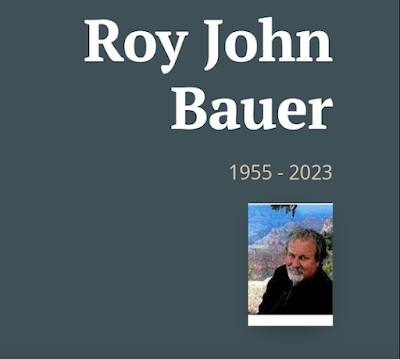
Roy's obituary in LA Times and Register: "we were lucky to have you while we did"

  This ran in the Sunday December 24, 2023 edition of the Los Angeles Times and the Orange County Register : July 14, 1955 - November 20, 2...