Tuesday, March 22, 2005

Trustee Fuentes’ Spanish Adventure —or “No one would do that!”


“Spain has abandoned our fighting men and women, withdrawing their support. I see no reason to send the students of our colleges to Spain at this moment in history.”

—Tom "Big-Foot" Fuentes
February 28, 2005:

Board Meeting: on this night, the Board is asked to approve a summer “study abroad” program in Santander, Spain. Trustee Fuentes suggests that he will vote against the item in part because Spain has “abandoned our fighting men and women” by pulling out of Iraq.

Four other trustees follow Fuentes’ lead with regard to the item, though they cite a concern for students’ safety, not Spain's politics.

Student Trustee Poulton expresses concern about a “political precedent”—that is, rejecting a program owing to the politics of the host country.

Program approval is denied on a 2-5 vote. (Milchiker and Lang cast affirmative votes, joining student trustee Poulton, whose vote is advisory.)

Fuentes’ remarks are videotaped. By the next morning, transcripts of the remarks are produced. Within a day or two, the transcripts and a DVD containing the video are provided to the Orange County Register’s Marla Jo Fisher.

A columnist for the OC Weekly also receives the transcripts.

Soon, Fuentes will find himself at the center of an embarrassing media firestorm.

March 4:

In the online edition of OC Weekly, Gustavo Arellano reminds readers of Fuentes’ controversial history as head of the local GOP. He reports that the “vindictive” Mr. Fuentes has now launched a “campaign against Spain.” According to Arellano:

Fuentes unveiled his new crusade at the Feb. 28 SOCCCD Board of Trustees meeting, when he requested a discussion on Item 10…The item would have allowed Saddleback College students to study abroad in Santander, Spain, during the summer. It wasn’t expected to generate much controversy; the SOCCCD board has allowed Saddleback students to learn Spanish in the Iberian country for the past 15 years.

But Fuentes shocked everyone in the audience when he began to assail his ancestral home. "One hundred ninety-five years ago, in 1810, my family arrived on this continent from Spain, so I have an affection for that land," Fuentes said. But he quickly dropped the amicable pretense, simultaneously attacking Saddleback College’s study abroad program as catering to "an elite" and as a death wish given the March 11, 2004, Madrid train bombings that left 193 dead.

Terror wasn’t what disturbed Fuentes the most, though. "Now: something more," he intoned sternly. "Many of our students in this college, and of its sister college Saddleback and Irvine, past and future today, fight on the battlefield of Iraq under the flag that is behind us. Spain has abandoned our fighting men and women, withdrawing their support. I see no reason to send the students of our colleges to Spain at this moment in history."


Arellano notes the strangeness of Fuentes’ reasoning:

For the 2004-2005 academic year, SOCCCD trustees have approved study abroad to Cambodia, China, New Zealand and Vietnam, all countries with administrations that oppose the U.S. Invasion of Iraq. And Fuentes & Co. also permitted district-funded student trips to Boston, New York City and Washington, D.C.; last year, each of these cities passed resolutions condemning the Iraq war (and on Sept. 11, 2001, each was as dangerous as Madrid was on March 11, 2004).

Indeed, notes Arellano, two months after the Madrid bombing, a group of Saddleback students visited Spain, and not one solitary squawk of concern was voiced by the Board, including Trustee Fuentes.

March 5:

On Saturday, an article concerning the “study abroad” decision appears in the OC Register:

"Spain has abandoned our fighting men and women, withdrawing their support," said trustee Tom Fuentes, who spearheaded the vote to end the 15-year-old program. "I see no reason to send the students of our colleges to Spain at this moment in history."

…UC Irvine professor Jacobo Sefami, who runs the University of California's program there, said Spain is still a U.S. ally.

"I strongly disagree with the use of politics as a motivating factor to disallow an academic program," he said in an e-mail from his Madrid office. Right now, 18 Saddleback College students are in Salamanca, Spain, on a spring semester abroad, Saddleback professor Carmenmara Hernandez-Bravo said. There are no plans to tell them to return. About 30 students had been planning to take the 37-day summer session to Santander in northern Spain to study Spanish civilization and language, Hernandez-Bravo said. The college is planning trips this year to Cambodia and Vietnam.

… Marcia Milchiker, a trustee who took the summer program to Spain last year, retorted that two students were pistol-whipped outside the University of Southern California recently and that terrorists destroyed the World Trade Center in New York.

"Why are you letting them dictate what we do?" Milchiker said. "Are you going to stay in your house in a bomb shelter all the time?"


In its online edition, the Register provides the video [provided by Dissent] of Fuentes sternly explaining his vote against the program.

The Register article broaches the question of Fuentes’ possible hidden motives:

Several faculty members alleged in interviews afterward that the vote was intended to punish Hernandez-Bravo, the trip's organizer, for past criticism of the board, particularly Fuentes….

Fuentes said it was "absurd" to suggest he was trying to punish her.

Hernandez-Bravo said she didn't think the board's refusal to approve the annual trip was directed at her.

"No one would do that, disappoint the students, just to get back at one person," Hernandez-Bravo said.


In an article that appears in “Inside Higher Ed,” more light is shed on Fuentes' possible “punishment” motive:

[Some of Hernandez-Bravo’s colleagues believe] that Fuentes was punishing her for suggesting in a television interview last year that she would have flunked him for comments he made complaining about faculty members' light workload, "because before you speak in my class, you have to do your research."

No doubt, Hernandez-Bravo's "flunk" comment was a response to Fuentes’ remarks in a TV interview in 2004 in which he asserted, falsely, that SOCCCD faculty have a "36-hour work week" and that their average pay is $100,000 per year. (See Dissent ARCHIVES, October 28, 2005.)

The charming Ms. Hernandez-Bravo's criticism, made at a Board meeting in Fuentes' presence, was both strong and rhetorically winning. (She is a former diplomat.)

INSERT [8-23-23]: Why would those Register Republicans seize an opportunity to make Fuentes, the King of OC Republicans, look bad? To get to the gist of the matter, let's turn to an article in the OC Weekly, written by Gustavo Arellano, that appeared a year after Fuentes stepped down from OC GOP Chair. He attempts to explain the problem with Fuentes. He writes:

It's been a bit more than a year since you stepped down as chairman of Orange County's Republican Party, a position you held for 20 years. Now you sit in the Siberia of politics known as the South Orange County Community College District (SOCCCD) Board of Trustees. What happened? 

I'm reminded of the story of Pyrrhus. He was a Greek general who fought the Romans in the Battle of Asculum in 279 B.C. Upon defeating the Roman hordes despite his forces suffering huge casualties, the good king is said to have proclaimed, “One more such victory, and I am lost.” His insight spawned the term “Pyrrhic victory,” which the literati use to describe such ruinous triumphs. 

That's been your political career, Tom. As you led the Orange County Republican Party to dominate a region in a way unseen in local government since the days of Tammany Hall, you also ensured your political doom. Petty fights, bizarre grudges, besmirchments: if you had avoided all of that, you'd still be the pontificus maximus of the county GOP. Instead you'll spend the rest of your political days doodling on agendas through another stultifying SOCCCD board meeting and dreaming of the Balboa Bay Club. 

Tom Fuentes, this is your Pyrrhic life: 

•1988: You approved the use of poll guards to stand outside polling places in Latino neighborhoods when they cast ballots for the 72nd Assembly District race. The Republican Party candidate, Curt Pringle, won the election. But the subsequent furor led to your resignation as communications director for the Catholic Diocese of Orange, an exodus of Latino voters from the GOP (the first of many, it would turn out) and various settlements of lawsuits regarding the matter totaling more than $480,000. 

•1994: You led the local GOP in successfully pushing for the homegrown Proposition 187, the most vicious legislative attack on immigrants since the Chinese Exclusion Act of 1924. The measure passed overwhelmingly throughout the state—in Orange County, nearly 70 percent of voters approved it. Political scientists now consider such full-hearted support a colossal blunder, setting back GOP efforts to woo the Latino electorate by at least a decade. 

•1996: After Loretta Sanchez beat Bob Dornan in the 46th Congressional District, you joined Dornan's paranoid, ill-begotten campaign the following year, alleging Latino ballot-rigging. “Every day, more and more evidence of massive voter fraud by the Democrats and the Sanchez supporters comes to light,” you told a LosAngelesTimesreporter at the time. With your blessing, the House of Representatives launched an investigation but didn't find the light. Again, more Latinos shunned the Republican Party. 

•1998: On the eve of another battle between Sanchez and Dornan, you urged your old boss, Orange Bishop Norman McFarland, to admonish Sanchez's Catholic faith due to her pro-abortion beliefs, hoping the public scold would attract Latino Catholic votes. Sanchez slayed Dornan again; the Republican Party alienated Latinos again. 

•2000: A group of moderate Republicans calling themselves the New Majority unsuccessfully attempted a putsch against you. Instead of trying to mend bridges, you boasted to OrangeCountyRegistereditorial writer Steven Greenhut after the spring primaries, “We just cleaned their clock.” 

•2002: While the Bush administration backed Richard Riordan's campaign for the Republican nomination in California's governor race, you and other conservatives successfully got the nomination for Bill Simon. You told conservative columnist Bob Novak that Republicans who support moderates are “whores.” The move infuriates the Bushies: from that point on, any Orange County campaigning and fund-raising happen without you. 

•2003: While the rest of the state GOP rallied around replacing Governor Gray Davis with Arnold Schwarzenegger, you ordered local GOP staffers to remove 5,000 “Join Arnold” signs from county party headquarters. A week before the recall election, Schwarzenegger held a thousands-strong rally at the Orange County Fairgrounds. He did not invite you onstage. 

•Feb. 28, 2005: You persuaded four colleagues on the Board of Trustees to cancel Saddleback College's summer study-abroad program to Spain because the country had pulled its troops from Iraq. The decision drew national ridicule and outraged the locals; under heavy pressure, the SOCCCD board rescinded your decision on March 22 by a 5-2 vote. And, again, Latinos laughed at the GOP. [END of INSERT]


March 6:

On Sunday, the LA Times weighs in:

"Spain has abandoned our fighting men and women, withdrawing their support," said trustee Tom Fuentes…Fuentes, former head of the Republican Party in Orange County, said he also had concerns about student safety…When asked why students were allowed to go to Spain just three months after the Madrid bombings, Fuentes replied, "I think the terrorist situation is all the more prevalent and obvious today."

Professor Carmenmara Hernandez-Bravo, who runs the study-abroad program, said she was stunned by the board's decision. "I'm still in shock," she said. "I cannot believe a community college can put this much politics into academics."

…In deciding against sending students to Spain, board members also cited high program costs and potential liability to the school district.

"I think it's an affront to the working-student community who often utilizes the junior college system to propose a program of five weeks of study that is nearly $5,000," Fuentes said in a telephone interview Saturday.

The cost of the 37-day trip to Santander, Spain, is about $4,400 including meals, housing, transportation, books and airfare, Hernandez-Bravo said. But while rejecting the $119-per-day Spain trip, she said, the board approved a 14-day trip to Florence, Italy, costing $204 per day without airfare and some meals.


March 7:

On Monday, the Chronicle of Higher Education reports on the “Study abroad” matter:

[Hernandez-Bravo] said the students were safer in Spain than in parts of Los Angeles. "I feel a little more concerned," she said, "when I take my students to South Central LA when I take them to the Museum of Tolerance."…

And she said that the board had approved other trips at the same meeting that were more expensive and that included countries that have not sent troops to Iraq. "I'm confused," said Ms. Hernandez-Bravo. "I don't know the real reason" for the decision.

Mr. Fuentes could not be reached for comment on Sunday.

Ms. Hernandez-Bravo has sent an e-mail message to the college district's chancellor, Raghu P. Mathur, protesting the decision. She said she also plans to forward the message to Spanish and U.S. officials.

"Whatever Trustee Fuentes believes about Spain and its role as our ally, his personal political beliefs should have no part in determining the fate of a long-standing, successful, academic program," she wrote in the message. "It is irresponsible for a public official to make such remarks at a board meeting, because by doing so he is politicizing the educational process."


March 11:

On March 10, a columnist for USC’s “Daily Trojan” opines that Fuentes’ action and his reasoning are “inappropriately political.” (Dozens of articles and commentaries regarding the "study abroad" decision appear both in print and on TV; I am here providing a mere sample. As far as I know, no one defends Fuentes' reasoning.)

On the 11th, LA Times columnist Dana Parsons weighs in, emphasizing Fuentes’ controversial record as chair of the local Republican Party:

Leave it to Tom Fuentes to big-foot a situation. That was his calling card during the 20 years he ran the Orange County Republican Party, crushing enemies real and imagined.

If you want a handle on how Fuentes saw his job, picture Orange County as a house and Democrats as termites. Even peskier than Democrats, though, were Republicans who dared to challenge the party orthodoxy.

Fuentes' 20-year reign ended last year, and you'd think he might then have dropped from sight. Unfortunately, he's got the itch again, back as the apparent point man behind a decision to cancel a program that sends students to study in Spain.

…To state the obvious: Safety is an issue for the students and their parents to weigh. Fuentes' lament about the cost would make sense only if the district paid the bill. As for terrorists, the Basque separatists have been fighting the government for years and Islamic terrorists have shown they can strike any country in the world.

No, the only new factor is Spain's decision to pull its troops from Iraq and the year-old Socialist government's opposition to U.S. policy.


Parsons notes Fuentes’ effort to distance himself from his stated political motive:

I don't buy it for a minute.

This is Fuentes playing politics again with the same high-handedness he always has, couched in the same high-mindedness he developed into an art form. It was a tiresome act that eventually led many of the county's rank-and-file Republican leaders to want new party leadership.

Now he's taken his act to college.

Same old Tom Fuentes. Looking for enemies and finding them.


March 13:

The Register reports that Hernandez-Bravo has become something of a folk hero:

These days Carmenmara Hernandez-Bravo can't go anywhere on the Mission Viejo campus of Saddleback College without being stopped and cheered on.

"Are you going to Spain?" a dean asks.

"Of course I'm going to Spain," Hernandez-Bravo responds with a hint of humor and defiance in her voice.

Students, professors, support staff—everyone has an opinion.

"That's all we can do, be there for each other," a professor tells Hernandez-Bravo after a warm embrace. Another colleague blanketed her office walls with bright yellow fliers reading "bravíssima," a play on her last name and her courage. Students have inundated her with e-mails, and everyone from ABC to NPR is requesting interviews.


In the article, Fuentes stands by his decision while distancing himself from his political motives:

"I reserve the right, as I'm sure any citizen does, to comment," he says. "The decision to cancel the program was on the basis of cost, safety and liability risk. My concern for fighting men and women in the uniform of our land was not the reason the board voted 5 to 2."

So why bring it up? That's Hernandez-Bravo's question.


Fuentes joins other board members in emphasizing the “safety” issue, but the Register reporter is skeptical:

Hmmm. If safety comes first, why didn't Fuentes speak up last year when the summer study-abroad students arrived in Santander, Spain, just four months after the terrorist train bombings in Madrid?

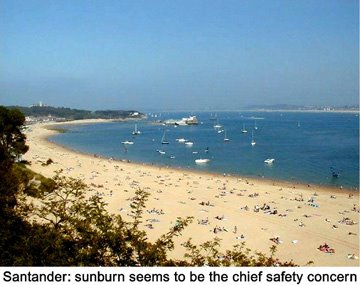
Hernandez-Bravo says that trip went without incident, and she describes Santander as one of the safest cities in Europe.

Former Saddleback College student Brian E. Siedlecki said it best in his letter to Chancellor Mathur: "Having spent time in Santander, I can assure you it is as likely to be victimized by a terrorist attack as Modesto, California."

And what about Saddleback's study-abroad students who are in Salamanca, Spain, this semester, as in, right now. Isn't Fuentes concerned for their safety?

Fellow trustee Marcia Milchiker was quick to point out the holes in Fuentes' safety arguments, mainly that the U.S. is just as likely to be attacked, i.e. Sept. 11.

But Fuentes brushed off her concerns and told me: "I don't think that such comparisons without full information is worthy intellectually."


March 18:

In his “Diary of a Mad County” column in the OC Weekly, Steve Lowery connects the “study abroad” controversy to Orange County’s struggles to overcome its right-wing “wacko” image:

[On March 10,] Spaniards observe[d] a moment of silence for the 191 people who died in a terrorist train bombing last year. One of those not observing silence or even on the premises is frequent OC house guest and prime minister at the time of the attacks, Jose Maria Aznar, who was in Mexico at the time, perhaps looking for his soul. Spain eventually pulled its troops out of Iraq, which eventually led the South Orange County Community College District, under the equally soulless thumb of former local Republican jefe Tom Fuentes, to cancel its study abroad program in Spain. While this will have little to no effect on Spain, it is yet another humiliation for Orange County, which seemed to be emerging from the hick/wacko shadow of the likes of Bob Dornan, Bill Dannemeyer, John Schmitz, John Birch and Wally George. In fact, Orange County’s reputation has taken such a hit that the likes of Mississippi is looking down on us. Missif*ckingssippi! Prior to this, the only place Mississippi has been able to look down on is pre-wheel Mesopotamia….

March 22:

At its March meeting, many people, including at least one soldier, address the board, passionately urging trustees to reverse the February decision. Virtually no one speaks in defense of the action.

The board votes to rescind its decision of February and to approve the Santander trip--by a 5-2 vote with Fuentes and Wagner again casting negative votes. (Padberg, Williams, and Jay change their votes to approval, joining Lang and Milchiker.)

March 25:

The Chronicle of Higher Education reports that

A community college in California that canceled a study-abroad program to Spain this month for political and safety reasons has reversed its decision.

Trustees of the South Orange County Community College District initially voted three weeks ago to close the program...One board member...said it would be unpatriotic to send students to Spain after that country's decision to withdraw its troops from Iraq (The Chronicle, March 7).

But on Tuesday the trustees changed their minds. Worries about cost and liability were sorted out, according to the district's chancellor, Raghu P. Mathur. And the trustee who brought up Spain's position in Iraq subsequently dropped that issue, Mr. Mathur said, though news reports indicated that the trustee still voted against the program….


April 1:

OC Weekly’s Gustavo Arellano writes a mock letter to Fuentes:

It’s been a bit more than a year since you stepped down as chairman of Orange County’s Republican Party, a position you held for 20 years. Now you sit in the Siberia of politics known as the South Orange County Community College District (SOCCCD) Board of Trustees. What happened?

I’m reminded of the story of Pyrrhus…That’s been your political career, Tom. As you led the Orange County Republican Party to dominate a region in a way unseen in local government since the days of Tammany Hall, you also ensured your political doom. Petty fights, bizarre grudges, besmirchments: if you had avoided all of that, you’d still be the pontificus maximus of the county GOP. Instead you’ll spend the rest of your political days doodling on agendas through another stultifying SOCCCD board meeting and dreaming of the Balboa Bay Club.


Arellano then provides a bulleted summary of Fuentes’ remarkable political career, which ends with this item:

Feb. 28, 2005: You persuaded four colleagues on the Board of Trustees to cancel Saddleback College’s summer study-abroad program to Spain because the country had pulled its troops from Iraq. The decision drew national ridicule and outraged the locals; under heavy pressure, the SOCCCD board rescinded your decision on March 22 by a 5-2 vote. And, again, Latinos laughed at the GOP.

UPDATE:

October 24, 2005:

At it's October 2005 meeting, the Board votes to approve Saddleback College's study abroad program to Salamanca, Spain for Spring 2006. There was no discussion.

Fuentes and Wagner, offering no explanation, voted against the item. (See ARCHIVES, Oct. 25, 2005.)

Wednesday, July 7, 2004

Orange County, the right-wing cradle

From the Palm Beach Post-Times, Sunday, July 7, 1974

Orange County, the right-wing cradle
A Fertile Land of Firsts, It’s Patriotic Above All

By Kay Bartlett

ORANGE COUNTY, Calif (AP) – Just About anything will grow here. Most things will flourish.

Societies to fight income tax, counter committee to battle the “Communist infiltrated” PTA, even something called SHRIK (the Society to Harass the Reds and Intimidate the Kikes).

Miles and miles of freeway, acres of shopping centers, enough fast-food emporiums to feed a small nation.

People who stand in lines to buy a lot and a house in an instant village that was farmland a few months back, with the certain knowledge the value of their property will skyrocket in a year or two.

If that bores you, there’s a 75-year-old goldfish that does card tricks at Japanese Deer Park, one of the score of amusement palaces which thrive here.

Just south of Los Angeles and just north of San Diego, Orange County is a never-never land of affluence, sunshine and its own particular brand of patriotism.

It’s citizenry tend to add fuel to the image. Four-star Gen. Curtis LeMay, four-star patriot John Wayne, Sen. Barry Goldwater, an Arizonian who keeps an apartment at Newport Beach overlooking a bay.

Bordered by mountains on the east and the Pacific Ocean on the west, Orange County has been, among other things, a stronghold of the John Birch Society, a former stomping ground of the Ku Klux Klan, the fastest growing county in the United States (U.S. Census Bureau figures), and the home of the first drive-in church.

Richard Nixon was born in the northern city of Yorba Linda and periodically presides from the southern city of San Clemente. Between lies Disneyland, the institution that is Knott’s Berry Farm, an aerospace and electronics industry, one giant company that owns 20 per cent of the county’s land and a populace that believes there’s something slightly odd about anyone who would choose to live elsewhere.

Currently popular bumper stickers include “CommUNism,” “Hanoi is Fonda Jane,” “Kissinger My Ass,” “Would You Want Your Daughter to Date a Kennedy,” and “Nixon is a Liberal.” The “X” in Nixon is a swastika.

Politically, Orange County has long had a reputation for its ultra conservatism, a reputation that has been the subject of national magazine articles and popular jokes. It once prompted John Schmitz, a former congressman and 1972 presidential candidate of the American Independent party, to remark that he joined the John Birch Society to get into the mainstream of Orange County politics.

Many of my neighbors were Birch members,” says Mrs. Judy Rosener, who teaches a course in Orange County politics at the University of California at Irvine (UCI). “They were almost evangelistic about it. The thing that was disturbing to me was that they were well-educated, very bright and they took this thing very seriously.”

That was several years ago, Mrs. Rosener said. Since then Birch Society membership appears to have dropped off, or perhaps there’s less discussion about belonging. The society itself doesn’t give out membership figures.

Many residents claim the image attached to their county never was justified. And then you meet a resident like Anthony Hilder, a self-proclaimed “new rightist” and author of a book – “The War Lords of Washington” – which argues that international bankers conspired to involve American in World War II.

“I’m slightly to the right of Genghis Khan and far, far right of the Birch Society,” Hilder says. “If I was in charge, I’d bomb London, New York and Washington. That’s the seat of the international banking cartel that wishes to dominate the world.”

Roy Holm, mayor of Laguna Beach, one of the county’s 26 cities says, “I think Orange County has been portrayed much too simplistically. I don’t think Orange County was ever as conservative as it was portrayed east of the Colorado River.”

Most will agree that the county – 782 square miles and 1.6 million people – has more of a political mix now than it did 5 or 10 years ago. Still, it retains a uniqueness.

“Politically speaking, I guess you could say there are only two counties left in the United States – Orange County and Cook County (Chicago),” says George Delahanty, chairman of the county’s GOP Central Committee.

And Goldwater remarked that in his disastrous 1964 election bid against Lyndon Johnson he carried five states and Orange County.

Why did conservatism hang on when, between 1950 and 1965, the county was growing sometimes as much as 6,000 people per day? Some ascribe it to the agricultural economy that dominated for many years, and the traditional conservatism of farmers. Undoubtedly an influence, but one that does not explain why the conservatism lingered when the county’s population tripled and the immigrants weren’t farmers.

Engineers, technicians, scientists and skilled workers arrived. School teachers came as the schools increased, postal clerks, grocery store clerks – everyone necessary for an area whose needs suddenly triple.

In addition, thousands live here in retirement. El Toro Marine Corps Base has a population of 10,000. But the public information officer says 70,000 people have PX privileges. There are civilian retirement complexes. The largest, Leisure World in Rossmore, has 17,000 elderly.

“Orange County’s the kind of place that is very kind to people who want to do nothing but goof off,” says Gen. LeMay, among the retired. “In fact, that’s why I’m here.”

Many see in the Register, a Santa Ana newspaper with a circulation of 172,000, a major reason for the county’s conservative bent. Since 1905, the Register has editorialized unwaveringly against income tax, public schools and government in general. It refuses, for instance, to endorse political candidates because, as Jim Dean, the executive editor, puts it, “Government is the problem.”

Its late publisher, Raymond Cyrus Hoiles, would offer $100 to anyone who would debate him. His position was that government should not collect taxes for any reason. If you want a sidewalk in front of your house, build it yourself. Freeways should grow from private enterprise, Hoiles maintained.

The bearded executive editor, in stressing that schools would be better run by free enterprise, uses this analogy: “If the government ran the grocery stores, a loaf of bread would cost a dollar and it wouldn’t taste good.”

A major Orange County personality is Walter Knott, a rock-ribbed conservative, an Okie who migrated here in the 30’s and made millions with Knott’s Berry Farm. He’s a man who peddles politics as well as jam and jelly.

Then there was the late Jimmy Utt, a dapper man who sat in the U.S. House of Representatives from the 83rd Congress until his death in 1970. Known as “Mr. Conservative,” Utt usually was cheered back to Congress with 70 per cent of the vote.

When Utt died, he was replaced by Schmitz, who continued the ultra-conservative voting pattern.

Schmitz was defeated in the 1972 Republican primary, a development some view as a move away from conservatism. Others say it was an upshot of Schmitz’s attacks on Mr. Nixon at the height of the President’s national popularity.

“Schmitz was saying the emperor wore no clothes before anyone else noticed,” said a newspaperman.

“The people wanted to spank me but not defeat me,” says Schmitz.

Andrew Hinshaw, who replaced Schmitz, campaigned as “A real Republican.” He’s frequently described as a conservative. There are six men in the House representing Orange County and surrounding areas. Five are Republicans and one is a Democrat.

Dr. Richard Baisden, dean of the Extension Center at UCI, believes the county never was as conservative as its leaders.

“A lot of right-wing people controlled some key positions for years and years,” says Dr. Baisden.

And then a young career girl, a pretty youngster who worked as a guide at Disney’s Magic Kingdom, relates: “I told my mother I was moving to Santa Monica. She was shocked. She said, ‘But they are so liberal up there.’”

Dixon Gayer, a former newspaper columnist and now a professor of journalism, disputes the new view that the people are less conservative.

“They are more conservative here than ever before. It’s just that the organizations are weaker. It’s more underground now,” says Gayer.

Or, as John Zemanek, head of the very right-wing American Volunteer Group, put it: “We’re practicing obscurity.” He claims the AVG, also tagged the American Volunteer Guerrillas and the Alternate Volunteer Government, is still active, although membership is down.

At one point, AVG had a few thousand members, Zemanek said, but membership has dropped to 300 or 400 today.

James Townsend, publisher of a newspaper called the National Educator and a man sometimes called the hub of the right wing in Orange County, assessed the reduced membership this way:

“There were a bunch of retired colonels and other military people in the group. But they got scared of those guys running around all the time with guns sticking out of their pockets.”

Not so, counters Zemanek, a burly longshoreman and an expert marksman once ranked sixth in the state.

“We kicked a number of people out. Some of them were Reds. And we stopped making membership drives,” he said.

Zamanek disputes the charge that the AVG is, or ever was, a paramilitary outfit. “We’re basically an intelligence organization. Ninety per cent of guerrilla warfare is intelligence work.”

He cites as an example a scheduled hippie march on Disneyland several years ago. An AVG infiltrator in the hippie group, Zemanek said, suggested that the marchers pass out handbills showing Pluto, Goofy and Minnie indulging in obscenities.

The hippies did it.

“That, of course, turned the people against them. And they (the hippies) paid for the cost of the handbills and as far as they knew, it was their idea. That’s guerrilla warfare at its finest,” Zemanek said.

Gayer, who once lost a job as a columnist because he spoofed Orange County’s Birch Society, now publishes a small newspaper, “The Dixon Line,” which he describes as liberal. He has this theory why the county clings to conservatism.

People come here without any roots and without anything to believe in. Because they are seeking to be friendly, they come to believe what their neighbors believe. It doesn’t take very many people to influence a community.”

A more widespread theory is that people came to Orange County to find both the ocean and the mountains within their purview. They bought beautiful homes in a beautiful climate. Their children grew tall, nourished by sunshine and exceptionally good produce, and suddenly, life was never better, never brighter.

“These people want to conserve the middle-class values. These are the values upon which Western civilization is built,” says Schmitz. “But Orange County is just like anywhere else, only more so.

“In this age of welfarism, some people think it’s kooky to want to do it yourself. And that’s where Orange County gets its image. It’s not the kind of place where you come to get on welfare. But if you’ve got the get up and go, Orange County is the place for you.”

But Orange County is where sex education was pioneered, then banned in some districts; the county where a theater manager in the 60s banned a film festival because Charlie Chaplin was featured, the county in which one school system rejected Jonathan Livingston Seagull as high school reading because it dealt with reincarnation and Hindu philosophy.

With a few exceptions – secluded Laguna Beach, plus Newport Beach and San Clemente – the cities here blend into one another. Fullerton becomes Anaheim at no discernible point, Anaheim creeps into Garden Grove, Garden Grove into Santa Ana, Santa Ana into Orange.

“These little communities used to have identities and separate personalities,” says [Jim] Sleeper. “Now they’re all like sandwiches that have been kept in the refrigerator for three or four days. No matter what they ate made of they all taste alike.”

Whether Communism is to be feared remains a hot issue in Orange County. Zemanek, of course, says yes and allows as how his group watches a man down in Laguna Beach. Gayer says the only Communist he ever met in Orange County was a 70-year-old gardener. And Townsend believes communism is just a pawn of the real force: The secret societies of the international banking cartel, the Zionist movement and the internationalists.

“The Zionists are a powerful force, money-wise,” says Townsend. “It’s a very wealthy, very well-organized, very fanatical force. Anyone who doesn’t recognize the power of the force is naïve. It is alien and very dangerous to the people of the United States. Their goal is world control. They can buy a candidate for any office. They exert a tremendous influence on who wins the presidency of the United States.”

Townsend’s newspaper, The National Educator, is mailed across the country, but he won’t reveal circulation figures. It regularly attacks the school system, the National Education Association, abortion, the United Nations, sex education, both the Republican and Democratic parties, Darwinian theories of evolution and income tax. It named Mr. Nixon the “tax rebellion leader of 1973” and noted “Award presentation will follow recipient’s expected availability in 1976 or sooner.”

Townsend, a middle-aged six-footer, describes Mr. Nixon as a “wild-eyed liberal who did more to promote the concept of one world in his first five years in office than all the Democratic presidents put together. Well, maybe, except for FDR. Nixon takes the concept further than McGovern’s wildest dream. McGovern would never have gotten away with what Nixon has.”

Townsend heads the National Justice Foundation, a nationwide organization first formed in Orange County as the right wing’s answer to the American Civil Liberties Union. Other right-wing groups headquartered here include the Citizen’s Committee for California, which launched the draft-Goldwater movement in 1964, and a half-dozen anti-income tax associations.

“It’s become somewhat of a badge of courage to get arrested for failing to pay taxes,” says Gayer.

Orange County is deeply involved in conflicts between homeowners and environmentalists. It might have more homeowner associations and planning commissions per square foot than any other U.S. county.

For example, Larry Smith of Newport Beach is in court because the architecture committee of the Canyon Hills Homeowners Association says the basketball hoop he put up on his garage must come down.

Smith says he painted the backboard the color of his house. Even so, the association says the hoop must be in the backyard and not in the garage.

“You need to get an environmental impact study around here before you put up a fence nowadays,” says Register editor Dean.

Besides the private groups and organizations, much of the environment hoopla results from Proposition 20, a statewide requirement that studies must be made before any development can be done within one thousand feet of the shore.

One thing Orange County has not been accused of being is a center of culture.

“As I’m fond of remarking,” historian Sleeper says, “the last cultural innovation that came to Orange County was indoor plumbing.”

Or, as the man on the bus was explaining to a newcomer: “It’s a never-never land. We never have problems here. It never rains here, the riots and the unemployment are never here.”

It was raining as he spoke, and when he had finished his chamber-of-commercing, he allowed as how Orange County, dependent on freeways, certainly would need a special dispensation if the energy crisis brought gasoline rationing.

And so it goes, in the county that seems to be built on contradictions.

“Orange County was floating on federal aerospace money while people were running around objecting to federal grants,” said Hank Panian, a history professor at Orange Coast College.

“Orange County is on a continental water shelf and gets its water from a river in the desert.”

There was a famous aviator who filed an historic flight plan to go to California and would end up in Ireland.

And guess what? Wrong-way Corrigan lives here, too.

Tuesday, May 25, 2004

Cosgrove/Senate letter re cost of ATEP 5/12/10

You might have to click on the letter below to see all of it.
A LARGER rendition of the letter follows the one below.
This was to be a part of the discussion at the May 2010 board meeting--discussion item re ATEP. Trustees acted to table the item (re ATEP) until July. This posting occurred May 25, 2010

LARGER (IN PARTS A AND B):


Tuesday, May 18, 2004

94% vote "no confidence" in Chancellor Mathur


Huge Vote Against College Chief (LA Times)

By Jeff Gottlieb

     Faculty in the South Orange County Community College District overwhelmingly voted no confidence Monday in Chancellor Raghu Mathur.
     Of the full-time professors at Irvine Valley and Saddleback colleges who cast ballots, 93.5% voted in favor of no confidence, and 6% were against the union-sponsored measure. One person abstained.
Out of 318 faculty eligible, 246 -- 77% -- voted, according to the district faculty association.
     "It's very clear that the chancellor does not have the confidence of the faculty," said Lewis Long, head of the faculty association. "Now it's up to the trustees to demonstrate whether they support the faculty and the students they represent."
     Mathur issued a statement late Monday attributing the outcome to friction between him and faculty members relating to contract negotiations underway. "They are unhappy that I take direction from the elected board of trustees and not them," the statement said in part. "I believe that my day-to-day decisions and policy recommendations to the board need to continue to be guided by what is best for the students, first and foremost."
     Donald Wagner, president of the board of trustees, characterized the vote as largely political.
"I'm not surprised that it passed," he said, "because the folks who were agitating for no confidence refused to give the chancellor a chance to address the issues they raised."
     Faculty at Irvine Valley twice voted no confidence in Mathur, where he served as president from 1997 until his appointment as chancellor in 2002, putting him over Irvine Valley and Saddleback College in Mission Viejo.
     Faculty members have been at odds with the former chemistry professor since shortly after the conservative-dominated board named him president, and Mathur replaced a system that relied on faculty to handle much of the college's administrative load.
     Trustees appointed Mathur chancellor even though a hiring committee did not rank him among the top three candidates, according to Lee Haggerty, then union president, who sat on the panel.
Teachers say Mathur and the elected board have taken away many of their powers to govern college life and added rules to control faculty.

Students Be Damned
Re "No-Confidence Vote Will Be 3rd for College Chief," May 17: 
     I appreciated South Orange County Community College District Board of Trustees President Donald Wagner's clarification about the board's "differing views of the responsibilities and roles of various players in the system." His role, the board's and Chancellor Raghu Mathur's all seem to involve expensive lawsuits, scaring away top administrators, alienating potential donors, violating district and state policy and intimidating students.
Andrew Tonkovich

Silverado


Thursday, January 1, 2004

template experiments

WELL, this'll have to be quick, cuz I've got stuff to do.

It was an oddly unpleasant night at the old SOCCCD board room. Weirdness and tension filled the air.

THE OPEN SESSION started over two hours late! That means that the trustees were in the back room, fighting over something.

Judging by Mathur's pallor—it was dreadful!—I'd say that, if there was a fight, he lost it. Bigtime.


WE GET JUSTICE

Trustee Fuentes announced three closed session actions, including approval of Dr. Craig Justice of Chaffey College as the new Irvine Valley College Vice President of Instruction. Every indication is that Justice is a good hire. (See Craig Justice.)

The only public comment came from Cal Nelson, who is stepping down after 8 months on the job as temp IVC VPI. As usual, he was gracious, warm. Everybody loves Cal.

I bet Raghu hates 'im.


SPASMODIC & GHASTLY & GOD-FEARING

Before he took on the job at IVC, Cal was told that things were pretty bad at the college, but that's not what he found, he said. Nope, people were pretty terrific, working hard, cooperating. Cal went out of his way to praise IVC's Academic Senate President, Wendy Gabriella, for her work and for her assistance to him.

Trustee Fuentes and Chancellor Mathur seemed to snicker at that. Well, Mathur didn't so much snicker as make that rat-faced scrunch of his. You know the one. It's spasmodic and ghastly, a rat's tic.

Trustee Wagner gave the invocation, and he laid it on pretty thick this time.

"Wisdom begins with fear of the Lord," he said.


JAY, MILCHIKER, PADBERG, WAGNER v. FUENTES, LANG, WILLIAMS

After the consent calendar, item 5.12—Academic Personnel Actions—was moved to the front, in "deference" to Bill Jay, evidently. Judging by the tension in the air, this item was the likely cause of trouble during the earlier closed session.

Three elements were "separated" from 5.12 for seperate discussion and approval. The central element, it seems, was h1, which, judging by factoids gleanable from trustee remarks, concerned the "transfer" of a "chemistry instructor" (an IVC chem instructor was on the closed session agenda). Based on an exchange involving Rich McCullough, the transfer was at or to his college (Saddleback).

In the end, trustees Jay, Padberg, Milchiker, and Wagner prevailed: the "reassignment indicated in h1" was not approved.

One wonders what that's all about.


PRESENTATIONS

Gary Poertner and the Bean Counters, a local rock band, gave a presentation about the tentative budget. Andreea Serban of Transylvania gave a presentation about "Grant opportunities and strategies for grant development."

"Good evenink," she said.

She's been very successful in getting super-duper grants for the district.

Both presentations were well-received.

Well, I've gotta feed the cat. Maybe I'll have more tomorrow. Maybe not.


USING:

...


1 carriage return prior to subtitle
2 carriage returns after subtitle

Monday, April 14, 2003

IVC FACULTY PROHIBITED FROM DISCUSSING THE WAR, by Chunk Wheeler


[Editors note: It’s been years since the episode described below. Since that time, VPI Dennis White has proved to be one of the good guys, administrator-wise, even if he is a severe knucklehead.]

From April, 2003. The essay was originally entitled,

“Exploration… inappropriate”

OR: How many pinheads can dance at the head of a college?


By Chunk Wheeler

March 27:

OK, so there I was in the lounge, fixin’ to go to the Irvine Valley College Academic Senate meeting, when Rebel Girl slips me a copy of a memo that had been sent to deans earlier that day by one Dennis White.

I read it. It said:

It has come to my attention that several faculty members have been discussing the current war within … their classrooms. We need to be sure that faculty do not explore this activity within … their classroom unless it can be demonstrated, to the satisfaction of this office, that such discussions are directly related to the approved instructional requirements … associated with those classes … College personnel are … encouraged to explore their views … outside … the classroom. Again, however, the exploration of those reviews [sic] within … the classroom is professionally inappropriate…

“Good Lord!” I said. “This memo is sayin’ that we can’t talk about the war in class unless we clear it with Dennis White first!”

The memo instructed deans to “advise…faculty and staff members of the position of this office.” That sounded pretty official.

Wow. We hadn’t seen anything like this since ’97, when then-President Mathur forbade discussion of district politics in the classroom (except for Poli Sci courses).

Nowadays, of course, Mathur is the Chancellor of the SOCCCD.

* * * * *
Meanwhile, at UCI, their Chancellor urged students and faculty to discuss the war in class and elsewhere, but always to “express themselves with civility and tolerance, and act in a peaceful, nonviolent manner.” College administrators around the country are encouraging polite and peaceful discussion of the war in class and elsewhere.

Not at IVC. There, “exploration” of the war in the classroom is “inappropriate.”


Thou beslubbering dismal-dreaming ratsbane!

Who is this “Dennis White” anyway? Why, he’s our dapper new VP of Instruction. I recall first meeting Dennis, last November, outside Saddleback’s Library 104, on the night of his appointment. He seemed like a nice guy, so I apprised him of the recent history of our district.

When I finished, he paused; he thunk; he assured me that he wouldn’t do anything indecent or illegal.

I said: “I hate to break it to you, but if you’re a decent guy, you’ll be gone within a year.”

A coupla weeks later, I saw White again at a Humanities department meeting, at which time he answered someone’s question by telling a story. To this largely feminist audience, he explained that, as a young man, he dropped out of high school and joined the military, whereupon he discovered the difference between officers and enlisted men, namely, the officers’ cars were better and the officers’ wives were “prettier.”

Eyebrows arched skyward.

White realized, he said, that the officers had sheepskins, and so he decided then and there to further his education. After his military stint, White, that seeker of spiffy cars and pretty women, snagged an A.A., then a B.A., then an M.A.

Maybe White noticed some community college administrators and their wives and cars. He went out an’ snagged some Education degrees, including a doctorate.

* * * * *
In early January, White showed up to his first IVC Academic Senate meeting, launching his practice of standin’ and speechifyin’. He referred to the turmoil that has beset our district. All that stuff, he said, amounted to mere “politics.”

Now, one can describe our district’s infamous disquietude in many ways. But White, standing before a group of faculty, chose to describe it as faculty “antagonizing” administrators and the board.

That such remarks plummeted to earth entirely escaped White’s consciousness. He closed by asking faculty to send him, via email, their “dreams.”

Soon thereafter, I emailed the fellow my dream that faculty be accorded their appropriate role in college and district governance. I outlined the unfortunate facts, shared governance-wise, about our district. I noted that our “turmoil” concerned substantive issues. I suggested that the culprits, turmoil-wise, were, not the faculty, but administrators and trustees.

In an email, White responded by warmly thanking me for my note and then accusing me of foully trying to draw him into my disagreements with administrators. He closed by alluding to his success at every institution where he has served.

Where’s that? Why, until January of this year, White has spent his administrative life at Antelope Valley College, in beauteous Lancaster, California, where, as Dean of Fine & Performing Arts, he presided over about 16 full-time instructors.


Thou impertinent fen-sucked horn-beast!

March 27: Immediately after my encounter with Rebel Girl, I headed for the Senate meeting with Mizz G, a senator. Along the way, I described White’s memo. She laughed. She asked if I was joking.

During the meeting, which White attended, the Senate Prez bemoaned the failure of junior faculty to participate in governance, owing to fear. He sought ways to overcome the problem. Some senators suggested that the fears are reasonable. Mizz G then cited White’s memo as the latest in a series of threats to faculty.

White defended his memo. His point, he said, was that faculty, except in some areas, shouldn’t be expressing their opinions about the war in the classroom.

Ted, a PE coach and Vietnam War vet, explained how discussions of the Iraq war can arise even in his courses. Others made reference to our “academic freedom.” That sounded pretty reasonable, but White was unmoved.

He commenced lecturing us about “history.” According to White, the Supreme Court has considered whether faculty have a right to academic freedom. According to the Supremes, said White, they don’t.


Thou puking dismal-dreaming dewberry!

Friday morning, I contacted my pal Marla Jo at the OC Register. “What’s up?” she asked.

On Saturday morning, an article appeared in that paper entitled, “Irvine Valley bans talk of war.” According to the article, “Faculty members at Irvine Valley College were banned this week from discussing the Iraqi war in classrooms, unless their course touches directly on the conflict….” According to the article, White says that he was responding to “student complaints.” He says he wanted to “protect” students from the “personal opinions” of faculty. He suggests that, in class, faculty should stick to their subjects.

Naturally, editors at the L.A. Times were plenty steamed that the lowly Reg had beaten them to this sexy bannage story, so, on Sunday, they scrambled to out-do their rival, interviewing just about everybody in Orange County.

That night, over a plate of GB’s wondrously excessive pasta, me ‘n’ Mizz G made predictions. “They’re gonna dig in their heels; you watch,” said G.

“Nope,” said I. “They’re not that stupid. They’ll back off.”

“Wanna bet?”

* * * * *

The Times article appeared the next morning. It covered the same ground as the Reg piece, but it also sported IVC Prez Glenn Roquemore’s seemingly equivocal attempts at damage control:

…[C]ollege President Glenn Roquemore said the memo was “not a ban” and that the college respects the faculty’s academic-freedom rights. Though Roquemore didn’t rule out any disciplinary action [!], the memo “doesn’t say you’re going to be disciplined and thrown out of your job,” he said. “The memo has little effect, it’s certainly not official, and it’s subject to further debate.”

Not official? Little effect? Academic-freedom rights? Having read that, I figured I’d won the bet.

But Rocky went on to explain—and apparently to endorse—what White “meant” to say:

“I believe [White’s] memo was really meant to say, ‘Please talk to me before you enter into a conversation with your students, unless it’s in the context of a political science class’”….

According to Rocky, therefore, unless an instructor teaches Political Science, he IS obliged to run things past White before talkin’ about the war.

Rocky did throw in the word “please.”

The Times also quoted staunch Mathurian apologist, and bowdlerizer extraordinaire, Ray Chandos, who sought to minimize the problem. Chandos “thought the memo was a case of ‘an administrator who received a complaint from a student, wrote a memo and hoped the situation would go away.’”

* * * * *

Also on that Monday, Reuters, the news service, ran a story entitled “California college war talk ban stirs debate.” There, White explains that the limits he imposed on discussion and opining in the classroom are “attempting not to limit academic freedom or limit discussion but to define a framework for the discussion….” Oh.

White went on to say:

War is very different to the people who are fighting and the people who are at home. I was just trying to make sure our faculty are sensitive to the type of students we have.’’

Which “type of students” do we have? The ones at home, right?

I don’t get it.

Perhaps White’s point is that the studentry comprise diverse groups, and we ought not to reason in class in a manner that offends one or some of these groups.

Does this mean we should avoid discussing natural selection and the problem of evil?

White adds “that students at the community college, many of whom have relatives fighting in Iraq or families trapped there by Saddam Hussein, should not become a ‘captive audience’ to teachers.” He means, I suppose, that students should not be forced to listen to teachers’ opinions when those opinions offend them.

But aren’t there importantly different kinds of opinions? Some opinions are mere opinions, but others, including some that offend, are much more than that.

Isn’t that obvious?

* * * * *
According to the Reuters article, the American Association of University Professors “has had several reports of incidents across the country in which state officials or communities tried to curb war talk….” In each case, says an AAUP spokesman in the article, “administrators resisted public pressure to limit campus speech….”

In each case, that is, except ours.

The phenomenon of community pressures to limit professors’ speech about the war on campuses even made the front page of the New York Times (“Professors protest as students debate,” 4/5/03).

There, IVC gets a brief dishonorable mention.


Thou villainous rump-fed lout!

The Reg, Times, and Reuters articles incited a media frenzy-ette. By Monday afternoon, the TV people—Fox, KCBS, KMEX, etc.—descended upon our little college, spillin’ wires and has-been reporters all over the lawn. Faculty were invited onto radio talk shows (KABC’s Al Rantel). Al Jazeerah’s website (jazeerah.infoNews) ran the Times article under the title: “Neo-McCarthyism.” Saudi Arabia’s decidedly anti-Bush Arab News ran the article.

Meanwhile, NEAR (Network for Education and Academic Rights) weighed in, and the AAUP formed a special committee to monitor IVC. Academics from near and far (U of Redlands, Cal Arts, Riverside Community College, etc.) wrote to condemn White’s memo.

An administrator at Glendale Community College sent the Times article to faculty, adding that “Banning classroom discussions of the war and other controversial topics is not the way” to approach the phenomenon of students who are upset by discussions of the war.

* * * * *

Amidst all this, Dennis White issued a 2nd memo, in which he explains that he “strongly support[s] the concept of academic freedom.”

But what about his claim, made just four days earlier, that the Supremes say there ain’t no Academic Freedom? I guess Dennis forgot to mention that he disagrees with the jurists.

And how exactly does his “strong support” for Academic Freedom square with his muzzling of faculty?

According to White, a “faculty member had spoken his personal views on the war effort,” and this resulted in student tears. In an effort to “recognize” the “diversity of the student body,” which includes students of “Middle Eastern backgrounds,” White “issued guidelines,” he says, that attempt to “define the proper context of” discussions of the war.

How does a policy that muzzles speech recognize student diversity? What does the poor fellow mean?

What many of us at IVC wanted to know, of course, was whether White’s “guidelines” obliged us to secure White’s approval before discussing the war! We wanted clarification about this pre-approval business, and memo #2 sheds no light on that at all.

On the other hand, in the Times, Rocky seems to endorse pre-approval. Despite his guff about the memo not bein’ “official” an’ all, Rocky was, in truth, endorsing bannage and muzzlage.


Thou froward fat-kidneyed joithead!

In the article that appeared in Tuesday’s Chronicle of Higher Education online, Roquemore again denies that the memo is “a new official policy.” “This college certainly approves of discussions about war by faculty and their students,” he is quoted as saying.

He’s saying, of course, that faculty get to discuss the war all right, but not in the classroom.

According to the Chronicle article, White “stands by” his memo. He explains that it would be appropriate to discuss the war in a political science or a cultural anthropology class, but not in a mathematics class.

Now, what does it mean when a guy like Dennis White says he stands by his memo? That’s hard to say. Maybe he’s sayin’ that he’s hungry or that his feet hurt.

In the Chronicle article, White steps deeper into dictatorial doo-doo. According to White, even in “courses where the war is a reasonable topic for discussion, professors should refrain from stating their personal views.” Further, White’s concerns aren’t “limited to the war.” For instance, it would be “problematic,” he says, for a criminal-justice instructor to express his opinion about the death penalty.

In other words, in the classroom, opining in general is verboten.


Thou fobbing fool-born skainsmate!

To my amazement, the Times editorial that appeared on Tuesday largely supported White:

[A]t Irvine Valley College…, the administration issued a heavy-handed warning to professors to avoid spouting their views on the war during class and to stick to their approved lesson plans. Here, common sense largely favors the college’s administration. Faculty members can be forgiven for overreacting to the memo; the Coast Community College District [!] has a miserable record on free speech…Into a campus thus primed for a free-speech battle, …Dennis White dropped a poorly worded memo…The document…provoked immediate faculty cries to protect academic freedom. This time, though, campus administrators are within their rights.

On Thursday, the Irvine World News expressed a similar view, though it suggested that administrators and students over-reacted.

Meanwhile, at least one paper called White’s edict “un-American” (The Bakersfield Californian, 3/31/03).

OK, Bakersfield doesn’t count.


Thou errant half-faced nut-hook!

In an article appearing in the Irvine World News on Thursday, Roquemore suggests that the notion that White “banned all discussion about the war” resulted from “misinterpretations” of his memo. Contrary to critics, he suggests, faculty at IVC are free to express their opinions all over campus. It’s only in class, when they are teaching, that they gotta clam up about the war.

Rocky assumes, of course, that faculty interpret White’s memo as a ban on discussions of the war anywhere on campus. But no one interprets it that way. The faculty complaint is that the memo bans discussion of the war in class.

It is true, of course, that the media keep referring to White’s “ban on war talk.” But the reason that they do not bother to add “in the classroom” is that, when you think college, you think classroom.

Duh!

According to President Rocky, even when discussion of an issue is related to course content, “teachers have an obligation to present the various sides in a balanced manner….”

Does this mean that, in class, I may not suggest that the Holocaust occurred unless I also refer to the contrary view and arguments of Holocaust deniers? That’s absurd. Well-trained academics know that some “sides” are not worth presenting. Sometimes, from a logical point of view, only one “side” (e.g., “the Holocaust occurred,” “the earth is round”) is worth presenting.

Roquemore goes on to offer a sophistical understanding of opining. Offering an opinion, he suggests, is tantamount to “disseminating one’s personal sense of truth.”

Really? If a biology instructor offers her assessment of, say, punctuated equilibrium, she is offering an opinion. But only a lout would suppose that she is thereby merely disseminating her personal sense of truth!

Perhaps Rocky and his friends are thinking of the merest sort of opining—opining unencumbered by reasons. Or perhaps they object to opinions that are mere whims or matters of taste.

Is that what one intends when one judges a war to be right or wrong—the expression of one’s tastes or whims? Obviously not.

Or perhaps the Rockettes object, not to opining, but to forceful opining that muzzles disagreement.

If that is what they mean, then they should express their view more clearly. They ought not to say that “discussions of the war” and “opinions” are inappropriate in the classroom.


Thou jarring guts-griping pignut!

On Thursday, in yet another memo, Rocky attempted a clarification of White’s original ban. Here, he repeats White’s theme of the need for “sensitivity” to some students (those from the Middle East and those who have family serving in the military). According to Rocky, White’s purpose in the memo was only to “encourage faculty to use professional discretion in discussing the war in order to protect the integrity of the curricula and the students’ right to a course-related education.”

Upon reading this memo, Mr. B unearthed a nicely framed photograph of Richard Nixon and handed it to me, saying, “You’ve clearly won the bet; you’ve won the Nixon.”

I said, “I want this Nixon. I do. But I don’t get it. Haven’t I lost?”

Meanwhile, in his column for the Times, Dana Parsons came down firmly on the side of academic freedom.

What better place than a [college] to discuss something as vital as war and its inevitable global consequences?…Is there anything more important nowadays than the war in the Middle East? Its potential to affect so many aspects of American life…cuts across all disciplines. With the war on TV 24 hours a day, it’s unrealistic to expect students not to have it on their minds. Does that mean a week’s worth of chemistry lectures should be shelved to talk Iraq? Obviously not, but let’s trust our college instructors…to know how much is too much. Inevitably, some teachers will…rant and rave…but the students will survive it. At day’s end, they’ll at least have had their minds challenged, if not their patience…[T]hey’ll realize down the road that they were part of a great debate of the modern age. Those discussions aren’t likely to happen with Mom and Dad, and they’re not likely to happen on Friday night dates…At a time of war, the classroom is a great place to be.

That pretty much nails it.


Thou rank dread-bolted wagtail!

April 10: There I was at yet another Senate meeting, along with VPI Dennis White. Item 10 was White’s “bannage” memo.

When we got to that item, I spoke first. Addressing my comments to White, I noted that one can glean a philosophy about faculty classroom speech from White and Roquemore’s various memos and media interviews. I identified its elements.

I asked White if this philosophy has any standing in the operations of his office.

I then noted that the President had said that he was “investigating” cases in which faculty discussed the war in class, producing tears and whatnot. (I should have also mentioned that Roquemore “didn’t rule out any disciplinary action” in those cases.) I asked whether these faculty were being called in by administrators and whether the philosophy was being applied in their cases.

White answered that he could not talk about meetings between administrators and faculty regarding this issue, owing to confidentiality. He noted, however, that he was “satisified” with those meetings.

Regarding the status of his bannage philosophy, White said that there had been enough talk about it—it had been discussed all over the country—and he was not going to comment on it further.

To some, White’s remarks were unsatisfactory. One instructor suggested that it is “hogwash” to suppose that only Poli Sci instructors have occasion to discuss the war. Others also explained how reference to the war naturally occurs in their classes.

One instructor reported that White’s memo had a “chilling” effect on some instructors, who said they were now afraid to refer to the war in class at all. Another instructor suggested that Roquemore was trying to have it both ways: he seemed to agree with the memo and yet he also seemed to disown it.

Someone motioned that the Senate seek clarification about the administration’s policy regarding academic freedom, about faculty opining, and about discussion of the war in particular.

White then suggested that, if faculty ask for clarification, they might not like what they get.

That raised eyebrows. Some senators viewed White’s remark as a threat. (That they understood him in that spirit became clear later, in conversation.)

One instructor suggested that, as things stand, for all that she had been told, the bannage philosophy could be wielded against faculty now. It is better, she said, to be clear about the rules than to wonder whether one is somehow violating them.

The motion failed by one vote.


Thou yeasty boil-brained fustilarian!

On the 6th, the Times printed my response to their unfortunate editorial. A former student—he was a Marine at the time, he said—read it and then emailed me to express his anger and his support of Dennis White. According to this former student, I have chosen to defend “anti-American” professors who are “Saddam enablers.” He based this assessment of the professors on the fact that they are criticizing our President and the war. Evidently, in his mind, professors ought not to do that in the classroom.

I also heard from a UCI professor who included a quotation by Teddy Roosevelt that I rather like:

To announce that there must be no criticism of the President, or that we are to stand by the President, right or wrong, is not only unpatriotic and servile, but is morally treasonable to the American public.

Bully! —CW

[I CAME ACROSS THIS OLD MEMO THE OTHER DAY. CHECK IT OUT.]

Memo from IVC President Raghu Mathur to "all faculty" 4/2/98 [NO POLITICS IN CLASS]
OFFICE OF THE PRESIDENT


To: All Faculty

I understand that some students have asked instructors to allow them to speak in their classes about campus political matters. In light of professional sense and matter [sic] of good practice, I would like to caution and advise all faculty to maintain the integrity of the classroom instruction [sic] by adhering to approved curriculum and course outlines of record for their day-to-day activities. It is not a good practice for faculty to allow campus politics to interfere with the educational interests of the students in the classroom. Discussion of political matters, for example, in political science classes is certainly appropriate. Students are welcome to use other forums and avenues to exercise their freedom of speech without interfering with educational interests of other students.

I appreciate very much your professional consideration of this matter. Thank you.

Raghu Mathur
President
Irvine Valley College

Roy's obituary in LA Times and Register: "we were lucky to have you while we did"

  This ran in the Sunday December 24, 2023 edition of the Los Angeles Times and the Orange County Register : July 14, 1955 - November 20, 2...