Monday, March 15, 1999

"ASK MISS FORTUNE" -- inauguration

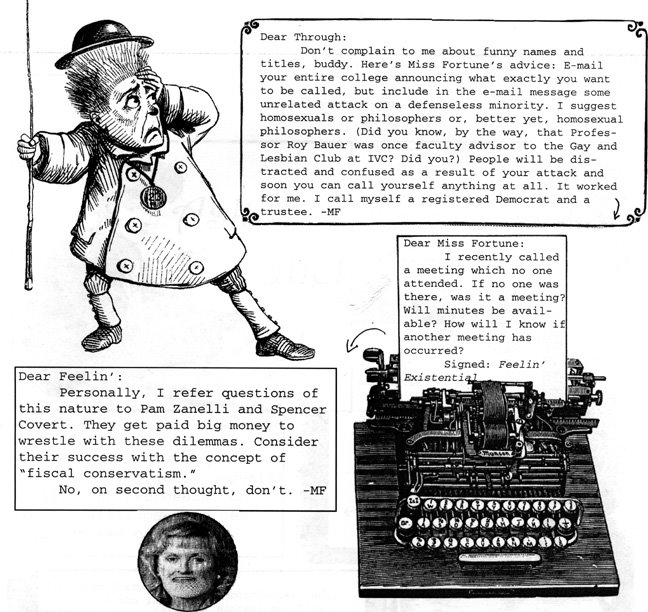
"Ask Ms. Fortune" (or "Ask Miss Fortune") was one of our more popular features. "Miss Fortune" is, of course, a pun. "Misfortune" or "Miss Fortune"? The latter was a certain notoriously bumptious trustee, one who quit the Board amid rumors that she no longer resided in the county. Ah, a typical SOCCCD factoid! The feature was authored by the one and only Red Emma, starting March of 1999. Click on the image to make it larger.

AFTERWORDS:

This one (on three pages, from August 1999) features lots of graphics. (If you click on the image, it should become LARGER.) The first letter concerns Spencer Covert (yes, "Covert"), the district's "Brown Act" lawyer.

The first letter below concerns Mr. Wagner's obsession with Jane Fonda. In the second letter, Red alludes to the rise of Mr. Armando Ruiz to the ranks of administration. (Raghu desperately sought faculty who would play ball with him. Armando is all that he could scrape up.) As you know, the Ruiz saga ultimately flamed out in disgruntlement and infamy (see news stories about his "double dipping").

Below, Red alludes to Dean Howie's highly peculiar action of commanding that a painting be removed from the walls of A200 owing to its alleged potential for upsetting people. Judge for yourself. Nobody was ever upset by the painting--except, of course, for Howard. (A closeup follows.)


VARIOUS ICONS:


Andrew Tonkovich

Tuesday, January 26, 1999

1999: "Malfunction and misfortune": Accrediting Team Strongly Rebukes SOCCCD Leadership


Accrediting Team Strongly Rebukes Leadership at College District


By ROBERT OURLIAN - LA Times

JAN. 26, 1999

     Citing a “sad, sad state of affairs” at South Orange County Community College District, a national accrediting panel is demanding top-to-bottom reforms—especially within the board of trustees—before renewing accreditation for the district’s two colleges.
     In a pair of scathing reports, the Accrediting Commission for Community and Junior Colleges denounced the way Irvine Valley College and Saddleback College have been governed for the last two years.
     Bluntly rebuking trustees, the reports demanded that the board immediately begin stepping back from day-to-day operations.
     “Some members of the board of trustees do not understand the extent of the climate crisis in their colleges,” the team wrote.
     “Furthermore, they do not accept responsibility for their role in contributing to the situation. . . . Some trustees are in a state of denial in that they said they would not do anything differently if they had it to do all over again.”
     The reports stated that “Irvine Valley College and its district . . . are organizations in crisis—primarily a governance crisis. . . . A multiplicity of deep and bitter divisions characterize virtually all entities and relationships. . . . The district had become wracked by malfunction and misfortune.”
     Both campuses remain accredited for the moment, but district officials had hoped for reaffirmed accreditation, though with some conditions.
     The reports released Monday were “less than we wanted,” said Cedric A. Sampson, the district’s new chancellor, who took over last year and has the daunting task of dealing with the problems.
     Formal notification about actual accreditation status and terms for winning reaffirmation are expected any day, he said.
     College trustee David Lang said at Monday night’s board meeting, “I hope we will accept their input in a renewed spirit of cooperation and commitment.”
     He proposed that the seven trustees immediately begin putting some of the accreditation panel’s recommendations into effect. 
     Specifically, Lang said, he hoped the board would relinquish control over executive hiring, delegate non-policy district matters to the chancellor and rededicate itself to “shared governance” with the two campuses’ faculty, staff and students.
     But trustee Steven J. Frogue took a less conciliatory tone.
     “I’m always led back to the question, ‘Who evaluates the evaluators?’ ” he said.
     The accreditation team’s reports said that trustees have taken actions that violated their own policies and procedures. It said also that some trustees may be in a “state of denial” regarding their responsibility for problems at the two colleges.
     “Although . . . these trustees think they are doing what is best for the colleges, they have failed to evaluate their performance and accurately assess the consequences of their behavior,” said the report on Saddleback College. “Our assessment is there is a need for immediate, extensive intervention and change.”
     The reports cite contention at all levels, including faculty groups vs. the faculty union and one college against another.
     But they focus more on the bloc of four—Board President Dorothy Fortune, former President John S. Williams, Frogue and former trustee Teddi Lorch—that has dominated the campuses for the past two years.
     That “high-profile, often controversial group of trustees felt obliged to involve itself actively in the day-to-day operations of the district and of the colleges far beyond the traditional roles for trustees,” the Irvine Valley report stated.
     The result was the development of two factions on the board—the one led by Fortune and Williams and another that unsuccessfully tried to block what it called “micromanaging.”
     The reports noted that Raghu Mathur was chosen president of Irvine Valley in 1997 on a 4-3 board vote after a stormy selection process run completely by the trustees. The accrediting team found the effects of split votes on that and on other issues to be unacceptable.
     “The board itself interviewed all 19 presidential applicants!” the team wrote.
     “This policy brings the board totally out of compliance” with standards, it said.
     While the team members did not question Mathur’s qualifications to be president, they wrote that the controversy over his appointment could threaten the college’s ability to comply with accreditation requirements.
     The reports also criticized a controversial 1997 administrative overhaul on both campuses.
     The commission is expected to give the district until June to show how it will comply with detailed recommendations—or face serious consequences for its accreditation status.
     Colleges need accreditation so students can transfer credits to other schools and to attract federal grants and foundation support.
     The release of the reports came a week after Orange County Superior Court Judge Tully H. Seymour slammed the trustees in a court ruling for “persistent and defiant misconduct” in disobeying the state’s Ralph M. Brown Act, which governs open meetings. The ruling was in response to a lawsuit against trustees filed by a faculty member at Irvine Valley.
     The presidents of the two colleges on Monday noted that the accrediting teams found the educational structures—classes, programs and facilities—to be in good shape.
     “They did talk about our excellent programs, which is gratifying,” said Dixie Bullock, president of Saddleback College.
     Mathur, of Irvine Valley, said the reports underscore the need for the campuses to pull together.
     “We have to focus on things that unite us, and that is: we are here to serve the students.”

SEE ALSO:


Thursday, January 21, 1999

The board's "persistent and defiant misconduct" (according to Orange County Superior Court Judge Tully H. Seymour)


     A judge has ordered the South Orange County Community College District to tape-record its closed-door meetings for two years because of its “persistent and defiant misconduct” in violating state open-meeting laws. Orange County Superior Court Judge Tully H. Seymour also referred the case to the District Attorney’s Office for possible criminal prosecution, court records show. A prior finding of Brown Act violations against the district in 1997 also will be forwarded…”
     The (district) board engaged in a continuing course of conduct that appears to the court to reflect a total disregard for the requirements of the open-meeting law,” Seymour ruled. Terry Franke, director of the California First Amendment Coalition, said Seymour’s order might set a precedent. “This is extraordinary,” said Franke, who helped write the Brown Act. “This would be the first effective order for taping, and I have absolutely never heard of a judge in a civil (Brown Act) matter taking the initiative to alert the DA’s office.”
—From the OC Register, 1/21/99

"Defiant college trustees ordered to tape meetings"


"College board must seek unity"

Thursday, January 14, 1999

The District accuses Roy "Dissent" Bauer of violence and discrimination

From Dissent 15, 1/14/99

ORIGINALLY ENTITLED:

A DISSENTER’S TALE 
by Big Bill [Roy Bauer]
[See also How to inspire administrators/trustees to go after you]

In Dissent XIV, I reported that I had received a letter from the Chancellor that said that I was causing a “hostile work environment” “as a result of statements written and distributed” by me—namely, “statements” (and graphics) that appeared in the ‘Vine and the Dissent. Astonishingly, the Chancellor takes the position that some elements that appeared in those newsletters—he cited, among other things, a goofy 50s sci-fi movie still depicting three miniature people scrambling atop a chair to aim an enormous gun at returning “downsizers”—constitute “threats of violence.” Further, the letter charged that one of the newsletters’ monikers for IVC president RAGHU P. MATHUR—Mr. Goo—is racist. Inexplicably, it also referred to “statements” allegedly made by me “which members of the Christian religion experience as interfering with their work environment.”

Huh?

Most ominously, perhaps, the letter “strongly urged” me to seek counseling to assist me in dealing with my “feelings of anger.”

The letter, dated Dec. 2 and received by me on Dec. 8, was the first I had heard about any such complaints. Nevertheless, as I later learned, the document was immediately placed in my personnel file. Observe that the Ed Code specifies that any disciplinary action taken against an instructor must refer to items already in his or her file.

Naturally, I took the letter to be the first step in a process designed to result in my dismissal. I spoke to my lawyer, Bill Shaeffer—he helped in the Brown Act lawsuits—who told Sampson that he would be attending the meeting with me that the Chancellor had demanded in the letter. We arranged to meet in Sampson’s office on the 18th of December, a Friday.

* * * * *
The meeting started at about 11:10. Shaeffer, Sampson, and I were joined by Robina Husting, the Chancellor’s assistant and our note-taker, VP of Human Resources Georgiana Sizelove, and her replacement, Harry Parmer.

As we seated ourselves, Sampson looked at me and asked whether I was taping the meeting. “Taping?”, I asked. Yes taping—you know, with a tape recorder. I assured him that I wasn’t. I pointed to my pen and said, in jest, that that was the only recording device I needed.

Sternly and somewhat cantankerously, the Chancellor proceeded to explain the purpose of the letter and the meeting. As he spoke, he used the first person plural: “we.”

I politely interrupted him. “Who’s ‘we’?”, I asked.

“‘We’ refers to the district, to the Trustees,” said Sampson.

“Have the trustees been informed of the existence of the letter that was sent to me?”, I asked. Sampson seemed flustered. “No,” he admitted. I said: “So the trustees—and you—are taking this action against me, but they haven’t even heard about it yet. Is that right?”

Sampson looked annoyed.

At some point, Shaeffer noted that, as far as Sampson knew, I was not the author or the sole author of the elements of the newsletters that were at issue. Shouldn’t an effort be made to determine whether I am the author before these extreme steps are taken?

Sampson explained that “everyone knows” that Roy Bauer is the author and publisher of the ‘Vine and Dissent, that he is responsible for their elements. Then he turned to me and asked, “Are you?” He had never bothered to ask the question before. No one had. I refused to answer. Shaeffer referred to the 1st Amendment.

* * * * *
Eventually, the Chancellor got to the heart of the matter, insofar as it had a heart. Administration Regulation AR-4000.3, section 7, lists 15 “early warning signs of the potential for violence in the workplace.” Oddly enough, I had read through that list only two hours earlier. I remember telling Shaeffer that none of these “signs” applied to me, although I expected Sampson to claim that maybe one of them did.

Boy was I wrong. Sampson proceeded to go down the list, declaring in eight instances that the “sign” in question applied to me.

But not “warning sign” A, which is “any history of violent behavior.” Sampson turned to me and rudely barked, “Do you have a history of violent behavior?” “Of course not,” I said. We moved on.

“Warning sign” B describes

An extreme interest in or obsession with weapons; e.g., paramilitary training, weapons collections (often including semiautomatic weapons), and compulsive reading and collecting of gun magazines.

That’s me, said “doctor” Sampson: I’m obsessed with that stuff. Clearly.

Shaeffer and I looked at each other. Then we looked back at Sampson and asked: “And how does that one apply?” Answer: the newsletters have images of military aircraft, etc.

Now, in fact, literally hundreds of images have appeared in the ‘Vine and the Dissent, but only a handful have depicted weaponry. (I checked.) True, during the last days of the recall effort, a Dissent graphic placed Mr. Frogue in the pilot seat of a crashing W.W.II Nazi warplane. And for the December 7 issue, Mr. Frogue was depicted piloting a Japanese Zero. (Dec. 7 is Pearl Harbor day—and it is also the date of a board meeting in which many of us expected the trustees to “drop a bomb” on Pauline Merry, which they did.) These images have obvious meanings relative to the issues of the district, and those meanings fully explain the images; no reasonable person would cite the “warplane” graphics as evidence that their creators have an “obsession” with weaponry.

And consider: I own no guns and have never purchased a gun publication; I display no images of guns or weaponry at school or at home; and no one will say that I am in the habit of discussing weaponry in class or in any other setting.

Sampson’s “diagnosis”—that I am obsessed with weapons—is ludicrous.

It would be tedious to go through Sampson’s entire list of “warning signs” supposedly applicable to me. Suffice it to say that, according to “doctor” Sampson, I make threats, intimidate employees, have “failed” or “strained” relationships, hold grudges, am fascinated with incidents of workplace violence, disregard the safety of co-employees, and am under great stress.

(In tagging me with “sign” F—failed relationships, etc.—Sampson implied that my personal life is somehow extremely troubled. “What do you know about my personal life?”, I asked. “Well, you went through a divorce, didn’t you?” —Oh.)

* * * * *
At the end of the “warning signs” portion of our little meeting, Sampson declared that “referal to counseling is indicated.”

In his letter, Sampson had “urged” me to seek counseling. Now, without explanation, Sampson was upping the ante: he announced that I am “directed” to seek counseling. “‘Directed’ means ‘ordered,’” suggested Shaeffer. Sampson gestured affirmatively. Wow.

I was also “directed” to cease and desist in making “violent threats” and discriminating on the basis of race by referring to President Mathur as Mr. Goo.

How, we asked, is using the phrase Mr. Goo to refer to Raghu an instance of racial discrimination? Well, explained Sampson, Goo sounds like “gook,” and “gook” is a term of disparagement for Asians. “President Mathur,” explained Sampson, “is an Asian.”

I responded by noting that never—I mean never—had I associated the phrase Mr. Goo with the term “gook.” I said that I intended the term Mr. Goo as an allusion to “Mr. Magoo” and perhaps to, well, goo, the sticky substance. Besides, isn’t the term “gook” usually associated with Vietnam and the North Vietnamese?

“No no!”, said Sampson. “The term was used in World War II against Asians in general!” Sizelove nodded in solemn agreement: “Yes, it is applied to Indians, too,” she pronounced. Shaeffer guffawed. “But,” I said, “it isn’t World War II. It’s 1998, and nobody associates the term ‘gook’ with people born in India.”

Sampson made clear that he rejected my account of the term Mr. Goo. When he first encountered the moniker, he said, the first thing he thought of was “gook.” His reasoning seemed to be: “Goo is three-quarters of the way to ‘gook,’ and that clinches it! RACIST!”

Gee. I gave Sampson a collection of ‘Vines and Dissents in August, and I’ve been supplying him with new issues ever since—and he has happily taken them. They’re filled with references to Mr. Goo. If Sampson thought from the very beginning that our use of the phrase Mr. Goo is racist or offensive, why did he wait until now to say something about it?

* * * * *
Shaeffer then asked an important question: is the letter in Professor Bauer’s personnel file? “Yes.” He asked when it was placed there. Sampson referred to the date on the letter: Dec. 2. He said that the letter was placed in my file on Dec. 2 “or soon thereafter.”

Now, in fact, I did not receive the letter until about a week later. That means, Perry, that the letter was placed in my file before I knew of its existence—before, therefore, I had any chance to contest its assertions.

It is worth mentioning, I suppose, that section 4 of AR-4000.3 refers to the rights of the “accused”:

The supervisor in consultation with Human Resources and the college police should decide how to approach the accused. Fairness and due process require that the perpetrator’s side of the story be told.

No opportunity to tell my side of “the story” was provided before the accusatory letter was placed in my file. Further, during the meeting, Sampson did not ask me for my side of anything. Clearly, the point of the meeting was to explain what I had “done” and what I needed to do about that.

Shaeffer asked if Sampson knew who the author is of the various elements of the newsletters. Sampson said he “assumed” that I am the author. Shaeffer asked whether he had considered the possibility that there are multiple authors, editors, and distributors. Sampson said that I am “seen by everybody” to be the distributor of the newsletters and that it is “assumed” that I am the author of their elements.

A quick perusal of the newsletters quickly reveals, however, that at least one frequent contributor to the Dissent is a part-timer (I am not a part-timer) and that at least one other frequent contributor is a woman (I am not a woman). Further, obviously, that Sampson and others see me distributing the newsletters (I do indeed hand him a copy each week—and he always pleasantly thanks me) establishes neither that I am the sole distributor nor that I am the sole author or editor. Finally, that people commonly assume—if they do—that I am solely responsible for the newsletters hardly constitutes evidence for that belief. I have never made that assertion, nor am I inclined to make it.

Shaeffer suggested that, in truth, this whole “hostile work environment” business is just a way to get around the 1st Amendment. In reality, the Chancellor—and perhaps a certain trustee who gives him his orders each morning—are trying to stifle dissent, and charging a ‘Vine/Dissent contributor with “violent threats” and “racial discrimination” will serve that purpose. Or so they hope.

Sampson explained that I am threatening to people, and that, if the district does not take steps, it will later be held liable. “Look at it from our point of view,” he said. “People will say: ‘you had all these warning signs, and you ignored them.’”

Shaeffer suggested that no reasonable person would interpret the contents of the newsletters as violent or threatening. Sampson said, “Oh, yeah. Well, I’m not a reasonble person!” –Well, no.

Shaeffer asked what Sampson envisioned “counseling” to be. Answer: I am to seek a counselor through the Employee Assistance Program. I am to lay out for the counselor what I think my problem is, and I am to show him the letter.

“Why would he do that?”, asked Shaeffer.

It is an “opportunity,” said Sampson, to show that I have examined my “hatred and anger and resentment” concerning Mr. Mathur. Sampson added that, if I choose not to do these things, then that will be part of the record.

Shaeffer asked if this would be a district-wide policy. After all, perhaps dozens or even hundreds of employees are upset and frustrated these days. So will all these employees be ordered to seek counseling? “Blah blah blah,” said Sampson.

* * * * *
Things were winding down, but I really wanted to know what that “interfering with Christians” stuff was all about. I had no clue whatsoever. I pointed to the relevant section of his letter and asked the Chancellor to shed some light on the charge. “Surely, if I am going to be accused of such things, it is not unreasonable for me to ask what the accusation refers to,” said I.

Sampson thought about the matter a moment and then said he “didn’t know.”

“You don’t know?”, I said. “You put this accusation in the letter—a letter that is now placed in my personnel file—but you don’t know what it’s about?”

I honestly don’t remember how Sampson responded. At no point did he explain the nature of the accusation. He did explain that my accusers shall remain “anonymous.”

* * * * *
After the meeting, Shaeffer and I talked. We decided that Sampson had blown chunks.

Later in the day, I heard the following rumors from a friend: that (1) the district had already hired a law firm to deal with me—a request would be made for retroactive approval of the hire at the January 25 meeting—and (2) the district’s plan was to use my acceding to the counseling order—my going to a counselor to deal with my “anger” and “hatred”—as evidence that I am indeed disturbed—and the evidence would form the basis, or part of the basis, for my dismissal. “On no account,” said the friend, “should you accede to the order.”

Of course, if I don’t accede, they’ll try to dismiss me on the grounds that I’m insubordinate.

On the following Monday, I received another letter from the Chancellor, dated Dec. 18. It reiterated the “direction” I received the previous Friday. I am to see a counselor, it said, “for the purpose of addressing the anger and hate so openly displayed against the President of Irvine Valley College and other employees.”

I’ll keep you posted.

* * * * *
Like everyone, I am capable of flashes of anger and stupidity. But I hate no one. I suppose that’s true of a lot of people.

Though I can be unpleasantly and even boorishly direct, I have never been violent and am in fact gentle by nature. I don’t hate Raghu P. Mathur and I never have; and I certainly don’t mean him any harm. Am I opposed to his presidency? Yes. Do I oppose his conduct? Absolutely.

But opposition, even rude opposition, is not hatred. Neither is it violence. —BB


[AT ABOUT THE TIME I WROTE THE ABOVE ACCOUNT, I SECURED THE SERVICES OF ATTORNEY CAROL SOBEL OF SANTA MONICA.

I REFUSED TO GO TO COUNSELING.

I SUED THE DISTRICT. I WON. THE DISTRICT APPEALED. I WON THE APPEAL.]

Monday, January 11, 1999

It's a bad, bad, bad, bad world! (Dissent, 1/11/99)

ATEP's official "opening": some time in the last dozen years
This piece describes events in the district at the opening of the Spring 1999 semester

IT’S A BAD, BAD, BAD, BAD WORLD!
By Big Bill [i.e., Roy Bauer]
[Dissent 16, 1/11/99]

January 7, 1999

“News at eleven!”:
     What a week it’s been.
     Last Thursday (the 31st), I spent much of the day hanging out with Buster and my sister Annie—she was down for a visit—and intermittently communicating with my lawyer [Carol Sobel] and Kimberly Kindy of the Register [nowadays with the Washington Post]. Kindy, fearing scoopage by the Times, insisted on putting out a story about the Chancellor’s recent action against me. We filed in Federal Court that day, naming Cedric “Spanky” Sampson. Other names will be added. (See Bauer v. Sampson, 2001 for the final disposition of the case, upon appeal.)
     The next day, Friday, the excrement hit the fan. Kindy’s story appeared, not only in the Register, but in the San Francisco Chronicle and who knows where else. It was picked up by the Associated Press, and so a truncated version of the story appeared in other outlets, including the LA Times and various radio and TV newscasts around the country. These truncations yielded a version of the story that, to my mind, seemed to say: VULGARIAN’S RIGHTS VIOLATED!
     In fact, in about 35 issues of ‘Vines and Dissents, seldom if ever has anything like the inelegant “beemer up the butt” paragraph appeared. Nevertheless, the press seized upon that example, ignoring all else. Heimat Land!
     By Monday, I was talking to a reporter with the Chronicle of Higher Education, among others. I told her the facts, as usual. She seemed to say, “You’ve got to be kidding. What kind of ***holes run your district?” I got that reaction from more than one reporter, and that made me feel better.
     Monday night, I dropped Annie off at the airport. It was great having her around during those crazy first few days of unwanted fame. We have much in common. Long ago, quite independently, we decided to become vegetarians, for we like animals, including the human kind, and so, naturally, we do not want to participate in hurting them. Have I mentioned that we were raised by wolves in the mountains of British Columbia? Arf, arf.

El Ced:
     Tuesday morning, I attended Chancellor Sampson’s address down at Saddleback in the cavernous McKinney Theater. On my way there from the parking lot, I stepped in some disgusting goo, and I noticed, too, that the campus was redolent of sewage. (Later, I encountered some workers who were pumping stinkwater from out of a manhole near the Library.) Despite these obstacles, I found my way to the theater and entered.
     It was nearly empty. Eventually, I counted about 100 people, nearly all seated in the back and along the sides. John Williams was there, looking as disgruntled as usual. He walked in with Raghu P. Mathur and Glenn “Dandy” Roquemore, the latter looking as gruntled as usual if not more so. The three seated themselves in awkward proximity, creating a grotesque little cluster of loutishness and ambition. Nice suits, though.
     At 9:17, the Chancellor began to speak. “Good morning,” he said. And then, absurdly, he added: “Nice to see so many happy faces here,” a line that bounced around the walls of the empty hall for several seconds. I sat smack dab in the middle of the audience, nearly alone, affecting a lugubrious expression. Sampson tried hard not to see me.
     Next came introductions of some visiting bigwigs, starting with Williams and then moving on to Nancy Padberg, one of the new trustees. Marcia Milchiker was introduced last for some reason. I seem to recall that Sampson also mentioned Trustee President Dot Fortune, who was not actually present, though she was there in spirit, a kind of moral stinkwater that covered the ground and filled the air. Dot gives Cedric his marching orders each morning. Despite her zany past (witchcraft, professional wrestling) and her manifest looniness and boorishness (she drives everyone nuts), she is now the Empress of SOCCCD, the “brains” of the operation. Good Lord. (I was just kidding about the professional wrestling.)
     At about that time, a confused-looking Lee Walker waddled into the building and sat himself down about 5 seats to my left. As he sat down, he seemed to hunt briefly for a seatbelt.
     Simpering Sam commenced speaking to the empty room; he told it that he wanted to share his thoughts and impressions. Though he professed wanting badly to hear from faculty, paradoxically, on this occasion in which an opportunity clearly presented itself, he failed to solicit comments and questions, borrowing a well-worn page from the Raghu P. Mathur playbook.
     Alas, our image in the educational community and beyond has gone south, said Sampson. Everyone seems to be focusing on our problems, not our accomplishments, said he. Not that we don’t have problems. But, he suggested, many of us are excessively devoted to “internal struggles.”
     He was saying, in effect, that we should just stop complaining. According to the Chancellor, then, when the board repeatedly violates the Open Meetings law, we should say nothing. When a college president flouts shared governance requirements and harasses faculty critics, we should say nothing. When the union leadership declares an election “null and void” because it doesn’t like its results, we should say nothing. When the Chancellor places an accusatory letter in an instructor’s file without bothering to make inquiries about the justice of the charges—or providing the instructor a chance to contest them—we should say nothing. And when faculty critics are ordered to seek counseling, we should SAY NOTHING.
     Imagine a population inclined to take such advice. Just add water, and you’ve got a Holocaust.
     The Cedric next spoke of fiscal matters; he seemed to want to deny that we have financial problems any longer. His reasoning seemed to be: “Since money is no longer a central problem for the district, it isn’t really any problem at all!” We’ve moved from level 2 to level 3 on the state’s fiscal watch list, he said. Maybe, by next year, he added cheerily, we won’t be on the list at all!
     Then came my favorite Sampsonian remark of the morning: “No one is to blame for where we are today.” I do believe he meant to say only that, “if we focus entirely on blame, we won’t progress.” But, in fact, he said no one is to blame.
     Isn’t that obviously false? Personally, I’m in favor of people being accountable for the messes they make. Could it be that our new Chancellor is into New Age psychology?
     Having listed the board’s goals for the district, Sampson proceeded to explain that each of us has the power to affect enrollments positively. For instance, he said, we should reassure students about our accreditation, for it isn’t threatened.
     Now just what is the Chancellor suggesting that we do? For instance, soon, the Accreditation Reports will be released. They will say, “Get your acts together, you idiots, or else!” Is Sampson advising us to hide this from students? Guess so.
     He moved on to the issue of student access, describing the Tustin “Learning Village” and facilities at the El Toro base. He displayed a slide labeled, “The airport and open space plan/year 2020 concept C.”
     Airport? Weren’t the two new trustees elected on the basis of a promise to fight the airport? Boy, things sure do get complicated in the SOCCCD.
     The Chancellor then described the second district technology initiative, which will go beyond providing mere “communication” and will provide s “pedagogical tools.” “We need to press the use of technology in the classroom,” he said. That’ll take money.
     Sampson, who stammered through much of his address, seemed relieved to turn the mike over to the lively and articulate Dr. Sam Chan.


“EK” cetera:
     Professor Chan’s address sported one of those “colon” titles—“Virtual Diversity: Responding to California’s Changing Population.” According to the Flex Week schedule, “Dr. Chan is recognized for his expertise in diversity issues and the design of training models to promote intercultural competence.”
     The guest speaker—half Chinese, half Scotch/Irish, he said—seemed aware that our district suffers from internal conflicts, for he went out of his way to explain that conflict is not all bad. In the Eastern Tradition, he said, conflict is viewed as a “gift of energy.”
     Eventually, Chan settled into discussing diversity. By the year 2040, he said, California’s population will be very different. He spoke of “the browning of America,” and he discussed how “cultural competence” issues will be increasingly forced upon us. The likeable Dr. Chan showed a video clip to illustrate differences in communication styles between cultures. It depicted a (clearly staged) exchange between a white male professor and a student from the nation of Cameroon. The white guy acted like a dope. At the end of the clip, the video commanded: “Pause for reflection. Discuss.” And we did.
     Chan said that the communication conflicts depicted in the video “play themselves out in the classroom.” I have no reason to doubt it.
     For a moment, there were signs of life in the audience. Someone way in the back (where almost everyone was) asked Chan whether immigrants should be made to adjust to “our” way of doing things or “we” should accommodate the immigrants. Chan sagely suggested that the situation should be a “two way street.” Students need to gain “survival skills,” but educators need to find “common ground” with these students.
     The otherwise articulate Chan is a member of “team EK cetera”—those educators who seem unable or unwilling properly to pronounce the phrase “et cetera.” I mention this only because, as the week wore on, I found that, goddamit, virtually all the flex week guest speakers that I encountered spewed numerous EK ceteras at the audience.
     Nevertheless, Professor Chan’s presentation was pleasant and helpful, a mild success, if success is possible in a nearly empty room down at Stinkwater Junction, the House of Dot. When we broke for lunch, I ventured down to the stage to thank Chan for his efforts. Sampson and Williams stood directly in my path, and so I said “Excuse me,” and walked between them. (More violence! More intimidation!) I saw Williams involuntarily reach for his Colt. Sampson hissed into my ear.
     Not really. In truth, everyone was terribly pleasant. It was as though we were at a college or something—you know, where people get to express their opinions without being sent to the loony bin.

     Outside, I spoke briefly with Margaret Hoyos, the local CCA (CTA) rep. Twice, we were heckled by a certain instructor, who did his best to impersonate a wandering and disheveled schizophrenic. “Who’s that?”, she asked. “Why, it’s just the odious Mr. P,” I said. “He’s one of the union regulars!”
By the way: some instructors at Saddleback—Old Guard union cronies all—have been involved in truly ugly episodes involving hitting and even injury. I wonder if they were ordered to seek “anger management” counseling? I wonder if anything appears in their personnel files?


“Going Nowhere”:
     On Wednesday at about 8:00, I attended IVC’s “President’s Welcome Address and Breakfast,” where the following was projected upon a screen:

President’s Address
Welcome Back to the Spring Semester 1999[?]
Raghu P. Mathur, Ed.D.
President, IVC

     Observe the letters after Raghu’s name. Raghu now refers to himself as “Dr. Mathur.” Evidently, he found a diploma in a box of Cracker Jack and decided to go with it. Good for him, I say. At one point, he announced his new title and then waited for applause. Feeble clappage washed over him. He feigned humility.
     Raghu thanked us for the excellent work we do and have done. He seemed flustered—evidently, he expected trustees to be present, but none could be found. He settled for President Bullock, whom he described as a “true professional.” She walked up and said Bla Bla Bla Bla Bla.
     Various other people in the room were identified, including new hires. As usual, Raghu forced us to applaud twice for each person, a truly, deeply annoying practice, reason enough to demand his resignation. [Since this piece was written, I’ve learned that this odd practice originated with Tom Fuentes, chairman of the OC GOP. Fuentes joined the board in July of 1999—seven months after the event reported here.] He thanked Tom Mucciaro, too. This time, Tom didn’t arrange for his Scoutmaster to speak. I think we should go back to the Scoutmaster.
     When I first arrived, I found a table near the front at which Tamara C. was seated. I asked her if she minded my sitting there, and she said no. I sat down, leaving an empty chair between us. Soon, a good looking fellow wandered in and sat between us. He was Robert Barr, the main “keynote speaker” for the occasion. (There were two “keynote” speakers.) I introduced myself, as did Tamara. He seemed like a nice guy, and we talked.
     I happened to leave a copy of Dissent XV in front of me. (It’s just possible I put it there on purpose.) Barr kept craning his neck to read it, so I handed it to him. “Here. For you.” He was enthralled by it. And why not? He read it while Herr Doktor Mathur spoke. (Everyone’s been saying that our Chancellor looks good in a dress. [See Dissent XV.] I wondered if Barr agreed.)
     After the introductions, president Mathur, who suffered from a cold, explained that he would comment on several things. He spoke of the organizational review on which the board will take final action on the 25th. Bla Bla Bla.
     Raghu then espied John “Strict Accountability!” Williams and Nancy “No Airport!” Padberg, and his spirits palpably improved. Williams came up and explained that our financial situation looks good, thanks to the diligent efforts of the trustees, those staunch fiscal conservatives. As usual, he failed to mention that he was as responsible as anyone—and more responsible than most—for our fiscal woes. “We hope to be off the watch list by fall,” said he. Gee, thanks, College Boy.
     Raghu made trustee Padberg speak, too. She indicated that she is impressed with the personnel she has met at the college.
     Back to Raghu. He explained that the college will be advertising 9 new positions though, realistically, we can only expect to get 2 or 3. It’s “a good way to go,” he said.
     I don’t think so. If we are advertising 9 positions despite knowing that (very probably) only 2 positions are real, then, in the case of 7 positions, we are advertising in bad faith, causing hundreds of people to apply and dozens to be interviewed—for nothing. No decent institution would do that.
     Trustee Don Wagner showed up, and, naturally, Raghu made him come up to speak, which he was more than happy to do. Wagner said that he has enjoyed meeting and talking with faculty and others. He acknowledged, refreshingly, that the trustees are far removed from what’s actually going on in the colleges, and they need to work against that. He invited us to call him at work to express our concerns. He was impressed, he said, that everyone with whom he has met is concerned about students. He suggested that concern for students is perhaps our unifying factor.
     Mathur went back to his blathering. He crowed about the many avenues of communication he has allegedly opened—new and different ways for him to express his autocratic will. He expressed hope that communication with the Academic Senate would improve. (As things stand, IVC Senate officers, who are now compelled to perform their duties as overload, don’t have the time to do the work. The upshot: the Senate may essentially shut down this semester. That, of course, should streamline Raghu’s communication with the Senate considerably.)
     Eventually, he spoke about the Tustin Base. Our role there, he said, is “up to us.” Evidently, we have been informed by the Chancellor that the process whereby a college is selected for involvement at Tustin is “competitive between the two colleges.” Raghu, of course, has allowed IVC to fall way behind in this competition. He will never admit this. He never acknowledges discrete errors of his own.
     After a while, Raghu spoke of “greatness” and commenced comparing himself with Abraham Lincoln. Having read a book about the man, Raghu decided that there are “three qualities of greatness”: being focused on self-mastery, fixity of purpose, and malice toward none. These are, he said, “my goals.” Achieving these goals is a “tall order,” he added.
     Then things got really weird. “I’ve been here for 20 years,” he said. “I know where we’ve been, where we are now, and where we’re going.” We can make things better if we work together, he offered. We need to work together “for the students,” “not our egos.”
     He discussed his critics. He has heard a lot from them, he said. “They are my best teachers.” Still, he wanted critics to know that he is “undeterred.” The critics want to deter him from his direction, but that won’t work because he, Raghu P. Mathur, is not going anywhere. The election and the recall are over, he said. “I’m here.” “So what’s the problem?” (The answer to that question can be found in this issue’s “Mathurian Candidate” column. Please see p. 10)
     There is, he said, no need to stand on the sidelines and criticize, to bring people down. We should be able to rise above that, to be constructive.
     There is, he added, no need to run to the newspapers. If you do, he continued ominously, “I won’t stop you.” He never has, he said. (Apparently, Raghu thinks that stopping us is an option, but one that he generously chooses not to take.)
     Go ahead and keep filing lawsuits and talking to the state chancellor, said Raghu. It won’t solve any problems. We need to quit dwelling on the past. We need to engage in compromise, give and take. “Where there’s a will, there’s a way,” he said. “I’m not going anywhere.”
     Ain’t he gracious? Ain’t he wonderful?

“A wonderful, gracious man”:
     The first “keynote” speaker was Michelle Bonds, President of the California Student Association of Community Colleges. She offered only one memorable remark, namely, her description of Raghu P. Mathur as a “wonderful, gracious man.”
     Obviously, she hadn’t read Dissent XV, which revealed the “epistolary” Raghu, a malicious scribbler who is perfectly happy to criticize and to “bring down” those whom he perceives as obstacles to the satisfaction of his enormous ego. (He is, he wrote, “the best qualified to do the job 100 times better than Clella Wood or any other dean in this position...on any day of any week, month, or year.”)
I missed the first few minutes of Dr. Barr’s address, for I was in the parking lot trading cat stories with Nancy Padberg. When I returned, he was explaining his view according to which things in education will continue to deteriorate until we force ourselves to go through a “paradigm shift” from “teaching” to “learning.”
     Barr obviously borrows heavily from Thomas Kuhn’s Structure of Scientific Revolutions, a book whose concepts, though influential, have by no means achieved general acceptance within the philosophical community to whom the work was addressed back in 1962. But the scholars in the education department don’t know that. With them, phrases like “paradigm shift” sound new and thrilling and can be counted on to promote measurable pants wettage outcomes.
     Hours (it seemed like hours) later, Glenn gave a presentation concerning enrollments, among other things. “We’re adding classes where there are wait lists,” he said. (Thus requireth Empress Stinkwater.) He seemed defensive about the Spring enrollments picture. Students are waiting until the last minute to enroll, he suggested. Everything looks good, he seemed to say. Really, really good.
     In fact, as I write, IVC’s enrollments are down 10%, and the ad hoc measures that Mathur and company are taking have never worked in the past. Though things may improve, it now appears that we are witnessing the beginning of the Big Slide, the inevitable result of the Big Incompetence.
     As always, Raghu had placed Q&A dead last in the schedule for the program, and when, as always, time ran out, he explained that, regret-tably, there just isn’t time for questions.

     With that, the Mathurian Era lurched miserably into its fourth semester and into history. God save us all.
—BB [Roy Bauer]

Thursday, January 7, 1999

Professor, college leaders at odds over newsletters


THE IRVINE WORLD NEWS, January 7, 1999

Professor, college leaders at odds over newsletters
By Laura Hayes

Oo, violence!
     It’s no secret that Irvine Valley College philosophy professor Roy Bauer has long opposed actions of South Orange County Community College District trustees and administrators and he is not alone in his dissension.
     But as the plaintiff in lawsuits against those authorities and as the creator of two underground newsletter, “The Vine” and “The Dissent,” Bauer may now become the lightening rod for possible district action.
     Chancellor Cedric Sampson warned Bauer in December that aspects of his writings and artwork in issues of “The Dissent” has caused concerns of potential workplace violence to arise. The chancellor advised Bauer to seek counseling. [Note: on the 18th of Dec., Bauer was “directed” to seek counseling.]
     In response, Bauer filed a lawsuit against the chancellor and the district on Dec. 31, claiming violation of his First Amendment rights. Carol Sobel, a Los Angeles attorney specializing in First Amendment issues and lawyer to two Irvine Valley students who filed a case with the ACLU against the district last spring, is working on his behalf. Bauer is also seeking legal representation from the California Teachers Association.
     Sampson, in his letter to Bauer, said that individuals have complained the newsletters are creating a hostile work environment and fear among district employees. Cartoons, fantasy stories and commentary from “The Dissent” were extracted as examples of violation of district policies pertaining to workplace violence and discrimination and harassment. One citation was the metaphorical account of a trustee’s demise.
     Sampson’s letter said, “It’s like a person going on an airplane and making a joke about a bomb. This is not a First Amendment issue, it relates to district policy.
     “Employees of the district have certain responsibilities,” he said. “We’re not interested in restricting the freedom of speech.”
     Sampson said the district uses a checklist of warning signs to determine actions concerning employees, but he did not comment further on Bauer’s case or the impending lawsuit.
     “I haven’t seen the suit, but we will respond,” he said. According to Sampson, the district is taking action now because of a change in the tone of the newsletters.
     Bauer is a graduate of the UC Irvine department of philosophy and has taught at the community college district since 1986. He said his personnel file contained nothing but a perfect record and glowing evaluations until now.
     He claimed his newsletters have not changed and one issue among 35 has been held up as the only criteria by which he is being judged.
     Debbie Burbridge, a Cal Poly Pomona student who attended Irvine Valley last semester and is still a part time student there, started a student rights club on campus last spring. She questioned the district’s timing and singling out of Bauer.
     “He’s been writing it for 18 months and only now they’re reprimanding him. I’ve been reading it for six or seven months and it’s always been that way. For me, it was really informative, because I couldn’t go to all the board meetings and I relied on “The Dissent” for what was going on. I find his sense of humor satirical. I didn’t take it very seriously at all. If anyone knows Roy he’s the most soft-spoken and non-violent person you can imagine.“
     Jody Hoy, a professor in the humanities and languages department, said, “People say he’s creating a hostile working environment, it’s not true. It’s a response to a hostile environment. It’s a refusal to accept a hostile environment.”
     Pam Zanelli, acting district public affairs officer, said. “It’s a workplace. Whether you agree with him, or disagree we all have to work here. Some of it is political lampooning. It is very clever, very creative. But over time you see different people react. It ranges from uncomfortable to fearful.”
     Wendy Phillips, Irvine Valley instructor and Bauer’s attorney in two other cases against the district involving alleged violations of state laws requiring open board meetings, said the singling out of Bauer is retaliatory. “Very, very clearly, the newsletters are not creating a hostile working environment.”
     By claiming to enforce a policy, Phillips said, the district is abbreviating an employee’s rights. “Employees are still citizens of the United States.
     “In my opinion, Roy’s cartoons and writings are just like those you find in the L.A. Times. They are just trying to drum up a case against him,” she said. Phillips said the actions against Bauer could represent a serious threat to the rights of other faculty members as well.
     Bauer said “The Vine” and “The Dissent” have their origin in a newsletter he once co-wrote for faculty members in his role as academic senator and later as chair of the Department of Humanities and Languages at Irvine Valley. When an administrative reorganization occurred in July 1997, and chairs were replaced by deans from Saddleback College, Bauer’s writings went underground and the publications were widely distributed.
     Bauer takes most of the heat and credit for the news sheets, but they often are compilations of information from public and not-so-public sources. Various writers with pseudonyms contribute humorous, straight and satirical commentary. The publications also contain excerpts or whole articles from newspapers.
     “My primary intention is to keep members of the district community informed. Also to express the frustrations they themselves feel about the place,” said Bauer.
     “I got into this whole thing because I take seriously principles and ethics. When I see good people being fired or being pressured to leave the district, violations of procedures, violations of state law, corrupt politicians lying to communities, I feel an obligation to throw in with others.”
     Bauer said accurate accounts of events are important to him. In-depth descriptions of public board meetings in his newsletters are coupled with background information and Baueresque editorial touches. The juicy stuff—confidential letters, memos and conversations—don’t remain in the dark long once Bauer publishes them.
     What about the extras? Graphics include Bauer’s favorite targets, Irvine Valley President Raghu Mathur and “board majority” members Dorothy Fortune, Steven Frogue, John Williams and former trustee Teddi Lorch, with a host of other district characters. Their photos are stretched and distorted in often unflattering poses. Mathur, a favorite Bauer target, has been cast as Napoleon, Alfred E. Newman and Elvis shaking hands with Richard Nixon.
     “The Vine” and “The Dissent” emerged as an unsanctioned outcry from some on the Irvine Valley campus after four trustees voted down their three colleagues to make major changes in the district over two volatile years.
     Lawsuits were brought against the board concerning two specific actions. The board set aside traditional hiring practices in appointing chemistry professor Raghu Mathur as president and they changed the administrative structure of the district and the college, replacing faculty chairs at Irvine Valley with deans from Saddleback College. Faculty chairs were tenured professors and enjoyed a certain degree of independence. Deans and vice presidents do not. As newly elected Trustee Don Wagner stated in a recent letter to the editor of the Irvine World News, “administrators at institutions of higher education do not have tenure, but serve at the pleasure of their superiors.”
     Wagner said he is not familiar with Bauer’s publications. In one issue he read, Wagner said, Bauer made some substantive points about college and district problems. But Wagner added, Bauer’s “rhetoric” won’t accomplishes his purposes and won’t win him any friends.
     “If his purpose is to air legitimate grievances, I think he could go about it in a more measured way,” said Wagner.
     “He has very definite opinions. He’s a player and he’s involved in these problems. He’s someone I’d like to work with,” he said.
     But Wagner said from what he’s seen, the newsletter is not persuasive to those outside Bauer’s audience. “He’s preaching to the choir.”

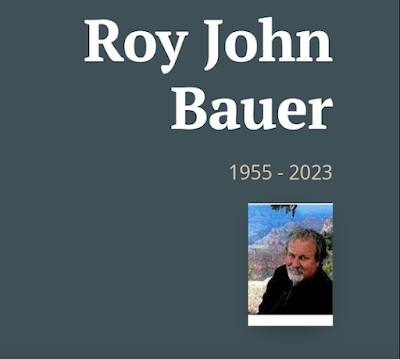
Roy's obituary in LA Times and Register: "we were lucky to have you while we did"

  This ran in the Sunday December 24, 2023 edition of the Los Angeles Times and the Orange County Register : July 14, 1955 - November 20, 2...